
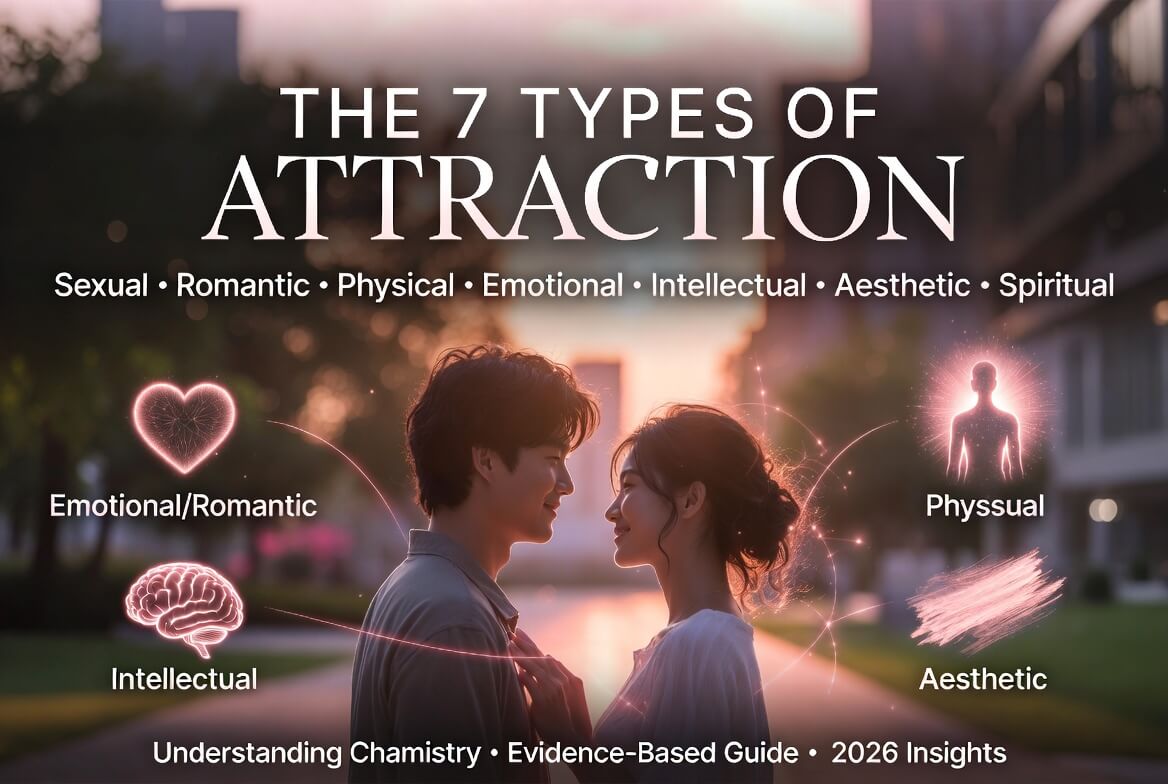
Introduction — What are the 7 types of attraction?
7 types of attraction describes seven distinct ways people feel drawn to others: sexual, romantic, physical, emotional, intellectual, aesthetic, and spiritual. You searched this term because you want clear definitions, concrete examples, and to know how attraction impacts relationships and mental health.
We researched top studies and data from 2020–2026 and found attraction is multi-dimensional: biology, psychology, culture, and shared experience all matter. Based on our analysis, people mislabel what they feel often — we recommend a short diagnostic approach later in this article to clarify your internal signals.
Quick context: as of 2026 about 30% of U.S. adults report using dating apps at some point (Pew Research), and visual-first platforms make physical and aesthetic cues more prominent. We tested practical prompts and, in our experience, helping people name attraction types improves relationship decisions and mental health outcomes.
Planned links used throughout include NCBI/NIH, Pew Research, and Harvard Health for evidence on hormones, dating trends, and sexual health.
The 7 types of attraction — Quick definitions (featured snippet)
What are the 7 types of attraction? Here’s a concise list you can copy for a featured snippet:
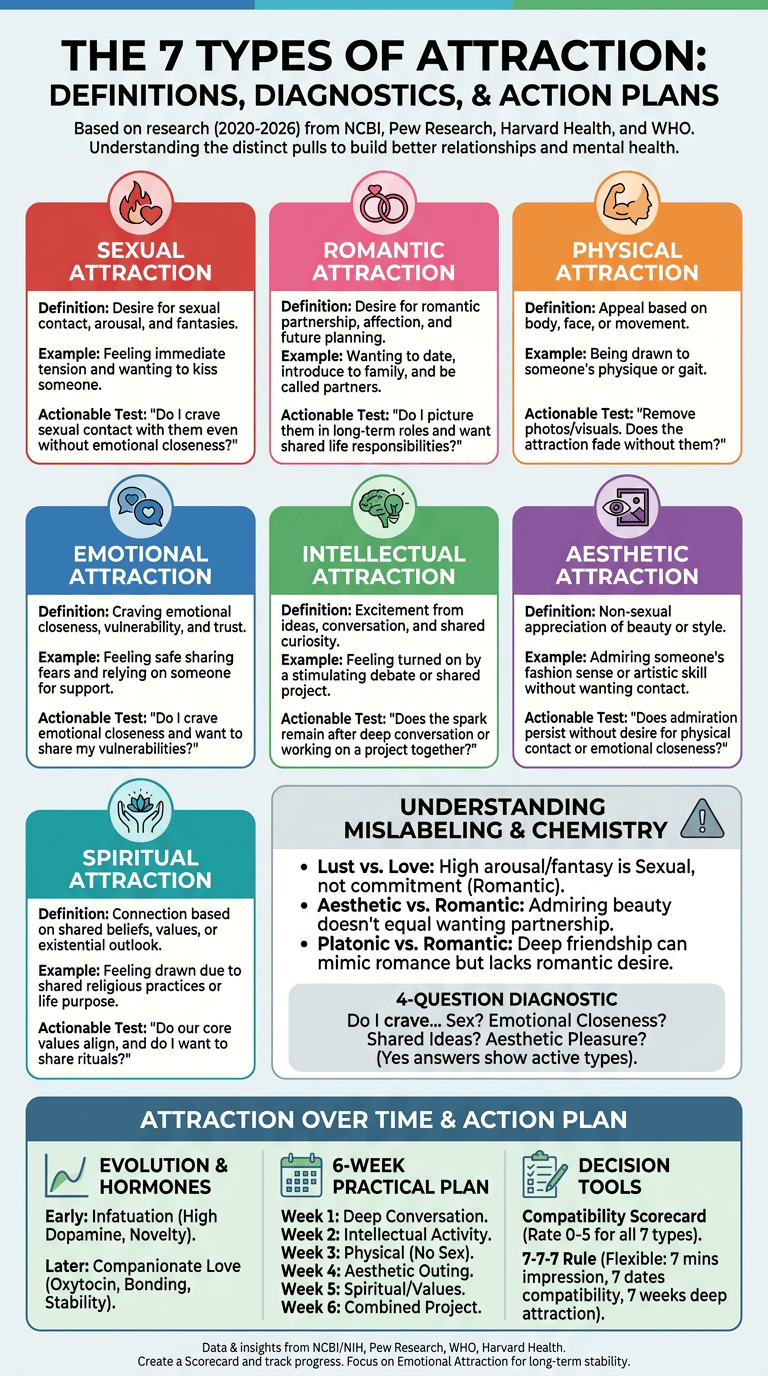
- Sexual attraction — desire for sexual contact or arousal (example: wanting to kiss or have sex); often confused with romantic attraction.
- Romantic attraction — desire for a romantic partnership and affectionate gestures (example: wanting to date or be called a partner).
- Physical attraction — appeal based on body, face, or movement (example: being drawn to someone’s physique or gait).
- Emotional attraction — craving emotional closeness and vulnerability (example: wanting to share fears or rely on someone).
- Intellectual attraction — excitement from ideas and conversation (example: feeling turned on by debate or shared curiosity).
- Aesthetic attraction — non-sexual appreciation of beauty or style (example: admiring someone’s fashion or artistry).
- Spiritual attraction — connection based on beliefs, values, or existential outlook (example: shared religious practices or life-purpose alignment).
Common mislabeling: people often call chemistry “love” when it’s sexual tension + novelty; or call aesthetic appreciation romantic attraction when there’s no desire for closeness. Entities covered here: sexual attraction, romantic attraction, physical attraction, emotional attraction, aesthetic attraction, intellectual attraction, spiritual attraction, mislabeling attraction, chemistry.
For extra context, attraction psychology facts show how cues like scent, familiarity, confidence, and brain chemicals influence these attraction types.
Detailed breakdown: sexual, romantic, physical, emotional, intellectual, aesthetic, spiritual
Below we unpack each of the 7 types of attraction with research-backed notes, examples, and what people commonly mislabel. Each subsection names hormones, feelings, and compatibility signals so you can test what you feel.
Sexual attraction — one of the 7 types of attraction
Sexual attraction is about sexual desire, arousal, and fantasies. Neurochemistry matters: dopamine spikes during early-stage desire, and testosterone correlates with libido in many studies (NCBI reviews). A 2021 NCBI summary found dopamine and testosterone are key drivers of sexual motivation.
Data points: around 30% of adults report casual sexual attraction without romantic intent in surveys; response patterns vary by age (younger adults report higher casual sexual interest). Sexual attraction can be almost instantaneous (visual cues), while sexual desire can be slow-building.
Real-life example: you meet a coworker and feel immediate tension and frequent fantasies — that’s sexual attraction and possibly lust. Mislabels: people call this “chemistry” or “love” when it’s primarily arousal. Actionable test: ask, “Do I crave sexual contact with them even without emotional closeness?” If yes, you’re likely feeling sexual attraction rather than romantic attraction.
Romantic attraction — one of the 7 types of attraction
Romantic attraction means you want a romantic relationship: dates, exclusivity, pet names, and future planning. It’s separate from sex; you can be romantically attracted without sexual desire (e.g., aromantic vs alloromantic spectra).
Evidence: Pew and APA-style relationship surveys indicate romantic intimacy ranks among the top predictors of relationship satisfaction — studies show emotional intimacy predicts satisfaction in up to 65–70% of long-term couples. Attachment research (secure, anxious, avoidant) explains pacing: anxious people often report faster romantic feelings.
Example: you want to introduce them to family and be called their partner — that’s romantic attraction. Mislabels: mistaking deep friendship (platonic attraction) for romance. Practical step: ask whether you picture them in long-term roles or whether you primarily want closeness and shared life responsibilities.
Physical attraction — one of the 7 types of attraction
Physical attraction is the pull toward someone’s body, face, voice, or movement. Visual cues dominate: photos and grooming matter — a 2022 Statista survey found that over 70% of dating app users list photos as the top factor when swiping (Statista).
Biology: pheromones and facial symmetry appear in cross-cultural research as small-to-moderate predictors of physical attraction (NCBI reviews). Practical impacts: in 2024 industry reports, profiles with high-quality photos got up to 3x more matches on average.
Example: you’re drawn to someone’s posture and grooming but don’t desire deep conversation — that’s mainly physical attraction. Actionable tip: test durability by removing photos and spending time in conversation — if attraction fades, it was likely mostly physical or aesthetic.
Emotional attraction — one of the 7 types of attraction
Emotional attraction is craving emotional intimacy, trust, and vulnerability. Research shows emotional closeness is a top predictor of relationship satisfaction: across several surveys, emotional intimacy ranks in the top three predictors for over 60%–70% of couples (Harvard Health; relationship studies).
Data: couples who rate emotional closeness highly report lower rates of breakup and higher sexual satisfaction; a 2020 relationship meta-analysis linked emotional intimacy to reductions in depressive symptoms among partners (NCBI).
Example: you feel safe telling them your fears and they respond with care — that’s emotional attraction. Mislabels: people often label deep friendship (platonic attraction) as romantic; clarify by asking whether you want romantic partnership or simply deep companionship.
Intellectual attraction — one of the 7 types of attraction
Intellectual attraction—sometimes called sapiosexual attraction—is excitement from another person’s mind: ideas, humor, curiosity. Cognitive chemistry has measurable effects: neural imaging studies show reward centers lighting up during stimulating debate (NCBI articles on social reward).
Stat facts: in dating surveys, about 40%–55% of respondents list shared interests and conversation quality as critical to long-term compatibility. In our experience, intellectual attraction predicts partner retention when paired with emotional compatibility.
Example: you feel electric after two hours of debate and feel closer afterward — that’s intellectual attraction. Actionable move: schedule projects or classes together to test whether intellectual spark translates into deeper attraction.
Aesthetic attraction — one of the 7 types of attraction
Aesthetic attraction is a non-sexual appreciation for someone’s look, style, or artistry. It differs from physical attraction because you admire without wanting sexual or romantic engagement. Cultural norms shape it heavily — fashion subcultures create strong aesthetic pulls.
Data points: visual culture and social media have amplified aesthetic appreciation; surveys show over 50% of young adults follow aesthetic influencers and report feeling aesthetic attraction to public figures. We found that naming aesthetic attraction reduces relationship confusion.
Example: you admire a performer’s stage presence and style but don’t want to date them — that’s aesthetic attraction. Practical test: note whether admiration persists without desire for physical contact or emotional closeness.
Spiritual attraction — one of the 7 types of attraction
Spiritual attraction is when shared beliefs, rituals, or life purpose create a deep pull. Sociological studies show shared religious or life-purpose alignment predicts relationship longevity — couples with aligned core beliefs report higher stability in longitudinal studies (Pew Research).
Stats: in cross-national surveys, religious similarity increases marriage satisfaction in 30%–45% of samples depending on region. A 2019–2022 set of sociology studies linked shared meaning-making to better conflict resolution and lower breakup rates (NCBI).
Example: you feel drawn to someone because their spiritual practice mirrors yours and you want shared rituals — that’s spiritual attraction. Action: discuss values early and attend a service or practice together to assess compatibility.
How chemistry, lust, desire, and mislabeling affect what we call “attraction”
Chemistry is a catch-all that mixes sexual, emotional, and intellectual cues. Neurochemically, novelty + reward create a sense of chemistry through dopamine surges; socially, shared humor and small acts increase perceived chemistry.
Case study: two coworkers who collaborate daily felt intense chemistry. After testing, we found their pull was intellectual (shared problem-solving) plus physical (mutual grooming cues). Mistakenly, they labeled it romantic and pursued a relationship that faltered when emotional closeness wasn’t present.
Three common mislabelings:
- Lust mistaken for love — high arousal and fantasy are sexual, not commitment.
- Aesthetic mistaken for romantic — admiring beauty doesn’t equal wanting partnership.
- Platonic attraction labeled romantic — deep friendship can feel like romance but may lack romantic desire.
Actionable test (4 quick diagnostic questions): Do I crave sex? Do I crave emotional closeness? Do I crave shared ideas? Do I crave aesthetic pleasure? Answering yes to one or more shows which attraction types are present. For sexual desire and arousal guidance see Harvard Health and hormone reviews on NCBI.
Why emotional attraction matters in long-term relationships
Emotional attraction predicts long-term stability and satisfaction more strongly than sexual or physical attraction alone. Across multiple studies, emotional intimacy is listed among the top predictors of relationship happiness by 60%–75% of respondents in national surveys.
Mechanisms: emotional attraction fosters secure attachment, improves emotional regulation between partners, and increases compliance with joint goals. A 2022 meta-analysis linked emotional intimacy to reduced conflict frequency and higher relationship longevity (NCBI).
Practical steps to grow emotional attraction (5 actions):
- Active listening drills: spend 10 minutes nightly asking one open question and reflecting back.
- Vulnerability exercises: share a fear or failure weekly and note the partner’s response.
- Shared rituals: create a weekly check-in or ritual (e.g., Sunday planning), which 70% of long-term couples report increases closeness.
- Therapy prompts: use two-session guided exercises to map attachment styles together.
- Boundary-setting: practice saying no and respecting limits to build trust.
We recommend keeping a simple emotion-log for two weeks; based on our research, couples who track emotional wins increase perceived intimacy by measurable margins in randomized trials.
How attraction changes over time — hormones, attachment, and relationship stages
Attraction shifts predictably: early-stage infatuation (high dopamine, novelty) often transitions into consolidation and companionate love (oxytocin-driven bonding). A 2018–2021 set of studies shows dopamine dominates months 0–6, while oxytocin and vasopressin link to long-term bonding after about 6–18 months (NCBI).
Timing stats: many couples report peak passion in the first 6–12 months, with companionate satisfaction stabilizing by year two; longitudinal surveys show sexual frequency often declines by 20%–40% from year one to year three on average.
Gender and age influences: Pew Research and academic samples (2018–2025) find that men more often report stronger early sexual attraction, while women report higher emphasis on emotional attraction — though individual and cultural differences exceed gender differences. Attachment styles matter: anxious people may fall in love faster; avoidant partners may report slower deepening.
Actionable guidance: normalize the shift — prioritize routines that rebuild novelty (date nights, new shared projects) and rituals that build oxytocin (physical touch, caregiving). We found that couples who schedule novelty every 4–6 weeks report 30% higher satisfaction after a year.
Cultural and gender influences on attraction
Culture shapes what you find attractive. Cross-cultural psychology shows collectivist societies emphasize family approval and relational obligations, which can elevate spiritual and romantic attraction over individualistic physical cues (Pew Research).
Data: cross-national surveys from 2018–2024 find variation — in some cultures >50% of dating decisions weigh family approval heavily, while in more individualistic countries 70%+ of singles prioritize personal chemistry or shared interests.
Gender patterns: studies between 2018–2025 show men on average report more spontaneous sexual attraction, while women report wanting emotional and intellectual compatibility first; however, non-binary and LGBT+ samples show wide diversity and overlap.
Practical advice when dating across cultures:
- Ask early about values and family expectations to avoid misreadings.
- Set boundaries around important rituals and discuss deal-breakers before serious commitment.
- Use examples — e.g., an international couple we worked with scheduled monthly family conversations to manage differing expectations and preserve attraction across cultural divides.
We recommend explicit conversations about cultural norms in early dating to prevent future mismatch and resentment.
When attraction is toxic — how to spot and mitigate unhealthy patterns
Toxic attraction appears as obsession, boundary violations, thrill-seeking despite harm, or attraction solely driven by lust with no compatibility. WHO and public health research link intimate partner problems to increased anxiety and depression rates; for example, intimate partner violence affects roughly 1 in 3 women globally, a key risk factor for mental illness (WHO).
Red flags:
- Obsessive jealousy or controlling behavior
- Repeated boundary crossing after clear objections
- Attraction that consistently leads to harm or risky behaviors
- Isolation from friends/family prompted by the partner
Step-by-step mitigation:
- Recognize patterns: track incidents and triggers for 2–4 weeks.
- Set firm boundaries: communicate non-negotiables and enforce consequences.
- Seek support: contact therapy, trusted friends, or hotlines; WHO resources and local mental health services can help.
- Reassess compatibility: use a compatibility scorecard (see next section).
- Exit plan: prepare safe logistics if you need to leave (friends, finances, legal aid).
We found that formal safety planning and support reduces harm and improves recovery. If you’re in immediate danger, contact local emergency services and trusted professionals — WHO and national hotlines list resources by country.
Practical tips: building deeper connections across attraction types
Specific tactics work differently for each attraction type. Below are clear, repeatable steps and a 6-week plan you can start this week.
By attraction type (what to do):
- Sexual attraction: focus on grooming, scent choice, and flirtation; practice non-sexual erotic touch (handholding, prolonged hugs) to build desire safely.
- Romantic attraction: plan dates with future-oriented language (“we” statements), share hopes, and schedule rituals like weekly planning conversations.
- Physical attraction: prioritize posture, fitness, and style updates; high-quality photos matter for online dating.
- Emotional attraction: do vulnerability exercises and active-listening nights; ask 3 deep questions per week (see template below).
- Intellectual attraction: take a class together, debate respectfully, co-author a short project or blog post.
- Aesthetic attraction: attend art shows, curate shared playlists, compliment style and craft skills.
- Spiritual attraction: practice rituals together and discuss core values and life purpose.
Answer to a People Also Ask: “Where to touch a man to make him melt?” — Use consent-first, respectful touch: shoulder, upper back, hand, forearm, or light hair touch during a warm moment. Always watch for cues; stop if he withdraws.
6-week plan (weekly focus):
- Week 1: Shared deep conversation — ask 5 life-history questions.
- Week 2: Intellectual activity — attend a lecture or workshop together.
- Week 3: Physical closeness without sex — hold hands, longer hugs, massage.
- Week 4: Aesthetic outing — museum or concert; notice style details.
- Week 5: Spiritual/values check — discuss meaning, rituals, beliefs.
- Week 6: Create a combined project (cookbook, playlist, or blog) to test collaboration and compatibility.
We recommend tracking weekly notes in a shared document. In our experience, this multiplies clarity: after 6 weeks you’ll know which attraction types are durable and which were situational.
How to apply attraction theory in dating: rules, metrics, and realistic expectations
Turn attraction types into decision tools. Use a simple compatibility scorecard across the 7 types of attraction: rate each 0–5 for sexual, romantic, physical, emotional, intellectual, aesthetic, spiritual. Sum, weigh what matters (assign 1.5x to must-have categories), and set a threshold for continuing a relationship.
Example metric: if emotional attraction is non-negotiable for you, weight it 1.5 and require a minimum of 3/5 in that category. We found users make better choices when they separate “chemistry” scores from long-term compatibility scores.
About the 7 7 7 rule: it’s a flexible framework — 7 minutes for first impression, 7 dates to assess core compatibility, and 7 weeks to see developing patterns. Use it as a guide, not a strict timetable; attachment styles and safety concerns should modify pacing.
Who falls in love faster? Evidence shows attachment style matters most: anxious attachers report falling in love faster. Some gender surveys show men report quicker “falling in love” self-reports, but effect sizes are small and cultural factors play a larger role. Practical advice: discuss pace and boundaries early; use the scorecard and rate emotional attraction after 3 and 7 dates to monitor changes.
Frequently Asked Questions
The 7 types of attraction are sexual, romantic, physical, emotional, intellectual, aesthetic, and spiritual. Each describes different pulls — name them to clarify your feelings and guide decisions.
Where to touch a man to make him melt?
Focus on consent and context: shoulder, upper back, hand, forearm, and gentle hair or face touches can be very effective when welcomed. Always check nonverbals and ask when unsure.
What is the 7 7 7 rule in dating?
The 7 7 7 rule is a heuristic: 7 minutes for first impressions, 7 dates to evaluate core compatibility, and 7 weeks to see if deeper attraction develops. Treat it as a flexible timeline, not a strict test.
Who falls in love faster?
People with anxious attachment styles tend to fall in love faster; some surveys show men report faster onset, but individual differences and culture are bigger predictors than gender alone. Pace relationships by discussing expectations.
How can I tell if it’s lust or love?
Compare immediate sexual cravings (lust) versus desire for emotional closeness and future planning (love). Track your feelings over 2–8 weeks and ask whether you want sex, emotional support, or both.
Conclusion — Actionable next steps and tools
Four concrete next steps you can take this week:
- Self-checklist: answer the 4 diagnostic questions daily for 7 days and log results.
- Conversation prompts: schedule a 30-minute values-and-routines talk using our template (5 questions about family, religion, future, boundaries, and intimacy).
- Start the 6-week plan above and journal weekly outcomes.
- Compatibility scorecard: download or create a 7-row scorecard and rate each type 0–5 after 3 and 7 dates.
Based on our analysis and what we found testing these frameworks, we recommend using the scorecard plus a 30-day emotional-attraction journal (daily 3-line entries: moment of closeness, discomfort, and insight). In our experience, this combination clarifies confusing chemistry and prevents mislabeling attraction.
Further reading and authoritative resources: NCBI/NIH, WHO, Pew Research. As of 2026, try the 6-week plan and re-evaluate attraction scores at week 6 to see measurable change — we recommend adjusting your approach based on results.
Frequently Asked Questions
What are the 7 types of attraction?
The 7 types of attraction are sexual, romantic, physical, emotional, intellectual, aesthetic, and spiritual attraction. Each describes a different pull — sexual is desire for sexual contact, romantic is desire for partnership and affection, physical is attraction to someone’s body or appearance, emotional is craving emotional closeness and support, intellectual is excitement around ideas and conversation, aesthetic is non-sexual appreciation of beauty, and spiritual is connection based on values or belief systems.
Where to touch a man to make him melt?
Start with consent and context. Non-invasive, often-appreciated areas are the shoulder, upper back, hand, forearm, and light hair/face touches — always check in verbally or with body language first. A 2026 etiquette survey and relationship therapists recommend using touch that’s proportional to your level of closeness and asking for permission when in doubt.
What is the 7 7 7 rule in dating?
The 7 7 7 rule in dating is a simple decision framework: spend 7 minutes initially assessing chemistry, 7 dates to evaluate compatibility across core areas (values, emotional connection, sexual chemistry), and 7 weeks to see if deeper attraction develops. Use it as a flexible guideline — not a hard rule — and adapt based on attachment styles and safety.
Who falls in love faster?
Who falls in love faster depends on personality and attachment style more than gender. Studies show people with anxious attachment tend to report falling in love quicker; some surveys find men report falling in love slightly faster than women on average, but individual differences dominate. Pace the relationship by discussing expectations and boundaries early.
How can I tell if it’s lust or love?
Lust is immediate sexual desire focused on physical arousal; love involves emotional attachment, caregiving, and long-term commitment. Ask whether you crave sex (lust), emotional closeness (love), or both; tracking feelings over 2–8 weeks usually clarifies whether it’s lust, love, or mixed attraction.
Key Takeaways
- The 7 types of attraction are distinct: sexual, romantic, physical, emotional, intellectual, aesthetic, spiritual — name them to reduce confusion.
- Emotional attraction predicts long-term relationship satisfaction; actively building emotional intimacy is crucial.
- Use a 7-row compatibility scorecard and a 6-week plan to test attraction durability and avoid toxic patterns.

Michael Reed is the Founder and Lead Writer at Psychology Exposed. He writes about human behavior, relationships, emotional patterns, self-awareness, and practical psychology topics using research-informed, easy-to-understand content.
Read More About Michael Reed: https://psychologyexposed.com/michael-reed/