

Cognitive psychology explained in simple terms is the study of how the mind takes in information, selects what matters, interprets what is happening, stores experience, uses language, solves problems, and makes choices. It looks at the mental work that often happens before behavior becomes visible.
You can see this in everyday life. Two people hear the same comment, but one takes it as helpful and the other hears it as criticism. A student reads the same page three times because their attention keeps slipping. A driver reacts quickly to a brake light because past experience has taught their mind what that signal means. A person makes a decision based on a memory that feels accurate, even though memory can be incomplete.
This article explains cognitive psychology without turning it into a neuroscience lecture or a therapy manual. The focus is practical: how attention, perception, memory, thinking, learning, language, and mental load shape ordinary behavior.
Quick Answer

Cognitive psychology studies mental processes such as attention, perception, memory, language, learning, reasoning, and problem-solving. It helps explain how people interpret situations before they act, why the same event can feel different to different people, and how mental shortcuts, limited attention, and memory shape everyday behavior.
What Cognitive Psychology Means
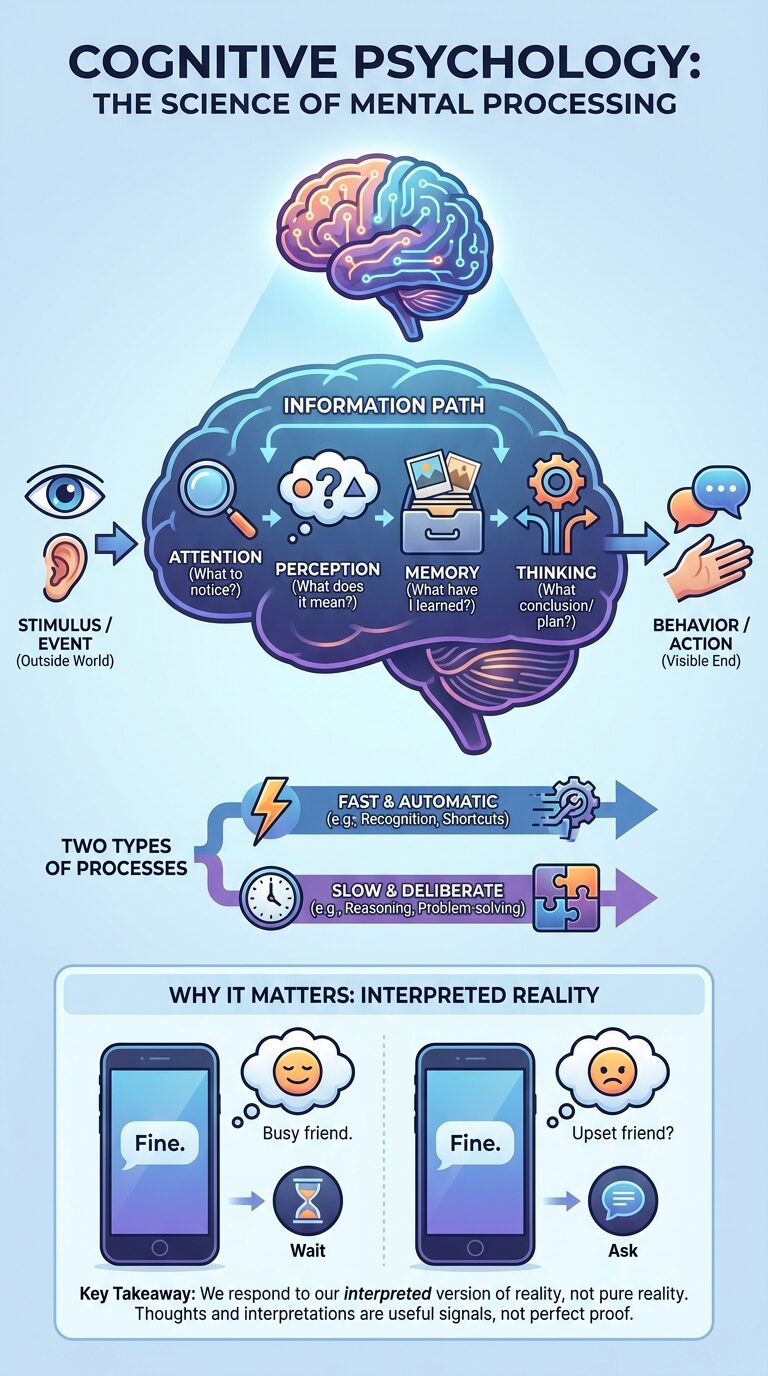
Cognitive psychology focuses on the inner processing behind outward behavior. Instead of only asking what someone did, it asks what the person noticed, how they interpreted it, what they remembered, what they expected, and what mental rule they used to respond. Cognition is one lens within human behavior psychology.
The APA Dictionary of Psychology describes cognitive psychology as a field concerned with mental processes such as perception, thinking, learning, and memory. That definition is helpful because it reminds us that behavior is rarely just a direct reaction to the outside world. Something happens in the mind between the event and the action.
The study of mental processes
A mental process is any inner activity involved in taking in, organizing, storing, or using information. Some mental processes feel deliberate, such as solving a math problem or deciding what to say in a hard conversation. Others feel fast and automatic, such as recognizing a face, reading a familiar word, or reaching for your phone when it buzzes.
Cognitive psychology studies both kinds. It looks at slow thinking and fast recognition, careful reasoning and mental shortcuts, learning and forgetting, focus and distraction. It also asks why people sometimes make errors even when they are intelligent, motivated, and trying to be fair.
A simple way to picture cognition is as an information path:
| Stage | Question the mind is answering | Everyday example |
|---|---|---|
| Attention | What should I notice? | You hear your name in a noisy room |
| Perception | What does this mean? | You read a facial expression as annoyed or tired |
| Memory | What have I learned from similar situations? | You remember that this road usually has traffic |
| Thinking | What conclusion or plan makes sense? | You compare two possible responses |
| Action | What should I do next? | You speak, wait, leave, ask, buy, study, or choose |
The table is simplified, but it shows the basic idea. Behavior is often the visible end of several invisible steps.
Why cognition matters for behavior
Cognition matters because people do not respond to reality in a pure, camera-like way. They respond to the version of reality their mind has selected, interpreted, and connected to past experience.
For example, imagine a friend replies with a short message: “Fine.” One person may think the friend is busy. Another may think the friend is upset. A third may barely notice the tone. The message is the same, but the interpretation is different, so the next behavior may be different too.
This does not mean people should distrust every thought. It means thoughts, memories, expectations, and interpretations should be treated as useful signals, not perfect proof. Cognitive psychology gives people language for that middle space between stimulus and behavior.
Attention: What the Mind Selects

Attention is the mind’s selection system. At any moment, there is more information available than a person can fully process. Sounds, faces, tasks, body signals, memories, notifications, worries, and goals all compete for mental space.
The American Psychological Association explains that perception and attention are connected cognitive processes that help people become aware of and respond to their environment. In daily life, this means what you attend to strongly affects what you believe is happening.
Focus, distraction, and limited mental bandwidth
Attention is powerful because it makes selected information feel more important. If you are worried about making a mistake, you may notice every pause in another person’s voice. If you are hungry, food cues become more visible. If you are looking for danger, ambiguous details may stand out more than neutral details.
Attention is also limited. Most people cannot deeply read a document, answer messages, monitor a conversation, plan dinner, and evaluate emotions at the same time. They may switch between tasks, but switching has a cost. Important details can be missed because the mind is spending energy on shifting focus.
Here are common attention patterns:
| Attention pattern | What it looks like | How it can affect behavior |
|---|---|---|
| Selective attention | Focusing on one part of a situation | You notice criticism but miss reassurance |
| Divided attention | Trying to handle several inputs at once | You make small errors while multitasking |
| Sustained attention | Staying with one task over time | You finish a long assignment without drifting too much |
| Attentional capture | A sudden cue pulls focus | A notification interrupts your train of thought |
These patterns are not character flaws. They are part of how a limited mind handles a busy world.
Why attention changes what becomes behavior
Attention often decides which response feels available. If your attention is locked on embarrassment, hiding may feel natural. If your attention moves to the task, the next step may become clearer. If your attention stays on a threat cue, your behavior may become tense even when the situation is not actually dangerous.
This is why a useful first move is sometimes not “think positive.” It is “notice what my attention is feeding.” A person can ask: What am I zooming in on? What am I filtering out? What would I notice if I looked at the whole situation instead of the most emotionally loud part?
Attention does not control everything, but it sets the mental stage. What enters the spotlight is more likely to shape what happens next.
Perception: How the Brain Interprets Information

Perception is not just seeing, hearing, touching, tasting, or smelling. It is the process of organizing sensory information into meaning. The mind does not simply receive the world. It interprets the world.
The APA Dictionary entry on perception defines it as the process of becoming aware of objects, relationships, and events through the senses. In real life, awareness is shaped by context, expectation, attention, and past learning.
Why perception is not a perfect copy of reality
Perception feels immediate, so people often assume it is complete. Yet the mind fills gaps constantly. It uses context to guess what is likely. It groups information into patterns. It decides whether a tone sounds playful, cold, respectful, impatient, sarcastic, or uncertain.
This is useful most of the time. You do not need to analyze every sound from scratch. You recognize a doorbell, a stop sign, a familiar face, or a worried voice quickly because your mind uses prior knowledge.
The same speed can create mistakes. A person who has been judged harshly before may perceive neutral feedback as rejection. Someone who expects agreement may hear a careful question as resistance. A tired person may read normal noise as irritating because their body and mind have less room to process calmly.
Expectations, context, and interpretation
Expectation acts like a lens. If you expect a meeting to be hostile, you may scan for signs of hostility. If you expect someone to be kind, you may interpret awkward wording more generously. Neither expectation is automatically wrong, but both can shape perception before you realize it.
Context matters too. A short reply from a friend means one thing during a busy workday and another after a painful argument. A serious facial expression can mean anger, concentration, sadness, fatigue, or stress. Cognitive psychology encourages people to treat first interpretations as possibilities, not final verdicts.
A practical perception check is: “What else could this mean?” That question does not force you to ignore your first impression. It simply makes room for more than one interpretation.
Memory: How Experience Shapes the Present

Memory is the mind’s way of using the past in the present. It helps people learn, predict, recognize, avoid danger, build identity, keep promises, and make decisions. Without memory, every situation would feel new.
Memory is also reconstructive. People often remember the meaning of an event more strongly than every detail. They may combine pieces, forget context, or update a memory each time they revisit it.
Working memory and long-term memory
Working memory is the mental space used to hold and use information right now. It is involved when you remember a phone number long enough to type it, follow a multi-step instruction, compare two choices, or keep track of a conversation while forming a response.
Long-term memory stores knowledge, skills, personal experiences, emotional associations, language, routines, and expectations. It helps you know how to drive, what certain words mean, what a familiar person sounds like, and what happened the last time you tried a similar action.
Research available through PubMed Central has linked working memory capacity and executive attention, showing how attention control is tied to higher-level cognition. One open-access paper on working memory capacity and executive attention is useful for understanding why attention and memory are not separate boxes in real life.
Why memory can guide or distort behavior
Memory guides behavior by giving the mind patterns to use. If you remember that a certain route is crowded, you may leave earlier. If you remember being embarrassed after speaking up, you may hesitate next time. If you remember solving a problem before, you may feel more confident trying again.
Memory can also distort behavior when the remembered lesson is incomplete. Maybe one bad presentation becomes “I am terrible at public speaking.” Maybe one awkward date becomes “People always lose interest.” Maybe one harsh teacher becomes “Questions make me look stupid.” The memory contains real emotion, but the conclusion may be broader than the evidence.
A helpful question is: “Is this memory giving me information, or is it giving me an old rule that may not fit this situation?” That distinction lets memory remain useful without letting it run every choice.
Thinking and Problem-Solving
Thinking includes reasoning, planning, comparing, imagining outcomes, forming beliefs, questioning assumptions, and solving problems. It is the part of cognition people usually notice most clearly because it often appears as inner speech. Efficient thinking can turn into mental shortcuts that distort judgment.
Problem-solving happens when the mind tries to move from a current state to a desired state. That might mean fixing a technical issue, deciding how to apologize, planning a budget, choosing a route, or figuring out why a habit keeps repeating.
Mental models, reasoning, and shortcuts
A mental model is a simplified idea about how something works. People use mental models constantly: “If I study in shorter sessions, I remember more,” “If I ask directly, I may get a clearer answer,” or “If traffic is bad at 5 p.m., I should leave earlier.”
Mental models help because life is too complex to calculate from zero every time. They allow quick predictions. They also create blind spots when the model is outdated, too rigid, or based on a narrow sample.
Reasoning uses information to reach conclusions. Sometimes it is careful and step-by-step. Other times it uses shortcuts, also called heuristics. A shortcut can be useful when time is limited, but it can also lead to errors when a fast conclusion feels more certain than it deserves.
When efficient thinking becomes biased thinking
Efficient thinking becomes biased when the mind keeps choosing the easiest interpretation instead of the most accurate one. For example, people may search for information that supports what they already believe, judge a situation by the most vivid example they can remember, or assume a confident person is correct because confidence feels persuasive.
This is where cognitive psychology connects to cognitive biases, but the two topics are not identical. Cognitive psychology studies many mental processes. Biases are one group of predictable thinking errors within that larger picture.
A useful thinking check is: “What information would change my mind?” If nothing would change your mind, you may be protecting a conclusion rather than reasoning through a situation.
Learning and Language
Learning is not only memorizing facts. It is the process of changing knowledge, skill, expectation, or behavior through experience. Language helps organize that learning by giving people categories, labels, stories, and explanations.
A child learning that “hot” means danger is learning more than a word. They are connecting sensation, warning, memory, and future behavior. An adult learning a new workplace system is building expectations about where information goes, what steps matter, and what errors to avoid.
How people build meaning from experience
People build meaning by connecting new information to what they already know. If a new idea fits an existing category, it is easier to understand. If it challenges an old category, it may require more mental effort.
This is why examples help learning. A definition gives the mind a label, but an example shows the label in motion. Someone may understand “cognitive load” better when they imagine trying to follow directions while tired, hungry, and interrupted by messages.
Learning also depends on feedback. Feedback tells the mind whether a prediction worked. If a study strategy leads to better recall, the strategy becomes more likely. If interrupting a conversation creates tension, the mind may learn to pause, unless the person gets rewarded for interrupting in that setting.
Why language shapes categories and choices
Language gives people mental handles. The word “distraction” makes it easier to notice when attention has been pulled away. The word “assumption” helps separate what happened from what the mind added. The word “habit” helps describe behavior that has become automatic.
Labels can help, but they can also narrow thinking. Calling someone “lazy” may stop curiosity about fatigue, unclear instructions, fear of failure, lack of skill, or low motivation. Calling a disagreement “drama” may hide the real issue. Calling yourself “bad at decisions” may prevent you from learning the specific step where decisions go wrong.
In cognitive terms, better language can create better categories. Better categories can make better choices easier to see.
Cognitive Psychology in Everyday Life
Cognitive psychology may sound abstract, but it shows up in ordinary moments all day. Every time you focus, misread, remember, forget, compare, plan, learn, scroll, argue, decide, or change your mind, cognition is involved.
Studying, working, driving, arguing, scrolling, and deciding
In studying, attention determines whether the material is actually being processed. Memory determines what is retained. Thinking determines whether the student can apply the idea, not just repeat it.
At work, cognitive load affects accuracy. A person may make more mistakes when instructions are unclear, interruptions are constant, or they are holding too many unfinished tasks in mind.
While driving, perception and memory work quickly. You recognize signs, predict motion, watch speed, remember rules, and respond to unexpected cues. If attention shifts to a phone, the whole system becomes weaker.
In arguments, perception and memory can intensify conflict. A person may hear a question as blame because of past conversations. They may remember the emotional theme more strongly than the exact words. Their attention may lock on one phrase and miss a repair attempt.
Online, attention is constantly pulled by novelty, social feedback, emotional headlines, and endless choices. The mind may mistake repeated exposure for importance, or confuse fast reaction with clear judgment.
Why cognitive load changes behavior
Cognitive load means the amount of mental effort being used at one time. When load is manageable, people usually think more clearly, remember instructions better, and respond with more flexibility. When load is too high, they may become forgetful, irritable, impulsive, avoidant, or rigid.
An open-access PubMed Central article on cognitive load and health behavior programs describes cognitive load theory as involving finite capacity for processing new information, especially in working memory. That idea applies beyond classrooms. A stressed mind has less room for complex choices.
This is one reason good advice can fail at the wrong moment. A person may know what to do, yet be too overloaded to retrieve it, evaluate it, and act on it. In practical terms, reducing mental clutter can sometimes improve behavior more than adding more information.
Cognitive Psychology Compared With Behavioral and Social Psychology
Cognitive psychology is not the only way to understand behavior. It is one lens. Other psychology lenses may focus more on learning through consequences, social pressure, environment, emotion, development, personality, or culture.
Mental processes vs observable learning
Behavioral psychology focuses heavily on observable behavior and how behavior is shaped by consequences, reinforcement, punishment, cues, and learning histories. Cognitive psychology asks more about the inner processing that happens before, during, and after behavior.
For example, if someone keeps checking their phone while studying, a behavioral lens may look at rewards: notifications, novelty, relief from boredom. A cognitive lens may look at attention, working memory, mental fatigue, expectation, and difficulty staying with one task.
Both lenses can be useful. The behavior is visible, but the mind’s interpretation helps explain why that behavior feels so tempting in the moment.
Inner processing vs social influence
Social psychology focuses on how other people, groups, norms, roles, status, and social settings influence behavior. Cognitive psychology focuses more on how information is processed inside the person.
Imagine someone stays quiet in a meeting. A social lens may ask about group pressure, authority, and fear of judgment. A cognitive lens may ask what the person is thinking, what they are attending to, what memory is being activated, and what outcome they are predicting.
The strongest explanation may use both. A room can create social pressure, and the mind can interpret that pressure through memory, expectation, and attention.
What This Helps You Understand Next
Once you understand cognitive psychology, several everyday behavior topics become easier to follow. You can see how thoughts shape actions, why mental shortcuts sometimes become biases, and why some behavior happens before conscious reflection catches up. These processes help explain how interpretation changes what someone does.
How thoughts become action
Thoughts influence behavior when interpretations, predictions, self-talk, and mental images change what feels possible or risky. A thought such as “I will probably fail” may lead to avoidance. A thought such as “I can try one small step” may lead to action. For the wider system, how the human mind works includes emotion, motivation, and action too.
Cognitive psychology gives the broader foundation. It explains where those thoughts fit within attention, perception, memory, and reasoning. Some processing happens before full awareness, which connects with conscious vs unconscious behavior.
Why cognitive biases feel convincing
Cognitive biases feel convincing because they often use normal mental tools. Memory, attention, pattern recognition, and shortcuts are useful, but they can produce predictable errors. The problem is not that the mind is broken. The problem is that speed and certainty sometimes arrive before careful checking.
When you understand the larger cognitive system, bias becomes easier to notice without turning every mistake into a personal failure.
Why some behavior happens before full awareness
People sometimes act before they can fully explain why. They reach for a familiar snack, tense up at a tone, click a notification, or withdraw from a conversation. Some of that behavior may come from learned associations, attention shifts, memory cues, and automatic interpretations.
This does not remove responsibility. It shows why awareness often has to be built earlier in the chain, before the action feels inevitable.
When Cognitive Changes Deserve Support
Everyday distraction, forgetfulness, and mental fatigue are common, especially during stress, poor sleep, overload, grief, or major life changes. A person should not diagnose themselves from a single article or assume every attention problem means a disorder.
Support may be worth considering when memory, attention, confusion, language, decision-making, or daily functioning changes suddenly, worsens over time, creates safety concerns, or interferes with work, school, relationships, or basic routines. The National Institute on Aging offers practical information on memory problems, forgetfulness, and aging, including when memory changes may deserve medical attention.
For immediate danger, severe confusion, thoughts of self-harm, or sudden changes that may signal a medical emergency, seek urgent help through local emergency services or a crisis resource in your area.
FAQ About Cognitive Psychology
What is an example of cognitive psychology?
An example of cognitive psychology is studying why a person remembers some details from a conversation but forgets others. A cognitive psychologist might look at attention during the conversation, the person’s expectations, emotional importance, working memory limits, and how the memory was reconstructed later.
Is cognitive psychology the same as neuroscience?
No. Cognitive psychology studies mental processes such as attention, memory, perception, learning, language, and reasoning. Neuroscience studies the nervous system and brain activity more directly. The fields can overlap, but cognitive psychology can explain everyday mental processes without requiring a detailed brain scan or biological explanation for every behavior.
How does memory affect behavior?
Memory affects behavior by carrying lessons from the past into the present. It helps people recognize patterns, avoid repeated problems, use learned skills, and predict outcomes. It can also distort behavior when a painful or vivid memory becomes a broad rule, such as “speaking up is unsafe” or “I always fail at this.”
Why is attention important for decision-making?
Attention is important because people make decisions based partly on what their mind has selected. If attention is focused only on fear, social approval, short-term reward, or one vivid example, the decision may become narrower. Better decisions often start by widening attention enough to include facts, goals, consequences, and alternatives.
Key Takeaways
- Cognitive psychology studies mental processes, including attention, perception, memory, language, learning, reasoning, and problem-solving.
- Behavior is often shaped by what the mind notices, interprets, remembers, predicts, and uses as a rule for action.
- Attention is limited, so what enters mental focus can strongly affect what feels important or urgent.
- Perception is an interpretation of information, not a perfect copy of reality.
- Memory helps guide choices, but it can also create old rules that no longer fit the current situation.
- Cognitive load can change behavior by reducing the mental space available for flexible thinking and careful decisions.
Final Thoughts
Cognitive psychology gives you a clearer way to understand the space between an event and a response. Before someone acts, the mind has usually selected information, interpreted it, connected it to memory, formed a prediction, and chosen a path that feels workable in the moment.
A practical next step is to watch one ordinary behavior today and ask: What did I notice first? What did I assume it meant? What memory or expectation shaped my reaction? That small pause can turn an automatic response into something easier to understand and, when needed, easier to change.

Michael Reed is the Founder and Lead Writer at Psychology Exposed. He writes about human behavior, relationships, emotional patterns, self-awareness, and practical psychology topics using research-informed, easy-to-understand content.
Read More About Michael Reed: https://psychologyexposed.com/michael-reed/