

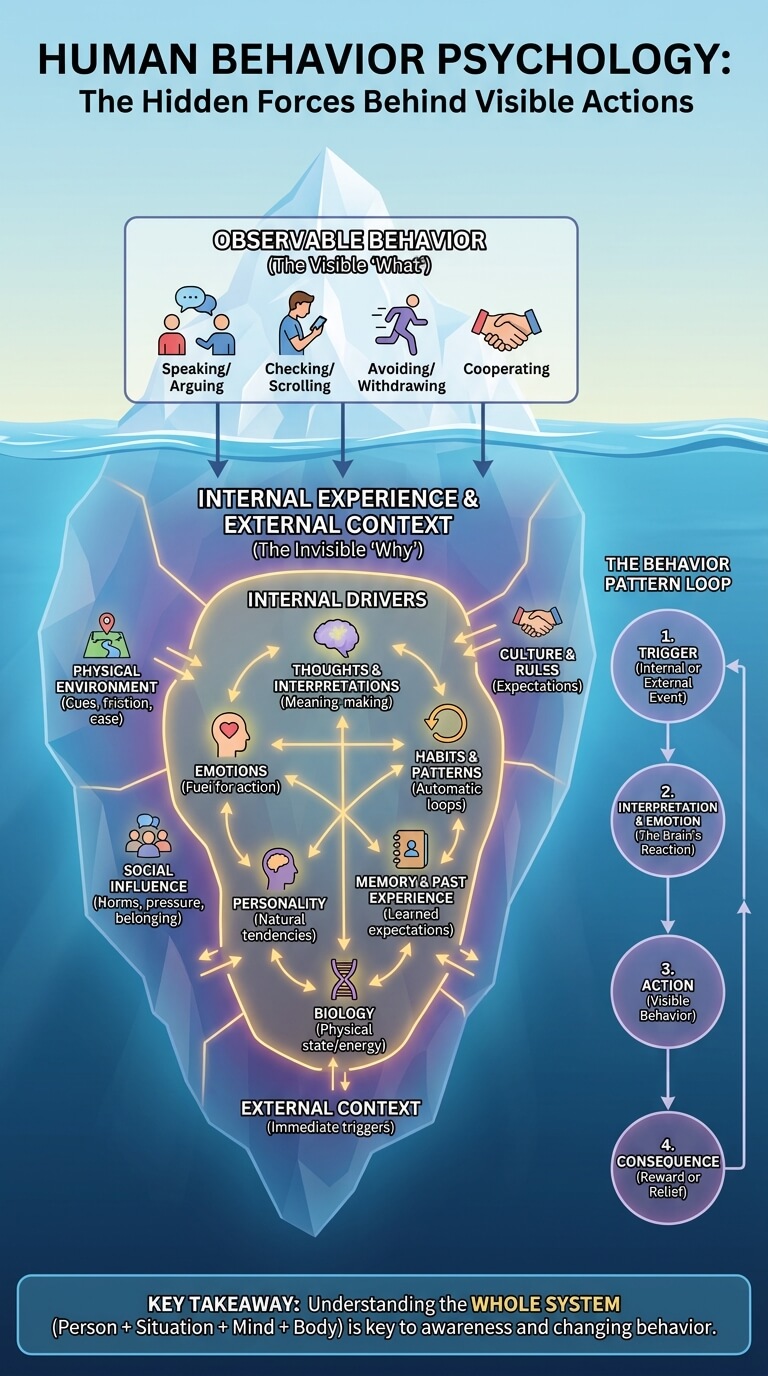
Human behavior psychology is the study of how people act, react, choose, avoid, connect, repeat patterns, and change over time. It looks at both the visible part of behavior, such as what someone says or does, and the less visible part behind it, such as thoughts, emotions, memories, habits, motives, personality, biology, and social pressure.
This matters because human behavior is rarely random. A person may avoid a conversation, check their phone without thinking, apologize too quickly, overreact to criticism, stay quiet in a group, repeat an unhealthy habit, or make a decision they later regret. On the surface, these actions can seem simple. Underneath, they often come from a mix of learned patterns, emotional states, past experiences, beliefs, incentives, and the situation the person is in.
Human behavior psychology helps explain these patterns without reducing people to one cause. Biology matters, but it does not explain everything. Childhood matters, but it does not control every choice. Thoughts matter, but emotions and environment can still push behavior in another direction. The most useful way to understand behavior is to look at the whole system: the person, the situation, the mind, the body, and the social world around them.
This guide gives you a clear foundation for understanding human behavior in everyday life. You will learn what human behavior psychology means, what shapes behavior, why people respond differently to the same situation, how conscious and unconscious processes work, why behavior patterns repeat, and how behavior can change.
What Is Human Behavior Psychology?
Human behavior psychology is the branch of psychology that studies why people behave the way they do. It examines observable actions, such as speaking, helping, avoiding, arguing, learning, working, buying, eating, cooperating, and withdrawing. It also studies the internal processes that influence those actions, including thoughts, emotions, motivation, attention, memory, perception, expectations, and self-control.
A simple definition is this:
Human behavior psychology explains how internal processes and external conditions shape the actions people take in everyday life.
For example, imagine someone ignores a message from a friend. The behavior is visible: they do not reply. But psychology asks deeper questions. Are they overwhelmed? Are they angry? Are they avoiding conflict? Did they forget? Do they feel socially anxious? Are they repeating a pattern of withdrawing when they feel pressured? Did the message arrive during a stressful workday? The same behavior can have different causes depending on the person and the situation.
This is why psychology does not only ask what someone did. It also asks why it happened, when it happens, what triggers it, what rewards it, and what could change it.
If you want a simple starting point, it helps to separate human behavior into three layers:
- Observable behavior: what a person says or does.
- Internal experience: what the person thinks, feels, remembers, wants, fears, or expects.
- External context: the environment, relationships, culture, pressure, rewards, rules, and social cues around the person.
Real behavior usually comes from all three layers at once. A student may procrastinate because a task feels difficult, because they fear failure, because their phone keeps interrupting them, and because they have learned to work only when pressure becomes intense. A worker may stay silent in a meeting because they are unsure, because the team punishes disagreement, or because past criticism taught them to avoid speaking up.
That is the value of human behavior psychology. It gives you a fuller way to understand action instead of jumping to a quick label.
Why Human Behavior Matters in Everyday Life
Human behavior is not only a topic for textbooks or therapy rooms. It affects nearly every part of daily life. Your routines, reactions, relationships, work habits, decisions, conflicts, and self-image all depend on behavior patterns.
Understanding behavior can help you notice why you do things that seem confusing at first. You may know you should sleep earlier but still scroll at night. You may want to be calm during conflict but become defensive when someone criticizes you. You may want to build confidence but keep avoiding situations where confidence could grow. These moments are not signs that you are broken. They are signs that behavior often follows patterns that need to be understood before they can be changed.
Human behavior psychology is also useful for understanding other people. It can help you respond with more clarity when someone shuts down, overexplains, lies, competes, clings, withdraws, helps, conforms, or reacts emotionally. It does not mean you excuse harmful behavior. It means you can understand behavior more accurately before deciding how to respond.
In everyday life, this knowledge can help with:
- Self-awareness: noticing your own repeated reactions and choices.
- Relationships: understanding conflict, attachment, boundaries, and emotional patterns.
- Work: understanding motivation, stress, teamwork, trust, feedback, and burnout.
- Decision-making: seeing how bias, emotion, and habit affect choices.
- Behavior change: making habits easier to repeat and unwanted patterns easier to interrupt.
- Emotional control: recognizing how feelings influence actions before you react.
The goal is not to analyze every small action until life feels mechanical. The goal is to see the patterns that matter, especially the ones that affect your well-being, relationships, decisions, and growth.
The Main Forces That Shape Human Behavior
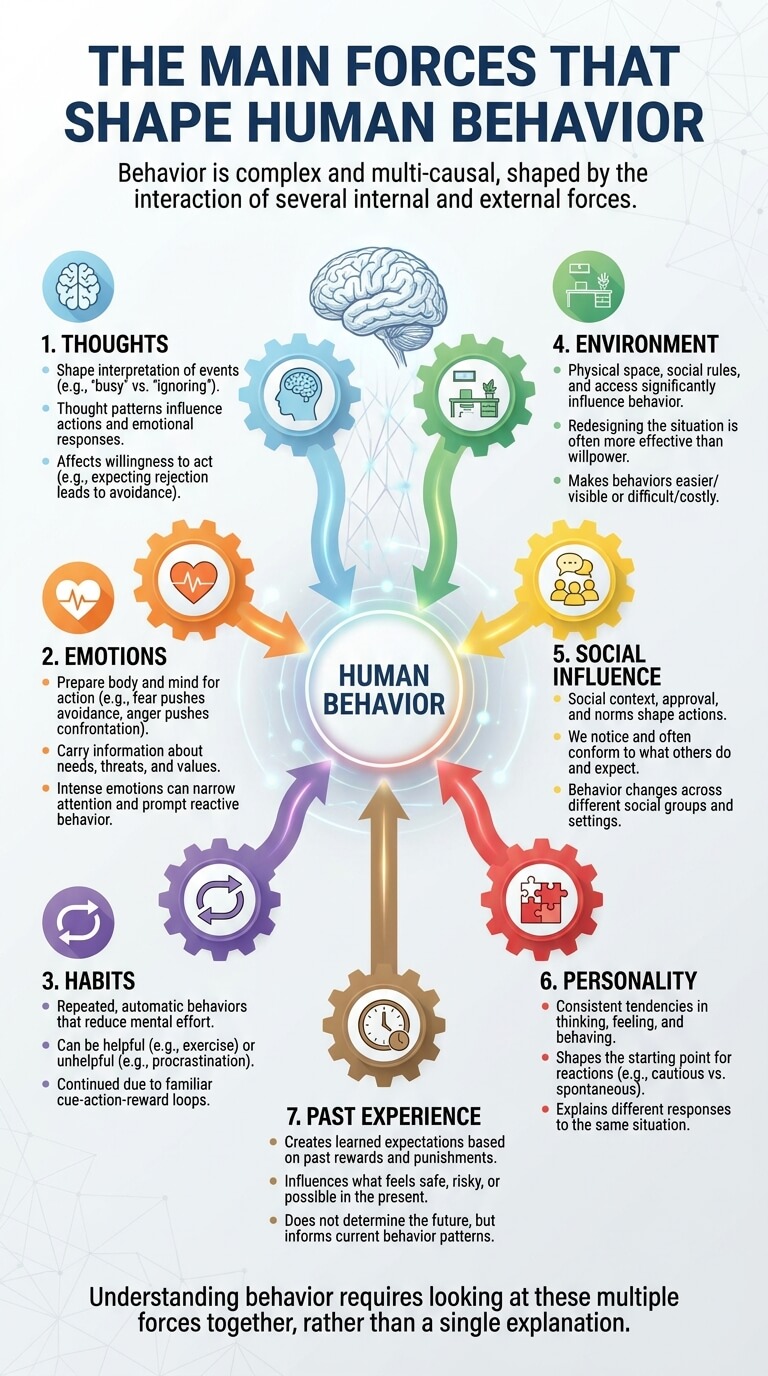
Human behavior has many causes. Some come from inside the person. Some come from the environment. Some come from the past. Some happen in the moment. The most useful approach is to look at several forces together instead of searching for one single explanation.
1. Thoughts
Thoughts influence behavior because they shape how you interpret what is happening. Two people can face the same event but act differently because they explain the event differently in their minds. The cognitive side of behavior also becomes clearer when you look at attention, memory, and thinking as mental processes.
For example, if someone does not reply to your message, you might think, “They are busy,” and move on. Or you might think, “They are ignoring me,” and feel anxious or angry. The event is the same, but the interpretation changes the emotional response, and the emotional response changes the behavior.
This is why thought patterns matter. A person who expects rejection may avoid reaching out. A person who expects failure may delay starting. A person who believes conflict is dangerous may stay silent even when something matters. To explore this connection more deeply, read How Thoughts Influence Behavior.
2. Emotions
Emotions prepare the body and mind for action. Fear can push avoidance. Anger can push confrontation. Shame can push hiding. Guilt can push repair. Joy can push connection. Anxiety can push checking, reassurance seeking, or overpreparing.
Emotions are not always irrational. They often carry information about needs, threats, values, or past experiences. But emotions can also become intense enough to narrow attention and make a person react before thinking clearly.
This is why emotional awareness is part of behavior understanding. A behavior that looks like laziness may involve discouragement. A behavior that looks like arrogance may involve insecurity. A behavior that looks like coldness may involve emotional shutdown.
For a broader overview of this part of psychology, read Psychology of Emotions Explained.
3. Habits
Habits are repeated behaviors that become easier to perform automatically. They can be helpful, such as brushing your teeth, preparing for work, exercising, or checking your calendar. They can also become unhelpful, such as avoiding hard tasks, reaching for your phone whenever you feel bored, or reacting defensively whenever you feel judged. Over time, repeated cues and rewards help explain how habits form.
Habits matter because they reduce mental effort. Once a behavior becomes familiar, the brain does not need to fully decide each time. This makes life easier, but it also means old patterns can continue even after they stop helping.
Many behavior patterns are not repeated because people consciously choose them every time. They are repeated because the cue, action, and reward have become familiar.
4. Environment
Environment shapes behavior more than people often realize. A messy room can make focus harder. A phone on the desk can invite distraction. A calm workplace can make speaking up easier. A critical family environment can make someone more guarded. A supportive group can make a difficult habit easier to maintain. Behavior is also shaped by environmental cues that shape behavior before a person fully notices them.
The environment includes physical space, social rules, expectations, access, friction, rewards, and consequences. If the environment makes a behavior easy, visible, and rewarding, that behavior is more likely to happen. If the environment makes a behavior difficult, awkward, or costly, that behavior is less likely to happen.
This is why behavior change often works better when people redesign the situation instead of relying only on willpower.
5. Social influence
People are social beings. We notice what others do, what they approve of, what they punish, and what they expect. Even when we think we are acting independently, social context often shapes behavior.
A person may laugh more in a group, speak differently at work than at home, avoid disagreeing with friends, copy another person’s posture, or follow a group norm without realizing it. Social approval, rejection, belonging, status, and comparison all influence behavior.
This is why behavior can change when the social environment changes. Someone may seem quiet in one group and confident in another. They may act responsible in one setting and careless in another. To understand this layer more deeply, read Social Psychology Basics.
6. Personality
Personality influences how people usually think, feel, and behave across situations. Some people are more cautious. Some are more open to new experiences. Some are more emotionally reactive. Some are more organized. Some are more cooperative. These tendencies do not control every action, but they shape the starting point.
For example, a highly conscientious person may naturally plan ahead, while a more spontaneous person may prefer flexibility. A highly anxious person may scan for danger more quickly, while a calmer person may wait before reacting. Personality helps explain why people do not all respond to the same situation in the same way.
7. Past experience
Past experience teaches the mind what to expect. If honesty was punished in the past, a person may become guarded. If asking for help led to criticism, they may avoid needing anyone. If hard work was rewarded, they may become persistent. If conflict felt unsafe, they may freeze or withdraw during disagreement.
This does not mean the past determines the future. It means the past can create learned expectations. Those expectations influence what feels safe, risky, familiar, embarrassing, or possible in the present.
Why People Behave Differently in the Same Situation
One of the most important lessons in human behavior psychology is that the same situation does not produce the same behavior in every person. The same event can produce different reactions to the same situation because each person brings a different context.
Imagine three people receive the same critical comment at work. One person becomes motivated and improves the project. Another person feels ashamed and avoids the manager. A third person becomes defensive and argues. The situation is similar, but the behavior is different because each person brings a different inner world into the moment.
People behave differently because they differ in:
- Interpretation: what they think the situation means.
- Emotional state: how stressed, tired, safe, or threatened they feel.
- Personality: their usual patterns of reacting and coping.
- Past learning: what similar situations taught them before.
- Social context: who is watching and what consequences are expected.
- Current needs: whether they need rest, approval, control, safety, connection, or achievement.
- Biology: temperament, stress response, energy level, sleep, and physical condition.
This is why quick judgments are often incomplete. A person who avoids a party may not be rude. They may be socially anxious, exhausted, overstimulated, or unsure how to enter the group. A person who talks too much may not be selfish. They may be nervous, excited, trying to connect, or afraid of silence. A person who seems calm may not be unaffected. They may simply express stress less visibly.
Understanding behavior does not mean ignoring responsibility. People are still responsible for how their actions affect others. But better understanding helps you separate a behavior from a simplistic label. Instead of saying “that person is difficult,” psychology asks, “What pattern is happening here, and what might be driving it?”
Conscious vs Unconscious Behavior
Some behavior is conscious. You decide to make coffee, reply to an email, ask a question, take a walk, or apologize. You are aware of the action and the reason for it. Some reactions are deliberate, while others make more sense through automatic and intentional behavior.
Other behavior is less conscious. You may tense your shoulders when someone raises their voice, check your phone without deciding to, copy someone’s body language, avoid eye contact when uncomfortable, or become defensive before you fully understand why. These actions can happen quickly because they are connected to habit, emotion, memory, threat detection, or learned association.
Unconscious behavior does not mean mysterious or uncontrollable. It means the process starts outside full awareness. The brain is constantly predicting, filtering, and reacting. Much of daily life depends on automatic processing because conscious attention is limited.
For example:
- You may take the same route home without thinking.
- You may feel uneasy around someone before you can explain why.
- You may reach for a snack when stressed, not hungry.
- You may agree too quickly because disagreement once felt unsafe.
- You may procrastinate because starting triggers fear of failure.
Awareness is often the first step toward change. Once a person notices a behavior pattern, they can ask better questions: What triggered this? What did I feel? What did I believe in that moment? What reward did the behavior give me? What would I like to do differently next time?
This is also where cognitive biases matter. A bias can make a person see information in a distorted way without realizing it. Someone may remember evidence that supports their fear and ignore evidence that challenges it. Someone may overvalue the first number they hear, assume others are judging them, or interpret neutral events as personal rejection. To explore these thinking errors, read Cognitive Biases List and Examples.
How Thoughts, Emotions, and Habits Create Behavior Patterns
A behavior pattern is a repeated way of responding. It may show up in relationships, work, conflict, stress, decision-making, or self-care. Some patterns are useful. Others create problems even when the person does not want them to continue. When the same response keeps returning, it may point to repeated behavior patterns rather than one isolated choice.
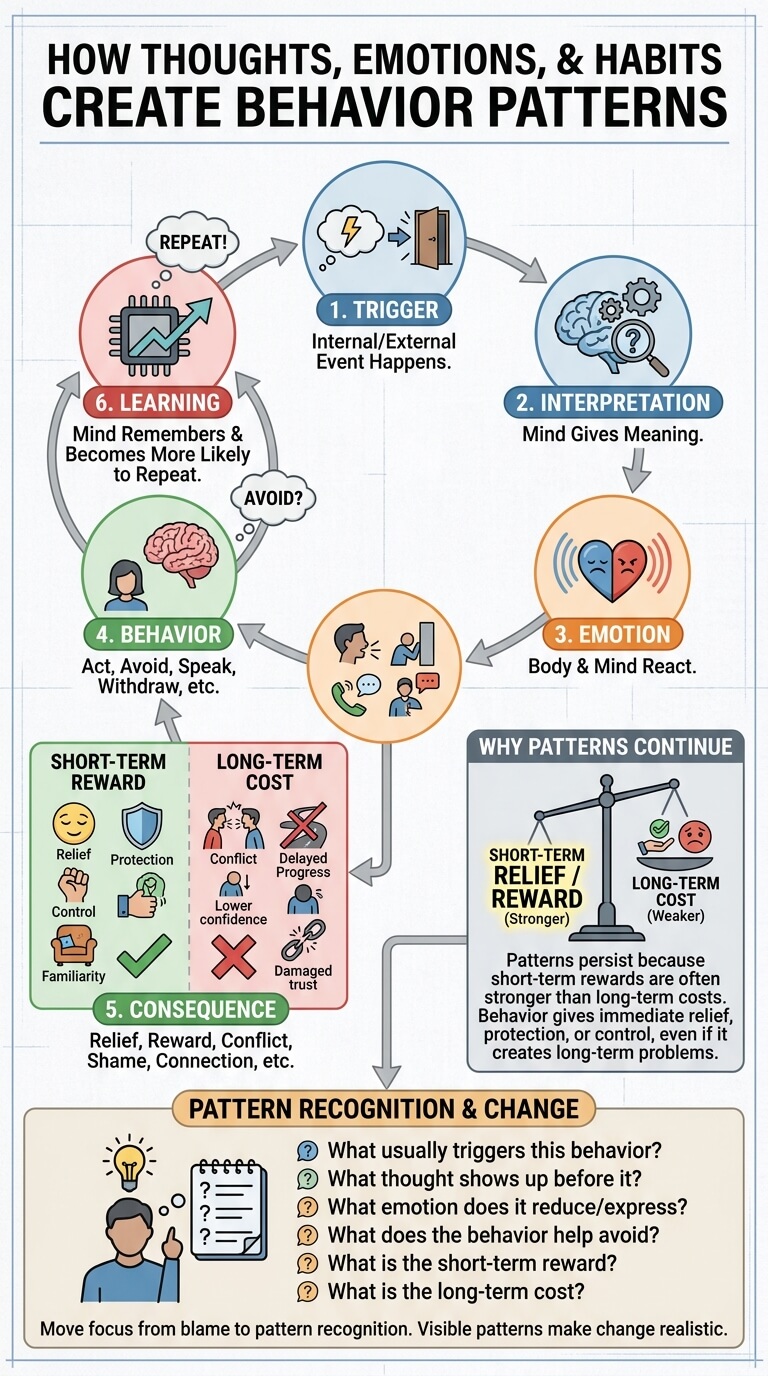
Many patterns form through a loop: That is one reason people can know better and still repeat the same mistake in a familiar context.
- Trigger: something happens internally or externally.
- Interpretation: the mind gives the event meaning.
- Emotion: the body and mind react.
- Behavior: the person acts, avoids, speaks, withdraws, checks, argues, or delays.
- Consequence: the behavior produces relief, reward, conflict, shame, connection, or another outcome.
- Learning: the mind remembers what happened and becomes more likely to repeat or avoid the behavior.
For example, someone who fears criticism may avoid sharing their work. Avoidance brings short-term relief, so the brain learns that hiding reduces discomfort. But over time, the person misses feedback, delays progress, and feels less confident. The pattern continues because the short-term reward is stronger than the long-term cost.
Another person may become angry during conflict. Anger gives them energy and a sense of control. If others back down, the behavior may feel effective. But if it damages trust, the long-term result may be worse. The pattern continues because it solves one problem while creating another.
This is why repeated behavior can feel confusing. People often repeat patterns not because they want the long-term result, but because the behavior gives short-term relief, protection, control, attention, belonging, or familiarity.
When you want to understand a repeated pattern, ask:
- What usually triggers this behavior?
- What thought shows up before it?
- What emotion does it reduce or express?
- What does the behavior help the person avoid?
- What reward does the behavior create in the short term?
- What cost does it create in the long term?
These questions help move the focus from blame to pattern recognition. Once the pattern is visible, change becomes more realistic.
How Environment and Social Context Shape Behavior
It is easy to explain behavior only through personality or willpower. But environment often shapes what people do more quietly and more powerfully than they notice.
A person who cannot focus may be surrounded by interruptions. A person who overeats at night may keep high-reward snacks in the most visible place. A person who avoids exercise may live in a routine where movement requires too many extra steps. A person who never speaks up at work may be in a team where disagreement is punished. A person who seems confident with friends may become guarded in a family setting that still activates old roles.
Environment affects behavior through friction and ease. If a behavior is easy, obvious, and rewarded, it becomes more likely. If a behavior is difficult, hidden, awkward, or punished, it becomes less likely.
Social context works the same way. People often adjust behavior depending on who is present. They may become more agreeable around authority, more playful around friends, more careful around strangers, or more reactive around family. This does not mean they are fake. It means human behavior is responsive to social cues.
Culture also shapes behavior by teaching people what is normal, respectful, embarrassing, successful, selfish, mature, or acceptable. A behavior that seems confident in one environment may seem rude in another. A behavior that seems caring in one culture may seem intrusive in another. Psychology becomes more accurate when it considers context instead of treating one behavior as having the same meaning everywhere.
This is also why the nature vs nurture question matters. Human behavior is shaped by both biological tendencies and environmental experience. Genes, temperament, brain development, family patterns, culture, learning, opportunity, and stress all interact. To explore that interaction more fully, read Nature vs Nurture Psychology.
Can Human Behavior Change?
Human behavior can change, but change usually works better when people understand the pattern they are trying to change. Advice like “just be more disciplined” or “stop overthinking” often fails because it ignores the triggers, rewards, emotions, and environment behind the behavior. Lasting improvement usually depends on the psychology behind lasting behavior change, not willpower alone.
Behavior change becomes more realistic when you work with the system instead of fighting it. That means noticing cues, reducing friction for the desired behavior, increasing friction for the unwanted behavior, practicing new responses repeatedly, and changing the reward structure. Sometimes a short-term payoff explains why people act against their own interests.
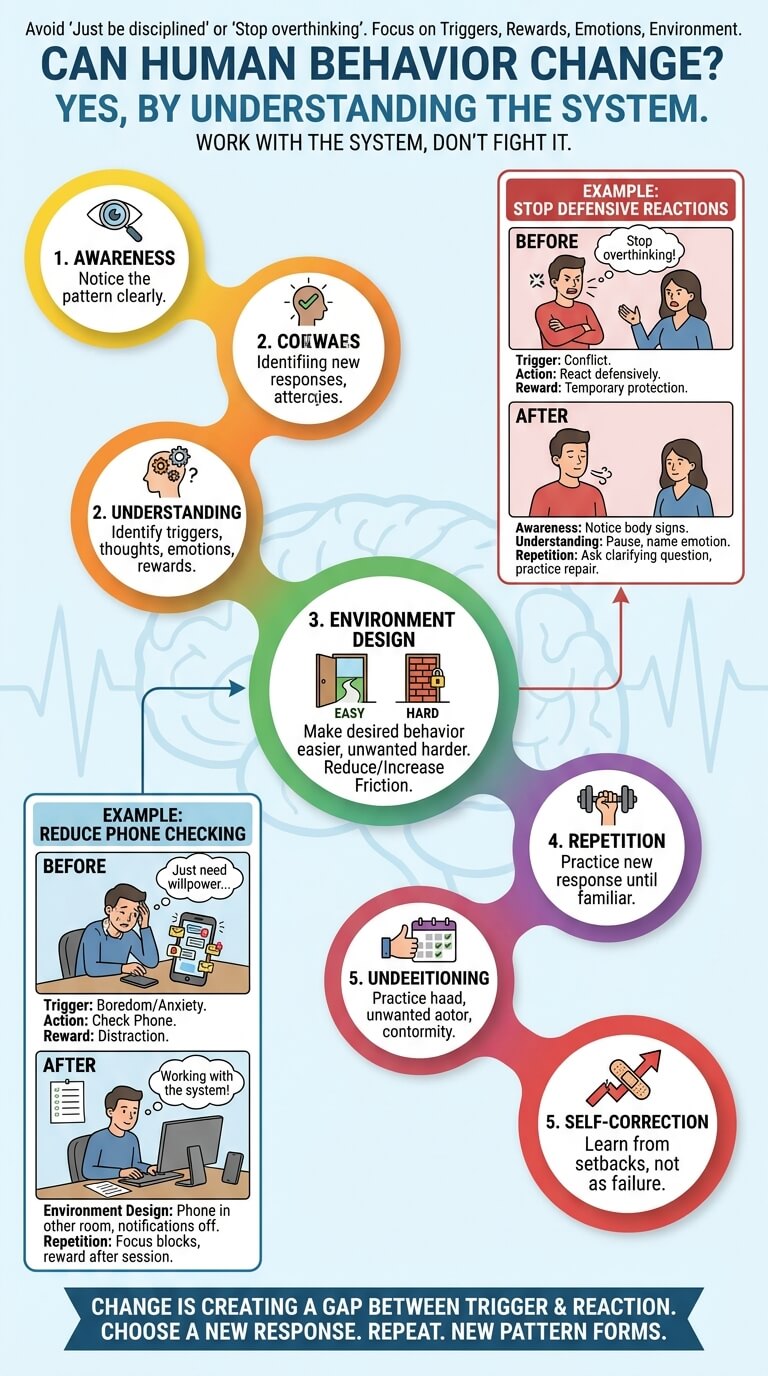
For example, someone who wants to stop checking their phone while working may need more than willpower. They might put the phone in another room, turn off notifications, use a written task list, create short focus blocks, and reward themselves after completing a session. The environment changes, the cue changes, and the desired behavior becomes easier.
Someone who wants to stop reacting defensively during conflict may need to notice the body signs of defensiveness, pause before answering, name the emotion internally, ask one clarifying question, and practice repair after mistakes. The behavior changes because awareness, emotion regulation, and new action are practiced together.
Behavior change often depends on five steps:
- Awareness: noticing the pattern clearly.
- Understanding: identifying triggers, thoughts, emotions, and rewards.
- Environment design: making the desired behavior easier and the unwanted behavior harder.
- Repetition: practicing the new response often enough for it to become familiar.
- Self-correction: learning from setbacks without turning one mistake into proof of failure.
Change does not mean becoming a completely different person overnight. It often means creating a small gap between trigger and reaction. In that gap, a person can choose a slightly different response. Over time, those small choices can become a new pattern.
To understand the learning side of this process, read Behavioral Psychology Principles.
Common Examples of Human Behavior
Human behavior can be obvious or subtle. Some behaviors are physical actions. Some are social responses. Some are emotional reactions. Some are habits so familiar that people barely notice them. The same forces also shape daily choices and behavior.
Common examples include:
- Checking your phone when you feel bored: a habit reinforced by novelty and quick reward.
- Apologizing automatically: a social behavior that may come from politeness, anxiety, or conflict avoidance.
- Copying another person’s posture: a nonverbal behavior linked to social connection and attention.
- Avoiding a difficult task: a behavior that may reduce anxiety in the short term but increase stress later.
- Helping someone in public: a prosocial behavior influenced by empathy, norms, identity, and perceived responsibility.
- Arguing when criticized: a defensive behavior that may protect self-image but damage trust.
- Following the group: a social behavior influenced by belonging, uncertainty, or fear of rejection.
- Repeating a routine: a habit that reduces decision effort and creates predictability.
The key is not just naming the behavior. The deeper question is what function it serves. Does it protect the person? Reduce discomfort? Seek reward? Maintain connection? Avoid shame? Create control? Express a need? Once you understand the function, the behavior becomes easier to understand.
For more everyday examples, read Examples of Human Behavior in Daily Life.
What Human Behavior Psychology Does Not Mean
Human behavior psychology is useful, but it can be misunderstood. It does not mean every action has one hidden meaning. It does not mean you can read people perfectly. It does not mean biology determines everything. It does not mean childhood explains every adult choice. It does not mean people have no responsibility for their actions.
Here are a few important limits:
- One behavior can have many possible causes. Avoidance can come from anxiety, fatigue, disinterest, resentment, confusion, or lack of skill.
- Patterns matter more than one moment. A single reaction may be situational. A repeated reaction tells you more.
- Context changes meaning. Silence can mean respect, fear, anger, concentration, overwhelm, or cultural politeness.
- Understanding is not the same as excusing. Harmful behavior can be explained and still need boundaries.
- Psychology is not mind reading. Good interpretation requires evidence, humility, and attention to context.
A healthy use of psychology makes you more curious and more accurate. An unhealthy use turns every action into a dramatic label. The best question is usually not “What does this prove about this person?” but “What pattern might be happening, and what else do I need to know?”
Human Behavior Topics to Explore Next
Human behavior is easier to understand when you break it into smaller parts. Everyday examples show what behavior looks like in real life. Thoughts explain part of the inner process. Cognitive biases show how judgment can become distorted. Nature and nurture explain why biology and environment both matter. Social psychology shows how other people shape what we do. Behavioral psychology explains how learning, reinforcement, and consequences change action over time.
- For real-life actions and patterns, read Examples of Human Behavior in Daily Life.
- To understand the thought-behavior connection, read How Thoughts Influence Behavior.
- To see how judgment gets distorted, read Cognitive Biases List and Examples.
- To understand biology and environment together, read Nature vs Nurture Psychology.
- To understand how other people influence behavior, read Social Psychology Basics.
- To understand learning, reinforcement, and behavior change, read Behavioral Psychology Principles.
- To understand the mind behind behavior, read How the Human Mind Works.
Key Takeaways
- Human behavior psychology studies both visible actions and the internal processes behind them.
- Behavior is shaped by thoughts, emotions, habits, environment, social influence, personality, biology, and past experience.
- People behave differently in the same situation because they interpret, feel, remember, and expect different things.
- Many behaviors are partly automatic, especially when they are tied to emotion, habit, or learned patterns.
- Repeated behavior often continues because it gives short-term relief, reward, control, or familiarity.
- Behavior can change, but change usually works better when people understand triggers, rewards, and context.
- Psychology should make interpretation more careful, not more judgmental.
FAQ About Human Behavior Psychology
What is human behavior psychology?
Human behavior psychology is the study of how people act, react, decide, avoid, connect, learn, repeat patterns, and change. It looks at both observable behavior and the thoughts, emotions, habits, biology, environment, and social influences behind that behavior.
What are examples of human behavior?
Examples of human behavior include helping, avoiding, arguing, cooperating, checking your phone, following a group, apologizing, procrastinating, exercising, learning, comforting someone, or withdrawing during stress. Each behavior can have different causes depending on context.
What influences human behavior the most?
Human behavior is influenced by several forces at once, including thoughts, emotions, habits, personality, biology, past experience, environment, social pressure, culture, rewards, and consequences. No single factor explains every behavior.
Why do people behave differently in the same situation?
People behave differently because they interpret situations differently, feel different emotions, have different personalities, carry different past experiences, and face different social pressures. The same event can feel safe to one person, threatening to another, and unimportant to someone else.
Is human behavior learned or natural?
Human behavior is both learned and natural. Biology, temperament, and genetics can influence tendencies, but learning, environment, relationships, culture, and life experience shape how those tendencies are expressed.
Can human behavior change?
Yes. Human behavior can change through awareness, practice, environment design, emotional regulation, repetition, and new learning. Change is usually easier when the person understands the trigger and reward behind the old pattern.
Is psychology the same as mind reading?
No. Psychology does not let you read minds or know one perfect reason for every action. It helps you understand likely patterns and influences, but good interpretation still requires context, evidence, and humility.
Final Thoughts
Human behavior psychology gives you a practical way to understand why people do what they do. It shows that behavior is not only about willpower, personality, childhood, biology, or the situation. It is usually a combination of many forces working together.
When you understand this, behavior becomes less mysterious. You can notice patterns instead of only reacting to them. You can ask better questions about your own choices. You can understand other people with more accuracy. And when a behavior is not helping anymore, you can look for the trigger, the emotion, the thought, the reward, and the environment that keep it alive.
The more clearly you understand behavior, the easier it becomes to respond wisely instead of automatically.
Sources and Further Reading
- APA Dictionary of Psychology
- APA Dictionary of Psychology: Behavior Theory
- Mayo Clinic: Cognitive Behavioral Therapy
- Cognitive Behavioral Therapy for Management of Mental Health Conditions
- OpenStax Psychology 2e

Michael Reed is the Founder and Lead Writer at Psychology Exposed. He writes about human behavior, relationships, emotional patterns, self-awareness, and practical psychology topics using research-informed, easy-to-understand content.
Read More About Michael Reed: https://psychologyexposed.com/michael-reed/