
Cognitive biases are the quiet shortcuts behind many everyday judgments. They can shape what you notice, what you ignore, who you trust, what you buy, how certain you feel, and how you explain another person’s behavior. Most of the time, they do not feel like bias from the inside. They feel like common sense, instinct, experience, or “just knowing.” Biases are especially visible in daily decision-making.
A practical cognitive biases list and examples guide is useful because it gives names to thinking patterns that are easy to miss in real time. Once you can name a bias, you have a better chance of slowing down before it turns into a rushed opinion, an unfair judgment, a poor purchase, or a decision you keep defending only because you already invested in it.
This guide focuses on common cognitive biases that show up in daily life. It is not an encyclopedia of every bias ever studied. The goal is to give you a clear working vocabulary, realistic examples, and simple ways to reduce the influence of bias when the decision actually matters.
Quick Answer

Cognitive biases are predictable thinking shortcuts that can distort judgment. Common examples include confirmation bias, availability heuristic, anchoring bias, framing effect, sunk cost fallacy, halo effect, fundamental attribution error, hindsight bias, optimism bias, and overconfidence. Bias does not mean a person is foolish. It means the mind is using fast judgment under limited time, emotion, memory, or uncertainty.
What Is a Cognitive Bias?

A cognitive bias is a repeated tendency in thinking that can lead people away from a fully balanced judgment. It often happens because the mind is trying to simplify information. Instead of weighing every fact from scratch, people rely on memory, emotion, first impressions, familiar stories, social cues, or whatever is easiest to notice. Biases are one piece of the psychology of everyday behavior.
The APA Dictionary of Psychology describes a heuristic as an experience-based strategy for solving a problem or making a decision that is often efficient but does not guarantee a correct answer. Many cognitive biases grow out of these quick strategies. They can be helpful in simple situations and misleading when accuracy matters.
Mental shortcuts, imperfect judgment, and predictable errors
Imagine you are choosing a restaurant in a new city. You do not have time to study every menu, read every review, compare hygiene records, map distance, check prices, and interview past customers. Instead, you may pick the place with a long line, a familiar cuisine, a high rating, or a friend’s recommendation. Those shortcuts may work well enough.
The problem starts when the same shortcut is treated as proof. A long line may mean the food is good, but it may also mean slow service. A friend’s recommendation may be useful, but their taste may not match yours. A high rating may help, but it may also be shaped by hype, recency, or review manipulation.
Bias does not mean stupidity or bad character
One reason people resist the word bias is that it sounds like an insult. In everyday speech, bias can sound like unfairness, ignorance, or bad intent. In psychology, cognitive bias is broader. It describes a thinking tendency, not a moral verdict.
Smart, kind, educated, careful people still use shortcuts. A doctor, teacher, parent, judge, manager, investor, student, or friend can all be influenced by the first number they hear, the story that is easiest to remember, the person they already like, or the belief they already hold. The point is not to shame the mind. The point is to understand where it can be too quick.
Why Cognitive Biases Happen

Cognitive biases happen because human thinking is limited. Attention is limited. Time is limited. Memory is selective. Emotion changes what feels urgent. Social belonging changes what feels safe to say. Under those limits, the mind often chooses a fast answer over a complete one. To see the larger mental system, it helps to understand attention, memory, and judgment.
The brain saves effort
Careful thinking takes energy. Every day includes hundreds of small decisions: what to wear, what to eat, where to look, what to answer first, whether a message is serious, whether a price is fair, whether someone is annoyed, and whether a problem can wait. If the mind analyzed each one fully, daily life would become exhausting.
Biases often begin as effort-saving shortcuts. Familiar options feel safer. Recent examples feel more important. First impressions become reference points. Existing beliefs organize new information. The shortcut may not be perfect, but it often feels fast and usable.
Emotion, memory, uncertainty, and speed
Bias becomes more likely when a person feels rushed, threatened, embarrassed, excited, angry, tired, or overloaded. Emotion does not make people irrational in every situation, but it can change what feels convincing. A fear-based story may feel more important than a dry statistic. A flattering comment may make someone seem more competent. A bad first interaction may color later judgments.
Memory also matters. People do not retrieve every past example evenly. The most vivid, recent, emotional, repeated, or personally meaningful examples usually come to mind first. When the mind treats “easy to remember” as “probably common” or “probably true,” judgment can tilt.
| What the mind is trying to do | How that can help | How it can mislead |
|---|---|---|
| Save time | Quick decisions become easier | The first answer may be accepted too soon |
| Reduce uncertainty | Confusing situations feel more manageable | A simple story may replace a more accurate one |
| Protect identity | People maintain confidence and belonging | Contradictory evidence may be ignored |
| Use memory | Past experience guides action | Vivid memories may seem more typical than they are |
Biases That Affect What We Notice
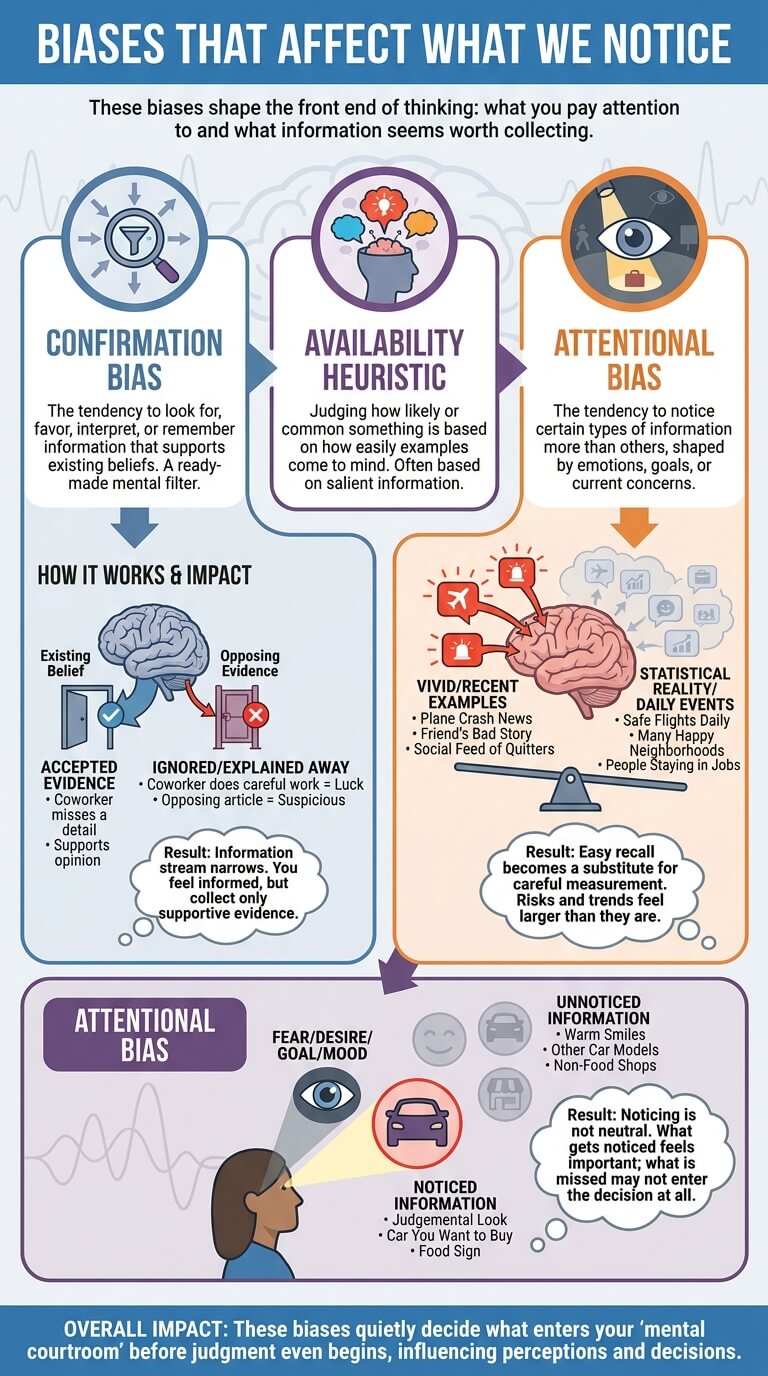
Some biases shape the front end of thinking: what you pay attention to, what feels important, and what information seems worth collecting. These biases can quietly decide what enters the mental courtroom before judgment even begins.
Confirmation bias
Confirmation bias is the tendency to look for, favor, interpret, or remember information that supports what you already believe. It is one of the most common cognitive biases because existing beliefs give the mind a ready-made filter.
Example: You believe a coworker is careless. When they miss one detail in a report, you treat it as proof. When they do careful work, you explain it away as luck or outside help. Over time, you collect evidence for the belief and miss evidence that could soften it.
Confirmation bias can also show up online. A person may search for articles that support their opinion, follow creators who agree with them, and treat opposing evidence as suspicious before reading it carefully. The person feels informed, but the information stream has become narrow.
Availability heuristic
The availability heuristic happens when people judge how likely or common something is based on how easily examples come to mind. The APA Dictionary of Psychology entry on availability heuristic describes this as a strategy for judging likelihood based on information that is especially salient or accessible.
Example: After seeing several news stories about plane crashes, someone may feel that flying is suddenly much more dangerous, even if the actual risk has not changed in the same way. The vivid examples are easy to recall, so the risk feels larger.
This bias also affects daily judgment. If your friend tells you three bad stories about a neighborhood, you may think the whole area is unsafe. If your social feed shows many people quitting their jobs, you may feel that “everyone” is doing it. Easy recall becomes a rough substitute for careful measurement.
Attentional bias
Attentional bias is the tendency to notice certain types of information more than others. What you notice may be shaped by fear, desire, goals, past experience, mood, or current concerns.
Example: If you are worried that people are judging you, you may notice one person looking away and miss three people smiling warmly. If you are thinking about buying a certain car, you may suddenly notice that model everywhere. If you are hungry, food signs may grab your attention more quickly.
Attentional bias matters because noticing is not neutral. What gets noticed often feels important. What goes unnoticed may not enter the decision at all.
Biases That Affect How We Decide

Other biases show up during choice. They influence estimates, risk judgments, product comparisons, planning, negotiation, and whether people keep going with a decision that no longer makes sense.
Anchoring bias
Anchoring bias happens when the first number, label, offer, or idea you encounter becomes a reference point. Even after new information appears, judgment may stay pulled toward the anchor.
Example: A jacket is first shown as $240, then discounted to $120. The $120 price may feel like a bargain because your mind compares it to the first number. But the real question is whether the jacket is worth $120 to you compared with other options.
Anchoring also appears in negotiation. If a seller names a high price first, later offers may feel reasonable even when they are still high. If a project manager guesses that a task will take two days, the team may adjust around that number instead of building a fresh estimate from the actual steps.
Framing effect
The framing effect happens when the same information leads to different reactions depending on how it is presented. The content may be equivalent, but the wording highlights gain, loss, safety, risk, success, failure, or social approval.
Example: A product described as “90 percent fat-free” may feel more appealing than the same product described as “10 percent fat.” A medical option described in survival terms may feel different from the same option described in mortality terms. A workplace change framed as “protecting quality” may be received differently from one framed as “reducing errors.”
Framing does not mean the facts are fake. It means presentation changes emotional weight. When stakes are high, it helps to restate the information in more than one way before deciding.
Sunk cost fallacy
The sunk cost fallacy happens when people continue investing time, money, effort, or emotion because they have already invested so much, even when continuing is not the best choice now.
Example: You sit through a movie you dislike because you already paid for the ticket. You keep using an expensive app that does not help because you bought the annual plan. You stay in a project long after the evidence says it should be changed because quitting would make the earlier effort feel wasted.
The hard part is emotional. Walking away can feel like admitting the earlier choice was wrong. A cleaner question is: “If I had not already invested in this, would I choose it again today?”
Status quo bias
Status quo bias is the tendency to prefer the current option because it is familiar, even when a change could be better. Familiarity lowers mental effort. Change requires comparison, uncertainty, and possible regret.
Example: Someone stays with the same phone plan for years even after cheaper plans become available. A team keeps an outdated process because “this is how we do it.” A person avoids changing their routine because the new option feels uncomfortable, not because the old option is working well.
Biases That Affect How We Judge People
People are especially vulnerable to bias when judging other people. Social information is complex, and the mind often builds quick stories about character, competence, intention, and belonging.
Fundamental attribution error
Fundamental attribution error is the tendency to overemphasize personality and underemphasize situation when explaining someone else’s behavior. The APA Dictionary of Psychology defines fundamental attribution error as a tendency to overestimate how much behavior is determined by personal characteristics instead of situational factors.
Example: A driver cuts you off, and you immediately think, “What a selfish person.” That may be true, but other possibilities exist. They may be rushing to an emergency, confused by the lane, distracted by a crying child, or reacting badly under stress. The bias jumps from behavior to character too quickly.
This does not mean people are never responsible for behavior. It means a single action rarely proves a full personality. Context matters before judgment hardens.
Halo effect
The halo effect happens when one positive trait spills over into unrelated judgments. If someone is attractive, confident, charming, successful, or warm, people may assume they are also smarter, kinder, more honest, or more capable than the evidence shows.
Example: A charismatic speaker gives a polished presentation, and the audience assumes their plan is well researched. A friendly job candidate feels trustworthy, so the interviewer asks fewer tough questions. A celebrity endorses a product, and the positive feeling toward the celebrity transfers to the product.
In-group bias
In-group bias is the tendency to favor people who seem to belong to your group. The group may be based on family, team, workplace, school, country, religion, hobby, political identity, professional role, or shared experience.
Example: A manager gives more benefit of the doubt to employees who remind them of themselves. Fans excuse behavior from their own team that they condemn in another team. Online communities treat the same argument as wise when it comes from an insider and suspicious when it comes from an outsider.
Biases That Affect Memory and Confidence
Some biases do not only affect what people choose now. They affect how people remember the past and how certain they feel about their judgment. This matters because memory and confidence often feel more reliable than they actually are.
Hindsight bias
Hindsight bias is the tendency to believe, after an outcome is known, that it was more predictable than it really was. The APA Dictionary of Psychology explains hindsight bias as overestimating how foreseeable an event was after it has occurred.
Example: After a business idea fails, people say, “It was obvious that would not work.” Before the failure, the signs may have been mixed. After the result, the mind reorganizes the story so the ending feels clearer than it was at the time.
Hindsight bias can make people unfairly harsh toward themselves and others. It can also block learning because it turns complex uncertainty into a simple “I should have known.”
Optimism bias
Optimism bias is the tendency to believe positive outcomes are more likely for yourself than for others, or that negative outcomes are less likely to happen to you. A little optimism can support motivation. Too much can weaken preparation.
Example: A person assumes they can finish a large project in one evening because “I always pull it off.” Another person skips basic financial planning because they believe things will work out. A driver checks their phone because accidents feel like something that happens to other people.
Optimism bias is not the same as hope. Hope can include planning and reality testing. Optimism bias dismisses risk because the preferred outcome feels more emotionally acceptable.
Overconfidence effect
The overconfidence effect happens when people are more certain in their judgment than their accuracy justifies. Confidence feels persuasive, both to the person feeling it and to others watching.
Example: Someone gives a confident estimate in a meeting, so the group accepts it. Later, the estimate is far off. The issue was not that the person lied. The issue was that confidence sounded like evidence.
Overconfidence is common in planning, investing, driving, debating, and predicting how future emotions will feel. A useful habit is to ask, “What would make me less certain?” and “How often have I been wrong in similar situations?”
Everyday Examples of Cognitive Biases
The easiest way to understand cognitive biases is to see how they show up in ordinary moments. One bias can affect what you notice, another can shape how you explain it, and another can make you too confident about the conclusion.
Shopping, social media, work, health, and relationships
| Situation | Bias that may show up | What it can look like |
|---|---|---|
| Shopping | Anchoring bias | A sale price feels good because the original price was high, not because the item is truly worth it |
| Social media | Confirmation bias | You keep seeing posts that support your view and begin to think most informed people agree with you |
| Work | Halo effect | A confident speaker gets more trust than a quieter person with stronger evidence |
| Health choices | Availability heuristic | A vivid story from a friend feels more convincing than broader medical guidance |
| Relationships | Fundamental attribution error | You assume a late reply proves disrespect instead of checking whether the person was busy, stressed, or unable to answer |
| Planning | Optimism bias | You expect a task to take one hour because that is the outcome you want, not because past tasks took that long |
In high-stakes areas such as health, money, legal choices, or safety, bias reduction should not rely only on self-reflection. It is often better to pause, gather more complete information, and speak with a qualified professional who can help separate personal impressions from relevant evidence.
How one bias can combine with another
Biases rarely arrive alone. Suppose someone believes a new coworker is arrogant. Confirmation bias makes them notice every blunt comment. Fundamental attribution error makes them explain the bluntness as character rather than stress or communication style. Hindsight bias later makes them say, “I knew from the first day they were a problem.”
Or imagine someone buying a course online. Anchoring bias makes the discounted price feel valuable. The framing effect makes the offer feel urgent. Availability makes the success stories easy to remember. Sunk cost fallacy later keeps them watching lessons they do not need because they already paid.
This is why the most useful question is not always “Which bias is this?” Sometimes the better question is, “What information am I giving too much weight right now?”
How to Reduce the Impact of Bias
You cannot remove every cognitive bias from thinking. A mind with no shortcuts would struggle to move through daily life. The practical goal is to reduce bias when the cost of being wrong is high, when another person may be judged unfairly, or when emotion is making one answer feel too obvious. In some cases, bias can push people toward short-term relief over long-term goals.
Research on judgment under uncertainty became widely known through the classic Science article by Tversky and Kahneman on heuristics and biases.
Later reviews, including work on cognitive biases in professional decision-making, show why bias awareness matters in fields where decisions can affect other people’s finances, health, work, or legal outcomes.
Slow the decision when stakes are high
Speed increases the power of the first impression. When a decision matters, create a pause. This does not need to be dramatic. Wait overnight before buying something expensive. Re-read a message before sending a harsh reply. Ask for a second estimate before committing to a plan. Write down what you know and what you are guessing.
A useful question is: “Would I make the same choice if I had to explain my reasoning to someone calm and fair?” If the answer is no, the decision may need more time.
Seek disconfirming evidence
To reduce confirmation bias, deliberately look for information that would challenge your first conclusion. If you think someone is careless, look for evidence of care. If you think a product is perfect, read the most thoughtful negative reviews. If you believe a plan will work, ask what would make it fail.
This is not the same as becoming negative. It is a way of making your confidence more honest. A belief that survives fair challenge is stronger than a belief protected from every challenge.
Change the environment, not just the intention
Bias is easier to manage when the environment supports better thinking. Remove countdown timers before making a purchase. Compare prices without looking at the original “discount” number first. Use checklists for repeated decisions. Ask people to write ideas privately before a group discussion, so the loudest person does not anchor everyone else.
Environment matters because bias often appears before willpower does. A better setup can protect thinking from speed, pressure, and social influence.
Cognitive Biases vs Thoughts, Habits, and Decisions
Cognitive biases overlap with thoughts, habits, and decisions, but they are not the same thing. Keeping the difference clear makes the topic more useful. They often work through thinking patterns that affect behavior.
How biases relate to thought patterns
A thought pattern is a repeated way of interpreting situations. A cognitive bias is a specific tilt in judgment. For example, “People will judge me” is a thought. Attentional bias may make you notice every sign of possible judgment. Confirmation bias may make you remember only the moments that support the fear. A familiar bias can also explain why people repeat the same mistakes.
The thought is the content. The bias is the mental process that gives some information more weight than it deserves.
How biases differ from habits and behavior patterns
A habit is a repeated action linked to a cue, such as checking your phone after hearing a notification. A behavior pattern is a broader repeated sequence, such as avoiding difficult tasks until pressure becomes intense. A bias is a thinking shortcut that may influence either one.
For example, status quo bias can make you keep an old routine. Sunk cost fallacy can keep you inside a failing plan. Availability heuristic can make a rare risk feel so large that you avoid an activity. The bias helps explain the judgment, but the repeated action may need a different kind of change plan.
FAQ About Cognitive Biases
What is the most common cognitive bias?
Confirmation bias is often one of the easiest to recognize because people naturally notice information that supports what they already believe. Availability heuristic is also common because vivid examples feel convincing. The “most common” bias depends on the situation, but these two show up often in online information, arguments, risk judgments, and everyday opinions.
Are cognitive biases always bad?
No. Many biases come from shortcuts that help people act quickly with limited information. A shortcut can be useful when the decision is small, familiar, or low risk. It becomes a problem when the shortcut is treated as certainty, when it affects another person unfairly, or when the stakes are high enough to require slower thinking.
Can you remove all bias from thinking?
No one can remove all bias. Human attention, memory, emotion, and judgment are limited. What you can do is build better thinking habits for important decisions: slow down, compare alternatives, ask what evidence would change your mind, get outside feedback, and use structured steps when accuracy matters.
How do cognitive biases affect everyday decisions?
Cognitive biases can affect what you buy, who you trust, how you judge a message, how you explain someone’s behavior, how you estimate risk, and whether you keep investing in a poor choice. They often work quietly because they feel like instinct or experience. Naming them makes it easier to pause before acting on the first interpretation.
Key Takeaways
- Cognitive biases are predictable thinking shortcuts that can tilt judgment, attention, memory, and confidence.
- Bias does not mean a person is unintelligent or dishonest. It means the mind is simplifying information under limits.
- Confirmation bias, availability heuristic, anchoring bias, framing effect, sunk cost fallacy, halo effect, and hindsight bias are common in daily life.
- Biases can combine, which is why one strong first impression can shape what you notice, remember, and defend later.
- The best time to slow bias is before high-stakes choices, unfair judgments, expensive purchases, or emotionally charged reactions.
- Simple tools such as seeking disconfirming evidence, restating the frame, and changing the decision environment can make judgment more balanced.
Final Thoughts
Cognitive biases are easiest to notice in other people, but they become most useful when you can spot them in yourself without shame. The next time a judgment feels obvious, ask what made it feel that way. Was it the first number, the most vivid story, the person you already liked, the belief you wanted to protect, or the cost you did not want to waste?
Choose one decision this week and slow it down by one step. Look for the strongest evidence against your first answer, restate the situation in a different frame, or ask what you would advise a friend to do. That small pause can turn a mental shortcut into a more deliberate choice.

Michael Reed is the Founder and Lead Writer at Psychology Exposed. He writes about human behavior, relationships, emotional patterns, self-awareness, and practical psychology topics using research-informed, easy-to-understand content.
Read More About Michael Reed: https://psychologyexposed.com/michael-reed/