

Human behavior is not only the dramatic choice someone makes in a crisis. It is also the small action that happens before a person has fully thought it through: checking the fridge without feeling hungry, staying quiet in a meeting, buying something because the discount timer is running, or scrolling for ten more minutes after deciding to sleep.
Examples of human behavior in daily life help psychology feel less abstract. They show how thoughts, feelings, habits, social pressure, routines, body states, and surroundings can shape what people do. A behavior may look simple from the outside, but it can carry several possible meanings depending on the person and the situation.
This guide looks at ordinary behavior at home, at work or school, in social settings, online, during emotional moments, and during everyday decisions. The point is not to label people from one action. It is to notice behavior more accurately, with enough context to avoid quick judgment.
Quick Answer
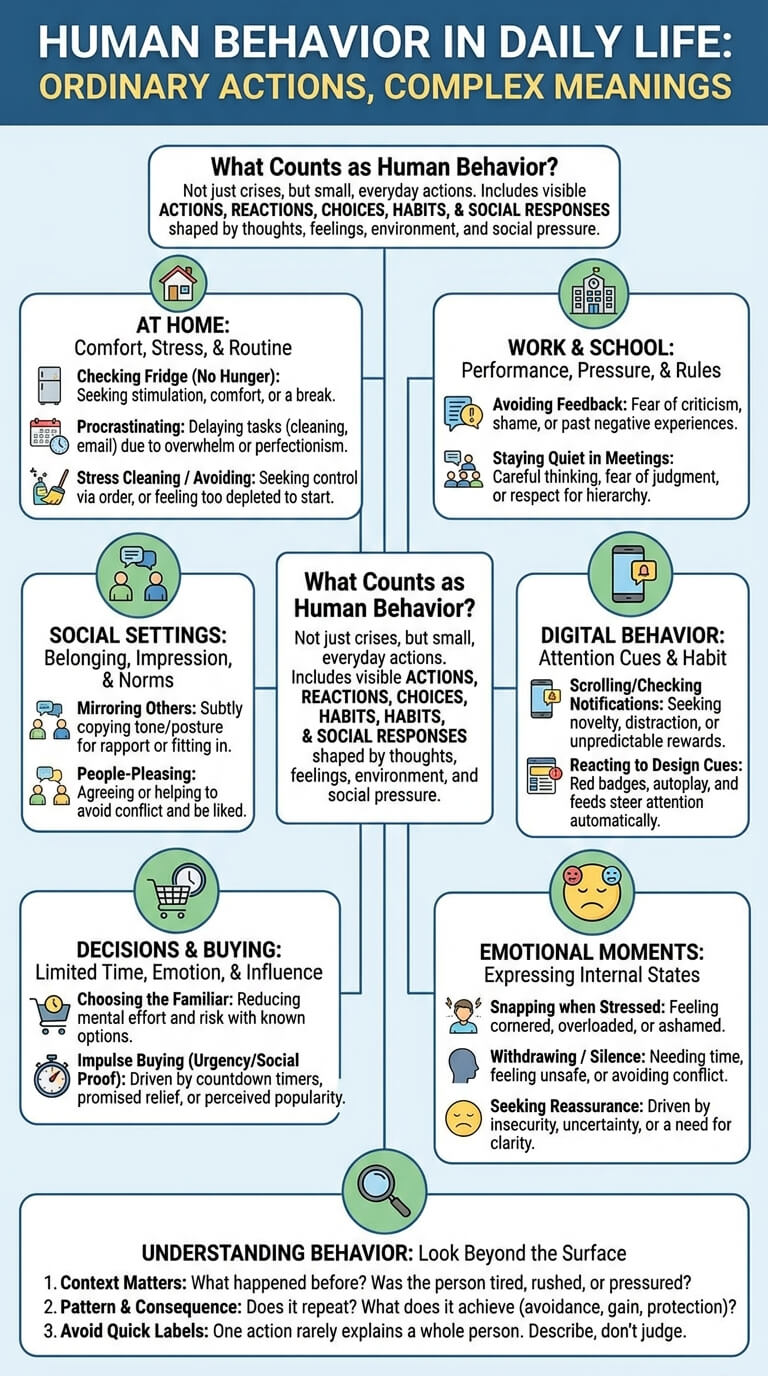
Examples of human behavior in daily life include procrastinating, helping, cleaning, avoiding feedback, mirroring another person, checking notifications, buying familiar products, seeking reassurance, snapping when stressed, and following routines without thinking. A behavior can be intentional, automatic, emotional, social, or shaped by the environment. One action rarely explains a whole person.
What Counts as Human Behavior?
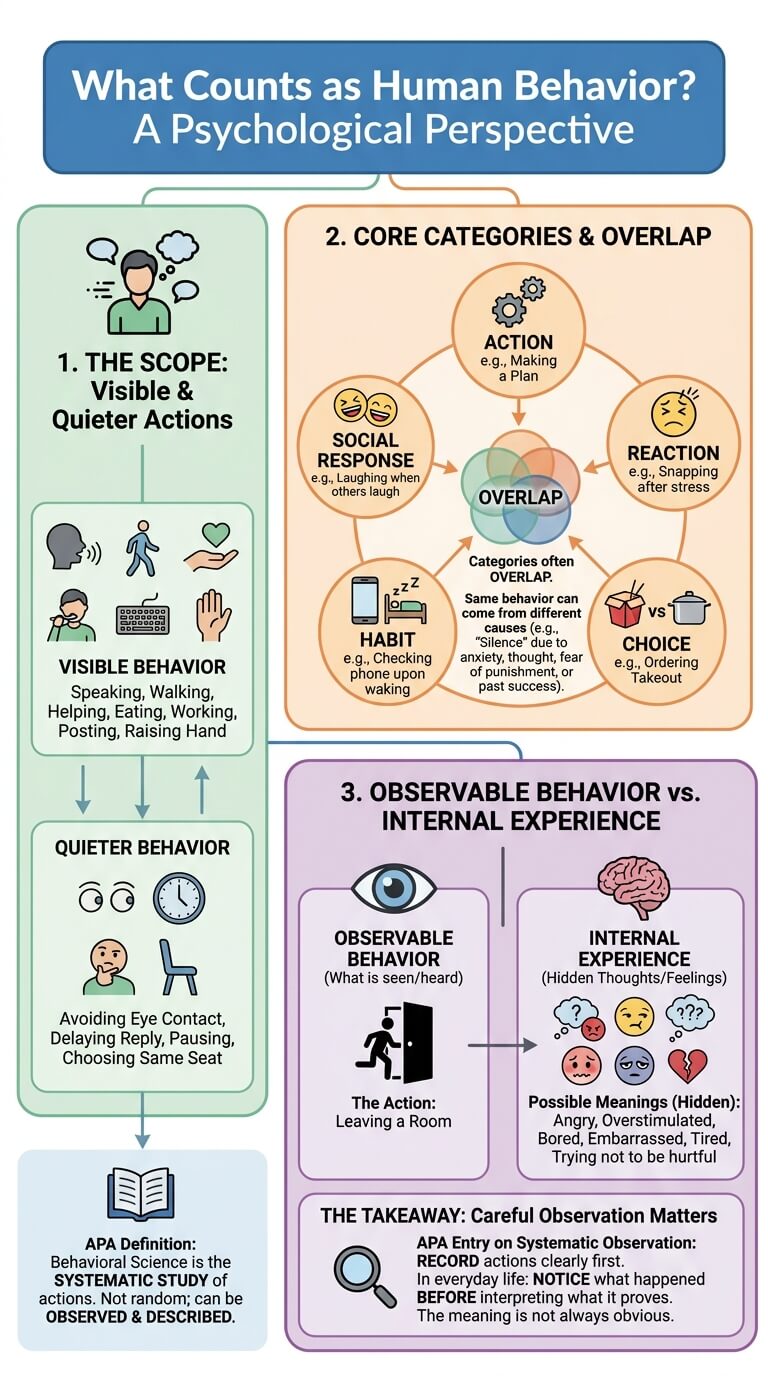
Human behavior includes the actions people take, the reactions they show, the choices they make, and the routines they repeat. Some behavior is visible, such as speaking, walking away, helping, eating, working, posting online, or raising a hand in class. Some is quieter, such as avoiding eye contact, delaying a reply, pausing before answering, or choosing the same seat every day. These examples make the broader psychology of human behavior easier to see in ordinary life.
Psychology does not treat behavior as random movement. The APA Dictionary of Psychology describes behavioral science as the systematic study of human and nonhuman actions, which is useful because behavior can be observed, described, and studied without pretending that one action tells the whole story.
Actions, reactions, choices, habits, and social responses
Behavior can be an action, such as making a plan. It can be a reaction, such as snapping after a stressful day. It can be a choice, such as ordering takeout instead of cooking. It can be a habit, such as checking the phone immediately after waking. It can also be a social response, such as laughing when others laugh, even if the joke was not very funny.
These categories often overlap. A person may choose to stay quiet in a group because they are thinking carefully, because they feel anxious, because the group punishes disagreement, or because silence has worked for them before. The same behavior can come from different causes.
Observable behavior vs internal experience
Observable behavior is what another person can see or hear. Internal experience is what the person thinks, feels, wants, fears, remembers, or expects. A person who leaves a room may be angry, overstimulated, bored, embarrassed, tired, or trying not to say something hurtful. The action is visible, but the meaning is not always obvious.
This is why careful observation matters. The APA Dictionary entry on systematic observation points to the importance of recording actions in a clear way before adding interpretation. In everyday life, that means noticing what happened before deciding what it proves.
Everyday Examples at Home
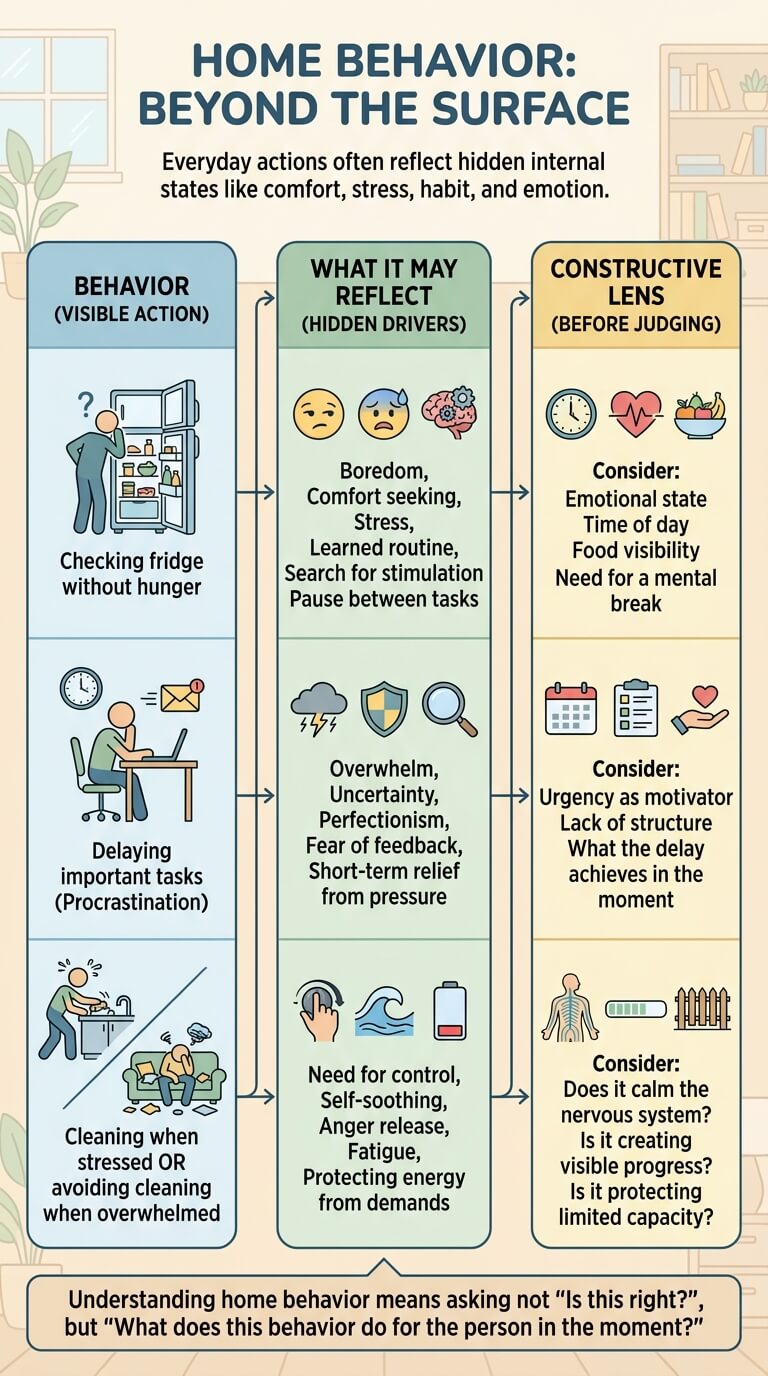
Home behavior often feels personal because it happens in private routines. These examples show how ordinary actions can reflect comfort, stress, habit, avoidance, emotion, or the way a space is set up.
Checking the fridge without hunger
Many people open the fridge when they are not actually hungry. Sometimes the behavior is a search for stimulation. Sometimes it is a pause between tasks. Sometimes it is comfort, boredom, stress, or a learned routine tied to being in the kitchen.
The behavior does not automatically mean a person has no self-control. It may mean the environment offers an easy action when the mind wants a break. If the most visible option is food, the body may move toward the fridge before the person has named what they actually need.
Delaying a task even when it matters
Procrastination is a common example of behavior that looks irrational from the outside. A person may care deeply about the task and still delay it. The delay can reduce pressure for a few minutes, which makes it feel rewarding in the short term.
For example, someone may avoid opening an important email because they imagine bad news. Another person may wait until the last minute to clean, study, write, or pay a bill because urgency finally makes the task feel clear. The visible behavior is delay, but the hidden driver may be overwhelm, uncertainty, perfectionism, fear of feedback, or lack of structure.
Cleaning when stressed or avoiding cleaning when overwhelmed
Two people can respond to stress in opposite ways. One person cleans the kitchen because order gives them a sense of control. Another person cannot start cleaning because the mess feels too large and their energy is already low. Both are examples of behavior shaped by emotional state.
A useful question is not, “Which person is right?” A better question is, “What does this behavior do for the person in the moment?” Cleaning may calm the nervous system by creating visible progress. Avoiding cleaning may protect the person from one more demand, at least briefly.
| Home behavior | What it may reflect | What to look at before judging |
|---|---|---|
| Opening the fridge repeatedly | Boredom, stress, routine, comfort seeking, or real hunger | Time of day, emotional state, food visibility, and whether meals were skipped |
| Leaving dishes until later | Fatigue, avoidance, low energy, unclear routine, or lack of shared responsibility | Whether it is occasional, repeated, tied to conflict, or affected by workload |
| Cleaning intensely after a stressful event | Need for control, self-soothing, anger release, or habit | Whether cleaning restores calm or becomes a way to avoid every difficult feeling |
Examples at Work or School
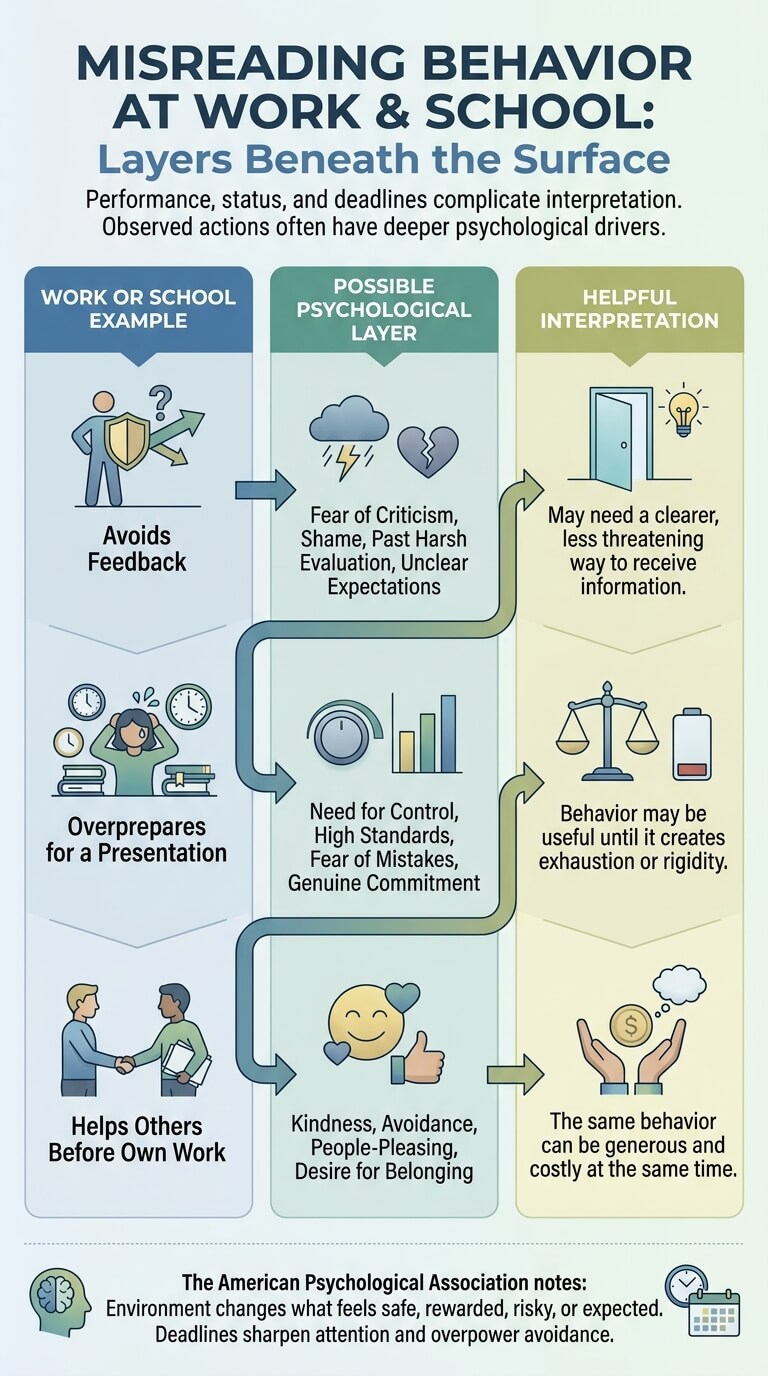
Work and school settings make behavior easier to misread because performance, status, deadlines, evaluation, and group rules are involved. A behavior that looks like confidence in one setting may be pressure management in another.
Speaking up, staying quiet, competing, helping, and avoiding feedback
Speaking up in a meeting can show confidence, but it can also show preparation, role expectation, excitement, or pressure to prove value. Staying quiet can show careful thinking, fear of judgment, disagreement, respect for hierarchy, or simple lack of context.
Competition and helping behavior also have layers. A student who works hard to outperform others may be driven by ambition, fear of falling behind, family pressure, or the reward structure of the class. A coworker who helps everyone may be generous, but may also be trying to be liked, avoid conflict, or protect their image as reliable.
The American Psychological Association explains that psychology studies the relationships between brain function, behavior, and environment in its overview of the science of psychology. Work and school are clear examples of this relationship because the setting changes what feels safe, rewarded, risky, or expected.
Why deadlines change behavior
Deadlines can turn a vague task into an immediate demand. Before the deadline is close, the task may feel abstract. As the deadline approaches, consequences become clearer, attention sharpens, and avoidance may become harder to maintain.
This is why some people say they “work best under pressure.” Sometimes pressure does improve focus. Other times it simply creates enough discomfort to overpower avoidance. The behavior looks productive at the end, but the full cycle may include days or weeks of tension before action begins.
| Work or school example | Possible psychological layer | Helpful interpretation |
|---|---|---|
| A person avoids feedback | Fear of criticism, shame, past harsh evaluation, or unclear expectations | They may need a clearer, less threatening way to receive information |
| A person overprepares for a presentation | Need for control, high standards, fear of mistakes, or genuine commitment | The behavior may be useful until it creates exhaustion or rigidity |
| A person helps others before finishing their own work | Kindness, avoidance, people-pleasing, or desire for belonging | The same behavior can be generous and costly at the same time |
Social Behavior Examples
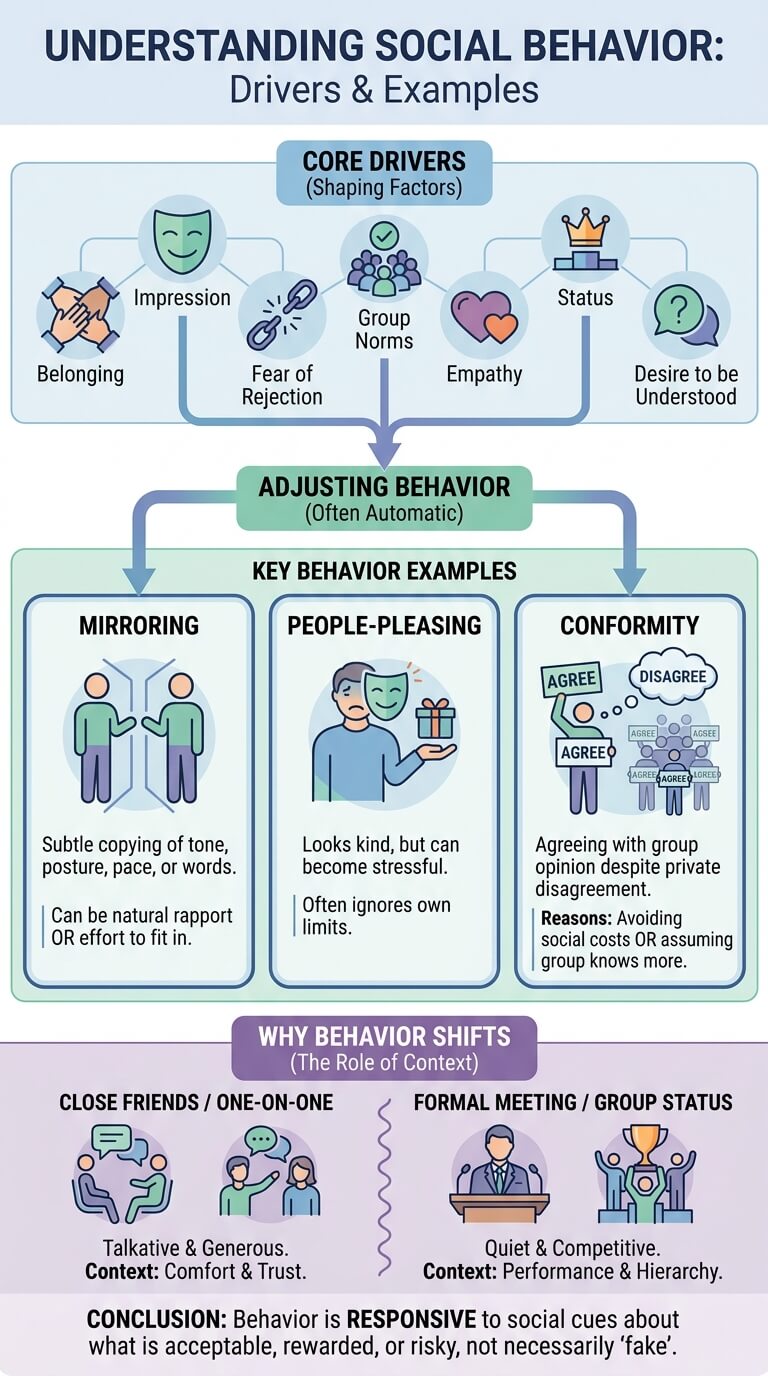
Social behavior is shaped by belonging, impression, fear of rejection, group norms, empathy, status, and the desire to be understood. People often adjust behavior around others before they realize they are doing it. Group settings often reveal how people behave around others.
Mirroring, people-pleasing, conformity, helping, and conflict avoidance
Mirroring happens when someone subtly copies another person’s tone, posture, pace, or word choice. It can be a natural sign of rapport, but it can also happen when a person is trying to fit in. People-pleasing may look kind on the surface, yet it can become stressful if the person constantly ignores their own limits.
Conformity is another everyday example. Someone may agree with a group opinion even when they privately disagree. That does not always mean they are weak. Sometimes people conform because disagreement has social costs. At other times, the group provides information, and the person assumes others know something they do not.
Why the same person may act differently in groups
A person can be talkative with close friends and quiet in a formal meeting. They can be generous one-on-one and competitive in a group where status matters. They can be patient at home and impatient in public when they feel watched or rushed.
This does not mean the person is fake. Human behavior is responsive. Social settings send cues about what is acceptable, rewarded, embarrassing, or risky. A group can bring out courage, kindness, silence, humor, defensiveness, or performance depending on the situation.
Decision and Buying Behavior Examples
Decision behavior shows how people choose when they have limited time, limited information, emotion, habit, and social pressure. Buying behavior is especially useful because stores and apps often create cues that make certain choices feel easier. Many ordinary examples come from small daily choices that feel automatic in the moment.
Choosing the familiar option
People often choose what they already know. They buy the same brand, sit in the same place, take the same route, order the same food, or use the same app. Familiarity reduces mental effort. It also feels safer because the outcome is easier to predict.
This can be helpful when the familiar choice works. It becomes limiting when someone keeps choosing the known option only because new options feel uncomfortable. A familiar choice can protect time and energy, but it can also keep a person stuck in habits that no longer fit.
Buying because of urgency, emotion, or social proof
A person may buy because a countdown timer creates urgency, because a product promises relief, or because reviews suggest that many other people approve. The purchase may not be purely logical or purely emotional. It is often a mix of need, desire, identity, timing, and the way the choice is presented.
Social proof is powerful because people use other people’s behavior as information. If many people appear to want something, the item may feel more valuable. The same idea can show up offline too, such as choosing a crowded restaurant because the crowd makes it look trustworthy.
Online and Digital Behavior Examples
Digital behavior can feel voluntary, but apps and platforms are built around attention cues. Notifications, likes, short videos, unread badges, recommendation feeds, and streaks all make behavior easier to repeat.
Scrolling, checking notifications, comparing, and reacting quickly
Scrolling is often an automatic behavior. A person may open an app to check one message and then spend twenty minutes moving through posts, videos, comments, and recommendations. The behavior may provide novelty, distraction, connection, or escape from a task that feels uncomfortable.
Checking notifications is similar. The action is short, but the reward is unpredictable. Sometimes there is nothing. Sometimes there is a message, like, reply, or update. That uncertainty can keep the behavior alive because the next check might bring something interesting.
How design cues shape attention
Design cues reduce friction. A red badge, autoplay video, endless feed, visible like count, or “people also bought” prompt can steer attention and action. This does not remove personal choice, but it changes the path of least resistance.
Environment matters here in a very literal way. The CDC’s explanation of conditions that shape daily life focuses on health contexts, but the broader lesson is relevant: people do not make choices in a vacuum. Surroundings, access, norms, and systems influence behavior.
Emotional Behavior Examples
Emotion often becomes visible through behavior. This can include tone, facial expression, posture, speed of speech, withdrawal, reassurance seeking, overexplaining, crying, snapping, joking, silence, or leaving the room.
Snapping, withdrawing, seeking reassurance, or overexplaining
Snapping can happen when a person feels cornered, overloaded, ashamed, or interrupted. Withdrawing can happen when a person needs time, feels unsafe, does not know what to say, or has learned that silence creates less conflict. Seeking reassurance can come from love, insecurity, uncertainty, or a need for clarity. Overexplaining can be an attempt to prevent misunderstanding.
These behaviors deserve context. A single sharp tone after a sleepless night is different from a repeated pattern of humiliating others. A pause to calm down is different from using silence to punish. Everyday examples should help people notice nuance, not excuse harm.
Behavior as a signal, not always the whole story
Behavior can be a signal that something is happening, but it is not always the complete explanation. Someone who jokes during a serious moment may be avoiding discomfort, trying to lighten tension, or unsure how to respond. Someone who cries may be sad, angry, overwhelmed, relieved, or physically exhausted.
This is why emotional behavior is best understood with curiosity and boundaries together. Curiosity asks, “What might be happening here?” Boundaries ask, “Is this behavior acceptable, safe, and respectful?” Both questions matter.
Conscious vs Automatic Examples
Some behavior is deliberate. Other behavior happens on autopilot because the cue is familiar and the response has been repeated many times. Daily life contains both types, often within the same hour. Some daily actions are planned, while others are better understood as intentional behavior vs autopilot.
Planned actions vs autopilot actions
A planned action might be deciding to call a friend, prepare a healthy meal, ask for feedback, or save money. The person has awareness and intention. An automatic action might be unlocking the phone without a reason, saying “yes” before checking energy, interrupting when nervous, or taking the usual route while barely noticing the drive.
| Type of behavior | Example | What makes it different |
|---|---|---|
| More conscious | Choosing to apologize after reflecting | The person pauses, considers impact, and chooses a response |
| More automatic | Opening an app whenever there is a quiet moment | The cue appears and the action follows with little awareness |
| Mixed | Buying a familiar comfort food after a stressful day | The person may know what they are doing, but emotion and routine make it easier |
How routines become invisible
Routines become invisible when the brain no longer has to spend much energy on them. This is useful for brushing teeth, driving familiar routes, preparing coffee, or locking the door. It would be exhausting to make every small action a new decision.
The downside is that unhelpful routines can also disappear into the background. A person may not notice how often they check messages during work, interrupt a partner, buy things when bored, or avoid difficult tasks until the routine is pointed out.
How to Read Behavior Without Overinterpreting It
Behavior can teach you something, but it should not become a shortcut for judging a person’s entire character. One action is a clue. A repeated pattern across situations is stronger information. Context, timing, consequences, and the person’s own explanation all matter.
Look for context, pattern, and consequences
Context means what was happening around the behavior. Was the person tired, rushed, embarrassed, hungry, threatened, praised, or under pressure? Pattern means whether the behavior repeats. Consequences mean what happens after the behavior, both immediately and later.
For example, if someone avoids a conversation once after a long day, that may simply be fatigue. If they avoid every serious conversation and the other person is left carrying all responsibility, the behavior has a different meaning. Repetition and impact change the picture.
Avoid turning one behavior into a personality label
It is tempting to say, “They are lazy,” “They are selfish,” “They are dramatic,” or “They are weak.” Those labels may feel satisfying because they simplify the situation. They also often stop curiosity too early.
A better first step is to describe the behavior without turning it into identity. Instead of “She is lazy,” say, “She delayed the task until the deadline became urgent.” Instead of “He does not care,” say, “He did not respond after I asked for follow-through.” Clear description makes problem-solving more accurate.
Four questions that make behavior easier to understand
When a behavior feels confusing, ask four simple questions. What happened right before it? What did the person seem to gain, avoid, express, or protect? What happened afterward? Does this happen often enough to create a pattern?
These questions do not turn you into someone else’s therapist. They simply slow down the jump from action to judgment. They are also useful for self-reflection because people often understand their own behavior better when they look at cues and consequences, not only intentions.
What These Examples Help You Understand Next
Once you can recognize behavior in daily life, it becomes easier to study the forces behind it. Examples are the doorway. The deeper questions are about thought, habit, environment, and social influence.
Thoughts behind behavior
Many actions make more sense when you ask what interpretation came first. A person who thinks feedback means failure may avoid it. A person who thinks silence means rejection may seek reassurance. A person who thinks trying something new will embarrass them may stay with the familiar choice. Many examples become clearer when you look at the thought behind a reaction.
Habits and repeated patterns
Some behaviors matter most because they repeat. A repeated behavior can become a habit, a coping style, a relationship pattern, or a daily routine. Repetition does not always make behavior bad. It simply means the behavior has become familiar enough to run with less effort.
Environment and social influence
People behave differently when the environment changes. A quiet room, public audience, supportive friend, strict boss, visible snack bowl, loud notification, or group expectation can all shift action. Human behavior is not only inside the person. It also happens between the person and the world around them. Daily behavior also changes when environmental cues make one action easier than another.
When a Behavior Needs More Support
Most daily behaviors are not emergencies. Procrastinating once, checking a phone too often, avoiding a difficult conversation, or buying something impulsively can be ordinary human behavior. Still, support may be worth considering when behavior causes serious harm, repeated loss of control, severe distress, major disruption in daily life, or safety concerns.
If someone is in emotional distress, thinking about self-harm, or unsure how to stay safe, the National Institute of Mental Health guidance on finding help explains immediate options for crisis and mental health support. For less urgent concerns, talking with a qualified mental health professional can help when behavior feels hard to understand or change alone.
FAQ About Human Behavior Examples
Is emotion a behavior?
Emotion itself is an internal experience, but emotion often shows through behavior. Crying, withdrawing, snapping, laughing, freezing, pacing, or seeking reassurance can be behavioral expressions of emotion. The same emotion can also lead to different behaviors in different people.
Are habits examples of behavior?
Yes. Habits are repeated behaviors that become linked to cues, routines, and rewards. Brushing your teeth, checking your phone, making coffee, avoiding a task, or taking the same route can all be habits. Some habits are useful because they save effort. Others create problems when they keep repeating without much awareness.
Can the same behavior have different meanings?
Yes. Silence may mean careful thought, fear, anger, tiredness, respect, confusion, or avoidance. Buying something may reflect need, pleasure, stress relief, social influence, or habit. This is why one behavior should be read with context instead of treated as proof of one fixed meaning.
Why do people do things they cannot explain?
People often act from habit, emotion, learned responses, social cues, body states, or quick interpretations before they have clear words for what is happening. Not being able to explain a behavior does not mean there is no reason. It may mean the reason is automatic, mixed, or not yet understood.
Key Takeaways
- Human behavior includes visible actions, reactions, choices, routines, habits, and social responses.
- Daily examples such as procrastinating, checking notifications, helping, snapping, or choosing familiar options often have more than one possible meaning.
- Behavior is easier to understand when you look at context, repetition, consequences, and what the action does for the person in the moment.
- One behavior should not be turned into a full personality label. Clear description is more useful than quick judgment.
- Some behavior is planned, while other behavior runs on autopilot because a cue and response have been repeated many times.
- Support may help when behavior causes severe distress, harm, safety concerns, or major disruption in daily life.
Final Thoughts
The best way to understand examples of human behavior in daily life is to start with ordinary moments. Notice what people do when they are rushed, tired, praised, criticized, bored, watched, included, or uncertain. Then slow down before deciding what the behavior means.
For your own behavior, choose one repeated action this week and describe it without judgment. What usually happens before it? What does it help you avoid, gain, express, or protect? What happens afterward? That small amount of observation can turn a confusing behavior into something you can understand more clearly.

Michael Reed is the Founder and Lead Writer at Psychology Exposed. He writes about human behavior, relationships, emotional patterns, self-awareness, and practical psychology topics using research-informed, easy-to-understand content.
Read More About Michael Reed: https://psychologyexposed.com/michael-reed/