

Most people have noticed this in ordinary life: the same event can lead to completely different reactions depending on what it seems to mean in the moment. A short reply from a friend may feel harmless if you think they are busy. The same reply may feel painful if you think, “They are pulling away from me.” A mistake at work may lead one person to ask for feedback and another person to hide, not because the event is totally different, but because the interpretation is different.
Thoughts influence behavior by shaping what you notice, what you expect, what you feel, and what action seems necessary. They do not control every choice. Your body state, habits, environment, past learning, social pressure, and real-life limits also matter. But thoughts often act like a filter between what happens and what you do next.
This guide explains the thought-to-behavior pathway in plain English. It is not a therapy protocol, and it does not suggest that you are responsible for every thought that crosses your mind. The practical aim is simpler: learn to spot the interpretation behind a reaction so you have a little more room to choose your next step.
Quick Answer

Thoughts influence behavior by giving meaning to a situation. A thought can predict danger, expect rejection, assume success, interpret a motive, or tell you what kind of person you are. That meaning affects feelings, body responses, attention, and action. Thoughts do not force behavior, but they can make some actions feel more urgent, safer, smarter, or more justified than others. This is one part of why people act the way they do, not the whole explanation.
The Thought-to-Behavior Pathway

A helpful way to understand thoughts and behavior is to slow down the sequence. In real life, it often happens fast. You receive a message, notice a tone, feel a shift in your body, and react before you have fully named what you believed. When you pause the sequence, you can usually find a thought or interpretation somewhere between the event and the action. The process fits closely with the cognitive processes behind behavior.
Psychology often studies cognition, which includes knowing, perceiving, remembering, reasoning, judging, and imagining. The American Psychological Association’s overview of cognition and the brain describes cognition as a broad set of mental processes involved in awareness and understanding. Those processes matter because behavior is not just a response to the outside world. It is also a response to how the mind organizes the outside world.
Situation, interpretation, feeling, body response, action
The pathway often looks like this:
| Part of the pathway | What happens | Everyday example |
|---|---|---|
| Situation | Something happens outside or inside you. | Your manager says, “Can we talk after lunch?” |
| Interpretation | Your mind gives the event meaning. | “I must have done something wrong.” |
| Feeling | An emotion rises based on that meaning. | You feel nervous or ashamed. |
| Body response | Your body prepares for action. | Your chest tightens and your attention narrows. |
| Action | You do something to handle the moment. | You avoid eye contact, over-explain, or spend lunch worrying. |
The event itself matters, but the interpretation changes the emotional weight of the event. If your first thought is “They probably need a routine update,” your behavior may be calmer. If your first thought is “I am in trouble,” you may act as if a threat is already present, even before you know what the meeting is about.
Why two people can react differently to the same event
Two people can hear the same feedback and behave differently because they attach different meanings to it. One person may think, “This helps me improve,” and ask questions. Another may think, “They think I am incompetent,” and become quiet or defensive. Neither reaction appears from nowhere. Each action grows from a different internal reading of the same situation.
Past experiences can make certain interpretations easier to reach. If someone grew up being criticized harshly, even mild feedback may feel loaded. If someone has often been rewarded for taking initiative, uncertainty may feel like a challenge rather than a warning. Thoughts are shaped by memory, learning, culture, family messages, personality tendencies, stress, and the immediate environment.
Thoughts Are Not Commands
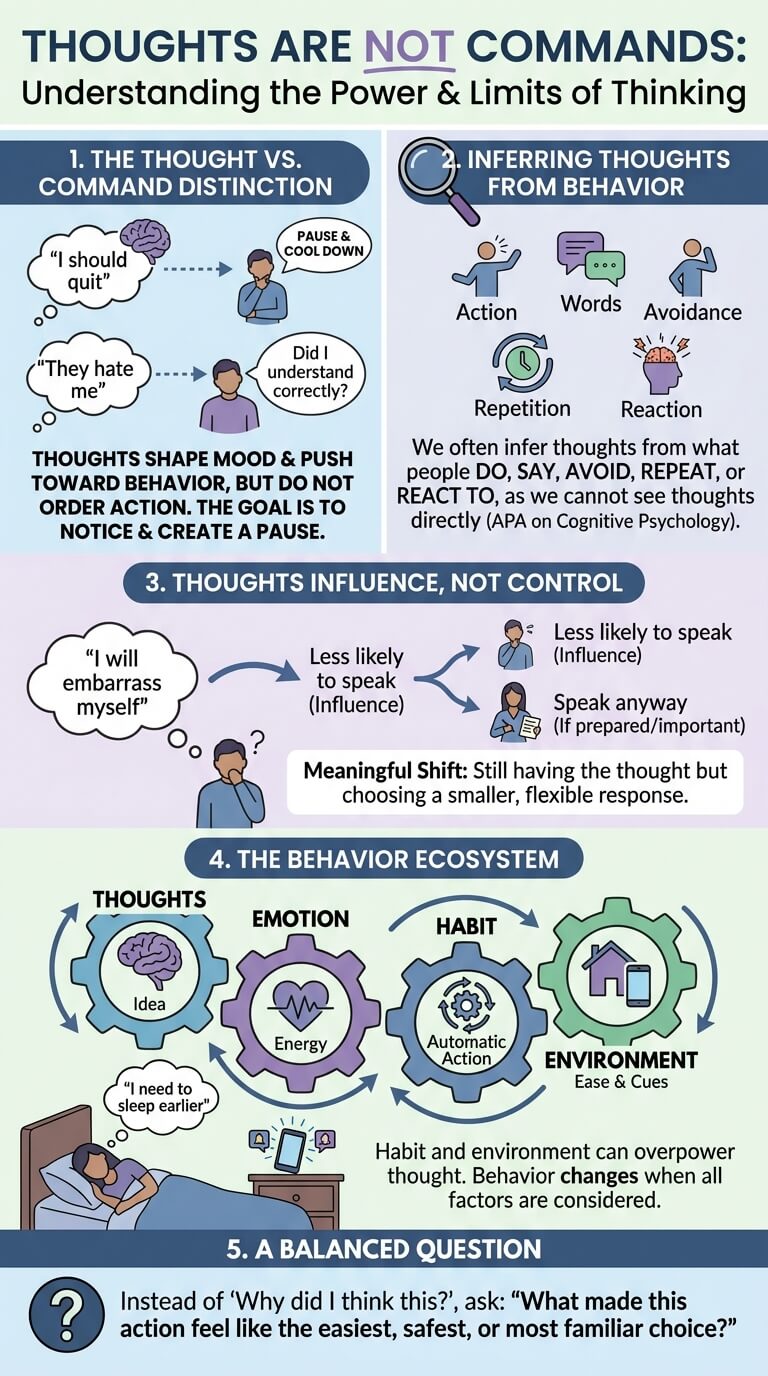
It is easy to overstate the power of thoughts. A thought can pull your attention, shape your mood, and push you toward a behavior, but it is not the same as an order. You can think “I should quit” and still stay long enough to cool down. You can think “They hate me” and still ask, “Did I understand that correctly?” The goal is not to control every thought. It is to notice when a thought is acting like a command and create a pause before action. Some thoughts move quickly enough to become behavior that happens before reflection.
The APA Dictionary description of cognitive psychology notes that cognitive psychology examines mental processes such as perceiving, attending, thinking, language, and memory, often by making inferences from behavior. That is useful here because we usually cannot see a thought directly. We often infer it from what a person does, says, avoids, repeats, or reacts to.
Thoughts can influence behavior without fully controlling it
A thought may change the likelihood of a behavior without making it unavoidable. For example, the thought “I will embarrass myself” may make you less likely to speak in a meeting. But if the topic matters enough, or if you have prepared a simple opening sentence, you may speak anyway. The thought still influenced the moment. It just did not decide the whole outcome.
This distinction matters because people can become discouraged when they cannot stop certain thoughts. They may think, “If I still have this thought, nothing has changed.” But change often begins earlier than that. You may still have the thought and choose a smaller, more flexible response. That is already a meaningful shift.
The role of emotion, habit, and environment
Thoughts are only one part of behavior. Emotion gives thoughts energy. Habit makes certain actions automatic. Environment makes some behaviors easier than others. A person may think, “I need to sleep earlier,” but if their phone is next to the bed, notifications are active, and late-night scrolling is a familiar routine, the environment and habit may overpower the thought.
This is why it is unfair and inaccurate to say behavior is simply a matter of thinking better. Thoughts matter, but behavior often changes when thought, feeling, body state, routine, and surroundings are all considered. A more balanced question is not “Why did I think this?” but “What made this action feel like the easiest, safest, or most familiar choice?”
Common Thought Patterns That Shape Behavior

Some thoughts show up as single sentences. Others are more like background rules. They may not appear as clear words, but they still guide behavior. Below are several common thought patterns that influence daily action.
Predictions about what will happen
Predictions are thoughts about the future. They can help you prepare, but they can also narrow behavior too early. If you predict rejection, you may avoid asking. If you predict failure, you may delay starting. If you predict conflict, you may soften your needs before anyone has responded.
| Prediction | Possible behavior | More flexible question |
|---|---|---|
| “They will say no.” | You do not ask for help. | “What is one low-pressure way to ask?” |
| “I will mess this up.” | You procrastinate or over-prepare. | “What would a rough first version look like?” |
| “This conversation will become a fight.” | You avoid the topic completely. | “Can I raise one specific point calmly?” |
| “If I rest, I will fall behind.” | You ignore fatigue until you crash. | “Would a short reset help me work better?” |
Predictions become especially powerful when they are treated as facts. The mind may present them with confidence even when the evidence is incomplete. A useful pause is to say, “This is a prediction, not a result.” That sentence creates enough distance to consider a second option.
Beliefs about yourself and other people
Beliefs are more stable than passing thoughts. A person who believes “I am always a burden” may behave very differently from someone who believes “People can care about me and still have limits.” A person who believes “Others cannot be trusted” may scan for danger more quickly and keep emotional distance even around people who have not caused harm.
Beliefs influence behavior because they act like rules for what feels possible. If you believe you are not allowed to make mistakes, you may hide uncertainty. If you believe asking questions makes you look weak, you may pretend to understand. If you believe conflict always ends in rejection, you may give in before you know whether the other person is willing to listen.
Stories about threat, rejection, failure, or reward
The mind does not only think in sentences. It also creates stories. A story might be, “This always happens to me,” “I am falling behind everyone,” “They are losing interest,” or “If I get this right, I will finally feel secure.” Stories connect events into a pattern, and that pattern can shape behavior powerfully.
Some stories make avoidance feel protective. Some make people-pleasing feel necessary. Some make risk-taking feel exciting. Some make overworking feel like survival. The story does not have to be completely false to become limiting. It may contain a real concern but leave out other facts that could lead to a different action.
Self-Talk and Action
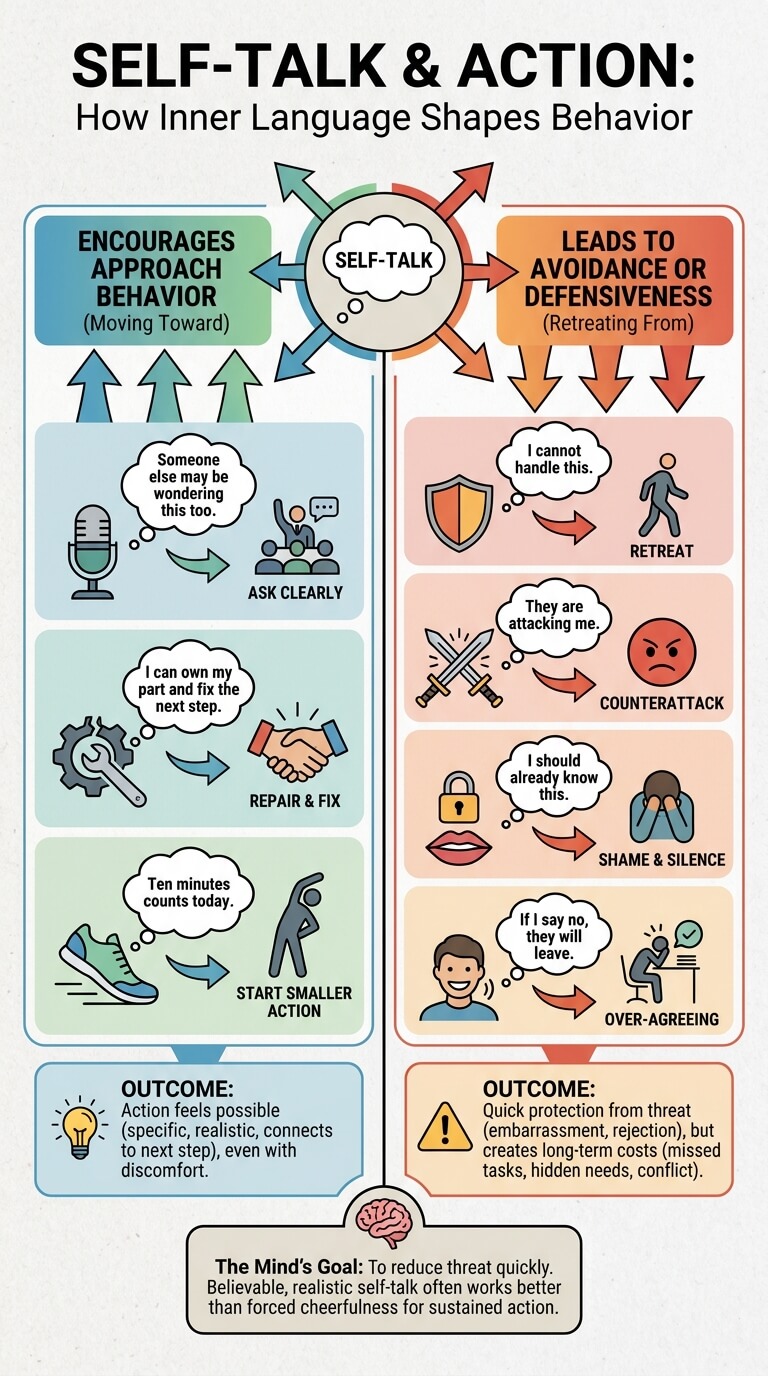
Self-talk is the inner language you use before, during, and after action. It may sound like encouragement, criticism, warning, coaching, or pressure. Self-talk can influence whether you approach something, avoid it, repair a mistake, defend yourself, or try again. A thought can make choosing short-term relief feel safer than the long-term choice.
When self-talk encourages approach behavior
Approach behavior means moving toward something: asking, trying, learning, apologizing, applying, practicing, or starting. Self-talk that supports approach does not have to be unrealistically positive. In fact, believable self-talk often works better than forced cheerfulness.
| Situation | Approach-supporting self-talk | Likely behavior |
|---|---|---|
| You need to ask a question in a meeting. | “Someone else may be wondering this too.” | You ask clearly instead of staying silent. |
| You made a mistake. | “I can own the part that is mine and fix the next step.” | You repair rather than hide. |
| You want to start exercising again. | “Ten minutes counts today.” | You begin with a smaller action. |
| You need to set a limit. | “A clear no is kinder than a resentful yes.” | You state the limit with less guilt. |
This kind of self-talk does not erase discomfort. It simply makes action feel possible. The best version is specific, realistic, and connected to the next small behavior.
When self-talk leads to avoidance or defensiveness
Other forms of self-talk make avoidance or defensiveness feel necessary. “I cannot handle this” can lead to retreat. “They are attacking me” can lead to counterattack. “I should already know this” can lead to shame and silence. “If I say no, they will leave” can lead to over-agreeing.
Defensive self-talk often tries to protect you from embarrassment, rejection, or loss of control. That does not make it bad. It means the mind is trying to reduce threat quickly. The problem is that quick protection can create long-term costs, such as missed conversations, unfinished tasks, hidden needs, or repeated conflict.
Cognitive Appraisal in Everyday Life
Cognitive appraisal means the meaning your mind gives to an event. You are not only asking, “What happened?” You are also asking, often very quickly, “Is this safe? Is this fair? Is this my fault? Can I handle it? What does it mean about me?” Those questions influence emotion and action.
Appraisal is why a barking dog may feel playful to one person and frightening to another. It is why a deadline may feel motivating on one day and overwhelming on another. The event matters, but the meaning attached to it changes the intensity and direction of the response.
How meaning changes emotional intensity
Small changes in meaning can create large changes in behavior. Imagine a friend cancels plans. If the meaning is “They are exhausted,” you may feel disappointed but understanding. If the meaning is “I do not matter,” you may withdraw, send a sharp message, or stop reaching out. The same canceled plan can produce different behavior because the meaning is different.
Meaning also changes body response. A situation interpreted as danger may bring tension, a faster heartbeat, or narrowed attention. That body state can then make urgent behavior feel more reasonable. This is one reason it can help to settle the body before deciding what a thought means.
How reappraisal can change the next step
Reappraisal means considering another possible meaning. It is not pretending everything is fine. It is asking whether the first interpretation is the only reasonable one. For example, “They ignored my message” might become “They may not have had time to answer yet.” “I failed” might become “This result gives me information about what to change.”
Reappraisal can change behavior because it changes what action seems necessary. If the situation is not clearly rejection, you may ask for clarification instead of withdrawing. If the mistake is information, you may revise instead of quitting. If discomfort is not danger, you may take one small step instead of avoiding the whole situation.
Thoughts, Biases, and Decisions
Thoughts also influence behavior through mental shortcuts. Shortcuts help people move through life without analyzing every detail. They are not automatically wrong. But they can distort action when they make one interpretation feel more certain than it really is. When interpretation relies on shortcuts, common thinking biases can distort what feels obvious.
When mental shortcuts distort action
A mental shortcut may tell you that the most recent example is the most likely example. After hearing about a plane incident, flying may feel more dangerous than before, even if your actual travel risk has not changed in the way your fear suggests. Another shortcut may make you notice evidence that supports what you already believe while missing evidence that complicates it.
These shortcuts can affect behavior in small ways: what you buy, who you trust, what you avoid, how quickly you judge someone, whether you ask a follow-up question, and how much risk you think you are taking. A person does not need to be irrational or careless for this to happen. The mind often chooses speed and familiarity when it has limited time, energy, or information.
Why this is related to but different from a bias list
A list of cognitive biases names specific patterns, such as confirmation bias, anchoring, or the availability heuristic. This article is focused on the broader pathway: how a thought, interpretation, belief, or prediction becomes action. Biases are one part of that pathway, but not the whole story.
For example, if you assume a quiet coworker dislikes you, that could involve a bias, a past experience, a current insecurity, a real interpersonal cue, or a mix of all four. Naming a bias may help, but the more practical question is often, “What did this thought make me do next, and is that action helping?”
How to Notice the Thought Behind a Behavior
You will not catch every thought before you act. Many thoughts are quick, familiar, or half-formed. A more realistic skill is to look backward after a reaction and identify the interpretation that made the behavior feel necessary.
Pause after the action and identify the interpretation
After a strong reaction, ask yourself:
- What did I do, avoid, say, delay, hide, or repeat?
- What did the situation seem to mean at the time?
- What feeling came up first?
- What was I trying to prevent or protect?
- What did my behavior make easier in the short term?
- What did my behavior make harder later?
These questions are not meant for self-blame. They are meant to reveal the invisible middle step between event and action. Once you can name that middle step, the behavior becomes easier to understand and sometimes easier to change.
Ask what assumption made the behavior feel necessary
Many behaviors make sense when you find the assumption underneath them. Avoiding a message may come from the assumption, “If I answer, I will be trapped in conflict.” Over-explaining may come from, “If they misunderstand me, I will be rejected.” Procrastinating may come from, “If I start and it is not good, that proves I am not capable.”
Try filling in this sentence: “I acted this way because, in that moment, part of me believed…” The answer may not be perfectly rational, but it often reveals the emotional logic of the behavior. Emotional logic is not always accurate, but it is usually trying to protect something.
First Steps for More Flexible Behavior
Changing behavior does not require winning an argument with every thought. In many cases, the first step is to loosen the link between thought and action. You can still have a thought and choose a behavior that is one degree more flexible.
Name the thought without obeying it immediately
Use simple language: “I am having the thought that I will fail.” “I am telling myself they are disappointed.” “My mind is predicting rejection.” This wording creates a little distance. The thought is still present, but it is no longer the only voice in the room.
Distance is useful because it turns a thought from a command into information. The thought may be pointing to a concern, but it does not automatically know the best action. Once you name it, you can ask whether obeying it immediately will help or harm the situation.
Test one alternative interpretation
An alternative interpretation does not have to be the opposite of your first thought. If your first thought is “They are angry,” you do not have to force “They are definitely fine.” A more balanced alternative might be, “They may be stressed, distracted, or upset, and I do not have enough information yet.”
Then choose a small behavior that fits the alternative. Ask a question. Wait before sending the message. Start with ten minutes. Request clarification. Check the facts. A new interpretation becomes more useful when it changes one concrete action.
Change the next small action before changing the whole pattern
Large behavior change can feel overwhelming because thoughts often return. Start with the next small action. If the thought says, “Do not ask,” ask one clear question. If it says, “Quit now,” revise one paragraph. If it says, “You must fix everyone’s mood,” pause before apologizing for something that is not yours.
The first change may be small, but it teaches your brain that a thought can be present without running the whole response. Over time, repeated small actions can weaken the automatic link between one interpretation and one behavior.
When Thoughts and Avoidance Start to Interfere
Sometimes thoughts become intense enough that they shrink a person’s life. Worry may lead to repeated checking. Fear of judgment may lead to avoiding ordinary social situations. Intrusive thoughts may feel frightening even when the person does not want them. In these situations, the issue is not laziness or weakness.
The National Institute of Mental Health’s information on anxiety disorders notes that anxiety can interfere with school, work, relationships, and routine activities, and severe fear can lead some people to avoid common situations. If thoughts, fear, or avoidance are causing major impairment, professional support can be important. If thoughts include self-harm or fear that you may harm yourself or someone else, seek immediate local emergency help or crisis support.
Where This Shows Up in Everyday Choices
Once you understand the thought-to-behavior pathway, several other everyday patterns become easier to recognize. These topics are related, but each one answers a different question. These interpretations also shape the psychology of daily decision-making.
Cognitive biases
Cognitive biases are named patterns in judgment. They help explain why people may overvalue recent information, seek confirming evidence, anchor on the first number they hear, or misread cause and effect. Biases are useful to study when you want to understand predictable errors in thinking, especially in decisions, opinions, and social judgment.
Everyday decisions
Everyday decisions involve more than thoughts alone. Time pressure, emotion, habits, incentives, identity, social influence, and available options all matter. A decision-focused view asks why one option wins in a real moment, even when another option makes sense later.
Behavior change and habit formation
Behavior change asks how to make a different action more likely over time. Habit formation looks at repeated cues, routines, rewards, and environment design. Thoughts can help or block change, but habits often need practical structure, not only new insight.
Research-Aware Ways to Think About Thought and Behavior
One reason the thought-behavior link is familiar to many people is that it appears in cognitive behavioral approaches. Mayo Clinic’s overview of cognitive behavioral therapy explains that looking at the relationship between thoughts, feelings, and behaviors can help people view challenging situations more clearly and respond more effectively. This does not mean every everyday issue needs therapy. It means the thoughts-feelings-behavior connection is a well-known and useful lens.
Research reviews also show why it is important not to reduce everything to simple positive thinking. A review available through PubMed Central on the efficacy of cognitive behavioral therapy discusses CBT as an evidence-based approach across several concerns, especially anxiety and stress-related problems. In everyday self-understanding, the takeaway is modest: thoughts can be workable, but they are only one part of a larger picture that includes behavior, emotion, biology, relationships, and context.
FAQ About Thoughts and Behavior
Can thoughts cause behavior directly?
Sometimes a thought can lead quickly into action, especially when the action is familiar. But most behavior is influenced by several factors at once: thought, emotion, body state, habit, environment, social pressure, and real consequences. It is more accurate to say thoughts shape the likelihood and direction of behavior rather than directly causing every action.
Can changing thoughts change habits?
Changing a thought can help a habit change, but it is usually not enough by itself. A person may think differently about sleep, exercise, money, or communication and still fall back into an old routine if the cues and rewards stay the same. For habits, thoughts work best when paired with small behavior changes and a supportive environment.
What if my thoughts feel automatic?
Automatic thoughts are common. The first sign of progress is not always stopping them. Often, progress means noticing them sooner, naming them more clearly, and delaying the behavior they usually trigger. A thought can feel automatic and still be followed by a more deliberate next step.
Are negative thoughts always inaccurate?
No. Some negative thoughts point to real problems, risks, or unmet needs. The question is not “How do I make this thought positive?” The better question is “Is this thought complete, proportionate, and useful for the next action?” A thought can contain useful information and still need checking before you act on it.
Key Takeaways
- Thoughts influence behavior by shaping the meaning of a situation, not by controlling every action.
- The pathway often moves from situation to interpretation, feeling, body response, and action.
- Predictions, beliefs, self-talk, and stories about threat or reward can make certain behaviors feel necessary.
- Thoughts are not commands. Naming a thought can create enough distance to choose a more flexible response.
- Behavior change usually works better when thoughts, emotions, habits, and environment are considered together.
- If thoughts, anxiety, avoidance, or intrusive experiences seriously interfere with daily life, support from a qualified professional may help.

Michael Reed is the Founder and Lead Writer at Psychology Exposed. He writes about human behavior, relationships, emotional patterns, self-awareness, and practical psychology topics using research-informed, easy-to-understand content.
Read More About Michael Reed: https://psychologyexposed.com/michael-reed/