

Nature vs nurture psychology asks a question many people wonder about in everyday life: are we the way we are because of biology, because of experience, or because of both? The question comes up when someone sees a child with a strong temperament, a teenager who learns quickly in one subject but struggles in another, an adult who repeats a family pattern, or two siblings who grow up in the same home but act very differently.
The most useful answer is not that genes win or environment wins. Human behavior develops through interaction. Biology can shape starting points, sensitivities, and possibilities. Environment can shape learning, safety, expectations, habits, opportunities, and the way those biological tendencies are expressed. A person is not just their DNA, and they are not simply a product of upbringing either.
This article explains nature and nurture in balanced, practical terms. It looks at behavior, personality, learning, emotional reactions, and development without blaming parents, reducing people to genes, or pretending that effort alone can override every influence.
Quick Answer

Nature vs nurture psychology is the study of how inherited biological factors and life experiences work together to shape behavior, personality, learning, and development. Modern psychology usually treats the question as an interaction, not a contest. Genes may influence tendencies and sensitivity, while environment influences what gets practiced, supported, discouraged, rewarded, or made harder.
What Nature and Nurture Mean in Psychology
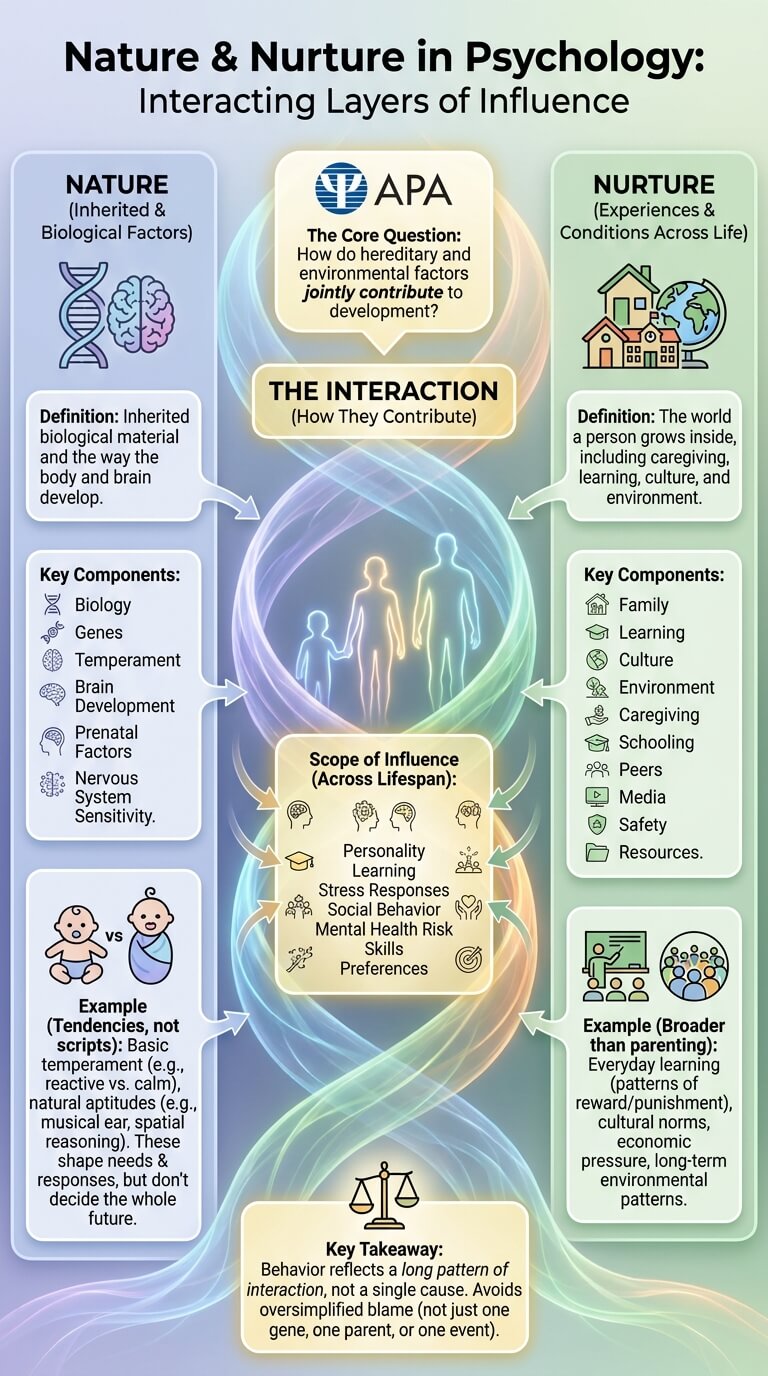
The phrase nature vs nurture can sound like two separate forces pulling against each other. In psychology, it is better to think of them as different layers of influence. Nature refers to inherited and biological factors. Nurture refers to the experiences and conditions that surround a person across life. The debate belongs inside the broader question of what shapes behavior.
The APA Dictionary of Psychology defines the nature-nurture issue as the question of how hereditary and environmental factors contribute to development. That definition matters because the question is not only about childhood. It can apply to personality, learning, stress responses, social behavior, mental health risk, preferences, skills, and patterns of behavior over time.
Nature: biology, genes, temperament, and brain development
Nature includes the biological material a person inherits and the way the body and brain develop. This can include genetic influences, prenatal factors, nervous system sensitivity, physical traits, hormonal systems, basic temperament, and some differences in how quickly people react to stimulation, novelty, stress, or reward.
Temperament is a helpful example. Some babies are naturally more reactive to noise, hunger, change, or unfamiliar people. Others are calmer, more adaptable, or slower to warm up. These differences do not decide the whole future, but they can shape what a child needs from caregivers and how the child responds to the same environment.
Nature can also affect learning and ability. A person may have a strong ear for music, quick spatial reasoning, high physical coordination, or a nervous system that becomes overwhelmed easily. These are not complete life scripts. They are tendencies, capacities, or sensitivities that develop within a context.
Nurture: family, learning, culture, environment, and experience
Nurture includes the world a person grows inside: caregiving, schooling, language exposure, culture, food security, neighborhood safety, peer relationships, media, stress, routines, rules, rewards, expectations, and opportunities. It also includes everyday learning. People repeat behaviors that seem to work, avoid situations that feel punishing, and absorb social rules from the people around them. Nurture includes the role of surroundings in behavior, not only childhood experiences.
The APA Dictionary of Psychology describes environment as the external physical, biological, social, and cultural conditions that influence an organism. That means nurture is much broader than parenting style. It includes family, but it also includes school quality, discrimination, community resources, cultural norms, economic pressure, sleep environment, technology, safety, and relationships across life.
This broader view helps reduce oversimplified blame. A behavior rarely comes from one event, one parent, one gene, or one choice. It often reflects a long pattern of what was possible, what was modeled, what was rewarded, and what felt safe enough to try.
Why the Either-Or Debate Is Too Simple
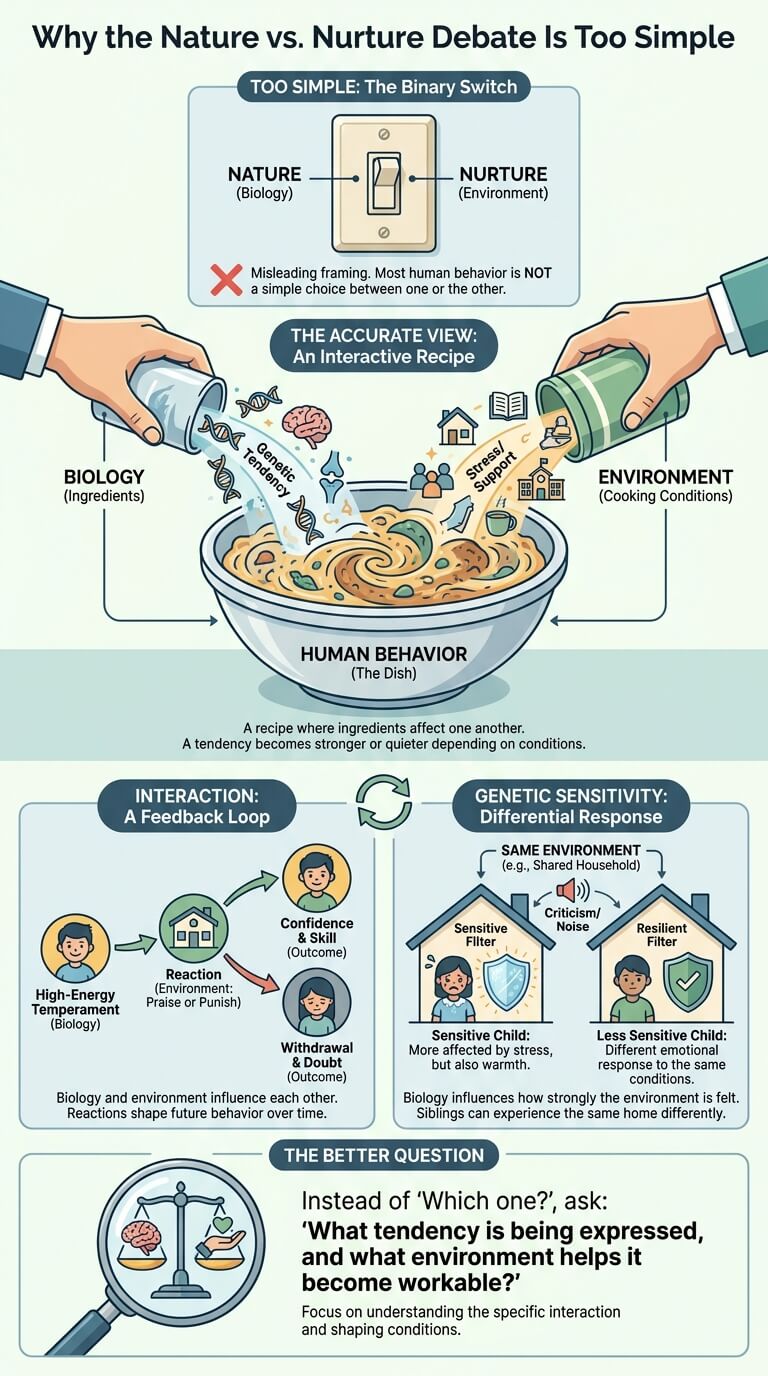
Older versions of the debate often asked whether a trait was caused by nature or nurture. That framing can be useful for starting a conversation, but it becomes misleading if taken too literally. Most human behavior is not like choosing one side of a switch. It is more like a recipe where ingredients affect one another. Biology and experience both influence the mind behind behavior.
A genetic tendency may become stronger in one environment and quieter in another. A supportive environment may help a person use a natural strength. A stressful environment may make a sensitive nervous system work harder. A child who is naturally curious may flourish with books, encouragement, and patient teaching, but withdraw in a setting where questions are mocked or punished.
Most behavior reflects interaction
Interaction means that biology and environment influence each other instead of acting separately. A person with a high-energy temperament may seek stimulation, sports, novelty, leadership, or risk. That same energy may be praised in one setting and punished in another. Over time, the reaction from the environment can shape confidence, identity, and behavior.
Interaction also works in small everyday ways. A child who learns easily may receive more encouragement, which leads to more practice, which improves skill. A child who struggles early may avoid the subject, receive fewer positive learning experiences, and look less motivated even when the original difficulty was not laziness.
This is why behavior often makes more sense when you ask, “What tendency is being expressed, and what conditions are shaping it?” That question is more useful than asking whether nature or nurture is the single cause.
Genes can influence sensitivity to environment
People do not all respond to the same environment in the same way. Some children are more sensitive to criticism, noise, unpredictability, or social rejection. Some are more responsive to praise, structure, calm routines, or one-on-one attention. Biology can influence how strongly the environment is felt.
An open-access review in PubMed Central discusses nature and nurture through genetic and family-environment pathways, including how family members can influence one another through both genetic and environmental routes. This helps explain why the same household can affect siblings differently. The environment is shared in some ways, but each person experiences and responds to it through their own traits, needs, and interpretations.
In practical terms, sensitivity is not automatically a weakness. A highly sensitive child may be more affected by stress, but may also respond strongly to warmth, mentoring, beauty, music, or encouragement. The question is not only “What traits does this person have?” It is also “What environment helps these traits become workable?”
Examples of Nature and Nurture in Behavior

Nature and nurture are easiest to understand through real examples. The point is not to label one side as the true cause. The point is to see how inherited tendencies, learning history, culture, rewards, stress, and opportunity combine. Repeated experience can become routine behavior through learning and practice.
| Behavior or trait | Nature may influence | Nurture may influence | Interaction example |
|---|---|---|---|
| Emotional reactivity | Nervous system sensitivity and temperament | How emotions are handled, named, ignored, or punished | A reactive child may learn calming skills in a supportive home or become more guarded in a critical one |
| Language development | Brain systems for hearing, memory, and speech | Exposure to conversation, reading, schooling, and responsive interaction | A child with strong verbal potential still needs language-rich experience to develop it |
| Risk-taking | Sensation seeking, reward sensitivity, impulse control | Peer norms, supervision, stress, opportunity, and consequences | A novelty-seeking teen may choose sports, entrepreneurship, unsafe driving, or creative projects depending on context |
| Study habits | Attention, memory, frustration tolerance, energy level | Routine, teaching style, sleep, support, expectations, and feedback | A student who struggles with focus may do better with structure instead of being labeled careless |
| Social confidence | Temperament, anxiety sensitivity, facial expressiveness | Peer experience, family modeling, culture, bullying, and practice | A shy child may become socially skilled through safe practice without becoming loudly outgoing |
Temperament and emotional reactivity
Temperament shows why the debate can become personal. One person may cry easily, startle quickly, get irritated fast, or feel embarrassed deeply. Another may stay calm under the same conditions. These differences may have biological roots, but the meaning of the reaction is learned over time.
If a child hears, “You are too much,” they may learn to hide reactions or feel ashamed of them. If they hear, “You feel things strongly, so let us help you name it and recover,” they may learn regulation without self-rejection. The biological starting point matters, but so does the emotional environment around it.
Language, learning, and social behavior
Humans have biological capacities for language and social learning, but those capacities need experience. A child learns words through exposure, interaction, correction, imitation, reading, and meaningful use. The ability to learn language is natural, but the language itself is nurtured by the social world. Culture and norms show how social influence becomes part of nurture.
Social behavior works similarly. People are born with social needs and the capacity to bond, but they learn the rules of eye contact, politeness, conflict, privacy, humor, and respect from their surroundings. A behavior that seems confident in one culture may seem rude in another. A behavior that seems respectful in one family may seem distant in another.
Risk-taking, habits, and personality tendencies
Some people are more drawn to novelty, speed, intensity, or competition. That tendency may be partly biological, but the final behavior depends on what options are available. The same drive can become athletics, performance, business risk, travel, unsafe substance use, impulsive spending, or creative experimentation.
Habits also show interaction. A person may have a temperament that seeks comfort quickly. If their environment offers constant snacks, instant entertainment, and little structure, that tendency may become a repeated coping routine. In a different setting, the same person may use walking, music, cooking, or social support as a way to regulate stress.
How Environment Can Shape Biological Potential
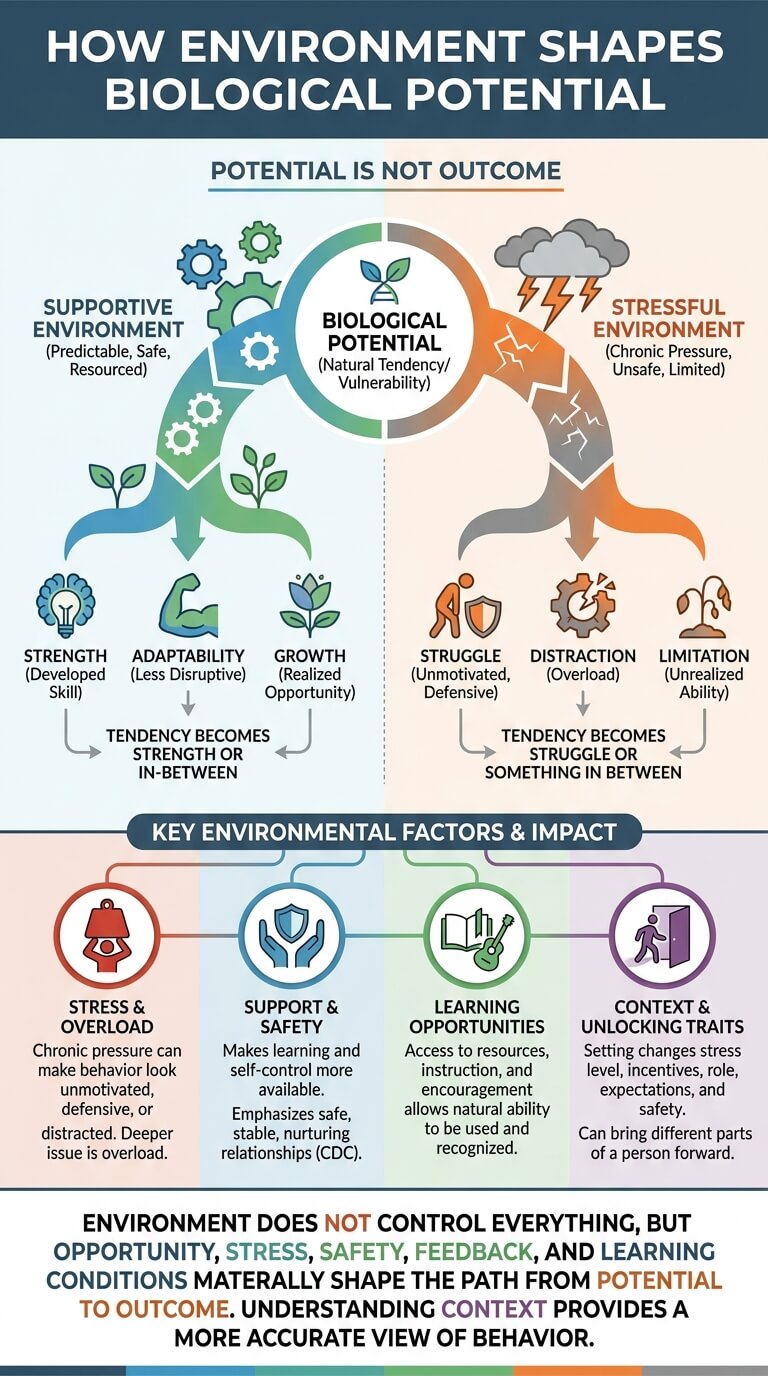
Potential is not the same as outcome. A person may have a natural strength that needs practice, support, resources, and time to develop. Another person may have a vulnerability that becomes less disruptive when the environment is predictable, safe, and supportive.
Environment can shape whether a tendency becomes a strength, a struggle, or something in between. This does not mean environment controls everything. It means opportunity, stress, safety, feedback, and learning conditions matter.
Stress, support, learning opportunities, and safety
Stress can change how behavior develops. A person under chronic pressure may look unmotivated, defensive, distracted, irritable, or withdrawn, even when the deeper issue is overload. A supportive environment may not erase every challenge, but it can make learning and self-control more available.
The CDC explains adverse childhood experiences in the context of potentially traumatic events and emphasizes the importance of safe, stable, nurturing relationships and environments. This is a good reminder that nurture is not only about manners or encouragement. Safety and stability can affect how people learn, trust, react, and cope.
Learning opportunities also matter. A child with musical ability may never know it without access to instruments, instruction, or encouragement. A teenager with leadership potential may shrink in a harsh setting but grow in a setting that gives responsibility with guidance. A natural ability often needs a chance to be used.
Why context can unlock or limit traits
Context can bring different parts of a person forward. A quiet person may speak confidently when the topic is familiar. A restless person may concentrate deeply when the task is hands-on. A cautious person may take brave action when they feel prepared. A person who seems difficult in one setting may function well in another that fits their needs better.
This is not an excuse for harmful behavior. It is a more accurate way to understand behavior. When a person acts differently across environments, it may mean the setting changes their stress level, incentives, social role, expectations, or sense of safety.
Nature vs Nurture in Personality, Learning, and Mental Health
Nature and nurture show up differently depending on the topic. Personality, learning, and mental health are not shaped by one clean cause. They often involve layers of inherited tendency, early experience, current stress, social support, culture, physical health, and repeated behavior.
Personality is influenced, not fixed in stone
Personality traits can show some stability across time, but stability does not mean immovable fate. A person may remain generally introverted, conscientious, curious, cautious, or emotionally reactive, while still learning new skills and changing how those traits appear.
A review on personality development in PubMed Central discusses how traits and environments are intertwined across development, including genetic and environmental pathways. This is why it is more accurate to say personality develops through ongoing influence than to say it is either born or taught.
For example, a naturally cautious person may not become reckless, but they can become more confident. A naturally intense person may not become emotionally flat, but they can learn to pause before reacting. A naturally social person may still need boundaries and self-awareness. Traits give shape, but they do not remove choice or learning.
Learning depends on ability, feedback, and practice conditions
When someone learns quickly, people may say they are naturally talented. When someone struggles, people may say they are not built for it. Both explanations can be too simple. Ability matters, but so do instruction, repetition, sleep, stress, feedback, motivation, and whether mistakes feel safe.
A student who says, “I am just bad at math,” may have had early experiences that made math feel threatening. Another student may have quick pattern recognition but poor study habits. A third may have strong effort but not enough support. Nature and nurture often combine in ways that are hard to see from the outside.
Mental health risk is not the same as destiny
Some people have a higher inherited vulnerability to anxiety, depression, addiction, attention difficulties, or emotional sensitivity. That risk is real, but risk is not the same as certainty. Life stress, support, sleep, relationships, physical health, treatment access, and coping skills can all affect how a vulnerability develops.
It is also important not to use nature vs nurture language to blame someone for distress. If a person is struggling, the question is not, “Was it your genes or your upbringing?” A more helpful question is, “What combination of support, safety, skills, and professional care may help now?”
What Nature vs Nurture Does Not Mean
The nature-nurture question is often misunderstood because people use it to argue about blame, identity, parenting, talent, or personal responsibility. A balanced view avoids several common mistakes.
| Misunderstanding | More accurate view |
|---|---|
| If something is genetic, it cannot change | Inherited tendencies can still be shaped by skills, support, environment, and choices |
| If something is learned, it should be easy to unlearn | Learned behavior can become deeply practiced, especially when it once helped a person cope |
| Environment means parenting only | Environment includes culture, school, safety, economics, peers, stress, media, and opportunity |
| Different siblings prove parenting does not matter | Siblings can have different temperaments, roles, peer groups, timing, and experiences within the same family |
| Nature vs nurture decides who deserves blame | The question is best used for understanding, prevention, support, and change, not shame |
Inherited does not mean unchangeable
People sometimes hear “genetic” and think “permanent.” That is too narrow. A person may inherit a tendency toward high reactivity, but still learn regulation skills. Someone may inherit a strong reward drive, but still build safer habits. Someone may inherit a vulnerability, but still benefit from structure, treatment, healthy relationships, and a better environment.
Learned does not mean fake or easy to stop
Learned behavior can feel automatic because it has been practiced many times. A person who avoids conflict may have learned that silence kept them safer. A person who overworks may have learned that achievement brought approval. A person who people-pleases may have learned that disagreement led to punishment or rejection.
These patterns are learned, but that does not make them imaginary. It means change usually requires new experiences, repeated practice, and sometimes support, not just a decision to “be different.”
Environment is not a simple parenting blame game
Parents and caregivers matter, but environment is wider than one person. A child grows within family stress, school conditions, economic pressure, neighborhood safety, cultural expectations, health issues, technology, peer groups, and chance events. Even loving caregivers may be working inside difficult conditions.
A responsible nature-nurture view should create more compassion, not more blame. It helps explain why support, safety, resources, and timing matter. It also leaves room for accountability when behavior harms others.
A Practical Way to Think About Your Own Behavior
Nature vs nurture becomes more useful when it helps you understand a pattern without getting stuck in blame. Instead of asking, “Was I born this way?” or “Did my past make me this way?” try looking at the pattern through four questions.
The tendency, the trigger, the learned response, and the current choice
The first question is about tendency: what seems to come naturally to you? Maybe you react quickly, avoid risk, seek approval, need quiet, get bored easily, or notice social tension fast. Naming a tendency can reduce shame, as long as you do not treat it as an excuse.
The second question is about triggers: what situations bring the behavior out? A person may be calm most of the time but become defensive around criticism. Another may be focused alone but scattered in a noisy room. The setting can reveal what the nervous system finds demanding.
The third question is about learned response: what did you learn to do when that trigger appeared? You may have learned to explain yourself, hide, joke, please, argue, freeze, rush, withdraw, overprepare, or give up early. The response may have made sense in the past, even if it creates problems now.
The fourth question is about current choice: what small response would fit your adult life better? You may not choose your first feeling, but you can often build a different next step. That might be pausing before replying, asking for clarification, changing the environment, practicing a skill, or getting help for a pattern that feels too strong to shift alone.
| Question | Example reflection | Useful next step |
|---|---|---|
| What is my tendency? | I react strongly to criticism | Name the sensitivity without calling it a flaw |
| What triggers it? | I react most when feedback is public or sudden | Ask for feedback in a calmer format when possible |
| What did I learn to do? | I defend myself before I understand the point | Practice one clarifying question before explaining |
| What can I choose now? | I can pause and ask what outcome the person wants | Build a replacement response, not just a promise to stop |
How This Fits With Everyday Behavior
Nature vs nurture explains where broad tendencies may come from, but it does not explain every single action by itself. Daily behavior is also shaped by immediate thoughts, current emotion, the room you are in, who is watching, what happened earlier that day, and what consequences you expect. Different starting points help explain why two people respond differently.
Why this differs from immediate environment
The immediate environment is about what is happening around you right now: noise, time pressure, social cues, rules, rewards, reminders, friction, and stress. Nature vs nurture is broader. It asks how biological tendencies and life experience developed over time.
For example, a person may snap during a stressful meeting because they are hungry, tired, under pressure, and feeling judged. That moment matters. But their broader nature-nurture history may explain why criticism feels especially threatening, why they learned to defend quickly, or why they struggle to notice body signals before speaking.
Why this differs from situational differences
Two people can act differently in the same situation because they bring different traits, histories, goals, stress levels, skills, and interpretations into that moment. Nature vs nurture helps explain those differences, but it should not be used to lock people into labels.
A better takeaway is curiosity. What is this person sensitive to? What have they practiced? What does this setting reward? What support or structure changes the behavior? These questions lead to more useful understanding than deciding that someone is simply born a certain way or trained by one past event.
When to Get Support
Most nature-nurture questions are normal reflections about personality, learning, family patterns, or behavior. Support may be worth considering when a pattern causes serious distress, harms relationships, affects work or school, leads to unsafe behavior, or feels impossible to shift despite repeated effort.
Professional help can be especially important if behavior is connected to trauma, chronic fear, coercion, threats, humiliation, addiction, self-harm thoughts, or severe anxiety or depression symptoms. Understanding origins can be helpful, but safety and care matter more than debating the exact cause.
If you are trying to understand a child, avoid using nature-nurture language as a label. A child who is “difficult,” “lazy,” “too sensitive,” or “just like their parent” may actually need a better fit between their temperament, support, expectations, and environment. Labels can close curiosity too early.
FAQ About Nature vs Nurture Psychology
Is behavior more nature or nurture?
Most behavior is shaped by both. Some traits have stronger biological influence than others, and some behaviors are heavily shaped by learning and environment. The more useful question is usually how inherited tendencies and life conditions are interacting, not which side wins completely.
Can personality change if some of it is inherited?
Yes, personality can change in how it is expressed. A person may keep a general tendency, such as being introverted, cautious, intense, or novelty-seeking, while learning new coping skills, communication habits, routines, and ways of responding. Inherited influence does not remove growth.
Does nurture only mean childhood?
No. Childhood is important, but nurture continues across life. Friendships, partners, work culture, education, stress, illness, community, therapy, financial pressure, habits, and repeated experiences can keep shaping behavior in adulthood.
Do siblings raised in the same home have the same nurture?
Not completely. Siblings may share a home, but they can have different temperaments, birth order experiences, peer groups, teachers, health events, family roles, and relationships with each caregiver. The same event can also be interpreted differently by different children.
Is nature vs nurture useful for behavior change?
Yes, if it is used carefully. It can help you stop moralizing a pattern and start asking better questions. What tendency is involved? What environment strengthens it? What response was learned? What support, skill, or setting would make a better response easier?
Key Takeaways
- Nature vs nurture psychology examines how inherited biology and life experience work together to shape behavior, personality, learning, and development.
- Modern psychology usually treats nature and nurture as interacting influences, not competing explanations where one side wins.
- Temperament, sensitivity, ability, stress response, and personality tendencies may have biological roots, but their expression depends strongly on context.
- Environment is broader than parenting. It includes family, culture, school, peers, safety, economics, routines, stress, and opportunity.
- Inherited does not mean unchangeable, and learned does not mean easy to stop.
- The most practical question is what tendency, trigger, learned response, and current choice are involved in the behavior you want to understand.
Final Thoughts
Nature vs nurture psychology is most helpful when it moves you away from blame and toward clearer understanding. You are not only your genes. You are not only your past. You are also a person whose traits, experiences, relationships, choices, and environments continue to interact.
Choose one behavior you want to understand better and look at it through the four-part lens: tendency, trigger, learned response, and current choice. That will not explain everything, but it can give you a more compassionate and practical place to begin.

Michael Reed is the Founder and Lead Writer at Psychology Exposed. He writes about human behavior, relationships, emotional patterns, self-awareness, and practical psychology topics using research-informed, easy-to-understand content.
Read More About Michael Reed: https://psychologyexposed.com/michael-reed/