

Practice is one of the most common answers people give when someone wants to improve: practice more, keep going, repeat it until it sticks. That advice is partly right, but it is incomplete. Repetition can build skill, yet it can also strengthen the same error, the same rushed habit, or the same shallow understanding if nothing changes between attempts.
This is one part of a larger question in learning psychology: how experience changes what people notice, remember, expect, and do next.
Practice and skill acquisition psychology looks at how effort turns into usable ability. A person may know the rules of grammar but still freeze while speaking a new language. A beginner may understand a tennis swing but miss the ball under pressure. A writer may know what a strong introduction should do but still produce vague first paragraphs. The problem is not always laziness or lack of talent. Often, the skill has not yet been broken down, corrected, repeated, and made flexible enough for real use.
When learning does not stick, it often helps to look at the full chain: attention, meaning, practice, feedback, memory, and application.
This guide explains why some practice works and some does not. It will help you understand stages of skill growth, deliberate practice, feedback, automaticity, frustration, and the difference between repeating an action and improving it.
Quick Answer

Practice builds skill when repetition includes attention, feedback, and correction
Practice improves skill when each attempt gives the learner better information for the next attempt. The mind needs attention to notice what is happening, feedback to reveal the gap between intention and result, and correction to change the next try. The APA Dictionary describes skill learning as learning to perform a task with ease, speed, and accuracy through extensive practice.
Why effort alone does not guarantee improvement
Effort matters, but effort is not the same as adjustment. A person can spend many hours repeating a song, speech, sport movement, math process, or work task while still practicing around the real weakness. Improvement usually depends on whether the practice session changes the part of the performance that is limiting the learner. More time helps most when the time is structured around the next correction.
What Skill Acquisition Means
Skill as usable ability, not just knowledge
A skill is not simply information stored in the mind. It is the ability to use knowledge in action. Knowing the steps for parallel parking is different from steering, checking mirrors, judging distance, and adjusting calmly while another car waits behind you. Skill appears when the body, attention, memory, judgment, and timing begin working together.
The difference between knowing what to do and being able to do it
Knowing what to do is mostly about recognition and understanding. Being able to do it requires retrieval, timing, coordination, and correction under changing conditions. A learner may say, “I know what I should have done,” after a mistake. That statement is not hypocrisy. It often means the knowledge exists, but the skill is not stable enough to appear at the right moment.
| Knowing | Skill |
|---|---|
| You can explain the rule. | You can apply the rule while doing the task. |
| You recognize a good example. | You can produce a good example yourself. |
| You understand the correction afterward. | You can adjust during the next attempt. |
| You perform well in easy conditions. | You can adapt when conditions change. |
Why skills develop through repeated adjustment
Skills grow through a cycle of attempt, result, information, adjustment, and another attempt. The important part is not just the number of repetitions. It is the quality of the adjustment between repetitions. A piano student who plays the same wrong fingering fifty times may become faster at the wrong pattern. A student who pauses after each mistake, slows down, and corrects the hand movement is practicing in a different psychological way.
The Stages of Building a Skill

Early stage: understanding the task
The early stage is mentally busy. The learner is trying to understand what the task requires, what counts as success, what the main steps are, and what mistakes to watch for. Attention is stretched thin because almost everything feels new. A beginner driver thinks about the mirror, brake, steering wheel, speed, road signs, and other cars all at once.
Middle stage: correcting errors and building consistency
The middle stage is where many people feel stuck. The learner can perform parts of the skill, but mistakes repeat. This is where feedback and targeted correction become especially important. The goal is not to practice everything equally. The goal is to identify the part of the skill that most limits performance and work on that part deliberately.
A language learner may need pronunciation correction, not more vocabulary. A writer may need clearer topic sentences, not more grammar rules. A basketball player may need footwork work, not more random shots. The middle stage is less glamorous than starting and less smooth than mastery, but it is often where real skill is built.
Later stage: automaticity and flexible use
In the later stage, some parts of the skill require less conscious control. The learner can pay attention to larger goals because smaller actions have become smoother. The APA Dictionary defines automaticity as the capacity to perform a behavior with little attention, awareness, or intentional control. In skill learning, this can free mental space for strategy, creativity, or adaptation.
Automaticity does not mean the person stops thinking. It means easier parts no longer consume all attention, which leaves more room for strategy, expression, or adaptation.
Why Practice Works
Repetition strengthens access
Repetition helps because the learner becomes quicker at finding and using the information or movement pattern. The first attempt may require slow conscious effort. Later attempts may feel more available. The learner has seen the problem before, made the movement before, or retrieved the step before, so the next attempt is less foreign.
Feedback corrects the next attempt
Feedback turns practice into a learning loop. It tells the learner what happened, what was missing, or what should change next. Feedback can come from a teacher, a coach, a recording, a test result, a reader, a timer, or the outcome of the task itself.
The National Academies report How People Learn II discusses learning as a process shaped by knowledge, context, practice, and feedback. In everyday terms, this means practice becomes stronger when the learner receives information that helps them revise what they are doing, not just encouragement to continue.
Errors reveal what needs adjustment
Errors are not pleasant, but they are informative. A mistake shows where the current method breaks down. The learner who misses a note, forgets a word, loses balance, or confuses a step has found the edge of their current ability. That edge is useful when it is treated as information rather than humiliation.
Not every mistake needs a long analysis. Sometimes the next correction is simple: slow down, isolate the part, ask for an example, compare your attempt to a better one, or repeat only the section that failed. The key is to make the error visible enough to guide the next attempt.
Challenge keeps practice from becoming mindless
Practice works best when the task is demanding enough to require attention but not so hard that the learner cannot tell what to change. If the task is too easy, practice may become automatic repetition. If it is too hard, the learner may become confused, discouraged, or unable to locate the useful lesson.
A good challenge feels slightly beyond current comfort. It creates effort, but not chaos. The learner is stretched in a specific direction.
Deliberate Practice in Plain English
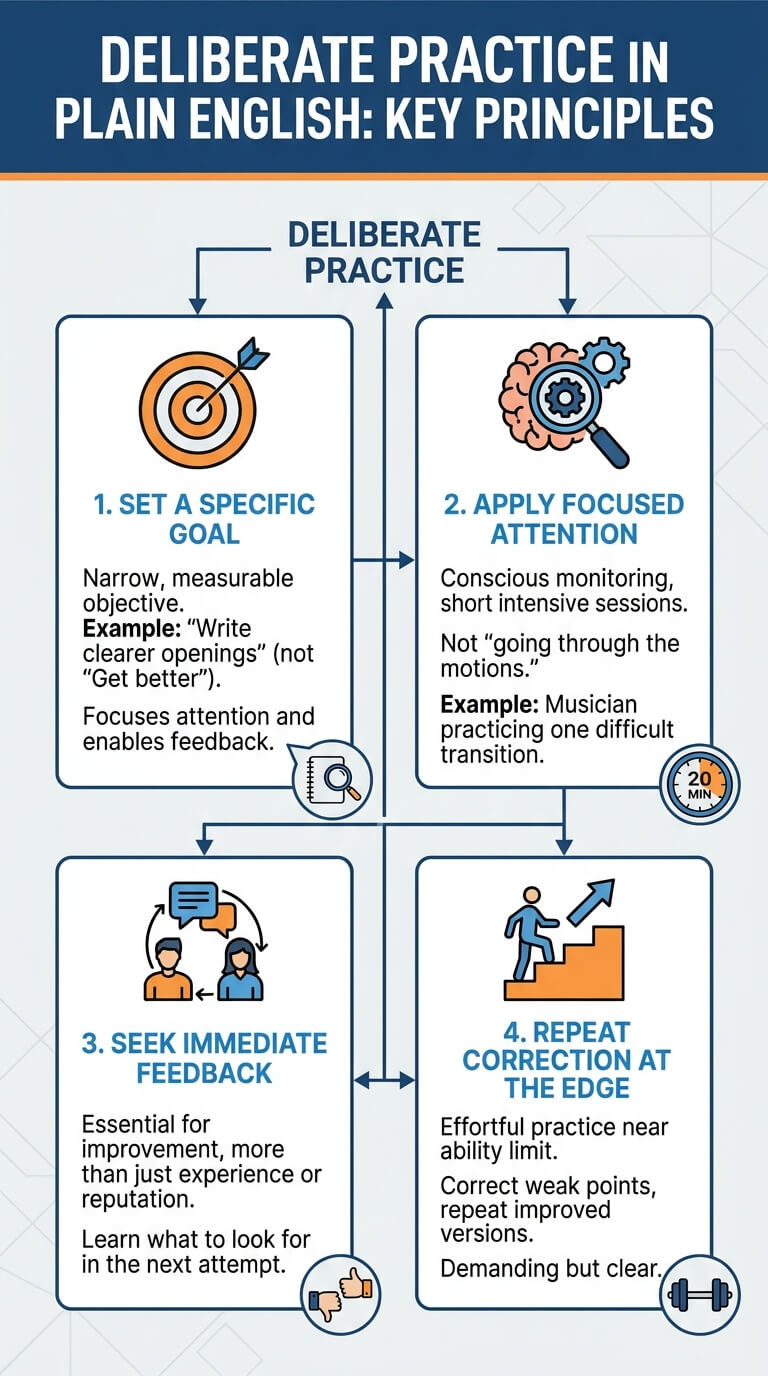
Specific goal
Deliberate practice begins with a narrow goal. “Get better at writing” is too broad for one session. “Write clearer openings for opinion articles” is more usable. “Improve Spanish” is vague. “Practice past tense verbs in spoken sentences for fifteen minutes” is something the learner can actually attempt and evaluate.
A specific goal gives attention a place to land. It also makes feedback easier because the learner knows what kind of improvement to look for.
Focused attention
Focused attention means the learner is not merely going through the motions. They are paying attention to one part of performance and comparing the attempt with the goal. This can be tiring because it requires conscious monitoring, especially before the skill feels natural.
That is why focused practice is often shorter than casual repetition. A musician might spend twenty minutes on a difficult transition rather than two hours playing the whole song loosely.
Immediate or useful feedback
A PubMed abstract of K. Anders Ericsson’s review on deliberate practice and expert performance highlights a core point often missed in popular conversations: performance is not explained simply by years of experience or reputation. What matters is the kind of practice and feedback that improves observed performance.
Repeated correction just beyond comfort
Deliberate practice usually feels effortful because it asks the learner to work near the edge of current ability. They are correcting a weak point and repeating the improved version until it becomes more stable.
This is different from punishing yourself with difficulty. The best version is demanding but clear. You know what you are practicing, why it matters, and what signal will tell you whether the next attempt improved.
Practice vs Repetition
Repetition can repeat mistakes
Repetition is simply doing something again. Practice is doing it again with a learning purpose. The difference matters because the mind can become more fluent at almost anything it repeats, including rushed movements, unclear sentences, poor timing, and avoidant habits.
If a learner practices typing with the same finger errors, the errors may become familiar. If a singer repeats the same strained note without changing breath or pitch, strain may become the pattern. Repetition builds what is repeated.
Practice changes based on evidence
Real practice responds to evidence. The learner notices what happened, compares it with the goal, and changes the next attempt. Evidence may be a score, a sound, a reader’s confusion, a missed step, a teacher’s note, a video replay, or a felt difference in control.
| Repetition | Practice |
|---|---|
| Do the whole task again. | Work on the part that most needs correction. |
| Measure time spent. | Measure what changed between attempts. |
| Hope effort turns into improvement. | Use feedback to guide the next try. |
| Repeat at the same speed. | Slow down, isolate, vary, then rebuild. |
Why slower practice can be faster learning
Slower practice can feel inefficient because it produces fewer total repetitions. But it may produce better repetitions. Slowing down lets the learner notice the exact moment where the mistake begins. A guitarist can hear the transition that causes the rhythm to collapse. A student can see which step in the equation creates confusion. A writer can notice where a paragraph loses its main idea.
Speed is useful after accuracy has something stable to stand on. If you speed up too early, you may only become faster at the unstable version.
The Role of Feedback in Skill Growth
Why you need information about the gap
A skill grows when the learner sees the gap between the current attempt and the desired result. Without gap information, improvement becomes guesswork. The learner may feel busy but not know whether they are getting closer to the goal.
Feedback makes the gap more visible. It can say, “your answer is correct but your explanation skips a step,” “your drawing has the right shape but the proportions are off,” or “your customer message is polite but does not answer the question.” The best feedback points to the next adjustment, not just the final judgment.
When self-feedback works
Self-feedback works best when the learner has a clear standard and enough experience to compare attempts accurately. A writer can read a paragraph aloud and hear where it becomes confusing. A speaker can watch a recording and notice filler words. A runner can use a timer and pace notes to see whether the plan matched the result.
Self-feedback becomes harder when the learner does not yet know what good performance looks like. In that case, examples, rubrics, demonstrations, or outside comments may be needed.
When a teacher, coach, or outside eye helps
An outside eye can notice patterns the learner cannot see from inside the task. A coach may notice that the tennis player’s issue is foot placement, not arm strength. An editor may notice that a writer’s problem is structure, not vocabulary. A teacher may see that a student’s errors come from one misunderstanding rather than many separate weaknesses.
Automaticity: When Skill Starts to Feel Easier

Why practiced actions require less mental effort
In early learning, the mind must consciously manage many details. With practice, some details become easier to perform without constant monitoring. This reduces mental load. The learner can use attention for higher-level decisions because lower-level actions have become more reliable.
For example, a new typist thinks about each key. An experienced typist thinks about the sentence. A new driver thinks about every movement. An experienced driver can pay more attention to traffic, route, and safety because many basic actions are familiar.
Why automaticity can help performance
Automaticity helps because performance often requires timing. If a musician had to consciously calculate every finger movement, the song would collapse. If a soccer player had to think through every step before passing, the moment would pass. Some parts of a skill need to become quick enough to support the larger goal.
Automaticity also supports confidence. The learner no longer feels as if every small action might fall apart. This does not make the person perfect, but it gives them more room to think, adapt, and recover from small mistakes.
When automatic habits need updating
Automaticity has a downside: a habit can become easy before it becomes good. If a person has practiced a poor grip, awkward sentence pattern, or rushed decision style, the familiar version may feel natural even when it limits performance. Updating an automatic habit can feel strangely difficult because the old way is fast and comfortable.
This is why experienced learners sometimes need to slow down again. They are not returning to zero. They are making a familiar action conscious long enough to improve it.
Why Practice Feels Hard Before It Feels Smooth
Cognitive load in early learning
New skills feel hard because working attention is limited. The learner is trying to remember steps, monitor mistakes, understand feedback, and manage emotion at the same time. The OpenStax Psychology chapter on what learning is explains learning as a change in behavior or knowledge that results from experience, which helps explain why skill growth requires repeated contact with the task, not only explanation.
When the mind is overloaded, even simple instructions can feel hard to use. This does not mean the learner is incapable. It often means the task needs to be simplified, slowed down, or broken into smaller parts.
Learning often feels harder at the beginning because the mind is managing too many new details before the task starts to feel familiar.
Frustration and ego threat
Practice exposes the gap between the person you want to be and the ability you currently have. That gap can sting. A learner may think, “I should be better by now,” “Other people learn faster,” or “Maybe I am just not built for this.” Those thoughts can turn a learning challenge into a threat to identity.
Frustration is not always a sign that practice is failing. Sometimes it means the learner has reached the edge of current ability. The useful question is not “Why am I bad at this?” A better question is “What part is breaking down, and what smaller correction can I try?”
The dip between understanding and ability
One of the most discouraging moments in learning is the gap between understanding a concept and being able to use it. You may understand what the teacher means, but your body, speech, timing, or judgment has not caught up. This dip is common in skill acquisition.
The dip can be misread as failure because the learner has enough knowledge to see the mistake but not enough skill to prevent it consistently. In reality, noticing the mistake may be progress. Awareness often becomes sharper before performance becomes smoother.
How to Practice More Effectively
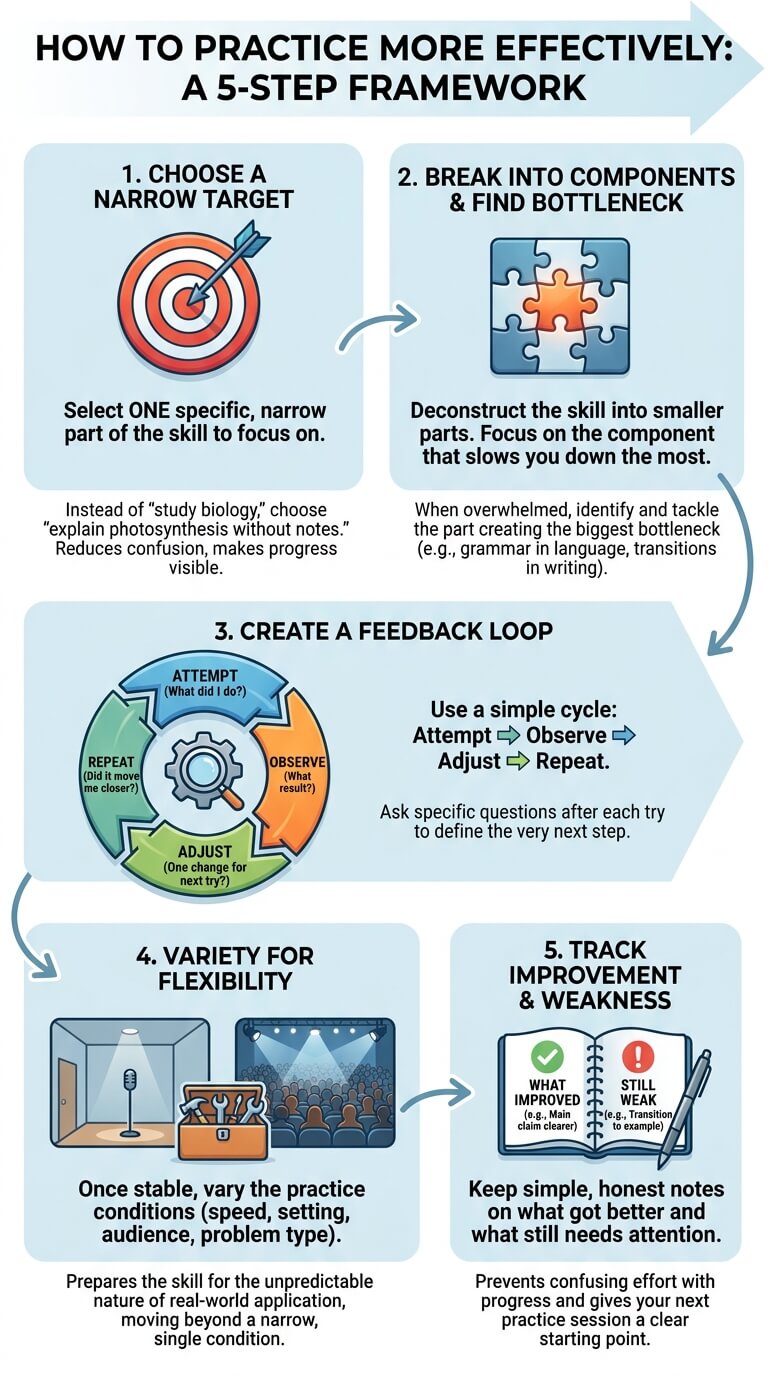
Choose one skill target
Before practicing, choose one narrow part of the skill. Instead of “study biology,” choose “explain photosynthesis without looking at notes.” Instead of “get better at design,” choose “create stronger spacing between elements.” Instead of “practice guitar,” choose “change from G to C cleanly at a slow tempo.”
A narrow target reduces confusion. It also makes progress easier to notice.
Break the skill into small components
Most skills are built from smaller parts. Speaking a language includes vocabulary, pronunciation, listening, grammar, confidence, timing, and cultural context. Writing includes idea selection, structure, sentence clarity, examples, transitions, and revision. When the whole skill feels overwhelming, choose the component that creates the biggest bottleneck.
Create a feedback loop
Use a simple loop: attempt, observe, adjust, repeat. After each attempt, ask three questions. What happened? What was different from the goal? What is one change for the next try?
| Step | Question to ask |
|---|---|
| Attempt | What did I actually do? |
| Observe | What result did I get? |
| Adjust | What one thing should change next? |
| Repeat | Did the change move me closer? |
Use varied practice before real-world application
After the basic version becomes stable, vary the practice. Change the example, speed, setting, order, audience, problem type, or level of support. A learner who only practices in one condition may struggle when the real situation changes. A student may solve problems in textbook order but freeze when the same problem appears in a different format. A speaker may rehearse alone but struggle in front of people.
Varied practice helps the learner move from a narrow version of skill to a more flexible one. It prepares the skill for life outside the practice environment.
Track what improved and what stayed weak
Tracking does not need to be complicated. Write down the skill target, what you practiced, what improved, and what still needs attention. This keeps practice honest. It also prevents the learner from confusing effort with progress.
A simple note might say: “Today I practiced the first paragraph. The main claim became clearer. The transition into the example is still weak.” That note gives tomorrow’s practice a starting point.
Practice vs Flow State
Practice is skill-building
Practice is where the learner intentionally works on ability. It can feel awkward, effortful, slow, and corrective. The purpose is to improve the system, not necessarily to feel smooth while doing it.
Flow is absorption during performance
Flow is the feeling of being deeply absorbed in an activity. It may happen during music, sport, writing, art, coding, studying, or work. Flow can feel rewarding, but it is not the same as deliberate practice. A person can be absorbed in a task without correcting a weak point. A person can also be practicing effectively without feeling absorbed or effortless.
Why beginners may need effort before flow becomes possible
Beginners often need conscious effort because the basics are not yet stable. Flow becomes more likely when the challenge and skill level begin to match. Before that, practice may feel choppy. That choppiness is not a sign that the learner is doing something wrong. It may be the normal cost of building the ability that later makes smoother performance possible.
How Practice Connects With the Rest of Learning
Feedback turns effort into information
Feedback is one of the main reasons practice improves. It tells the learner whether an attempt moved closer to the goal. Without feedback, the learner may keep repeating an ineffective method. With feedback, the learner can make practice more precise.
Difficulty is not always a bad sign
Learning something new often feels mentally heavy because attention, memory, emotion, and action are all working at once. Difficulty should not be romanticized, but it should not always be feared. The useful question is whether the difficulty is specific enough to guide practice. Confusing struggle may need simplification; useful struggle points to the next correction.
Transfer requires more than one practice setting
A skill that works only in one familiar situation may not transfer well. To apply learning in real life, the learner often needs practice across examples and contexts. That is why a student should not only review solved problems, a speaker should not only rehearse alone, and a manager should not only practice a conversation in their head.
Memory supports skill, but skill is more than memory
Memory helps you store rules, examples, steps, and past corrections. Skill uses that memory in action. You may remember what to do and still need practice before you can do it reliably. This distinction can reduce self-criticism. The problem may not be that you forgot the lesson; it may be that the lesson has not yet become a stable performance.
FAQ About Practice and Skill Acquisition
How long does it take to build a skill?
There is no universal timeline because skills differ in complexity, feedback quality, practice consistency, prior experience, and learning environment. A small subskill may improve in a few sessions, while a complex ability may take months or years. The better question is whether your practice is producing visible corrections. If nothing changes after many attempts, the method may need adjustment.
Is deliberate practice always uncomfortable?
Deliberate practice is often effortful because it targets weak points, but it should not feel unsafe, humiliating, or impossible. Productive discomfort usually has a clear purpose. You know what you are working on and how to try again. If practice only creates dread, shame, or confusion, the task may need to be made smaller, better supported, or approached differently.
Why am I practicing but not improving?
You may be repeating the whole task without correcting the limiting part. You may not be getting useful feedback. You may be practicing too fast, too vaguely, or only in easy conditions. Improvement often returns when you choose one skill target, isolate the difficult component, get better information, and repeat a corrected version instead of the familiar version.
What is automaticity in skill learning?
Automaticity means a practiced action can happen with less conscious effort. In skill learning, this lets you use attention for higher-level goals. For example, a fluent reader does not sound out every letter, so they can focus on meaning. Automaticity is helpful when the practiced habit is useful, but limiting when an unhelpful habit has become too familiar.
Is talent more important than practice?
Talent, prior exposure, body factors, resources, coaching, time, and opportunity can all affect learning. But talent alone does not explain skill. Many abilities improve through structured practice, feedback, correction, and persistence over time. It is more useful to ask what kind of practice the skill needs than to decide too quickly that you either have talent or do not.
Key Takeaways
- Practice builds skill when repetition includes attention, feedback, correction, and another attempt.
- Knowing what to do is not the same as being able to do it under real conditions.
- Deliberate practice uses a specific goal, focused attention, useful feedback, and repeated correction just beyond comfort.
- Repetition can strengthen mistakes when the learner keeps repeating the same uncorrected pattern.
- Automaticity makes parts of a skill feel easier, but automatic habits sometimes need to be slowed down and updated.
- Effective practice becomes more flexible when the learner varies examples, settings, and conditions before real-world use.
The next useful step is to choose one skill you are working on and name the smallest part that needs correction. Do not start with a huge promise to practice harder. Start with a clearer loop: one target, one attempt, one piece of feedback, one adjustment, and one repeat. That is how practice begins to turn into ability.
Educational note: Michael Reed writes for Psychology Exposed as a psychology-focused writer who explains human behavior, learning, emotional patterns, self-awareness, and everyday decisions in a simple, research-aware way. This content is educational and is not a substitute for professional mental health, medical, legal, or crisis support.

Michael Reed is the Founder and Lead Writer at Psychology Exposed. He writes about human behavior, relationships, emotional patterns, self-awareness, and practical psychology topics using research-informed, easy-to-understand content.
Read More About Michael Reed: https://psychologyexposed.com/michael-reed/