

You can work on a problem for twenty minutes, get nowhere, walk away annoyed, and then see the answer while washing a cup or opening another document. The solution feels as if it arrived in one piece. There was no obvious chain of steps leading to it, only a sharp change from “I do not see it” to “Of course, that could work.”
Psychologists often study this experience under the idea of insight problem solving. The sudden feeling is real, but it does not mean the mind has performed something mysterious or infallible. In many insight problems, progress depends on changing how the problem is represented, relaxing an assumption, noticing a relationship that had been ignored, or escaping a search path that kept reproducing the same dead end.
Understanding that sequence is useful because it changes what you do when effort stops producing new information. Instead of simply pushing harder or waiting passively for inspiration, you can look for signs of fixation, deliberately alter the representation, take a purposeful break when useful, and test any sudden answer before trusting it.
Quick Answer

Insight problem solving refers to solutions that feel sudden, often after a period of difficulty or impasse. A common explanation is that the solver restructures the problem, such as dropping a false constraint or seeing a new relationship among its parts. Breaks may sometimes help loosen fixation, but an Aha feeling is not proof that an answer is correct. Insight still needs verification.
What Counts as Insight in Problem Solving?
The APA Dictionary of Psychology definition of insight includes the clear and often sudden discernment of a solution by means that may not be obvious to the person. That description captures an important distinction: insight is partly about the subjective experience of arriving at an answer, not merely whether the final answer is clever.
Some problems can be solved by visible, reportable steps. Others seem to resist progress until the solver’s understanding changes. Real-life problems can contain both modes, so it is more useful to think in terms of processes than to label every task as either an “insight problem” or an “analytic problem.”
Sudden Subjective Clarity
The hallmark of an Aha experience is discontinuity. One moment, the route to the answer is unclear. The next, a candidate solution feels coherent enough that several previously disconnected pieces suddenly seem to fit together.
That does not mean nothing happened before the moment of awareness. It means the person does not experience progress as a smooth sequence they can easily narrate. A recent Frontiers in Psychology study of the Aha experience discusses this contrast between gradual analytic progress and a more abrupt subjective change around insight.
The Aha Experience Versus a Slow Analytic Solution
Analytic solving usually gives you intermediate checkpoints. You calculate, compare, eliminate, test, and move closer to an answer. If someone asks how you got there, you can often reconstruct the sequence.
Insight feels different because awareness of the candidate solution may arrive before awareness of a full derivation. You may know what to try before you can explain why you did not see it earlier. The distinction is not absolute, however. A sudden idea may still require several analytic steps afterward, and a carefully reasoned solution may contain one brief moment of insight in the middle.
What Often Happens Before an Aha Moment
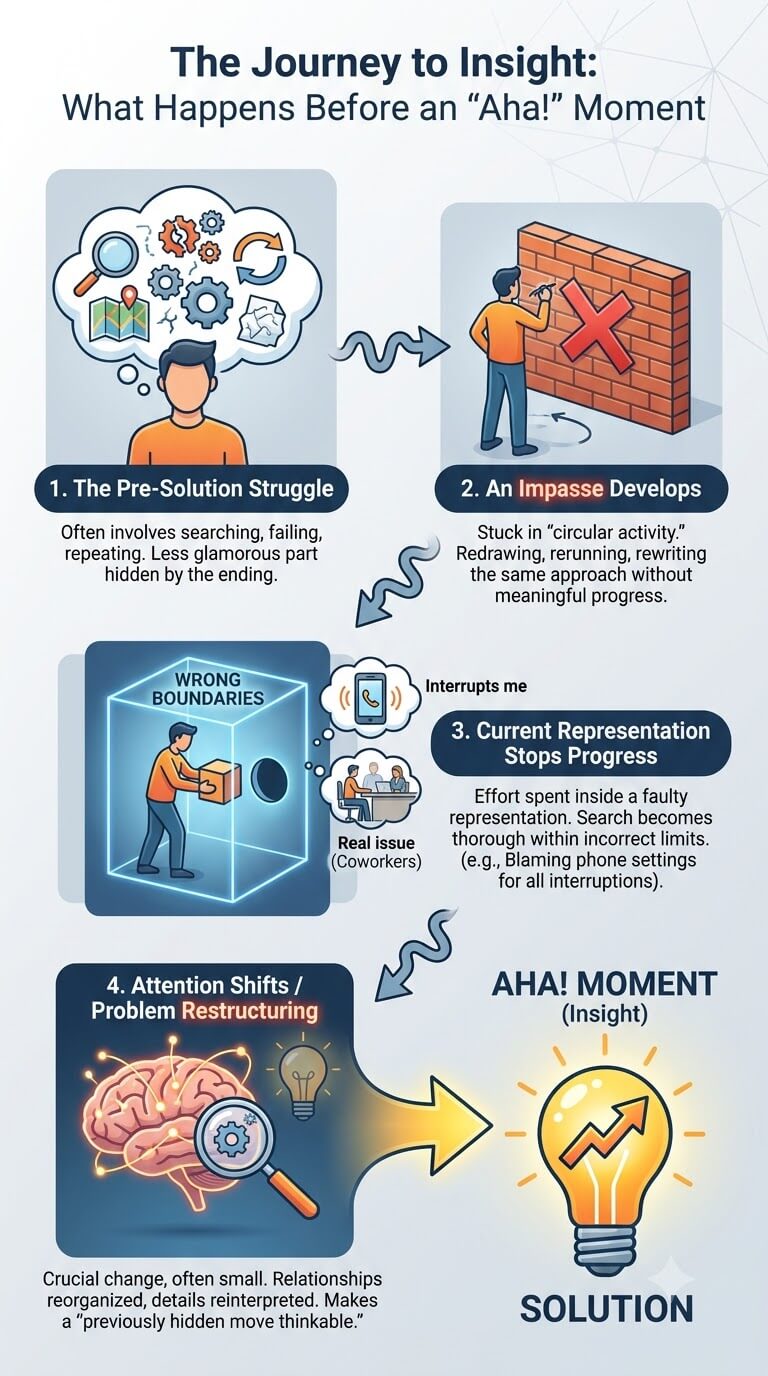
Insight stories are often told from the exciting ending backward. That can hide the less glamorous part: the solver usually spent time searching, failing, repeating, or reaching a point where the current approach stopped producing useful change. The Aha moment makes more sense when you pay attention to that pre-solution period.
An Impasse Develops
An impasse is the experience of being unable to make meaningful progress with the approach currently available. You may still be active, but the activity has become circular. You redraw the same diagram, rerun the same calculation, rewrite the same sentence, or keep asking a question that produces the same limited answers.
Researchers do not treat every insight as requiring an identical sequence, but impasse is prominent in many accounts. A study of stages in insight problem solving describes sequences in which search is followed by impasse, representational change, renewed search, and solution. Importantly, some problems can be solved without passing through a dramatic impasse at all.
The Current Representation or Strategy Stops Producing Progress
Getting stuck is not always caused by lack of effort. Sometimes the effort is being spent inside a representation that excludes the needed move. If you have decided, without noticing, that a task must be completed in a certain order, every solution you generate may obey that order. The search becomes thorough within the wrong boundaries.
For example, imagine trying to reduce interruptions during a workday. You keep testing different notification settings because you represent the problem as “my phone interrupts me.” If most interruptions actually come from coworkers walking over to your desk, more phone settings cannot solve the central issue. The problem needs to be represented differently before a better route becomes visible.
Attention Shifts or the Problem Is Restructured
The crucial change may be small. A detail that looked irrelevant becomes important. Two elements are grouped differently. A rule you treated as fixed becomes optional. A goal is restated in a way that opens another path.
This change is often called restructuring or representational change. The important idea is not that the entire problem becomes new. Rather, the relationships among its parts are reorganized enough to make a previously hidden move thinkable.
Restructuring: The Central Idea Behind Insight

Restructuring is one of the most useful concepts for understanding insight because it explains why a person can possess the necessary information yet fail to use it. The obstacle is not always missing knowledge. It may be the way existing knowledge has been organized.
A broad review in Frontiers in Psychology on the insight phenomenon discusses restructuring and incubation as central themes while also emphasizing that researchers use different definitions and methods. That uncertainty matters. “Restructuring” is a useful model, not a claim that every Aha experience follows one identical hidden mechanism.
A False Constraint Is Relaxed
A false constraint is a rule that the solver has added even though the problem does not require it. In a logic puzzle, this may be an assumed boundary. In daily life, it may sound like “both tasks have to happen today,” “the person who starts the project has to finish every part,” or “the solution must use the tools we normally use.”
The constraint may feel so natural that it is never stated. Insight can occur when the solver notices that the rule was self-imposed and mentally removes it.
Elements Are Grouped Differently
Problems often become difficult because we organize their parts according to familiar categories. A team may group tasks by department even though grouping them by customer stage would reveal duplicated work. A student may group study material by chapter even though grouping it by underlying principle would make similarities easier to see.
Regrouping changes which relationships stand out. Two elements that seemed unrelated can become part of the same functional unit. Something that looked like one large problem can split into two independent problems, or several scattered issues can become one recurring bottleneck.
A Previously Irrelevant Detail Becomes Useful
Attention is selective. When you form an initial understanding of a problem, some details become central and others fade into the background. Insight may involve promoting one of those background details because its relevance changes under a new interpretation.
Suppose a delivery keeps arriving late. You focus on driving time, traffic, and route choice. Then you notice that the driver spends fifteen minutes waiting for paperwork before leaving. The paperwork detail was always present, but the initial “transportation delay” interpretation made it feel peripheral. Once the problem becomes “departure delay,” that detail becomes central.
The Goal or Relationship Among Parts Is Represented Differently
Sometimes the change concerns the goal itself. “How do we make everyone attend the same meeting?” may become “How do we ensure everyone has the same decision-relevant information?” The second version does not guarantee a better answer, but it reveals options that the first goal excludes.
Other times, the goal stays the same while the relationship among parts changes. What looked like a sequence may actually allow parallel work. What looked like a shortage may actually be a timing mismatch. What looked like disagreement may be two people answering different questions.
Incubation and Stepping Away
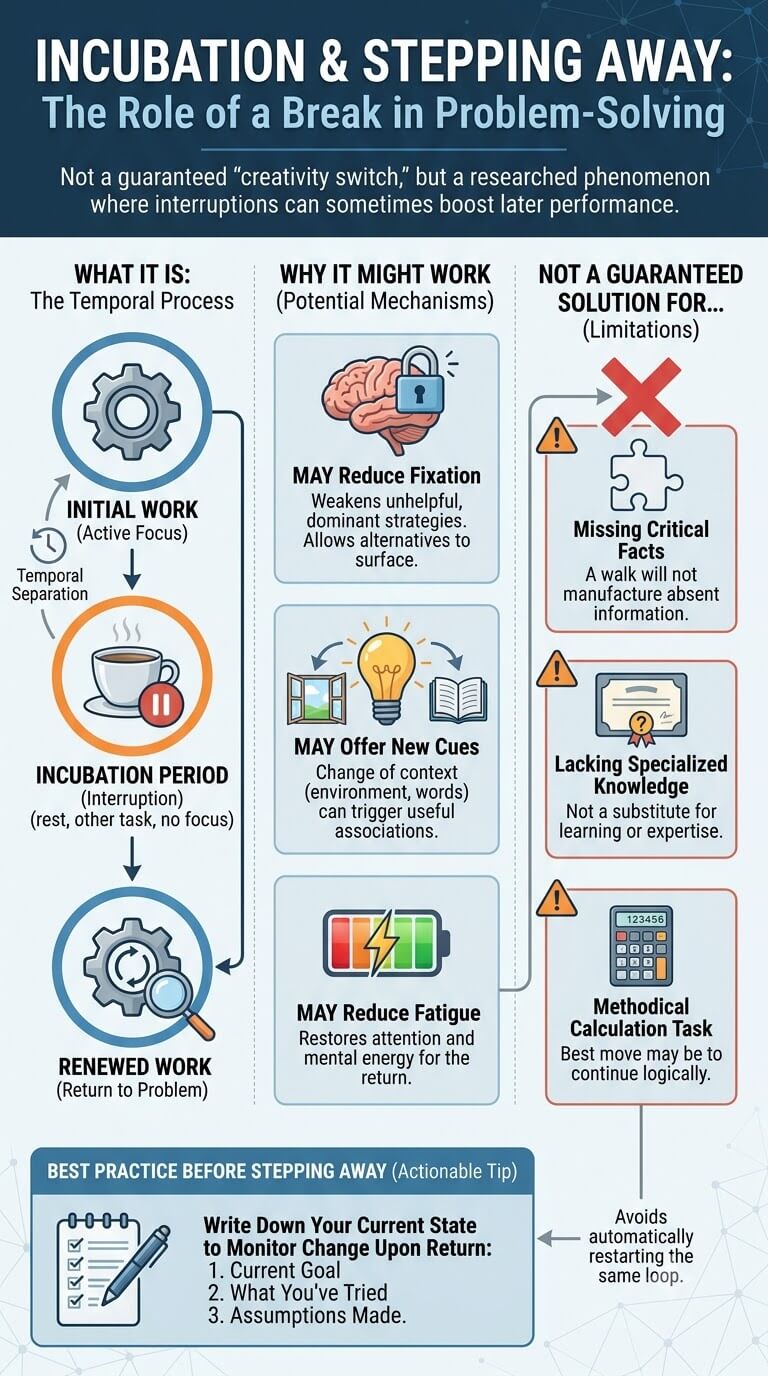
The familiar advice to “sleep on it” has some psychological basis, but it is easy to turn incubation into a myth. A break is not a guaranteed creativity switch, and researchers continue to debate exactly why breaks sometimes improve later performance.
What Incubation Means in Research
In problem-solving research, incubation generally refers to a period in which active work on the focal problem is interrupted before the solver returns to it. The break may involve rest, another task, or simply removing the original problem from attention.
The key point is temporal separation: initial work, a pause, and then renewed work. Researchers compare performance across different break conditions to ask whether interruption changes the chance of later solution.
Why Breaks May Reduce Fixation or Allow New Cues
One explanation is that stepping away weakens the immediate activation of an unhelpful strategy or assumption. When you return, the dominant but ineffective interpretation may have less momentum, making alternative cues easier to notice.
A break also changes context. You encounter different objects, words, conversations, or visual patterns. Occasionally one of those cues may make a useful relationship salient. Another possibility is simply that reduced fatigue improves attention when you come back.
Why Stepping Away Is Not a Guaranteed Solution Technique
If your problem is missing a critical fact, a walk will not manufacture that fact. If the task requires specialized knowledge you do not have, incubation is not a substitute for learning or asking someone with relevant expertise. If your representation is already accurate and the remaining work is calculation, the best move may simply be to continue methodically.
A break is most useful when effort has become repetitive rather than informative. Before stepping away, write down the current goal, what you have tried, and the assumptions you are making. When you return, you can see whether anything actually changed instead of automatically restarting the same loop.
What an Aha Feeling Tells You and What It Does Not
The emotional force of insight is part of what makes it memorable. Sudden solutions can feel cleaner, more certain, and more satisfying than ideas reached through slow comparison. That feeling is psychologically meaningful, but it should not be confused with a guarantee.
Insight Can Feel Unusually Certain
An Aha solution often arrives with a sense of coherence. Pieces that previously seemed disconnected now fit together, which can create immediate confidence. The answer may feel less like a hypothesis and more like a recognition.
Research has found that self-reported insight solutions are often more accurate than analytic responses in certain experimental tasks. For example, an open-access study comparing insight and analytic solutions reported higher average accuracy for responses participants identified as insightful across several task types.
Confidence and Accuracy Are Not the Same Thing
False insights exist. A person can experience suddenness, pleasure, and certainty around an answer that later proves wrong. Research on correct and incorrect Aha experiences found that incorrect solutions could still be accompanied by strong insight-like feelings.
The useful stance is neither “trust every gut realization” nor “ignore sudden ideas.” Treat the Aha moment as a promising candidate that deserves a fair test.
Verification Still Matters After a Sudden Solution
A simple verification routine is: state the answer, identify what it predicts, check it against the original constraints, and look for one way it could fail. For practical problems, run the smallest safe test that would distinguish the new explanation from the old one.
If the insight is “the delays are caused by approval handoffs, not workload,” check timestamps across several cases. If the insight is “these two spreadsheet errors share one formula issue,” test a corrected formula on a copy before changing the entire file. If the insight concerns another person’s motives, replace certainty with a question and seek direct information where appropriate.
Insight vs Trial and Error
Insight and trial and error can both solve problems, but they create progress differently. Insight emphasizes a change in understanding that makes a new route visible. Trial and error emphasizes learning from the consequences of successive attempts.
Restructuring Can Produce a Sudden Candidate Solution
In an insight sequence, several unsuccessful attempts may reveal that the current interpretation is constrained. Once the constraint changes, a new answer can appear rapidly because the solver is no longer searching the same restricted space.
The informational change occurs largely in how the problem is understood. The next action may be obvious once that understanding shifts.
Trial and Error Learns Through Attempt-Feedback Cycles
Trial and error makes the environment answer back. You try a setting, observe the result, adjust, and try again. Improvement can be gradual because each attempt provides information about what works, what fails, or which variable matters.
Real Problems Often Combine Both
You may test several options, become stuck, suddenly realize you have been measuring the wrong outcome, and then resume testing under the new understanding. The insight changes the search. Trial and error evaluates what the new search produces.
Insight vs Mental Set and Functional Fixedness
Mental set and functional fixedness help explain why insight is sometimes needed. Both can restrict what comes to mind before the breakthrough, but they restrict different things.
Fixation Can Create the Impasse
A mental set keeps a familiar strategy dominant because it worked before. Functional fixedness keeps a familiar use of an object or resource dominant. Either can make repeated attempts look varied while preserving the same hidden assumption.
An impasse may continue until one of those constraints becomes visible.
Re-Representation Can Make a Hidden Route Visible
The shift might be “the sign does not need to be attached to the wall at all.” That removes the strategy constraint. Then the binder clip’s shape becomes relevant as a support, relaxing the functional constraint. What felt like one mysterious flash may actually contain more than one representational change.
A Worked Example of Impasse and Restructuring
Consider a small team that needs to review twelve short documents before a deadline. They repeatedly fail to finish on time, even though each person appears to be working quickly. The team concludes that it needs faster reviewers.
The Initial Assumption
The workflow is sequential: Person A reviews every document, then Person B checks all of Person A’s changes, then Person C gives final approval. The team treats that order as part of the task rather than as one possible arrangement.
Their representation is “three quality checks must happen one after another.” Because that assumption remains invisible, every improvement idea concerns speed: shorter checklists, fewer comments, tighter timers, more pressure to respond quickly.
Why Repeated Attempts Fail
The team trims a few minutes from individual reviews, but waiting time remains. Person B cannot begin until Person A releases work, and Person C receives documents only after many have accumulated. Faster effort inside the same sequence produces only small gains.
At this point, the team has feedback, but the feedback is being interpreted through the old model. They continue asking, “How do we review faster?” rather than examining why documents wait between reviewers.
What Changes in the Representation
Someone notices that the checks do not depend on all twelve documents being complete. The problem shifts from “How can three people review twelve documents faster?” to “How can each document move without waiting for the other eleven?”
Now a new arrangement becomes visible: release documents in small groups as soon as the first review is complete. Person B can begin while Person A continues. Person C can receive completed items earlier. The task has not become easier because of a motivational burst. The relationship among the parts has changed from one long sequence to overlapping flow.
How the New Solution Should Be Tested
The team should not redesign the whole process based on the pleasure of the realization. It can try the new flow on three documents and measure turnaround time, error rates, handoff confusion, and reviewer workload.
If quality falls or coordination costs rise, the idea needs revision. If waiting time drops without creating new problems, the insight survives an initial test. The Aha moment generated a different candidate. Evidence decides whether that candidate deserves adoption.
Ways to Create Better Conditions for Insight Without Forcing It

You cannot command yourself to have a genuine Aha moment on schedule. You can, however, make fixation easier to detect and give alternative representations a better chance to emerge. The following method is especially useful when you have already made a serious first attempt and your next attempts are starting to repeat one another.
Externalize the Problem
Put the problem somewhere you can inspect it. Draw the sequence, list the constraints, write the goal in one sentence, arrange the components physically, or create a simple table of what is known and unknown.
Identify Assumed Constraints
Write two lists: “must be true” and “I have been treating this as true.” Put deadlines, safety requirements, physical limits, explicit rules, and contractual obligations in the first list. Put habits, conventions, preferences, and untested expectations in the second.
A good sign is that relaxing one assumption produces qualitatively different options rather than minor variations of the same option.
Change Representation or Perspective
Translate the problem into another form. Turn words into a diagram. Turn a diagram into a sequence of actions. Describe the obstacle from the viewpoint of a customer, a machine, a later stage in the process, or a person who does not know the usual procedure.
Take a Purposeful Break When Effort Becomes Repetitive
Use a break when your attempts have stopped teaching you anything. Before leaving, capture the exact point of impasse. Write what you believe the obstacle is and one assumption that may be restricting you.
Return and Verify the Candidate Solution
When an idea arrives, write it down in testable terms. “Maybe the problem is timing” is vague. “The delay happens because approvals are released only after many have accumulated” predicts a pattern you can check.
When an Aha Moment Does Not Arrive
Some problems do not need insight, and some genuinely difficult problems will remain difficult even after good attempts at restructuring. Waiting for sudden clarity can become another form of being stuck.
Diagnose Barriers Rather Than Waiting Passively
Ask what kind of obstacle you are facing. Are you missing information? Is the goal vague? Are there too many interacting constraints? Are you emotionally overloaded? Are you repeating one strategy? Are you treating one interpretation as fact?
If the stakes involve health, safety, legal obligations, significant money, or specialized technical risks, sudden intuition should not replace qualified guidance or appropriate verification.
Use Feedback or Collaboration to Create New Information
Another person can sometimes spot an assumption because they do not share your history with the problem. Instead of asking, “Do you have the answer?” show them your representation and ask, “Which part of this am I treating as fixed?” or “What do you think the actual goal is?”
FAQ
Insight is memorable because the solution experience feels distinctive, but several common questions become clearer when the feeling is separated from the process and from the accuracy of the answer.
What Causes an Aha Moment?
There is no single agreed mechanism that explains every Aha experience. Many theories emphasize restructuring, in which the solver relaxes a constraint, changes how elements are grouped, or represents the problem differently. Attention shifts, prior knowledge, new cues, and release from fixation may also contribute. The subjective feeling of suddenness describes how the solution enters awareness; it does not reveal every process that occurred beforehand.
Does Incubation Mean the Brain Solves the Problem Unconsciously?
Not necessarily. Some theories propose unconscious processing, but improved performance after a break can have several possible explanations, including reduced fixation, changed context, recovery from fatigue, or exposure to useful cues. It is safer to say that stepping away can sometimes change the conditions for later thinking. A break should not be treated as proof that a complete hidden solution process is running outside awareness.
Are Insight Solutions More Accurate Than Analytic Solutions?
In some experimental tasks, solutions accompanied by self-reported insight have shown higher average accuracy than analytic responses. That does not mean every insight is correct or that insight is generally superior for real-world problems. False insights occur, and real situations often contain uncertain evidence, multiple acceptable outcomes, and consequences not captured by laboratory puzzles. Verification remains necessary.
Can You Train Yourself to Have More Insights?
You cannot reliably schedule an Aha moment, but you can practice behaviors that reduce common constraints. Externalize the problem, distinguish real from assumed rules, use alternative representations, notice when attempts become repetitive, and test new interpretations. Those habits improve the conditions for restructuring. They are more realistic than trying to force sudden inspiration directly.
Key Takeaways
- Insight problem solving involves a solution that feels sudden, often after progress has stalled, but not every solution requires an impasse or Aha experience.
- Restructuring can involve relaxing a false constraint, regrouping elements, noticing a previously ignored detail, or redefining the relationship among parts.
- A purposeful break may sometimes help by reducing fixation or changing the context of thought, but incubation does not guarantee a solution.
- Insight differs from trial and error because the key change is often in how the problem is understood, while trial and error learns through attempt-feedback cycles.
- Mental set and functional fixedness can help create impasse by restricting strategies or perceived uses of available resources.
- A strong Aha feeling is worth investigating, not automatically trusting. State the idea clearly, check the original constraints, and run an appropriate test.

Michael Reed is the Founder and Lead Writer at Psychology Exposed. He writes about human behavior, relationships, emotional patterns, self-awareness, and practical psychology topics using research-informed, easy-to-understand content.
Read More About Michael Reed: https://psychologyexposed.com/michael-reed/