
A problem can feel impossible even when the missing ingredient is not a better solution. Sometimes the difficulty begins earlier, with the version of the problem you are trying to solve. You may be focusing on the wrong starting point, treating an assumption as a rule, overlooking a relationship between facts, or aiming at a goal that is too vague to guide action.
In cognitive psychology, this is the territory of problem representation. Before you can search for a path forward, your mind has to organize the situation into some workable form. That internal model influences what looks relevant, what counts as progress, which moves seem available, and which possibilities never enter awareness. The APA Dictionary of Psychology’s description of the cognitive perspective emphasizes that people respond not simply to events themselves, but to how those events are mentally represented and evaluated.
Understanding this process changes the question from “Why can I not think of a solution?” to “What version of the problem am I actually holding in mind?” That shift often reveals where thinking has become unnecessarily constrained.
Quick Answer
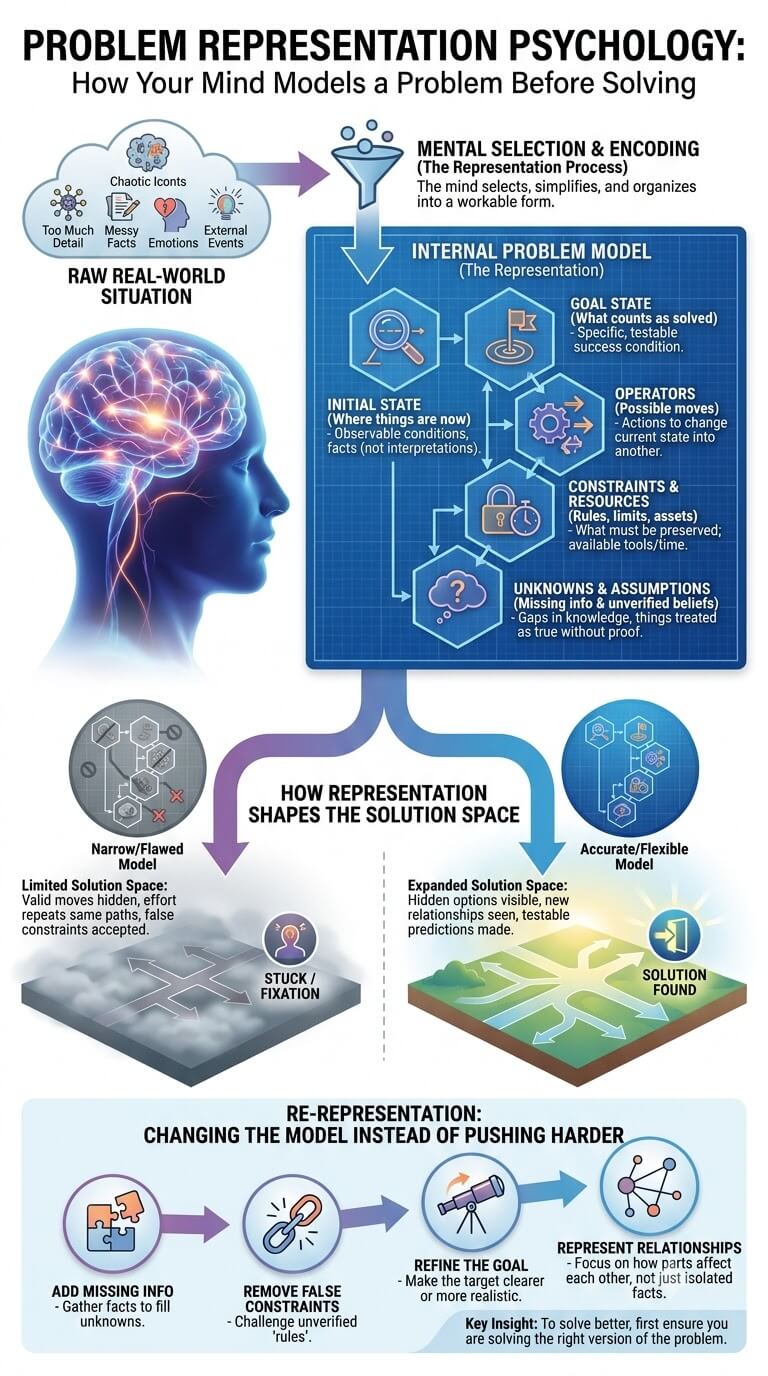
Problem representation psychology examines how the mind constructs an internal model of a problem, including the current situation, desired goal, possible actions, constraints, and unknowns. That model shapes the solution paths you can notice. If the representation is incomplete or distorted by assumptions, solving harder may not help. Changing the representation can make previously hidden relationships or options visible.
What Problem Representation Means
Problem solving is often described as moving from a starting situation toward a desired goal. The APA Dictionary of Psychology defines problem solving in terms of overcoming difficulty or moving from a starting situation toward a goal through higher mental functions such as reasoning. But between the real-world situation and any attempted solution sits an important cognitive step: the mind has to encode what the problem is.
The mind does not solve the raw situation directly
Real situations contain more information than you can process at once. If you are trying to fix repeated lateness, you might notice traffic, sleep, morning routines, meeting times, childcare, or transport reliability. The mind selects some of these details, connects them, and treats that simplified structure as the problem.
If your internal model is “I need more motivation in the morning,” you will search for motivational solutions. If the model is “my preparation sequence has two unpredictable bottlenecks,” you may look at timing, dependencies, or backups. Same life situation, different representation, different solution space.
A representation selects what seems relevant
A mental representation acts like a working map. It highlights some features and leaves others in the background. This selectivity is necessary. Without it, thinking would be overwhelmed by detail. The risk is that what gets excluded may later turn out to matter.
Research discussions of real-world problem solving describe problem definition and representation as an early phase in which relevant information is encoded and maintained so a plan can be formed. A review in Frontiers in Human Neuroscience, available through PubMed Central, notes that working memory helps maintain relevant problem information while a person reasons about it. This helps explain why simplifying a problem can be useful, but also why a poor simplification can send reasoning in the wrong direction.
The Building Blocks of a Problem Representation

A useful representation does not need to be formal. Even a rough sketch on paper can contain the main elements that matter. One practical way to examine a problem is to separate five components: where things are now, what would count as solved, what moves are possible, what constraints apply, and what remains uncertain.
Initial state: where things are now
The initial state is the best available description of the present situation. Good problem representations begin with observable conditions rather than conclusions disguised as facts.
Compare “My team does not care about deadlines” with “Three of the last five deliverables arrived after the agreed date, and ownership changed twice during each project.” The first statement bundles observation and interpretation. The second creates a more testable starting point. It gives you something you can inspect.
A useful initial-state question is: What would a neutral observer be able to verify right now? This does not mean feelings or interpretations are irrelevant. It means they should be distinguished from the facts they are helping you make sense of.
Goal state: what would count as solved
A vague goal produces a vague search. “Make this better” gives the mind little structure, while “reduce average response time from two days to one business day without adding staff” provides a clearer target. Goals can also be unrealistic. “Never feel uncertain again” is hard to operationalize; “have enough information to choose a reasonable next step by Friday” gives a usable success condition.
Operators or possible moves
In classic problem-space language, an operator is an action that changes the current state into another state. In everyday life, operators might be asking someone for information, changing a schedule, testing a smaller version, removing a step, negotiating a constraint, or trying a different resource.
People often mistake familiar moves for all possible moves. If every previous attempt involved “work harder,” effort can start to look like the only option. A better representation asks what kinds of change are actually possible.
Constraints, rules, and resources
Constraints define what cannot change or must be preserved, such as a legal deadline, fixed budget, or contractual requirement. Others are assumptions that have quietly acquired the status of rules. Resources matter too: time, expertise, tools, information, and access can change the path. A model that tracks limits but ignores resources can look more hopeless than the real situation.
Unknowns and assumptions
Many difficult problems are not difficult because they contain too many facts. They are difficult because facts, guesses, and missing information have become mixed together.
| Type of information | Example | Best next move |
|---|---|---|
| Known | The software fails after a specific update | Keep it in the working model |
| Assumed | The update must be the only cause | Test the assumption |
| Unknown | Whether the same failure happens on another device | Collect information |
| Constraint | The system must stay online during business hours | Design tests around the limit |
| Resource | A previous stable version is available | Use it as a comparison point |
This separation is simple, but it often changes the problem immediately. It turns an undifferentiated feeling of confusion into a structure that can be examined.
How Representation Shapes the Solution Space

The term problem space is useful because it captures the idea that solving involves moving among possible states toward a goal. A representation helps determine which states and moves a person even considers. Research on problem solving has long described representation in terms of an initial state, a goal state, allowable operations, and constraints.
What becomes visible as a possible move
Suppose a small business wants to improve customer response time. If the problem is represented as “employees need to type faster,” the visible moves may include templates, typing practice, or stricter targets. If the problem is represented as “requests are waiting in an unassigned queue,” suddenly routing rules, triage, and ownership become visible.
The mind is not merely searching a fixed menu. The menu itself depends partly on the model.
What disappears when the model is too narrow
A narrow representation can erase valid moves before evaluation begins. If a student represents an assignment as “write the perfect introduction first,” outlining, drafting the body, collecting evidence, or writing a rough opening may not feel like legitimate progress. The problem is not a shortage of effort. The internal model has made one sequence feel mandatory.
This is why being stuck can sometimes persist despite intelligence, experience, or persistence. More effort applied inside the same narrow structure may simply repeat the same search.
Why two people can see different problems in the same facts
Different knowledge, goals, and prior experience can produce different representations from the same facts. One manager sees a missed deadline as a planning problem, another as an information-flow problem, and a third as unclear decision rights. Each model makes different causes and interventions salient.
Not every representation is equally accurate. A better model explains the important facts and produces predictions that can be tested.
When the Mental Model Is Wrong or Incomplete
A representation does not have to be wildly inaccurate to create trouble. Small errors can have large downstream effects because every later step is built on the structure created early.
Solving a symptom instead of the underlying structure
Imagine that you repeatedly run out of time at the end of the week. You represent the problem as “Friday is too busy” and respond by working later on Friday. But the actual structure may involve commitments accepted earlier in the week, delayed handoffs, and tasks that expand because no completion criteria were set.
Working later may reduce the immediate symptom while leaving the structure untouched. A representation check asks: Is the place where I feel the problem the same place where the problem is generated?
Treating an assumption as a fact
Assumptions are unavoidable. They let us reason without verifying everything from scratch. Trouble begins when an assumption becomes invisible.
“The client needs all five features before launch” may be true, or it may be inherited from an early conversation that no longer reflects the actual requirement. “I cannot ask for help until I have tried everything” may feel like a rule, but it may be a personal standard rather than a condition of the task.
Writing assumptions in a separate column is often enough to make them inspectable again.
Missing a constraint or inventing one that is not real
Ignoring a real constraint produces solutions that look elegant but cannot be used. Inventing a constraint produces the opposite problem: valid paths disappear unnecessarily.
For example, “we cannot change the deadline” and “we cannot change anything about how work is divided before the deadline” are not the same statement. The first may be fixed. The second may be an assumption. Good representation keeps those distinctions visible.
Using irrelevant detail as if it were central
Some details are memorable because they are vivid, recent, or emotionally charged, not because they explain the structure. A difficult conversation with a colleague may dominate your attention even when the larger bottleneck is a process that affects everyone.
Try removing a detail mentally and ask whether the basic problem still exists. If it does, the detail may matter without being central.
External Representations Can Change Internal Thinking
Thinking does not have to remain entirely in your head. Moving information onto paper, a screen, a timeline, or a diagram can expose relationships that are hard to maintain mentally. External representations are not merely records of thinking. They can change what thinking becomes possible.
Lists, diagrams, timelines, maps, and equations
Different formats are good at showing different structures. A list emphasizes separate items. A timeline emphasizes sequence and delay. A flowchart emphasizes dependencies and decision points. A table makes comparisons easier. A spatial diagram can show proximity, hierarchy, or relationships.
The best format depends on the structure you are trying to understand. If order matters, use a timeline. If the question is “what affects what,” use arrows or a causal map. If you keep confusing assumptions with evidence, use separate columns. The goal is not to make the problem look impressive. It is to make relationships easier to inspect.
Why changing format can reveal relationships
Research on mathematical problem solving shows that diagrams can support understanding when they represent the relationships that matter for the specific problem. An open-access study on problem-appropriate diagram instruction describes problem solving as involving construction of a representation from the given information before computation or solution procedures are applied.
The practical lesson extends beyond mathematics: format should serve structure. A decorative diagram that preserves the same misunderstanding will not help much. A simple sketch that makes a hidden dependency visible may help a great deal.
When externalizing reduces working-memory load
Working memory has limited capacity. When you try to hold goals, constraints, exceptions, possible moves, and new information at once, some elements can be lost or repeatedly reconstructed. Putting stable information outside the mind reduces how much has to be actively maintained.
Externalizing changes the task: less effort goes into remembering moving pieces, leaving more capacity for comparing their relationships.
Re-Representation: Changing the Model Instead of Pushing Harder
Sometimes the most productive move is not to search deeper inside the current model. It is to rebuild the model. In research on insight problem solving, this kind of representational change is often discussed as restructuring. A study of working memory and representational change during insight problem solving describes insight theories in which a solution can depend on restructuring the representation held in mind.
In everyday problems, re-representation can be much less dramatic than an “Aha” moment. It may simply mean correcting one assumption, adding one missing relationship, or redefining what success actually requires.
Add missing information
If the model contains a large unknown, generating more solutions may be premature. Suppose you are deciding how to reduce returns for an online product, but you do not know why customers return it. Ten brainstorming sessions cannot replace the missing information.
Re-representation begins by adding evidence: return reasons, timing, product category, expectations set before purchase. Once those pieces enter the model, the problem may split into several different problems with different solutions.
Remove a false constraint
Ask, “What am I treating as impossible that has not actually been established as impossible?” A team may assume a process has to remain in the same order because “that is how we have always done it.” A student may assume every chapter must be mastered before practice questions are attempted. A household may assume one person has to perform a task because they historically did it.
Removing a false constraint does not mean ignoring real limits. It means requiring each limit to earn its place in the model.
Change what counts as the goal
Sometimes the original goal is too broad, too rigid, or aimed at the wrong level. “Get everyone to agree” may be impossible and unnecessary. “Identify a plan everyone can live with for the next two weeks” creates a different problem.
Changing a goal is not automatically lowering standards. It can make the desired state more accurately reflect what matters.
Represent relationships rather than isolated facts
A pile of facts can still hide structure. If four tasks are late, the important information may not be the tasks themselves but that each depends on the same approval step. If three arguments happen around money, the common relationship may be uncertainty about when spending requires joint agreement.
Research on problem solving increasingly emphasizes relational structure. Recent open-access work on relational encoding and creative insight argues that representing relations among elements can support restructuring and problem-solving success. In practical terms, ask not only “What are the pieces?” but “How do these pieces affect one another?”
Problem Representation vs Problem Framing
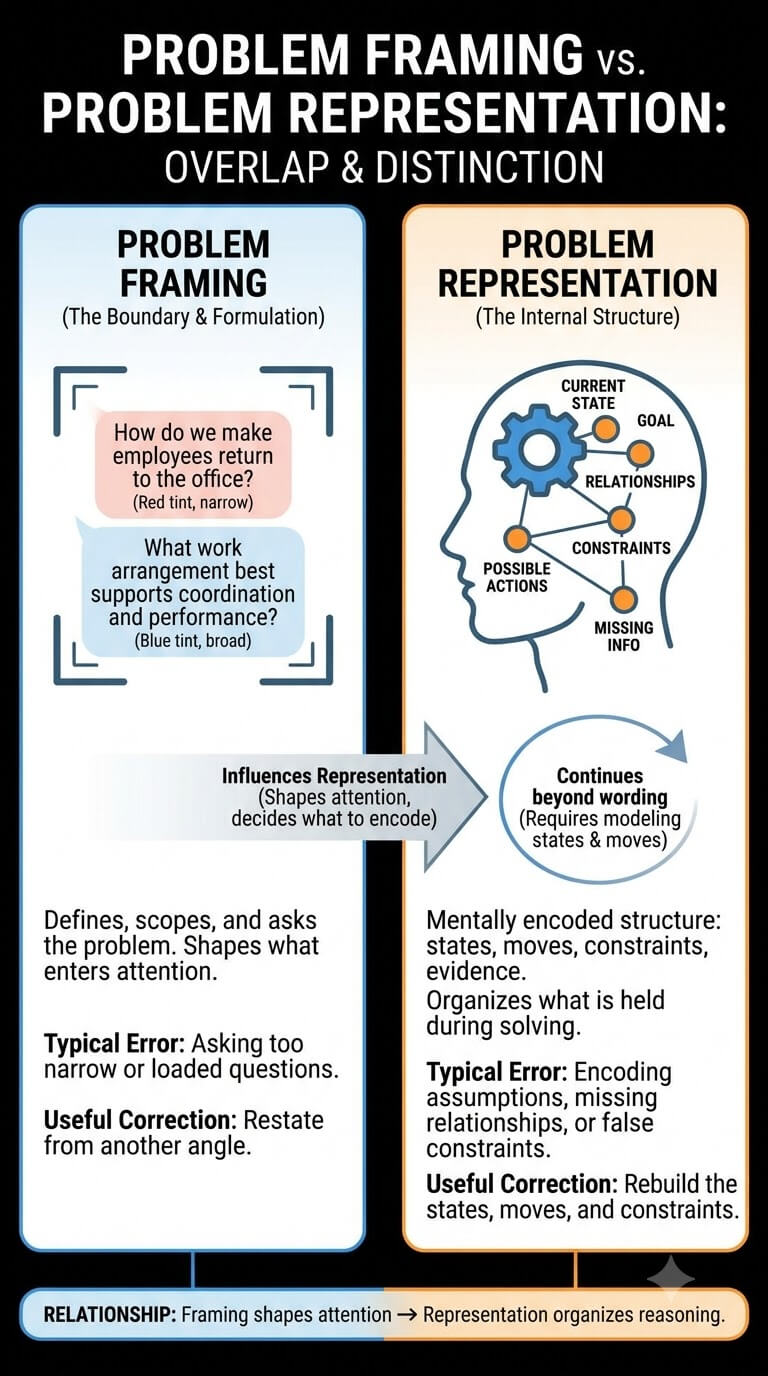
These ideas overlap, but changing the wording of a problem is not always the same as changing the internal model used to solve it.
Representation is the internal structure of the problem
Representation concerns what is mentally encoded: the current state, goal, relationships, constraints, possible actions, and missing information. Two people can hear the same wording and still build different internal representations because they bring different knowledge or assumptions.
Framing is how the problem is defined, scoped, and asked
Framing concerns the boundary and formulation of the problem. “How do we make employees return to the office?” and “What work arrangement best supports coordination and performance?” frame the situation differently. Each framing invites attention to a different set of variables.
How framing choices feed the representation
Framing often comes first and influences representation. The question you ask determines which facts seem relevant enough to encode. But representation continues beyond wording. Once the problem is framed, you still need to model states, relationships, constraints, and possible moves.
| Question | Problem framing | Problem representation |
|---|---|---|
| What does it primarily change? | The definition and scope of the problem | The internal structure used to reason about it |
| Typical error | Asking a question that is too narrow or loaded | Encoding assumptions, missing relationships, or false constraints |
| Useful correction | Restate the problem from another angle | Rebuild the states, moves, constraints, and evidence |
| Relationship | Shapes what enters attention | Organizes what is held and manipulated during solving |
A Worked Example: One Situation, Three Different Representations

Consider a freelance designer who keeps missing self-imposed project deadlines. The facts are simple: work is often completed two or three days late, clients frequently request revisions, and the designer tends to begin production before all requirements are confirmed.
Representation that creates a dead end
Model 1: “I am bad at time management.”
This representation makes the person themselves the problem. The goal becomes “be more disciplined,” the possible moves become working longer, using stricter schedules, or feeling guilty enough to start earlier, and the repeated revisions are treated as background noise.
The person may feel frustrated and self-critical because several process variables have been collapsed into one trait-like explanation. A better next move is to separate the timeline into stages and mark where unplanned work enters.
Representation that reveals a testable path
Model 2: “Projects begin before requirements are stable, so revisions add unplanned work after the schedule is already committed.”
Now the initial state includes requirement uncertainty. The goal becomes “reduce avoidable revision work before production begins.” Possible moves include a pre-start checklist, explicit approval of requirements, a revision allowance, or a smaller prototype before full production.
This model may reduce personal blame and increase curiosity because it contains a testable relationship between early ambiguity and later delay. The next move is to check whether projects with confirmed requirements actually finish closer to schedule.
What changed cognitively
The facts did not magically improve. The representation changed from a global judgment about the person to a process model with states and dependencies. That change created different operators and a testable prediction.
A third useful representation might focus on estimation: “The schedule assumes one revision round while the actual average is three.” That model would produce another testable path. The point is not that one representation is always correct. It is that representations should compete on explanatory fit, useful predictions, and what happens when you test them.
A Representation Check Before You Search for More Solutions
When you are tempted to generate another ten ideas, spend a few minutes checking the model first. The following questions are designed to expose missing structure rather than produce a solution immediately.
What do I know, assume, and still need to learn?
Make three columns: known, assumed, and unknown. Put every important statement into one column. If you cannot decide where a statement belongs, that uncertainty is useful information.
Then ask which unknown, if answered, would most change the problem. This prevents information gathering from becoming endless research.
What is the exact goal state?
Write one sentence that describes what would be observably different if the problem were sufficiently solved. Avoid goals that depend entirely on a feeling such as “I will know when everything feels certain.” Prefer something testable: “Customer requests receive an owner within four business hours” or “I can complete the assignment with the required evidence by Thursday.”
If several goals are competing, name them. Problems often feel incoherent when speed, cost, quality, fairness, and certainty are all being optimized at once.
Which constraints are real, and which are inherited assumptions?
For every statement containing “must,” “cannot,” or “have to,” ask what establishes it. A real constraint should have a reason outside mere habit. An inherited assumption may still be wise, but it should be visible enough to reconsider.
A useful four-part check is:
- State: What is true now?
- Goal: What specific change counts as success?
- Structure: What relationships connect the important parts?
- Limits: Which constraints are verified, and which are only presumed?
If you cannot answer one of these, the next step may be to improve the representation rather than hunt for another solution.
When a Good Representation Still Leads to Fixation
A clearer model is powerful, but it does not remove every obstacle. You can understand the problem accurately and still keep choosing familiar strategies or seeing resources only in their usual roles.
Mental set can restrict strategy selection
A mental set occurs when previous experience makes a familiar approach especially available. This is often useful because past success is informative. It becomes costly when the structure has changed but the solver keeps applying the old strategy.
A representation check can expose this by separating “possible moves” from “moves I usually make.” If those lists are identical, familiarity may be narrowing the search.
Functional fixedness can restrict resource use
Functional fixedness is a more specific form of fixation in which an object or resource is difficult to imagine outside its familiar use. In everyday settings, the same idea can apply broadly to tools, roles, spaces, or information.
If the model is accurate but options still seem strangely limited, ask: Which resource am I representing only by its usual function? That question belongs after the structure is clear, not instead of understanding the problem.
FAQ
These questions clarify the boundaries of problem representation and when changing the model is useful.
What is a problem space in psychology?
A problem space describes the states and possible moves involved in getting from the current situation to a goal. Because representation shapes what is encoded, a missing constraint or possible move can make a person search a smaller or different space than the real situation allows.
Can changing a diagram really change problem solving?
It can, when the format makes important relationships easier to see. A diagram is not automatically better than words. Timelines help with sequence, flowcharts with dependencies, and tables with comparisons. The format has to match the structure of the task.
What is the difference between representation and interpretation?
Interpretation usually refers to the meaning a person gives information. Representation is broader. It includes what information is selected, how elements are organized, what the goal is, which moves seem possible, and what constraints are encoded. Interpretation contributes to representation, but the representation also includes structural features that are not simply meanings or opinions.
When should you re-represent a problem?
Consider re-representing when repeated attempts produce the same dead end, when a solution seems impossible only because of one untested assumption, when new information changes the structure, or when you cannot clearly state the current state and goal. Re-representation is also useful when the facts are known but their relationships remain unclear.
Key Takeaways
- Problem solving begins with a mental model of the current state, goal, possible moves, constraints, resources, and unknowns.
- A representation is selective, so what gets omitted can be just as important as what gets included.
- Separating facts, assumptions, unknowns, constraints, and resources can turn confusion into a structure you can inspect.
- External formats such as diagrams, timelines, and tables can reveal relationships that are hard to hold in working memory.
- Re-representation means changing the model itself, for example by adding missing information, removing a false constraint, or representing relationships differently.
- Problem framing influences how a problem is defined; problem representation describes the internal structure used to reason through it.
Next step: choose one problem that currently feels stuck and write four lines: the present state, the goal state, the verified constraints, and the biggest unknown. If one line is vague, work on that part of the model before generating more solutions. Better solving often begins with seeing the problem more accurately.
Educational note: This material explains general cognitive psychology concepts and is not a clinical assessment or diagnosis. Difficulty organizing a complex problem is a normal part of thinking, especially when information is incomplete or demands are high.

Michael Reed is the Founder and Lead Writer at Psychology Exposed. He writes about human behavior, relationships, emotional patterns, self-awareness, and practical psychology topics using research-informed, easy-to-understand content.
Read More About Michael Reed: https://psychologyexposed.com/michael-reed/