
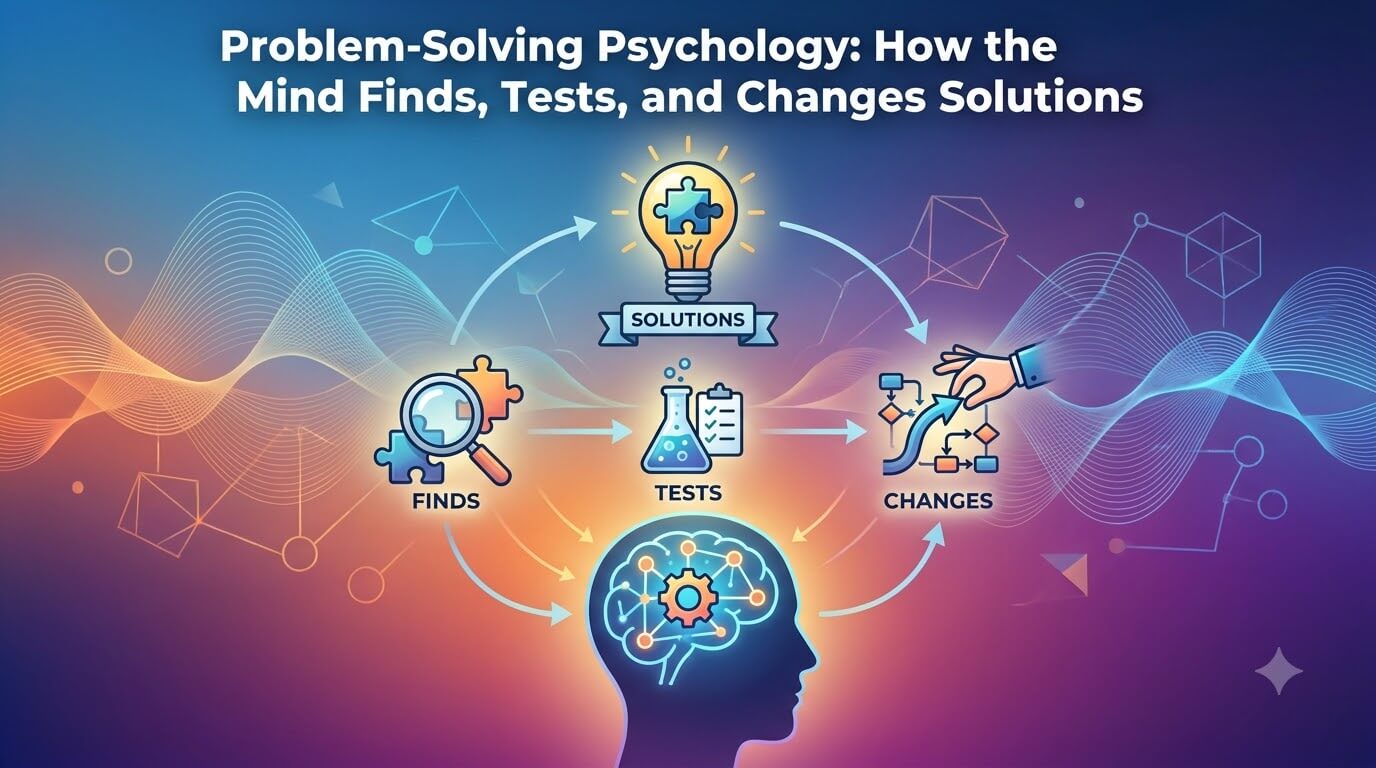
A problem becomes mentally demanding when there is a gap between where you are and where you want to be, but the route across it is unclear. The obstacle may be practical, social, or conceptual. Sometimes the difficulty is not lack of effort. It is that the problem has been represented or framed in a way that hides useful options.
Problem-solving psychology examines what happens between noticing an obstacle and finding a workable response. It includes how people define the problem, build a mental model, generate moves, test ideas, interpret feedback, become fixated, and sometimes suddenly see a new path.
Quick Answer

Problem solving in psychology is the set of mental and behavioral processes used to move from a current state toward a goal when the path is uncertain or blocked. Effective problem solving usually involves representing the problem accurately, generating possible approaches, testing them, learning from feedback, and changing the frame or strategy when the current approach stops working.
What Problem Solving Means in Psychology
A problem is more than a difficult situation
In everyday language, almost anything unpleasant may be called a problem. Psychology uses the idea more precisely. The APA Dictionary of Psychology defines problem solving as a process for overcoming difficulties or moving from a starting situation toward a desired goal through higher mental functions such as reasoning and creative thinking.
If you already know exactly what to do, the challenge may be execution rather than solving. A problem-solving task contains uncertainty about the path, information, constraints, or goal. “Submit this report by Friday” may be planning if the steps are familiar. “The report keeps failing quality review, but nobody agrees on why” requires solving because the cause and route forward are unclear.
The difference between finding a solution and choosing among options
Problem solving and decision making overlap, but they are not identical. Problem solving creates, discovers, or repairs a path toward a goal. Decision making selects among alternatives that already exist or have already been generated.
| Question | Problem solving | Decision making |
|---|---|---|
| Core challenge | How can this be solved? | Which option should I choose? |
| Main mental work | Understanding the obstacle and creating a workable route | Comparing alternatives, tradeoffs, and consequences |
| Typical failure | Misdefining the problem or repeating an ineffective strategy | Choosing poorly among available alternatives |
| Example | Finding a way to stop repeated project delays | Choosing between two scheduling systems |
The two often occur in sequence: create plausible options, choose one, test it, then return to solving if the choice fails.
Why Problem Solving Matters in Everyday Life
Work, learning, relationships, planning, and practical obstacles
Problem solving appears whenever a familiar script is not enough. At work, it may mean finding a bottleneck. In learning, it may mean discovering why a study method produces recognition but poor recall. At home, it may involve balancing time, money, and competing needs.
Social problems add another difficulty: other people have their own goals, information, and interpretations. A conversation that keeps failing may not need a clever sentence. The obstacle may be unclear expectations, conflicting goals, missing information, or a frame that treats one person as the entire problem.
Why more effort does not always produce a better solution
Persistence helps when effort produces information. If every failure means “try the same thing harder,” feedback is being collected without changing the model. Ask, “What did the last attempt teach me?” The answer may reveal a bad assumption, a missing variable, or a strategy that fit an older problem but not this one.
A Core Mental Model: Represent, Generate, Test, Learn, Reframe
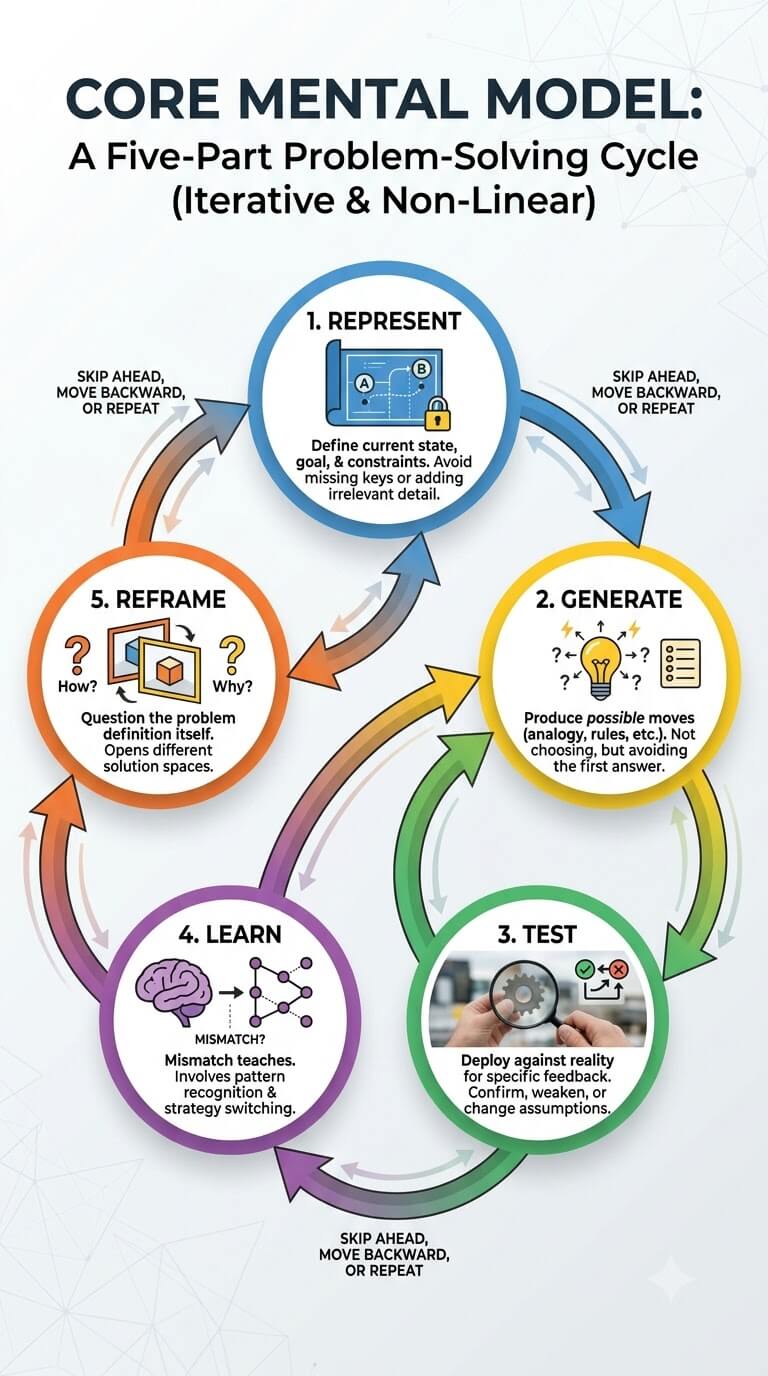
A practical way to understand problem solving is as a five-part cycle. The stages are not perfectly linear. People often move backward, skip ahead, or repeat a stage as new information appears.
Represent the current state, goal, and constraints
Before solving, the mind needs a representation of what is happening. A mental representation is an internal stand-in for a situation or idea. The APA Dictionary description of mental representation captures this basic point.
For a practical problem, representation means identifying the current state, desired state, relevant constraints, and connecting information. Leave out a key variable and a solution may look impossible. Add too much irrelevant detail and the problem may look harder than it is.
Generate possible moves or solution paths
Once the representation is workable, the next task is producing possible moves from memory, analogy, rules, experimentation, other people, or new combinations of familiar ideas. Generation is not choosing. Its purpose is to avoid being trapped by the first plausible answer.
For a recurring work delay, possible moves might include changing ownership, reducing handoffs, automating one step, or removing an unnecessary approval. Each option reflects a different theory about the bottleneck.
Test against reality and collect feedback
A solution becomes useful when it meets the problem outside your head. Testing may be formal or as simple as trying a revised process for a week. The goal is feedback that can confirm, weaken, or change assumptions.
Specific feedback changes the next attempt. “That failed” teaches less than “the new handoff reduced errors but added two days of delay.”
Learn from mismatch and change the model or strategy
When reality does not match the expected result, either the strategy may be wrong or the understanding may be incomplete. An NCBI Bookshelf discussion of cognitive skills describes nonroutine problem solving as involving pattern recognition, linked information, monitoring, and strategy switching.
Reframing becomes useful when the problem definition itself is suspect. “How do we make people follow this process?” and “Why does the process make the desired behavior difficult?” open different solution spaces.
The Main Psychological Processes Behind Problem Solving

Problem representation builds the mental model
Representation concerns what the mind treats as the important elements of the problem and how those elements relate. Two people can face the same facts yet work with very different internal models. One may see a time-management problem, while another sees a priority-conflict problem. Their solutions will differ because they are, in effect, solving different versions of the situation.
Problem framing defines what counts as the problem
Framing sets the boundaries and wording of the problem. “How do I become more productive?” frames the issue broadly. “Which recurring task consumes time without improving the result?” frames it narrowly and points toward different evidence. A frame can be useful, incomplete, or misleading without being intentionally biased.
Mental set can lock attention onto an old strategy
A mental set is a readiness to respond in a familiar way, especially when that response worked before. The APA Dictionary entry on set includes the example of someone being prepared to use a tactic that succeeded in previous situations. In problem solving, that efficiency becomes a liability when the old tactic keeps being applied after the problem has changed.
Functional fixedness narrows how resources are seen
Functional fixedness is a more specific kind of restriction. Instead of being stuck on a whole strategy, a person becomes stuck on the familiar use of an object, resource, role, or idea. The question shifts from “What is this normally for?” to “What properties does this have that could help here?” That small change can reveal options hidden by habit.
Insight can follow restructuring after an impasse
Some solutions feel sudden. A person may struggle, stop making progress, and then see the problem differently in a way that makes a solution appear almost at once. Reviews of insight research describe this as a process that can involve reorganization of the mental representation, often accompanied by an “Aha” experience. Importantly, research reviewed in Frontiers in Psychology also shows that insight is not simply a magical guarantee of correctness.
Barriers can appear at different stages of the process
A problem can fail before solution generation even begins. Important information may be missing, the goal may be vague, assumptions may be treated as facts, attention may be overloaded, or emotion may narrow what seems possible. Later, the barrier may be fixation, weak feedback, or reluctance to abandon a heavily invested approach.
Trial and error turns attempts into feedback
Trial and error is often caricatured as random guessing. Useful trial and error is more disciplined. Each attempt changes what is known. If a failed attempt tells you which condition does not work, the next attempt can be better targeted. The learning value comes from comparing the expected result with the actual result.
Collaboration requires a shared understanding of the problem
Groups do not automatically solve problems better just because more minds are present. People may hold different information, define the goal differently, or argue about solutions before agreeing on what is wrong. Collaborative problem solving improves when participants can make their assumptions visible, combine partial information, and distinguish disagreement about the problem from disagreement about the preferred solution.
Which Problem-Solving Topic Should You Explore Next?

If the problem itself feels unclear
Focus first on representation and framing. Ask what facts belong in the mental model, what the desired end state is, and whether the wording of the problem quietly assumes a cause or solution. If different people describe the “same” problem in incompatible ways, clarification may matter more than brainstorming.
If you keep repeating the same approach
Look closely at mental set, functional fixedness, and broader barriers. Repetition can feel like persistence even when no new information is being produced. Notice whether you are protecting a familiar method, treating a constraint as permanent without testing it, or overlooking a resource because you only see its usual function.
If the solution appeared suddenly
Insight problem solving is the most relevant lens. The useful question is not simply why an idea felt sudden, but what changed in the representation before the idea became visible. A strong feeling of certainty can be informative, but the solution still needs to be checked against evidence and constraints.
If you are unsure whether you are solving or deciding
Ask whether the missing piece is an option or a choice. If there is no satisfactory option yet, you are mainly solving. If several workable alternatives already exist and the difficulty lies in comparing tradeoffs, you are mainly deciding. Real situations often move back and forth between the two.
If several people must solve the problem together
Begin with shared understanding before pushing for agreement. Have each person describe the current state, goal, constraints, and evidence in their own words. Differences at that level often explain why a group appears to be fighting over solutions when members are actually working from different problem definitions.
Going Deeper Into the Psychology of Problem Solving
How Problem Solving Works in Psychology
A closer look at the process focuses on how a solver moves from recognition to representation, generation, testing, feedback, and adjustment. It is especially useful when you want to understand the sequence rather than one specific obstacle. The key question is how information changes the next move. A failed attempt should not merely trigger more effort. It should update something about the goal, constraints, assumptions, or strategy. This process-oriented view also makes it easier to see why problem solving is rarely a neat straight line. People revise earlier stages as new evidence changes what they think the problem actually is.
Problem Solving vs Decision Making
The comparison becomes important when “I cannot decide” is actually “I do not have a good option yet.” Problem solving creates or repairs possible routes. Decision making evaluates alternatives and commits to one. Confusing them can produce wasted analysis. Someone may spend hours comparing two weak choices when the better move is to step back and generate a third. The reverse also happens: a person may keep brainstorming long after enough workable options exist because choosing has become uncomfortable. Separating the two tasks clarifies whether the next useful action is to create, test, compare, or commit.
Problem Representation Psychology
Problem representation examines the internal model a person builds before and during solving. It asks which elements are treated as relevant, how they are connected, and what is missing. This matters because a solver does not act directly on reality in all its complexity. They act on a simplified mental version of it. If that version hides a causal relationship or includes an unnecessary restriction, the available solutions shrink. Representation is especially useful when a problem feels confusing, overloaded, or strangely resistant despite repeated effort. Improving the model may involve drawing the system, changing the level of detail, identifying the goal state, or making hidden assumptions explicit.
Problem Framing Psychology
Framing concerns how the problem is defined and bounded. Small changes in wording can direct attention toward different causes and solutions. “How do we stop late work?” invites one set of answers. “What makes on-time work difficult in this process?” invites another. Neither frame is automatically correct. The purpose is to notice what each frame emphasizes, excludes, or assumes. Framing is particularly valuable when discussion keeps circling around blame, when the problem statement already contains a preferred solution, or when people are optimizing one outcome while ignoring another. A stronger frame makes the goal and tradeoffs visible without pretending the situation is simpler than it is.
Mental Set Psychology
Mental set explains why previous success can create present-day rigidity. Once a strategy becomes familiar, it is efficient to reuse it. That efficiency is usually helpful. Trouble begins when familiarity is mistaken for fit. A manager may keep adding reminders because reminders solved a past compliance issue, even though the new problem is conflicting priorities. A student may keep rereading because it once helped with simpler material, even when the new task requires retrieval and application. The practical challenge is not to reject experience, but to notice when experience has become a default that no longer earns its place through current evidence.
Functional Fixedness Psychology
Functional fixedness narrows the perceived uses of what is already available. A resource is seen mainly through its usual purpose, so alternative uses remain mentally hidden. This can apply to physical objects, but the broader lesson is useful in daily life. A meeting may be treated only as a place to make decisions when it could instead be used to surface missing information. A spreadsheet may be seen only as a reporting tool when it could help reveal a process bottleneck. Overcoming fixedness often starts by describing properties rather than labels: what can this resource do, what information does it contain, and what constraints could it satisfy?
Insight Problem Solving Psychology
Insight problem solving focuses on solutions that feel sudden after a period of difficulty or incomplete progress. The interesting psychological event is often representational change: the solver stops organizing the elements in the old way and a previously hidden relationship becomes visible. Insight can feel effortless at the moment it arrives, but that does not mean no mental work preceded it. Prior attempts, impasse, attention shifts, and incubation may all contribute. The important caution is that the feeling of “Aha” and the correctness of the answer are different things. An insightful idea should still be tested, especially when the real-world consequences matter.
Barriers to Problem Solving
Barriers are best understood as a map of where the process can break down. Some barriers affect understanding, such as missing information, hidden assumptions, or a vague goal. Others affect generation, such as fixation or narrow attention. Still others interfere with testing and revision, including poor feedback, cognitive overload, or emotional pressure that makes changing direction feel threatening. A barrier-focused approach is useful when you know you are stuck but do not yet know why. Instead of immediately hunting for a better solution, you diagnose the stage that is failing. That often produces a more precise next step than simply trying harder.
Why People Get Stuck on Problems
Getting stuck is the lived experience of repeated thinking without meaningful movement. It can involve replaying the same possibilities, defending sunk effort, fearing the cost of being wrong, or waiting for certainty that the situation cannot provide. Unlike a broad list of cognitive barriers, this question focuses on what the loop feels like and why it sustains itself. A person may remain attached to an approach because abandoning it would mean admitting that time, money, or identity was invested in the wrong direction. The useful shift is to separate past investment from present evidence and ask what information would justify continuing versus changing course.
Trial and Error Learning Psychology
Trial and error becomes powerful when attempts are designed to teach. Random repetition produces noise, while informative experimentation reduces uncertainty. A practical solver changes one important feature, predicts what should happen, observes the result, and uses the mismatch to guide the next attempt. In this sense, failure is not automatically useful. It becomes useful when the result is interpretable. This distinction keeps trial and error centered on solving rather than turning it into a general discussion of learning. The key concern is how failed attempts reshape the current solution path and help the solver eliminate, refine, or replace hypotheses.
Collaborative Problem Solving Psychology
Collaborative problem solving studies what changes when the relevant knowledge is distributed across several people. A group may have more information than any individual member while still performing poorly because that information never becomes shared. Productive collaboration requires more than brainstorming. Participants need a common picture of the goal, enough psychological room to challenge assumptions, and a way to integrate different pieces of evidence without turning every disagreement into a status contest. It also helps to separate idea generation from evaluation. When criticism begins too early, less obvious information and weaker voices may disappear before the group has fully understood the problem.
Common Misunderstandings About Problem Solving

Better problem solving is not simply thinking longer
Time helps only when the thinking changes. Productive effort tests assumptions, gathers information, compares models, or changes perspective. Repeating the same interpretation for hours is not automatically deeper reasoning. When nothing new is being learned, a pause or reformulation may be more useful.
Reframing is not the same as avoiding the real problem
A good reframe does not erase uncomfortable facts. It reorganizes them into a more useful question. If a team has missed four deadlines, a useful reframe might separate estimation errors, scope changes, approval delays, and unclear ownership. Strong reframing increases testable options rather than replacing evidence with optimism.
An Aha feeling does not guarantee a correct answer
Insight can create a strong sense of coherence when disconnected pieces suddenly fit. That experience is not proof. A clever explanation can still ignore evidence or violate a constraint. Treat insight as a promising hypothesis that still deserves testing.
Persistence helps only when feedback can change the approach
Persistence is useful when each attempt updates the next one. If stopping feels like failure, effort can become disconnected from evidence. Ask whether the current strategy is still earning continued investment and what result would count as evidence to change course.
A First-Step Reset When a Problem Feels Unclear
Separate facts, goals, constraints, and assumptions
Write four short lists. Facts are observations you can reasonably verify. Goals describe the state you want to reach. Constraints are real limits such as time, money, rules, or dependencies. Assumptions are beliefs you are currently treating as true but could, at least in principle, test. Many stuck problems become more manageable when an assumption stops masquerading as a constraint.
Identify one assumption that can be tested
Choose an assumption that meaningfully shapes your options. If you believe customers will not accept a simpler process, test that belief with a small sample rather than redesigning everything around it. If you believe a colleague “will never agree,” identify the specific proposal or condition you expect them to reject. A testable claim creates information; a global prediction creates resignation.
Decide what evidence would make you change strategy
Before the next attempt, define a switching condition. For example: “If the revised process does not reduce delays after two cycles, we will inspect handoffs rather than add more reminders.” Predefined criteria make feedback easier to interpret and reduce endless escalation of the same tactic.
You can use a short reset question set when needed:
- What exactly is happening, and what part is interpretation?
- What outcome am I actually trying to create?
- Which constraints are fixed, and which are merely assumed?
- What did the last failed attempt teach me?
- What result would make me revise the problem or change strategy?
FAQ
Is problem solving a single skill or a group of skills?
It is better understood as interacting abilities and processes. Depending on the task, problem solving may draw on attention, memory, reasoning, representation, knowledge, creativity, monitoring, and collaboration. Someone can therefore excel with one kind of problem and struggle with another because domain knowledge and task structure matter.
What is the first step in psychological problem solving?
A useful first step is building a clear representation of the current state, desired state, and meaningful constraints. Ask what is known, what is assumed, what success would look like, and what blocks the route. If the problem is defined incorrectly, excellent execution can still produce the wrong result.
Why do people keep using solutions that no longer work?
Familiar strategies are efficient, and past success makes them feel credible. A mental set can therefore keep an old method in use after conditions change. Sunk effort, unclear feedback, and narrow framing can strengthen the loop. The useful test is current evidence, not the strategy’s past reputation.
Is insight better than trial and error?
Neither is universally better. Insight may reveal a solution through restructuring, while trial and error can reduce uncertainty through informative attempts. Many real problems use both. Experimentation may support later insight, and an insightful idea may still require testing against actual constraints.
How is problem solving different from decision making?
Problem solving finds or creates a workable path when the route is unclear. Decision making selects among available alternatives. If no option seems good enough, the task may be to generate or redesign options rather than compare harder. Once viable options exist, the task may shift from solving to choosing.
Key Takeaways
- Problem solving begins with how the situation is represented, not with the first solution that comes to mind.
- A useful cycle is to represent the problem, generate possibilities, test them, learn from feedback, and reframe when needed.
- Mental set and functional fixedness can make familiar strategies or uses feel more inevitable than they really are.
- Insight may follow a change in representation, but an “Aha” feeling still needs reality testing.
- Problem solving creates or repairs solution paths, while decision making mainly selects among alternatives.
- When you are stuck, ask what the last attempt taught you and what evidence would justify changing strategy.
Educational note: Difficulty with a particular problem is a normal part of thinking and does not by itself indicate cognitive impairment or a mental health condition. If changes in thinking, memory, attention, or everyday functioning are persistent, severe, or concerning, consider discussing them with a qualified health professional.

Michael Reed is the Founder and Lead Writer at Psychology Exposed. He writes about human behavior, relationships, emotional patterns, self-awareness, and practical psychology topics using research-informed, easy-to-understand content.
Read More About Michael Reed: https://psychologyexposed.com/michael-reed/