

You can know that something is wrong and still have no idea what to do with it. A project keeps missing deadlines. A study routine produces hours of effort but weak recall. A household expense keeps rising even after several attempts to cut it. In each case, the difficulty is not simply choosing an answer. The mind has to work out what the problem actually is, what can be changed, which move is worth trying, and what the result of that move teaches you.
Psychological problem solving is therefore better understood as an updating process than as a neat checklist. You build a workable picture of the situation, generate a path, test part of it, read what happened, and revise either the strategy or the picture itself. That cycle may take seconds for a small task or weeks for a messy real-life problem.
Quick Answer

Problem solving in psychology usually involves representing the current situation and goal, generating possible solution paths, choosing a move to test, using feedback from the attempt, and adjusting the strategy or the problem model. These stages are iterative rather than fixed. When an attempt fails, the useful question is not only “What should I try next?” but also “What did this result teach me about the problem?”
From Problem to Solution: What the Mind Is Trying to Do
The APA Dictionary of Psychology describes problem solving as the process of trying to overcome difficulties or move from a starting situation toward a desired goal using higher mental functions such as reasoning and creative thinking. That definition captures a central feature: there is a gap between the present state and the desired state, but the route across the gap is not immediately available.
This sequence sits inside the broader psychology of problem solving, which also includes framing, fixation, insight, and collaboration.
Current state, goal state, constraints, and possible moves
A useful way to picture the task is as a problem space. The current state describes where things stand now. The goal state describes what would count as success. Constraints limit what you can do, and possible moves are the actions or transformations that might move the situation closer to the goal.
Open-access research discussing the classic idea of a problem space in cognition explains it as a mental representation containing the initial state, possible states, and the goal. Real life is often less tidy than a laboratory puzzle, but the idea is practical. If you cannot say what “better” would look like, which limits are real, or what parts of the situation are changeable, you are likely to test moves without knowing what they are meant to accomplish.
| Part of the problem | Question to ask | Example |
|---|---|---|
| Current state | What is happening now? | Customer requests take five days to answer. |
| Goal state | What observable result would count as progress? | Most requests receive a useful first response within two days. |
| Constraints | What cannot be ignored? | Staffing cannot increase this month. |
| Possible moves | What could change the path? | Triage requests, remove duplicate approvals, or change ownership. |
Why real problem solving is rarely a straight line
Many textbook diagrams show a sequence of steps because sequences are easy to teach. Actual solving is more recursive. New information can change the goal, reveal a hidden constraint, or show that the original description was incomplete. A person may generate options, discover that none are feasible, then return to the representation and redefine what is changeable.
This is why a failed attempt does not automatically mean poor problem solving. Failure becomes wasteful when it produces no update. If an attempt reveals that a supposed cause was not actually driving the problem, the solver has gained information even though the immediate outcome was disappointing.
Stage 1: Build a Usable Representation of the Problem

Before looking for answers, the mind needs a working model. It does not have to be perfect, but it has to be specific enough to guide useful action. A vague statement such as “I am bad at managing time” contains almost no testable structure. “I underestimate tasks with multiple handoffs, then start them too late” gives the mind something it can examine.
Identify what is known, unknown, and assumed
One of the simplest improvements is to separate three categories that people often mix together. What is known is supported by observation or reliable information. What is unknown is genuinely missing. What is assumed feels plausible but has not yet been established.
| Category | Meaning | Example in a missed-deadline problem |
|---|---|---|
| Known | Directly observed or documented | Three of the last four delays happened after legal review. |
| Unknown | Information not yet available | How long each review stage actually takes. |
| Assumed | An explanation treated as likely | Legal review is slow because the team is understaffed. |
That separation matters because an assumption can quietly become the foundation for every later move. If the assumption is wrong, better execution will not rescue the plan. You may need a small information-gathering step before you need a solution.
Separate the goal from the first solution idea
People often smuggle a proposed solution into the problem statement. “How do we get everyone to use this new dashboard?” assumes dashboard adoption is the goal. The deeper goal might be “How do we make project status visible enough that handoffs stop being missed?” A dashboard may help, but it is now one possible route rather than the definition of success.
This distinction protects the solving process from premature commitment. If the first idea is treated as the goal, evidence against that idea can feel like evidence that the entire problem is unsolvable.
Stage 2: Generate Possible Solution Paths

Once the representation is usable, the mind searches for moves. Some are retrieved from memory because a similar strategy worked before. Others come from analogy, recombination, advice, experimentation, or a change in perspective. The purpose at this stage is not to produce dozens of ideas. It is to avoid confusing the first available idea with the only available path.
Retrieve familiar strategies
Familiar strategies are efficient for a good reason. If a printer stops responding, restarting it is a reasonable early move because it has worked in similar situations. If a meeting repeatedly runs over, using an agenda may be a sensible first adjustment. Experience reduces the need to solve every problem from zero.
The risk appears when familiarity outruns fit. A strategy can be successful in one class of problems and misleading in another. The solver needs a way to ask, “What feature of the current problem makes this old strategy relevant?” That question is more diagnostic than “Has this ever worked before?”
Combine, modify, or create alternatives when familiar strategies fail
When retrieval produces nothing useful, solution generation becomes more constructive. You might split the problem into smaller parts, borrow an idea from another domain, reverse the sequence of steps, remove a constraint that turns out to be negotiable, or combine two partial solutions.
For example, suppose a student remembers material while reviewing notes but blanks during practice questions. “Study longer” is an available strategy, but it does not address the mismatch. Better alternatives might include delayed retrieval practice, practice without notes, or checking whether the student can explain the concept in their own words. These moves come from redefining what successful studying must produce, not from adding more time to the same method.
Stage 3: Select a Move to Test
Generating options and selecting the next move are different mental tasks. At this point, the solver narrows the field using constraints, expected consequences, effort, reversibility, and the information each move could produce. The best next move is not always the move most likely to solve everything immediately.
Use constraints and predicted consequences to narrow the next step
A proposed action has to survive contact with the actual situation. If a team cannot change headcount, “hire two more people” may be a good long-term possibility but a poor test for this week. If a student has an exam tomorrow, redesigning the entire study system may be less useful than testing one high-yield change tonight.
Predictions make testing clearer. Before acting, state what you expect to happen and why. “If duplicate approvals are the bottleneck, removing one approval should reduce waiting time without increasing rework.” A prediction gives the later feedback something to compare against.
Prefer informative tests when certainty is impossible
Many everyday problems do not allow certainty before action. Instead of asking, “Which solution is guaranteed to work?” ask, “Which small move could teach me the most while keeping the cost of being wrong manageable?”
This is especially useful when several explanations are plausible. If customer complaints might come from unclear instructions or from a technical bug, two small targeted checks may be more informative than launching a large redesign based on one guess.
A useful test has three properties:
- It is tied to a clear assumption or prediction.
- Its result can be observed soon enough to guide the next move.
- It is small or reversible enough that learning is affordable.
Stage 4: Read Feedback From the Attempt
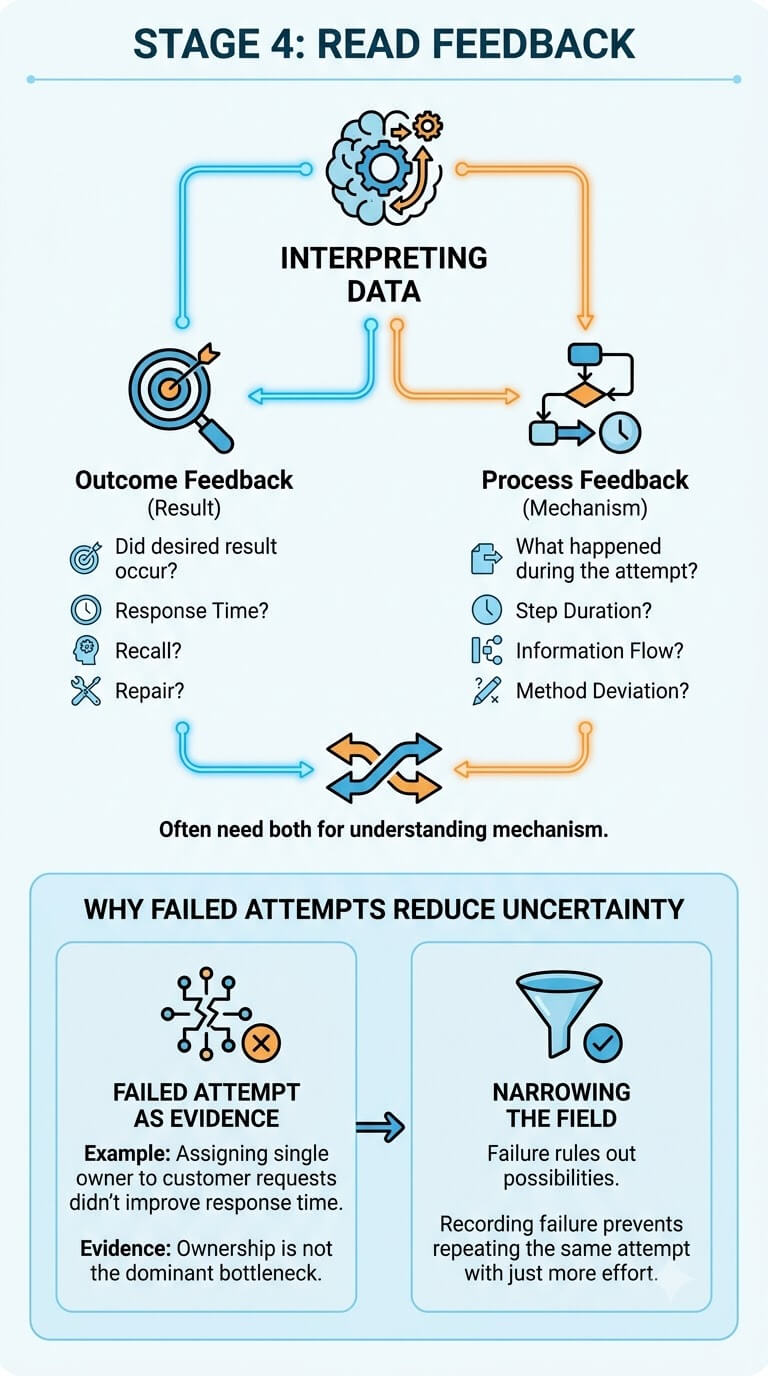
Action creates data. The crucial step is interpreting that data without reducing it to “worked” or “failed.” Feedback can tell you about the result, the process, the assumptions, or the measurement itself. Research on learning and problem solving also shows that the form of feedback matters because different feedback can guide different kinds of adjustment. A Frontiers in Psychology study on feedback and mathematics problem solving, for example, compared different feedback approaches and found that feedback design influenced problem-solving performance and self-regulated learning outcomes.
Outcome feedback versus process feedback
Outcome feedback asks whether the desired result occurred. Did response time drop? Did recall improve? Did the repair stop the leak? Process feedback asks what happened during the attempt. Which step took longer than expected? Where did information disappear? Which part of the method was followed differently?
You often need both. A new workflow may improve speed but increase errors. A study method may raise practice scores only when the material is still fresh. A household budget may reduce total spending while shifting costs into a category that was not being tracked. Looking only at the final number can hide the mechanism.
Why a failed attempt can still reduce uncertainty
Suppose you think delayed customer responses are caused by unclear ownership. You assign a single owner to each request, but response time barely changes. That is disappointing as an outcome, yet useful as evidence. Ownership may not be the dominant bottleneck, or the change may not have altered the step that actually consumes time.
The failure narrows the field if you record what it rules out. Without that step, people often repeat the same attempt with slightly more effort and call it persistence.
Stage 5: Adjust the Strategy or the Problem Model
This is the stage where problem solving becomes visibly adaptive. The solver decides whether to keep the basic model and change the move, or question the model itself. Those are not the same kind of correction.
Change the move when the model is sound
If the evidence still supports your understanding of the problem, adjust the strategy. You may change the sequence, intensity, timing, tool, or person responsible. For instance, if you know a bottleneck occurs at review because requests arrive incomplete, changing the submission form may be more sensible than rethinking the entire project system.
This kind of adjustment says, “We are probably solving the right problem, but this move was weak.” It preserves useful structure while improving execution.
Reframe or re-represent when repeated moves fail
Repeated failure across several reasonable strategies raises a different possibility: the mental model may be wrong or incomplete. Recent research on task representation and strategy selection highlights that how a task is represented can influence which strategies are generated and chosen. In everyday terms, if your picture of the problem is off, your strategy search may stay trapped inside the wrong space.
Re-representation means changing how the elements and relationships are understood. Reframing changes the way the problem is posed or bounded. You do not need those labels in the moment. The practical signal is simpler: several sensible moves have failed for reasons your current explanation cannot account for.
The Problem-Solving Loop in One Worked Example

Consider a freelance designer whose projects repeatedly finish late. The problem feels familiar enough that the first impulse is to “be more disciplined,” but the person wants to understand what actually happens before adding another productivity system.
Initial representation
The designer first describes the current state: about half of recent projects finished three to five days late. The desired state is not “never be late again,” which is too absolute to guide a test. It is “finish most standard projects by the agreed date without reducing quality.”
The known facts are that early design work usually starts on time and delays appear near final delivery. The unknown is how much time is lost to revisions. The assumption is that procrastination causes the delay.
First attempt and unexpected feedback
The designer tests the procrastination theory by starting each project one day earlier and blocking extra focus time. If procrastination is the cause, the added time should create a larger buffer.
After three projects, deadlines are still tight. The process record shows something more interesting: client revisions arrive in several small rounds because feedback is collected from different stakeholders at different times. The extra day is consumed by the same revision pattern.
Strategy change and second test
The designer keeps the goal but changes the working model. The problem is no longer “I start too late.” It becomes “feedback arrives in fragmented rounds that make completion unpredictable.”
The next test is smaller and more targeted: require one consolidated feedback window before final revisions begin. The prediction is that fewer revision rounds will reduce late-stage uncertainty. Over the next projects, the designer tracks number of revision rounds, waiting time, and delivery date.
What the solver learned even before the final answer
Even if consolidated feedback does not fully solve the delay, the process has improved. The designer now knows that simply starting earlier was not enough, that late-stage revisions are an important variable, and that the next useful question concerns either feedback structure or scope control.
That is the essence of iterative problem solving. Progress is not only getting the final answer. It is reducing uncertainty in a way that changes what you do next.
Where the Process Commonly Breaks
Not every difficulty needs a separate psychological explanation. Many solving failures can be located by asking which part of the cycle stopped producing useful information.
If the loop stops producing useful information, a diagnosis of barriers to problem solving can show which stage is breaking down.
Poor representation
The solver is working with a vague, incomplete, or distorted picture. Symptoms include arguing about solutions before agreeing on the problem, treating assumptions as facts, or using a goal that cannot be observed. More option generation will not help much if every option is aimed at the wrong target.
Premature commitment to one strategy
The first plausible move becomes psychologically “the plan.” New evidence is interpreted as a reason to execute it harder rather than reconsider it. A simple guardrail is to name at least one alternative explanation before making a costly commitment.
Weak feedback or no feedback
The attempt happens, but nobody records what changed. This is common with slow problems. A team changes a process, months pass, and people remember impressions rather than comparable observations. Without a feedback signal, experience does not reliably become learning.
When several people share the task, solving problems collaboratively adds the challenge of building a shared model before testing solutions.
Continuing after the evidence says to change course
Persistence is valuable when another attempt can still test the same hypothesis more accurately. It becomes less useful when repeated evidence contradicts the model and the only response is increased effort. At that point, stepping back is not giving up. It is part of the solving process.
| If you notice this | The process may be stuck here | Useful next question |
|---|---|---|
| No one agrees on what success means | Representation | What observable result are we trying to change? |
| Only one solution keeps appearing | Generation | What assumption makes this seem like the only option? |
| Large changes happen without clear predictions | Testing | What smaller move would distinguish between explanations? |
| People debate whether the attempt worked | Feedback | What result did we expect and what actually happened? |
| Several reasonable attempts fail in the same way | Adjustment | Is the strategy wrong, or is our picture of the problem wrong? |
Problem Solving vs Decision Making Inside the Same Task
Problem solving and decision making often alternate inside one real task, which is why they are easy to confuse. An NCBI Bookshelf discussion of learning and problem solving distinguishes problem solving as assessing the present state, defining the desired state, and finding ways to transform one into the other, while decision making concerns evaluating possible solutions and selecting one for implementation.
Generating a workable option is problem solving
If a small business has declining repeat purchases and no clear explanation, identifying causes and creating possible responses is problem solving. The owner may investigate delivery delays, customer expectations, product quality, pricing, or follow-up. The key difficulty is constructing a workable path where none is obvious.
Choosing among workable options is decision making
Once the owner has three feasible responses with known tradeoffs, choosing which one to fund first is decision making. The distinction is useful because a person can make a careful choice among weak options if the problem-solving stage was poor. Likewise, strong option generation does not guarantee a good final choice.
A Practical Process Reset
When you feel mentally stuck, you do not need to restart the entire task. A short reset can restore the feedback loop without pretending that a complicated problem has a simple formula.
Restate the goal in observable terms
Replace “fix this,” “be better,” or “make it work” with a result that another person could recognize. “Reduce the number of late handoffs,” “remember key concepts without looking at notes,” or “lower the average time required to complete this task” creates a clearer target.
List one assumption and one missing piece of information
Write one sentence beginning with “I am assuming…” and one beginning with “I still do not know…” This prevents uncertainty from hiding inside confident language. Sometimes the next move is not a solution attempt at all. It is finding the missing information.
Choose the smallest test that can teach you something
A small test is not always possible, but when it is, it reduces the cost of being wrong. Decide what you predict, what you will observe, and what result would make you change your mind. That turns action into a learning opportunity rather than a vote of confidence in your favorite idea.
Three-minute reset:
- State the current situation without explaining its cause.
- Name the result you want to observe.
- Identify one assumption that could be wrong.
- Pick one test that distinguishes between at least two possibilities.
- Decide in advance what feedback would trigger a change in strategy.
When the Setup, Not the Strategy, Is the Real Problem
Sometimes strategy switching becomes another form of trial and error because the underlying setup was never examined. Two setup problems are especially important: the mental representation may be incomplete, or the way the problem is framed may be steering attention toward the wrong goal.
Representation problems
A representation problem concerns the internal model. Important variables may be missing, relationships may be misunderstood, or irrelevant details may be treated as central. Imagine repeatedly changing a marketing message when the actual constraint is that the message reaches the wrong audience. The strategy changes, but the model still points to copy rather than distribution.
A clue is repeated surprise. If outcomes keep violating your predictions in ways you cannot explain, inspect the model before producing more tactics.
Framing problems
A framing problem concerns how the question is posed. “How do I force myself to finish everything on my list?” assumes finishing everything is necessary. “Which tasks actually need to be done by me this week?” creates a different problem. Both may involve the same workload, but they direct attention toward different solution spaces.
Framing is worth revisiting when the available solutions all feel undesirable, when the goal contains an untested assumption, or when solving the stated problem would not actually improve the situation you care about.
FAQ
Does problem solving always follow the same steps?
No. A staged model is useful for understanding the work involved, but real solving is iterative. You may discover a constraint while testing, return to the representation, generate a new path, then test again. Familiar problems may compress several stages into seconds, while unfamiliar problems may require repeated cycles.
What happens when no solution comes to mind?
Do not assume the only problem is lack of creativity. First check whether the goal, constraints, and relevant information are clear. Then look for a smaller subproblem, a similar past case, a missing piece of information, or a negotiable constraint. If familiar strategies dominate attention, changing how the problem is represented may produce more useful options than forcing more brainstorming.
Why is feedback part of problem solving?
Feedback connects a mental prediction with what actually happened. Without that comparison, an attempt is only an action. With it, the solver can learn whether an assumption held, whether the process behaved as expected, and whether the next move should be a strategy adjustment or a revision of the problem model.
When should you change strategy instead of trying harder?
Change strategy when repeated, reasonably executed attempts produce evidence that the current move is not affecting the relevant part of the problem. Reconsider the problem model when several different sensible strategies fail in ways the model cannot explain. Trying harder is most useful when the strategy still fits and the previous attempt was incomplete, inconsistent, or too weak to test it fairly.
Key Takeaways
- Problem solving moves from a current state toward a goal when the path is uncertain, so defining the state, goal, constraints, and possible moves matters early.
- A practical cycle is to build a representation, generate solution paths, choose an informative test, read feedback, and revise the strategy or the model.
- Failed attempts are not automatically wasted. They become useful when they reduce uncertainty or expose a bad assumption.
- Changing a strategy is different from changing how you understand the problem. Repeated unexplained failure is a reason to inspect the mental model.
- Problem solving generates or repairs workable options, while decision making selects among options that are already available.
- When stuck, define an observable goal, identify one assumption, find one missing fact, and choose the smallest test that can teach you something.
Educational note: This article explains general cognitive processes and is not a diagnostic or clinical assessment. If a problem involves severe distress, safety, or a situation beyond your ability to manage alone, appropriate professional or practical support may be more useful than trying to optimize the solving process by yourself.

Michael Reed is the Founder and Lead Writer at Psychology Exposed. He writes about human behavior, relationships, emotional patterns, self-awareness, and practical psychology topics using research-informed, easy-to-understand content.
Read More About Michael Reed: https://psychologyexposed.com/michael-reed/