
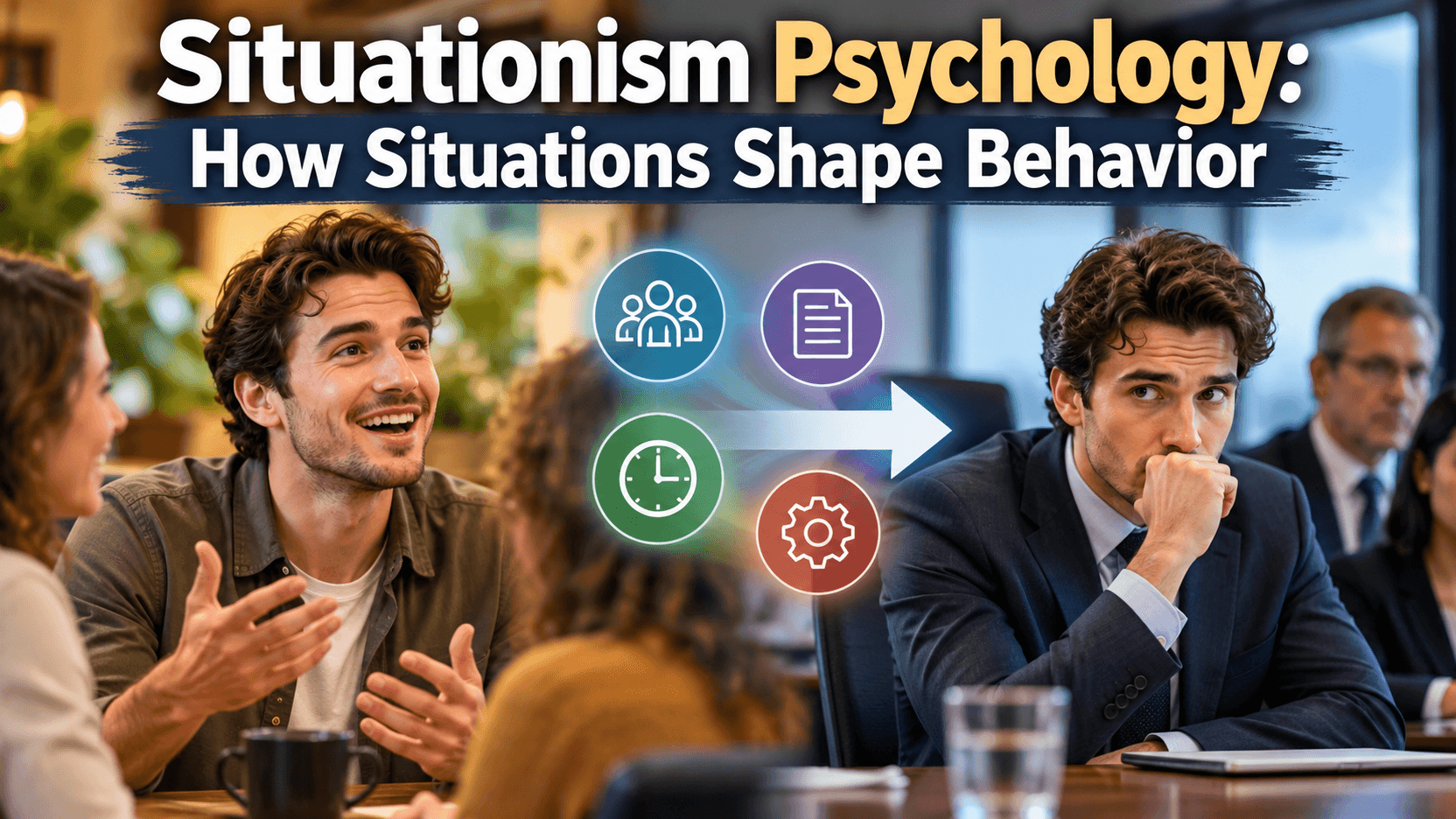
A person who speaks confidently with friends may become unusually quiet in a meeting with strict rules. A thoughtful employee may rush a decision when a deadline is approaching. In both cases, the immediate setting can change what behavior is possible, expected, or costly. Does that mean the situation matters more than personality?
That question leads to situationism in psychology, a perspective that puts situational conditions at the center of explanations for behavior. Understanding it helps you notice influences that are easy to miss when you judge a person from one action. It also requires care: explaining an influence is not the same as saying a person had no choice. Situationism is a theoretical perspective, not a tool for diagnosing someone’s personality or excusing harmful decisions.
Quick Answer: What Is Situationism in Psychology?
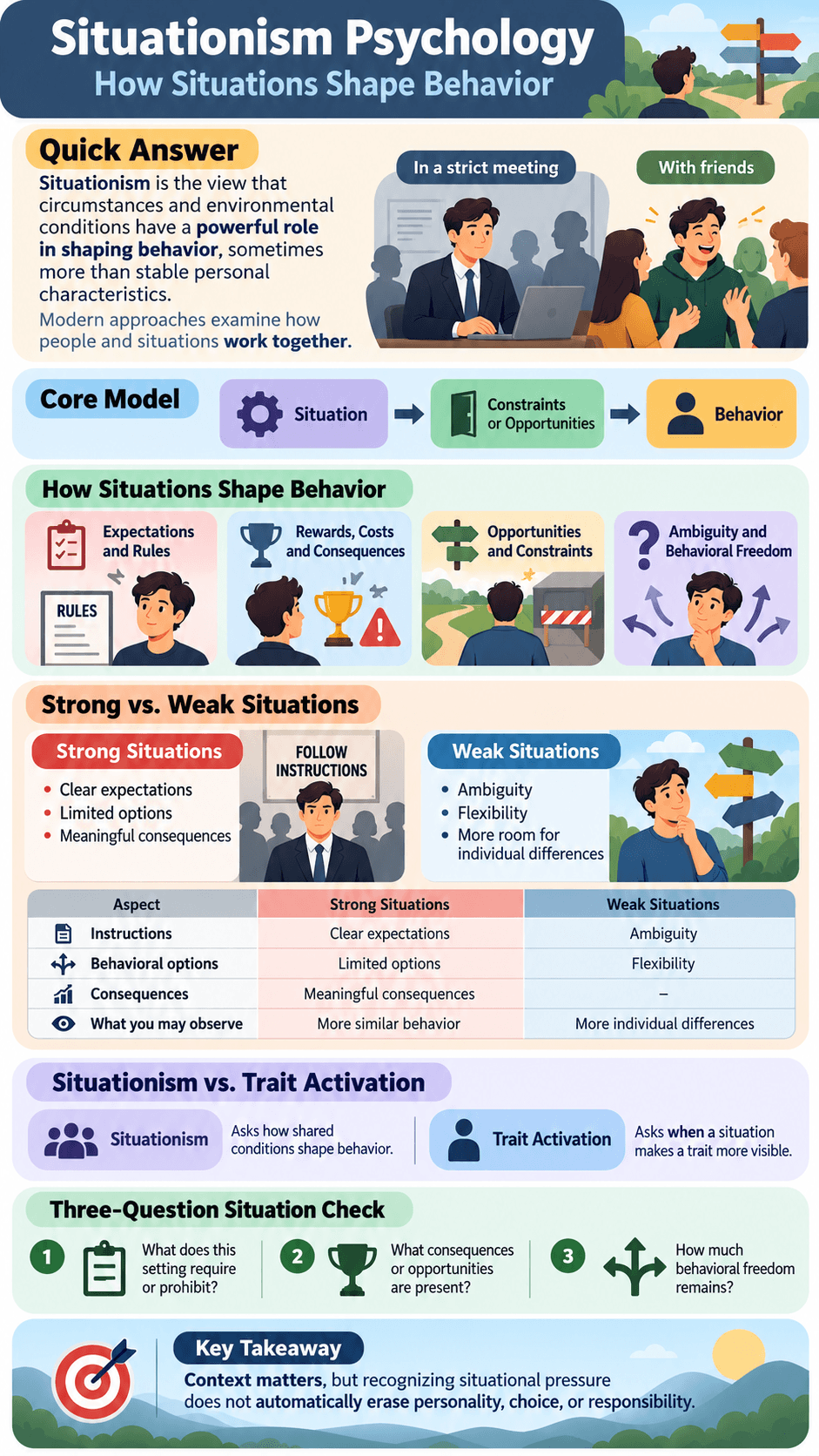
Situationism is the view that circumstances and environmental conditions have a powerful role in shaping behavior, sometimes more than stable personal characteristics. Rules, opportunities, expectations, and consequences can change what people do. It challenges explanations based only on personality, but it does not establish that personality is meaningless. Modern approaches generally examine how people and situations work together.
The situationist emphasis in one sentence
Situationism directs attention to the conditions surrounding an action before treating that action as proof of an enduring trait. The APA Dictionary of Psychology defines the position in terms of the primary importance of situational and environmental factors rather than internal characteristics. That is a description of a theoretical emphasis, not a rule that applies equally to every action.
What situationism does not claim
People sometimes hear a situationist explanation and conclude that personality must be fictional. That goes too far. Someone may generally prefer structure while still adapting to a setting that demands improvisation. The adaptation shows that context matters; it does not make the preference vanish. A more useful question is which features of the setting changed the likelihood of the behavior you observed.
Where Situationism Fits in the Person-Situation Debate
For much of personality psychology’s history, researchers have asked how reliably a person’s tendencies appear across different circumstances. Situationism became influential because it challenged the expectation that a broad description such as “assertive” or “careful” should predict a specific action in almost any setting.
Why strong trait explanations were challenged
Imagine describing someone as outspoken because they often express opinions during relaxed dinners. If they stay silent while giving evidence in a formal hearing, has the personality description failed? Not necessarily. The hearing has different expectations, stakes, and rules. Early debates exposed a genuine measurement problem: predicting a single action under unfamiliar conditions is not the same task as describing someone’s average tendencies.
Walter Mischel as historical context, not a final verdict
Psychologist Walter Mischel’s work, especially Personality and Assessment in 1968, helped sharpen questions about cross-situational consistency. His criticism encouraged psychologists to consider context-sensitive explanations more seriously. Later work did not simply discard traits; it investigated how dispositions and situational processes could be integrated. A historical account by Mischel and Yuichi Shoda discusses this reconciliation rather than presenting situation and personality as permanently opposed.
From situationist challenge to modern interactionism
The most productive outcome of the debate was not a victory for one side. Researchers increasingly study the ways personal tendencies and situational features combine. Personality may matter strongly in some circumstances and less visibly in others. Meanwhile, two people can experience an apparently similar setting differently because they bring different goals, abilities, or histories. Situationism remains valuable because it prevents the context from disappearing out of the explanation.
How Situations Can Shape What People Do

A situation is more than a physical place. It includes the instructions, incentives, restrictions, uncertainty, and available choices surrounding an action. These features often work together. A quiet room may invite concentration, but a strict deadline in that same room could make a person hurry.
Expectations and rules
Rules tell people what behavior is permitted and sometimes what behavior is required. At a library, conversation may become softer even among naturally talkative people. At a formal event, people may wait their turn rather than interrupt. Such changes do not reveal their entire personalities. They show that a shared expectation can narrow the range of actions that feel appropriate.
Rewards, costs, and consequences
Consequences alter the practical stakes of behavior. A worker might double-check a calculation when an error could delay a shipment, but work more quickly during a low-stakes practice run. Neither choice proves that the worker is always meticulous or careless. A consequence changes how much attention, caution, or initiative an action seems to require. It may influence behavior without guaranteeing it.
Opportunities and constraints
People cannot display a behavior when the opportunity is absent. Someone may enjoy leading a discussion, yet a training session with no questions allowed provides little room for leadership through speaking. Conversely, an open brainstorming session gives participants opportunities to offer ideas. The distinction matters because missing behavior can sometimes reflect missing opportunity rather than a missing personal tendency.
Ambiguity and behavioral freedom
Some environments specify exactly what to do. Others allow interpretation. A detailed checklist may produce similar steps across employees, while an open-ended assignment may invite varied approaches. Ambiguity can make personal preferences more visible, but it can also create confusion. A setting that offers freedom is not automatically easier; it merely leaves more decisions to the person.
Strong vs Weak Situations

One influential idea within situationism is situation strength: how clearly a setting communicates what conduct is expected and how strongly it limits alternatives. This distinction is useful, although researchers have cautioned against treating it as an established universal law.
Strong situations: clear expectations, limited options, meaningful consequences
A strong situation has clear demands, restricted choices, or substantial consequences for ignoring its rules. Consider a laboratory safety procedure with specified steps. People who normally organize tasks differently may nevertheless follow the same sequence. Their visible similarity reflects a common constraint. The strength lies in the situation’s signals and restrictions, not simply in how emotionally intense it feels.
Weak situations: ambiguity, flexibility, and more room for individual differences
A weak situation generally offers more latitude about acceptable behavior. During an informal project-planning meeting, one person might organize the conversation, another might sketch possibilities, and a third might listen before contributing. Different tendencies can show through because the instructions do not force everyone into one response. Still, variations could also reflect task knowledge, uncertainty, or social relationships.
Why behavior can look more similar across people in strong situations
If everyone is required to use the same procedure, observed differences may shrink. The classic prediction is that personality contributes less to visible differences when strong rules constrain action. But this is a hypothesis about conditions, not permission to assume that stronger situations always erase personality effects. A review by Cooper and Withey on the strong situation hypothesis examined the gap between the conventional claim and the available evidence.
| Feature | Stronger situation | Weaker situation |
|---|---|---|
| Instructions | Specific procedures or rules | Open-ended or flexible guidance |
| Behavioral options | Relatively limited | Relatively varied |
| Consequences | Often clear or substantial | Often less defined |
| What you may observe | More similar outward actions | More room for distinct approaches |
| What you should not infer | That personality has disappeared | That any difference must be a trait |
Situation → Constraints or Opportunities → Behavior

A compact way to reason about situational effects is to move from the conditions people face to the options those conditions create, and finally to the behavior that becomes visible. This is a reading aid, not a scientific formula that predicts every individual decision.
A reader-friendly model of situational influence
Situation → expectations, constraints, or opportunities → possible behavior. Picture a community workshop in which participants can either ask questions aloud or submit anonymous notes. The format changes which responses are accessible and how exposed participants may feel. If the organizer eliminates spoken questions, silence no longer provides useful evidence about who prefers speaking.
Why this is not a deterministic formula
A constraint influences choices without producing identical reactions in every individual. Some participants may challenge an unfair rule; others may comply, leave, or seek clarification. Resources, obligations, and perceived risks differ. Situationism encourages attention to these conditions but cannot tell you, from the conditions alone, exactly what any particular person will do.
How the same situational feature can matter differently for different people
Consider a short deadline. One person may respond by simplifying the task, another by requesting help, and another by working through the evening. Their differences do not cancel the deadline’s influence. Instead, the deadline is a shared condition that interacts with experience, available support, priorities, and energy. Explaining those individual differences fully requires looking beyond situationism alone.
Situationism vs How Environment Shapes Behavior
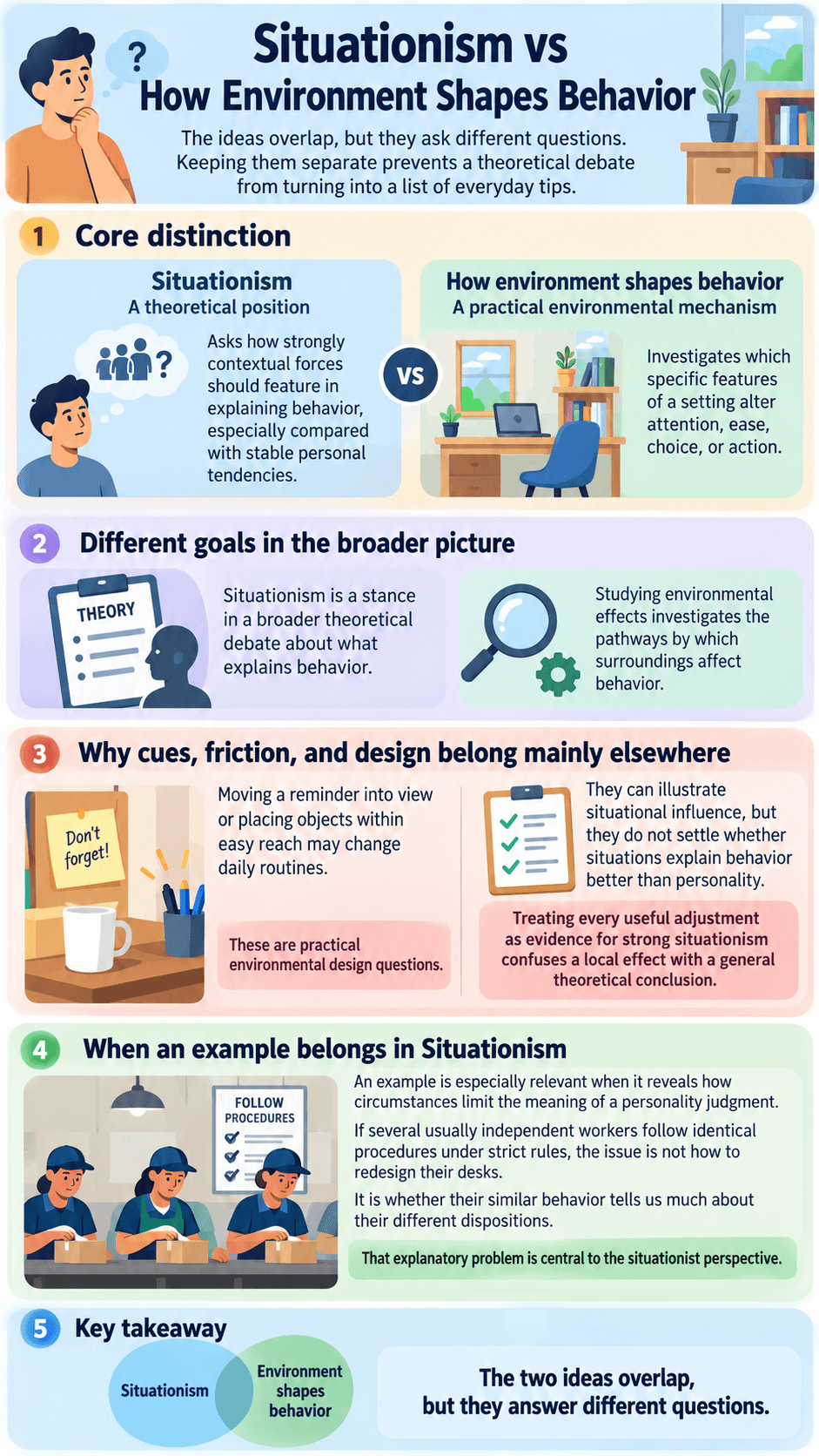
Situationism overlaps with the familiar idea that surroundings influence action, but the two questions are not identical. Keeping them separate prevents a theoretical debate from turning into a long list of everyday productivity or design tips.
Theoretical position versus practical environmental mechanism
Situationism asks how strongly contextual forces should feature in an explanation of behavior, especially when compared with stable personal tendencies. Studying environmental effects often asks which specific features of a setting alter attention, ease, choice, or action. The first is a stance in a broader theoretical debate; the second investigates pathways by which surroundings affect behavior.
Why cues, friction, and environment design belong mainly elsewhere
Moving a reminder into view or placing objects within easy reach may change daily routines. Those are practical environmental design questions. They can illustrate situational influence, but they do not settle whether situations explain behavior better than personality. Treating every useful adjustment as evidence for strong situationism would confuse a local effect with a general theoretical conclusion.
When an example belongs in Situationism instead
An example is especially relevant when it reveals how circumstances limit the meaning of a personality judgment. If several usually independent workers follow identical procedures under strict rules, the issue is not how to redesign their desks. It is whether their similar behavior tells us much about their different dispositions. That explanatory problem is central to the situationist perspective.
Situationism vs Social Influence
Other people can be a major part of a situation, but not every situational effect is social influence. A sudden change in available time, a broken tool, or a complicated procedure may alter behavior even when nobody is pressuring anyone else. Recognizing this distinction avoids reducing the entire topic to conformity or obedience.
Situational forces can be social or nonsocial
Social situations include expectations from supervisors, requests from friends, audience reactions, and shared rules. Nonsocial conditions might involve poor visibility, a narrow time window, limited equipment, or a task with only one safe sequence. Both kinds of condition can constrain choices. The analytical question here is how circumstances shape what someone does, not only how other people persuade them.
Why conformity and obedience are not the structure of this article
Conformity concerns changes associated with group norms or expectations; obedience concerns responses to authority. Both may provide examples of situational influence, yet each has its own psychological mechanisms. A description of a person obeying a rule does not automatically show whether personality was irrelevant, whether the rule was perceived as legitimate, or what alternative responses were available.
Social influence as a useful contrast
Suppose a receptionist follows a strict emergency sign-in procedure while working alone. The procedure is a situational constraint. If colleagues later urge the receptionist to skip a step, that introduces interpersonal pressure. The second event involves social influence layered onto the existing situation. Separating these influences makes the explanation more precise than labeling both events simply “the power of the situation.”
Situationism vs Trait Activation Theory
Situationism asks us not to overlook context. Trait Activation Theory asks a more specific question: under what conditions does a setting give someone an opportunity or reason to express an existing trait? The two ideas can describe the same setting from different angles.
Situationism asks how strongly situations shape behavior
In a tightly managed meeting, every participant has two minutes to speak. A situationist interpretation highlights the shared rule and the fact that it limits speaking time across the group. The relevant observation is that the meeting format narrows outward differences, regardless of what people would have preferred.
Trait activation asks how cues make an existing trait relevant
Now imagine the meeting leader invites volunteers to question an unfamiliar proposal. That invitation may create an opportunity for people inclined toward assertive discussion to act on that tendency. The invitation is not simply a universal restriction. It may change how strongly a particular personal characteristic appears in behavior. That is a different explanatory task from saying that rules shape everyone.
Where situation strength can connect the two
Strict rules may leave few opportunities for some tendencies to appear, while a loosely structured task may permit several approaches. Yet freedom does not guarantee that every trait will become visible. A situation has to make a particular response possible or relevant. An account of person-situation interactionism in Nature Reviews Psychology distinguishes situational strength from the opportunities that make particular traits relevant.
| Question | Situationism | Trait activation |
|---|---|---|
| Main focus | How much circumstances shape behavior | When a trait is likely to be expressed |
| Key feature | Constraints, demands, expectations, and consequences | Cues or opportunities relevant to a particular trait |
| Typical observation | Several people act alike under shared rules | One trait appears more clearly when the setting makes it useful |
| Interpretive caution | Do not conclude traits are irrelevant | Do not treat traits like mechanical switches |
Limits of Extreme Situationism
The strongest version of a situationist claim would treat personal characteristics as negligible in explaining behavior. That is more than the available theory and evidence justify. A careful explanation has to account for stability, variation, and the possibility that people choose or change some of the situations they enter.
Situations do not erase stable individual differences
A person can show recognizable preferences across many settings even if any single action is strongly shaped by circumstances. Someone who usually prepares early may continue to do so across school, home, and work, while occasionally abandoning that habit under unusual pressure. A meaningful average tendency and a context-sensitive exception can coexist without contradiction.
Different people can respond differently under the same conditions
Shared conditions rarely mean identical practical options. In a building with a temporary elevator outage, a visitor carrying heavy equipment faces different constraints from a visitor carrying nothing. Even when the external rule is the same, ability, experience, responsibilities, and available alternatives affect what can be done. Situationism helps reveal the outage as an influence, but it is not the entire explanation for each response.
When the question is whether a setting’s demands and resources match a particular person’s needs or abilities, person-environment fit offers the more precise comparison.
Responsibility and choice can remain even when context exerts pressure
Understanding why someone felt pressured does not automatically justify their action. If a workplace norm encourages cutting corners, recognizing that norm is relevant to improving the system. It does not make the harm disappear or determine what accountability is appropriate. Responsibility depends on the circumstances, including actual freedom to act, available alternatives, consequences, and the person’s knowledge.
This distinction also protects against unfair judgments in the opposite direction. People with little genuine choice should not be described as if they enjoyed unlimited freedom. A responsible account can recognize a person’s constraints without claiming those constraints fully dictated their response.
From Situationism to Interactionism

Modern person-situation research has increasingly moved toward questions of combination: which personal tendencies matter under which circumstances, and which situational conditions make particular responses more or less likely? This approach keeps situationism’s central insight without making it exclusive.
Why modern explanations include both person and situation
Consider a volunteer at a public event. The rules permit anyone to guide newcomers, but no one is assigned to do so. One volunteer steps forward; another assists quietly when asked. The permissive setting creates the opportunity, while personal inclinations and previous experience may help explain who uses it. Neither the opportunity nor the disposition is a complete account by itself.
This also connects with the state-trait distinction, which separates a temporary, context-sensitive response from a more enduring tendency across situations.
A 2025 review of personality expression in context discusses how people select situations, experience them, express momentary behavior, and shape outcomes. It adds an important correction to a simple one-way model: people are not merely placed into settings; where feasible, they may also seek, avoid, or alter them.
When situational effects are likely to be stronger
It is reasonable to examine situational influence closely when rules are explicit, alternatives are limited, consequences are immediate, or behavior must follow a standardized sequence. These conditions may place common demands on many people. Even then, the strength of a situation can depend on which behavior is being measured. A rule may standardize the final action while leaving differences in effort, interpretation, or private reactions.
When individual differences have more room to appear
Personal tendencies may be easier to observe when the setting permits meaningful choice, especially across repeated opportunities. In an open-ended creative exercise, people may differ in how they generate ideas, ask for feedback, or manage uncertainty. The wider range of acceptable responses gives researchers and observers more to compare. It still takes repeated observations to decide whether those differences reflect enduring tendencies rather than one-time circumstances.
A Three-Question Situation Check
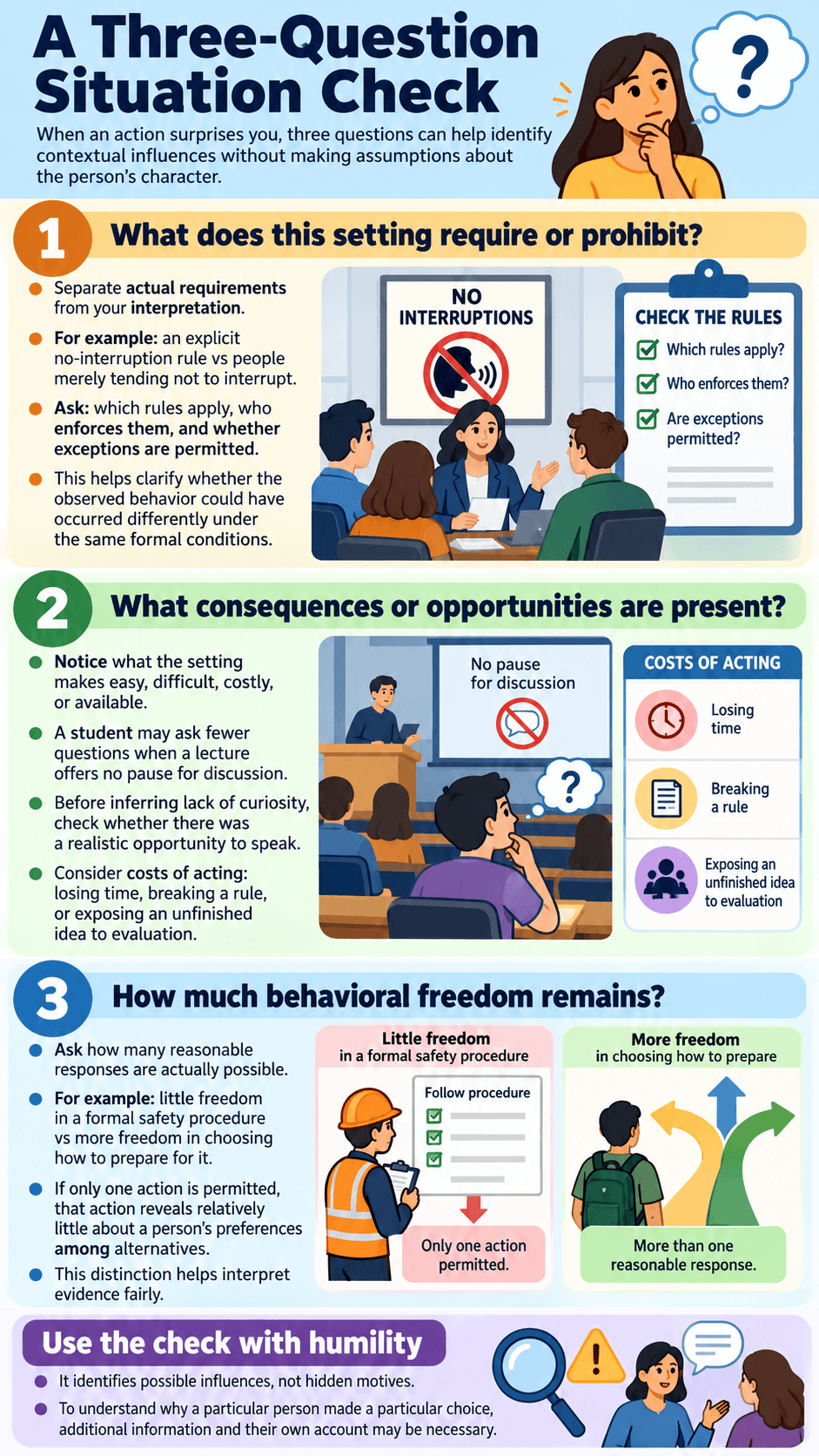
You do not need to label someone “situationist” to use the perspective constructively. When an action surprises you, three questions can help identify contextual influences without making assumptions about the person’s character.
What does this setting require or prohibit?
Separate actual requirements from your interpretation of them. A meeting with an explicit no-interruption rule is different from one where people merely tend not to interrupt. Ask which rules apply, who enforces them, and whether exceptions are permitted. This clarifies whether an observed behavior could have occurred differently under the same formal conditions.
What consequences or opportunities are present?
Notice what the setting makes easy, difficult, costly, or available. For example, a student might ask fewer questions when a lecture offers no pause for discussion. Before inferring a lack of curiosity, check whether there was a realistic opportunity to speak. Also consider the costs of acting, such as losing time, breaking a rule, or exposing an unfinished idea to evaluation.
How much behavioral freedom remains?
Finally, ask how many reasonable responses are actually possible. There may be little freedom in a formal safety procedure but considerable freedom in choosing how to prepare for it. The distinction helps you interpret the evidence fairly. If only one action is permitted, that action reveals relatively little about a person’s preferences among alternatives.
Use the check with humility: it identifies possible influences, not hidden motives. If you need to understand why a particular person made a particular choice, additional information and their own account may be necessary.
FAQ About Situationism Psychology
These questions clarify what the situational perspective can explain, and where a broader account of personality and behavior is still needed.
Does situationism say personality does not exist?
No. Situationism gives explanatory priority to situational conditions, but that is not the same as demonstrating that stable personal tendencies are imaginary. Modern personality research investigates both relatively enduring differences and changes in behavior across contexts. A strong situationist argument should be evaluated as a claim about the relative importance of causes in a particular setting, not accepted as a universal denial of personality.
What is the difference between situationism and environmental psychology?
Situationism is a theoretical position about how much circumstances contribute to behavior compared with personal characteristics. Environmental psychology is a broader area studying relationships between people and their physical or built surroundings, among other topics. The subjects can overlap, but they do not ask identical questions. One is about explanatory emphasis; the other encompasses research into particular person-environment relationships and settings.
What is a strong situation in psychology?
A strong situation communicates relatively clear expectations, narrows acceptable choices, or brings meaningful consequences for acting differently. Standardized procedures are a useful example. The theory predicts that these conditions can reduce visible differences between people, but that prediction depends on what is observed and should not be treated as automatic proof that personality has no effect.
Is situationism the same as social influence?
No. Social influence concerns the effects of other people and social processes on behavior. Situationism includes such influences but also considers nonsocial constraints, opportunities, deadlines, procedures, and uncertainty. A group expectation is one kind of situational condition, not the entire category.
Why does modern psychology prefer interactionist explanations?
Interactionist approaches can accommodate evidence that both personal tendencies and contextual features matter. They also allow the influence of one to depend on the other. This produces more precise questions than asking whether personality or circumstances always “win.” It does not mean that every behavior is caused equally by both, or that psychologists can always estimate the contributions with certainty.
Key Takeaways
- Situationism puts contextual conditions, rather than personality alone, at the center of explanations for behavior.
- Rules, consequences, opportunities, and ambiguity can change which actions are realistic or expected.
- Strong situations may narrow visible differences between people, but the evidence does not support treating this effect as automatic in every setting.
- Situationism differs from social influence, environmental design, and trait activation because each asks a more specific question.
- Personal tendencies and situational constraints can matter together; recognizing pressure does not automatically remove responsibility.
Final Thoughts
The next time someone’s behavior seems out of character, describe the setting before making a personality judgment. Identify one rule, one consequence, and one opportunity that could have influenced what happened. Then consider what the person could realistically have done differently. That small shift does not replace a fuller explanation, but it makes room for context without losing sight of individual differences.
Written by Michael Reed, Founder & Lead Writer at Psychology Exposed. This article provides educational psychology information, not an individual assessment.

Michael Reed is the Founder and Lead Writer at Psychology Exposed. He writes about human behavior, relationships, emotional patterns, self-awareness, and practical psychology topics using research-informed, easy-to-understand content.
Read More About Michael Reed: https://psychologyexposed.com/michael-reed/