
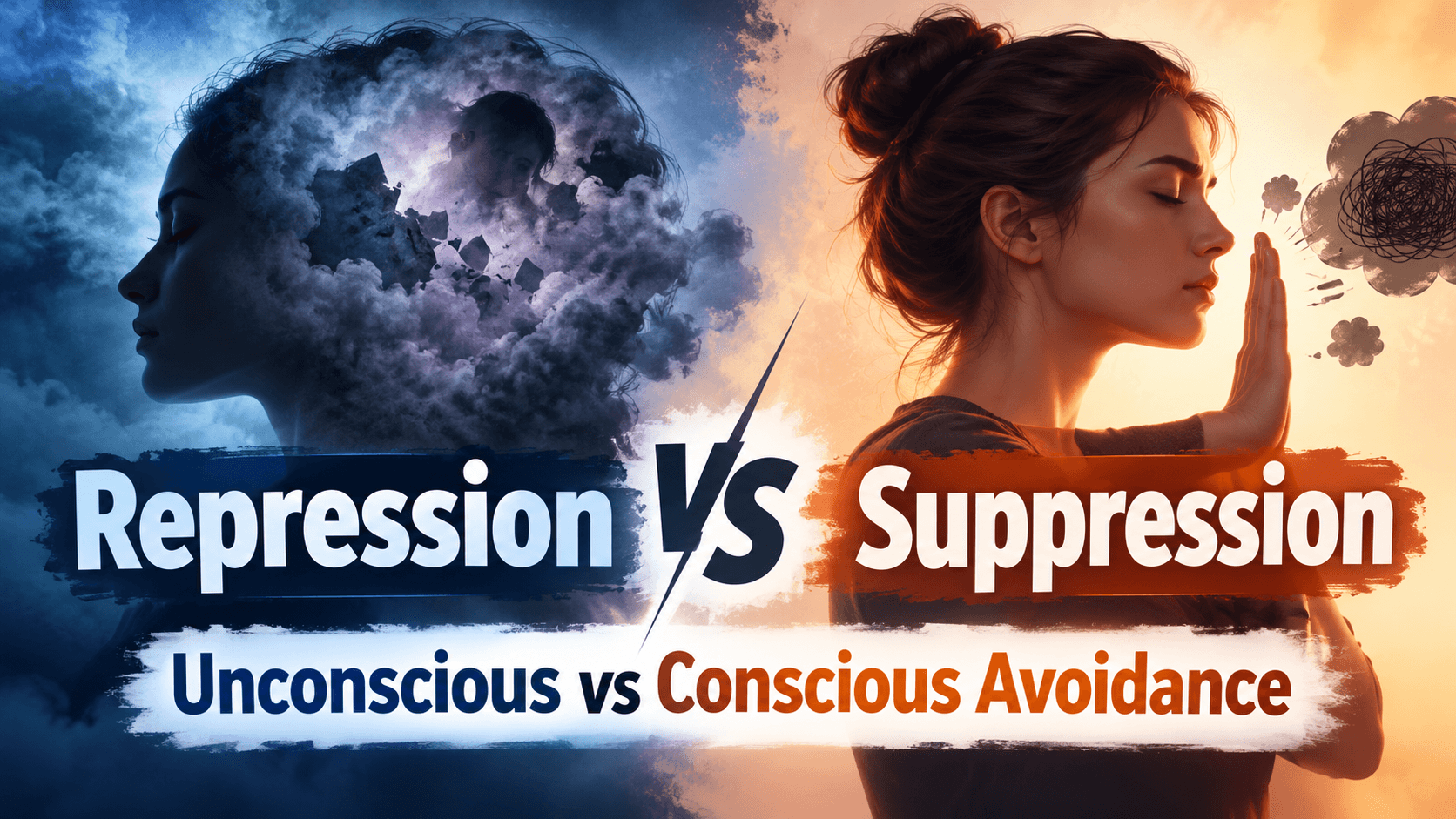
Someone notices anger rising before an important meeting and decides, “I will deal with this tonight.” Another person has no conscious sense of anger at all, even though a theorist might propose that the feeling is being kept outside awareness. Psychology textbooks often use this contrast to explain repression vs suppression: repression is described as unconscious exclusion, while suppression is described as conscious restraint or postponement.
The distinction is useful, but everyday experience is rarely so neat. Awareness can be partial, intention can change over time, and the word suppression has several meanings in psychology. Research on deliberate thought control and motivated forgetting does not automatically validate classical repression. Most importantly, forgetting an event cannot reveal by itself why the memory is unavailable.
This comparison helps clarify the terminology without treating memory gaps, dreams, symptoms, or intense feelings as proof of hidden experiences. It also offers safer ways to handle troubling thoughts without forcing recall or assuming that an unknown past event must exist.
Quick Answer

Repression traditionally means the proposed unconscious exclusion of distressing thoughts, impulses, or experiences from awareness. Suppression means a conscious attempt to inhibit, postpone, or set aside unwanted mental content or emotional expression. Awareness and intention are the main textbook differences, but evidence for classical repression remains debated, and ordinary forgetting or a memory gap does not prove it.
The Main Difference Between Repression and Suppression

Three questions organize the comparison: Is the person aware of the material, are they deliberately trying to manage it, and can they intentionally return to it? These questions are more informative than attaching a label to behavior from the outside.
Awareness
In classical theory, repression operates outside awareness. The person is not simply refusing to talk about a thought; the thought, impulse, or experience is proposed to be unavailable to conscious inspection. The APA Dictionary of Psychology entry on repression places the concept within classical psychoanalytic theory and distinguishes it from suppression.
Suppression begins with at least some awareness. A person notices anger, worry, an image, or an urge and attempts not to engage with it. Awareness may later fade, but the initial management is conscious enough to involve a goal such as “not now” or “do not think about this.”
Deliberate control
Suppression involves intention. The person tries to inhibit a thought, postpone reflection, or control outward expression. That choice may be sensible, ineffective, or costly depending on context. Repression, by definition, is not a strategy the person knowingly selects.
This difference prevents a common mistake. Staying quiet while angry is not automatically repression. If the person knows they are angry and chooses not to speak impulsively, conscious restraint is the closer description. Whether that restraint is helpful depends on what happens next.
Accessibility of psychological content
Suppressed material is usually understood as potentially accessible. The person may be able to name it, notice its return, or revisit it deliberately. Classical repression proposes that the material has been excluded from awareness, so the person cannot simply retrieve it by deciding to think about it.
Accessibility is not all or nothing. A feeling may be vague, difficult to name, or noticed only after the body reacts. Limited access can result from weak encoding, distraction, language difficulty, ordinary forgetting, or many other processes. It does not establish repression.
Repression in Classical Psychology
Repression has a specific historical meaning. Understanding that meaning is different from claiming that the full mechanism has been conclusively demonstrated.
Historical definition
Freud treated repression as a central defense through which unacceptable ideas, wishes, or experiences could be kept from consciousness. The concept helped explain how psychological conflict might continue to influence a person without being directly recognized. Later psychoanalytic writers refined the idea, but definitions and proposed pathways have not always been identical.
Within the wider framework of psychological defense mechanisms, repression is defined by proposed exclusion from awareness, a claim that must remain separate from deliberate control and ordinary forgetting.
The theory concerns more than forgetting something unpleasant. It proposes motivated exclusion linked to conflict or anxiety. A forgotten appointment, a hazy childhood year, or failure to recall a name does not meet that definition simply because the missing information matters emotionally.
The proposed unconscious defensive function
The protective function is proposed to be reduced contact with material that threatens self-image, attachment, morality, or emotional stability. A classical hypothetical example might involve anger toward a loved person becoming unavailable because acknowledging both love and anger feels intolerable.
This is an interpretation, not something an observer can read directly from behavior. Silence, tension, a dream, a physical sensation, or an inconsistent account can have many explanations. None is a reliable code that reveals a particular repressed thought or event.
Why modern research complicates this account
Research can test attention, retrieval, inhibition, directed forgetting, and deliberate attempts not to think. Classical repression is harder to test because the proposed content and the process excluding it are both outside awareness. Researchers must decide in advance what would count as evidence for the mechanism and what alternative explanations must be ruled out.
There is also a translation problem. Demonstrating that people can intentionally reduce later recall does not show that distressing autobiographical experiences are unconsciously blocked and later recovered intact. Similar words can hide important differences in awareness, method, and claim.
Indirect influence is not enough on its own. If a person reacts strongly without knowing why, researchers still need to distinguish repression from implicit learning, habit, incomplete recall, current context, and chance. Otherwise, any unexplained response can be made to fit the theory after the fact.
Suppression in Psychology
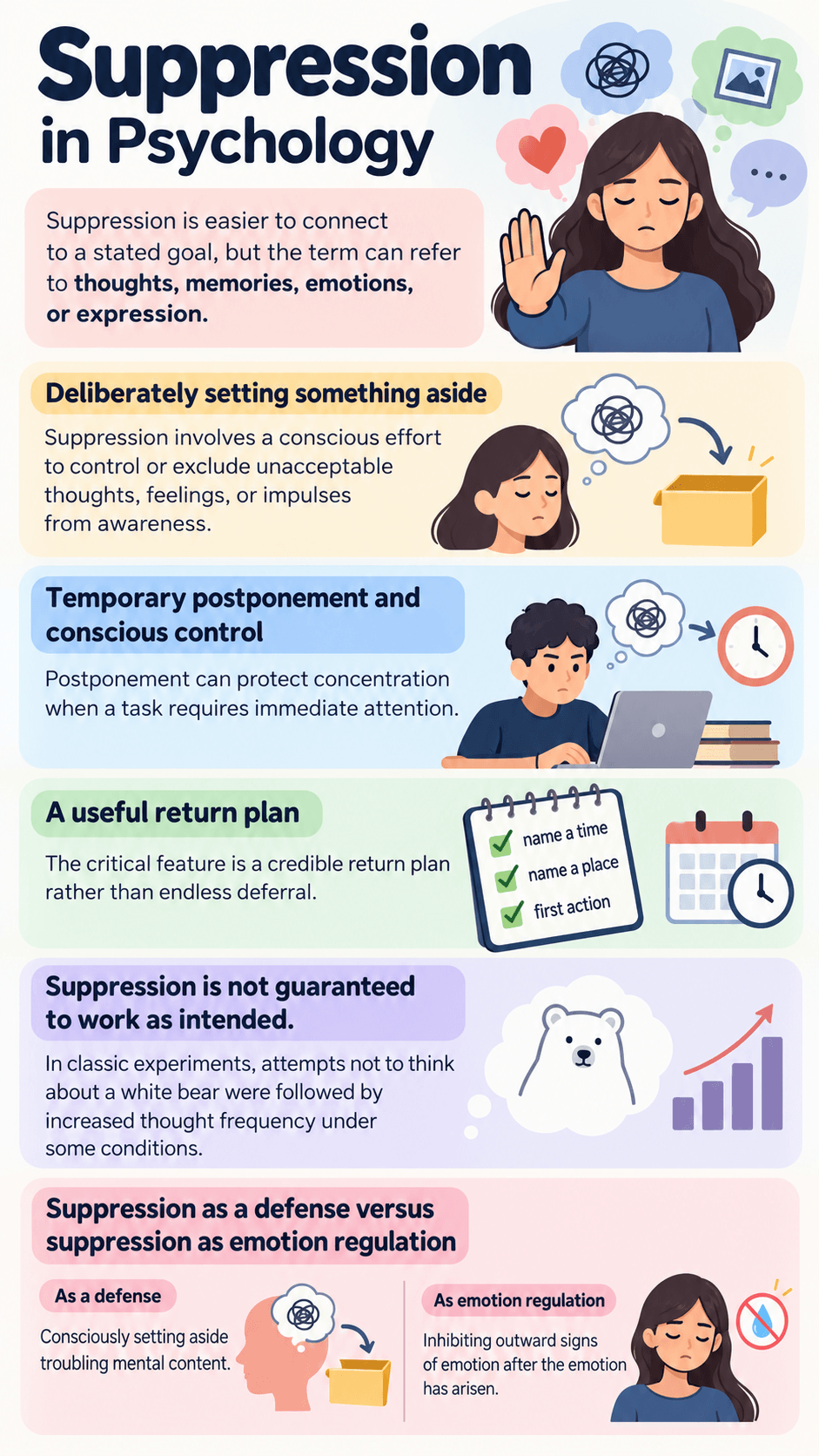
Suppression is easier to connect to a stated goal, but the term can refer to thoughts, memories, emotions, or expression. Clear discussion specifies what is being controlled.
Deliberately setting something aside
The APA Dictionary of Psychology entry on suppression describes a conscious effort to control or exclude unacceptable thoughts, feelings, or impulses from awareness. In ordinary use, this might mean noticing a painful thought and intentionally redirecting attention for a limited period.
The person does not have to explain the thought in detail for the act to be conscious. “I know what is bothering me, and I cannot examine it safely right now” contains awareness, intention, and a reason for postponement.
Temporary postponement and conscious control
Postponement can protect concentration when a task requires immediate attention. A surgeon, driver, caregiver, or student may need to set aside a personal concern briefly. The critical feature is a credible return plan rather than endless deferral.
A useful return plan names a time, place, and first action: review the message after dinner, write down the worry before bed, or speak once both people are calm. The plan keeps “not now” from quietly becoming “never.”
Suppression is not guaranteed to work as intended. In classic experiments on the paradoxical effects of thought suppression, attempts not to think about a white bear were followed by increased thought frequency under some conditions. The finding concerns deliberate thought control, not proof of unconscious repression.
Suppression as a defense versus suppression as emotion regulation
In defense terminology, suppression often means consciously setting aside troubling mental content. In emotion-regulation research, expressive suppression commonly refers to inhibiting outward signs of emotion after the emotion has arisen. A person may feel sadness fully while preventing tears during a public task.
Reaction formation differs from suppression because it proposes an opposite outward response rather than conscious postponement or inhibition.
These processes overlap but are not identical. Controlling facial expression does not necessarily remove a thought from awareness or reduce the emotion itself. Likewise, postponing a worry does not always involve hiding its outward expression. The object of control must be stated.
Repression vs Suppression Comparison
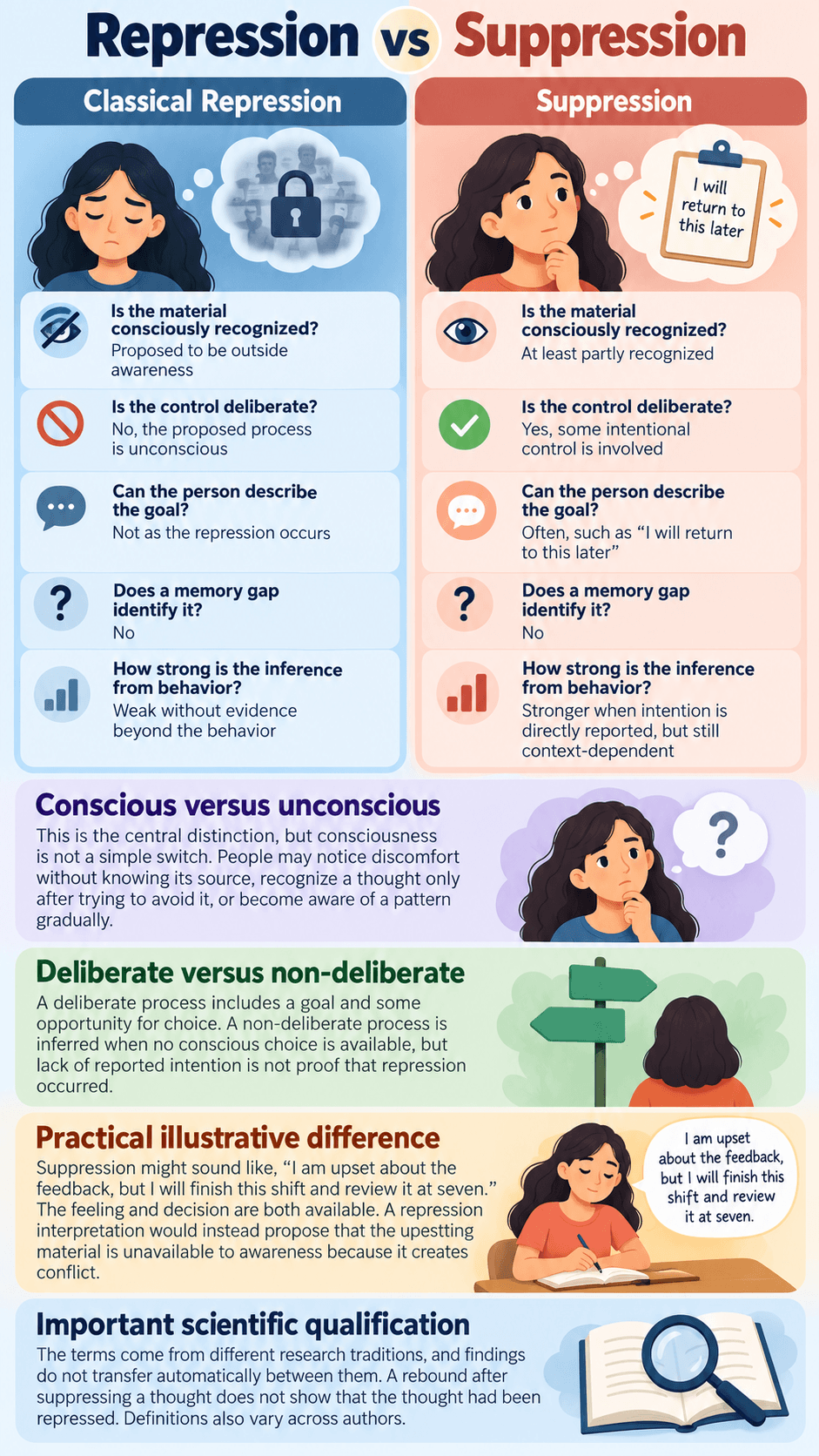
The textbook contrast is clearest when awareness and intention are considered together. The table summarizes the concepts while preserving uncertainty about what can be inferred in real life.
| Question | Classical repression | Suppression |
|---|---|---|
| Is the material consciously recognized? | Proposed to be outside awareness | At least partly recognized |
| Is the control deliberate? | No, the proposed process is unconscious | Yes, some intentional control is involved |
| Can the person describe the goal? | Not as the repression occurs | Often, such as “I will return to this later” |
| Does a memory gap identify it? | No | No |
| How strong is the inference from behavior? | Weak without evidence beyond the behavior | Stronger when intention is directly reported, but still context-dependent |
Conscious versus unconscious
This is the central distinction, but consciousness is not a simple switch. People may notice discomfort without knowing its source, recognize a thought only after trying to avoid it, or become aware of a pattern gradually. Partial awareness makes sharp classification difficult.
A cautious description can be more accurate than a confident label: “I noticed that I changed the subject when the feeling appeared” says what happened without pretending to know the complete mechanism.
Deliberate versus non-deliberate
A deliberate process includes a goal and some opportunity for choice. Someone can say what they are trying to postpone or inhibit. A non-deliberate process is inferred when no conscious choice is available, but lack of reported intention is not proof that repression occurred.
Habits complicate the contrast. A once-deliberate avoidance routine may become fast and automatic. That does not necessarily transform it into classical repression; it may reflect learned attentional or behavioral patterns.
Practical illustrative differences
Suppression might sound like, “I am upset about the feedback, but I will finish this shift and review it at seven.” The feeling and decision are both available. A repression interpretation would instead propose that the upsetting material is unavailable to awareness because it creates conflict.
Only the first example can be identified from the person’s stated intention. The second requires a theory about hidden mental activity. It should remain hypothetical unless evidence can distinguish it from forgetting, distraction, confusion, limited emotional vocabulary, and other explanations.
Important scientific qualifications
The terms come from different research traditions, and findings do not transfer automatically between them. A laboratory instruction to avoid recalling a word pair is not equivalent to an unconscious defense involving a complex autobiographical experience. A rebound after suppressing a thought does not show that the thought had been repressed.
Definitions also vary across authors. Responsible use states which meaning is intended, separates theory from observation, and avoids treating one simplified comparison as a settled account of every form of unwanted memory.
Evidence for one component should not be treated as evidence for the entire sequence. Demonstrating control over retrieval, for example, does not automatically establish unconscious motivation, accurate preservation, or later recovery. Each part of the claim needs its own support.
Everyday Examples and Their Limitations
Everyday situations can clarify conscious postponement. They cannot provide a reliable way to identify unconscious repression in someone else.
Choosing not to discuss anger yet
During an argument, Maya recognizes that she is angry and says she needs thirty minutes before continuing. She avoids speaking while highly activated and agrees on a return time. This is conscious regulation or temporary suppression, not evidence that the anger has been repressed.
If Maya never returns, repeatedly denies being angry, or cannot name what happens, several explanations remain possible. Fear, conflict avoidance, learned politeness, uncertainty, and limited trust should be considered before an unconscious defense is proposed.
This also differs from denial as a defense mechanism, which concerns nonacknowledgment of a distressing reality or its implications rather than the accessibility of a thought or feeling.
Deliberately postponing a difficult thought
Jon receives upsetting feedback before an exam. He writes one sentence about what he will review later, closes the message, and returns to studying. The note preserves a route back to the issue. His aim is not to prove the feeling unimportant but to choose when to address it.
This strategy becomes less useful if every return time is postponed or if attention must be constantly occupied to keep the thought away. The problem would be persistent avoidance or interference, not proof that the material has become repressed.
Why forgetting a past event does not establish repression
An adult remembers little about many ordinary days from childhood. That gap is not evidence that a hidden traumatic event occurred. Memories can be absent because the experience was never strongly encoded, details faded, retrieval cues are missing, or many similar events blended together.
The reverse is also important: uncertainty about a memory does not prove that nothing happened. A memory gap is simply insufficient to identify an event or its cause. Corroborating records, independent evidence, and careful professional assessment matter more than a confident story built from absence.
Repression, Forgetting, and Memory Reliability

Memory is not a complete recording that either plays correctly or has been locked away. Remembering depends on encoding, storage, retrieval, cues, later information, and reconstruction.
Normal forgetting
People forget names, conversations, sequences, and long periods of routine life. Attention may have been divided when the event occurred. Similar experiences interfere with one another. Details weaken over time, and retrieval changes with context. These ordinary mechanisms can explain many gaps without invoking a defense.
Emotional significance does not guarantee permanent, detailed recall. Some meaningful events remain vivid, while others are remembered in fragments or with uncertainty. The pattern varies and cannot identify a single cause from the memory report alone.
Memory reconstruction and false memories
Remembering is reconstructive. Later questions, stories, images, expectations, and repeated imagination can influence what feels familiar. In an original experiment using a doctored childhood photograph and imagery instructions, some participants developed partial or full false memories of a suggested event. The study does not show that all disputed memories are false; it demonstrates that suggestion can matter.
A memory may be accurate, inaccurate, incomplete, or a mixture. Confidence and emotional intensity do not independently establish accuracy. This is why attempts to uncover a presumed hidden event can be risky when the premise has not been established.
False-memory research does not justify dismissing every late or uncertain recollection. Its practical value is showing that memory evidence needs the same care as other evidence. Context, independent corroboration, suggestion history, and changes across retellings all matter.
Why memory gaps do not reveal a specific psychological cause
The same absence can result from many pathways, including limited attention, ordinary forgetting, ineffective cues, deliberate non-rehearsal, developmental factors, or uncertainty about what counts as a memory. The gap does not contain a label explaining how it formed.
Dreams, bodily reactions, relationship patterns, and symptoms can deserve attention as present experiences, but they do not reliably identify a forgotten event. Hypnosis and guided efforts to recover a presumed memory cannot convert uncertainty into historical proof.
What Contemporary Research Says

Current research supports several forms of cognitive control and motivated forgetting. The debate concerns how those findings relate to the stronger claim of unconscious repression of autobiographical experience.
Historical psychoanalytic claims
Classical repression combined motive, lack of awareness, inaccessibility, and continued psychological influence. Testing that complete sequence is difficult because a researcher must establish that material existed, became inaccessible through a defensive process, and later affected behavior for that reason.
A major review of persistent claims about repressed and recovered memories describes continuing scientific and professional controversy. The debate should not be reduced to “all recovered memories are true” or “all are false.” The responsible position evaluates each claim with evidence while recognizing memory’s limits.
Motivated forgetting and cognitive control
In the think/no-think paradigm, people learn associations and then practice retrieving some while trying to prevent others from entering awareness. Anderson and Green reported reduced later recall after repeated attempts to suppress retrieval. This provides evidence that intentional control can affect memory accessibility under defined laboratory conditions.
The result is relevant to motivated forgetting, but its starting point is a conscious instruction. It does not by itself demonstrate that an autobiographical event was unconsciously repressed, preserved accurately, and later recovered. Laboratory effects should be described at the level actually tested.
Controversies in defining and testing repression
Researchers disagree about definitions, evidence standards, and whether other concepts better explain findings attributed to repression. Some studies examine retrieval inhibition, others examine avoidance, dissociation, self-protective memory, or reports of recovered experience. Treating them as one mechanism creates false agreement.
A useful scientific claim must be distinguishable from alternatives. If every memory gap supports repression and every remembered detail also supports it, the theory cannot be meaningfully tested. Evidence should have the possibility of changing the conclusion.
How to Respond to Uncomfortable Thoughts Without Forcing Recall
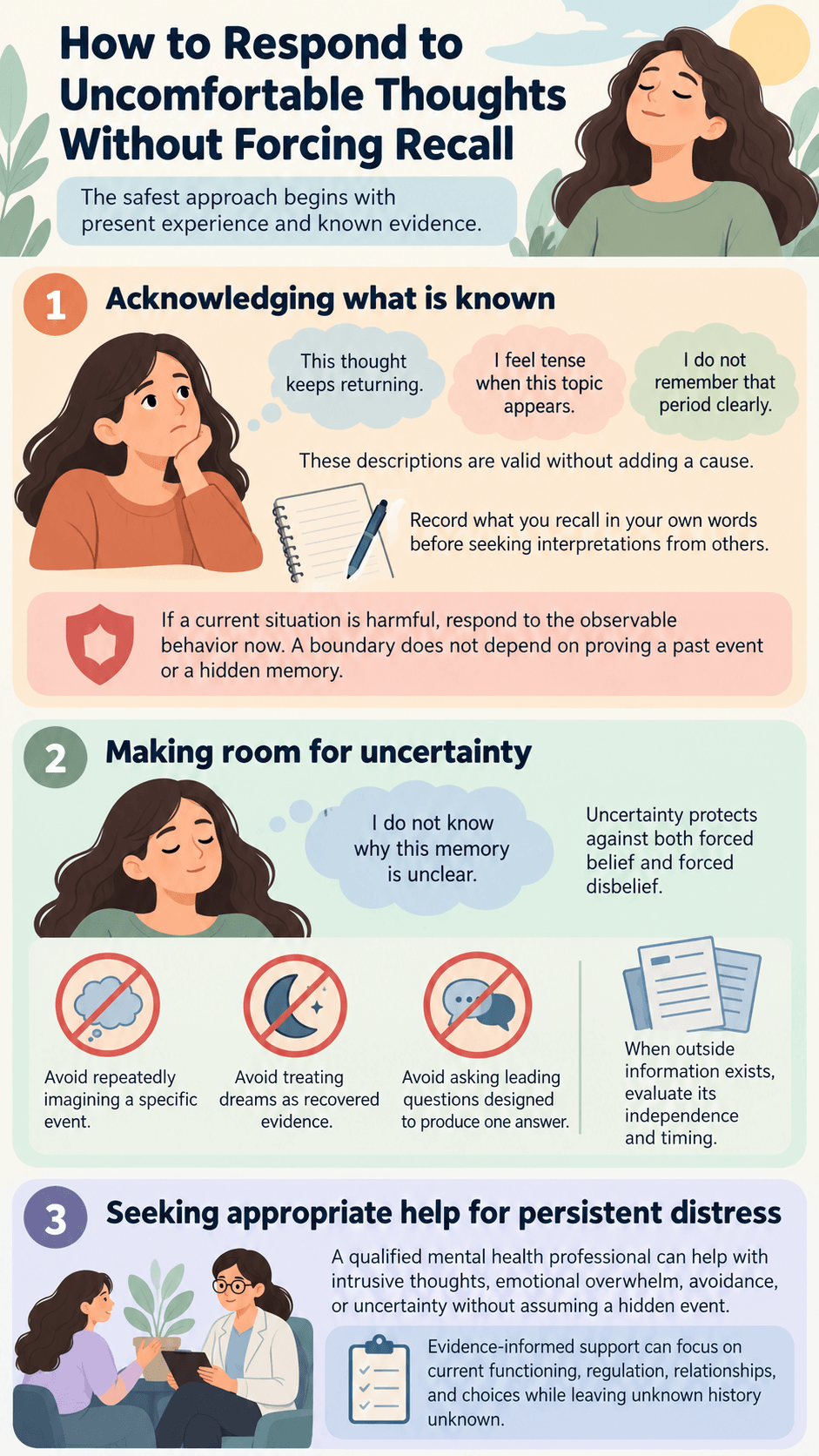
The safest approach begins with present experience and known evidence. It does not require deciding that an unknown event must explain current distress.
Acknowledging what is known
Use precise statements: “This thought keeps returning,” “I feel tense when this topic appears,” or “I do not remember that period clearly.” These descriptions are valid without adding a cause. Record what you recall in your own words before seeking interpretations from others.
If a current situation is harmful, respond to the observable behavior now. A boundary does not depend on proving that a past event was repressed or that a present reaction came from a hidden memory.
Making room for uncertainty
It is possible to say, “I do not know why this memory is unclear.” Uncertainty protects against both forced belief and forced disbelief. Avoid repeatedly imagining a specific event, treating dreams as recovered evidence, or asking leading questions designed to produce one answer.
When outside information exists, evaluate its independence and timing. A contemporaneous record differs from a later account influenced by repeated discussion. Even corroboration should be weighed carefully rather than used to fill every missing detail.
Seeking appropriate help for persistent distress
A qualified mental health professional can help with intrusive thoughts, emotional overwhelm, avoidance, or uncertainty without assuming a hidden event. Evidence-informed support can focus on current functioning, regulation, relationships, and choices while leaving unknown history unknown.
Ask how the professional handles memory uncertainty. Caution is warranted if someone promises to recover memories, treats hypnosis as verification, or interprets every symptom as proof of a specific forgotten experience.
A responsible helper can acknowledge that the distress is real without claiming certainty about its origin. Present-focused work may include managing intrusive thoughts, improving sleep, reducing avoidance, documenting current concerns, and strengthening safe relationships while historical questions remain open.
When Professional Support May Help
Consider support when unwanted thoughts, memory concerns, avoidance, or emotional suppression repeatedly disrupts sleep, work, relationships, or daily decisions. Seek urgent local help if there is immediate danger, self-harm risk, severe confusion, or inability to stay safe. This educational comparison cannot identify a diagnosis or determine what happened in an uncertain past.
Medical or neurological concerns about sudden memory change require appropriately qualified medical evaluation. Psychological reflection should not replace assessment of a new or rapidly worsening cognitive problem.
FAQ About Repression vs Suppression
These answers preserve the textbook distinction while keeping the scientific limits visible.
Is repression unconscious while suppression is conscious?
That is the standard conceptual distinction. Classical repression is proposed to exclude material outside awareness without deliberate choice. Suppression involves conscious effort to inhibit, postpone, or set something aside. Real awareness can be partial, so the categories are not always easy to identify from everyday behavior.
Is suppression the same as ordinary forgetting?
No. Suppression involves an intention to control thought, retrieval, or expression. Ordinary forgetting can occur without any such goal because information was weakly encoded, faded, interfered with other memories, or lacks effective retrieval cues.
Can a memory gap prove that repression occurred?
No. A gap shows that information is not currently available, not why it is missing. Ordinary forgetting, limited attention, retrieval difficulty, deliberate non-rehearsal, and other processes remain possible. A gap also cannot prove that a particular hidden event occurred.
Does research on motivated forgetting prove classical repression?
No. Motivated-forgetting studies show that goals and cognitive control can affect later memory under specified conditions. Many paradigms begin with conscious instructions, which differs from a process defined as unconscious. The findings are relevant but do not settle the broader classical claim.
Should someone try to recover a presumed repressed memory?
Do not assume that an unknown event exists or use suggestive methods to search for it. Focus on current distress and known evidence with an appropriately qualified professional. A memory that emerges may require careful evaluation; vividness or confidence alone does not verify historical accuracy.
Key Takeaways
- Classical repression is proposed to be unconscious, while suppression involves awareness and deliberate control.
- Suppression can refer to setting aside thoughts, inhibiting retrieval, or limiting emotional expression, so the meaning should be specified.
- Research on thought control and motivated forgetting does not automatically validate classical repression.
- Normal forgetting, memory reconstruction, and retrieval problems can all produce gaps without an unconscious defense.
- Memory gaps, dreams, symptoms, hypnosis, and emotional intensity do not establish a hidden event or its cause.
- Helpful support can address present distress while respecting uncertainty and avoiding forced recall.

Michael Reed is the Founder and Lead Writer at Psychology Exposed. He writes about human behavior, relationships, emotional patterns, self-awareness, and practical psychology topics using research-informed, easy-to-understand content.
Read More About Michael Reed: https://psychologyexposed.com/michael-reed/