

A person feels irritated with a colleague yet becomes unusually warm and accommodating around them. Someone is frightened by a challenge but presents intense, almost theatrical confidence. These contrasts may invite a familiar explanation: perhaps the visible response is the opposite of a feeling the person cannot accept. In classical psychology, that proposed process is called reaction formation.
The idea can be useful for thinking about internal conflict, but it is easily turned into mind-reading. Friendliness does not prove resentment, moral conviction does not prove a forbidden desire, and hostility does not prove secret attraction. The same behavior can arise from politeness, values, fear, role expectations, strategic self-presentation, mixed feelings, or many other causes.
This guide explains the reaction formation defense mechanism as a historical and contemporary psychological concept, then separates it from conscious restraint, hypocrisy, impression management, suppression, and undoing. The central limit matters throughout: behavior is observable, while an unconscious motive is an interpretation that requires much more evidence.
Quick Answer

Reaction formation is a proposed defense mechanism in which an unacceptable or distressing feeling, wish, or impulse is unconsciously replaced by an opposing attitude or behavior. The outward response may appear unusually strong or rigid, but contrast and intensity alone do not prove reaction formation. Context, alternative explanations, and the limits of inferring unconscious motives must remain visible.
What Reaction Formation Means
The term describes a particular relationship between a proposed inner conflict and an outward response. It does not simply mean changing one’s mind, behaving inconsistently, or choosing a socially appropriate action.
The classical psychoanalytic definition
In classical psychoanalytic theory, a thought, feeling, wish, or impulse creates conflict because it seems dangerous, shameful, disloyal, immoral, or otherwise unacceptable. Rather than being consciously acknowledged, it is proposed to be replaced in awareness by its opposite. The APA Dictionary of Psychology entry on reaction formation provides a concise reference point for this traditional definition.
The theory does not describe a momentary decision to act differently from a feeling. It proposes that an opposing psychological position forms as a defense against recognizing the original experience. Deliberately displaying the opposite of a known feeling would point toward another process.
Reaction formation is part of the psychoanalytic tradition associated with Sigmund Freud and later systematized in work on ego defenses by Anna Freud and others. Modern authors do not all define or measure defenses in exactly the same way, so historical terminology should not be mistaken for a single, fully settled scientific model.
The wider framework of psychological defense mechanisms helps distinguish changes in outward expression from changes in awareness, acknowledgment, or attribution.
The proposed role of unacceptable internal feelings
The original feeling does not need to be objectively wrong. Within the theory, it only needs to feel incompatible with the person’s self-image, loyalties, moral standards, relationships, or safety. Anger toward someone loved, relief after a burden ends, or envy toward a friend could all be difficult to acknowledge.
Mixed emotions are ordinary. Love can coexist with anger, loyalty with disappointment, confidence with fear, and generosity with resentment. Reaction formation is a stronger claim than ambivalence. It proposes that one side of the conflict remains outside awareness while an opposing response takes its place.
Reaction formation also differs from psychological projection, which attributes uncomfortable self-related content to someone else rather than replacing it with an opposite.
A person who says, “Part of me is happy for my friend, and part of me feels envious,” is recognizing conflict rather than replacing one side with its opposite. That awareness makes the classical explanation less fitting.
How Reaction Formation Is Proposed to Work
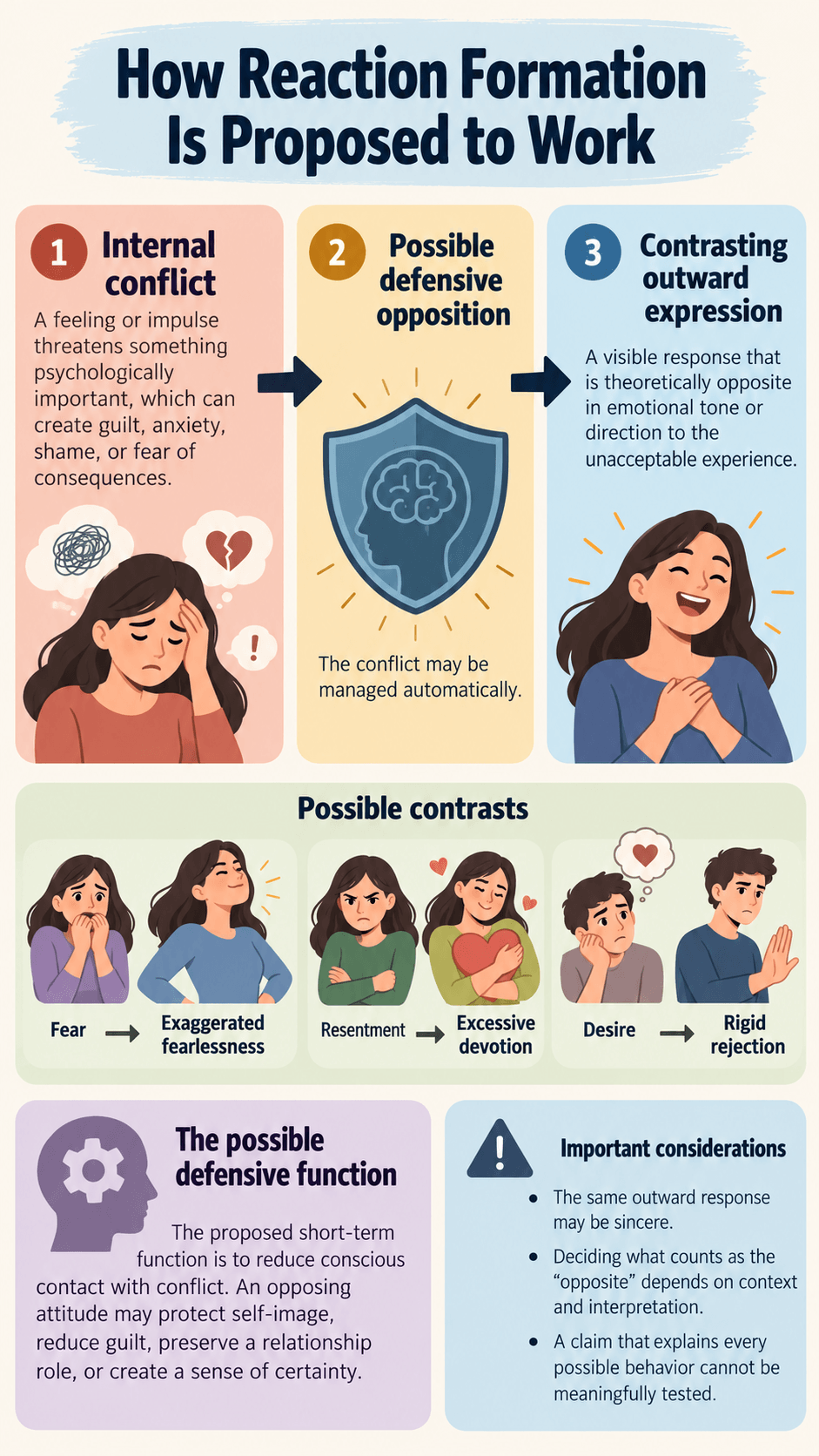
A simple conceptual sequence is: difficult internal experience, possible defensive opposition, and contrasting outward expression. Every step after the observable behavior remains a proposed interpretation rather than a fact visible from the outside.
Internal conflict
The process is proposed to begin when a feeling or impulse threatens something psychologically important. The threat might concern being a good parent, a loyal partner, a brave employee, a generous friend, or a morally consistent person. Recognizing the feeling could create guilt, anxiety, shame, or fear of consequences.
Classical theory suggests that the conflict may be managed automatically. Phebe Cramer’s review of defense mechanisms in modern psychology describes renewed empirical interest in defenses and unconscious processes. Still, unconscious processing in general does not prove reaction formation in a particular person. The specific claim must be distinguished from habit, learning, social rules, and sincere attitudes.
Opposite outward expression
The visible response is theoretically opposite in emotional tone or direction to the unacceptable experience. Possible contrasts include fear expressed as exaggerated fearlessness, resentment expressed as excessive devotion, or desire expressed as rigid rejection. The word possible is essential because the same outward response may be sincere.
Opposition is not always a perfect mirror image. A person may become unusually strict, enthusiastic, agreeable, or protective, but deciding what counts as the “opposite” depends on context and interpretation.
Observers also bring their own expectations. If they assume that warmth must conceal hostility, any kindness can be recast as evidence. If they assume that strong disagreement must conceal desire, both agreement and disagreement become compatible with the same story. A claim that explains every possible behavior cannot be meaningfully tested.
The possible defensive function
The proposed short-term function is to reduce conscious contact with conflict. An opposing attitude may protect self-image, reduce guilt, preserve a relationship role, or create a sense of certainty. From this perspective, the response is not necessarily calculated deception and is not automatically a moral failing.
Protection can still have costs. A rigid position may make nuance harder to tolerate, strain relationships, or prompt overcommitment. Yet function and origin must be separated. Extra courtesy during conflict may protect a working relationship because the person deliberately values professionalism, not because an unconscious opposite has been substituted.
Illustrative Examples of Reaction Formation
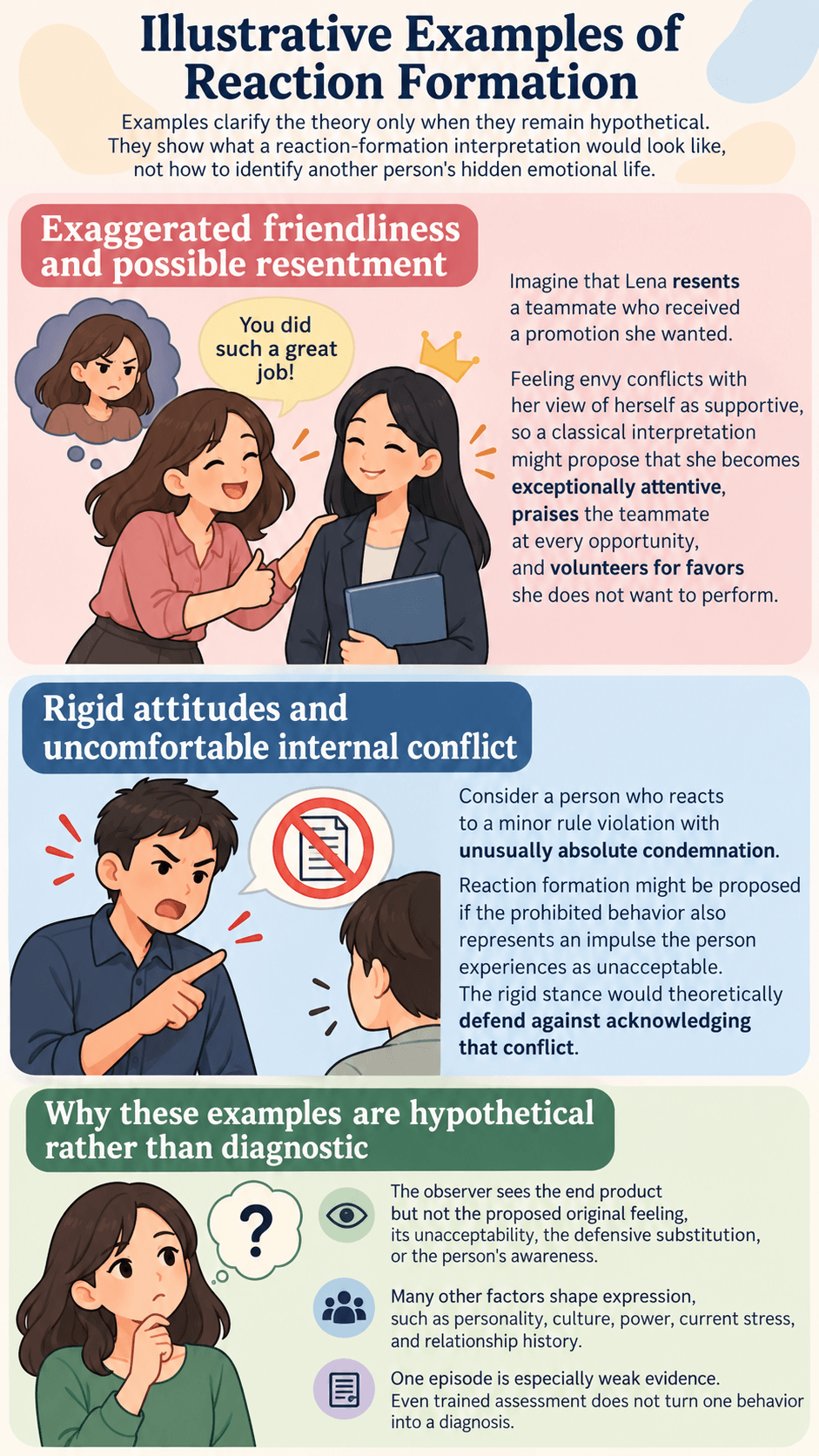
Examples clarify the theory only when they remain hypothetical. They show what a reaction-formation interpretation would look like, not how to identify another person’s hidden emotional life.
Exaggerated friendliness and possible resentment
Imagine that Lena resents a teammate who received a promotion she wanted. Feeling envy conflicts with her view of herself as supportive, so a classical interpretation might propose that she becomes exceptionally attentive, praises the teammate at every opportunity, and volunteers for favors she does not want to perform.
Several other explanations fit the same behavior. Lena may genuinely admire the teammate, consciously compensate for noticing envy, follow professional norms, hope to strengthen the relationship, or simply have an expressive communication style. Even unusual warmth cannot decide among these explanations.
The responsible observation stays close to what is known: Lena is offering frequent praise and help. In self-reflection, she can ask whether this generosity feels freely chosen, obligatory, or difficult to sustain. An observer should not claim access to feelings she has not expressed.
Rigid attitudes and uncomfortable internal conflict
Consider a person who reacts to a minor rule violation with unusually absolute condemnation. Reaction formation might be proposed if the prohibited behavior also represents an impulse the person experiences as unacceptable. The rigid stance would theoretically defend against acknowledging that conflict.
Firmness can come from sincere values, cultural learning, prior harm, a formal role, or incomplete information. A strong moral position does not reveal someone’s sexual orientation, attraction, identity, trauma history, or hidden intention.
This limitation is especially important when reaction formation is used as a rhetorical weapon: “You oppose it, so you must secretly want it.” That statement makes disagreement impossible and turns speculation into accusation. It is neither a sound method of psychological assessment nor a respectful way to discuss identity.
Why these examples are hypothetical rather than diagnostic
The observer sees the end product but not the proposed original feeling, its unacceptability, the defensive substitution, or the person’s awareness. Each missing step leaves room for alternatives.
One episode is especially weak evidence. Personality, culture, power, current stress, and relationship history all shape expression. A warm greeting to a disliked supervisor may reflect workplace judgment rather than an unconscious transformation of resentment.
Even trained assessment does not turn one behavior into a diagnosis. Observer-rated systems use definitions, context, repeated material, and comparisons with nearby defenses. Use examples to understand the concept, not to decode people.
Reaction Formation vs Ordinary Emotional Restraint
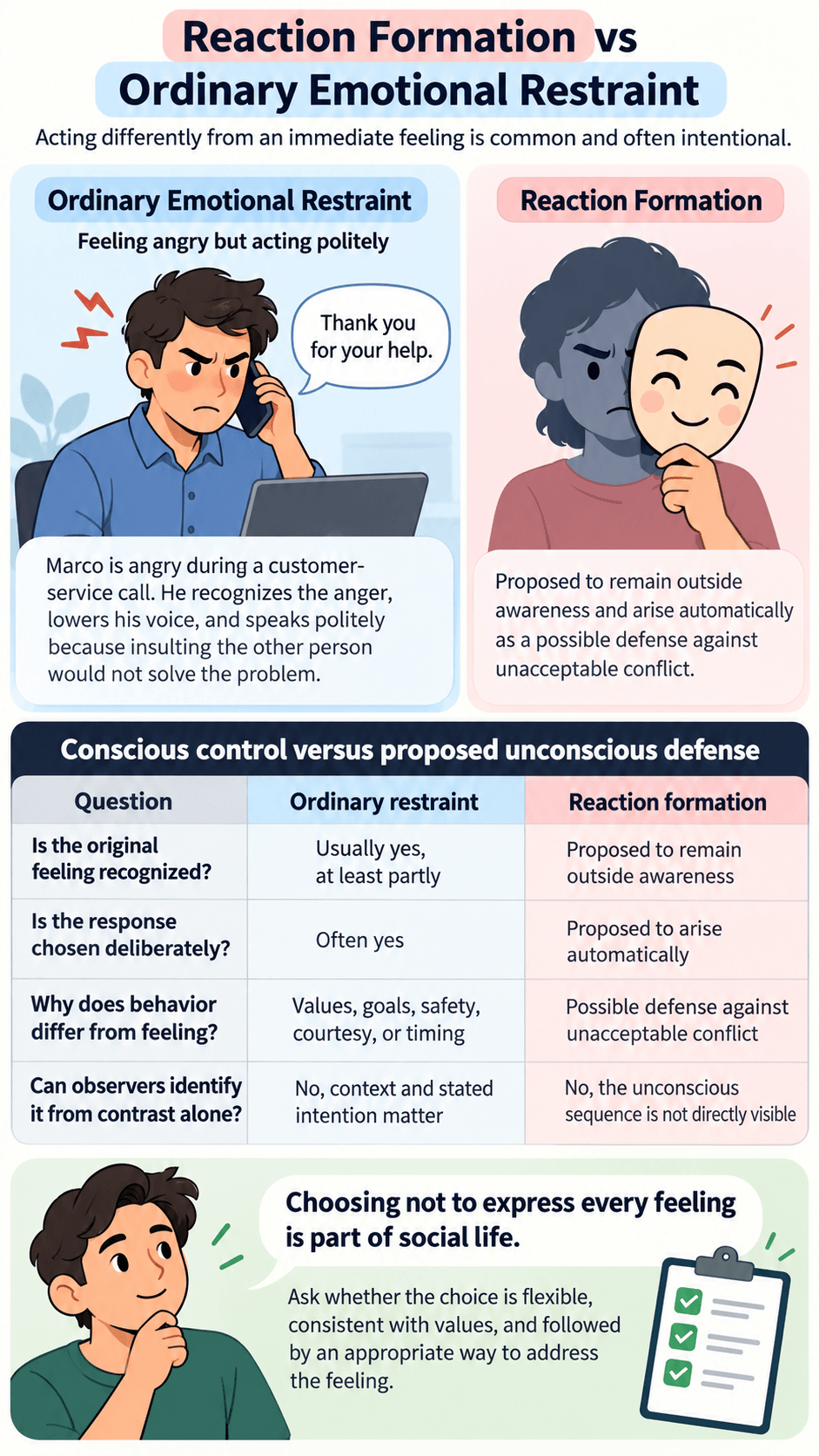
Acting differently from an immediate feeling is common and often intentional. The key distinction is not the visible contrast but awareness of the feeling and the reason for choosing a response.
Feeling angry but acting politely
Suppose Marco is angry during a customer-service call. He recognizes the anger, lowers his voice, and speaks politely because insulting the other person would not solve the problem. His behavior contrasts with his emotional impulse, but he has not necessarily replaced anger with its opposite.
This can be ordinary self-control or emotion regulation. Marco may still feel the anger, name it afterward, and decide whether a boundary is needed. Politeness does not mean the anger disappeared or require an unconscious defense.
Restraint becomes costly when it is chronic, compulsory, or prevents a person from addressing legitimate needs. That concern can be discussed directly. It is unnecessary to infer reaction formation when the person already knows what they feel and why they are choosing not to act on it.
Conscious control versus proposed unconscious defense
| Question | Ordinary restraint | Reaction formation |
|---|---|---|
| Is the original feeling recognized? | Usually yes, at least partly | Proposed to remain outside awareness |
| Is the response chosen deliberately? | Often yes | Proposed to arise automatically |
| Why does behavior differ from feeling? | Values, goals, safety, courtesy, or timing | Possible defense against unacceptable conflict |
| Can observers identify it from contrast alone? | No, context and stated intention matter | No, the unconscious sequence is not directly visible |
Choosing not to express every feeling is part of social life. Ask whether the choice is flexible, consistent with values, and followed by an appropriate way to address the feeling.
Reaction Formation vs Hypocrisy and Impression Management
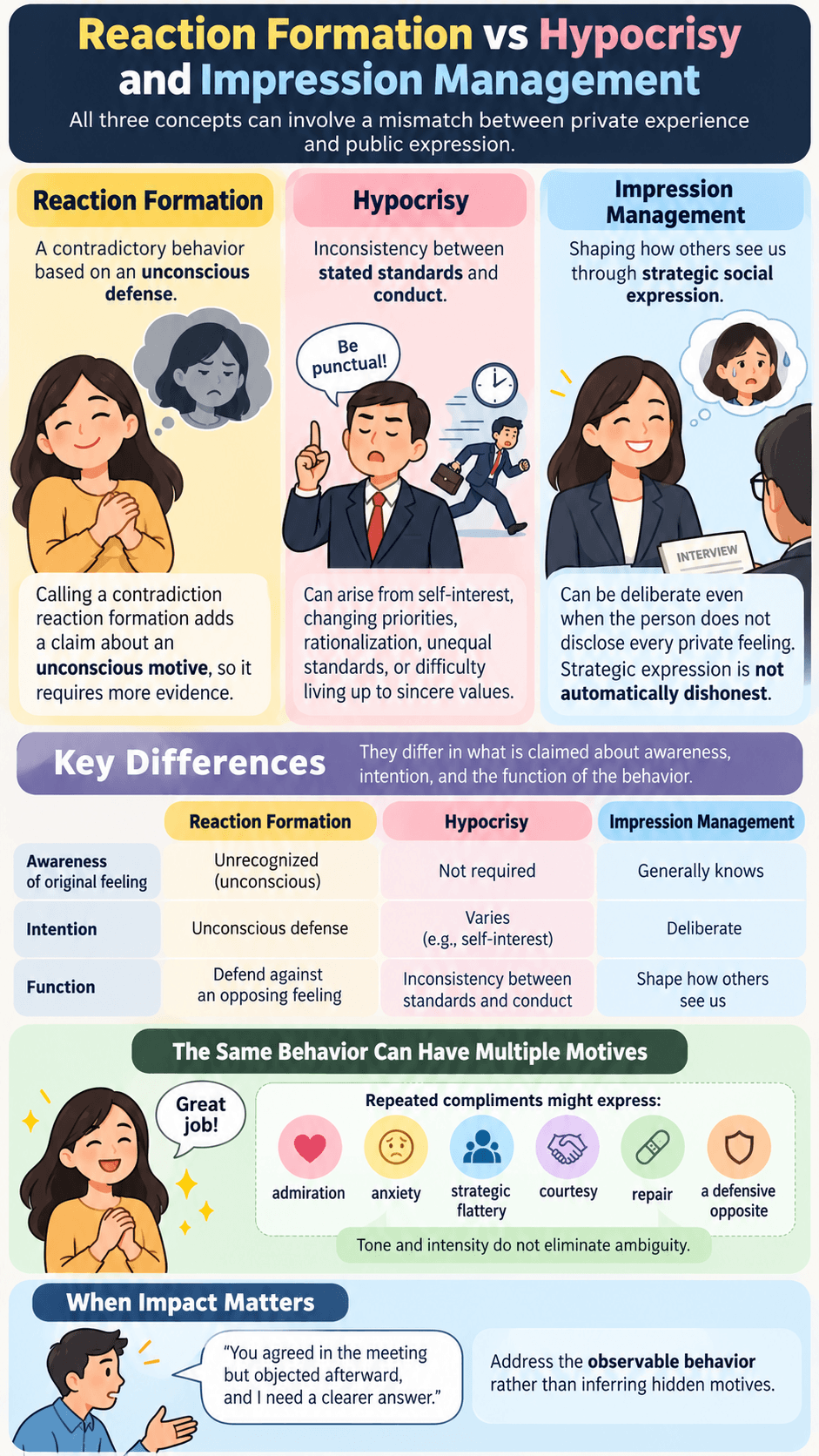
All three concepts can involve a mismatch between private experience and public expression. They differ in what is claimed about awareness, intention, and the function of the behavior.
Contradictory behavior without an unconscious defense
Hypocrisy usually refers to inconsistency between stated standards and conduct. A person publicly demands punctuality but is repeatedly late, or condemns dishonesty while lying for convenience. The contradiction can be identified without knowing whether an opposing feeling has been formed.
Hypocrisy can arise from self-interest, changing priorities, rationalization, unequal standards, or difficulty living up to sincere values. Reaction formation is only one theoretical interpretation among many.
Calling a contradiction reaction formation adds a claim about an unconscious motive, so it requires more evidence than identifying the contradiction itself.
Strategic social expression
Impression management involves shaping how others see us. A candidate may emphasize confidence during an interview despite feeling nervous. A host may act welcoming toward a difficult guest to preserve the occasion. The presentation can be deliberate even when the person does not disclose every private feeling.
Strategic expression is not automatically dishonest. Social roles require selectivity, and privacy permits people to keep some feelings private. Consequences and actual deception matter more than an assumed hidden opposite.
In reaction formation, the original feeling is proposed to remain unrecognized. In impression management, the person generally knows what impression they want to create. The same smile could fit either description, so the smile alone proves neither.
Why motives cannot be inferred confidently
Several motives can produce the same action. Repeated compliments might express admiration, anxiety, strategic flattery, courtesy, repair, or a defensive opposite. Tone and intensity do not eliminate ambiguity.
A useful comparison separates observation from inference:
| What can be observed | What remains uncertain |
|---|---|
| The person praises someone repeatedly | Whether admiration, strategy, anxiety, or resentment is driving it |
| The person takes an unusually absolute position | Whether it reflects sincere values, fear, role demands, or internal conflict |
| The person behaves differently in public and private | Whether the difference reflects safety, privacy, status, strategy, or defense |
When impact matters, address the observable behavior. “You agreed in the meeting but objected afterward, and I need a clearer answer” is more grounded than “Your agreement proves you secretly feel the opposite.”
Reaction Formation vs Suppression and Undoing
These neighboring concepts describe different ways of managing conflict. The contrasts become clearer when we ask what happens to the original feeling and whether the person is aware of managing it.
The repression versus suppression distinction is especially useful here because it centers on awareness and intention rather than opposite expression.
Opposite expression
Reaction formation proposes substitution. An unacceptable feeling or impulse is not consciously held alongside a chosen behavior; an opposing attitude or response takes its place in awareness. The defensive element lies in the proposed transformation into an opposite.
That differs from simple concealment. Someone may dislike a coworker and knowingly act civil. The feeling remains in awareness, and the conduct follows a deliberate rule.
Conscious inhibition
Suppression generally refers to consciously setting aside a thought, feeling, or impulse. The APA Dictionary of Psychology entry on suppression distinguishes this intentional control from processes proposed to operate outside awareness.
A person using suppression might think, “I am jealous, but I will not discuss it until I have calmed down.” The feeling is recognized and postponed. A reaction-formation account would instead propose that the jealousy is unacceptable and outside awareness while conspicuous praise or self-sacrificing support occupies the foreground.
Suppression may be useful with a realistic return point or become avoidance if the issue is never revisited. Neither outcome makes it reaction formation.
Attempts to counteract a thought or act
Undoing, in classical defense language, involves an attempt to symbolically cancel, reverse, or neutralize an unacceptable thought, feeling, or action. A person might follow a hostile act with an excessive reparative gesture that seems intended to erase what occurred. The sequence is action or thought, followed by a counteracting response.
Reaction formation is organized around an opposing stance, while undoing is organized around cancellation. In everyday life, sincere repair can resemble undoing from the outside. Apologizing, replacing something damaged, or making amends may simply be responsible behavior.
More than appearance is needed. Whether the person acknowledges what happened, takes proportionate responsibility, and changes future behavior is usually more useful than deciding which unconscious mechanism might be present.
What Evidence Can Actually Tell Us
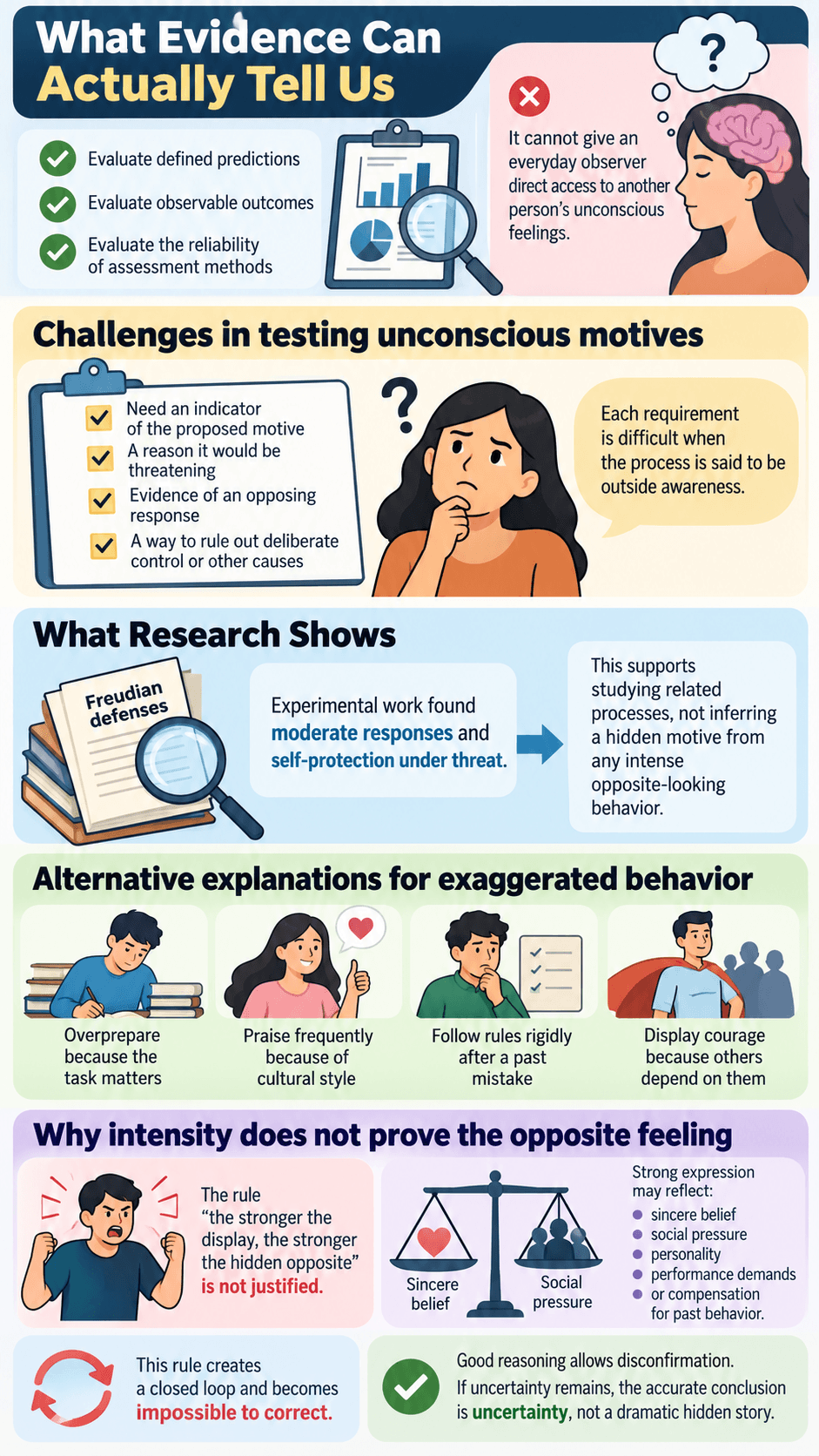
Research can evaluate defined predictions, observable outcomes, and the reliability of assessment methods. It cannot give an everyday observer direct access to another person’s unconscious feelings.
Challenges in testing unconscious motives
A test must establish more than opposite behavior. Researchers need an indicator of the proposed original motive, a reason it would be threatening, evidence of an opposing response, and a way to rule out deliberate control or other causes. Each requirement is difficult when the process is said to be outside awareness.
A widely cited review of Freudian defenses in social psychology found experimental work relevant to reaction formation and several other defenses. It focused on moderate responses and self-protection under threat. This supports studying related processes, not inferring a hidden motive from any intense opposite-looking behavior.
Operational definitions state what counts as evidence before results are known. A study may show compensatory behavior after threat without demonstrating a stable unconscious reversal in daily life.
Alternative explanations for exaggerated behavior
Many processes produce intensity. A person may overprepare because the task matters, praise frequently because of cultural style, follow rules rigidly after a past mistake, or display courage because others depend on them.
Context-sensitive tools do not rely on one sign. Research on the Defense Mechanisms Rating Scales Q-Sort illustrates how definitions, functions, and multiple observer-rated indicators are used. This differs sharply from a checklist claiming one behavior reveals a secret feeling.
Measurement remains difficult because defenses are theorized to be automatic or partly outside awareness. A discussion of current defense-mechanism research and methodology highlights both established assessment work and problems separating defenses from coping and regulation.
Why intensity does not prove the opposite feeling
The rule “the stronger the display, the stronger the hidden opposite” is not justified. Strong expression may reflect sincere belief, social pressure, personality, performance demands, or compensation for past behavior.
The rule also creates a closed loop. If a person calmly denies the inferred motive, the denial is treated as concealment. If they deny it forcefully, the intensity is treated as proof. No response could count against the interpretation, so the observer’s theory becomes impossible to correct.
Good reasoning allows disconfirmation. Direct statements, consistent behavior, and available evidence should matter. If uncertainty remains, the accurate conclusion is uncertainty, not a dramatic hidden story.
Reflecting on Conflicting Feelings Without Labeling Others
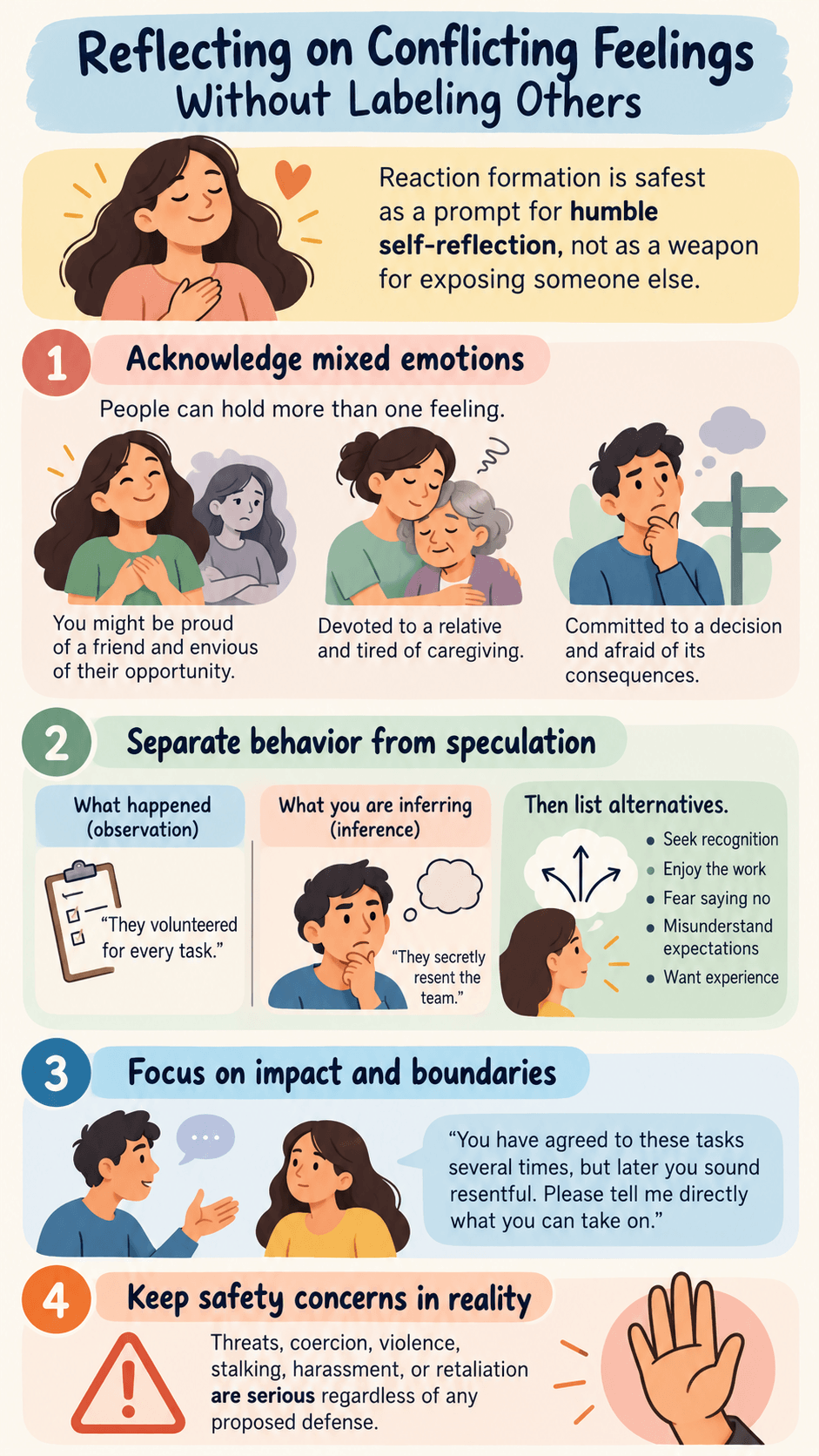
Reaction formation is safest as a prompt for humble self-reflection, not as a weapon for exposing someone else. The aim is to make room for complexity while keeping conclusions proportional to evidence.
Acknowledge mixed emotions
People can hold more than one feeling. You might be proud of a friend and envious of their opportunity, devoted to a relative and tired of caregiving, or committed to a decision and afraid of its consequences. Naming both sides reduces pressure to make one cancel the other.
Use language that leaves room for degrees: “I notice some resentment alongside affection,” or “I want to be brave, and I am also scared.” Feelings provide information, but values and chosen actions still guide behavior.
If a feeling is hard to name, describe sensations and situations: “My chest tightens before I agree to help, and afterward I feel drained.” Clarity can develop without deciding that an unconscious defense is responsible.
Separate behavior from speculation about motives
Use two columns mentally or on paper: what happened, and what you are inferring. “They volunteered for every task” belongs in the observation column. “They secretly resent the team” belongs in the inference column. The distinction does not make the inference impossible; it shows that it is not yet established.
Then list alternatives. The volunteer may seek recognition, enjoy the work, fear saying no, misunderstand expectations, or want experience. This keeps the first interesting explanation from becoming a certainty.
Apply the same fairness to yourself. You can wonder whether an intense stance protects you from a difficult feeling without turning the question into a verdict. Curiosity must permit both “no” and “maybe.”
Focus on impact and boundaries
You do not need proof of a hidden motive to respond. If excessive helpfulness creates unspoken obligations, clarify responsibilities. If rigid criticism is hurtful, name its impact. If a public-private mismatch affects trust, ask for consistency.
A grounded statement might be: “You have agreed to these tasks several times, but later you sound resentful. Please tell me directly what you can take on.” It identifies a pattern that can be discussed without claiming, “Your kindness is fake because you secretly dislike me.”
Safety concerns should also stay anchored in observable reality. Threats, coercion, violence, stalking, harassment, or retaliation are serious regardless of any proposed defense. Do not use reaction formation to reinterpret danger as hidden love or to excuse harmful conduct.
When Professional Support May Help
Consider professional support when emotional conflict, rigid self-presentation, compulsive overcompensation, or difficulty acknowledging feelings repeatedly disrupts relationships, work, sleep, or daily functioning. A qualified mental health professional can explore present experiences and patterns without claiming certainty about unconscious motives from one behavior.
Support may also be useful when self-reflection becomes obsessive or shame-based. The goal is not to uncover a secret opposite behind every value or emotion. It is to increase flexibility, recognize mixed feelings, and choose actions that fit both current reality and personal values.
If a relationship involves fear, coercion, violence, stalking, threats, or retaliation, prioritize appropriate safety assistance rather than joint interpretation of motives. An explanation for someone’s behavior does not remove its impact or make unsafe conduct acceptable.
FAQ About Reaction Formation
These answers clarify the classical definition while keeping the limits of everyday inference explicit.
Is reaction formation always unconscious?
In the classical definition, yes. The original unacceptable feeling and the defensive substitution are proposed to operate outside conscious awareness. If a person recognizes a feeling and deliberately chooses an opposite-looking action, conscious restraint, self-regulation, compensation, or impression management may be a clearer description.
Is acting opposite to a feeling always reaction formation?
No. People act differently from immediate feelings because of courtesy, safety, values, roles, long-term goals, or concern for others. An unconscious conflict and substitution cannot be established from contrast alone.
How is reaction formation different from suppression?
Suppression involves consciously inhibiting or postponing a recognized thought, feeling, or impulse. Reaction formation is proposed to replace an unacceptable experience with its opposite outside awareness. Someone who knows they are angry but waits to speak is using conscious control, not necessarily reaction formation.
Is reaction formation the same as hypocrisy?
No. Hypocrisy describes inconsistency between professed standards and behavior, not why it exists. Reaction formation is one theoretical explanation, but self-interest, rationalization, changing priorities, or failure to meet sincere standards may explain the contradiction.
Can reaction formation reveal secret attraction or sexual orientation?
No. Hostility, moral opposition, exaggerated friendliness, or any other outward behavior cannot establish someone’s attraction, sexual orientation, identity, or private desire. Using reaction formation to make such claims is speculative, invasive, and unsupported by behavior alone.
Key Takeaways
- Reaction formation is the proposed unconscious substitution of an unacceptable feeling or impulse with an opposing attitude or behavior.
- Mixed feelings, deliberate politeness, emotional restraint, and strategic self-presentation do not automatically indicate reaction formation.
- Exaggeration or rigidity may prompt a question, but neither proves that the hidden opposite is present.
- Hypocrisy describes a contradiction, suppression involves conscious inhibition, and undoing centers on counteracting or canceling a thought or act.
- Observable behavior should be separated from speculation about motives, with cultural, situational, interpersonal, and cognitive alternatives kept open.
- Respond to impact and safety directly rather than using psychological labels to expose, excuse, or reinterpret another person’s conduct.

Michael Reed is the Founder and Lead Writer at Psychology Exposed. He writes about human behavior, relationships, emotional patterns, self-awareness, and practical psychology topics using research-informed, easy-to-understand content.
Read More About Michael Reed: https://psychologyexposed.com/michael-reed/