

A person can sincerely value honesty yet avoid a fact that feels unbearable. Someone can feel angry but experience the anger as if it belongs to another person. Another person may set a painful thought aside until the workday ends. These responses can look similar from the outside, but psychology does not treat them as one simple process.
Psychological defense mechanisms are proposed ways the mind manages thoughts, feelings, impulses, memories, or realities that create emotional conflict. Some may reduce distress long enough for a person to keep functioning. Others may narrow awareness, bend interpretation, or postpone a problem that eventually needs attention. Their meaning depends on context, flexibility, and the quality of the evidence, not on a single action observed from a distance.
Understanding defenses is most useful when it supports careful self-reflection. It is much less useful when it becomes a way to diagnose a partner, explain every disagreement, or claim certainty about someone else’s unconscious motives.
Quick Answer
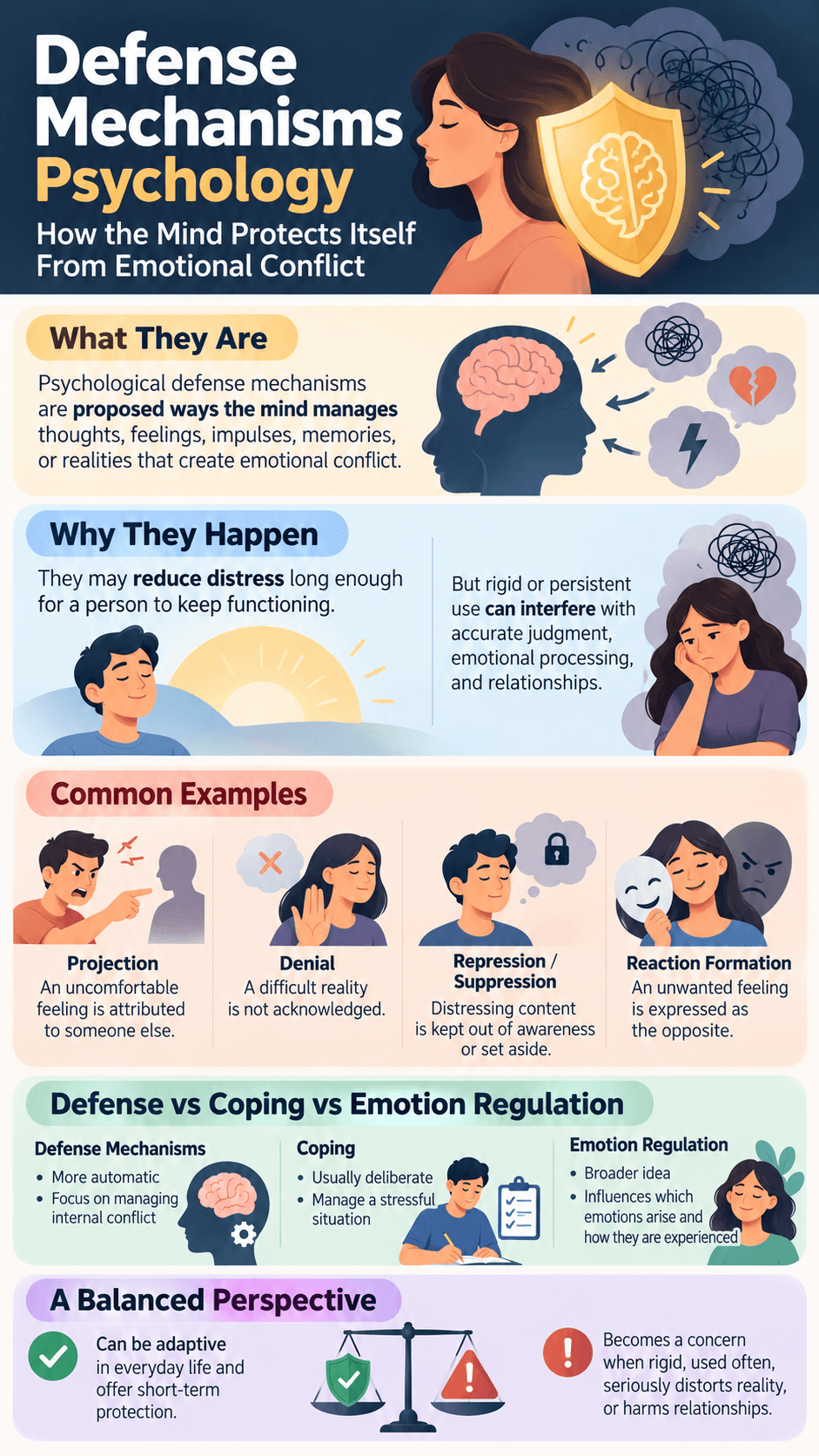
Psychological defense mechanisms are automatic or partly unconscious processes proposed to reduce distress from internal conflict or threatening experiences. They may offer short-term protection, but rigid or persistent use can interfere with accurate judgment, emotional processing, and relationships. Different mechanisms change awareness, attribution, acknowledgment, or expression in different ways, and the evidence is stronger for some than for others.
What Psychological Defense Mechanisms Mean
The APA Dictionary of Psychology definition of a defense mechanism places the idea within a long tradition of explaining how people protect themselves from anxiety, conflict, and threatening inner experiences. Modern discussion is broader than the popular image of a mind simply hiding an unwanted truth. Researchers may examine defensive functioning, self-protective interpretation, awareness, emotional regulation, and the ways people respond to threats to identity or self-esteem.
Emotional conflict and self-protection
Emotional conflict occurs when two meaningful realities pull in different directions. A person may love a family member and also feel resentful. They may see themselves as competent while receiving evidence that a plan has failed. They may want closeness but fear the vulnerability that closeness requires.
A defense can be understood as an attempt to make that conflict easier to bear. The attempt may change what receives attention, how an event is interpreted, where a feeling seems to come from, or how an impulse is expressed. This does not mean the person has consciously decided to distort reality. The proposed protective function is often automatic.
Awareness and automatic psychological processes
Classical theories generally describe defenses as operating outside full awareness. That feature separates them from a deliberate choice such as deciding to postpone a difficult conversation until both people are calmer. In practice, awareness is not always all or nothing. A person may notice that they are avoiding a topic without fully understanding why it feels threatening.
It is therefore safer to think in degrees. Some responses are clearly intentional, some appear largely automatic, and others combine both. A label should not create false certainty about where a process sits on that continuum.
Why defenses are not automatically disorders
Defensive responses can occur in ordinary life. Humor may create enough distance to face an awkward moment. Temporary emotional compartmentalization may help an emergency worker complete an urgent task. A person receiving shocking news may need time before its full emotional meaning becomes manageable.
The presence of a defense does not establish a mental health condition. Concern is more reasonable when a response becomes rigid, appears across many situations, seriously distorts what is happening, or repeatedly harms decision-making and relationships. Even then, proper assessment requires more than a list of behaviors found online.
Where the Idea of Defense Mechanisms Came From
The meaning of defense has changed as psychology moved from early psychoanalytic explanation toward concepts that researchers attempt to define and measure.
Freud and early psychoanalytic explanations
Sigmund Freud developed early accounts of psychological defense within psychoanalytic theory. He proposed that unacceptable impulses, painful ideas, and anxiety-producing conflicts could be managed through processes that kept them from direct awareness or changed their psychological form. Repression held a central place in this early account.
These ideas were theoretical explanations, not brain mechanisms observed directly. Their historical importance is substantial, but that importance should not be confused with equal scientific support for every classical claim.
Anna Freud and the classification tradition
Anna Freud organized and expanded the study of defenses, describing multiple ways a person might manage conflict rather than treating repression as the only important process. Projection, denial, reaction formation, displacement, regression, and other concepts became part of a wider vocabulary.
Later writers proposed groupings based on how much a defense alters reality and how flexibly it supports adaptation. These hierarchies can be useful maps, but they should not be treated as a moral ranking of people. A response that helps briefly in one setting may become costly when it is the only response available.
How contemporary psychology studies defenses
Contemporary work tries to define defensive processes in ways that can be rated, compared, and studied. Phebe Cramer’s review of defense mechanisms as processes of adaptation helped connect the historical tradition with empirical questions about development and functioning.
Researchers now use interviews, observer ratings, self-report measures, experimental tasks, and studies of person perception. Each method captures something different and has limitations. Self-report is difficult when a process is defined as unconscious, while observer ratings can be influenced by interpretation. A careful account keeps those measurement problems visible.
A recent open-access review of contemporary defense research also emphasizes conceptual overlap with coping and emotion regulation, along with the need for stronger longitudinal and culturally diverse evidence.
A Working Model of Psychological Defense

A useful four-part model is conflict, defensive shift, immediate protection, and later consequence. It describes a possible sequence, not a universal law.
| Part | Question to ask | Everyday illustration |
|---|---|---|
| Conflict | What feels threatening, painful, or hard to integrate? | Feedback conflicts with a valued image of being highly capable. |
| Defensive shift | What changes in awareness, interpretation, attribution, or expression? | The feedback is dismissed as jealousy without examining its substance. |
| Immediate protection | What discomfort is reduced right now? | Embarrassment and uncertainty briefly decrease. |
| Later consequence | What becomes easier or harder over time? | Self-confidence is preserved today, but useful correction may be missed. |
Perceived threat or internal conflict
The starting point does not have to be physical danger. A threat can involve self-image, belonging, moral identity, competence, control, or attachment. The same event may feel mildly uncomfortable to one person and deeply destabilizing to another because it touches a different personal meaning.
A possible defensive response
The response may redirect a feeling, exclude something from awareness, reject a difficult reality, or express the apparent opposite of an unwanted impulse. It may also involve humor, intellectualization, or channeling emotion into a socially constructive activity. Different theories draw the boundaries between these categories differently.
Short-term relief or protection
Immediate relief helps explain why a response can persist. If blaming an outside cause quickly reduces shame, or emotional distance helps someone finish an urgent task, the response has performed a function. Recognizing that function encourages curiosity rather than contempt.
Short-term usefulness does not prove that a response is accurate or beneficial overall. Relief and truth are separate questions.
Possible longer-term consequences
Flexible defenses may give a person time to regulate and return to reality with greater capacity. Rigid defenses may keep the original conflict unresolved. They can contribute to repeated misunderstandings, missed feedback, delayed decisions, or a widening gap between experience and acknowledgment.
The important questions are not simply, “Is this a defense?” They are, “How much does this response distort what is happening, how often is it used, and can the person reconsider when new information appears?”
Main Families of Defensive Responses
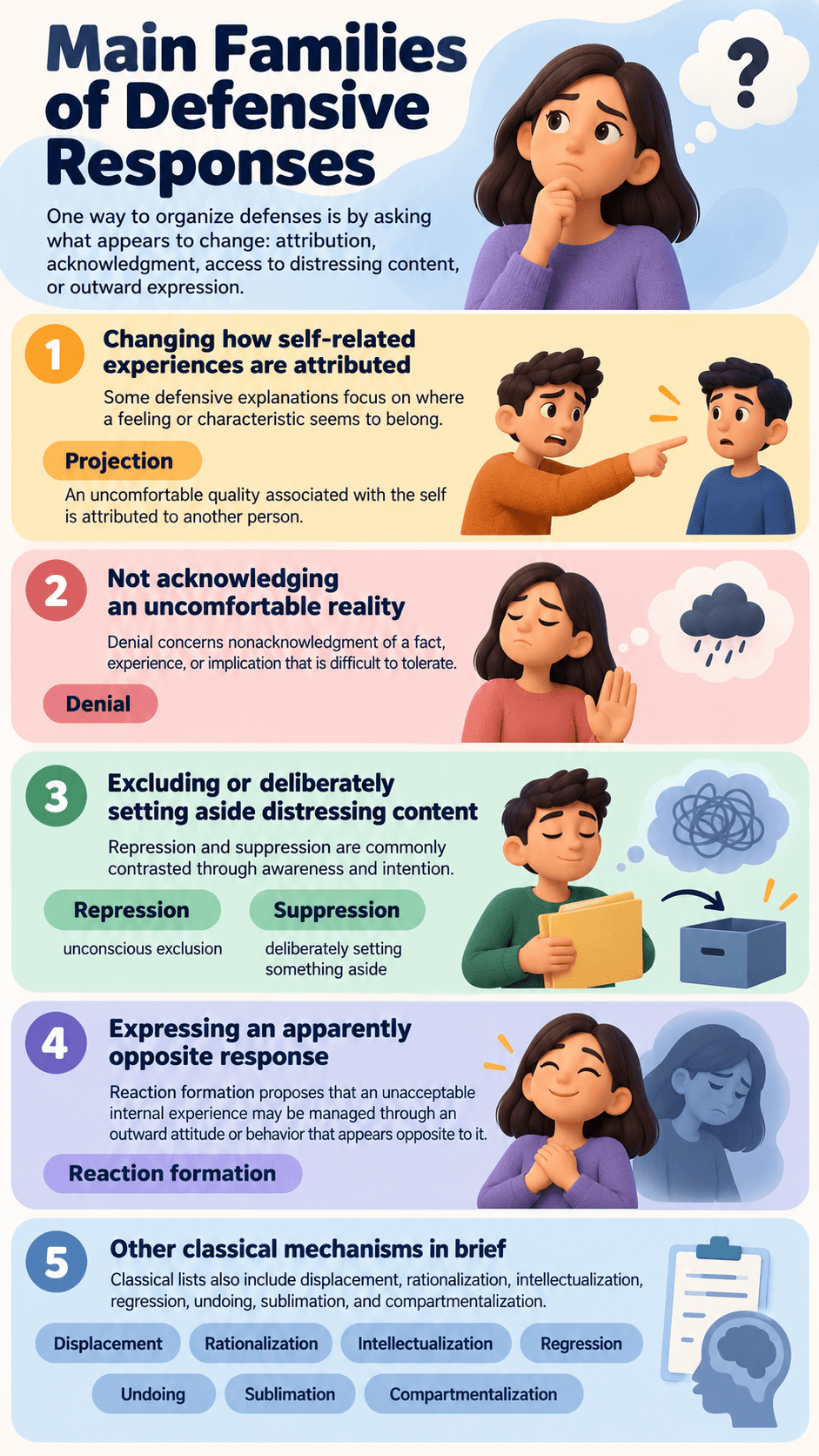
One way to organize defenses is by asking what appears to change: attribution, acknowledgment, access to distressing content, or outward expression.
Changing how self-related experiences are attributed
Some defensive explanations focus on where a feeling or characteristic seems to belong. In projection, an uncomfortable quality associated with the self is attributed to another person. This differs from merely making an incorrect judgment and from explaining who caused an event.
Not acknowledging an uncomfortable reality
Denial concerns nonacknowledgment of a fact, experience, or implication that is difficult to tolerate. It is not the same as lacking information, reasonably disputing weak evidence, or intentionally telling a lie. Those alternatives must be considered before applying a psychological interpretation.
Excluding or deliberately setting aside distressing content
Repression and suppression are commonly contrasted through awareness and intention. Classical repression refers to proposed unconscious exclusion, while suppression refers to deliberately setting something aside. Ordinary forgetting, divided attention, memory reconstruction, and conscious postponement complicate any attempt to infer the process from a memory gap alone.
Expressing an apparently opposite response
Reaction formation proposes that an unacceptable internal experience may be managed through an outward attitude or behavior that appears opposite to it. This is not established by intensity, politeness, moral conviction, or inconsistency. Many situational and deliberate explanations can produce the same visible behavior.
Other classical mechanisms in brief and with evidence qualifications
Classical lists also include displacement, rationalization, intellectualization, regression, undoing, sublimation, and compartmentalization. These terms do not all describe the same kind of process, and their research bases are not equally strong. They are most useful as carefully defined hypotheses about psychological function, not as a set of secret motives that can be decoded from one interaction.
Four Questions That Clarify Commonly Confused Defenses

These four concepts become easier to distinguish when each is tied to a different question about what the mind may be doing.
Psychological projection
Projection asks whether something attributed to another person may be connected to an uncomfortable feeling, impulse, or characteristic in oneself. For example, someone who struggles to accept their own competitiveness might become unusually certain that every colleague is trying to defeat them.
That example illustrates a possibility, not a verdict. Colleagues sometimes do compete unfairly. Responsible reflection compares interpretation with observable evidence and avoids using projection to dismiss credible concerns.
Denial as a defense mechanism
Denial asks whether a difficult reality or its implications are not being acknowledged. A business owner may repeatedly minimize clear evidence that a strategy is failing because accepting the loss threatens competence, identity, and hope. The nonacknowledgment may reduce distress briefly while making timely correction harder.
Disagreement is not enough to establish denial. People can have different information, standards of proof, cultural assumptions, or legitimate reasons for caution.
Repression vs suppression
This comparison asks whether setting aside distressing content is proposed to occur outside awareness or is done deliberately. Someone who thinks, “I cannot deal with this before the meeting, so I will return to it tonight,” is consciously postponing attention. That is different from a theory claiming that content has been unconsciously excluded.
Missing memories do not identify their cause. They do not by themselves prove repression, trauma, or any particular hidden event.
Reaction formation
Reaction formation asks whether outward expression may oppose an internal feeling that is experienced as unacceptable. A classic hypothetical example is exaggerated friendliness masking resentment. Yet friendliness may also reflect values, professionalism, conflict avoidance, social expectations, or a genuine effort to behave well despite anger.
Visible behavior cannot settle which explanation is true. The concept should not be used to infer sexuality, attraction, trauma history, moral beliefs, or concealed desire.
Defense Mechanisms vs Coping and Emotion Regulation

All three ideas concern responses to difficulty, but they differ in awareness, purpose, theoretical background, and whether the response addresses external reality.
Automatic versus deliberate responses
Coping usually refers to efforts to manage a stressful situation or its emotional effects. Planning, seeking information, asking for support, and taking a restorative break can all be deliberate coping responses. Defenses are traditionally described as less intentional and more focused on managing internal conflict.
Cramer’s analysis of the distinction between coping and defense emphasizes that both can serve adaptation, even though their psychological processes differ. Outcome alone does not always tell us which process occurred.
Where theoretical categories overlap
Emotion regulation is an even broader idea. It includes processes that influence which emotions arise, when they arise, and how they are experienced or expressed. Some regulation is intentional, while some is automatic. This creates overlap with both coping and defense.
Suppression shows why terminology can become confusing. It may refer to deliberately postponing a thought, inhibiting emotional expression, or a defense category in a particular theory. A clear explanation must state which meaning is intended.
Why coping is not simply another name for defense
A coping action may address external reality directly, such as gathering facts, changing a plan, or asking for practical help. A defense may primarily reduce internal tension without changing the situation. If a person dismisses accurate financial information to avoid shame, distress may fall while the financial problem remains.
The distinction should not become a good-versus-bad judgment. Coping can be avoidant, and a defense can temporarily support functioning. Flexibility, accuracy, and consequences matter more than the label alone.
How Strong Is the Scientific Evidence?
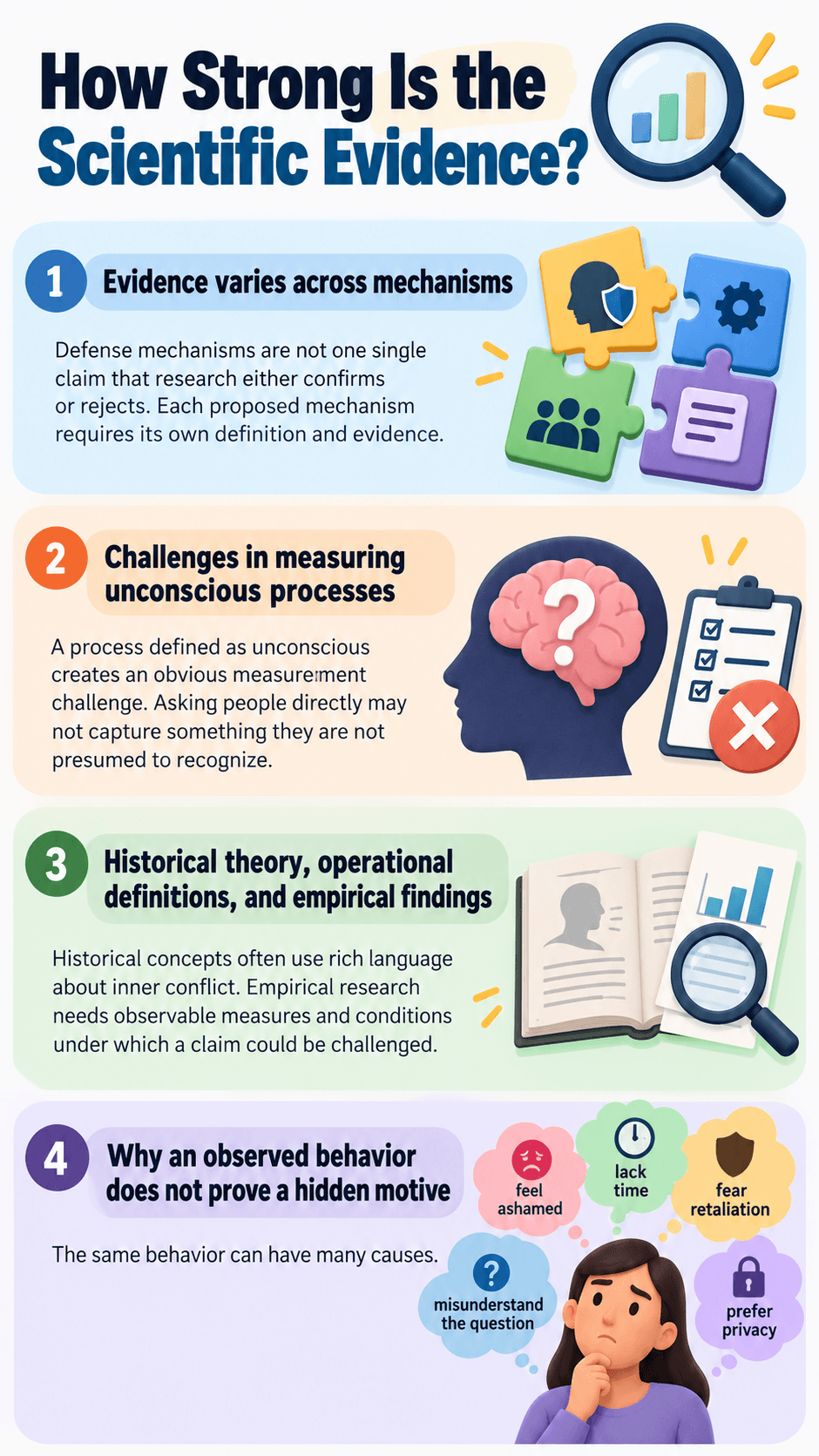
Evaluating the evidence requires more than asking whether defenses are real. Researchers must define a specific process, measure it reliably, and compare competing explanations.
Evidence varies across mechanisms
Defense mechanisms are not one single claim that research either confirms or rejects. Each proposed mechanism requires its own definition and evidence. Phebe Cramer’s review of four decades of empirical research on defense mechanisms describes experimental and observational work across different ages and populations.
Some broad findings support the idea that people respond defensively to threats to self-esteem and identity. That does not mean every psychoanalytic explanation has been demonstrated in its original form.
Challenges in measuring unconscious processes
A process defined as unconscious creates an obvious measurement challenge. Asking people directly may not capture something they are not presumed to recognize. Observer ratings add another problem: two evaluators may interpret the same words differently unless definitions and coding procedures are precise.
Laboratory experiments can isolate a narrow process, but a controlled task may not reproduce the emotional meaning of a family conflict, loss, or identity threat. Clinical observations offer depth but can be difficult to test against alternative explanations.
Historical theory, operational definitions, and empirical findings
Historical concepts often use rich language about inner conflict. Empirical research needs observable measures and conditions under which a claim could be challenged. The classic review by Baumeister, Dale, and Sommer examined modern social psychology findings related to several Freudian defenses, showing that evidence differed by mechanism and sometimes fit revised rather than original explanations.
This distinction matters. Research may support a self-protective bias without proving the exact unconscious sequence described by an early theory.
Why an observed behavior does not prove a hidden motive
The same behavior can have many causes. A person who changes the subject may feel ashamed, lack time, fear retaliation, misunderstand the question, or simply prefer privacy. Someone who acts warmly while angry may be exercising restraint rather than expressing an unconscious opposite.
A responsible interpretation distinguishes what was observed from what is inferred. It stays open to new evidence and avoids treating a theory as a mind-reading device.
Which Question Are You Actually Trying to Answer?
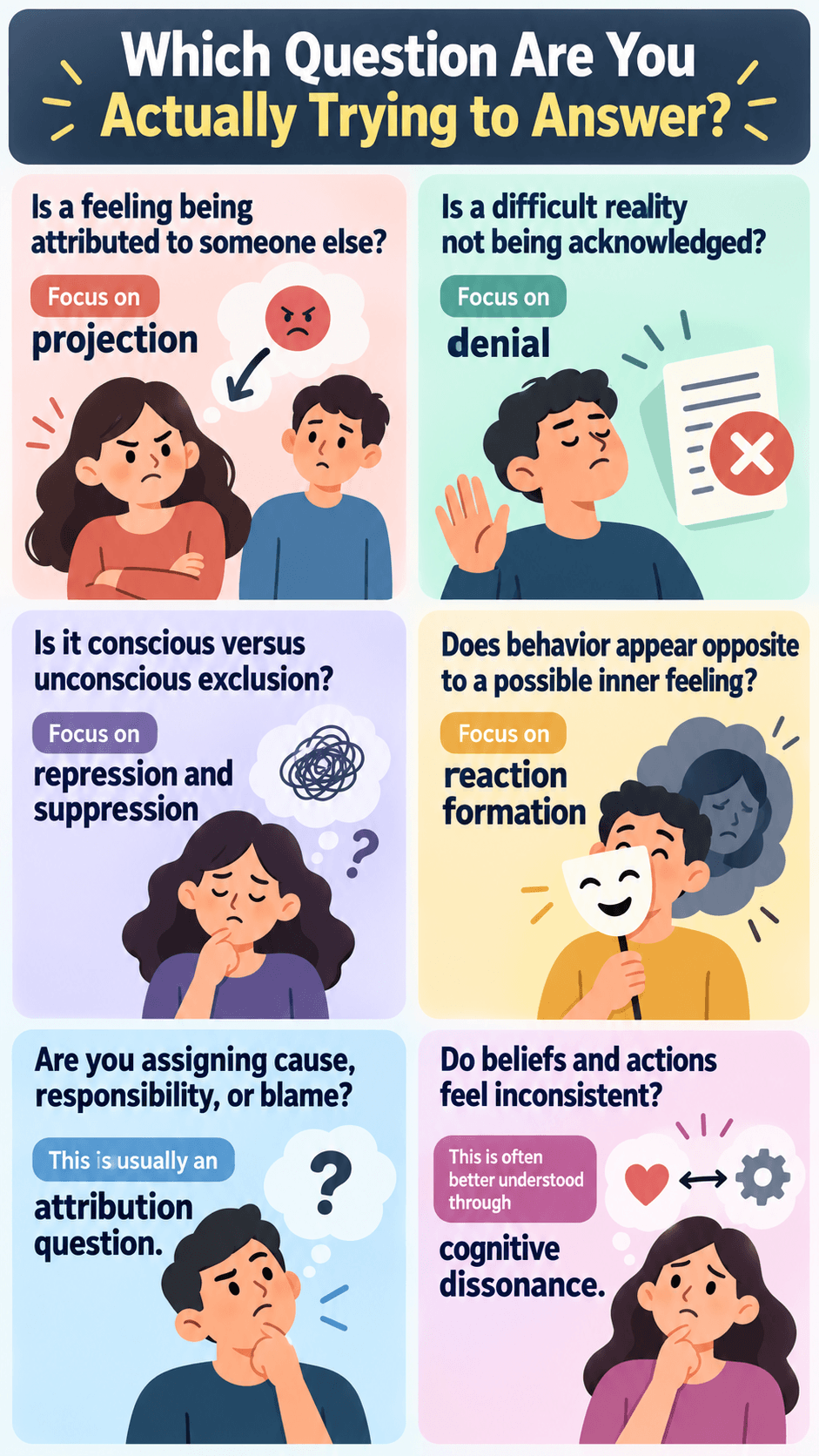
The clearest concept depends on the problem under examination. Choosing the right question prevents several distinct psychological ideas from being collapsed into one label.
When you wonder whether a feeling is being attributed to someone else
Focus on projection when the central issue is whether a self-related feeling or characteristic is being perceived in another person. Compare the interpretation with observable facts, and consider whether the same quality is uncomfortable to recognize in yourself.
When a difficult reality is not being acknowledged
Focus on denial when relevant evidence appears available but its reality or implications are not being accepted. First rule out uncertainty, information gaps, different standards of proof, conscious deception, and safety constraints.
When the issue is conscious versus unconscious exclusion
Focus on repression and suppression when the main question concerns awareness and intention. Deliberately postponing a thought is different from claiming that something was unconsciously removed from awareness. Do not use memory gaps as proof of cause.
When behavior appears opposite to a possible inner feeling
Focus on reaction formation when examining the theory of opposite expression. Keep ordinary restraint, social expectations, impression management, mixed emotion, and genuine values-based behavior available as alternatives.
When you are assigning cause, responsibility, or blame
This is usually an attribution question. It concerns how people explain why an event happened or who was responsible. Attribution can be self-protective, but it is not automatically projection.
When beliefs and actions feel inconsistent
This is often better understood through cognitive dissonance. The central issue is discomfort created by meaningful inconsistency and the ways a person may reduce it, such as changing a belief, changing behavior, or adding a justification.
Common Misunderstandings About Psychological Defenses
Popular use often turns defense language into accusation. Three corrections help keep the concept humane, proportionate, and scientifically responsible.
Defenses are not moral character flaws
Calling someone defensive often sounds like criticism. In psychological theory, however, a defense describes a possible function, not a measure of goodness. Shame and ridicule may make honest reflection harder by increasing the very threat that the response is managing.
Defenses are not diagnostic signs
A person can use denial, projection, humor, or intellectualization without meeting criteria for a disorder. Diagnosis requires a qualified evaluation of a much broader pattern, including duration, distress, impairment, development, context, and alternative explanations.
Self-reflection is different from labeling another person
Self-reflection asks, “What am I having difficulty recognizing, and what evidence might I be overlooking?” Labeling asks, “Which hidden mechanism explains this person?” The first question can increase flexibility. The second can harden conflict by placing one person’s interpretation beyond challenge.
Reflecting on Defenses Without Mind-Reading
A grounded reflection process preserves curiosity without pretending to know another person’s private mental state.
Separate observation from interpretation
Write down what a camera or audio recording could capture. “They interrupted me three times” is an observation. “They interrupted because they cannot tolerate being wrong” is an interpretation. The interpretation may be worth considering, but it is not the same kind of information.
Consider context and alternative explanations
Ask what else could produce the behavior. Fatigue, culture, fear, power differences, missing information, habit, privacy, and deliberate self-control can resemble a defensive process. Considering alternatives does not require dismissing your own experience.
Focus on impact, choices, and boundaries
You do not need to prove a hidden motive before responding to impact. If repeated dismissal prevents useful discussion, you can name the specific behavior, explain its effect, request a change, and decide what you will do if the behavior continues.
This approach remains useful even when the psychological explanation is uncertain. It keeps the conversation grounded in conduct that both people can observe.
When Professional or Safety Support May Help
Self-reflection has limits. Persistent impairment calls for fuller assessment, while fear and danger call for a safety-focused response.
Persistent distress or impaired daily functioning
Professional support may be worth considering when emotional conflict, avoidance, memory concerns, or repeated interpersonal problems cause significant distress or interfere with work, relationships, sleep, or daily decisions. A qualified professional can explore the full context rather than assigning meaning to one behavior.
Support should focus on current needs and established information. It should not promise to uncover hidden memories or treat a speculative interpretation as fact.
Coercion, threats, violence, stalking, retaliation, or serious fear
Defense language should never be used to minimize danger. If a situation involves coercion, threats, violence, stalking, retaliation, or serious fear, prioritize safety and appropriate local support. Do not rely on a difficult conversation with the person causing fear as the first solution.
It is possible to misunderstand someone’s motive and still identify unsafe conduct accurately. Safety decisions can be based on observable behavior without deciding which unconscious process, if any, explains it.
FAQ About Psychological Defense Mechanisms
These answers address the questions that most often cause confusion when defense language moves from theory into everyday conversation.
Are defense mechanisms always unconscious?
Classical definitions usually describe them as unconscious or largely automatic. Real experiences may involve degrees of awareness. A person might recognize that they are avoiding a topic but not understand the conflict driving the avoidance. Deliberate strategies are more often discussed as coping or conscious regulation, although terminology varies across traditions.
Does everyone use psychological defenses?
Self-protective psychological responses are generally discussed as part of ordinary human functioning, not as something limited to people with a diagnosis. People differ in which responses they use, how rigidly they use them, and whether they can return to a fuller view of reality after immediate distress settles.
Can a defense be adaptive in one context and unhelpful in another?
Yes. Temporary emotional distance may help someone act during an emergency, while persistent detachment may prevent later processing or connection. Humor may create perspective, or it may prevent a serious issue from being acknowledged. Context, timing, flexibility, and consequences determine much of the difference.
Are mature and immature defense rankings scientifically settled?
No single ranking should be treated as an unquestioned law. Hierarchies are used in some research and clinical traditions to describe relative adaptiveness and reality distortion. Their interpretation depends on definitions, measurement methods, culture, context, and whether a person can respond flexibly.
How strong is the evidence for individual defense mechanisms?
It varies. Broad evidence supports self-protective responses to psychological threat, and researchers have developed methods for assessing defensive functioning. Specific classical mechanisms differ in testability and empirical support. A strong explanation identifies the exact claim being made and considers competing explanations.
Key Takeaways
- Psychological defenses are proposed ways of managing emotional conflict, threat, and distress, often outside full awareness.
- Immediate relief does not necessarily mean that an interpretation is accurate or helpful over time.
- Projection, denial, repression, suppression, and reaction formation answer different psychological questions.
- Defenses overlap with coping and emotion regulation, but the concepts are not interchangeable.
- Observed behavior rarely proves a particular unconscious motive, so alternative explanations should remain open.
- A practical first step is to separate observable facts from interpretation, then focus on impact, choices, and safety.
A useful next step: Choose one recent situation that felt emotionally charged. Write one sentence describing only what happened, one naming the meaning you gave it, and one identifying another plausible explanation. The aim is not to talk yourself out of your experience. It is to create enough space for a more accurate and flexible response.
About the author: Michael Reed is the Founder and Lead Writer at Psychology Exposed. He explains human behavior, emotional patterns, relationships, self-awareness, and everyday decisions in clear, research-aware language for general readers.

Michael Reed is the Founder and Lead Writer at Psychology Exposed. He writes about human behavior, relationships, emotional patterns, self-awareness, and practical psychology topics using research-informed, easy-to-understand content.
Read More About Michael Reed: https://psychologyexposed.com/michael-reed/