
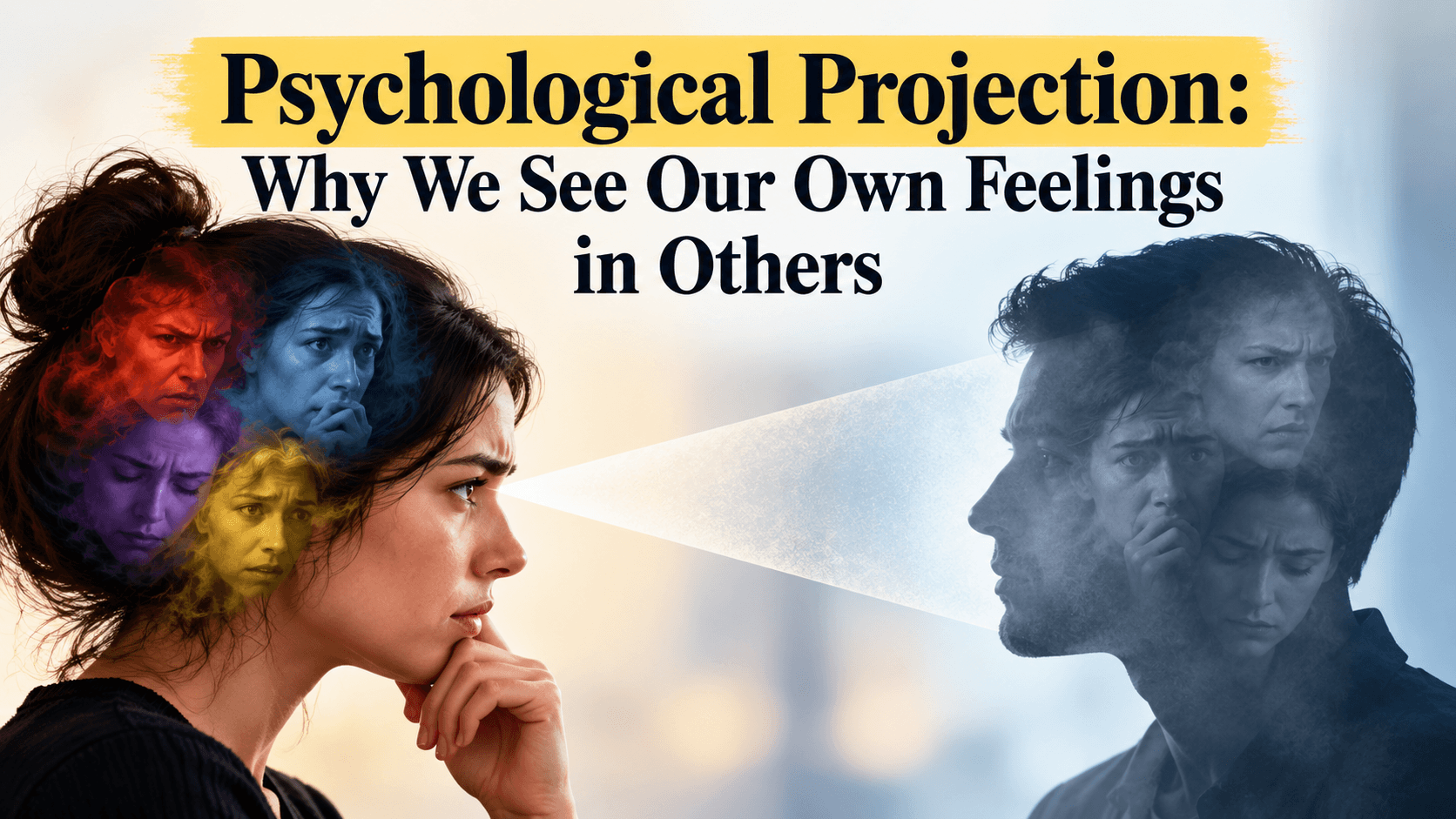
During a tense meeting, a manager who is worried about appearing unprepared becomes certain that everyone else is judging the presentation. In a relationship, someone who feels a flash of jealousy insists that their partner is the jealous one. These situations could involve psychological projection, but they could also have simpler explanations. The room may genuinely feel critical. The partner may actually be acting possessively. Similar words and actions can arise from very different processes.
Psychological projection is a proposed defense mechanism in which something difficult to acknowledge in oneself is attributed to another person. The concept can illuminate how self-protection shapes perception, especially when a disowned feeling or characteristic becomes highly noticeable outside the self. Yet projection is not visible in the way a spoken sentence or missed appointment is visible. It is an interpretation of what may be happening beneath the observation.
That distinction makes the term useful for careful self-reflection and risky as an accusation. Understanding projection means learning what the concept proposes, what research has tested, how it differs from ordinary suspicion or attribution, and why no isolated disagreement proves an unconscious motive.
Quick Answer

Psychological projection is the proposed process of attributing an uncomfortable feeling, impulse, or characteristic associated with oneself to another person. It may protect self-image in the short term, but the same behavior could reflect accurate observation, ordinary bias, stress, or misunderstanding. Projection is therefore a hypothesis to examine, not a diagnosis or a fact established by one accusation.
What Psychological Projection Means
The concept concerns the possible movement of psychological material from “this may be true of me” to “this is true of you.” What matters is not merely making a mistaken judgment. The defensive account proposes that the judgment has a self-protective relationship to something uncomfortable in the perceiver.
Attributing something of oneself to another person
The APA Dictionary of Psychology entry on projection describes a process in which a person attributes their own thoughts, feelings, or motives to someone else. In its defensive form, the attributed quality is usually difficult to accept as one’s own. Anger, envy, insecurity, dishonesty, competitiveness, attraction, and fear can all appear in hypothetical examples, but none should be presumed without evidence.
Projection is sometimes described too loosely as “seeing yourself in others.” That wording misses the proposed protective function. Noticing a trait that you genuinely share with someone may be accurate recognition. Assuming friends will enjoy the same restaurant may be ordinary similarity-based judgment. A defensive interpretation specifically involves discomfort, disavowal, and outward attribution.
Projection in classical defense theory
In classical psychoanalytic theory, projection helped explain how an unacceptable impulse could be experienced as if it came from outside the self. The person would gain psychological distance from the conflict while still encountering its content in another form. This made projection part of a broader account of how anxiety and threats to the ego might be managed outside awareness.
The wider framework of psychological defense mechanisms places projection alongside other ways the mind may manage emotional conflict, while keeping evidence limits visible.
A proposed mechanism, not a label proven by one behavior
If a coworker accuses another coworker of being competitive, the accusation alone does not reveal who is competitive or why it was made. The speaker may be projecting, identifying a real pattern, responding to incomplete information, or combining personal sensitivity with accurate observation. The same statement can contain both evidence and bias.
Calling the speaker “a projector” turns a tentative process into a fixed identity. It also creates a circular argument: disagreement becomes proof of projection, and any denial becomes more proof. A psychologically responsible use of the concept keeps the claim testable and allows new information to change the interpretation.
The Psychological Projection Core Model
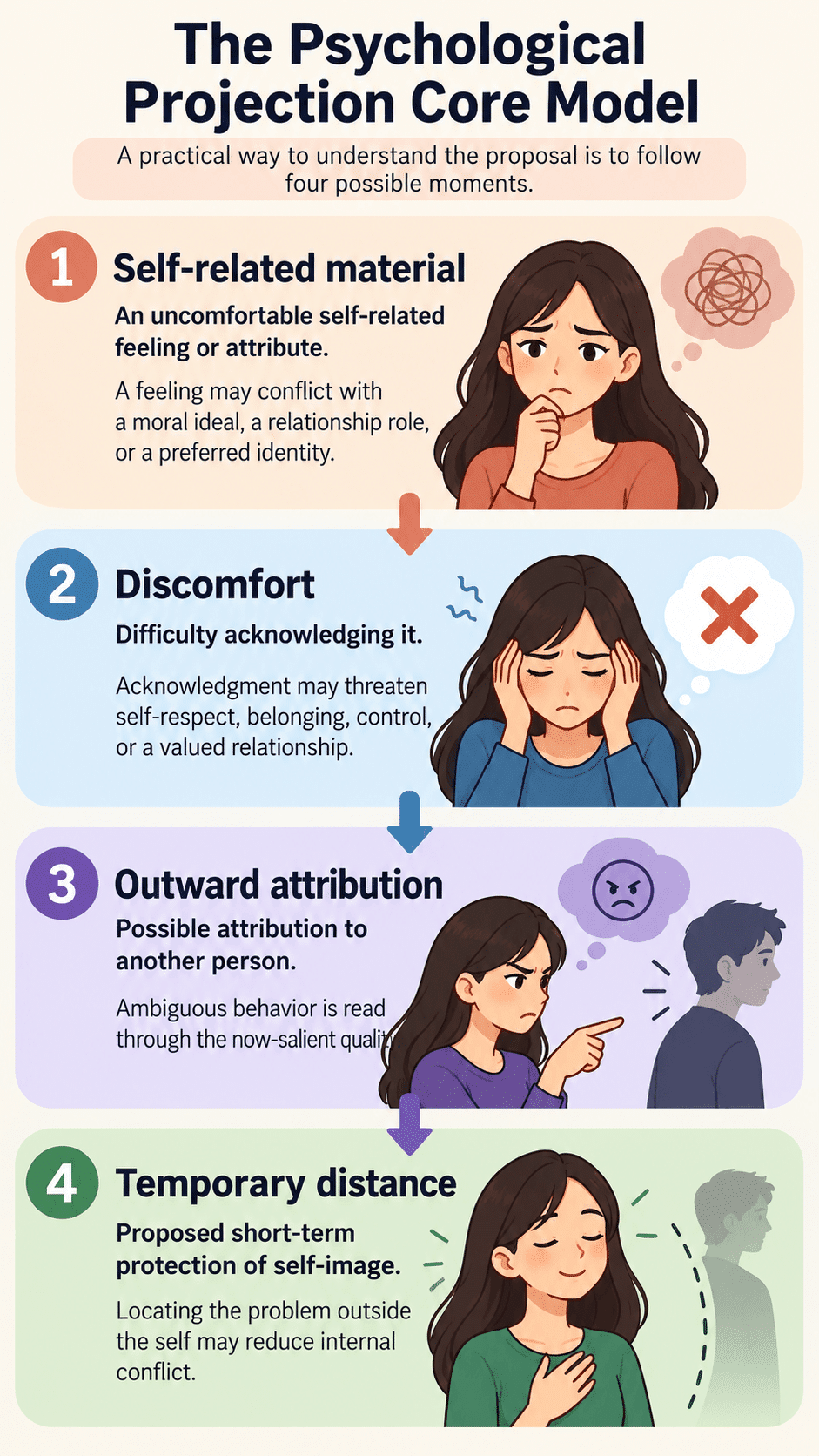
A practical way to understand the proposal is to follow four possible moments: self-related material, discomfort, outward attribution, and temporary distance. This sequence is a model, not a claim that every instance unfolds neatly or completely outside awareness.
An uncomfortable self-related feeling or attribute
The process begins with something that carries personal meaning. A feeling may conflict with a moral ideal, a relationship role, or a preferred identity. Someone who strongly values generosity may find envy especially threatening. A person invested in appearing calm may have difficulty acknowledging anger. The relevant issue is not that the feeling is objectively terrible, but that accepting it feels costly.
Difficulty acknowledging it
Acknowledgment may threaten self-respect, belonging, control, or a valued relationship. The person might avoid thinking about the feeling, reject its relevance, or experience it only vaguely as tension. This is different from deliberately lying. In the defensive account, the person may sincerely experience the external interpretation as true.
Possible attribution to another person
The unwanted material may then organize perception. Ambiguous behavior is read through the now-salient quality: a short reply looks hostile, a private conversation looks deceptive, or constructive feedback looks envious. The other person becomes the apparent location of the feeling or characteristic.
This does not require inventing every detail. Projection could amplify a weak cue, select confirming evidence, or shape the meaning assigned to a genuine event. The possibility of bias does not erase the external facts. It changes the question from “Did anything happen?” to “How much does the conclusion exceed what the facts support?”
Proposed short-term protection of self-image
Locating the problem outside the self may reduce internal conflict. “They are angry with me” can feel easier than “I am angry with them,” particularly when anger seems forbidden. “They are trying to outshine me” may protect a self-image that has no room for competitiveness.
The relief may be brief and costly. If the interpretation is inaccurate or exaggerated, the person may become defensive toward others, miss useful feedback, or create the conflict they feared. Short-term protection explains a possible function; it does not establish that the process is healthy, deliberate, or permanent.
Everyday Examples and What They Do Not Prove

Examples make the concept concrete, but they can easily become fake evidence. Each scenario below shows how projection might work and then names what would need to remain uncertain.
Anger and perceived hostility
After a frustrating commute, Elena enters a conversation already tense. She keeps her voice controlled but interprets her brother’s neutral questions as attacks and says he is looking for a fight. One possibility is that her own unacknowledged anger has made hostility easier to perceive. Another is that his tone, history, or wording really was provocative.
Insecurity and criticism
Marcus worries that he lacks the experience required for a new role. When a colleague suggests revising one slide, he concludes that she thinks he is incompetent. Projection is one possible explanation if his own feared judgment has been experienced as hers. Still, the conclusion could also reflect a harsh workplace, earlier criticism, or an ambiguous comment.
The revealing comparison is between what was said and what was inferred. “This slide needs another source” is an observable statement. “She thinks I should never have been hired” adds a broader interpretation. Recognizing that addition does not mean it is false; it shows where more evidence is needed.
Jealousy and relationship assumptions
Priya notices herself enjoying attention from a stranger and feels guilty. Later, she becomes certain that her partner was flirting at dinner, even though the behavior was unclear. A projection hypothesis would ask whether her discomfort increased the availability of infidelity-related interpretations. It would not declare that the partner was innocent or that Priya secretly intended to be unfaithful.
Self-judgment and perceived social evaluation
After making a mistake at a community event, Daniel thinks everyone considers him careless. No one has said this, but he scans faces for signs of contempt. His own self-criticism may be shaping what he believes others think. Social anxiety, memories of past ridicule, and ordinary uncertainty could also contribute.
In this kind of example, the attributed content is not necessarily a trait the person condemns in someone else. It can be a feared evaluation of the self that is experienced as coming from other minds. Because other people’s thoughts are not directly observable, checking assumptions gently is more informative than treating them as facts.
Why each example remains hypothetical rather than diagnostic
Every scenario has multiple plausible explanations. Stress can narrow attention. Prior learning can make certain threats more noticeable. Another person may truly be hostile, critical, deceptive, or judgmental. Communication can be ambiguous, and two people can contribute to the same misunderstanding.
Projection is most defensible as a hypothesis when the same unwanted quality is difficult for the person to acknowledge, becomes unusually accessible in perception, and is attributed beyond what available evidence warrants. Even that pattern does not permit a remote diagnosis. It supports curiosity, not certainty.
Projection vs Ordinary Suspicion and Accurate Observation

The central practical challenge is that projection and accurate perception can feel equally convincing from the inside. The difference cannot be settled by confidence, emotional intensity, or the other person’s denial.
Evidence-based concern versus inferred defensive process
An evidence-based concern points to specific observations: what was said, what occurred, when it happened, and whether a pattern can be corroborated. A projection claim adds an explanation about why the observer reached a conclusion and how that conclusion relates to the observer’s own disowned experience.
These are different levels of claim. “Three promised payments were not made” describes events. “You are dishonest” infers a characteristic. “I call you dishonest because I cannot face my own dishonesty” infers an unconscious process. Each step requires additional evidence and carries greater uncertainty.
When another person’s behavior genuinely supports a conclusion
If someone repeatedly threatens, lies, violates boundaries, or behaves aggressively, the relevant conduct should be evaluated directly. A person may have personal sensitivities and still perceive danger accurately. Bias and truth are not mutually exclusive. Sometimes an internal concern makes a person more alert to a pattern that is genuinely present.
Why one accusation is not proof
The popular claim “every accusation is a confession” is not a psychological rule. People accuse others for many reasons, including accurate perception, fear, misunderstanding, retaliation, learned expectations, poor communication, and deliberate manipulation. Projection is only one possible pathway.
The reverse inference is especially weak: observing an accusation and working backward to a hidden identical trait. Without evidence about the person’s self-concept, discomfort, thought process, and the external situation, the conclusion outruns what was observed.
Projection vs Attribution and Defensive Attribution

Projection is a type of proposed outward attribution, but not every attribution is projection. Keeping the concepts separate prevents a judgment about cause or blame from being mistaken for evidence that a person is exporting their own trait.
Attributing a quality from the self
Defensive projection asks whether a quality associated with the self is being attributed to another person because owning it is uncomfortable. The matching content matters. If someone cannot tolerate their own envy and persistently detects envy in ambiguous behavior, the projection hypothesis concerns that self-to-other correspondence.
Explaining causes, responsibility, or blame
Defensive attribution concerns self-protective explanations of why an event occurred or who is responsible. In Kelly Shaver’s original experiments on defensive attribution and accident responsibility, judgments of responsibility were studied in relation to an accident’s severity and personal relevance. The core question was how observers assigned responsibility, not whether they attributed their own unwanted trait to the actor.
For example, blaming a driver entirely for an accident may help an observer believe that careful people like themselves are safe. That judgment could be defensive without being projection. The observer has not necessarily disowned a matching trait and placed it in the driver.
Self-protective interpretation without collapsing concepts
Ask what is being transferred or explained. If the issue is “a quality in me appears to belong to you,” projection is the closer hypothesis. If it is “your character caused this outcome, so it cannot happen to someone like me,” defensive attribution is closer.
Projection vs Displacement
Projection changes where a feeling or characteristic seems to originate. Displacement changes where an emotional response is directed. The terms can describe the same conflict at different moments, but they are not interchangeable.
Assigning a feeling or characteristic vs redirecting emotional response
The APA Dictionary of Psychology entry on displacement describes redirecting an emotional response from its original object toward a less threatening substitute. A worker who is angry with a supervisor but snaps at a roommate may be displaying displacement. The anger remains the worker’s, but its target changes.
Why displaced aggression remains separate
Displaced aggression refers to aggressive behavior directed at someone other than the original provocateur. It can be studied through sequences of provocation and response without claiming that the aggressor perceives their own hostility in the substitute target.
A person could both project and displace, but one does not prove the other. Someone might wrongly perceive hostility in a roommate and then snap back, or carry anger from work home without misperceiving anyone. Clear descriptions prevent a broad “defense mechanism” label from hiding these differences.
What Research Can and Cannot Establish

Research can test parts of a projection account under defined conditions. It cannot inspect an unconscious motive directly or turn one laboratory result into a universal explanation of conflict.
Classical psychoanalytic explanations
Classical theory framed projection as a defense against unacceptable inner content. A major review by Baumeister, Dale, and Sommer examined social psychology findings related to projection and other Freudian defenses. Their analysis treated the mechanisms separately and considered revised cognitive accounts rather than assuming the original theory had been confirmed as a whole.
Thought accessibility and biased person perception
Newman, Duff, and Baumeister proposed a more specific account in six studies of defensive projection, thought suppression, and person perception. Their model suggested that trying not to think about an unwanted trait could make the trait concept more accessible, increasing its use when interpreting another person’s ambiguous behavior.
Problems with inferring unconscious motives from behavior
Unconscious processes create a measurement problem because direct self-report may be incomplete, while outside observers can import their own assumptions. Behavior is multiply determined: a sharp comment can reflect fatigue, anger, habit, fear, cultural norms, power dynamics, or a deliberate choice.
Alternative cognitive, situational, and interpersonal explanations
Trait accessibility can arise without defense. Recent experiences, repeated media exposure, mood, stereotypes, and learned vigilance can make a concept easier to notice. Relationship history can make one interpretation more likely, while unclear language invites people to fill gaps with prior expectations.
Related research on social projection to groups examines the tendency to use the self when estimating other people’s attitudes or characteristics. That broad self-other inference is not necessarily defensive. It may involve similarity assumptions rather than an unwanted quality that threatens self-image.
An Observation-to-Interpretation Self-Check

The safest use of projection is inward and provisional. This five-part check helps slow the jump from an event to a conclusion without demanding that you distrust your own perception.
State observable facts
Describe what a camera or neutral transcript could capture. Instead of “She was threatened by me,” write “She interrupted twice, questioned one figure, and ended the call after ten minutes.” Facts include words, actions, timing, and repetition. They do not include presumed motives or character.
Name the interpretation being added
Complete the sentence, “The story I am adding is…” Perhaps the story is that a friend is jealous, a manager is contemptuous, or a partner is hiding something. Naming the interpretation reveals the psychological leap without forcing an immediate verdict about whether it is right.
Ask whether the same quality feels uncomfortable in oneself
Consider the attributed quality without self-attack. “Have I felt competitive here?” “Am I angry?” “Do I fear being dishonest or inadequate?” A yes does not prove projection, and a no does not rule it out. The question tests whether self-related material deserves a place among the hypotheses.
Keep plausible alternatives open
List at least three explanations that fit the facts. Include one that supports your concern, one that involves misunderstanding or context, and one that considers your current state. For a delayed message, alternatives might include avoidance, workload, technical trouble, or a different expectation about response time.
Revise the interpretation when new evidence appears
Ask what information would increase or decrease confidence. A direct answer, repeated pattern, independent record, or changed behavior after clarification may all matter. Decide in advance what would count against your favored explanation.
Projection and Relationship Misunderstandings
Projection can be especially appealing in relationships because each person has access to their own feelings but must infer the other’s. The label becomes harmful when it replaces communication or invalidates experience.
When assumptions replace direct communication
Statements such as “You are embarrassed by me” or “You want to control everything” package observation, interpretation, and motive together. A more testable conversation starts with a concrete event and its impact: “When you changed the subject after I mentioned the plan, I felt dismissed. What was happening for you?”
How denial or reaction formation differs
Denial concerns not acknowledging a difficult reality or its implications. Reaction formation proposes an outward attitude or behavior that appears opposite to an unacceptable inner experience. Projection instead concerns experiencing self-related content as belonging to someone else.
A person who cannot acknowledge anger may minimize it, display exaggerated warmth, perceive anger in the other person, or do none of these. Similar conflict can lead to different proposed processes, which is why outward behavior cannot identify the mechanism by itself.
Why impact and boundaries matter more than proving defense
You do not need to establish projection to set a boundary. If repeated accusations, monitoring, insults, or interrogations are harming a relationship, describe the conduct and what you will do in response. “I will pause this conversation if I am called names” is clearer than “You are projecting your insecurity.”
When Support or Safety Guidance May Help
Self-reflection has limits. Outside support may be useful when the same interpretations keep producing distress, conflict, or uncertainty, and safety action takes priority when there are credible signs of danger.
Repeated conflict or distress affecting daily life
Consider speaking with a qualified mental health professional when suspicion, accusations, self-doubt, or fear repeatedly disrupts sleep, work, relationships, or decision-making. A clinician can help examine patterns, emotional triggers, communication, and alternative explanations without relying on an online label.
Credible warning signs must not be dismissed as projection
Threats, stalking, violence, sexual coercion, financial control, dangerous driving, escalating intimidation, and documented deception require attention to behavior and safety. Do not let anyone use “you are projecting” to make you ignore evidence, abandon boundaries, or accept unsafe conduct.
If there is immediate danger, contact local emergency services or a trusted local crisis resource. When possible, preserve relevant records, tell a trusted person, and seek advice suited to your location. The priority is not determining a defense mechanism; it is responding to credible risk.
FAQ About Psychological Projection
These answers address the most common ways the term becomes overextended in everyday conversation.
Is every accusation a form of psychological projection?
No. An accusation may be accurate, mistaken, exaggerated, strategic, fear-based, or shaped by incomplete information. Projection is a narrower hypothesis in which an uncomfortable self-related quality is attributed to someone else. The accusation alone cannot establish that sequence, and the slogan “every accusation is a confession” is not a valid psychological test.
Can an observation be accurate even if projection is possible?
Yes. A person’s own feelings can sensitize them to a quality that another person genuinely displays. Projection could amplify, narrow, or color perception without making every observed fact false. Evaluate concrete behavior separately from the proposed reason the observer noticed or interpreted it.
How is projection different from defensive attribution?
Projection concerns placing a self-related feeling or characteristic in another person. Defensive attribution concerns explaining causes, responsibility, or blame in a way that protects the observer from threat. They can overlap, but neither implies the other. Ask whether the claim transfers a quality or assigns a cause.
Can you know with certainty that someone is projecting?
Usually not from ordinary observation. The proposed process involves private experience, self-threat, acknowledgment, and motivation, none of which can be read directly from one behavior. Repeated patterns, self-report, and contextual evidence may make an interpretation more plausible, but certainty about another person’s unconscious motive is rarely justified.
What is a constructive way to examine projection in yourself?
Begin with observable facts, name the interpretation you added, and ask whether the same quality is difficult to accept in yourself. Generate alternatives, seek specific information, and revise your view when evidence changes. The goal is more accurate and compassionate perception, not proving that your concern is imaginary.
Key Takeaways
- Psychological projection is the proposed attribution of an uncomfortable self-related feeling, impulse, or characteristic to another person.
- A mistaken judgment is not automatically projection; a defensive account also requires a plausible link to self-threat and difficulty acknowledging the same content.
- Accurate observation and personal bias can coexist, so concrete behavior should be evaluated separately from inferred unconscious motives.
- Projection differs from defensive attribution, which focuses on causes and blame, and from displacement, which redirects an emotional response toward a different target.
- The most responsible self-check moves from observable facts to interpretation, alternatives, self-reflection, and revision based on new evidence.
- Credible signs of coercion, deception, violence, or danger should never be dismissed as projection; safety and boundaries come first.

Michael Reed is the Founder and Lead Writer at Psychology Exposed. He writes about human behavior, relationships, emotional patterns, self-awareness, and practical psychology topics using research-informed, easy-to-understand content.
Read More About Michael Reed: https://psychologyexposed.com/michael-reed/