
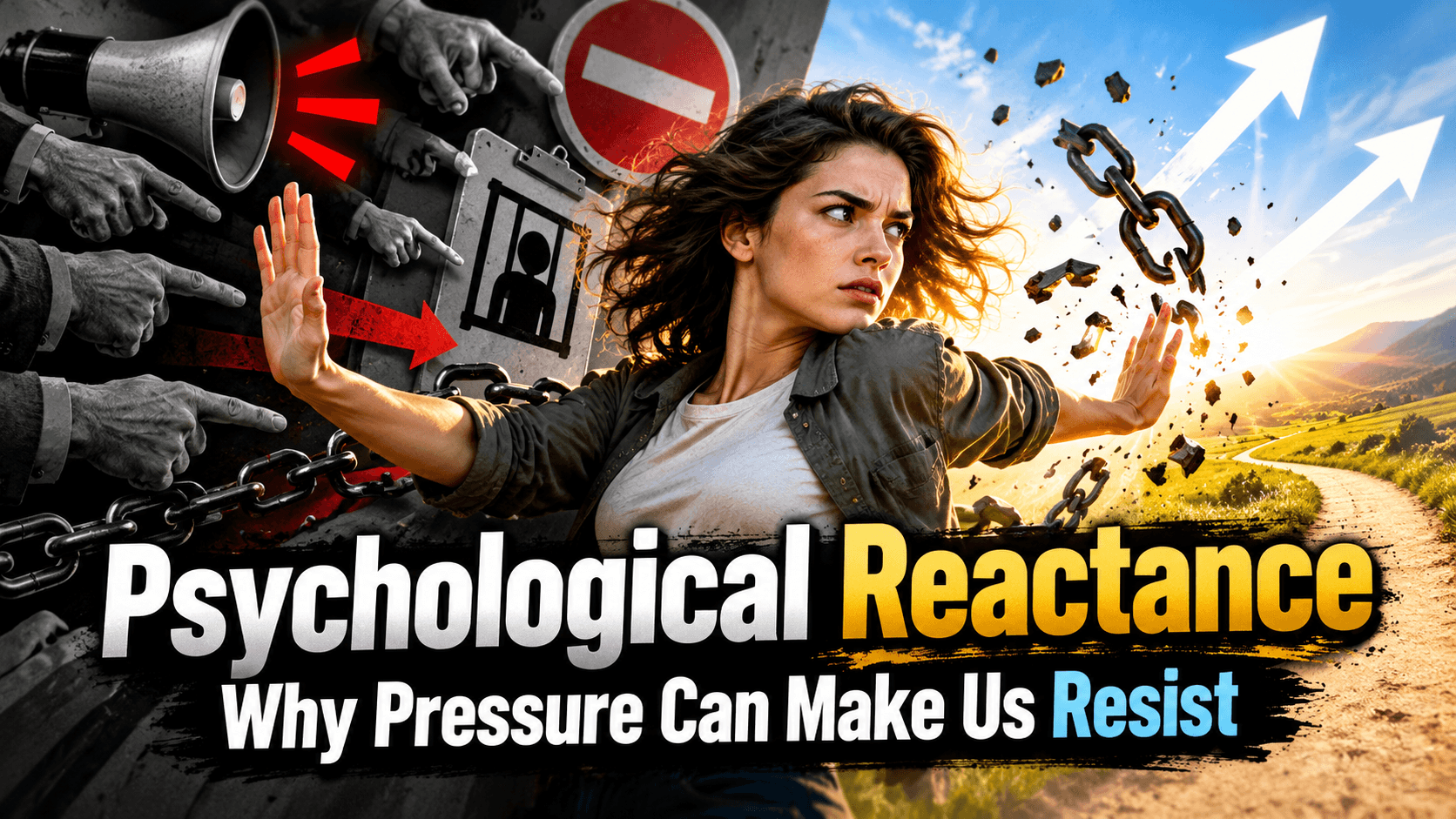
Sometimes the fastest way to make a choice feel more attractive is to tell someone they are not allowed to make it. A person who was only mildly interested in an option may suddenly defend it when it seems restricted. A reasonable suggestion may become irritating when it sounds like an order. Even useful advice can become harder to hear when the listener feels that someone else is trying to take over the decision.
Psychologists use the term psychological reactance for a specific kind of motivational response to threatened freedom. It is not a label for every disagreement, angry reaction, refusal, or independent choice. Understanding that distinction matters because reactance can sometimes protect a meaningful sense of choice, yet it can also pull attention away from the quality of the information itself.
Quick Answer
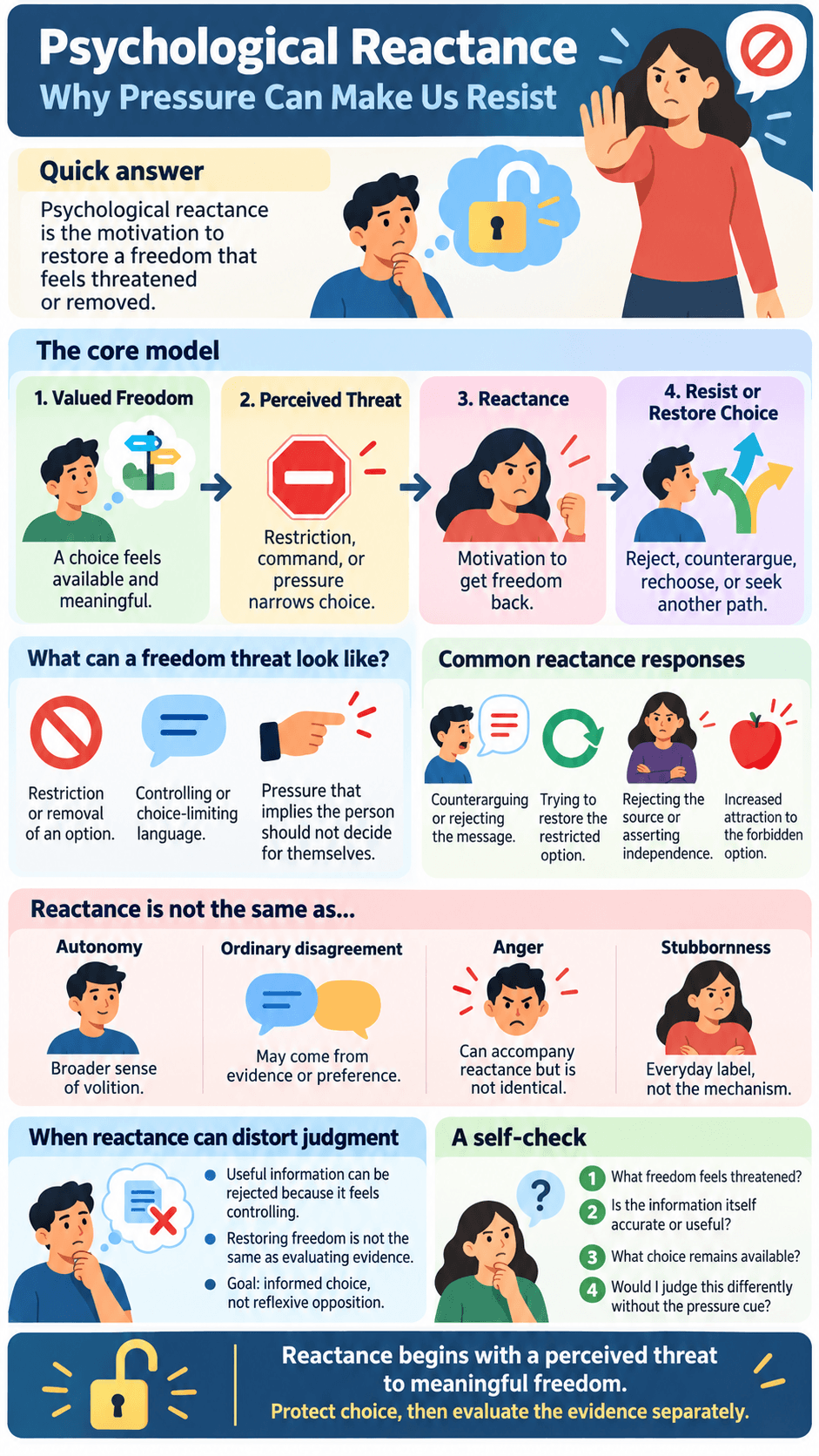
Psychological reactance is the motivation to restore a freedom that feels threatened or removed. It may show up as resistance, counterarguing, renewed interest in a restricted option, or rejection of the person or message creating the pressure. Reactance does not mean pressure will always produce the opposite behavior, and it is different from autonomy, ordinary disagreement, anger, and resistance that comes from evidence or reflection. Reactance is one specific pathway within social influence psychology, focused on what can happen when meaningful choice feels threatened.
What Psychological Reactance Means
Reactance theory begins with a simple idea: people often experience certain actions, choices, opinions, or ways of responding as available to them. When something makes an important freedom feel smaller, blocked, or illegitimately controlled, an uncomfortable motivational state may arise. That state pushes toward restoring the threatened freedom.
A broad research review in Zeitschrift für Psychologie describes reactance as motivation to regain freedom after it has been threatened or lost. The same review emphasizes that reactance depends on how a situation is interpreted, not merely on the presence of a rule, request, or restriction.
Valued freedom and perceived freedom threat
For reactance to make sense, there usually has to be some freedom the person believes they possess or should possess. That freedom might involve what to buy, whether to speak, how to spend time, which opinion to hold, whether to accept advice, or how to carry out a task.
The freedom also has to matter enough to notice. If a café removes a drink you never wanted, you may feel nothing. If a workplace suddenly removes a method you rely on and gives no explanation, the restriction may feel more personally relevant. The same objective limit can therefore produce very different reactions in different people or situations.
Motivation to restore choice
Reactance is not simply the thought, “I dislike this.” It includes a pull toward getting choice back. A person may defend the restricted option, question the source of the restriction, generate reasons the message is wrong, look for alternatives, or insist on deciding independently.
Restoration can be direct, such as choosing the restricted option once it becomes available. It can also be indirect, such as reaffirming another freedom, mentally rejecting the source, or becoming more favorable toward what was restricted. Which response appears depends on what options remain and what the person believes is possible.
Why reactance is not simply stubbornness, defiance, or anger
Calling someone stubborn says little about the mechanism behind the behavior. Reactance is narrower. It concerns a perceived threat to freedom and motivation to restore that freedom. Someone can refuse a suggestion because they have better evidence, because the cost is too high, because the suggestion conflicts with a value, or because they simply prefer something else. None of those reasons automatically establish reactance.
Anger can accompany reactance, but it is not identical to reactance either. A person may be angry about unfairness without feeling a particular freedom is threatened. Conversely, a person can quietly resist a restriction without displaying obvious anger.
Core Model: Valued Freedom → Perceived Threat → Reactance → Resist or Restore Choice
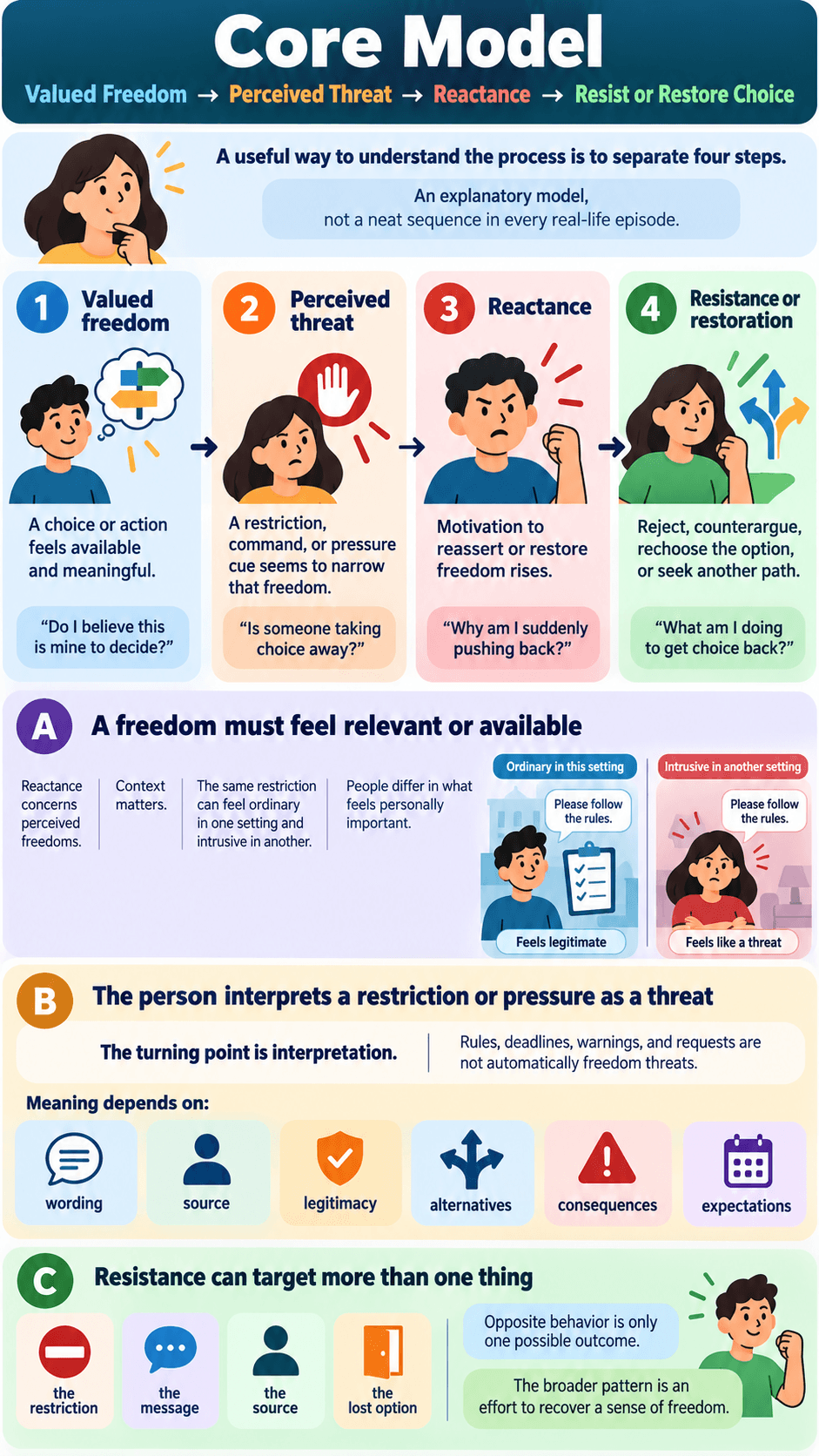
A useful way to understand the process is to separate four steps. This is an explanatory model rather than a claim that every real-life episode unfolds in a neat sequence.
| Stage | What is happening | Example question |
|---|---|---|
| Valued freedom | A choice or action feels available and meaningful. | “Do I believe this is mine to decide?” |
| Perceived threat | A restriction, command, or pressure cue seems to narrow that freedom. | “Is someone taking choice away?” |
| Reactance | Motivation to reassert or restore freedom rises. | “Why am I suddenly pushing back?” |
| Resistance or restoration | The person may reject, counterargue, rechoose the option, or seek another path. | “What am I doing to get choice back?” |
A freedom must feel relevant or available
Reactance theory does not require unlimited freedom. It concerns perceived freedoms. You might accept that a secure laboratory has strict safety procedures because those limits feel legitimate and expected. The same person may react strongly if a friend tries to dictate a personal choice that normally belongs to them.
This helps explain why context matters. A restriction that seems ordinary in one setting can feel intrusive in another. People also differ in what they consider personally important, so the strength of a response cannot be predicted from the restriction alone.
The person interprets a restriction or pressure as a threat
The psychological turning point is interpretation. Rules, deadlines, warnings, and requests are not automatically freedom threats. Their meaning depends on wording, source, legitimacy, alternatives, consequences, and the person’s expectations.
A doctor explaining risks and available options may be experienced differently from someone saying, “You must do this because I know better.” A manager setting a legal safety requirement may be experienced differently from a manager micromanaging a harmless preference. The surface form matters less than the meaning the person assigns to the pressure.
Resistance can target the restriction, message, source, or lost option
Once reactance is activated, the response does not have to be a literal reversal. A person might criticize the message, distrust the source, pay more attention to the forbidden option, delay action, seek a second opinion, or comply publicly while remaining internally resistant.
This is one reason “people do the opposite when pressured” is too crude. Opposite behavior is only one possible outcome. The broader pattern is an effort to recover a sense of freedom.
What Can a Freedom Threat Look Like?
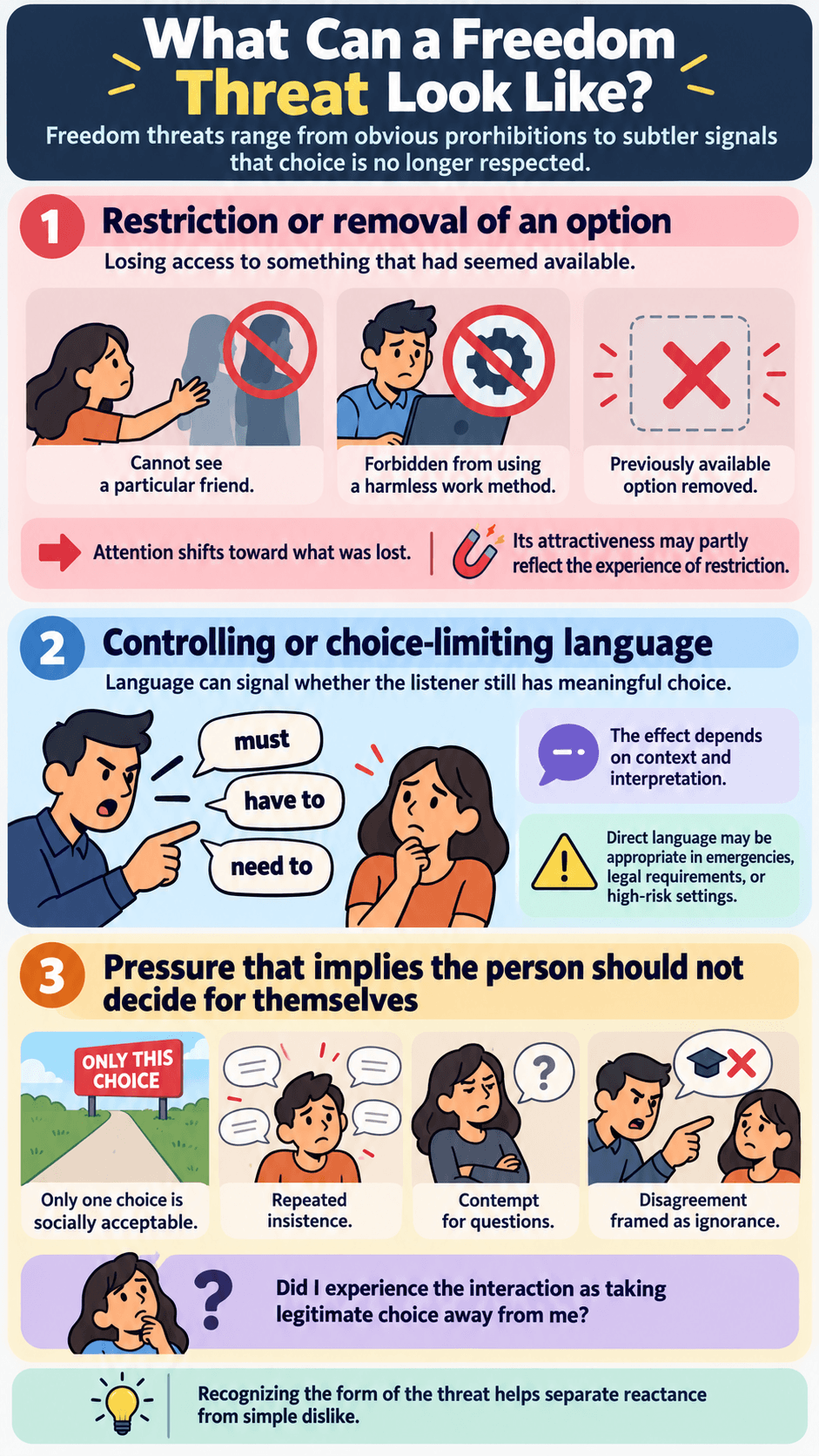
Freedom threats range from obvious prohibitions to subtler signals that choice is no longer respected. Recognizing the form of the threat helps separate reactance from simple dislike.
Restriction or removal of an option
The clearest example is losing access to something that had seemed available. A teenager is told they can no longer see a particular friend. An employee is suddenly forbidden from using a harmless work method. A consumer sees a previously available option removed without explanation.
The restricted option can become more psychologically salient because attention shifts toward what was lost. That does not mean the option becomes objectively better. Its attractiveness may partly reflect the experience of restriction.
Controlling or choice-limiting language
Language can signal whether the listener still has meaningful choice. Experimental work by Dillard and Shen, summarized by Penn State, found that perceived threats to freedom were associated with a combination of anger and negative thoughts about the message. Later research has often examined forceful terms such as “must,” “have to,” and “need to” as potential reactance cues.
That finding should not be turned into a universal wording rule. In emergencies, legal requirements, or high-risk settings, direct language may be appropriate. In other contexts, the same wording may feel unnecessarily controlling. The effect depends on context and interpretation.
Pressure that implies the person should not decide for themselves
A message may contain options on paper while still communicating that only one choice is socially acceptable. Repeated insistence, contempt for questions, or framing disagreement as proof of ignorance can make the decision feel pre-decided by someone else.
For self-awareness, the useful question is not merely, “Was I told what to do?” It is, “Did I experience the interaction as taking legitimate choice away from me?”
Common Reactance Responses
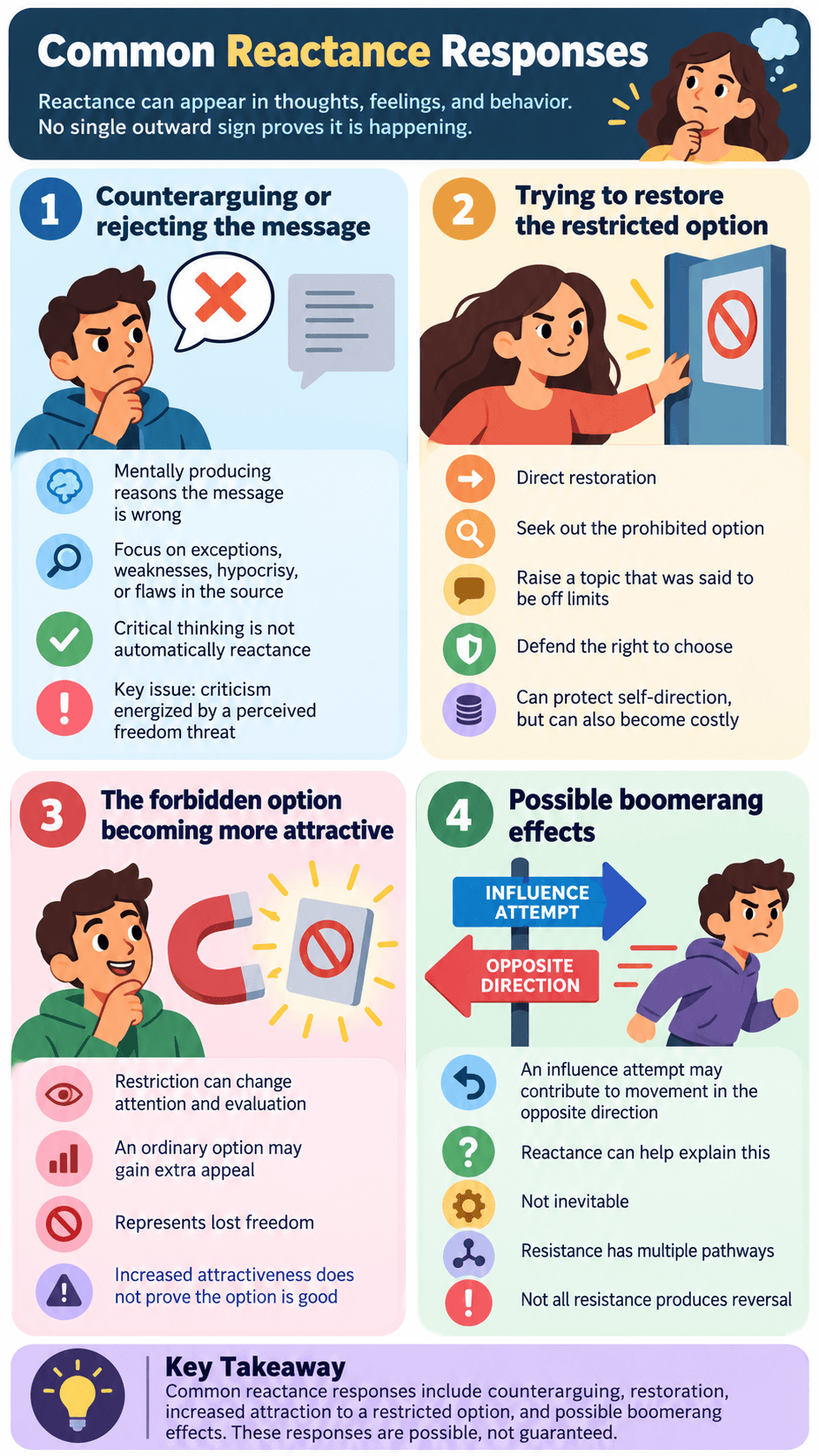
Reactance can appear in thoughts, feelings, and behavior. Research does not support one single outward sign that proves it is happening.
Counterarguing or rejecting the message
One common response is mentally producing reasons the message is wrong. The person may focus on exceptions, weaknesses, hypocrisy, or flaws in the source. This process is called counterarguing in communication research.
A meta-analytic review in Human Communication Research found support for a model in which anger and counterarguments operate together as indicators of reactance. That does not mean every critical thought is reactance. Critical thinking can be entirely appropriate. The distinctive issue is whether the criticism is being energized by a perceived freedom threat.
Trying to restore the restricted option
Another response is direct restoration. If an option is prohibited, the person may seek it out. If someone says a topic cannot be discussed, the person may become more determined to raise it. If a choice is dismissed, the person may defend their right to make it.
Restoration can sometimes serve a useful protective function by preserving self-direction. It can also become costly if the urge to restore freedom overshadows practical consequences.
The forbidden option becoming more attractive
Restriction can change attention and evaluation. An option that seemed ordinary may acquire extra appeal because it now represents lost freedom. This is sometimes described as an increase in the attractiveness of the restricted alternative.
The important nuance is that increased attractiveness does not prove the option is good. It may partly reflect the motivational meaning created by the restriction.
Possible boomerang effects without assuming they always occur
A boomerang effect occurs when an influence attempt contributes to movement in the opposite direction. Reactance theory helps explain why this can happen, but it should not be treated as inevitable.
A peer-reviewed review on resistance to persuasion in Frontiers in Psychology distinguishes freedom threat from other motives for resisting a message, including reluctance to change and concerns about deception. In other words, resistance has multiple pathways, and not all of them produce reversal.
Why Reactance Varies
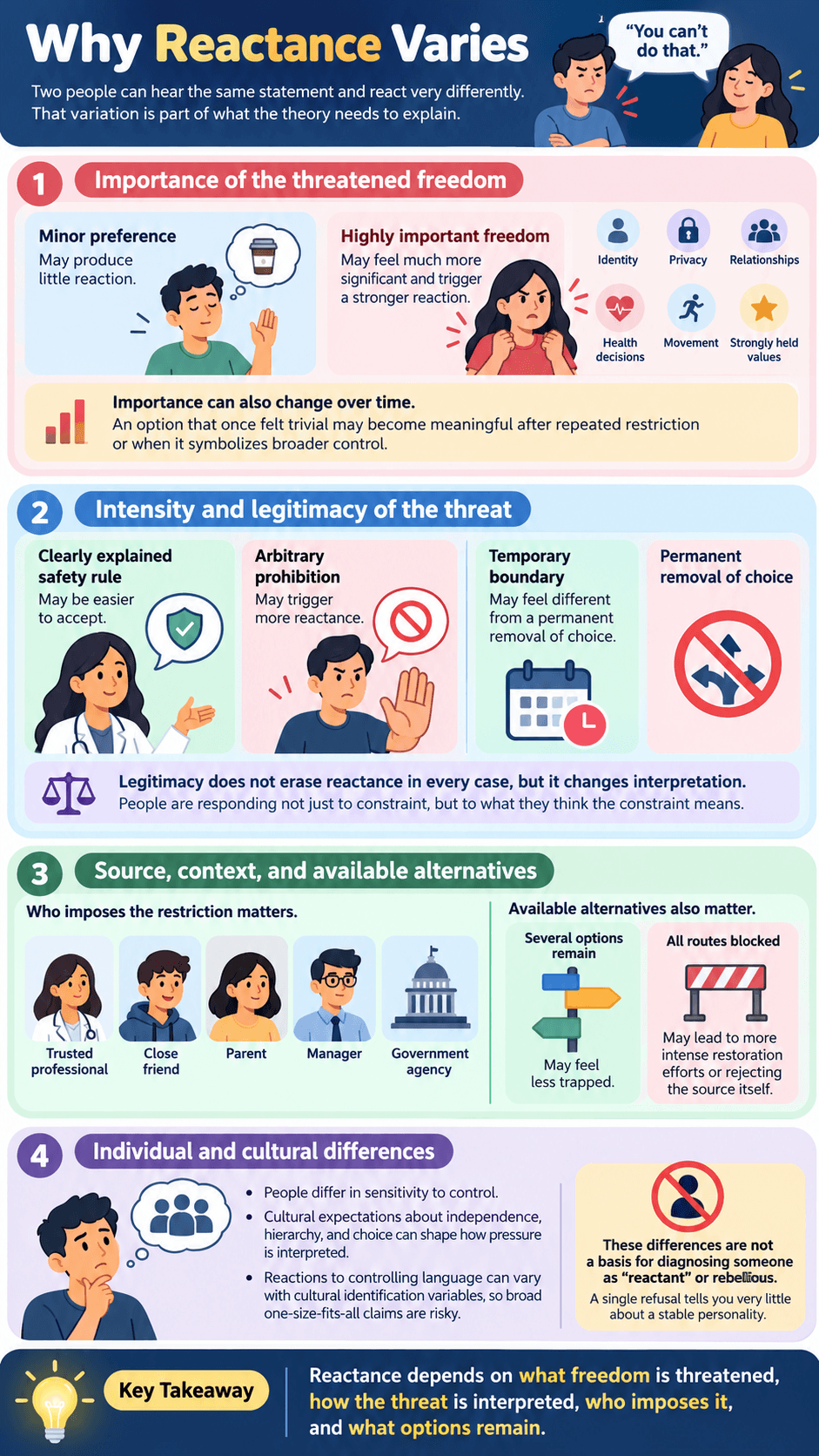
Two people can hear the same statement and react very differently. That variation is not noise around the theory. It is part of what the theory needs to explain.
Importance of the threatened freedom
A minor preference may produce little reaction, while a restriction touching identity, privacy, relationships, health decisions, movement, or strongly held values may feel much more significant. The more important the freedom, the stronger the potential motivation to restore it.
Importance can also change over time. An option that once felt trivial may become meaningful after repeated restriction or when it symbolizes broader control.
Intensity and legitimacy of the threat
Reactance is shaped by both how much freedom seems threatened and whether the limit feels justified. A clearly explained safety rule may be easier to accept than an arbitrary prohibition with no reason. A temporary boundary may feel different from a permanent removal of choice.
Legitimacy does not erase reactance in every case, but it changes interpretation. People are generally responding not just to constraint, but to what they think the constraint means.
Source, context, and available alternatives
Who is imposing the restriction matters. A trusted professional, a close friend, an anonymous platform, a parent, a manager, and a government agency carry different expectations and forms of authority. Context also shapes whether the source is seen as entitled to set a limit.
Alternatives matter too. A person may feel less trapped when several meaningful options remain. When all routes appear blocked, restoration efforts may become more intense or shift toward rejecting the source itself.
Individual and cultural differences without personality diagnosis
People differ in sensitivity to control, and cultural expectations about independence, hierarchy, and choice can shape how pressure is interpreted. A 2024 study indexed by PubMed found that reactions to controlling language varied with cultural identification variables, illustrating why broad one-size-fits-all claims are risky.
These differences are not a basis for diagnosing someone as “reactant” or rebellious. A single refusal tells you very little about a stable personality.
Reactance vs Autonomy vs Broad Resistance

These concepts overlap in everyday language but answer different psychological questions.
| Concept | Core question | What makes it distinct |
|---|---|---|
| Autonomy | Do I experience myself as acting with volition? | A general experience of self-directed choice. |
| Psychological reactance | Has a valued freedom been threatened? | A motivational response specifically tied to threatened or lost freedom. |
| Resistance to social influence | Why am I not yielding to pressure? | A broader category that can include evidence, dissent, social support, prior commitments, reflection, or reactance. |
Autonomy: experience of volition and self-direction
Autonomy concerns acting with a sense of willingness and ownership. Someone can value autonomy without currently experiencing a threat to freedom. You might choose your own schedule and feel self-directed without resisting anyone.
Reactance starts at a different point: a freedom feels threatened. It is therefore better understood as a response to a particular kind of situation than as a synonym for autonomy itself.
Reactance: motivational response to threatened freedom
Reactance is activated around loss or threat. It may prompt efforts to restore freedom, but the restored choice is not necessarily the wisest choice. The motive is about freedom, not guaranteed accuracy.
This distinction helps explain why a person may reject sound information after feeling controlled. The information has not become false, but the pressure has changed the motivational context in which it is being evaluated.
Resistance to social influence: broader pathways including evidence, allies, reflection, and dissent
People resist for many reasons. They may have strong evidence, support from an ally, prior commitments, competing values, more time to reflect, or doubts about the source. None of those require a freedom threat.
Reactance is therefore one route to resistance, not the umbrella for every act of standing firm. For the wider set of reasons people may maintain independent judgment under pressure, see resistance to social influence.
Reactance vs Ordinary Disagreement, Anger, and Stubbornness
Disagreement can occur without a freedom threat
You can disagree because you interpret evidence differently. You can refuse a recommendation because the costs outweigh the benefits. You can reject an opinion because it conflicts with a well-supported conclusion. Those are disagreements, but not necessarily reactance.
A useful clue is whether the pressure itself changed your motivation. If you would have reached the same conclusion without the controlling cue, reactance may not be central.
Anger can accompany reactance but is not identical to it
Research often finds anger involved in reactance, especially alongside negative thoughts about the message. Yet anger can arise from insult, injustice, frustration, loss, or conflict that has nothing to do with threatened freedom.
Likewise, reactance can be quiet. Someone may simply decide, “I want to make this choice myself,” without becoming visibly angry.
Repeated opposition is not enough to infer a stable personality trait
When someone often pushes back, it is tempting to explain the person rather than the situations. That leap can hide useful questions: Are they repeatedly being pressured? Do they distrust the source? Are the limits unclear? Are they defending a value? Are they simply making different judgments?
Behavior needs context. Reactance is a psychological process, not a shortcut for labeling a difficult person.
Reactance Inside Persuasion Research
Why freedom-threatening communication can trigger resistance
Persuasive communication can become a freedom threat when the listener experiences it as trying to remove choice rather than offer information. In Dillard and Shen’s experiments, threat-to-freedom influenced attitude and intention through a combination of anger and negative cognitions.
The key point is not that persuasion is inherently controlling. Many persuasive messages simply present reasons or recommendations. Reactance becomes especially relevant when the person perceives the attempt as intruding on a freedom they value.
Persuasion and reactance are not the same process
Persuasion asks how communication can influence attitudes, beliefs, or intentions. Reactance asks what may happen when a person experiences an influence attempt as a threat to freedom. One is a broad domain of influence; the other is a specific resistance mechanism.
Keeping the distinction clear prevents a common mistake: assuming that every unsuccessful message failed because it triggered reactance. People may reject a message because they find the evidence weak, the source untrustworthy, the recommendation impractical, or the conclusion inconsistent with what they already know.
Controlling versus choice-supportive language as a research comparison
Researchers often compare forceful wording with language that leaves more room for choice. Some studies find more reactance after controlling language, while results are not perfectly uniform across settings. For example, an open-access experiment in Digital Health did not find the predicted main effects of autonomy-supportive versus controlling message frames on reactance in its alcohol-reduction intervention.
That mixed evidence is useful. It discourages simplistic rules such as “never use direct language” or “one phrase prevents resistance.” Real responses depend on topic, source, stakes, audience, and how strongly the language is experienced as threatening freedom.
When Reactance Can Distort Judgment
Useful information can be rejected because it feels controlling
A warning can be accurate and still provoke reactance. If the feeling of being controlled becomes the main focus, a person may spend more effort defending freedom than evaluating the warning.
This matters in everyday decisions because source style and message quality are separate questions. An irritating messenger can still be correct. A respectful messenger can still be wrong.
Restoring freedom is not the same as evaluating evidence
Reactance answers a motivational question: “How do I get choice back?” Evidence evaluation answers an epistemic question: “What is most likely true or useful?” Those questions can point in the same direction, but they do not have to.
A person who notices reactance can preserve both goals by separating them. First, identify what choice feels threatened. Then evaluate the claim on its own merits. Finally, decide what action fits both the evidence and the freedom that legitimately belongs to you.
The goal is informed choice, not reflexive opposition
Reactance sometimes alerts people to genuine overreach. In other situations, it can encourage rejection simply because something felt controlling. Treating opposition as automatically independent thinking creates another form of automatic responding.
Calibrated independence means keeping the right to choose while still allowing accurate information to matter.
A Self-Check for Separating Message Quality From the Feeling of Pressure

When you notice a strong urge to push back, these questions can help slow the process without asking you to surrender your autonomy.
What freedom feels threatened?
Name the specific choice. Is it the freedom to decide whether to participate, how to do something, which opinion to hold, when to act, or whether to accept advice? A precise answer is more useful than a vague sense that “they are controlling me.”
Is the information itself accurate or useful?
Temporarily imagine the same information coming from a neutral source. Would the evidence still seem weak, or is the strongest objection aimed at how the message was delivered?
This does not require trusting the source. It simply separates message quality from the emotional meaning of pressure.
What choice remains available?
Reactance can intensify when a situation feels all-or-nothing. List the real options that remain. You may be able to seek clarification, delay a non-urgent decision, choose among alternatives, ask for the reason behind a rule, or decline when declining is genuinely available.
In settings involving legal duties, immediate safety, or unavoidable constraints, the realistic choice set may be narrower. Recognizing that reality is different from pretending every restriction is optional.
Would I evaluate the same information differently without the pressure cue?
This question is a useful test of judgment. If your evaluation changes dramatically when you imagine the same evidence presented without force, the pressure cue may be influencing your reasoning.
You do not need to suppress the feeling. Notice it, protect legitimate choice, and then return to the substance of the decision.
FAQ
Is psychological reactance the same as stubbornness?
No. Stubbornness is a broad everyday label for persistent unwillingness to change. Psychological reactance refers specifically to motivation that arises when a person perceives a valued freedom as threatened or removed. Someone may resist for many other reasons, including evidence, values, practical costs, distrust, or simple preference.
Does controlling language always cause a boomerang effect?
No. Controlling language can increase perceived freedom threat in some settings, but effects vary with context, topic, source, audience, legitimacy, and how the language is interpreted. Even when reactance occurs, the response may be counterarguing, source rejection, delayed action, or another form of restoration rather than doing the exact opposite.
How is reactance different from autonomy?
Autonomy is the experience of acting with volition and self-direction. Reactance is a motivational response to a perceived threat or loss of freedom. A person can experience autonomy without resisting anyone, while reactance becomes relevant when choice feels constrained.
Is every form of resistance psychological reactance?
No. Resistance may come from careful reasoning, prior commitments, dissent, social support, uncertainty, conflicting values, distrust, or strong evidence. Reactance is one pathway within a much broader range of reasons people may not yield to influence.
Can reactance make people reject helpful information?
Yes, it can. If a helpful message is experienced as controlling, the person may focus on restoring freedom rather than assessing the information fairly. That possibility does not mean the person is irrational or that the message is automatically correct. It means separating the pressure cue from the evidence can improve judgment.
Key Takeaways
- Psychological reactance begins with a perceived threat to a freedom the person experiences as meaningful.
- Reactance can involve anger, counterarguing, rejection of the source, renewed attraction to a restricted option, or other efforts to restore choice.
- A boomerang effect is possible but not inevitable, and not every refusal or opposite action is caused by reactance.
- Autonomy is a broader experience of volition, while reactance is specifically a response to threatened freedom.
- Resistance to social influence has many pathways besides reactance, including evidence, dissent, social support, and reflection.
- A practical way to respond to your own reactance is to identify the threatened freedom, separate delivery from evidence, and then make the decision deliberately.
Final Thoughts
Reactance helps explain a familiar human experience: pressure can change not only what we are being asked to do, but how the choice itself feels. A restriction may make an option more noticeable, a command may make a message harder to hear, and a threat to choice may shift attention toward getting freedom back.
The most useful next step is not to treat reactance as an enemy or as proof that resistance is correct. When you notice the urge to push back, ask what freedom feels threatened and then evaluate the underlying information separately. That preserves the value at the center of reactance, meaningful choice, without letting the feeling of pressure make the decision for you.
Educational note: This article explains psychological research for general education. It does not diagnose personality, mental health conditions, or the motives behind any individual’s behavior.

Michael Reed is the Founder and Lead Writer at Psychology Exposed. He writes about human behavior, relationships, emotional patterns, self-awareness, and practical psychology topics using research-informed, easy-to-understand content.
Read More About Michael Reed: https://psychologyexposed.com/michael-reed/