

Other people affect us even when they never issue an order or make an argument. A room can go quiet and make you lower your voice. A friend can ask for a favor and make refusal feel awkward. A manager can give a directive that carries more weight than the same words from a stranger. A crowd can make an uncertain choice look safer, while a forceful message can make you want to push back.
Social influence psychology studies these kinds of changes in thought, feeling, judgment, and behavior. The useful question is not simply, “Was this person influenced?” It is, “What kind of social signal was present, how was it interpreted, what response followed, and did the person’s private belief change too?” Those distinctions help separate conformity from compliance, obedience from authority, social proof from group norms, and resistance from reflexive opposition.
Quick Answer
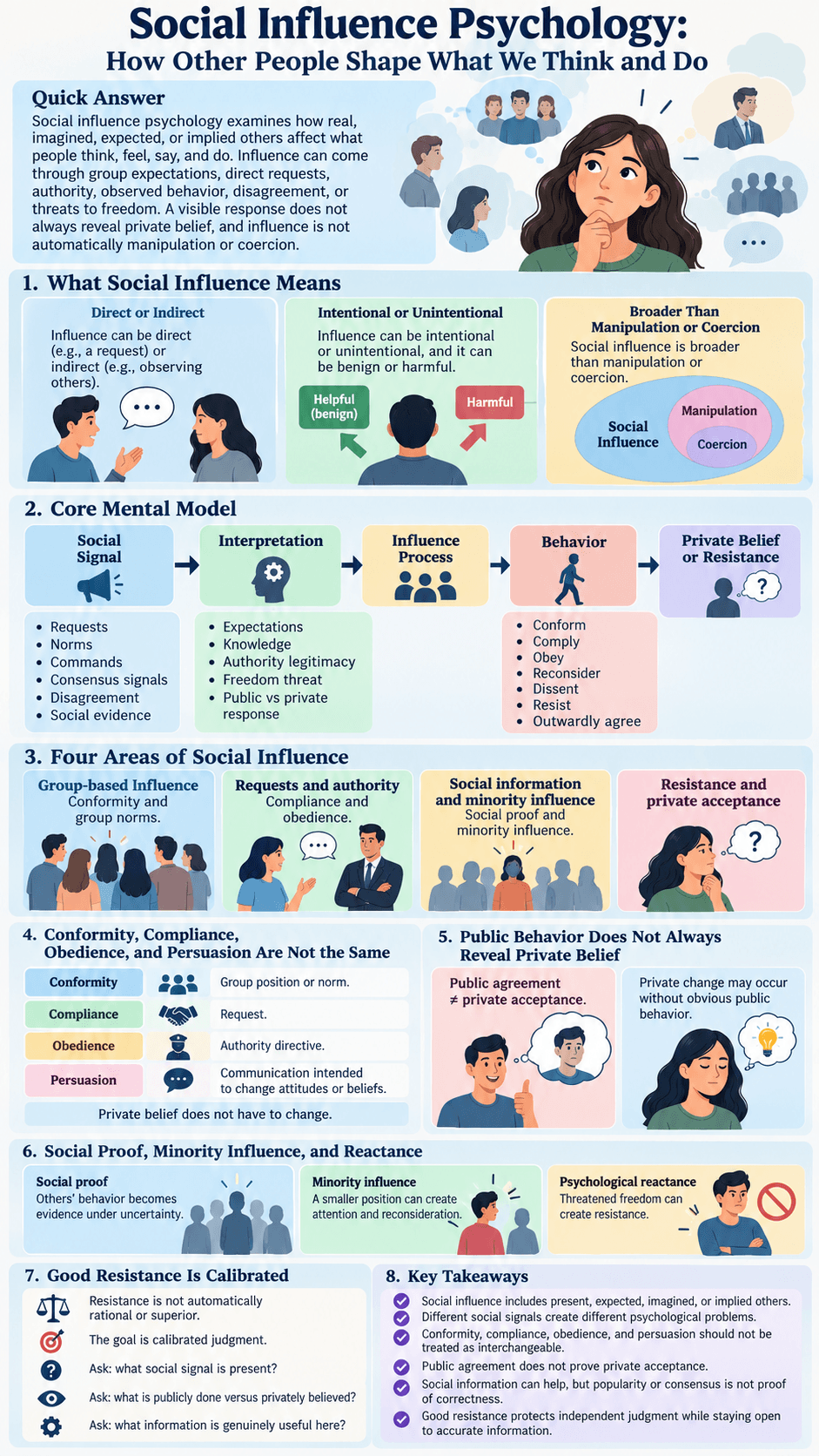
Social influence psychology examines how real, imagined, expected, or implied others affect what people think, feel, say, and do. Influence may come through group expectations, direct requests, authority, observed behavior, disagreement, or threats to freedom. A visible response does not always reveal private belief, and influence is not automatically manipulation or coercion.
What Social Influence Means
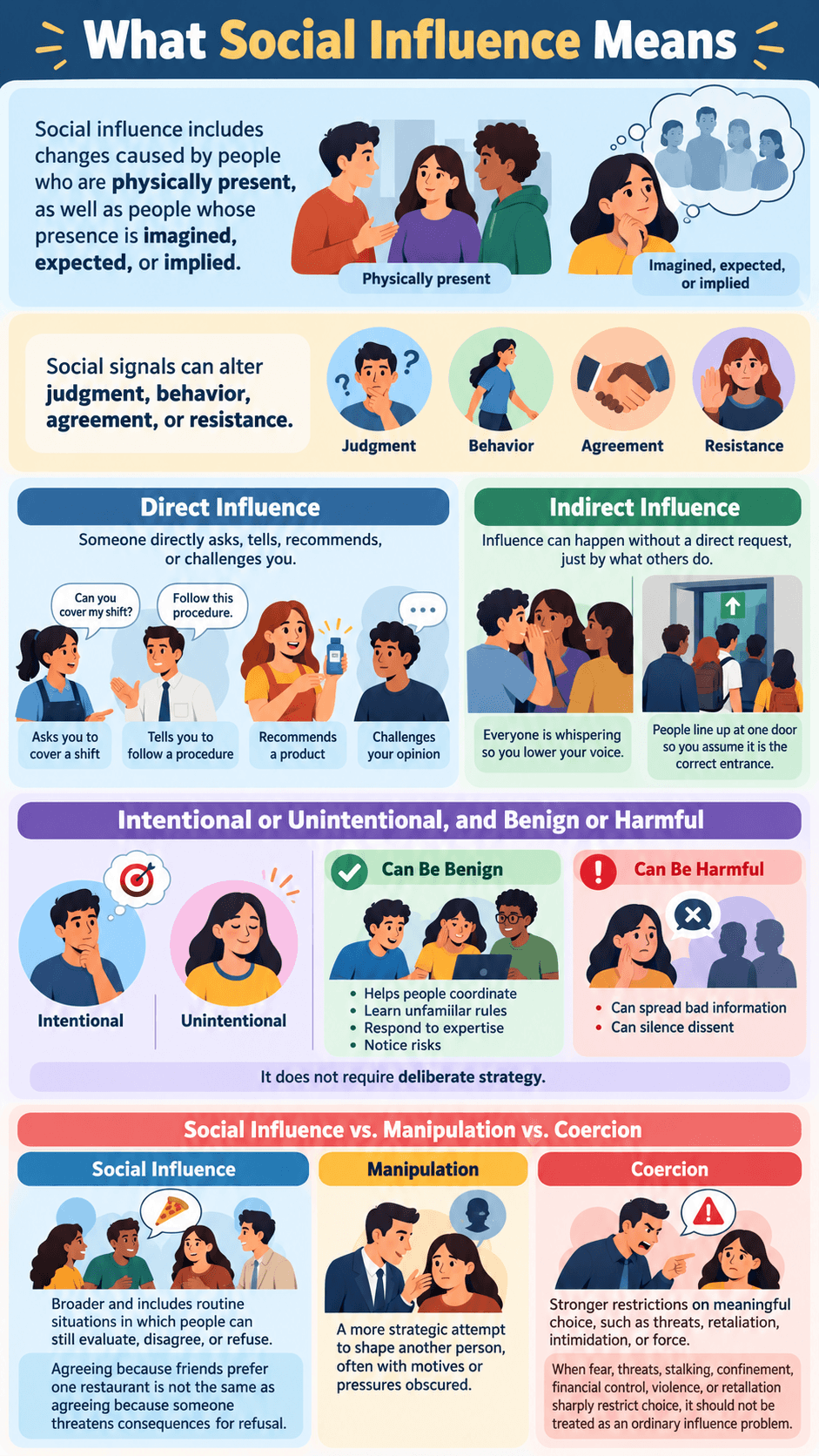
The APA Dictionary of Psychology definition of social influence includes changes caused by people who are physically present as well as people whose presence is imagined, expected, or implied. That broad definition matters because much of social life works without someone standing over us. Expectations can be carried through routines, reputations, roles, group habits, past reactions, or the simple knowledge that other people will see what we do.
For the wider field around person, situation, and group effects, Social Psychology Basics provides the broader context. Here, the focus stays on the narrower question of how social signals alter judgment, behavior, agreement, or resistance.
Influence can be direct or indirect without physical force
Direct influence is easy to notice. Someone asks you to cover a shift, tells you to follow a procedure, recommends a product, or challenges your opinion. The social signal is visible because another person is actively trying to shape what happens next.
Indirect influence can be quieter. You enter a waiting room and notice that everyone is whispering, so you lower your own voice. You see that nearly every person at an unfamiliar event is lining up at one door, so you assume it is the correct entrance. Nobody had to instruct you. Other people still changed the information available to you and, potentially, your behavior.
Intentional versus unintentional and benign versus harmful influence
Influence does not require deliberate strategy. A confident coworker may shift a discussion by speaking first, a worried friend may make an ambiguous situation seem riskier, and a family custom may guide choices without anyone explicitly enforcing it.
Influence can help people coordinate, learn unfamiliar rules, respond to expertise, or notice risks. It can also spread bad information or silence dissent. The fact that influence occurred does not tell us whether the outcome was accurate, fair, or voluntary.
Why social influence is not automatically manipulation or coercion
Manipulation usually implies a more strategic attempt to shape another person, often with important motives or pressures obscured. Coercion involves stronger restrictions on meaningful choice, such as threats, retaliation, intimidation, or force. Social influence is broader and includes routine situations in which people can still evaluate, disagree, or refuse.
Agreeing because friends prefer one restaurant is not equivalent to agreeing because someone threatens consequences for refusal. When fear, threats, stalking, confinement, financial control, violence, or retaliation sharply restrict choice, the situation should not be treated as an ordinary influence problem.
Core Mental Model: Social Signal → Interpretation → Influence Process → Behavior → Private Belief or Resistance
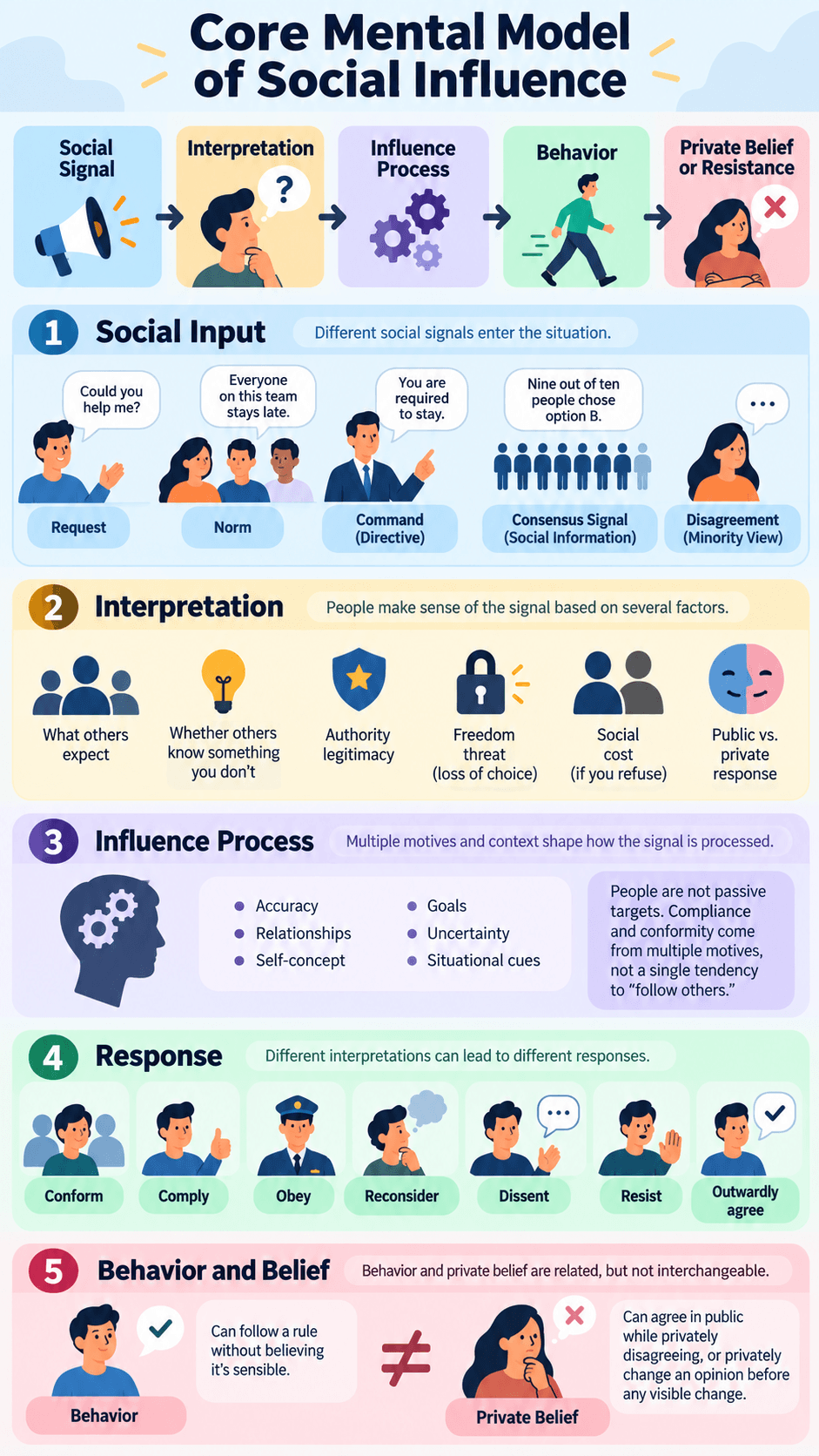
A practical way to understand social influence is to separate the event into stages. The same outward behavior can come from very different processes, so starting with the visible action alone often leads to poor conclusions.
Social input: requests, norms, commands, consensus signals, disagreement, and social evidence
First, identify what entered the situation. Was there a direct request? A shared expectation? A command from someone seen as having legitimate authority? A visible majority position? A minority viewpoint? A signal that “everyone else is doing this”? Each cue creates a different psychological problem for the person receiving it.
For example, “Could you stay late and help me?” is a request. “Everyone on this team stays late” signals a norm. “You are required to stay” is closer to a directive. “Nine out of ten people chose option B” supplies social information. The words may overlap, but the social signal differs.
Interpretation: expectations, knowledge, authority legitimacy, freedom threat, and public versus private response
Next comes interpretation. People judge what others expect, whether others know something they do not, whether a directing person has legitimate authority, whether refusal carries social cost, and whether choice is being respected. The same suggestion can feel useful, irrelevant, or controlling depending on context.
Research reviews of social influence emphasize that people are not passive targets who respond to one universal pressure. Accuracy, relationships, self-concept, goals, uncertainty, and situational cues all matter. A major review in the Annual Review of Psychology describes compliance and conformity as processes shaped by multiple motives rather than a single tendency to “follow others.”
Response: conform, comply, obey, reconsider, dissent, resist, or outwardly agree
The response may be movement toward the group, agreement to a request, obedience to a directive, reconsideration after hearing an unpopular view, resistance to pressure, or simple outward agreement. The person might also delay, ask questions, seek another opinion, or behave one way publicly while privately keeping a different view.
This final distinction is especially important: behavior and belief are related, but they are not interchangeable. Someone can follow a rule without believing it is sensible, agree with a group in public while privately disagreeing, or privately change an opinion before showing any obvious behavioral change.
Four Areas of Social Influence
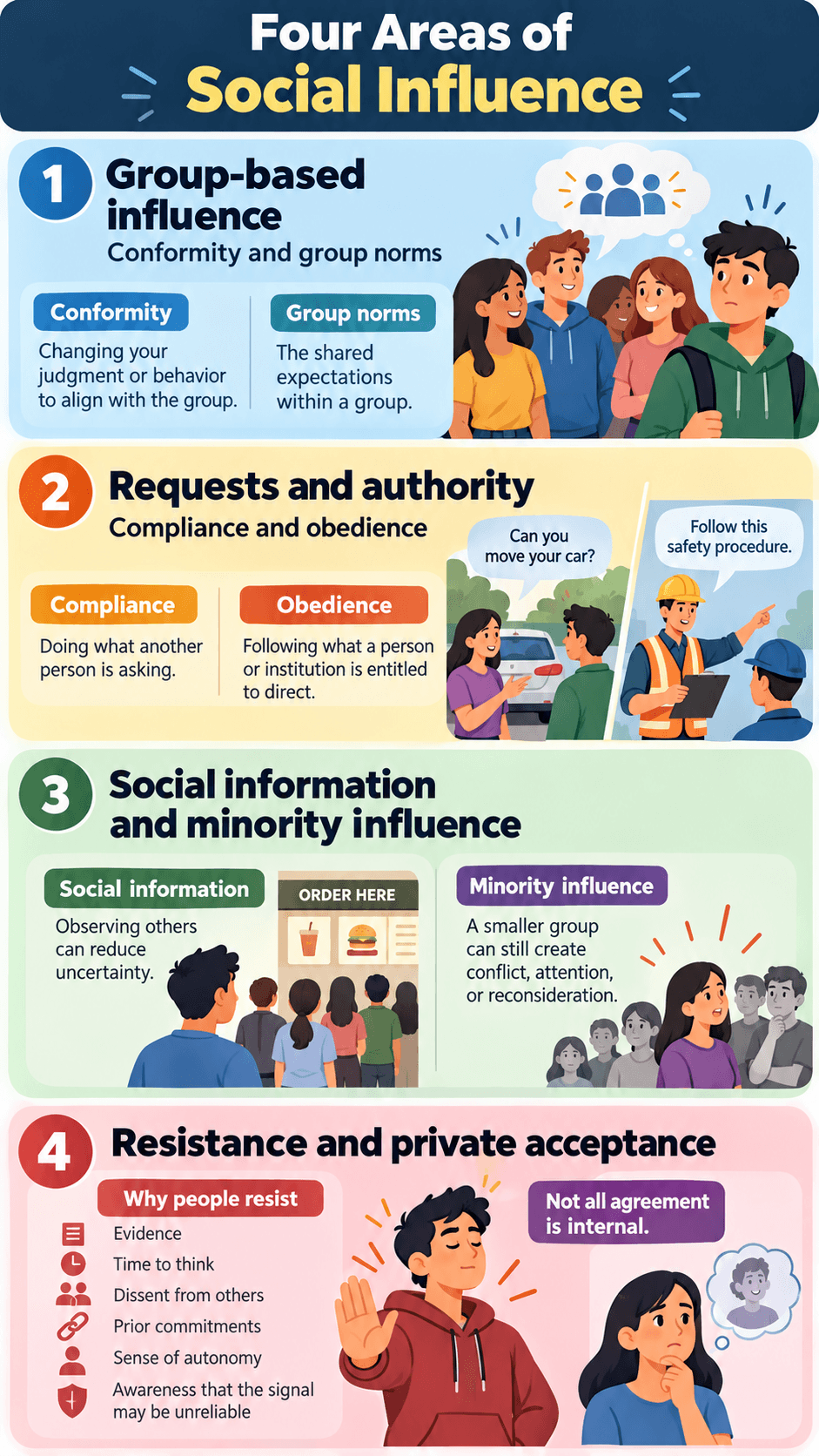
The field becomes easier to navigate when different forms of influence are grouped by the kind of social signal involved.
Group-based influence: conformity and group norms
When the central issue is movement toward a group position, the key concept is conformity. When the issue is the shared expectation itself, the focus is group norms. Psychology Exposed covers these separately because “what the group expects” and “how a person responds to that expectation” are related but not identical questions. For the deeper distinction, see how conformity changes judgment or behavior and how group norms create shared expectations.
Requests and authority: compliance and obedience
A request asks, “Will you do what another person is asking?” That is the core territory of compliance. An authority directive asks, “Will you follow what this person or institution is entitled to direct?” That is the core territory of obedience.
These processes can overlap, but the distinction still matters. A neighbor asking you to move a car, a supervisor directing a safety procedure, and friends expecting you to join them create different social relationships and different reasons to agree or refuse.
Social information and minority influence
Sometimes other people matter because their behavior becomes evidence. When you are uncertain about what to order, where to stand, or whether a situation is serious, observing others can reduce uncertainty. This is one reason social proof can be powerful without anyone explicitly requesting agreement.
Influence can also move in the opposite numerical direction. A minority position may create conflict, attention, or reconsideration even when most people initially disagree. A modern review of minority influence research emphasizes that influence between minorities and majorities is more complex than a simple one-way model in which the largest group always wins.
Resistance and private acceptance
Not every influence attempt succeeds, and not every visible agreement becomes internal belief. Resistance may be supported by evidence, time to think, dissent from another person, prior commitments, a sense of autonomy, or awareness that the social signal is unreliable. In other cases, pressure itself may create a motivation to restore threatened freedom.
The useful question is not whether someone is “influenceable.” Everyone operates in social environments. The better test is whether useful social information can be separated from pressure that deserves scrutiny.
Conformity, Compliance, Obedience, and Persuasion Are Not the Same
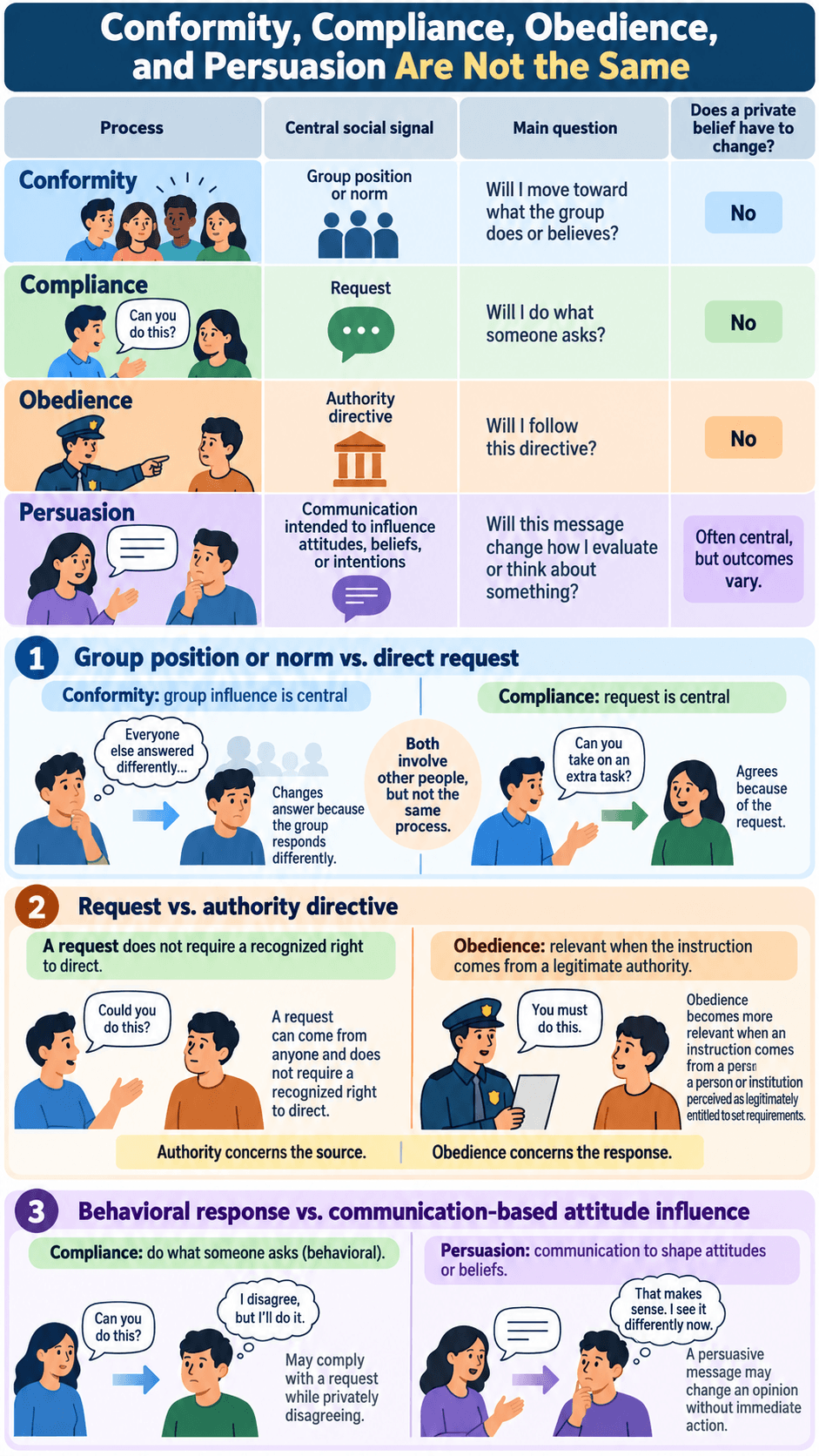
| Process | Central social signal | Main question | Does private belief have to change? |
|---|---|---|---|
| Conformity | Group position or norm | Will I move toward what the group does or believes? | No |
| Compliance | Request | Will I do what someone asks? | No |
| Obedience | Authority directive | Will I follow this directive? | No |
| Persuasion | Communication intended to influence attitudes, beliefs, or intentions | Will this message change how I evaluate or think about something? | Belief or attitude change is often central, but outcomes vary |
Group position or norm versus direct request
If you change an answer because everyone else responds differently, group influence is central. If one person asks you to take on an extra task and you agree, the request is central. Both involve other people, but not the same process.
Request versus authority directive
A request does not require a recognized right to direct. Obedience becomes more relevant when an instruction comes from a person or institution perceived as legitimately entitled to set requirements. Why authority carries psychological legitimacy concerns the source, while obedience concerns the response.
Behavioral response versus communication-based attitude influence
Persuasion centers on communication intended to shape attitudes, beliefs, evaluations, or intentions. That differs from simply doing what someone asks. A person may comply with a request while privately disagreeing, while a persuasive message may change an opinion without immediate action. See how persuasion works through communication.
Public Behavior Does Not Always Reveal Private Belief
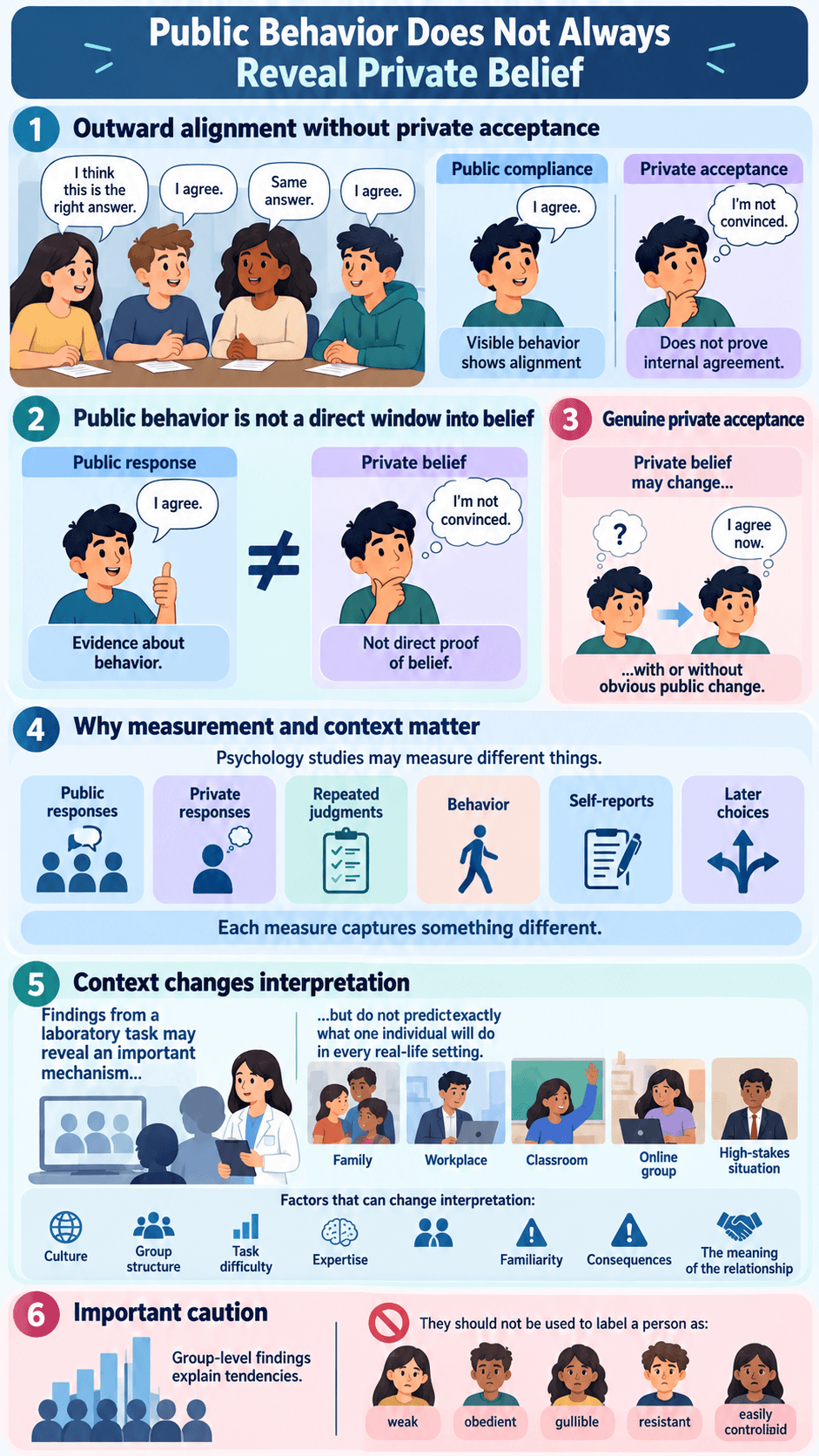
Outward alignment without private acceptance
Suppose a student gives the same answer as a group during a public discussion but privately remains unconvinced. The visible behavior shows alignment, yet it does not prove internal agreement. Researchers have long distinguished public compliance from private acceptance for exactly this reason.
An open-access study on public compliance and private acceptance illustrates how researchers can observe different patterns when responses are made publicly versus privately. The broader lesson is simple: public behavior is evidence about behavior, not a direct window into belief.
Genuine private acceptance with or without obvious public change
Why measurement and context matter
Psychology studies often need a specific way to measure influence: public responses, private responses, repeated judgments, behavior, self-reports, or later choices. Each measure captures something different. Findings from a laboratory task may reveal an important mechanism without predicting exactly what one individual will do in a family, workplace, classroom, online group, or high-stakes situation.
Culture, group structure, task difficulty, expertise, familiarity, consequences, and the meaning of the relationship can all change how a social cue is interpreted. Group-level findings help explain tendencies. They should not be used to label a person as weak, obedient, gullible, resistant, or easily controlled.
Social Information Can Guide or Mislead
Other people as evidence under uncertainty
Imagine arriving at an unfamiliar train station and seeing almost everyone move toward one platform after an announcement you could not hear. Their behavior becomes information. Following may be sensible because other travelers may have heard something you missed.
Now imagine that the first few people moved in the wrong direction and everyone else simply followed them. The visible consensus still looks informative, but its informational value is poor. Social proof is strongest as a cue when uncertainty is high, yet uncertainty is also when mistaken behavior can spread.
Social proof versus shared group expectations
Social proof asks, “What are other people doing, and what might that tell me?” A group norm asks, “What is expected here?” Many people may do something without strongly expecting everyone else to do it, while a norm may remain powerful even when not everyone follows it.
Popularity is not proof of truth or quality
Numbers are psychologically compelling because they compress social information. High ratings, long lines, repeated opinions, and visible counts can signal consensus. But consensus may reflect shared evidence, copying, limited options, common incentives, or the same misleading information spreading through a network.
Majority, Minority, and Dissent
Majority influence and conformity
Majorities can influence behavior through expectations, social acceptance, and information. Classic conformity research made this visible, but responses vary with ambiguity, public versus private answers, dissent, and how the group is understood.
How minority positions can trigger reconsideration
A minority view does not have to win immediate public agreement to matter. A consistent but flexible dissenting position can draw attention to assumptions that the majority had stopped examining. That does not make minorities inherently correct. It means numerical size is not the only route to influence.
Minority influence is most useful when the question is not why someone matched a majority, but why an initially unpopular view made people reconsider. It is not a formula for persuading a crowd.
Dissent and social support as routes to resistance
One dissenter can change the psychological situation for everyone else. A person who privately disagrees may feel less isolated once another person voices a different view. The importance is not that the dissenter supplies a new majority. The dissenter can make independent judgment feel more possible.
Freedom Threat and Resistance
Psychological reactance as one specific freedom-threat pathway
Psychological reactance refers to resistance that may arise when a valued freedom feels threatened or removed. A review of research on psychological reactance describes it as a motivational response linked to perceived threats to freedom and efforts to restore choice.
That does not mean pressure always produces the opposite behavior. People vary in how important a freedom feels, how strong the restriction seems, whether the restriction appears legitimate, and what alternatives remain. A firm instruction can sometimes be accepted, sometimes questioned, and sometimes experienced as controlling.
Broader resistance through evidence, allies, autonomy, and reflection
Reactance is only one route to resistance. A person may resist because the evidence is weak, because a trusted ally disagrees, because they have time to check the facts, because their prior commitment is well supported, or because they feel free enough to evaluate the situation without rushing.
Autonomy can support this process, but autonomy and resistance are not the same concept. the psychology of autonomy and self-directed action concerns the experience of volition more broadly. Resistance to influence asks what helps someone maintain or revise judgment appropriately while social pressure is present.
Why automatic opposition is not the goal
Refusing influence simply because it comes from other people is not independence. Other people sometimes know more, notice hazards we missed, provide corrective feedback, or represent legitimate responsibilities. The aim is calibrated judgment: neither automatic yielding nor automatic rejection.
A useful test is whether you can explain what evidence, role, request, expectation, or freedom concern is driving your response. “I am disagreeing because they are pressuring me” may be understandable, but it still leaves the factual question unanswered.
Decision Guide: Which Social Influence Topic Should You Read Next?
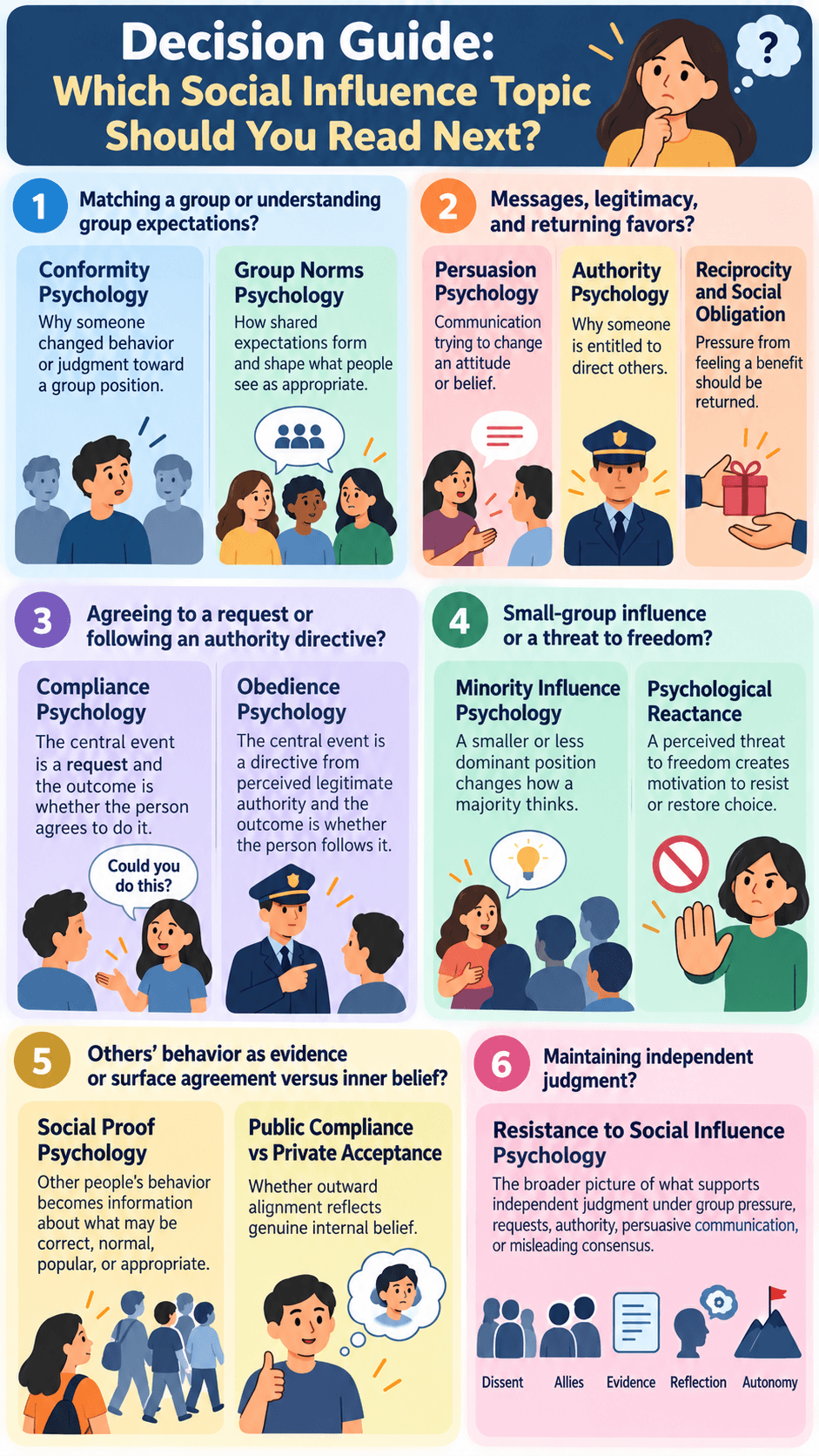
Matching a group or understanding group expectations
If the question is why someone changed behavior or judgment toward a group position, Conformity Psychology is the closer fit. If the question is how shared expectations form and shape what people see as appropriate, Group Norms Psychology is more precise.
Messages, legitimacy, and returning favors
If communication is trying to change an attitude or belief, Persuasion Psychology is the closer fit. If the issue is why someone is entitled to direct others, look to Authority Psychology. If pressure comes from feeling a benefit should be returned, see the psychology of reciprocity and social obligation.
Agreeing to a request or following an authority directive
Choose Compliance Psychology when the central event is a request and the key outcome is whether the person agrees to do it. Choose Obedience Psychology when the central event is a directive from perceived legitimate authority and the key outcome is whether the person follows it.
Small-group influence or a threat to freedom
Choose Minority Influence Psychology when a smaller or less dominant position changes how a majority thinks. Choose Psychological Reactance when the central mechanism is a perceived threat to freedom that creates motivation to resist or restore choice.
Others’ behavior as evidence or surface agreement versus inner belief
Choose Social Proof Psychology when other people’s behavior becomes information about what may be correct, normal, popular, or appropriate. Choose Public Compliance vs Private Acceptance when the key question is whether outward alignment reflects genuine internal belief.
Maintaining independent judgment
Choose Resistance to Social Influence Psychology when you want the broader picture of what supports independent judgment under group pressure, requests, authority, persuasive communication, or misleading consensus. That topic includes dissent, allies, evidence, reflection, and autonomy without reducing all resistance to reactance.
A Short Guide to the Seven Main Deep Dives
Compliance Psychology: request-response influence
Compliance focuses on response to a request. Agreement may change behavior without changing private belief, and it does not require majority pressure or legitimate authority.
Obedience Psychology: response to perceived legitimate authority
Obedience focuses on behavior after a directive from perceived legitimate authority. Authority itself concerns why the directing source is seen as legitimate.
Social Proof Psychology: others’ behavior as informational evidence
Social proof examines when other people’s behavior becomes information under uncertainty. Its focus is the cue supplied by others’ actions, not conformity as a whole.
Minority Influence Psychology: how smaller positions can affect broader thinking
Minority influence examines how a smaller position can prompt reconsideration or delayed change. Consistency may matter, but minority status does not imply correctness.
Public Compliance vs Private Acceptance: public expression versus private belief
This comparison asks whether outward alignment reflects genuine private belief. It also distinguishes public compliance in conformity research from compliance with a direct request.
Psychological Reactance: resistance after perceived freedom threat
Reactance focuses on threatened freedom and the motivation to restore choice. Controlling language may increase resistance, but a boomerang response is not automatic.
Resistance to Social Influence Psychology: calibrated independent judgment under pressure
Resistance is broader than reactance. It includes dissent, social support, evidence, reflection, prior commitments, and autonomy while remaining open to correction.
Common Misunderstandings About Social Influence
Influence is not synonymous with manipulation
You influence a friend when your recommendation helps them choose a restaurant. A teacher influences students by setting expectations. A stranger’s behavior may influence how you interpret an ambiguous situation. None of these examples automatically involve concealment, exploitation, or control.
Agreement does not necessarily mean belief change
People sometimes say yes because the cost of disagreement feels high, because a request seems easier to accept than contest, because an authority role is legitimate, or because public alignment preserves group harmony. Those are different explanations, and none proves that the person privately adopted the same belief.
Resistance is not automatically rational or superior
People can resist accurate advice, expert guidance, safety rules, or useful social information. Reactance can protect a sense of freedom, but it can also make a message less acceptable simply because it feels controlling. Independent judgment requires checking the content of the influence, not only noticing that influence is present.
First Step: Identify the Social Signal Before Explaining the Response
Is the signal a norm, request, command, behavior cue, minority view, or freedom threat?
When you notice yourself changing course around other people, name the social signal as precisely as you can. Did somebody ask? Did a group expectation become visible? Did an authority issue a directive? Did you copy behavior because you lacked information? Did disagreement make you reconsider? Did controlling language make choice feel threatened?
This classification prevents a common mistake: explaining every change as “peer pressure.” A request raises questions about willingness and obligation, a directive raises legitimacy and responsibility, and social evidence raises whether the crowd actually knows more.
Separate what was publicly done from what may be privately believed
Then separate observable response from internal judgment. What did the person say or do in public? What evidence is there about what they privately thought? If the private belief is unknown, keep it unknown rather than filling the gap with assumptions.
For your own decisions, ask two final questions: “What information from other people is genuinely useful here?” and “What would I choose if I had enough time, accurate information, and meaningful freedom to decide?” Those questions do not eliminate social influence. They make its role easier to see.
FAQ
Is social influence always intentional?
No. Some influence is deliberate, such as a request, instruction, or persuasive message. Other influence is incidental, arising from observed behavior, anticipated reactions, or unwritten expectations.
What is the difference between conformity, compliance, and obedience?
Conformity centers on a group position or norm, compliance on a request, and obedience on a directive from perceived legitimate authority. Real situations can contain more than one process.
Can someone be influenced without changing their private beliefs?
Yes. A person may align with a group, accept a request, or follow a directive while privately disagreeing. Public behavior alone does not establish private acceptance.
Is social proof the same as conformity?
No. Social proof focuses on other people’s behavior as informational evidence, especially under uncertainty. Conformity focuses on movement toward a group position or norm.
Is resisting social influence always a sign of independence?
No. Resistance may reflect careful evaluation or protection of meaningful choice, but it can also be reflexive or poorly informed. Independence requires evaluating the evidence as well as the pressure.
Key Takeaways
- Social influence includes changes linked to other people who are present, expected, imagined, or implied.
- The type of social signal matters: a group norm, a request, an authority directive, observed behavior, a minority view, and a freedom threat create different psychological problems.
- Conformity, compliance, obedience, and persuasion overlap in everyday life but should not be treated as interchangeable.
- Public agreement does not prove private acceptance, and private change may occur without immediate public behavior.
- Social information can be useful under uncertainty, but popularity or consensus is not proof that a choice is correct.
- Good resistance is calibrated: it protects independent judgment while staying open to accurate information and legitimate guidance.
Author note: Michael Reed is Founder & Lead Writer at Psychology Exposed. He writes about human behavior, relationships, emotional patterns, self-awareness, and everyday decisions in clear, research-aware language for general readers.

Michael Reed is the Founder and Lead Writer at Psychology Exposed. He writes about human behavior, relationships, emotional patterns, self-awareness, and practical psychology topics using research-informed, easy-to-understand content.
Read More About Michael Reed: https://psychologyexposed.com/michael-reed/