

You are in a meeting where everyone seems enthusiastic about a plan you think is weak. You hear three friends praise a restaurant you did not enjoy, and suddenly your own judgment feels less certain. In a family, a familiar expectation is repeated so often that disagreeing starts to feel more socially costly than going along. These moments are not all identical, but they point to a common psychological process: conformity.
Conformity is often described as if it means surrendering independent thought. That is too simple. People may align with a group because they want acceptance, because the group seems better informed, because coordination matters, or because the cost of standing apart feels high. Sometimes the outward agreement is temporary. Sometimes exposure to others genuinely changes what a person believes.
Understanding conformity helps separate social pressure from social information. The useful question is not only whether you went along, but what made the group influential and whether you still endorse the choice when you examine it privately.
Quick Answer: What Conformity Is and What It Is Not
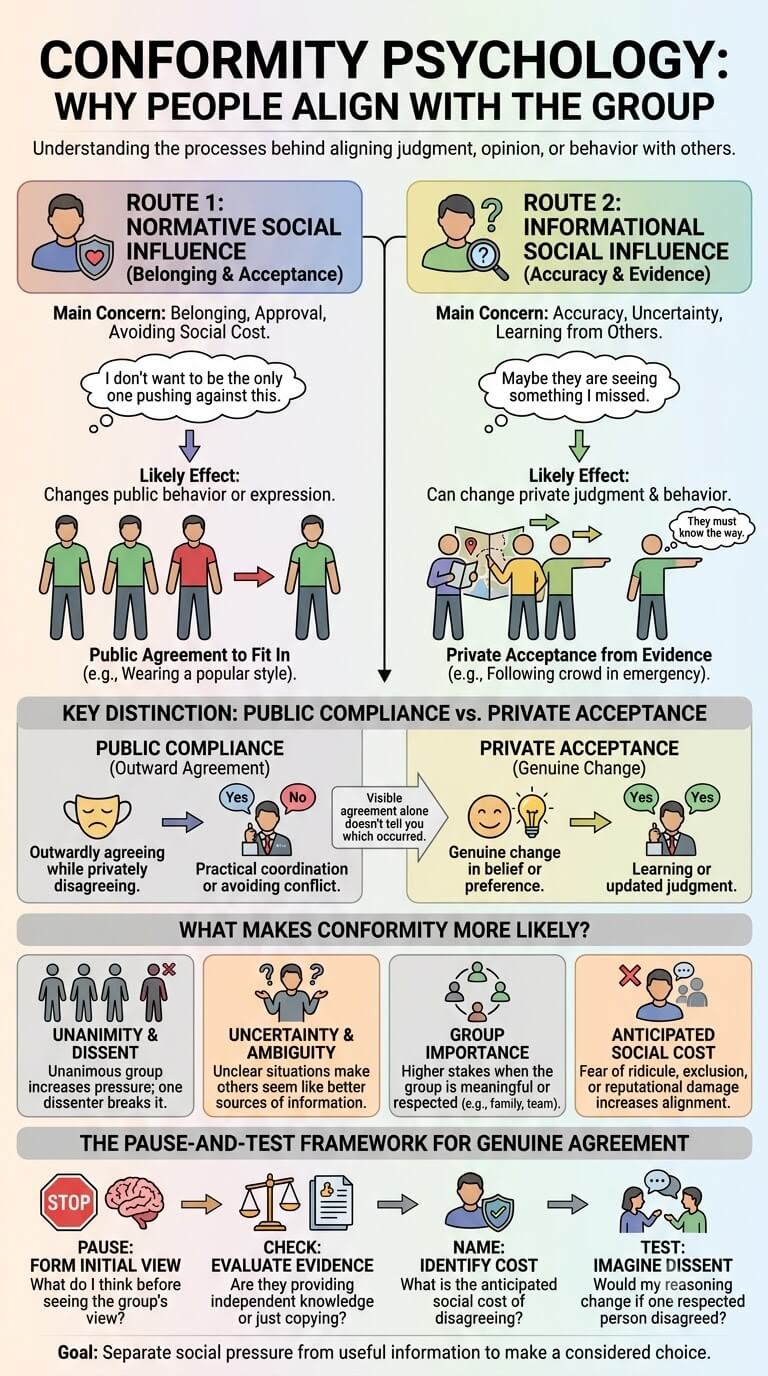
Conformity is alignment of a person’s judgment, expressed opinion, or behavior with a group. It can happen because fitting in matters, because other people are treated as useful evidence, or because both motives are active at once. Conformity is not automatically irrational, dishonest, weak, or permanent. The important distinction is whether the group is providing information, creating social pressure, or both.
Conformity Is Alignment With a Group, Not Automatically Loss of Belief
The Social psychology describes social influence broadly as changes in thoughts, feelings, or behavior caused by other people. Conformity is one narrower form of that influence. It concerns movement toward a group position, but the psychological meaning of that movement depends on what changed and why.
A person can conform while still thinking, doubting, and retaining the ability to choose differently later. Group influence does not erase agency. Other people simply become part of the evidence and social consequences being weighed.
Behavior, judgment, and expressed opinion can each shift
Conformity does not always look like saying “I agree.” A new employee may copy how formal everyone dresses. A student may change an answer after hearing several classmates choose another option. Someone in a hobby group may stop recommending a certain product after noticing that the group dismisses it.
Behavior can change without belief changing. A spoken judgment may move because uncertainty rises, while an opinion may shift because new social information seems credible. The same outward alignment can therefore come from different processes.
Agreement can be public, private, temporary, or genuine
Imagine four people choosing a movie. One person privately prefers a documentary but says, “The comedy is fine,” because everyone else wants it. That is different from hearing the others describe the comedy, reconsidering the options, and sincerely deciding it sounds better.
Both look like alignment from the outside, but one is public accommodation and the other is genuine acceptance. Visible agreement alone cannot tell you which occurred.
Two Major Routes to Conformity

A classic distinction in social psychology separates influence based on social acceptance from influence based on information. The two routes are useful because they answer different questions: “What will happen socially if I disagree?” and “What do other people know that I may not know?”
| Route | Main concern | Typical thought | Likely effect |
|---|---|---|---|
| Normative social influence | Belonging, approval, avoiding social cost | “I do not want to be the only one pushing against this.” | Often changes public behavior or expression |
| Informational social influence | Accuracy, uncertainty, learning from others | “Maybe they are seeing something I missed.” | Can change private judgment as well as behavior |
| Both at once | Accuracy and belonging | “They may know more, and disagreement also feels costly.” | Motives can be hard to separate in real life |
Normative social influence: belonging, approval, and social cost
APA’s definition of normative influence emphasizes pressures that make people act consistently with social standards and expectations. A group can reward alignment through inclusion, warmth, status, or simple ease. It can discourage deviation through teasing, coldness, ridicule, or loss of standing.
Normative influence is often subtle. People may soften disagreement or choose the familiar option because standing apart feels socially costly, even when nobody explicitly threatens punishment.
Informational social influence: using others as evidence under uncertainty
Informational influence becomes especially relevant when people are uncertain and treat others as a source of evidence. If you arrive at an unfamiliar event and everyone begins moving toward one entrance, following them may be a reasonable shortcut. You are not necessarily trying to win approval. You may simply infer that they know where to go.
This route matters most when the situation is ambiguous, others appear knowledgeable, or independent checking is difficult. The group then becomes a practical source of information.
Why both routes can operate at the same time
Real situations often mix motives. In a technical meeting, you may trust senior colleagues’ knowledge while also worrying that challenging them will carry a social cost.
Research separating normative and informational processes shows that they are distinguishable, but not mutually exclusive. A peer-reviewed study of informational and socially normative conformity illustrates why different motives can lead to similar outward alignment even when the underlying processes differ.
Public Compliance vs Private Acceptance
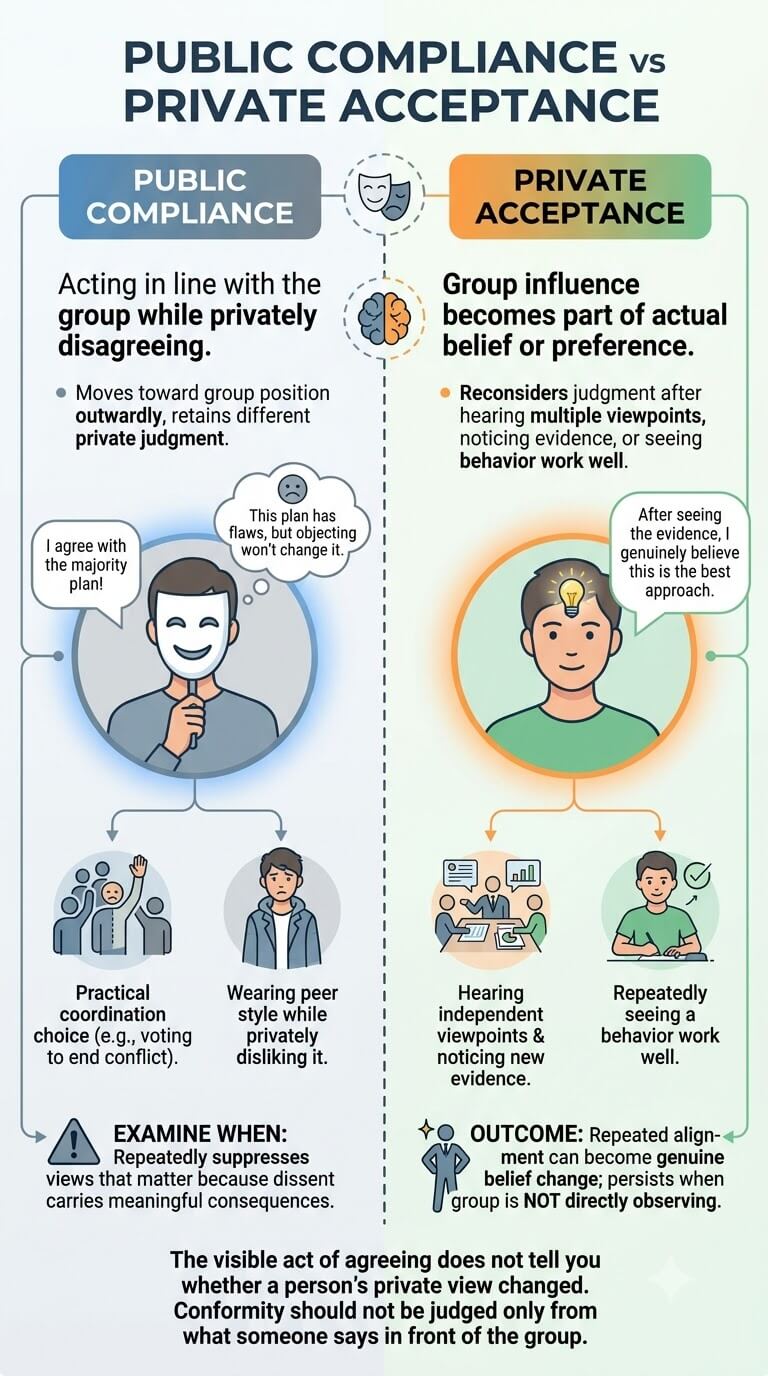
The visible act of agreeing does not tell you whether a person’s private view changed. This is one reason conformity should not be judged only from what someone says in front of the group.
Acting in line with the group while privately disagreeing
Public compliance means a person moves toward the group position outwardly while retaining a different private judgment. A team member may vote for the majority plan after deciding that continuing to object will not change the outcome. A teenager may wear what their peer group prefers while privately disliking the style.
Public alignment can be a practical coordination choice. It becomes more important to examine when a person repeatedly suppresses views that matter because dissent carries meaningful consequences.
When repeated alignment can become genuine belief change
Private acceptance means the group’s influence becomes part of what the person actually believes or prefers, not just what they display. A person may reconsider a judgment after hearing multiple independent viewpoints, noticing evidence they missed, or repeatedly seeing a behavior work well.
A study measuring public and private conformity makes the distinction explicit: public agreement can occur without private change, while acceptance persists when the group is not directly observing the response.
What Makes Conformity More Likely?
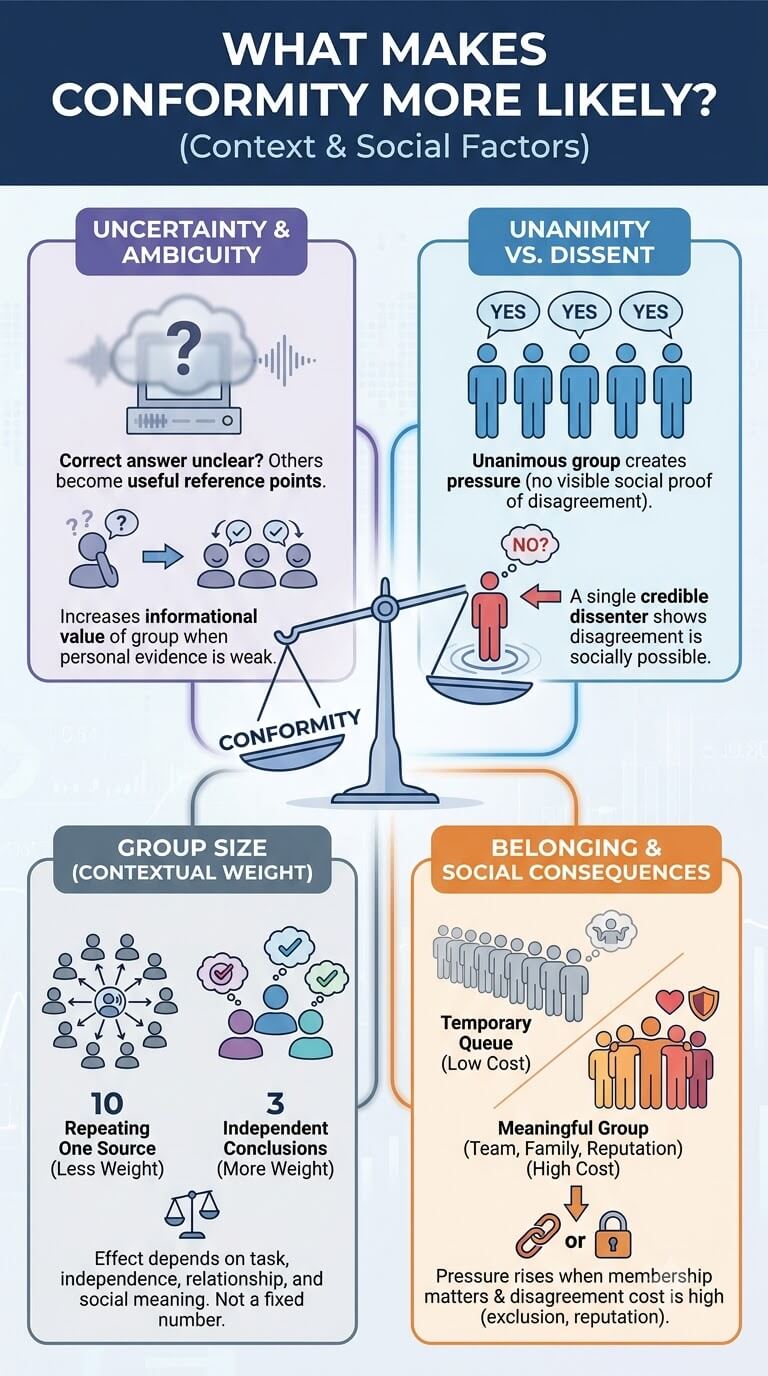
No single factor determines whether someone will conform. The same person may resist a majority in one setting and follow it in another. Context changes how much evidence the group seems to provide and how costly dissent appears.
Uncertainty and ambiguity
When the correct answer is unclear, other people become more useful as reference points. Suppose you are evaluating whether a strange sound from a machine is normal. If several experienced coworkers appear unconcerned, their reaction may legitimately update your judgment. If nobody seems sure, copying the group may provide less useful information.
Uncertainty increases the informational value of others when personal evidence is weak. The useful check is whether group members have independent knowledge or are mainly copying one another.
Unanimity and the power of a dissenting voice
A unanimous group can create a special kind of pressure because there is no visible social proof that disagreement is possible. One credible dissenter changes the situation. Their presence does not automatically prove the minority is right, but it can reduce the feeling that only one position is socially available.
Dissent can therefore matter beyond its content because it shows that disagreement is socially possible.
Group size without treating one number as a universal rule
Larger majorities can increase pressure under some conditions, but there is no useful everyday rule such as “three people cause conformity” or “seven people are enough.” The effect of numbers depends on the task, the independence of the group members, the person’s relationship to them, and the social meaning of agreement.
Ten people repeating one source may provide less information than three people who reached the same conclusion independently. Social weight also depends on who the group members are to you.
Importance of belonging and anticipated social consequences
Conformity pressure often rises when membership matters. Disagreeing with strangers in a temporary queue is not the same as disagreeing with a team you depend on, a family you want to stay close to, or a professional community tied to your reputation. This process sits within the broader psychology of social identity, where group membership can shape self-definition, expectations, and behavior.
What matters is how meaningful the group is and what disagreement is expected to cost, from mild awkwardness to exclusion or more serious consequences.
What Classic Conformity Research Can and Cannot Tell Us
Classic experiments are useful because they isolate particular social pressures. They are less useful when their findings are treated as a universal script for every group, culture, decision, or personality.
Asch line-judgment studies at a high level
Solomon Asch’s well-known experiments placed a participant in a group where others deliberately gave incorrect answers to simple line-length judgments. In the original program of research, the central question was how a person would respond when their clear perception conflicted with a unanimous majority. Asch’s 1956 report on independence and conformity remains a landmark demonstration that unanimous group judgments can influence public responding even on a simple task.
The useful lesson is not that people are “easy to control.” Social conditions can make even an obvious judgment harder to state, and breaking unanimity can change that pressure.
Why laboratory findings should not be copied mechanically into every real-world group
| Classic research helps show | It does not prove |
|---|---|
| A unanimous majority can affect public judgment. | Everyone will conform in every group. |
| A dissenter can change the social situation. | The dissenter is automatically correct. |
| Public and private responses can differ. | Every public agreement is fake. |
| Group size and unanimity can matter. | One fixed number predicts conformity across contexts. |
| Social pressure can alter behavior. | Conformity demonstrates weak character or brainwashing. |
A systematic review of conformity research highlights the diversity of motives and contexts involved. Classic findings are best used to understand mechanisms, not to label people.
Everyday Conformity Examples
Conformity becomes easier to recognize when the motive and the setting are separated. The following examples show how similar outward behavior can arise for different reasons.
Team meetings and silent agreement
A project lead proposes a deadline that several people privately think is unrealistic. The first two speakers support it, and the rest of the room stays quiet. One employee interprets the silence as evidence that their concern must be unusual and decides not to raise it.
The employee may feel both uncertainty and social exposure. Rather than forcing a dramatic challenge, they could ask, “What assumptions are we making about the workload?” That keeps the concern visible without pretending certainty.
Peer-group choices and taste
A friend group becomes enthusiastic about a particular style of music. Someone who initially feels neutral starts playing it more often and eventually enjoys it. At first, the behavior may partly support belonging. Over time, repeated exposure and shared experiences may produce a real preference. The social cost of disagreeing may feel greater when group cohesion makes continued belonging especially valuable.
Social life can genuinely shape taste. The useful check is whether the person still feels free to dislike something without disproportionate social consequences.
Online communities and visible consensus
A person opens a discussion thread and sees dozens of comments making the same judgment before forming their own view. The visible consensus becomes the starting point for interpretation. Even without direct interaction, the apparent majority can function as social information.
Before treating repetition as evidence, inspect the underlying source. Fifty comments may reflect one copied claim rather than fifty independent observations.
Families and recurring expectations
In a family, everyone attends a certain annual event. One adult child wants to skip it but expects disappointment and questions from relatives, so they attend without saying much about their preference.
That may be a reasonable tradeoff for a low-stakes event. The same pressure deserves more scrutiny when it governs major life choices, money, boundaries, relationships, or safety.
When Conformity Helps
Independent judgment is valuable, but social coordination would become exhausting if every person had to reinvent every shared practice from zero. Conformity can support ordinary cooperation when the underlying standard is reasonable and people retain room for disagreement.
Coordination, shared routines, safety, and efficiency
People line up in familiar ways, follow shared procedures, take turns speaking, and adopt common technical conventions because coordinated behavior saves time and reduces uncertainty. A new laboratory worker who follows an established safety procedure is not displaying a failure of individuality. They are using a tested social standard to act consistently with the group.
Many low-stakes customs work the same way: shared routines can make cooperation smoother without requiring deep personal agreement.
Why not every shared behavior requires independent reinvention
The higher the stakes, the more independent checking matters. Following a queueing convention needs little scrutiny; joining a risky financial decision because everyone else seems confident needs much more.
Conformity becomes more concerning when the stakes rise while the space for questioning shrinks. Coordination is different from requiring unquestioned loyalty.
When Conformity Suppresses Independent Judgment
The same processes that make groups efficient can also make disagreement harder than it needs to be. The warning sign is not agreement itself. It is a situation in which social pressure starts replacing evidence, silence is mistaken for endorsement, or the cost of dissent becomes disproportionate.
Fear of social cost
Someone may suppress a concern because they expect ridicule, exclusion, or reputational cost. Pressure changes category when it involves threats, humiliation, retaliation, stalking, isolation, financial control, or credible fear.
Those conditions call for a safety-focused response, not simply better disagreement skills.
Uncertainty mistaken for evidence that the group must be right
Feeling unsure can make a majority seem more credible than it is. “I am uncertain” does not logically mean “they must know.”
Ask what the others actually know, whether their judgments were independent, and whether anyone checked the original information. This separates useful social learning from circular copying.
Silence that gets misread as consensus
Several members may stay quiet because each assumes everyone else is convinced, while everyone interprets the silence as support.
Private input or independent first judgments can reveal concerns that public consensus hides.
Conformity vs Nearby Concepts
Several forms of social influence can look similar from the outside. Distinguishing them helps avoid calling every kind of agreement “conformity.”
| Concept | Central question | What makes it distinct |
|---|---|---|
| Group norms | What is normal or expected here? | The norm is the social standard itself. |
| Conformity | Why did this person move toward the group position? | The focus is individual alignment with group behavior, judgment, or expectation. |
| Persuasion | Did a message change an attitude or choice? | The mechanism centers on communication designed to influence. |
| Obedience | Did an authority issue a command? | The influence comes from a recognized authority relationship. |
| Groupthink | Did consensus pressure damage the group’s evaluation process? | The problem is at the level of group decision quality. |
Conformity vs group norms: response versus standard
A norm is what appears typical or approved. Conformity is movement toward that standard or the group’s position. The standard can exist even when nobody is actively adjusting to it.
Conformity vs persuasion: group alignment versus message-based influence
Persuasion centers on a message or appeal. Conformity can occur without a persuasive case, simply because the group’s behavior or judgment becomes influential.
Conformity vs obedience: peer or group alignment versus authority commands
Obedience involves a command from an authority figure. Conformity needs no command; peers can become the social reference point. The two may overlap, but they are not interchangeable.
Conformity vs groupthink: individual alignment versus impaired group decision process
Conformity asks why an individual moves toward the group. Groupthink concerns a broader decision process in which consensus pressure weakens evaluation. Individual conformity may contribute, but one person agreeing does not establish groupthink.
The Pause-and-Test Framework for Genuine Agreement

When stakes matter, a pause can separate useful social information from pressure to fit in. The aim is not automatic opposition, but enough space to evaluate the group without treating agreement or disagreement as proof of good judgment.
What do I think before checking the group?
When possible, record your initial estimate or preference before seeing votes, ratings, comments, or a senior person’s opinion. That gives you a reference point for noticing change.
What evidence is the group actually providing?
Separate headcount from information quality. Ask whether people observed different evidence, have relevant expertise, or are repeating one source. Repetition is not independent confirmation.
What social cost am I anticipating?
Name the consequence you expect if you disagree. Is it brief awkwardness, disappointment from people you value, loss of status, exclusion, or fear of retaliation? The answer changes what kind of problem you are dealing with.
If the anticipated cost is mostly discomfort, you may choose a low-intensity disagreement. If the consequence involves credible threats or control, protecting yourself matters more than proving that you can resist pressure.
What would I say if one respected person disagreed?
Imagine one respected person calmly expressing the view you are reluctant to state. If your reasoning suddenly feels easier to access, unanimity may be carrying extra weight.
This does not reveal which view is correct. It reveals whether visible unanimity is narrowing what feels sayable.
What to Do Next When You Are Unsure Whether You Truly Agree
Independence does not require taking the opposite position. It requires enough space to tell considered agreement from unexamined agreement.
Delay irreversible decisions when possible
If a costly decision is moving fast, ask for time: “I want to look at the assumptions before I commit.” Delay can reduce pressure to answer while the majority is watching.
Seek independent input before consensus becomes the only reference point
Consult someone outside the discussion, review primary evidence, or ask members to record judgments before comparing them. This helps when consensus may have formed through copying.
State uncertainty without making disagreement performative
You can preserve judgment without making disagreement confrontational: “I may be missing something, but I see one risk we have not discussed,” or, “I am not ready to agree yet. What evidence would change this?”
The aim is to keep genuine uncertainty visible, not to perform the role of “the dissenter.”
How Group Standards and Decision Pressure Connect
Conformity connects group expectations with individual choices. That makes it useful to distinguish the standard itself from problems in the group’s decision process.
Group norms define the standard that conformity responds to
A group norm asks what people usually do or approve. Conformity asks how a person responds to that standard or current group judgment. One is the standard; the other is the alignment.
Groupthink describes a group-level decision problem rather than conformity alone
Several members can conform without the entire decision process becoming groupthink. The broader concern begins when consensus pressure weakens the search for alternatives, dissent, and warning signs.
FAQ
These distinctions help clarify what visible agreement does and does not reveal.
What is the difference between normative and informational conformity?
Normative conformity centers on acceptance and social cost. Informational conformity uses other people as evidence under uncertainty. Both motives can operate at the same time.
Can someone conform publicly but disagree privately?
Yes. Someone may express the group position publicly while retaining a different private view. Outward agreement therefore does not by itself reveal private acceptance.
Why does one dissenter sometimes reduce conformity pressure?
A dissenter breaks unanimity and makes disagreement socially visible. The dissenter does not have to be correct; their presence changes the social situation.
Is conformity always irrational?
No. Groups often provide useful information and coordination. Conformity becomes less reliable when popularity substitutes for evidence or important concerns are suppressed because dissent feels too costly.
How is conformity different from persuasion?
Persuasion works through a message, argument, or appeal. Conformity works through alignment with group behavior, judgment, or expectations, even when nobody makes a persuasive case.
Key Takeaways
- Conformity means movement toward a group’s behavior, judgment, or expectations, but it does not automatically mean private belief has disappeared.
- Normative influence is mainly about belonging and social consequences, while informational influence is mainly about using others as evidence under uncertainty.
- Public compliance and private acceptance can look identical from the outside, so visible agreement does not reveal the whole psychological process.
- Unanimity, uncertainty, group importance, and anticipated social cost can all make alignment more likely, but none works as a universal formula.
- A dissenter can matter because breaking unanimity makes independent judgment easier to express, not because the dissenter is automatically right.
- For important decisions, forming an initial view, checking the group’s evidence, naming the social cost, and testing how dissent changes your thinking can help you decide whether agreement is genuinely yours.
Final Thoughts
The next time you move toward a group position, ask what kind of influence is operating. Are others providing useful information, supporting coordination, or making dissent feel socially costly? The answer is more useful than labeling yourself independent or weak.
For an important decision, form one private sentence before checking everyone else’s view. You may still agree in the end, but you will have a clearer basis for knowing why.

Michael Reed is the Founder and Lead Writer at Psychology Exposed. He writes about human behavior, relationships, emotional patterns, self-awareness, and practical psychology topics using research-informed, easy-to-understand content.
Read More About Michael Reed: https://psychologyexposed.com/michael-reed/