

You can feel like a distinct individual in one moment and strongly like a member of a group in the next. A designer working alone may think, “How do I want to solve this?” In a meeting where designers and engineers disagree, the same person may suddenly think more in terms of “what we designers value.” At a professional conference, an even broader identity may become relevant: “people in our field.”
Self-Categorization Theory helps explain these shifts. It focuses on how the mind organizes the self at different levels, why some group memberships become psychologically relevant in a particular setting, and how a salient group identity can change what feels typical, expected, or appropriate. It describes a context-sensitive change in how the self is represented, not the disappearance of individuality.
Quick Answer: How the Mind Shifts From “I” to “We”
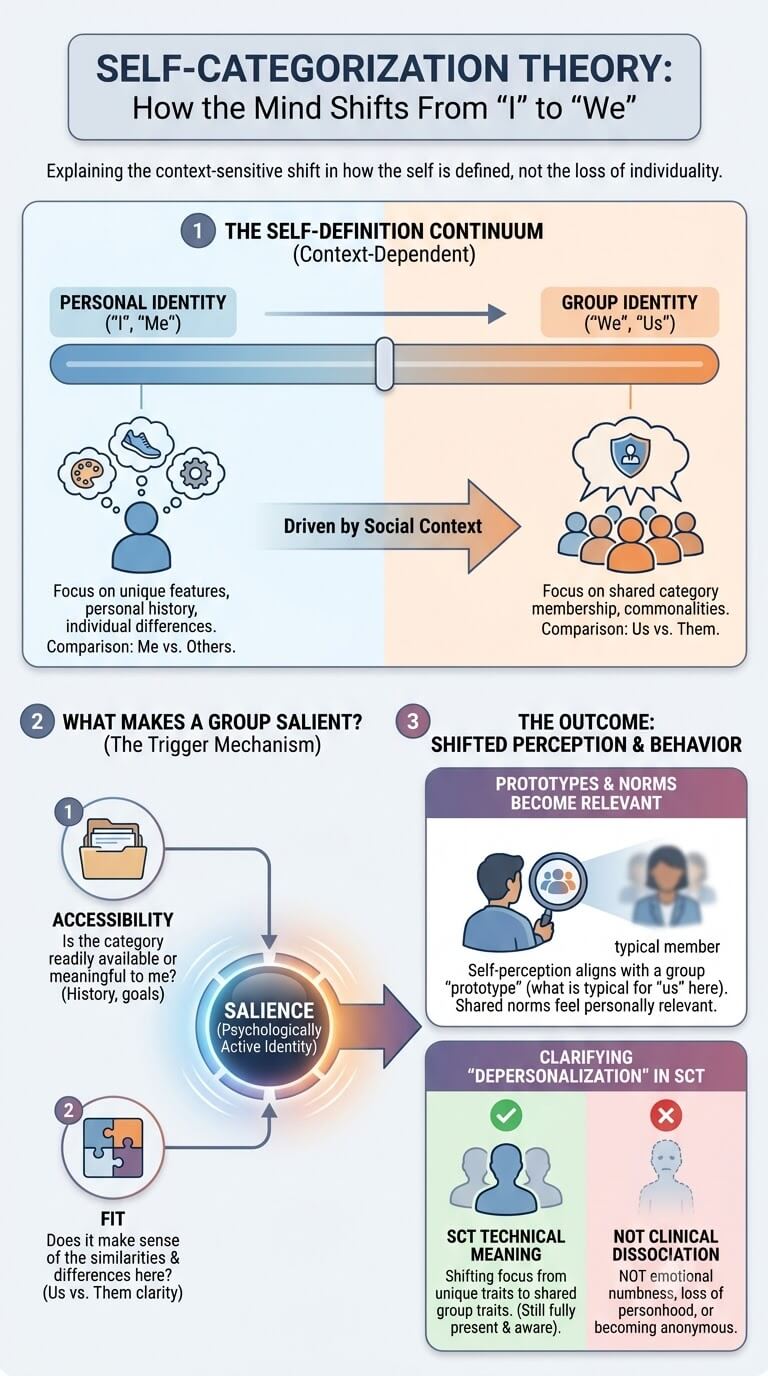
Self-Categorization Theory proposes that people can define themselves as unique individuals or as members of a relevant group. A group identity becomes more salient when it is accessible and fits the social context. When that happens, people may see themselves more through a group prototype, making shared norms and expectations feel more self-relevant. This is not the same as losing personhood, dissociating, or becoming anonymous.
What Self-Categorization Theory Explains
The APA Dictionary of Psychology describes Self-Categorization Theory as an account of the cognitive processes that align people’s self-conceptions with groups to which they belong. The key question is not simply whether a person belongs to a group. It is when a particular membership becomes the useful frame for understanding “who I am here.”
The same person can be a parent, runner, accountant, volunteer, neighbor, fan, and friend. All of those memberships may be real, yet only some become psychologically prominent in a particular moment.
Personal-level and group-level self-categorization
At a personal level, you perceive yourself in terms of features that distinguish you from other individuals. You may notice your own preferences, habits, skills, history, or style. The relevant comparison is often “me versus other people.”
At a group level, you perceive yourself as sharing a category with some people and differing from another relevant category. The frame becomes “us versus them” in a descriptive sense, without requiring hostility. In a cross-functional project, for example, “designers” and “engineers” may become useful categories because the work highlights different responsibilities. This contrast between personal and group-based identity describes the two levels of self-definition without treating either as permanent.
Why identity salience is context-dependent
A group identity does not need to dominate a person’s life to matter psychologically. Its salience can rise or fall with the situation. A nationality may feel unimportant during an ordinary grocery trip but become highly salient at an international sporting event. A professional identity may fade at home and become vivid during a debate about standards in one’s field.
This prevents a common mistake: treating one category as if it explains a person everywhere. Self-categorization is better understood as flexible self-definition within changing social comparisons.
The Levels of Self-Categorization
Self-Categorization Theory describes the self as representable at different levels of inclusiveness. For general readers, the most useful distinction is between seeing yourself as a unique individual and seeing yourself as a member of a meaningful social category. The shift is about the frame of comparison, not a permanent change in personality.
Seeing the self as a unique individual
Imagine a photographer editing images alone. She may focus on her personal taste, technical choices, deadlines, and preferred workflow. Her self-definition is relatively individualized because the immediate situation makes differences between individual people more relevant than differences between groups.
Even inside a team, personal-level categorization can remain prominent when the task highlights what makes each person’s work distinctive.
Seeing the self as interchangeable with members of a relevant category in a limited psychological sense
When a group category becomes salient, people may perceive themselves as more similar to other members of that category and more different from a relevant comparison group. The word “interchangeable” is technical and limited. It does not mean people become identical or stop having private preferences.
For the current comparison, individual differences become less central than category membership. A nurse discussing patient-care priorities with accountants may momentarily experience “being a nurse” as more defining than differences among nurses.
Why these levels can shift without one permanently replacing another
The mind does not have to choose one identity forever. A person can move between self-frames as the comparison changes. Someone may think as an individual during a performance review, as a department member during an interdepartmental meeting, and as an employee when speaking with people outside the organization.
This helps explain why behavior that looks inconsistent across settings may reflect a changed social frame rather than a personality switch.
What Makes a Social Category Salient?

One of the most useful parts of Self-Categorization Theory is its explanation of salience. A category is more likely to organize perception when it is both mentally available and a good fit for what is happening. A simple way to remember the process is Accessibility → Fit → Prototype → Self-frame → Norm relevance.
| Step | Question the mind is effectively answering | What may change |
|---|---|---|
| Accessibility | Is this category available and meaningful to me? | Some identities are easier to activate than others. |
| Fit | Does this category organize the similarities and differences I can see? | A particular “us” and comparison group becomes clearer. |
| Prototype | What seems typical of people like us in this setting? | Traits, attitudes, or behaviors associated with membership become more noticeable. |
| Self-frame | Am I seeing myself mainly as “me” or as “one of us” here? | Group-level self-description becomes more prominent. |
| Norm relevance | What does someone like us normally value or do? | Shared expectations may carry more psychological weight. |
Accessibility: which categories are available and meaningful to the person
Accessibility refers to how ready a category is to be used. Some identities are often meaningful; others become available because the setting cues them.
A person who rarely thinks about being a commuter may suddenly notice that identity during a transport disruption. Personal history, current goals, repeated use, and situational cues can all affect what comes readily to mind.
Comparative fit: similarities within and differences between categories
Comparative fit concerns whether a category makes the pattern of similarities and differences in the setting easier to understand. Suppose eight people are discussing a project. If four strongly favor speed and four strongly favor thorough testing, and those positions happen to line up with two functional teams, the team categories may suddenly appear informative.
If opinions are mixed within both teams, the same categories may provide a poorer fit. Their usefulness depends partly on the comparison that is currently meaningful.
Normative fit: whether observed behavior matches expected category patterns
Normative fit asks whether the observed pattern makes sense given what a person already expects about the categories involved. If a proposed grouping contradicts everything people understand about who normally acts that way, it may feel less psychologically convincing even if some surface differences exist.
Comparative and normative fit work together: one concerns perceived similarities and differences, while the other concerns whether that pattern matches expected category meaning.
Group Prototypes: The Mental Picture of “People Like Us”

A prototype is not necessarily one real person. In psychology, a prototype can be a mental representation of what is typical of a category. The APA Dictionary definition of prototype emphasizes this idea of a representative or typical example.
Within Self-Categorization Theory, prototypes help people make sense of what “people like us” are like relative to a relevant comparison group. They may include attitudes, values, styles, habits, or behaviors that seem characteristic in that context.
Prototypes are context-sensitive, not fixed stereotypes
A prototype can shift with the comparison. Urban cyclists may emphasize environmental concern when compared with drivers, but practicality when compared with competitive cyclists. Neither description has to be the timeless essence of “cyclists.”
This relativity matters. It is easy to read the theory as if people carry one fixed stereotype for each group and simply apply it. The prototype is dynamic because it is shaped by what the group is being contrasted with now.
How prototypes shape expectations of self and other members
Once a prototype becomes relevant, people may notice prototype-consistent behavior more readily, describe themselves with group-relevant traits, or expect similar behavior from fellow members.
Classic work by Michael Hogg and John Turner found that making a social category more salient was associated with greater self-categorization and self-stereotyping in the experimental context. Their 1987 study on category salience and self-stereotyping is useful because it demonstrates that self-description can shift with the comparative setting rather than simply reflecting a fixed personal profile.
Depersonalization in Self-Categorization Theory

“Depersonalization” is probably the term most likely to be misunderstood in this topic. In Self-Categorization Theory, it refers to a shift from seeing the self mainly through unique personal attributes toward seeing the self more through a salient group prototype.
The technical meaning: self-perception through a group prototype
When group membership becomes salient, the person may perceive themselves as more representative of “us.” Individual differences remain, but become less central to the current self-description.
A musician among nonmusicians may become more aware of musician-linked traits. Later, among musicians comparing individual styles, personal differences may become more prominent again.
Why it does not mean dissociation, emotional numbness, or loss of personhood
The technical term should not be confused with clinical depersonalization. Clinical sources use depersonalization to describe experiences of detachment from oneself, one’s feelings, or one’s body. The Cleveland Clinic overview of depersonalization-derealization disorder describes a very different phenomenon involving distressing experiences of disconnection.
Self-Categorization Theory is not describing that clinical experience. A person can strongly think of themselves as “one of us” while feeling fully present, emotionally connected, and aware of their individuality.
How Self-Categorization Can Change Behavior
A salient identity can alter behavior because the standards associated with the group become relevant to the self. This is more precise than saying, “groups make people conform.” Group norms may now help answer what someone like “us” should think or do.
Norms become more self-relevant when the group identity is salient
If an environmental club identity is salient, conservation practices may feel like expressions of who “we” are. If a professional identity is salient, professional standards may carry more weight in judgment.
Russell Spears’ review of social influence and group identity examines how group-based influence differs from explanations that treat social pressure only as external approval, disapproval, or persuasion. This distinction helps explain why people sometimes follow a shared norm even when no one is actively watching them.
Similarity, coordination, and self-stereotyping can increase in context
When people define themselves through the same salient membership, they may perceive greater similarity, coordinate more readily, and describe themselves in more group-typical ways. None of these outcomes is automatic. The effect depends on what the category means, how strongly it fits, and which norms are associated with it.
A group prototype can also support behavior that looks independent from outside. If a group’s norm values questioning authority, then acting like a “good group member” may involve disagreement rather than obedience.
A Context-Switch Example: The Same Person in Three Group Settings
Consider Maya, a product designer. Her values, skills, memories, and personality do not reset when she walks into a different room. What changes is which comparison becomes useful for interpreting the situation.
Individual task setting
Maya is working alone on three interface options. She compares her current work with her own previous designs. She thinks about her personal taste, strengths, and mistakes. The active frame is highly individual: “Which solution do I think works best?”
Her identity as a designer is still true, but it does not need to organize the moment because there is no meaningful designer-versus-other-profession comparison.
Team-versus-team setting
Later, Maya attends a meeting where design and engineering teams are debating whether to delay a release. Differences line up with the functional groups: designers emphasize usability problems, while engineers emphasize system stability and implementation cost.
Now “designer” may become more salient. Maya notices what the designers share, what distinguishes them from engineers in this discussion, and what a responsible designer is expected to protect. She may describe her own view in terms closer to the perceived design-group prototype.
Broader professional-community setting
A week later, Maya speaks at a community event where product professionals are compared with people unfamiliar with the field. The narrower design-versus-engineering boundary loses relevance. A broader “product professional” identity may become salient instead.
Salience is not a ranking of a person’s “true identities.” The active category depends on who is present, what differences matter, and what the situation makes meaningful.
Self-Categorization Theory vs Social Identity Theory
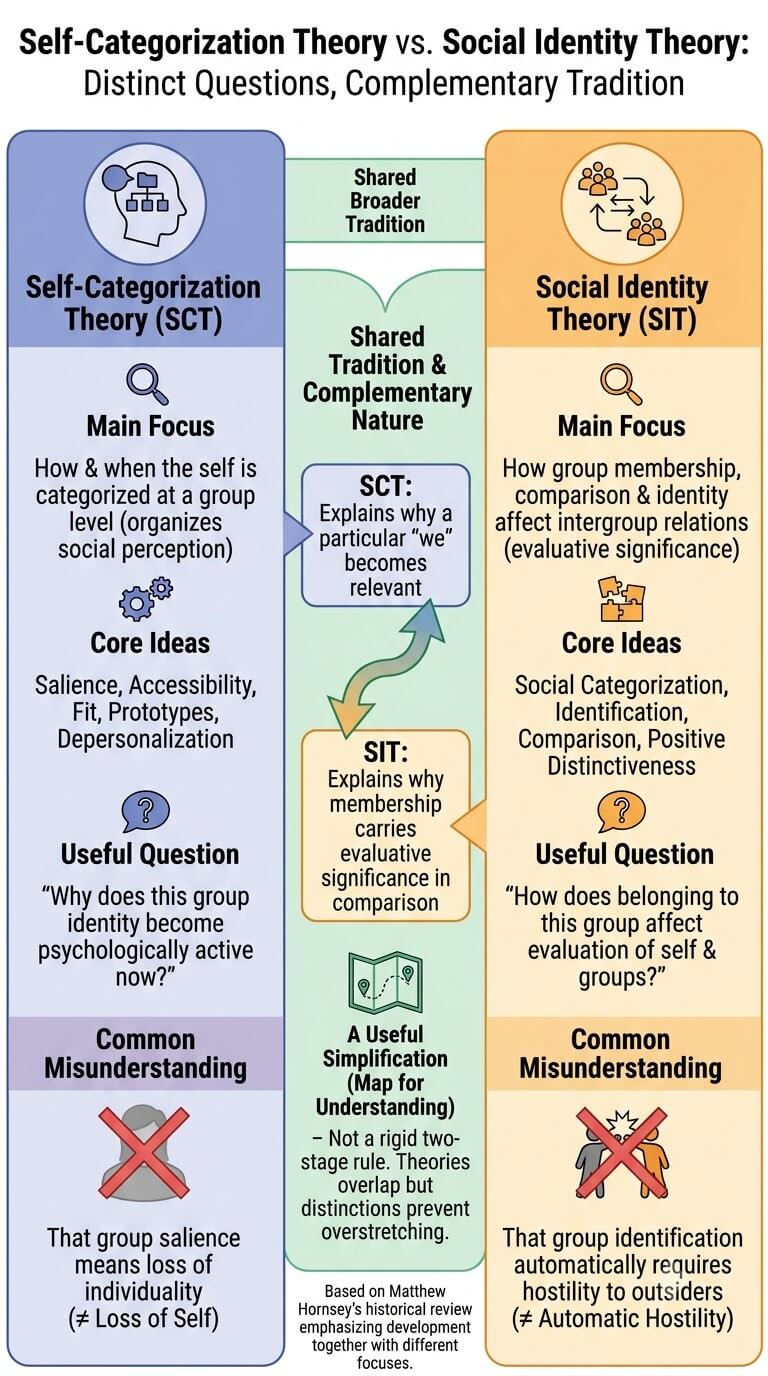
These theories belong to the same broader tradition, but they answer different questions. Matthew Hornsey’s historical review of Social Identity Theory and Self-Categorization Theory discusses how the two developed together while emphasizing different parts of group psychology.
| Question | Self-Categorization Theory | Social Identity Theory |
|---|---|---|
| Main focus | How and when the self is categorized at a group level | How group membership, comparison, and identity affect intergroup relations |
| Core ideas | Salience, accessibility, fit, prototypes, depersonalization | Social categorization, identification, comparison, positive distinctiveness |
| Useful question | “Why does this group identity become psychologically active now?” | “How does belonging to this group affect evaluation of self and groups?” |
| Common misunderstanding | That group salience means loss of individuality | That group identification automatically requires hostility to outsiders |
Salience and prototypes versus comparison and positive distinctiveness
Self-Categorization Theory concentrates on the conditions under which a category organizes the self and social perception. Social Identity Theory gives more weight to what group membership means for evaluation, comparison, and relationships between groups.
The theories overlap, but the distinction prevents one explanation from being stretched to cover every group effect.
How the theories complement rather than duplicate each other
A useful simplification is that self-categorization helps explain why a particular “we” becomes relevant, while social identity processes help explain why that membership can carry evaluative significance in group comparison.
That sequence is a simplification, not a rigid two-stage rule. It is best used as a map for understanding the different questions the theories were designed to illuminate.
Self-Categorization vs Deindividuation
Another common confusion is treating any shift toward group-based behavior as deindividuation. The concepts are different. Self-categorization concerns how the self is defined. Deindividuation concerns conditions such as reduced personal visibility, reduced self-focus, anonymity, or diffused accountability, depending on the specific account being used.
Group-based self-definition does not require anonymity
A person can categorize themselves strongly as a group member while remaining completely visible. A surgeon on a public panel may speak strongly from professional identity without anonymity.
Likewise, a classroom representative may become highly aware of “our class” precisely because they are visibly accountable for speaking on its behalf.
Reduced visibility and accountability are separate questions
When anonymity is present, it can affect behavior, but it does not tell you by itself which identity is salient or what norms will guide action. A person in an anonymous online community may become more responsive to local group norms, or may simply feel less personally accountable. Those are separable processes.
Keeping the distinction clear prevents the misleading idea that every group effect happens because people “lose themselves.”
Self-Categorization “Depersonalization” vs Clinical Depersonalization
The shared word creates confusion, but the concepts differ in domain, meaning, and implications.
| Term | What it means | What it does not imply |
|---|---|---|
| Depersonalization in Self-Categorization Theory | Seeing the self more through a salient group prototype than through unique individual features | Dissociation, numbness, losing reality testing, or losing personhood |
| Deindividuation | A set of group-context processes often discussed in relation to anonymity, reduced personal visibility, self-awareness, or accountability | That a group identity must be salient in the same way |
| Clinical depersonalization | A distressing experience of detachment from oneself, one’s body, thoughts, or feelings | A normal synonym for identifying strongly with a social group |
Social-psychology term versus clinical symptom language
In the social-psychology theory, “depersonalization” is a technical description of relative self-perception. It is about whether unique personal features or shared category features are foregrounded.
Clinical depersonalization belongs to mental-health language and concerns subjective experiences of detachment. If someone is distressed by persistent feelings of unreality or detachment, a group-identity theory is not an explanation or substitute for professional assessment.
Why the terms should never be treated as interchangeable
Using the terms interchangeably can make ordinary group identification sound pathological or minimize a distressing clinical experience.
The safest rule is simple: in this theory, depersonalization means a shift toward category-based self-perception. It does not mean feeling unreal or disconnected from your own mind or body.
What to Notice in Real Life
Self-Categorization Theory is useful for asking better questions about context, not for labeling people as “brainwashed” or incapable of independent thought. A salient group identity can influence which standards feel relevant while leaving room for reflection and disagreement.
Which category suddenly feels relevant?
Notice moments when your language shifts toward “we,” “people like us,” or “our kind of team.” Ask what changed in the situation. Did a comparison group appear? Did someone question the group’s competence, values, or status? Did a shared goal become more visible?
The category that becomes salient may be narrower or broader than expected. “My department” might matter in one meeting, while “our whole organization” matters when comparing with a competitor.
What prototype or norm seems to define “people like us” here?
Ask what characteristics are being treated as typical of a good member. Is the admired member supposed to be careful, bold, loyal, skeptical, generous, competitive, funny, technically precise, or willing to challenge others?
Then ask whether this prototype is genuinely shared or merely asserted by the loudest voices. Salience does not prove a norm is universal within the group.
What personal value remains important even when the group frame is salient?
A useful final check is to separate self-definition from automatic obedience. You may strongly identify with a group and still ask whether a specific expectation fits your personal values, responsibilities, and evidence.
Try three questions: “What does this group expect here?”, “Why does that expectation feel relevant to me?”, and “What do I choose after considering both the group standard and my own judgment?” That preserves the insight of the theory without turning social influence into destiny.
How Salient Identity Relates to Norms and Anonymity
Two nearby ideas are easier to separate once self-categorization is clear. Group norms concern expectations attached to membership; deindividuation raises different questions about visibility, self-awareness, and accountability.
Group norms as expectations attached to a salient identity
A norm can exist without being equally influential every moment. When the relevant identity becomes salient, the norm may feel more diagnostic of what “someone like us” should do. This helps explain why the same person may follow a professional norm carefully at work but barely think about it in an unrelated setting.
Changing a group norm therefore involves more than telling individuals what to do. Members may need to see the new expectation as representative of the group they identify with.
Anonymity as a separate route involving visibility and accountability
Anonymity can change behavior, especially online or in crowds, but it is not the same mechanism as identity salience. It may strengthen attention to shared identity in one setting and mainly reduce personal accountability in another.
Asking both questions gives a clearer picture: “Which identity is salient?” and “How visible and accountable does the individual feel?”
FAQ
These questions address common points of confusion in Self-Categorization Theory.
What makes one social identity more salient than another?
Salience depends on both accessibility and fit. An identity is more likely to become active when it is meaningful or readily available to the person and when it helps organize the similarities, differences, and expected behavior in the current setting. A change in comparison can therefore change which identity stands out, even if the person’s memberships themselves have not changed.
What is a prototype in Self-Categorization Theory?
A prototype is a context-sensitive representation of what seems typical of a group relative to a relevant comparison. It can include attitudes, values, behaviors, or traits. It is not necessarily a fixed stereotype or a single “perfect member.” Because comparisons change, the qualities that seem most representative of the group can change too.
What does depersonalization mean in this theory?
It means that a person perceives themselves more in terms of shared group characteristics and less in terms of unique individual differences for the current situation. It does not mean dissociation, emotional numbness, clinical depersonalization, or a literal loss of individuality.
Is self-categorization the same as conformity?
No. Self-categorization describes how the self is represented in relation to a group. Conformity describes alignment of judgments or behavior with a group. A salient group identity can make group norms more self-relevant and therefore contribute to alignment, but conformity has additional mechanisms and should not be reduced to self-categorization alone.
Can someone resist a group norm even when group identity is salient?
Yes. A salient identity does not erase judgment or agency. People may dispute which norm truly represents the group, identify with a different subgroup, prioritize another identity, or decide that a group expectation conflicts with an important personal value. Group-based self-definition changes the psychological context of a choice, not the existence of choice itself.
Key Takeaways
- Self-Categorization Theory explains why people sometimes experience themselves mainly as individuals and at other times mainly as members of a group.
- A social category becomes more salient when it is accessible and fits the similarities, differences, and expected patterns in the current context.
- Group prototypes are context-sensitive pictures of what “people like us” are like, not fixed definitions of every member.
- Depersonalization in this theory means category-based self-perception. It is not clinical depersonalization and does not imply loss of personhood.
- When a group identity is salient, its norms may become more self-relevant, but people can still reflect, disagree, and act from personal values.
- Self-categorization, deindividuation, conformity, and Social Identity Theory overlap in group psychology but answer different questions.
Final Thoughts
The most useful next step is to watch for a real context switch rather than trying to decide which group identity is your “real” one. Notice when “I” becomes “we,” identify the comparison that made that shift meaningful, and ask what prototype or norm suddenly gained influence. Then add one final question: does that expectation fit the judgment and values you still want to own as an individual?

Michael Reed is the Founder and Lead Writer at Psychology Exposed. He writes about human behavior, relationships, emotional patterns, self-awareness, and practical psychology topics using research-informed, easy-to-understand content.
Read More About Michael Reed: https://psychologyexposed.com/michael-reed/