
You finish a difficult certification course and wonder whether your score is actually good. The number tells you what you earned, but it may not tell you how demanding the test was or what competent performance usually looks like. You ask classmates how they did. In a new workplace, you may know the written rules yet still watch coworkers to figure out whether speaking up in meetings is expected, risky, or unusual. In both cases, other people become information.
This is the problem Leon Festinger tried to explain in his 1954 Social Comparison Theory. His central question was not simply why people feel jealous, competitive, or insecure. It was more basic: when direct evidence is limited, how do people decide whether their opinions are reasonable and their abilities are strong, weak, or typical? The original theory proposed that people often use other people as standards for evaluation, especially when objective answers are unavailable or unclear.
Modern social comparison research has grown far beyond that starting point. Keeping the original theory separate from later developments matters because otherwise almost any reaction to another person can be incorrectly attributed to Festinger.
Quick Answer: What Social Comparison Theory Says
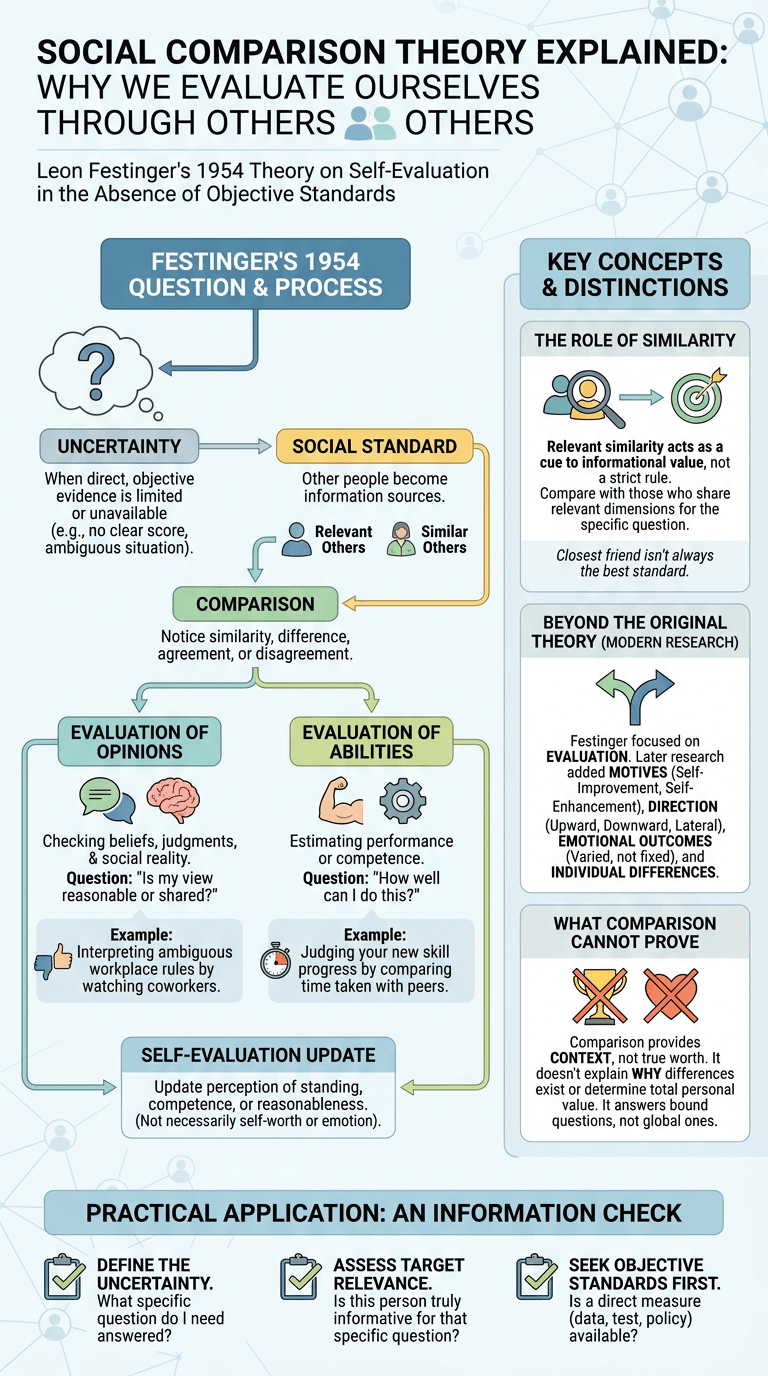
Social Comparison Theory proposes that people evaluate their opinions and abilities partly by comparing themselves with others, especially when clear objective standards are missing. Festinger’s 1954 theory emphasized the value of relevant, often similar others as informational standards. Later research expanded social comparison to include different motives, comparison directions, emotional reactions, cognitive processes, and stable differences in how much people compare.
Festinger’s 1954 Question: How Do We Know What We Think and How Well We Are Doing?
Festinger’s original paper, A Theory of Social Comparison Processes, began with the idea that people have a drive to evaluate their opinions and abilities. That sounds simple until you notice how often evaluation lacks a clean measuring stick.
Objective standards are not always available
Some judgments have relatively direct standards. If you want to know whether a shelf is level, you can use a tool. If you want to know whether you completed ten push-ups, you can count. If you want to know whether you passed an exam, a predefined cutoff may answer the question.
Other judgments are much less self-contained. Is your presentation skill strong for someone with your experience? Is your view about a new workplace policy sensible? Are you learning a language at a reasonable pace? Are you unusually nervous before public speaking, or is your reaction common among beginners? A number may exist, but it may not settle the psychological question you actually care about.
Festinger proposed that when nonsocial, objective means of evaluation are unavailable or limited, people become more likely to use social information. The APA Dictionary of Psychology definition of social comparison theory similarly describes evaluation of abilities and attitudes in relation to other people.
Other people can become informational standards
Imagine two employees who both finish a task in four hours. One works on a team where experienced colleagues usually take six hours. The other works on a team where colleagues routinely finish in two. The same four-hour performance can be interpreted differently because the surrounding information changes what the result seems to mean.
The comparison does not magically reveal the person’s true worth or complete ability. It supplies context. That distinction is essential. Social information can help answer a narrow question such as, “How does my current performance compare with people facing roughly the same task?” It cannot logically answer a much larger question such as, “How capable am I as a person?”
The Original Theory’s Two Central Domains
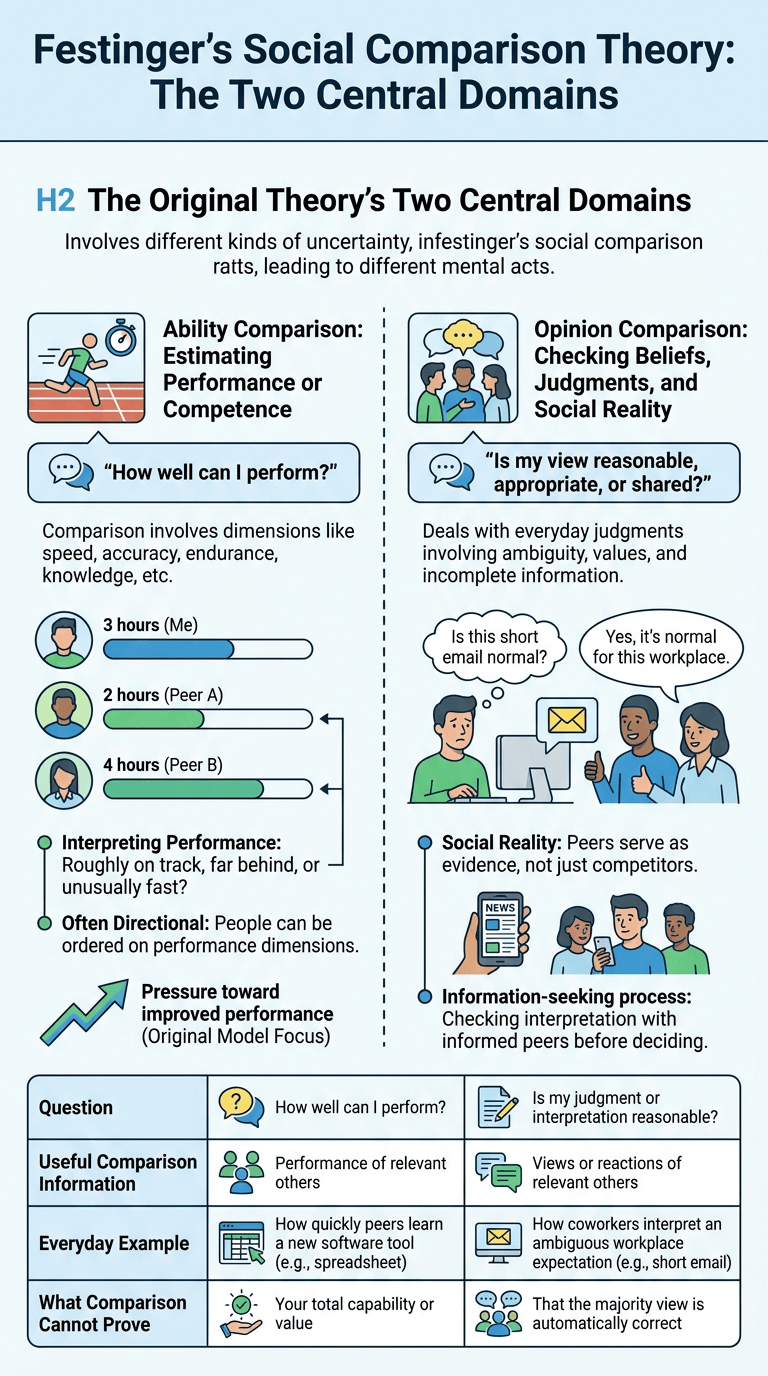
Festinger focused especially on two areas: abilities and opinions. They involve different kinds of uncertainty, which helps explain why comparison is not one single mental act.
Ability comparison: estimating performance or competence
Ability comparison asks some version of, “How well can I do this?” The comparison may involve speed, accuracy, endurance, knowledge, coordination, productivity, or another dimension that can vary from person to person.
Consider someone learning spreadsheet modeling at work. Knowing that they completed a model in three hours tells them something. Knowing that most coworkers at a similar experience level need between two and four hours provides another layer of interpretation. The comparison may help them judge whether they are roughly on track, far behind, or unusually fast.
Ability comparison is often directional because people can be ordered on many performance dimensions. One runner can currently run farther than another. One student can solve more problems correctly. Festinger also discussed pressure toward improved performance in ability contexts. Modern research has developed the consequences of looking upward, downward, or sideways much further, so it is more accurate to treat those detailed effects as later work rather than as a complete prediction of the original model.
Opinion comparison: checking beliefs, judgments, and social reality
Opinion comparison deals with a different question: “Is my view reasonable, appropriate, or shared?” Some opinions can eventually be tested against evidence, but many everyday judgments involve ambiguity, values, conventions, or incomplete information.
A new employee might wonder whether a manager’s short email is normal for that workplace. A person moving to a new community may be unsure whether arriving ten minutes early to an event is expected. Someone hearing a confusing piece of news may check how informed peers interpret it before deciding what they think.
Here, other people are not merely competitors. They can serve as evidence about social reality. This is one reason Social Comparison Theory should not be reduced to status contests or self-esteem. Comparison can be an information-seeking process even when nobody is trying to be better than anyone else.
| Question | Ability comparison | Opinion comparison |
|---|---|---|
| Typical uncertainty | How well can I perform? | Is my judgment or interpretation reasonable? |
| Useful comparison information | Performance of relevant others | Views or reactions of relevant others |
| Everyday example | How quickly peers learn a new software tool | How coworkers interpret an ambiguous workplace expectation |
| What comparison cannot prove | Your total capability or value | That the majority view is automatically correct |
Why Similar Others Can Be Especially Informative
If you are trying to evaluate your beginner-level swimming technique, comparing yourself with an Olympic swimmer may tell you what elite performance looks like, but it may be poor evidence about whether your own progress is typical. A person with a similar amount of training may be more informative for that specific question.
Similarity as a cue to relevance
Festinger proposed that comparison becomes less useful as the other person becomes very different on dimensions relevant to the evaluation. The reasoning is practical. A comparison standard is most informative when the difference between you and the other person does not make the comparison meaningless.
Relevant similarity depends on the question. Age may matter for one physical task but be irrelevant for a writing task. Years of professional experience may matter when judging work speed but not when comparing personal preferences. Similarity is therefore not a general rule that “people only compare with people like themselves.” It is better understood as a clue about whether a particular person provides useful information for a particular judgment.
Why the closest person is not always the best comparison target
Similarity can improve informational value, but it does not guarantee accuracy. Your closest friend may share your age and occupation but work in a much smaller company. A coworker at your level may have received very different training. A peer group may itself be unusually selective.
This is where a simple theory can become a practical check: ask what makes the comparison target relevant. “They are like me” is too vague. The better question is, “Are they similar on the dimensions that matter for what I am trying to evaluate?”
A Simple Original-Theory Model: Uncertainty → Social Standard → Comparison → Evaluation
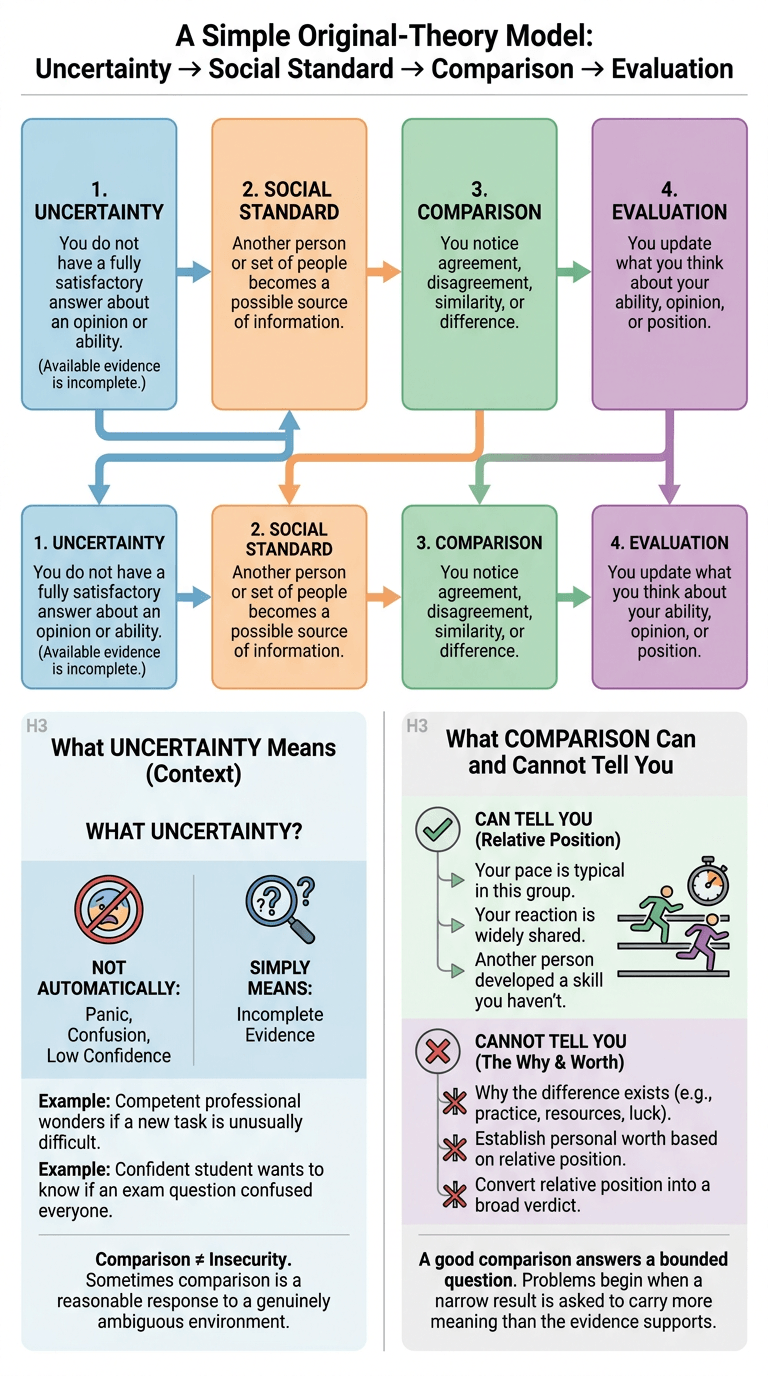
The original theory can be translated into a four-step information model:
- Uncertainty: You do not have a fully satisfactory answer about an opinion or ability.
- Social standard: Another person or set of people becomes a possible source of information.
- Comparison: You notice agreement, disagreement, similarity, or difference.
- Evaluation: You update what you think about your ability, opinion, or position.
What uncertainty means in this context
Uncertainty does not have to mean panic, confusion, or low confidence. It can simply mean that the available evidence is incomplete. A competent professional can still wonder whether a new task is unusually difficult. A confident student can still want to know whether an exam question confused everyone or only them.
This distinction prevents an easy mistake: comparing yourself with others does not automatically prove insecurity. Sometimes comparison is a reasonable response to a genuinely ambiguous environment.
What comparison can and cannot tell you
Social comparison can tell you something about relative position. It may reveal that your pace is typical in this group, that your reaction is widely shared, or that another person has developed a skill you have not yet developed.
It cannot, by itself, establish why the difference exists. It does not show whether the other person had more practice, different resources, easier circumstances, stronger prior knowledge, or simple luck. It also cannot convert relative position into a verdict about personal worth.
A good comparison answers a bounded question. Problems begin when a narrow result is asked to carry more meaning than the evidence supports.
What Festinger Did Not Fully Explain
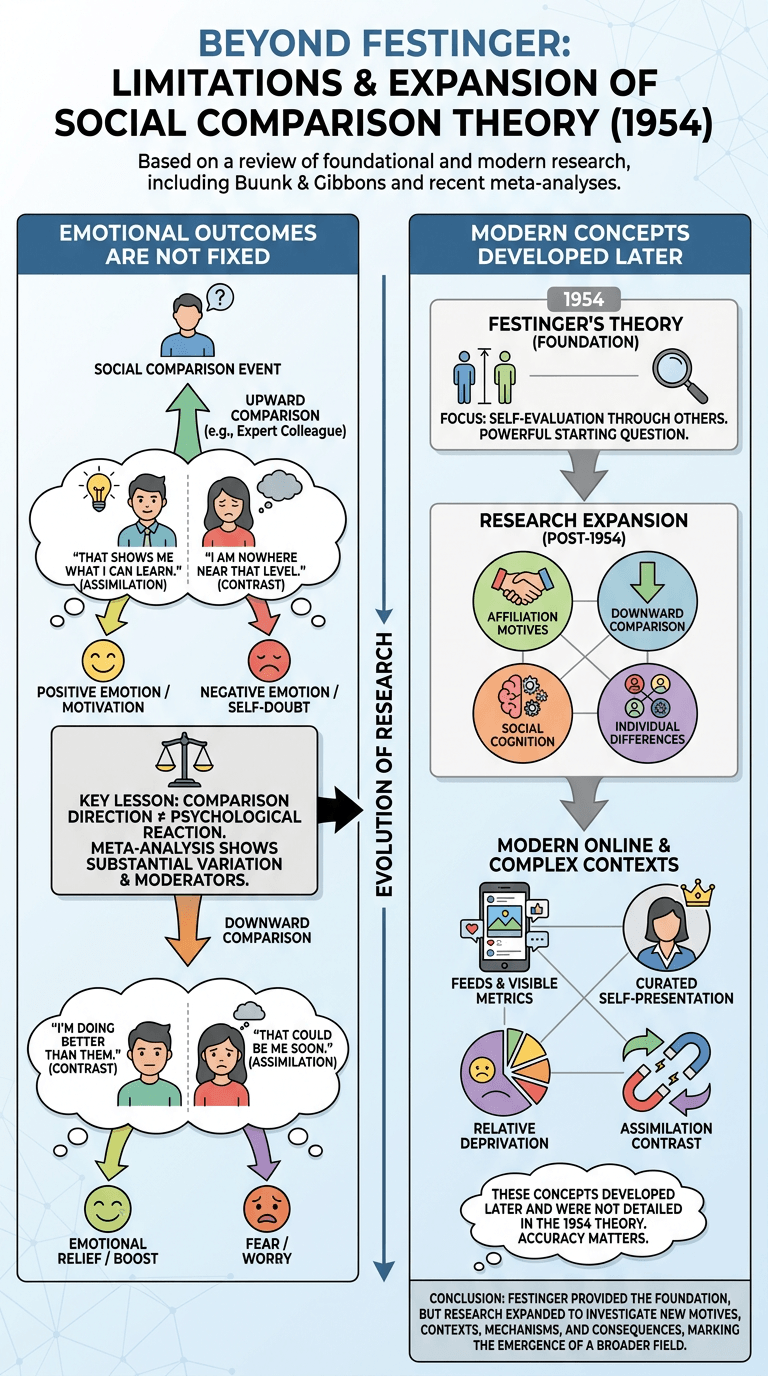
The 1954 paper was foundational, but social comparison research did not stop there. A later review by Buunk and Gibbons described how the topic expanded from classic theory into research on affiliation, downward comparison, social cognition, and individual differences. Their review is appropriately titled Social comparison: The end of a theory and the emergence of a field.
Emotional outcomes are not fixed by the original theory
It is tempting to turn Social Comparison Theory into a simple emotional rule: compare upward and feel worse, compare downward and feel better. Research does not support such a universal formula. A large meta-analysis covering more than six decades of social comparison research found substantial variation in comparison selection and reactions, while also showing that contrastive responses were common in many experimental settings. The key lesson is that comparison direction and psychological reaction should not be treated as the same thing. The social comparison meta-analysis also highlights unresolved questions and important moderators.
An expert colleague can make one person think, “That shows me what I can learn,” and another think, “I am nowhere near that level.” The target is the same. The interpretation is not.
Modern online comparison, relative deprivation, and assimilation/contrast developed through later research traditions
Feeds, visible metrics, curated self-presentation, relative deprivation, assimilation, contrast, and many other concepts are now studied within the broader social comparison field. They should not be retroactively presented as if the 1954 theory contained a detailed explanation of each one.
Historical accuracy matters because it clarifies what a theory actually explains. Festinger supplied a powerful starting question about self-evaluation through others. Later researchers investigated additional motives, new contexts, target choices, cognitive mechanisms, and consequences.
From the Original Theory to Later Social Comparison Research
Once comparison became a broader research field, psychologists began asking not only whether people compare, but what purposes comparison can serve.
Self-evaluation as one motive
The clearest link to Festinger is self-evaluation: people want information about where they stand. You may compare your presentation with a colleague’s because you want a more realistic estimate of your current skill. You may ask how others interpreted a confusing instruction because you want to check your own judgment.
Self-evaluation is not necessarily pleasant. Accurate information can be encouraging, neutral, or uncomfortable. Its function is calibration.
Self-improvement and self-enhancement as later comparison motives at a high level
Later work broadened attention to other reasons people seek comparison information. Self-improvement involves learning from another person or identifying a higher standard that may help guide development. Self-enhancement involves protecting or supporting a favorable view of oneself.
These motives can overlap. A musician may watch a more skilled performer partly to learn technique and partly to test whether reaching that level feels possible. A person may look at others doing worse during a difficult period because the comparison puts their own situation in perspective. These are useful extensions, but they should not be described as if Festinger’s original theory mapped every motive in its modern form.
Upward and downward comparison as later elaborations
Modern discussions frequently classify targets as upward, downward, or lateral. That vocabulary is useful, but direction alone does not tell you what the comparison will do. Upward targets may offer aspiration, information, or threat. Downward targets may provide perspective, reassurance, irrelevance, or discomfort. Similar others may help with calibration but can also become competitive.
The historical theory helps explain why people seek comparison information. Later work asks more detailed questions about which targets they choose and how they respond.
Social Comparison Theory vs Social Identity Theory
The two names are easy to confuse because both involve other people, but they answer different psychological questions.
Individual self-evaluation relative to others
In Social Comparison Theory, the central unit is often an individual trying to evaluate an opinion or ability with the help of information from other people. The practical question is, “What does their performance, reaction, or judgment tell me about mine?”
Intergroup comparison as part of group identity is a different theoretical use
Social Identity Theory focuses on group membership, self-concept, categorization, and relations between groups. The APA Dictionary description of Social Identity Theory emphasizes how meaningful group membership influences self-concept and intergroup processes.
The two traditions can intersect, but they should not be collapsed. Comparing your public-speaking skill with a colleague is not the same psychological question as evaluating your group in relation to another group. One is primarily about individual comparative information. The other concerns group-based identity and intergroup relations.
Social Comparison Theory vs Reference Group Psychology
Another useful distinction is between the reason comparison becomes useful and the reason a particular group becomes the standard.
Why people compare is different from why a particular group becomes the standard
Social Comparison Theory helps explain why another person may become useful when you need evaluative information. Reference-group research asks a more specific question: why this group, rather than some other group, becomes the standard.
A new graduate might compare salary with other new graduates, people in the same profession, former classmates, workers in the same city, or highly visible people online. Each choice creates a different frame. The theory of comparison and the selection of a reference group are related, but they are not identical problems.
What a Theory-Based Comparison Question Looks Like in Everyday Life
The theory becomes clearer when the question, comparison target, and available objective evidence are separated instead of blended together.
Ability example: learning a new professional skill
Situation: You have spent six weeks learning data visualization and still need to look up basic commands.
What you may feel: Uncertain about whether your progress is slow.
What it may mean: You lack a useful objective benchmark. Comparing with someone who has a similar amount of practice may provide calibration. Comparing with a specialist who has worked in the field for ten years may answer a different question, such as what expert performance can look like.
What to do next: Define the question before choosing the target. If the question is “Am I progressing normally for six weeks of practice?”, find a standard that matches that stage.
Opinion example: interpreting an ambiguous workplace norm
Situation: Your manager says employees should “take more ownership,” but nobody explains what that means in daily work.
What you may feel: Unsure whether you should make more decisions independently or communicate more often.
What it may mean: Coworkers’ interpretations can function as social information, especially if formal guidance is vague. Agreement among peers may help you understand the local norm, but it does not prove that their interpretation matches the manager’s intention.
What to do next: Use social information as a hypothesis, then verify it with clearer evidence when possible.
When objective evidence should override social information
Situation: Everyone on your recreational cycling group estimates that a route is about 20 kilometers, but your GPS records 27 kilometers.
What you may feel: Tempted to trust the group because several people agree.
What it may mean: Agreement is not always a better standard than direct measurement. Social comparison is most useful when objective evidence is absent, incomplete, or difficult to interpret.
What to do next: Prefer a reliable nonsocial standard when it directly answers the question. Comparison is a tool for evaluation, not a requirement to follow the crowd.
Common Misreadings of Social Comparison Theory
Several popular claims about comparison go beyond what the original theory actually says.
It does not say people always compare upward
The original theory does not reduce comparison to looking at people who are doing better. People may seek similar others because those comparisons are informative, and later research has examined upward, downward, and lateral targets in much more detail.
It does not say all comparison is competitive
You can compare to learn, calibrate, check an interpretation, understand what is typical, or decide whether an objective standard is needed. Competition is one possible context, not the definition of comparison.
It does not prove frequent comparison means insecurity
People differ in how strongly they attend to comparison information. Research on social comparison orientation has developed measures of those individual differences, including the Iowa-Netherlands Comparison Orientation Measure. The existence of a comparison tendency does not itself diagnose low self-esteem, anxiety, insecurity, or any other condition.
How to Use the Theory as an Information Check
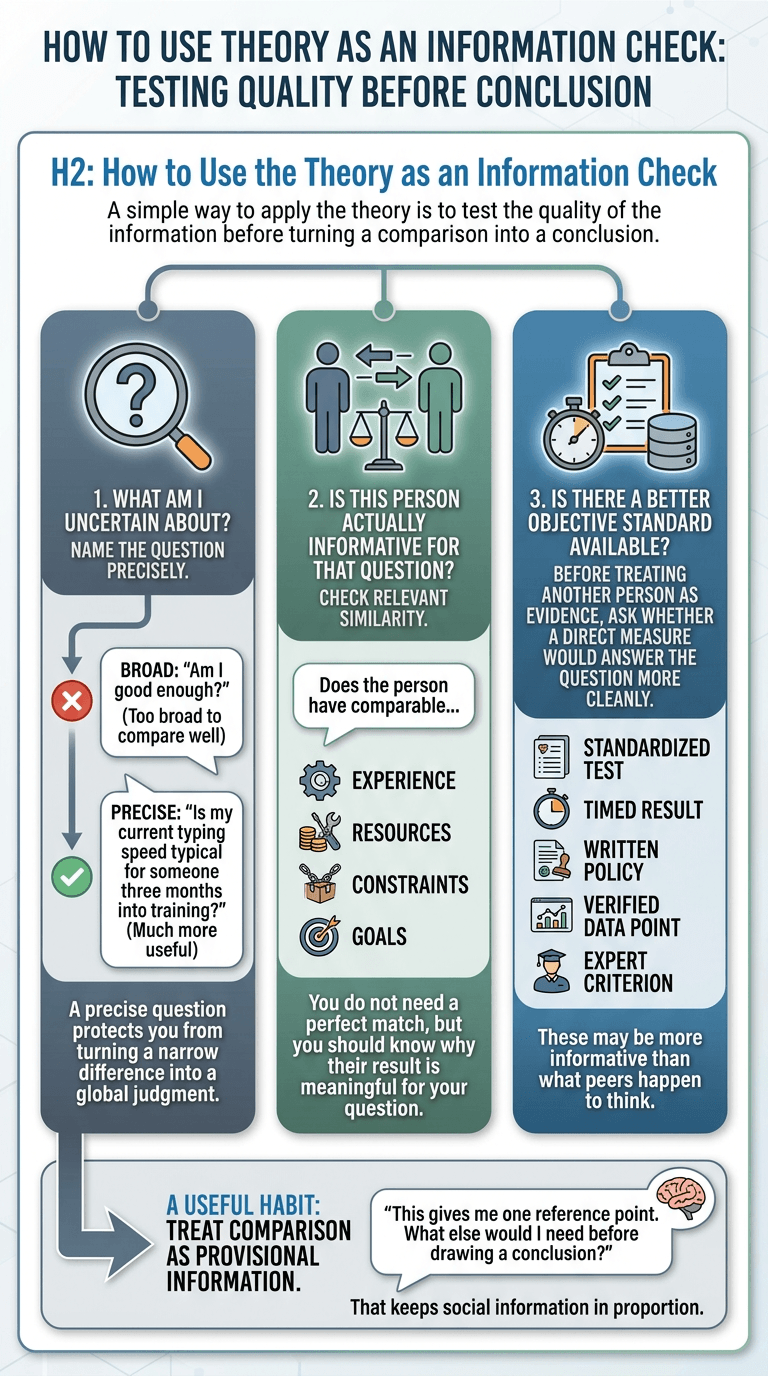
A simple way to apply the theory is to test the quality of the information before turning a comparison into a conclusion.
What am I uncertain about?
Name the question precisely. “Am I good enough?” is too broad to compare well. “Is my current typing speed typical for someone three months into training?” is much more useful. A precise question protects you from turning a narrow difference into a global judgment.
Is this person actually informative for that question?
Check relevant similarity. Does the person have comparable experience, resources, constraints, or goals? You do not need a perfect match, but you should know why their result is meaningful for your question.
Is there a better objective standard available?
Before treating another person as evidence, ask whether a direct measure would answer the question more cleanly. A standardized test, timed result, written policy, verified data point, or expert criterion may be more informative than what peers happen to think.
A useful habit is to treat comparison as provisional information: “This gives me one reference point. What else would I need before drawing a conclusion?” That keeps social information in proportion.
Questions That Modern Social Comparison Research Takes Further
The 1954 framework opened questions that later researchers have examined with more specific concepts and measures.
Does the direction of comparison matter?
Yes, but not as a simple good-or-bad rule. Later work examines what changes when the target is doing better, worse, or similarly on the dimension that matters.
Why do some people compare more than others?
Researchers study stable and situational differences in attention to comparison information. The development of the Iowa-Netherlands Comparison Orientation Measure helped formalize research on individual differences without treating frequent comparison as a diagnosis.
Why does one group become my standard instead of another?
That question leads toward reference groups. The people immediately around you, an aspirational professional community, former classmates, or a statistical average can each become a standard under different circumstances. Choosing the standard can change the conclusion even when your own performance stays the same.
FAQ
These questions clarify what belongs to Festinger’s original proposal and what belongs to later social comparison research.
Did Festinger invent the idea of comparing yourself with others?
No. People had discussed comparison, competition, social influence, and self-evaluation long before 1954. Festinger’s contribution was to formulate a systematic social psychological theory explaining why people may use others to evaluate opinions and abilities, particularly when objective standards are unavailable. His paper became a foundation for a much larger research field.
Why did the original theory emphasize opinions and abilities?
They illustrate two important kinds of evaluation. Abilities raise questions about performance, such as how well someone can do a task. Opinions raise questions about judgments and social reality, such as whether a belief or interpretation is reasonable. Both can become uncertain when direct standards are weak, making information from other people useful.
Does Social Comparison Theory predict whether comparison will feel good or bad?
Not in a simple one-to-one way. The original theory focused heavily on evaluation, while later research examined emotional and self-evaluative consequences in much greater detail. The same target can be encouraging, threatening, informative, irrelevant, or emotionally mixed depending on the person, domain, relationship, perceived attainability, and interpretation.
Is similarity always required for a useful comparison?
No. Similarity can make a target more informative for some evaluative questions, but very different people can still provide useful information. An expert may show what advanced performance looks like, while a similar novice may be better for judging typical early progress. The usefulness of similarity depends on the question you are trying to answer.
How is modern social comparison research broader than the 1954 theory?
Researchers now study comparison direction, emotional reactions, self-improvement and self-enhancement motives, social cognition, individual differences, reference standards, online environments, contextual effects, and many other processes. The field still builds on Festinger’s insight that other people can become evaluative information, but modern findings should be attributed to the research traditions that actually developed them.
Key Takeaways
- Festinger’s 1954 Social Comparison Theory focused on how people evaluate opinions and abilities when objective standards are limited.
- Other people can provide useful context, but relative information does not establish personal worth or explain why a difference exists.
- Relevant similarity can make a comparison more informative, yet the best target depends on the exact question being asked.
- The original theory does not predict one fixed emotional outcome from comparing upward, downward, or sideways.
- Modern social comparison research includes motives, cognitive processes, individual differences, target direction, and contextual effects that developed after the original theory.
- A practical use of the theory is to ask what you are uncertain about, whether the target is informative, and whether a stronger objective standard is available.

Michael Reed is the Founder and Lead Writer at Psychology Exposed. He writes about human behavior, relationships, emotional patterns, self-awareness, and practical psychology topics using research-informed, easy-to-understand content.
Read More About Michael Reed: https://psychologyexposed.com/michael-reed/