
Words can disagree, correct, challenge, warn, or set limits without becoming aggression. The distinction matters because labeling every harsh conversation as “verbal aggression” can blur meaningful differences, while dismissing threats, humiliation, or deliberate personal attacks as “just words” can minimize real harm.
In verbal aggression psychology, the central question is not simply whether speech sounds unpleasant. It is what the language is doing. Is it challenging an idea or behavior, or is it being used to injure a person psychologically, frighten them, degrade them, or make them feel smaller and less able to respond? Looking at the behavior, context, and apparent function gives a clearer picture than relying on volume or bluntness alone.
Quick Answer
Verbal aggression is language used to harm, threaten, humiliate, intimidate, ridicule, or degrade another person. It differs from ordinary disagreement because the target shifts from the issue to the person or their sense of safety and dignity. A raised voice, blunt criticism, or firm boundary is not automatically verbal aggression. Intent, message content, context, and impact all help clarify what is happening.
What Makes Language Verbally Aggressive?
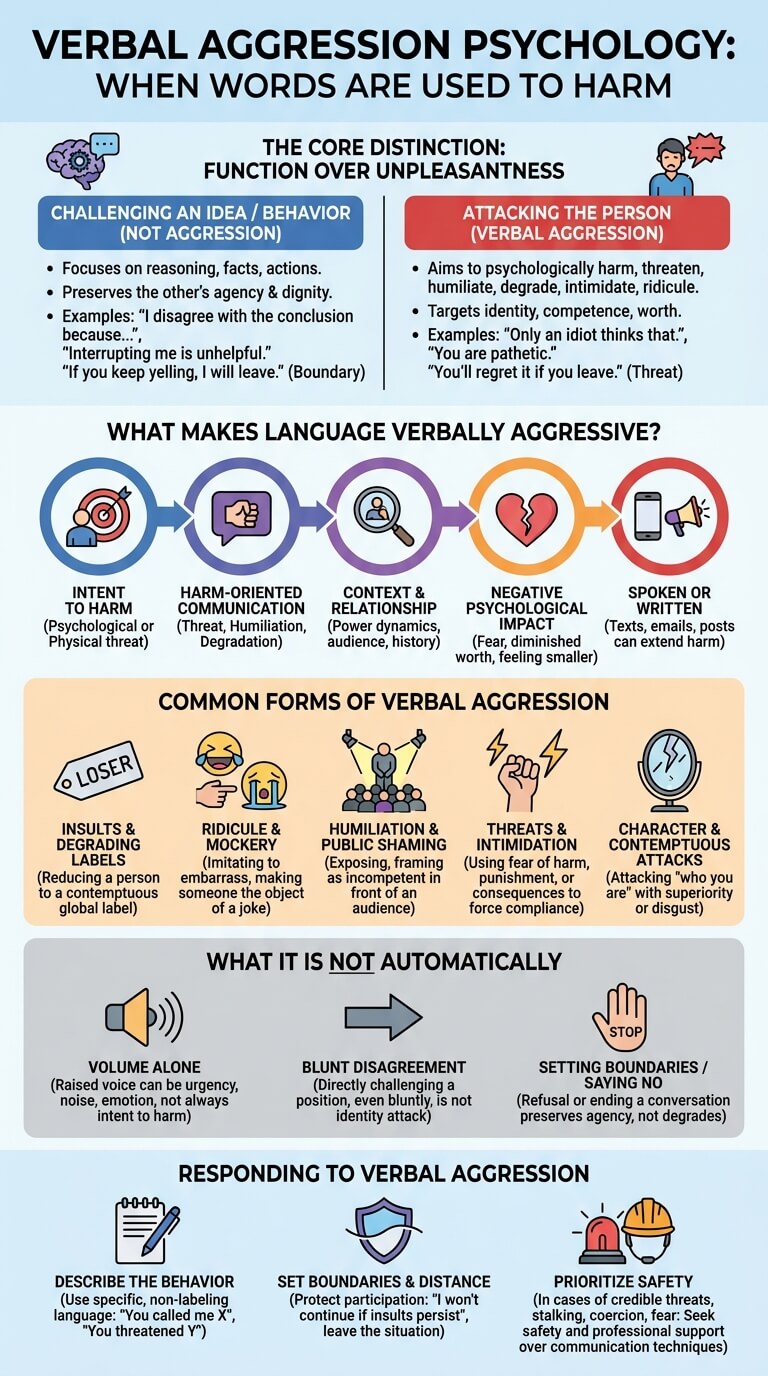
The APA Dictionary of Psychology definition of aggression centers on behavior aimed at harming another person physically or psychologically. Applied to language, this makes the core issue harm-oriented communication rather than mere unpleasantness.
Harm, threat, humiliation, degradation, or intimidation as the function
A verbally aggressive message often aims at more than making a point. It may attack competence, character, appearance, identity, social standing, or worth. Classic communication research on verbal aggressiveness drew an influential distinction between attacking a person’s self-concept and arguing against that person’s position.
That distinction is useful in everyday life. “I think that plan ignores an important risk” challenges a proposal. “Only an idiot would suggest that plan” targets the person. The first can still be sharp or poorly timed, but the second changes the object of attack.
Spoken versus written language
Verbal aggression is not limited to face-to-face speech. Texts, emails, direct messages, group chats, comments, and written notes can carry insults, threats, degrading labels, or deliberate humiliation. Written messages may also be reread, forwarded, screenshotted, or shown to an audience, which can extend the social impact beyond the original exchange.
The medium changes how the message travels, not the basic psychological distinction. The relevant question remains whether language is being used as a vehicle for harm.
Why tone or volume alone is not enough
Volume is a cue, not a diagnosis. Someone may raise their voice because of noise, urgency, fear, poor hearing, or emotional intensity without trying to harm the listener. Conversely, a threat can be delivered quietly and calmly.
It is usually more informative to ask what was said, what the speaker was trying to accomplish, whether the target was an idea or a person, and whether intimidation or degradation was part of the exchange.
Common Forms of Verbal Aggression

Research traditions differ in terminology, but several recognizable forms appear repeatedly in work on destructive communication. These examples describe behaviors, not fixed personality types.
Insults and degrading labels
Insults reduce a person to a contemptuous label rather than addressing a specific behavior. “You missed the deadline again” names an event. “You’re completely useless” turns the criticism into a global attack on worth or competence.
The difference is especially important when labels are repeated because repetition can transform a single ugly remark into an ongoing method of degrading another person.
Ridicule and mockery aimed at the person
Humor does not automatically make a message harmless. Mockery can imitate someone’s voice, intelligence, body, accent, mistakes, fears, or emotional reactions in order to embarrass them. A joke shared mutually is different from humor used to place one person beneath the audience.
Context helps: Was the person laughing with the group, or being made into the object of the joke after asking for it to stop?
Humiliation and public shaming
Public humiliation adds an audience to the attack. The aggressor may expose a mistake, repeat a private detail, invite others to laugh, or frame the target as incompetent or ridiculous in front of peers. The social audience can become part of the harm because reputation and belonging are now involved.
This does not mean every public correction is aggression. A supervisor can correct an error in a meeting without degrading the employee. The line is clearer when correction gives way to personal shaming.
Threats and intimidation
Threatening language communicates that harm, punishment, retaliation, or frightening consequences may follow if the other person does not comply. The speaker does not need to shout for the message to be intimidating. “You’ll regret it if you leave” can carry more threat than a loud but non-threatening disagreement.
Credibility and context matter. A bizarre statement made once in obvious jest is not psychologically equivalent to repeated threats from someone who has access, means, or a history that makes the threat feel real.
Character attacks and contemptuous personal attacks
Character attacks move from “what you did” to “what kind of person you are.” Contempt adds a sense of superiority or disgust, often through sneering, sarcasm, mockery, or language that treats the other person as beneath respect. The Gottman Institute describes contempt as an attack on a person’s worth in close conflict, which overlaps with the person-directed quality seen in verbal aggression.
The concepts are not identical, and contempt research is not a universal definition of verbal aggression. It is useful here because it shows how conflict can shift from an issue toward devaluing the person.
Attacking a Person vs Challenging an Idea

One of the most practical distinctions is whether the message is directed at a claim, choice, behavior, or proposal, or at the person’s worth and identity.
| Communication target | Example | What it does |
|---|---|---|
| Idea | “I disagree with that conclusion because the numbers do not support it.” | Challenges reasoning. |
| Behavior | “Interrupting me repeatedly makes it hard to finish the discussion.” | Names an observable action. |
| Boundary | “If the insults continue, I’m ending this conversation.” | States what the speaker will do. |
| Person | “You are pathetic and nobody respects you.” | Degrades identity and social worth. |
| Threat | “If you tell anyone, I’ll make you pay for it.” | Uses fear and threatened harm. |
Criticism of a behavior or claim
Criticism can be accurate or unfair, gentle or blunt. It is not automatically aggressive. “That report contains three factual errors” could be uncomfortable but still stays focused on work that can be corrected. Even “I’m angry that you broke our agreement” expresses strong emotion without necessarily attacking the other person’s humanity.
Personal degradation
Personal degradation gives the target less room to respond because the message is no longer about a changeable point. “You are stupid,” “You are disgusting,” or “No one could ever want you” attacks identity and worth. The listener cannot simply revise a proposal or correct a behavior to answer the attack.
Why disagreement can be direct without being aggressive
Directness is sometimes confused with aggression because both can feel uncomfortable. But clear disagreement can preserve the other person’s agency. You can say “No,” reject a request, challenge misinformation, leave a discussion, or insist on a limit without humiliating or threatening anyone.
That is why discomfort alone is not a reliable test. A respectful boundary can disappoint someone. A calm threat can frighten someone. The content and function matter more than whether the interaction feels easy.
Criticism, Assertiveness, Aggressive Communication, and Verbal Aggression

These concepts overlap enough that people often use them interchangeably, but keeping them separate makes real situations easier to evaluate.
| Concept | Main focus | Typical example |
|---|---|---|
| Criticism | Evaluation of behavior, work, or a claim | “This explanation leaves out a key fact.” |
| Assertiveness | Clear expression of needs, limits, or opinions with respect for others | “I’m not agreeing to that.” |
| Aggressive communication | A broader communication style that can involve pressure, domination, interruption, contempt, or threats | Repeatedly overriding another person while pushing one’s position. |
| Verbal aggression | Words used specifically to harm, degrade, intimidate, humiliate, or threaten | “You’re worthless, and I’ll make sure everyone knows it.” |
Firm boundaries versus threats
A boundary describes your own action or condition: “If you keep calling me names, I will leave the conversation.” A threat uses fear to force the other person: “If you leave, you’ll be sorry.” Both may contain consequences, but the psychological function differs.
The first protects participation. The second tries to control participation by implying harm.
Assertiveness preserves meaningful agency
The APA definition of assertiveness emphasizes direct expression while maintaining respect for others. That does not require softness or agreement. Assertiveness can be firm enough to stop a conversation, refuse a demand, challenge a false statement, or leave.
Psychology Exposed covers this skill more fully in assertive communication psychology.
Aggressive communication is a broader style
A communication style can include pace, interruption, listening, pressure, tone, control of turn-taking, and how disagreement is handled over time. Verbal aggression is narrower. It asks whether language itself is being used to harm or intimidate.
For a broader comparison of passive, aggressive, passive-aggressive, and assertive styles, see communication styles psychology.
Verbal aggression is language specifically used to harm
This narrower focus matters because not all domineering communication contains a clear personal attack, and not every personal attack reflects a stable communication style. Someone can use a single verbally aggressive statement without that one incident proving what they are “like” as a person.
Describe the behavior first. Labels should come later, if they are useful at all.
What Does Not Automatically Count as Verbal Aggression?
Over-broad definitions make it harder to identify the behaviors that actually need attention. Several uncomfortable forms of communication require context before being called aggression.
A raised voice by itself
Yelling can be intimidating, especially when combined with insults, threats, physical blocking, or repeated domination. But volume alone does not establish intent to harm. A person can raise their voice from panic, excitement, urgency, hearing difficulty, or mutual escalation.
Ask what accompanied the volume. The words, proximity, gestures, ability to leave, and presence of threats often tell you more.
Blunt disagreement
“I think you are wrong” may sound blunt, but it challenges a position. “You’re too stupid to understand this” attacks the person. The second statement may be verbal aggression because humiliation replaces argument.
Saying no or ending a conversation
Refusal is not aggression simply because the other person dislikes it. “No, I’m not lending you money” or “I’m ending this call now” preserves the speaker’s freedom without necessarily degrading the other person. Treating every refusal as aggression can make ordinary boundaries harder to maintain.
Corrective feedback that is not degrading
Feedback can be direct and still remain behavior-based. “This presentation was not ready for the client” is different from “You embarrass everyone because you are incompetent.” The first may require explanation and fairness, but the second attacks identity.
Why Verbal Aggression Happens
There is no single cause. Similar messages can serve different functions in different situations, and one incident does not tell you everything about motive.
Reactive verbal attacks after provocation
Some verbal aggression follows perceived insult, humiliation, unfairness, or threat. The person may counterattack quickly, especially when arousal is high and attention narrows around retaliation. That does not make the attack inevitable or justified. It simply describes one route by which an argument can become person-directed.
This route overlaps with defensiveness when criticism feels like an attack, but defensiveness and verbal aggression are not the same. Someone can defend themselves without insulting the other person. Psychology Exposed discusses that distinction further in defensive communication psychology.
Strategic intimidation or humiliation
Other verbal attacks are more deliberate. A person may threaten, ridicule, or shame someone because they expect the language to produce compliance, silence, status, or retreat. Strong visible anger is not required. A calm speaker can still use words aggressively when the goal is to frighten or degrade.
Audience, status, and retaliation as contextual factors
An audience can raise the social stakes. People may feel pressure to save face, entertain a group, defend status, or answer an insult with another insult. Public embarrassment can also make retaliation feel more tempting.
These influences help explain why a situation becomes volatile, but they do not erase choice or responsibility. Context changes pressure, not the basic boundary against deliberate harm.
The Reciprocal Verbal Escalation Loop
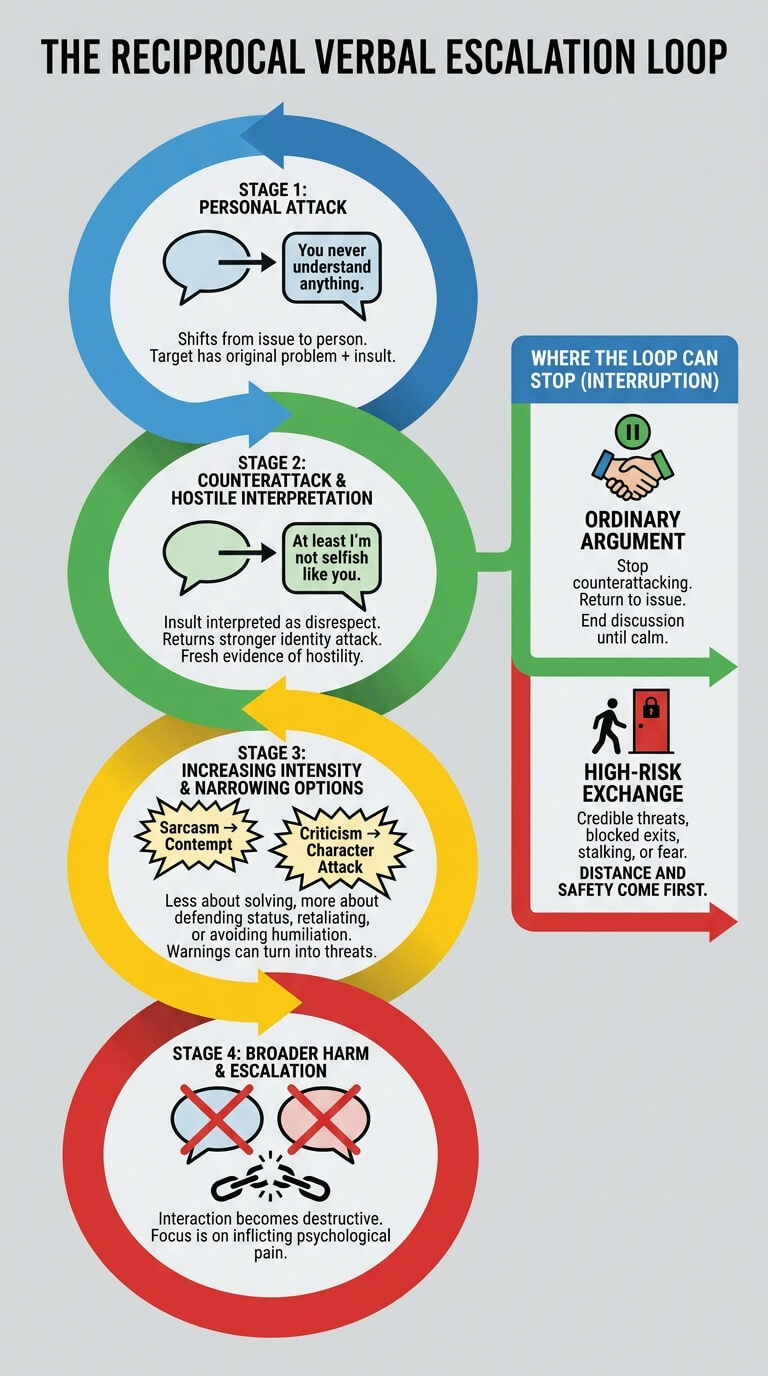
Verbal aggression often becomes more damaging when each person treats the previous attack as permission for a stronger one. The loop is not inevitable, but it can move quickly.
Personal attack
One person shifts from the issue to the person: “You never understand anything.” The target now has two problems, the original disagreement and the insult.
Counterattack and hostile interpretation
The target may interpret the insult as proof of disrespect and answer with another identity attack: “At least I’m not selfish like you.” Each person now has fresh evidence that the other is hostile.
Increasing intensity and narrowing options
As insults accumulate, the interaction can become less about solving anything and more about defending status, retaliating, or avoiding humiliation. Sarcasm becomes contempt, criticism becomes a character attack, and warnings can turn into threats.
Research on destructive verbal communication has long distinguished attacking positions from attacking self-concept, and later work has examined the hurt associated with verbally aggressive messages. A study summarized in PubMed on verbal aggressiveness describes self-concept attacks as messages intended to inflict psychological pain.
Where the loop can stop before broader harm
The safest interruption depends on the level of risk. In an ordinary argument, a person may stop counterattacking, return to the issue, or end the discussion until both can speak without personal attacks. When the exchange includes credible threats, blocked exits, stalking, or fear, the task is no longer to improve the conversation. Distance and safety come first.
Public, Private, and Online Contexts
The same words can have different effects depending on where they occur and who can see them.
Audience effects and humiliation
A private insult hurts differently from a public one because humiliation may now involve reputation and belonging. A person who is corrected respectfully in front of coworkers may feel embarrassed, but deliberate mockery designed to make the room laugh at them adds a social-harm component.
Written messages that persist and spread
Written aggression can remain visible after the moment ends. Screenshots, group messages, reposts, and forwarded emails can extend exposure. Persistence also changes what the recipient has to manage: the attack may be repeatedly encountered rather than disappearing when the conversation stops.
Why online context does not change the core distinction
Online spaces can amplify distance, audience size, anonymity, and speed, but the conceptual question stays the same. Is the message disputing content, or is it being used to threaten, humiliate, or degrade a target?
Not every rude comment is equally severe. A single sarcastic reply, a coordinated pile-on, a credible threat, and persistent stalking should not be collapsed into one category simply because all occurred online.
Verbal Aggression vs Emotional Invalidation
These concepts can overlap, but they answer different questions.
Invalidation targets the legitimacy of emotional experience
Emotional invalidation occurs when a feeling is dismissed, minimized, mocked, denied, or treated as illegitimate. “You have no reason to be upset” is invalidating because it rejects the emotional experience. It may be careless, defensive, or dismissive without necessarily being intended as an aggressive attack.
Verbal aggression targets harm through language
“You’re pathetic for being upset” adds a personal attack. Here, language is not merely rejecting the feeling. It is degrading the person for having it.
Where the concepts can overlap without becoming identical
Mocking someone’s tears in front of others could both invalidate emotion and function as verbal aggression if humiliation is part of the behavior. By contrast, an awkward attempt to reassure someone with “It’s not that bad” may feel invalidating without carrying an intent to harm.
Intent is not always visible, so context, repetition, content, and the person’s response all deserve attention. The goal is accurate description, not certainty about another person’s inner state.
What to Do Next When Verbal Aggression Appears
The most useful next step depends on whether you are dealing with an ordinary harmful exchange or a situation involving intimidation and credible danger.
Describe the specific behavior instead of debating labels
When it is safe, behavior-based language is often clearer than “You’re verbally aggressive.” For example: “You called me stupid twice after I disagreed,” or “You threatened to damage my property if I left.” Specific descriptions make it easier to identify what needs to stop.
If you are the person who used the attack, the same principle helps with accountability: “I criticized your character instead of staying with the issue.” That is more concrete than defending or condemning your entire identity.
Set or maintain distance and boundaries when safe
In a non-dangerous exchange, a boundary might be: “I’ll discuss the problem, but I’m not staying in a conversation where we insult each other.” Another option is to end the interaction and revisit the issue only if the conversation can return to behavior, facts, needs, or decisions.
A boundary does not require convincing the other person that your label is correct. It tells them what participation requires from you.
Do not remain in a threatening interaction to prove communication skill
If someone is threatening retaliation, blocking your exit, stalking you, escalating intimidation, or creating credible fear, communication technique is not the priority. You do not need to stay and demonstrate calmness, validation, or perfect wording.
Safety decisions should be based on the behavior and risk in front of you, not on whether the other person accepts your interpretation.
When Verbal Aggression Becomes a Safety Concern
Insults and ordinary arguments vary widely in seriousness. Certain behaviors deserve a different response because they signal more than a difficult conversation. Words can be aggressive without being violent, while credible threats can still create serious safety concerns even when no physical force has occurred.
Credible threats, stalking, coercion, repeated intimidation, or fear
Repeated threats, stalking, coercive pressure, threatening harm to children or pets, serious property destruction used to frighten someone, or fear that retaliation may follow are safety concerns. The National Domestic Violence Hotline offers safety-planning resources for people dealing with abuse or intimidation in intimate relationships.
If danger feels immediate, use appropriate emergency resources where you live. Legal definitions and available services vary by location, so local professional guidance may also be necessary.
Why safety outranks communication optimization
Advice that works for ordinary conflict can be unsafe in a coercive situation. Asking for clarification, challenging the threat, or scheduling another conversation may increase risk if the other person is using fear or retaliation to control access and behavior.
The key distinction is simple: ordinary disagreement may call for better communication, while credible danger calls for safety-focused action.
How Verbal Aggression Fits Into Broader Aggressive Behavior
Verbal aggression is one form of aggressive behavior, not a synonym for every kind of aggression. Seeing where it fits helps prevent overgeneralization.
When harmful exchanges escalate
Reciprocal insults can become part of a wider escalation process when each attack increases hostile interpretation, arousal, retaliation, or threat displays. But escalation is not a fixed staircase. People can stop, leave, seek support, or return to non-aggressive disagreement.
When the issue is communication style instead
If the main problem is chronic interruption, pressure, indirectness, passivity, or difficulty expressing needs, the broader communication-style framework may be more useful than the label verbal aggression. The narrow term is most helpful when words are being used to harm, threaten, humiliate, or degrade.
Why form and function both matter
An insult tells you the form of behavior. Context helps you understand its function. The same harsh phrase might be an impulsive retaliation in one situation and a calculated attempt to intimidate in another. The behavior can still be harmful in both cases, even though the immediate process differs.
FAQ About Verbal Aggression
These questions focus on distinctions that are easy to lose when a conversation becomes intense.
Is yelling always verbal aggression?
No. Yelling may accompany verbal aggression, especially when combined with insults, threats, or intimidation, but volume alone is not enough. Consider the words, context, physical behavior, ability to leave, and whether the speaker is trying to harm or frighten the other person. A calm threat may be more aggressive than a loud expression of frustration that contains no attack.
Is harsh criticism the same as verbal aggression?
Not necessarily. Harsh criticism can be unfair, insensitive, or poorly delivered while still focusing on a behavior, decision, or piece of work. Verbal aggression shifts toward harming the person through insult, degradation, humiliation, or threat. “This work is below the required standard” is different from “You are worthless and always will be.”
Can a calm threat be verbally aggressive?
Yes. Aggression does not require visible anger or shouting. If language is used to threaten harm or intimidate someone into compliance, a quiet delivery does not make it non-aggressive. This is one reason tone should never be the only criterion.
Is emotional invalidation always verbal aggression?
No. Invalidation concerns whether a person’s emotional experience is dismissed, denied, minimized, or mocked. It may overlap with verbal aggression when the dismissal is used to humiliate or degrade, but an invalidating statement can also come from misunderstanding, discomfort, or poor communication without a clear harm-oriented function.
How is verbal aggression different from aggressive communication?
Aggressive communication is a broader style that may include domination, interruption, pressure, contempt, threats, or reducing another person’s room to respond. Verbal aggression is more specific: language itself is used to harm, threaten, humiliate, intimidate, or degrade. One concept describes a broad interaction style, while the other identifies a harm-oriented use of words.
Key Takeaways
- Verbal aggression is best identified by harm-oriented language, not by volume, bluntness, or discomfort alone.
- Attacking a person’s worth is psychologically different from challenging an idea, behavior, or decision.
- Firm boundaries and direct disagreement can remain non-aggressive when they preserve the other person’s basic dignity and agency.
- Insults, humiliation, threats, ridicule, and character attacks can be impulsive or strategic, private or public, spoken or written.
- Emotional invalidation and aggressive communication can overlap with verbal aggression, but they are not interchangeable concepts.
- Credible threats, stalking, coercion, blocked exits, or escalating intimidation require safety-focused action rather than better conversational technique.
Final Thoughts
A useful first step is to describe the message precisely. Ask whether the words challenged an idea, named a behavior, set a boundary, or instead attacked worth, threatened harm, or used humiliation to gain an advantage. That distinction will not answer every question about motive, but it gives you a more reliable basis for deciding what kind of response the situation calls for.
If you were the person who used a personal attack, the next step is not to decide whether you are “an aggressive person.” It is to name the behavior, stop defending the attack as necessary, and return to the actual issue without degradation. If you are receiving repeated threats or intimidation, the next step may be distance and support, not another attempt to communicate more perfectly.

Michael Reed is the Founder and Lead Writer at Psychology Exposed. He writes about human behavior, relationships, emotional patterns, self-awareness, and practical psychology topics using research-informed, easy-to-understand content.
Read More About Michael Reed: https://psychologyexposed.com/michael-reed/