
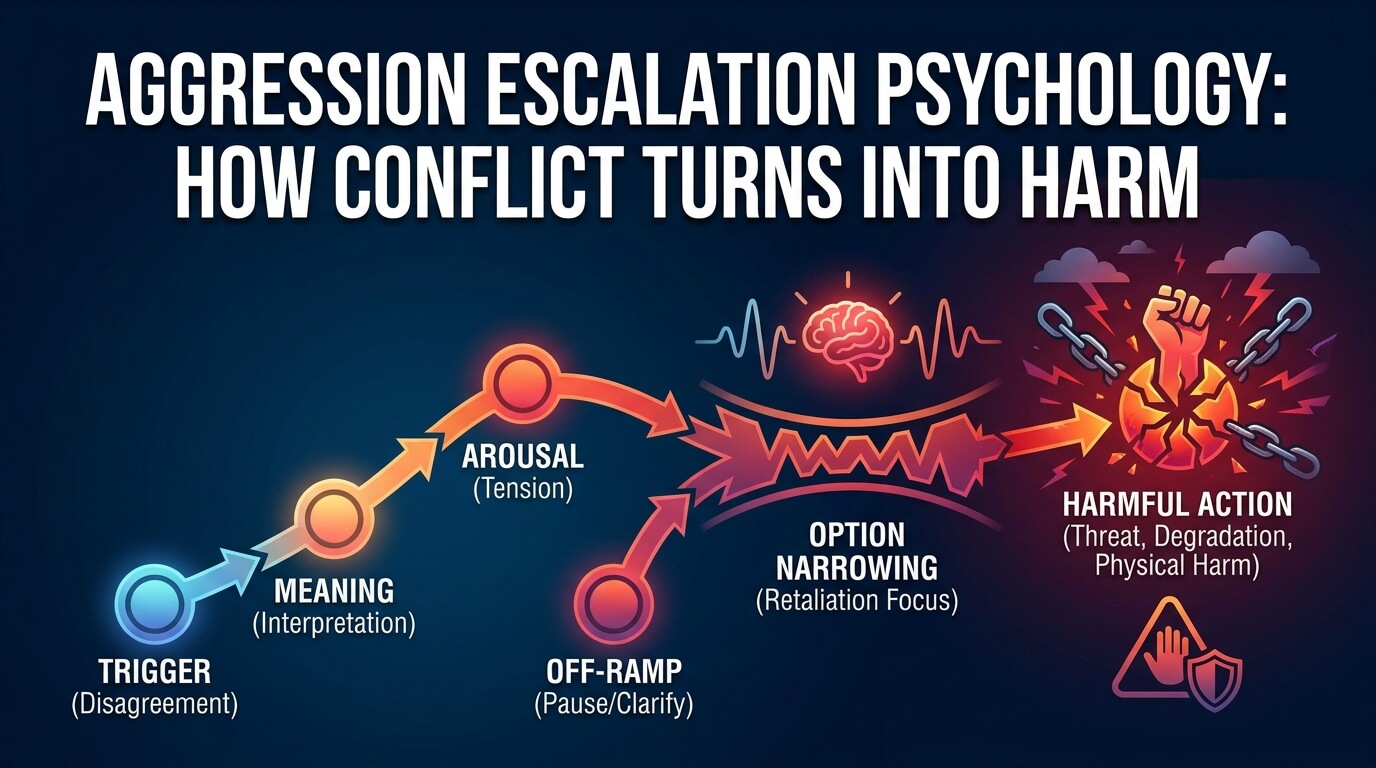
A tense interaction does not become aggressive simply because voices rise, people disagree, or someone feels angry. Escalation becomes more concerning when the exchange shifts toward intentional harm, such as humiliating, threatening, intimidating, degrading, retaliating against, or physically harming another person. That shift can happen quickly, but it is rarely explained by one feeling or one trait.
A useful way to understand escalation is as an interaction process: trigger, meaning, arousal, response choice, action, and then the other person’s interpretation. At several points, the exchange can intensify, pause, reverse, or end.
Ordinary conflict and credible danger require different responses. Clarification may help when intent is unclear and both people are safe. It is not the priority when there are threats, stalking, blocked exits, assault, strangulation, weapon-related intimidation, or credible fear.
Quick Answer
Aggression escalation is the process by which tension or provocation can move toward increasingly harmful behavior. A common pathway is trigger, interpretation, arousal, narrowed options, an aggressive response, and then reciprocal interpretation or retaliation. The sequence is not fixed or inevitable. Early pauses, distance, clarification, and reduced audience pressure may interrupt non-dangerous escalation, while credible danger requires safety-focused action instead.
Escalation Is a Process, Not a Personality Trait
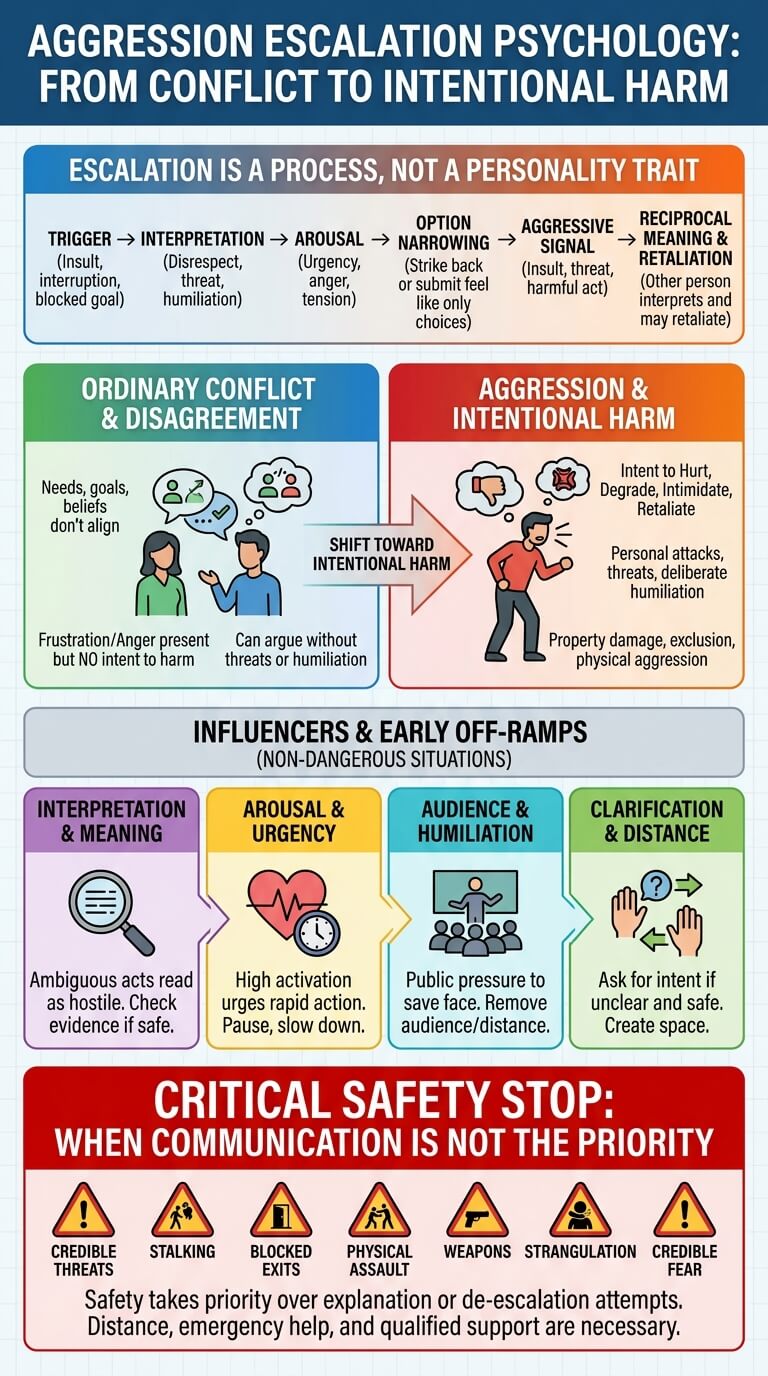
Calling someone “an escalating person” can hide the processes that matter. Escalation reflects the situation, interpretation, current state, available responses, expectations, and what happens next. The same individual may respond differently across contexts.
Disagreement Does Not Automatically Become Aggression
Conflict means that needs, goals, expectations, beliefs, or interests do not line up. Two coworkers can disagree over responsibility, two friends can argue about a plan, or two family members can want different things without either person trying to harm the other.
Even sharp disagreement can remain non-aggressive when people argue the issue without threatening, humiliating, or punishing each other. Frustration and anger may be present, but emotion is not aggression.
Harm enters when behavior becomes threatening, degrading, intimidating, or retaliatory
The practical boundary changes when the interaction includes conduct intended to hurt or impose an aversive cost. Examples include personal insults meant to wound, threats, deliberate humiliation, property damage used to frighten, retaliatory exclusion, or physical aggression.
Not every rude statement proves aggressive intent. Context, intention, pattern, and impact matter. Once intimidation or intentional harm enters the exchange, however, calling it “just a disagreement” may miss the shift.
Why escalation can stop, reverse, or change direction
Escalation is not a mechanical staircase. One person can refuse a retaliatory move. A misunderstanding can be corrected. An audience can leave. Someone can create distance. A pause can lower urgency enough for more response options to become visible.
Risk factors may shift probabilities, but group-level research cannot reliably predict what one individual will do next.
The Core Escalation Sequence
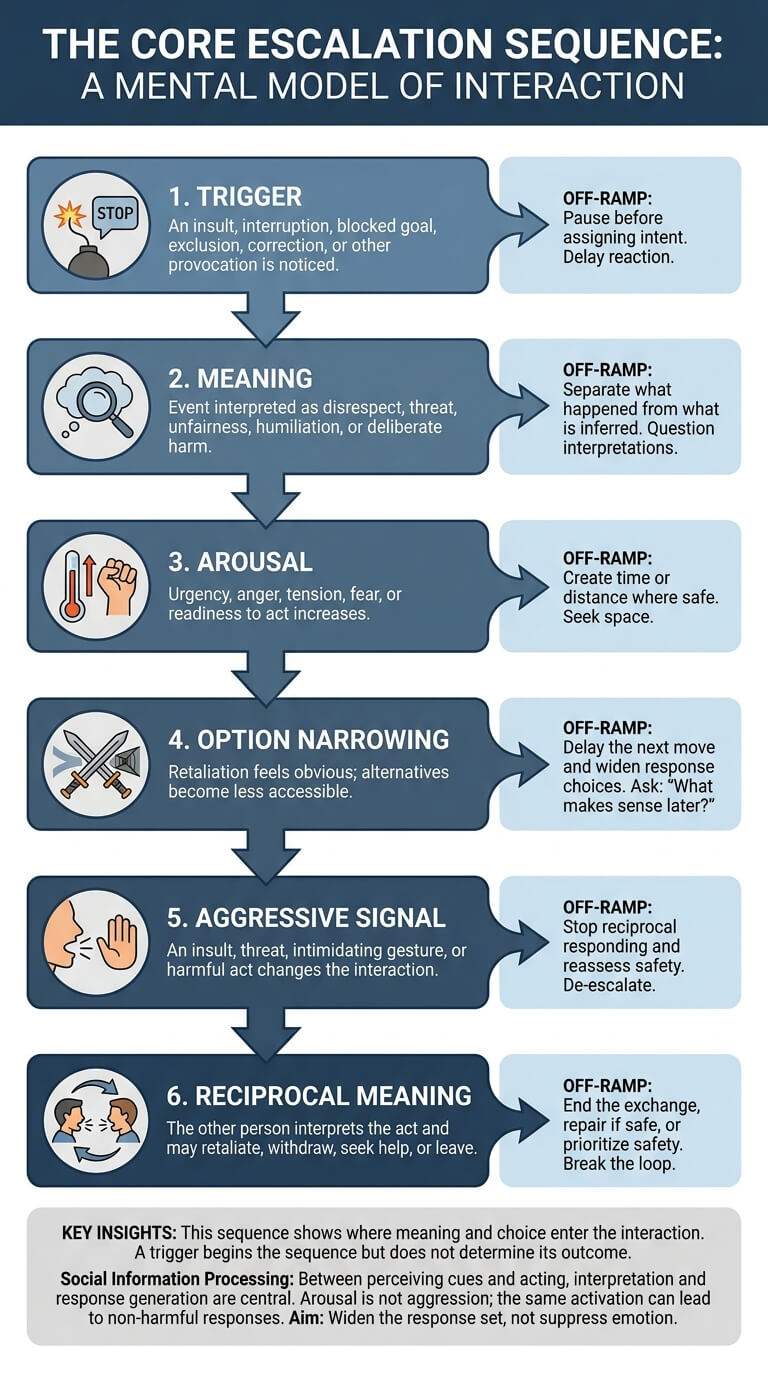
The sequence below is a mental model, not a diagnostic formula. Its value is that it shows where meaning and choice enter the interaction, and where the exchange may still take a different direction.
| Stage | What may happen | Possible off-ramp |
|---|---|---|
| Trigger | An insult, interruption, blocked goal, exclusion, correction, or other provocation is noticed. | Pause before assigning intent. |
| Meaning | The event is interpreted as disrespect, threat, unfairness, humiliation, or deliberate harm. | Separate what happened from what is inferred. |
| Arousal | Urgency, anger, tension, fear, or readiness to act increases. | Create time or distance where safe. |
| Option narrowing | Retaliation may feel more obvious while alternatives become less accessible. | Delay the next move and widen response choices. |
| Aggressive signal | An insult, threat, intimidating gesture, or harmful act changes the interaction. | Stop reciprocal responding and reassess safety. |
| Reciprocal meaning | The other person interprets the act and may retaliate, withdraw, seek help, or leave. | End the exchange, repair if safe, or prioritize safety. |
Trigger or provocation
A trigger can be ordinary: an interruption, bump, mockery, contradiction, embarrassment, or blocked goal. The trigger begins the sequence but does not determine its outcome.
Meaning and threat appraisal
People respond to events and to what they believe those events mean. The same correction might be heard as feedback, disrespect, humiliation, or attempted domination, changing which responses feel justified.
Social-information-processing research describes multiple steps between perceiving social cues and selecting a response, including encoding cues, interpreting them, generating possible responses, evaluating those options, and acting. A peer-reviewed review of social information processing explains why interpretation and response generation are central rather than incidental parts of aggressive behavior.
Arousal and action readiness
Provocation can increase physiological activation and urgency, especially when someone already expects hostility or fears that delay will look weak.
Arousal is not aggression, however. The same activation can lead to leaving, asking for clarification, seeking help, setting a boundary, freezing, or doing nothing.
Narrowing of perceived options
As emotion rises, people may act as if only two choices remain: strike back or submit. Less harmful alternatives then become easier to overlook.
In a non-dangerous situation, ask: “What response would still make sense ten minutes from now?” The aim is to widen the response set, not suppress emotion.
Aggressive signal or harmful response
An insult, threat, humiliating remark, shove, or intimidating action can redefine the exchange. The other person is now responding to a new aggressive act, not only the original disagreement.
Reciprocal interpretation and retaliation
The next response can become a new provocation. Retaliation may feel like an answer to the previous act while the other person experiences it as fresh aggression. The loop can reinforce itself without a planned sequence.
Perceived Provocation and Hostile Interpretation
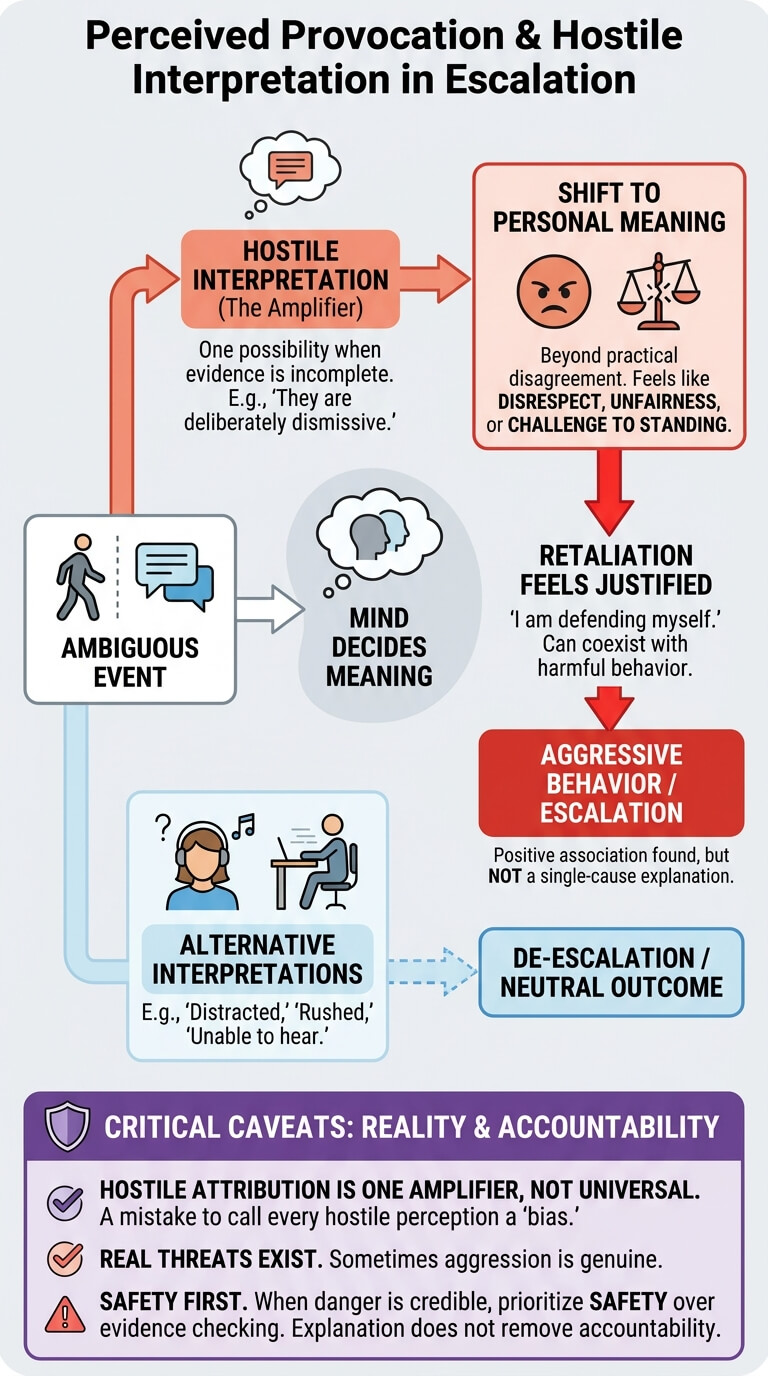
Many escalation episodes involve interpretation before behavior. That does not make a threat imaginary; it means the mind must decide what an ambiguous or negative event means before acting.
Ambiguous intent
Some events are ambiguous. A person who walks past may be ignoring you, distracted, unable to hear, or deliberately dismissive. An abrupt message may be hostile or merely rushed.
When the evidence is incomplete, hostile intent is one possible interpretation among several. A meta-analysis in PubMed Central on hostile intent attribution and aggression found a positive association between hostile interpretations and aggressive behavior, while also showing meaningful variation across studies. That supports a careful conclusion: hostile interpretation may amplify risk in some situations, but it is not a single-cause explanation.
Insult, disrespect, or unfairness
Escalation often accelerates when a person believes the issue is no longer just the practical disagreement. The interaction may now seem to communicate disrespect, unfair treatment, public embarrassment, or a challenge to standing.
Those meanings can make retaliation feel justified. “I am defending myself” can coexist with behavior that harms the other person. Explanation does not remove accountability.
Hostile attribution is one amplifier, not a universal explanation
It would be a mistake to tell people that every perception of hostility is a cognitive bias. Sometimes another person is genuinely insulting, threatening, or aggressive. Evidence checking is useful only when uncertainty is real.
When there is credible danger, the question is no longer “Could I be misreading this?” Safety should take priority over persuading yourself that the situation is benign.
Arousal, Attention, and Impulsivity
High activation may increase urgency while drawing attention away from quieter cues such as consequences, exits, or another person’s attempt to disengage.
Physiological activation and urgency
Rapid heartbeat, muscle tension, heat, shaking, or a strong urge to act can accompany anger, fear, embarrassment, or threat, making immediate action feel urgent.
That urgency is a useful warning signal because it can arrive before a harmful action. Readers who want techniques for managing acute anger can use the separate guide on how to control anger in the moment. Here, the important point is that rising activation can change the interaction by shortening the time between interpretation and action.
Attentional narrowing
A provoked person may focus on the insult and miss less threatening cues or signs that the other person is trying to stop, clarify, or leave.
In a non-dangerous exchange, distance may reduce incoming provocation and the pressure to answer immediately.
Impulsivity as a moderator rather than destiny
Impulsivity may make rapid reactions more likely, but it is not destiny. Someone can be impulsive without aggression, and aggression can also be deliberate.
The distinction matters because escalation is shaped by multiple factors at once. The CDC notes in its overview of violence risk and protective factors that violence is not usually caused by a single factor and that risk factors are not necessarily direct causes.
Alcohol or substance intoxication as a risk modifier
Alcohol also requires careful language. It does not make aggression inevitable, but it may alter attention, inhibition, and decision-making in ways that increase risk under some conditions.
A review of alcohol-related aggression emphasizes interacting social and neurobiological factors and notes that only a minority of people who drink become aggressive. That makes intoxication a modifier worth noticing, not a complete explanation for harmful behavior.
Reciprocal Aggression and Retaliation
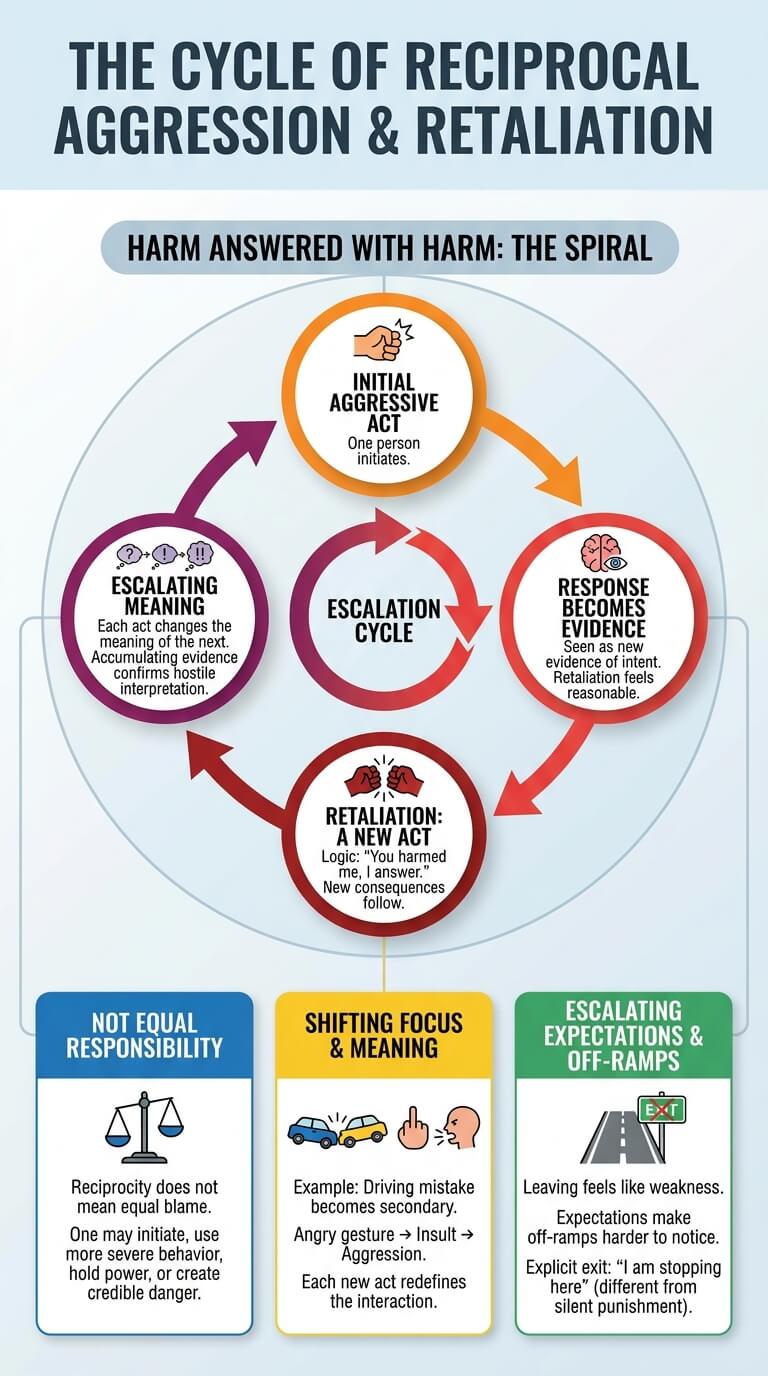
After the first aggressive act, each response can become new evidence about the other person’s intentions, making retaliation feel increasingly reasonable.
Harm answered with harm
Retaliation often follows a simple logic: “You harmed me, so I can answer.” But the response is now another aggressive act with its own consequences.
Reciprocity does not mean equal responsibility. One person may initiate the aggression, use much more severe behavior, hold more power, or create credible danger.
Why each response can change the meaning of the next
Imagine two drivers who nearly collide. One makes an angry gesture, the other reads it as a challenge and shouts an insult, and the first steps closer. The original driving mistake is no longer the main issue. Each new act creates a new meaning.
Escalation often works this way. The interaction accumulates evidence, some of it genuine and some inferred, until the latest aggressive behavior seems to confirm the most hostile interpretation.
Escalating expectations and reduced off-ramps
After several hostile exchanges, leaving may feel like weakness or surrender. Those expectations make off-ramps harder to notice.
In a non-dangerous situation, explicitly ending the exchange can help: “I am too wound up to continue this well. I am stopping here.” This is different from using silence to punish someone or disappearing without a return plan in a relationship where a later conversation is safe and appropriate.
Audience, Humiliation, and Face or Status Threat
Public conflict can raise the perceived cost of backing down, especially when dignity, competence, or standing seem to be under judgment.
Public exposure and loss of face
Humiliation is more than ordinary embarrassment. It often includes the sense that someone else has unfairly lowered or exposed you in front of others. Research on humiliation suggests that hostile intent and unfairness can be important parts of that experience.
Experimental work also indicates that an audience can intensify humiliation. In one study of audience laughter and humiliation, audience reactions affected the intensity of humiliation, which helps explain why public confrontations can feel more difficult to exit without saying that humiliation inevitably causes aggression.
Audience pressure and performative responding
When people feel observed, retaliation can become a performance for both the opponent and the audience, signaling toughness or refusal to be embarrassed.
When safe, reducing the audience can remove pressure to “win” publicly. End the public exchange, leave the group thread, or postpone the conversation.
Status threat can matter without explaining everything
Status concerns are one possible ingredient, not a universal motive. People can escalate because they feel threatened, wronged, frightened, angry, humiliated, or intent on retaliation without consciously pursuing status.
It is more accurate to ask whether a perceived loss of standing is adding pressure than to assume that all aggression is about dominance or power.
How Language Can Accelerate the Interaction
Once language shifts from disagreement toward degradation or threat, it changes the meaning of the exchange and may increase pressure for retaliation.
Personal attacks and contempt
“I think that decision was careless” challenges an action. “You are pathetic and everyone knows it” attacks the person and is more likely to function as deliberate degradation.
Repeated contemptuous or humiliating language may also make later neutral statements harder to interpret benignly because the interaction has already provided evidence of hostility.
Threat displays and intimidation
Threats can be explicit, such as saying someone will be hurt, or communicated through intimidating actions. At that point, the goal should not be to produce the perfect reply. The relevant question becomes whether the situation is still safe enough for conversation at all.
Broader communication styles are explained separately in Communication Styles Psychology. The distinction here is narrower: language contributes to escalation when it functions as harm, intimidation, humiliation, or threat rather than merely direct disagreement.
Verbal aggression does not guarantee a fixed progression
An insulting exchange can stop at words. It can also lead to withdrawal, apology, further verbal aggression, or physical confrontation. There is no universal sequence in which verbal aggression automatically becomes violence.
That uncertainty is another reason to focus on present behavior and actual safety indicators rather than assuming either “it is only words” or “this will definitely become physical.”
Early Interruption Points in Non-Dangerous Situations
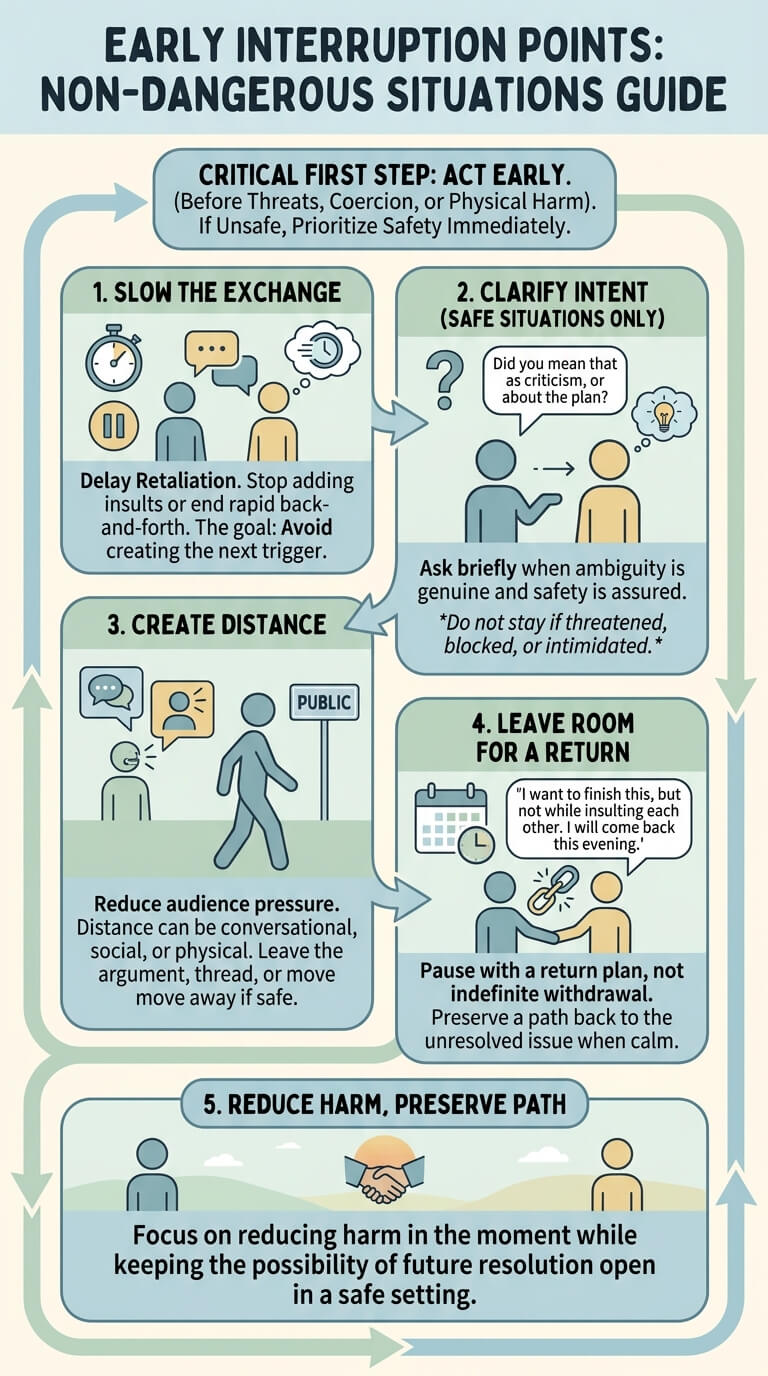
Interruption works best early. Once threats, coercion, or physical harm enter the exchange, ordinary communication techniques may no longer be appropriate.
Slow the exchange before retaliation
If retaliation feels immediately deserved, delay can be protective. Put down the phone, stop adding insults, or end the rapid back-and-forth.
The point is not to deny the provocation, but to avoid creating the next trigger.
Clarify intent when ambiguity is genuine and clarification is safe
If intent is genuinely unclear, ask briefly: “Did you mean that as criticism of me, or were you talking about the plan?”
Clarification is useful only when there is room for an answer. If the person is threatening you, blocking your exit, stalking you, or escalating intimidation, do not stay simply to test whether a calmer interpretation is possible.
Reduce audience pressure and create distance
Distance can be conversational, social, or physical. Stop the public argument, leave the group thread, or move away if it is safe to do so.
Leave room for a return later rather than forcing resolution
Some disputes need to be finished, but not at peak escalation. In a safe setting, a pause can include a return plan: “I want to finish this, but not while we are insulting each other. I will come back this evening.”
This is different from indefinite withdrawal used to punish or control. The point is to reduce harm while preserving a path back to the unresolved issue.
When De-Escalation Attempts Should Stop
Communication advice has a limit. When credible danger is present, prioritize distance, help, and safety planning rather than improving the conversation.
Threats, stalking, coercion, weapons, blocked exits, physical assault, or credible fear
Warning signs that should change the response include physical assault, credible threats, stalking, strangulation, weapon-related intimidation, blocked exits, coercive control, escalating property destruction used to frighten, or a strong and credible fear of immediate harm.
The National Domestic Violence Hotline’s safety-planning resources emphasize personalized safety planning and access to qualified support. If there is immediate danger, use emergency services appropriate to your location.
Why safety beats communication optimization
A person does not owe someone another explanation, another chance to calm down, or another carefully phrased sentence when staying present feels dangerous. Good communication is not the priority when the basic conditions for safe communication are gone.
Distance, emergency help, and qualified local support
Appropriate next steps depend on the situation and location. They may include moving toward a safer place, contacting trusted people, using local emergency services, seeking medical care after physical harm, or contacting a qualified local support service.
This article is educational and cannot assess an individual situation or replace professional, emergency, medical, or legal help.
Cross-Context Examples of Escalation and Interruption
Escalation can appear in public, peer, workplace, family, or relationship settings, but context changes what the behavior means and what response is appropriate.
Public disagreement with audience pressure
Situation: Two people argue in a queue while friends watch and laugh. What someone may feel: embarrassed and pressured not to back down. What it may mean: the audience has turned a practical dispute into a face-saving problem. What to do next: if safe, disengage from the crowd rather than answer each insult.
Peer provocation followed by reciprocal insults
Situation: A friend mocks someone, who answers with a harsher insult. What someone may feel: wronged and certain of hostile intent. What it may mean: retaliation is creating new evidence for hostility. What to do next: stop the personal attacks and, if safe, return later to the original comment.
A brief workplace example
Situation: A manager corrects an employee publicly, and the employee answers with a personal accusation. What someone may feel: exposed or angry. What it may mean: status threat has mixed with a work disagreement. What to do next: move the issue out of the audience and use the appropriate workplace process.
Workplace-specific status, fairness, role, and organizational dynamics deserve their own treatment. See Conflict at Work Psychology for that narrower context.
A relationship example that separates conflict from credible danger
Situation: A couple argues about money, raises voices, then pauses and returns later. That is not automatically aggression. If one partner blocks the doorway, threatens harm, smashes property to frighten, or prevents the other from leaving, the practical problem has changed.
What to do next: in the first version, a later repair conversation may be appropriate. In the second, prioritize safety rather than treating the situation as a communication exercise.
Aggression Escalation vs Nearby Topics
Several nearby concepts overlap with escalation but answer different questions. Keeping them separate helps avoid turning every difficult interaction into the same psychological story.
Anger regulation focuses on managing internal state
Anger regulation asks how a person can respond to their own arousal, urges, thoughts, and behavior. Aggression escalation asks how an interaction changes as interpretations and responses accumulate between people.
Conflict resolution focuses on incompatibility and negotiation
Conflict resolution is about addressing competing goals, needs, expectations, or interests. Aggression is not required for conflict to exist, and many conflicts can be negotiated without intentional harm.
Repair attempts focus on reconnecting after ordinary rupture
Repair can include acknowledging impact, softening a conversation, correcting a misunderstanding, or returning after a pause. Those ideas make sense when both people can safely re-engage. Repair is not a substitute for safety when intimidation or violence is present.
Aggression escalation focuses on movement toward intentional harm
The central question here is narrower: when does tension become a sequence of harmful signals and retaliatory responses, and where might that sequence stop before more harm occurs?
After a Non-Dangerous Escalation
After a non-dangerous aggressive exchange, review what changed without using psychology to erase responsibility. The aim is to recognize the points where harm became more likely.
Describe the aggressive behavior clearly
Use behavior rather than identity labels. “I insulted you in front of everyone” is more useful than “I am just an aggressive person.” “You threatened to embarrass me if I disagreed” is clearer than a vague statement that the conversation was “toxic.”
Identify the interpretation and retaliation points
Ask what event first felt provocative, what meaning was assigned to it, which response raised the stakes, and when retaliation began to feel justified. Those questions reveal the interaction sequence without pretending both people contributed equally.
Repair only where safety and accountability are present
Repair requires more than saying the situation “got out of hand.” It involves acknowledging the specific harmful behavior, reducing the chance of repetition, and respecting the other person’s right not to resume the conversation immediately.
If fear, coercion, threats, stalking, or physical violence are part of the relationship, ordinary repair language may be inappropriate. Safety and qualified support come first.
How the Main Aggression Processes Fit Together
No single process explains every escalation. Different mechanisms may matter at different moments, without forming a fixed formula. If the eventual aggression lands on someone other than the original provocateur, the more specific process is displaced aggression rather than escalation alone.
Reactive aggression helps explain threat-driven responding
When aggression follows perceived provocation, insult, or threat, a reactive function may be relevant. That does not mean every fast response is purely emotional or that the person had no alternatives.
Hostile attribution helps explain ambiguous intent
If the key moment was interpreting an unclear action as deliberately hostile, the most useful question concerns how intent was inferred. Real hostility remains possible, so this is about uncertainty, not automatic self-doubt.
Verbal aggression helps explain harmful language
When escalation happens through insults, ridicule, humiliation, or threats, the language itself becomes part of the aggressive behavior rather than merely a sign of a difficult conversation.
Frustration helps explain blocked-goal pressure
When a plan is blocked, the important question is what happens between obstruction and response. Irritation may rise, yet the next move could be negotiation, persistence, stepping away, asking for help, or aggression. The obstacle creates pressure, not a predetermined behavioral outcome.
FAQ About Aggression Escalation
These questions clarify how escalation unfolds and when ordinary communication advice stops being appropriate.
Does every heated conflict follow the same escalation stages?
No. The trigger-to-retaliation model is a way to organize common processes, not a rigid sequence. Some conflicts intensify quickly, some pause and restart, some never become aggressive, and some begin with a deliberate aggressive act rather than gradual escalation. Context and individual choices matter throughout.
Can an interaction de-escalate without either person admitting fault?
Yes. De-escalation can simply mean reducing immediate harm and ending the reciprocal exchange. Someone can stop replying, leave a public argument, or postpone the discussion without resolving who was right. Accountability and repair can come later if the setting is safe enough for them.
Why does an audience sometimes make escalation worse?
Being watched can raise the perceived social cost of backing down, especially when the person feels mocked, humiliated, or challenged. An audience can also reward dramatic responding. This effect is not universal, but reducing public exposure can remove one source of pressure in a non-dangerous situation.
When is clarifying intent a bad idea?
Clarification is a poor priority when the person is threatening you, stalking you, blocking your exit, using a weapon to intimidate, physically assaulting you, or creating credible fear. In those situations, focus on distance and safety rather than staying to test whether the behavior was misunderstood.
Is leaving the interaction the same as stonewalling?
No. Leaving an unsafe situation is a safety decision. In an ordinary, safe disagreement, taking a pause can also be responsible when it includes a plan to return. Stonewalling usually refers to shutting down or disengaging during interaction, and its meaning depends on context, pattern, and whether there is a safe return plan.
Key Takeaways
- Aggression escalation is an interaction process, not proof of a fixed aggressive personality.
- Conflict can remain non-aggressive; the boundary changes when intentional harm, intimidation, degradation, threats, or retaliation enter the exchange.
- Interpretation matters because ambiguous events can be read as disrespectful or hostile, but real hostility must not be dismissed as a bias.
- Arousal, impulsivity, intoxication, humiliation, and audience pressure may modify risk without making aggression inevitable.
- Early interruption works best before the exchange becomes dangerous: slow retaliation, reduce audience pressure, create distance, and clarify genuine ambiguity only when safe.
- When there are credible threats, stalking, blocked exits, physical assault, strangulation, weapons, escalating intimidation, or credible fear, safety takes priority over repairing the conversation.
Final Thoughts
After an escalation, begin with the sequence rather than a personality label. What triggered the interaction, what meaning was assigned, when did options narrow, and which act turned the exchange into intentional harm?
In an ordinary and safe conflict, finding that turning point can reveal an earlier off-ramp next time. When there is credible danger, the next step is different: create distance and use appropriate local safety or emergency support rather than trying to optimize the conversation.
Educational note: Michael Reed is Founder & Lead Writer at Psychology Exposed. This article explains psychological concepts for general education and is not a diagnosis, risk assessment, or substitute for professional, medical, emergency, or legal advice.

Michael Reed is the Founder and Lead Writer at Psychology Exposed. He writes about human behavior, relationships, emotional patterns, self-awareness, and practical psychology topics using research-informed, easy-to-understand content.
Read More About Michael Reed: https://psychologyexposed.com/michael-reed/