
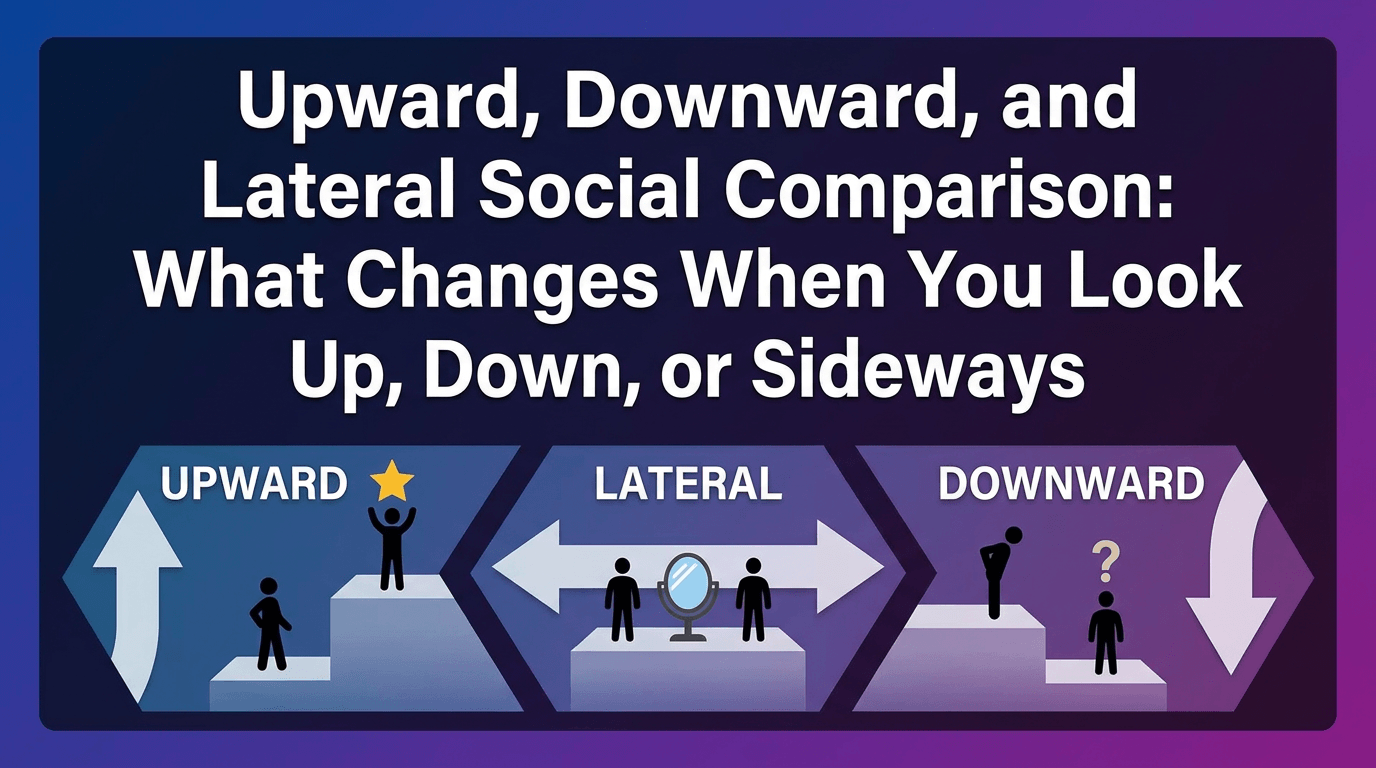
You can compare yourself with the same person three times and reach three completely different conclusions. A coworker may earn more than you, have roughly the same amount of experience, and know less than you about a particular technical tool. On salary, that person is an upward comparison. On experience, the comparison is lateral. On technical skill, the same person may be a downward comparison.
This is why comparison direction is more precise than a vague feeling of being “ahead” or “behind.” Upward, downward, and lateral social comparison describe where another person stands relative to you on a specific dimension. They do not tell you what emotion you must feel, what the comparison means about your ability, or whether the comparison will help you.
An upward comparison can provide a useful model, a discouraging gap, or both at once. A downward comparison can bring perspective, discomfort, or little useful information. A lateral comparison can help you calibrate what is typical, but it can also become competitive when the domain matters strongly to you.
Quick Answer: Direction Describes the Target, Not the Outcome
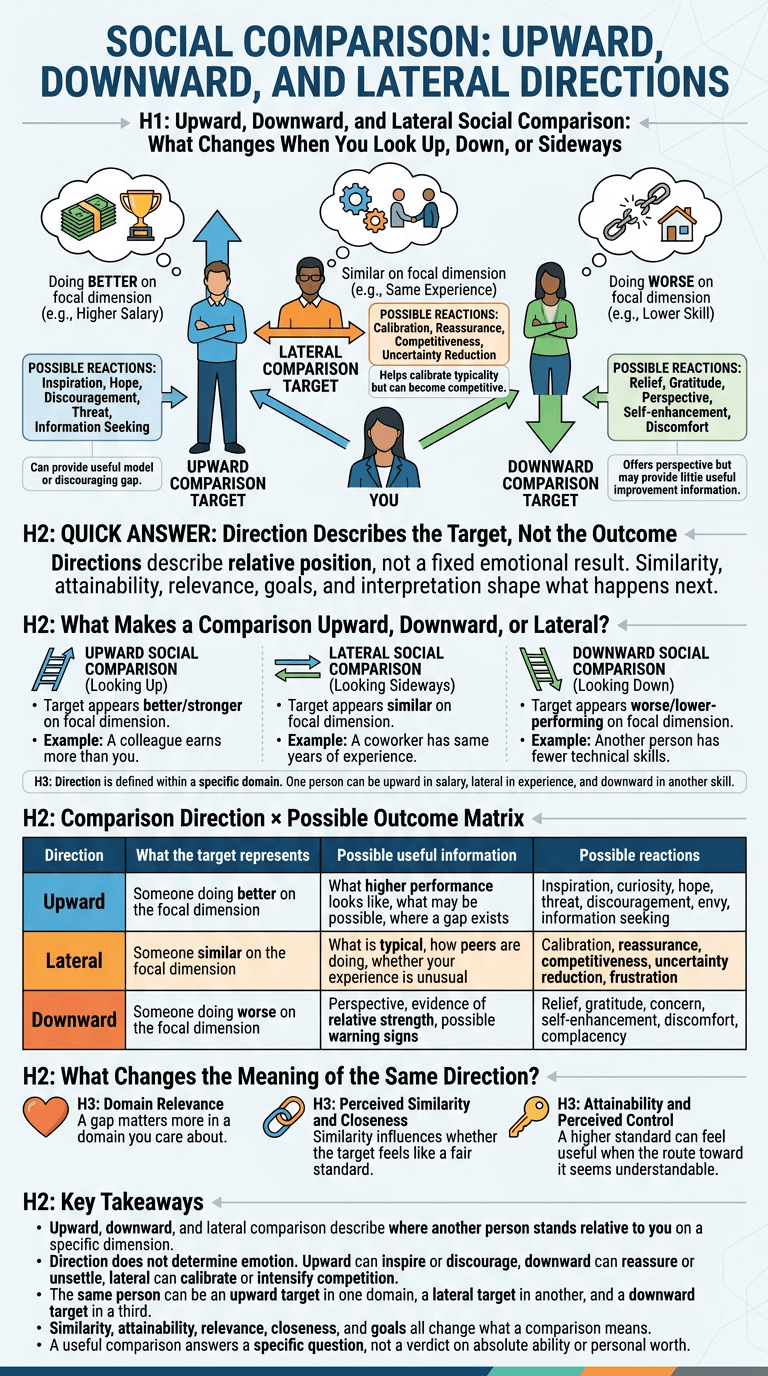
Upward social comparison means comparing yourself with someone who appears better off or stronger on the specific dimension you are judging. Downward comparison uses someone who appears worse off, while lateral comparison uses someone who seems similar. These directions describe relative position, not a fixed emotional result. Similarity, attainability, relevance, closeness, goals, and interpretation all shape what happens next.
What Makes a Comparison Upward, Downward, or Lateral?
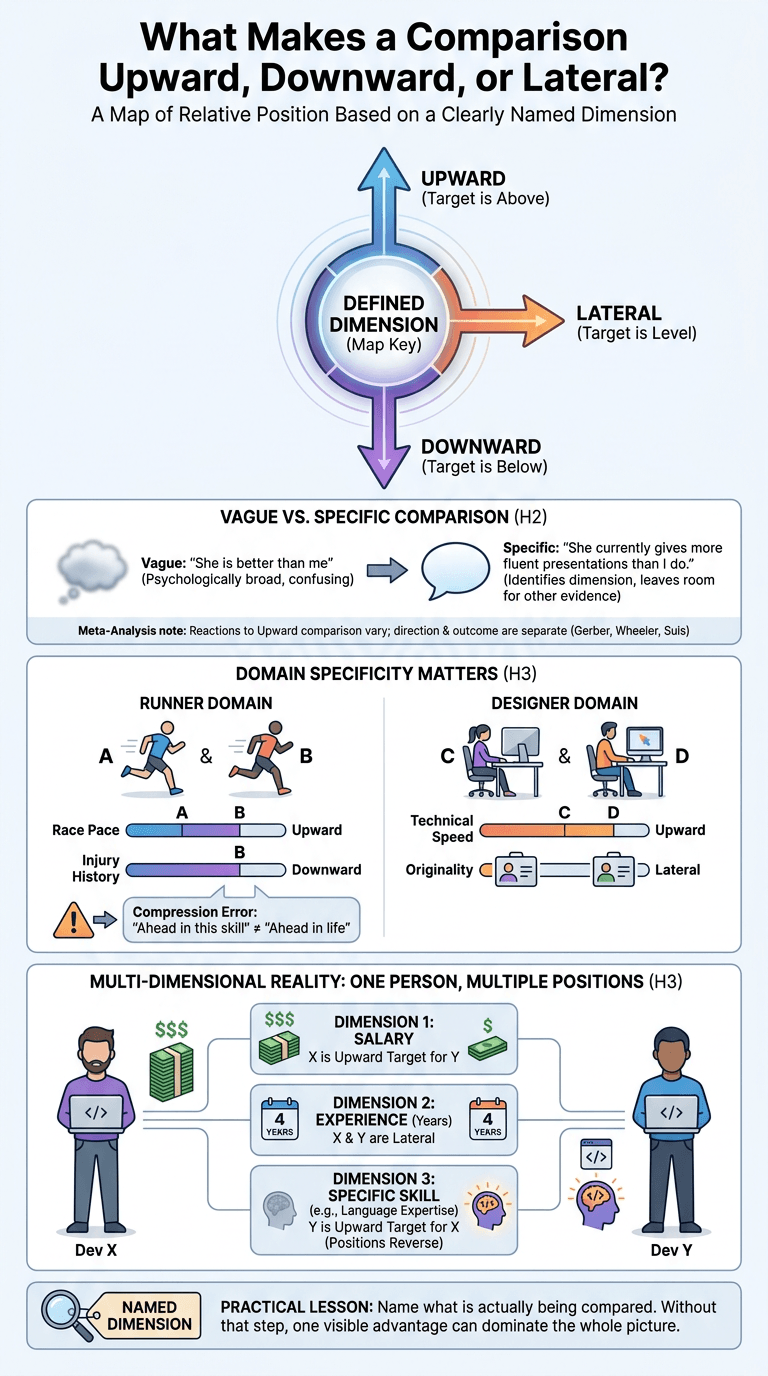
The three directions are easiest to understand as a map of relative position. The map only works when the dimension is named clearly. Saying “she is better than me” is psychologically much broader than saying “she currently gives more fluent presentations than I do.” The second statement identifies the comparison dimension and leaves room for other evidence.
A large meta-analysis covering more than six decades of social comparison research examined both the targets people select and how they react to them. The findings complicate simple advice about always comparing upward or avoiding upward comparison. People often choose upward information, yet reactions vary substantially depending on the situation and the way the comparison is processed. The meta-analysis by Gerber, Wheeler, and Suls is especially useful for seeing why target direction and psychological outcome should be kept separate.
Direction is defined within a specific domain
A comparison becomes upward, downward, or lateral only after you decide what is being compared. A runner may compare race pace, weekly mileage, injury history, or years of training. A designer may compare technical speed, originality, client retention, or public recognition. Different dimensions can place the same two people in different relative positions.
This domain specificity matters because the mind often compresses a narrow comparison into a global conclusion. “They are ahead of me in this skill” can turn into “they are ahead in life,” even though the first statement is much more defensible than the second.
One person can be upward in salary, lateral in experience, and downward in another skill
Imagine two software developers who both have four years of professional experience. One earns more, while the other has deeper expertise in a programming language used by their team. If salary is the dimension, the higher-paid developer is the upward target. If years of experience is the dimension, they are lateral. If expertise in that programming language is the dimension, the relative positions may reverse.
The practical lesson is not to avoid comparison. It is to name what is actually being compared. Without that step, one visible advantage can dominate the whole picture.
Upward Social Comparison: Looking at Someone Doing Better on the Focal Dimension
Upward social comparison occurs when another person appears to be doing better, possessing more, or performing at a higher level on the dimension that matters in the moment. The target might be only slightly ahead, far ahead, or simply more successful according to the standard you are using.
Historically, upward comparison was often discussed as potentially self-deflating because it highlights a gap. Later work made the picture more nuanced. Upward comparisons may lower a self-evaluation in one situation, but they may also supply information, a model, or a sense of possibility. Collins’ review of upward comparison argued that looking upward is not inherently opposed to positive self-regard and may support self-improvement or more favorable self-evaluation under some conditions. That argument is summarized in Collins’ review of upward social comparison.
What information upward targets can provide
An upward target can answer questions that a similar or downward target cannot answer as well. A beginner pianist may want to know what smoother fingering looks like. A junior employee may study how a strong presenter handles difficult questions. A recreational cyclist may compare training structure with someone a little faster to see what is realistically different.
The information is most useful when the target is relevant to the question. Comparing your first month of public speaking with a professional broadcaster may show what expert performance looks like, but it may tell you very little about whether your own progress is reasonable for a beginner.
Inspiration, hope, threat, discouragement, and information seeking as possible responses
There is no single emotional package attached to upward comparison. A stronger performer may make one person curious and another person discouraged. The same person may even experience both reactions at once. You can think, “That is possible for someone like me,” while also noticing, “I have a long way to go.”
This is one reason it is inaccurate to define upward comparison as envy. Envy is one possible emotional response when another person has an advantage you desire, but upward comparison can also produce admiration, learning, motivation, threat, resignation, or very little emotion. The direction tells you where the target stands, not how you will feel about the gap.
Why attainability and similarity matter
A target who seems meaningfully similar may offer information that feels more transferable. If a colleague has a comparable role, similar resources, and only a little more experience, their success may seem informative about what you could learn next. If the target has dramatically different resources, opportunities, training, or circumstances, the same outcome may feel less diagnostic.
Research on social comparison and competition also emphasizes the value of diagnostic information under uncertainty. A review of behavioral and neuroscience evidence notes that people use comparison information to judge relative position, ability, and outcomes, and that upward choices are common in the literature. See the review by Tor and Garcia on social comparison and competition for a current synthesis of this broader evidence.
Downward Social Comparison: Looking at Someone Doing Worse on the Focal Dimension
Downward comparison occurs when the target appears worse off or lower-performing on the focal dimension. A person recovering from an injury might notice that someone else has more severe limitations. A student who struggled on an exam might learn that many classmates scored lower. A new manager might compare their early mistakes with someone who is having greater difficulty in a similar role.
Downward comparison became especially influential through Thomas Wills’ 1981 theory, which proposed that people under negative affect may sometimes improve subjective well-being by comparing with less fortunate others. The original argument is broader and more historically specific than the popular idea that “looking down makes you feel better.” The record for Wills’ downward comparison theory summarizes that historical proposal.
Relief, gratitude, perspective, and self-enhancement as possible responses
Downward comparison may make a difficulty feel less extreme. If you believed your learning pace was unusually slow and then discover that many beginners need even longer, your situation may feel more manageable. In other cases, the comparison may produce relief or gratitude because it highlights what is going relatively well.
It may also support a narrow form of self-enhancement. Seeing that you perform better than another person on a relevant task can temporarily strengthen your judgment of your own standing on that task. That does not automatically mean the comparison improves general confidence or personal well-being.
Why downward comparison can also feel uncomfortable, irrelevant, or misleading
A downward comparison may be emotionally uncomfortable when the other person’s difficulty evokes concern rather than reassurance. It can also be irrelevant. Knowing that someone else runs more slowly does not tell you whether your training plan is appropriate, whether your form is efficient, or whether you are meeting your own goal.
There is another risk: using a lower standard can create a flattering relative judgment while hiding weak absolute performance. If you are practicing a safety-critical skill, “I am doing better than the least experienced person here” may be true and still be a poor standard for deciding whether you are competent enough.
Lateral Social Comparison: Looking Sideways at Similar Others
Lateral social comparison uses people who seem similar on the dimension or context that matters. You might compare your learning pace with other beginners, your recovery timeline with people at a similar stage, or your speaking anxiety with colleagues who have roughly the same experience.
Similar others are often useful because they can provide a realistic reference point. They are not necessarily identical to you, and “similar” itself depends on the question. Age may matter for one comparison, experience for another, and access to resources for a third.
Calibration when you want to know what is typical
Lateral comparison is especially useful for calibration. If you want to know whether your progress is typical for someone who has practiced a skill for six months, another six-month learner may be more informative than either an expert or a complete beginner.
The goal here is not to feel superior or inferior. It is to obtain context. This is close to the original informational logic of social comparison: when an objective standard is unclear, other people can help you estimate where you stand.
Why similar others can reduce uncertainty
Similarity can make information feel more applicable because fewer obvious differences have to be mentally adjusted. Experimental work on comparative thinking has also found that focusing on similarities can reduce judgmental uncertainty when the comparison standard itself is known with confidence. The study by Posten and Mussweiler on similarity and judgmental uncertainty helps illustrate why similarity can matter to how comparison information is used.
This does not mean similar people always provide the most accurate answer. Two beginners can both be confused. A peer group can share the same blind spot. Lateral comparison is useful when the peer standard is genuinely relevant to the question.
When lateral comparison still becomes competitive or emotionally charged
Similarity can increase emotional intensity when the domain is personally important. Being outperformed by a distant expert may feel unsurprising. Being narrowly outperformed by a close colleague with similar experience can feel much more diagnostic because the comparison seems harder to explain away.
Closeness can matter too. A small gap between strangers may be easy to ignore, while the same gap between friends, siblings, classmates, or teammates may carry more meaning because their trajectories are easier to compare directly.
Comparison Direction × Possible Outcome Matrix
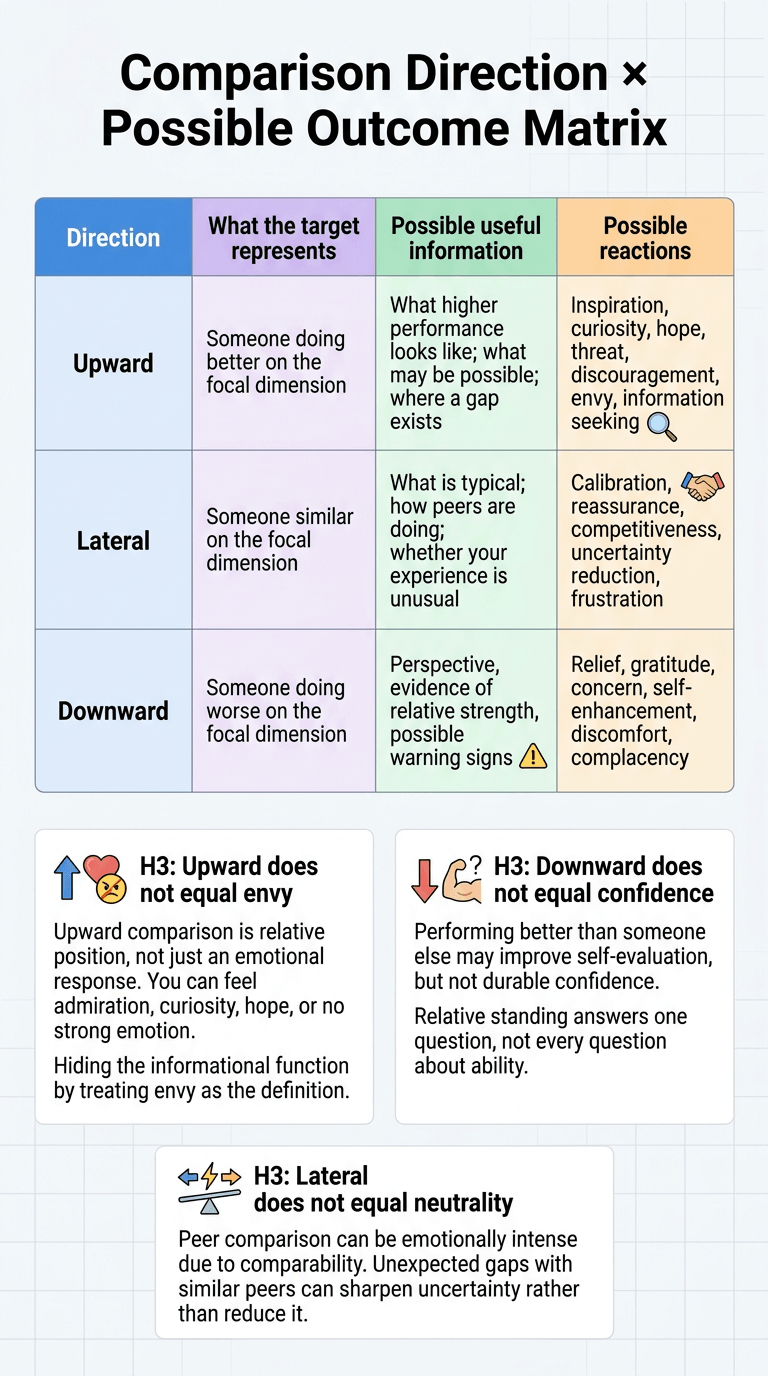
The table below separates direction from reaction. It is not a prediction chart. It shows why the same direction can support several different responses.
| Direction | What the target represents | Possible useful information | Possible reactions |
|---|---|---|---|
| Upward | Someone doing better on the focal dimension | What higher performance looks like, what may be possible, where a gap exists | Inspiration, curiosity, hope, threat, discouragement, envy, information seeking |
| Lateral | Someone similar on the focal dimension | What is typical, how peers are doing, whether your experience is unusual | Calibration, reassurance, competitiveness, uncertainty reduction, frustration |
| Downward | Someone doing worse on the focal dimension | Perspective, evidence of relative strength, possible warning signs | Relief, gratitude, concern, self-enhancement, discomfort, complacency |
Upward does not equal envy
Upward comparison describes a relative position. Envy describes an emotional response to another person’s advantage. You can look upward and feel admiration, curiosity, discouragement, competitiveness, hope, or no strong emotion at all. Treating envy as the definition hides the informational function of comparison.
Downward does not equal confidence
Performing better than someone else may improve a narrow self-evaluation without creating durable confidence. You might know that you are faster than a beginner and still feel uncertain about whether you can complete a difficult race. Relative standing answers one question, not every question about ability.
Lateral does not equal neutrality
Peer comparison can be emotionally intense precisely because the target seems comparable. If a person with similar training suddenly advances faster, you may interpret the gap as meaningful. Lateral comparison can reduce uncertainty, but it can also sharpen it when the result is unexpected.
What Changes the Meaning of the Same Direction?
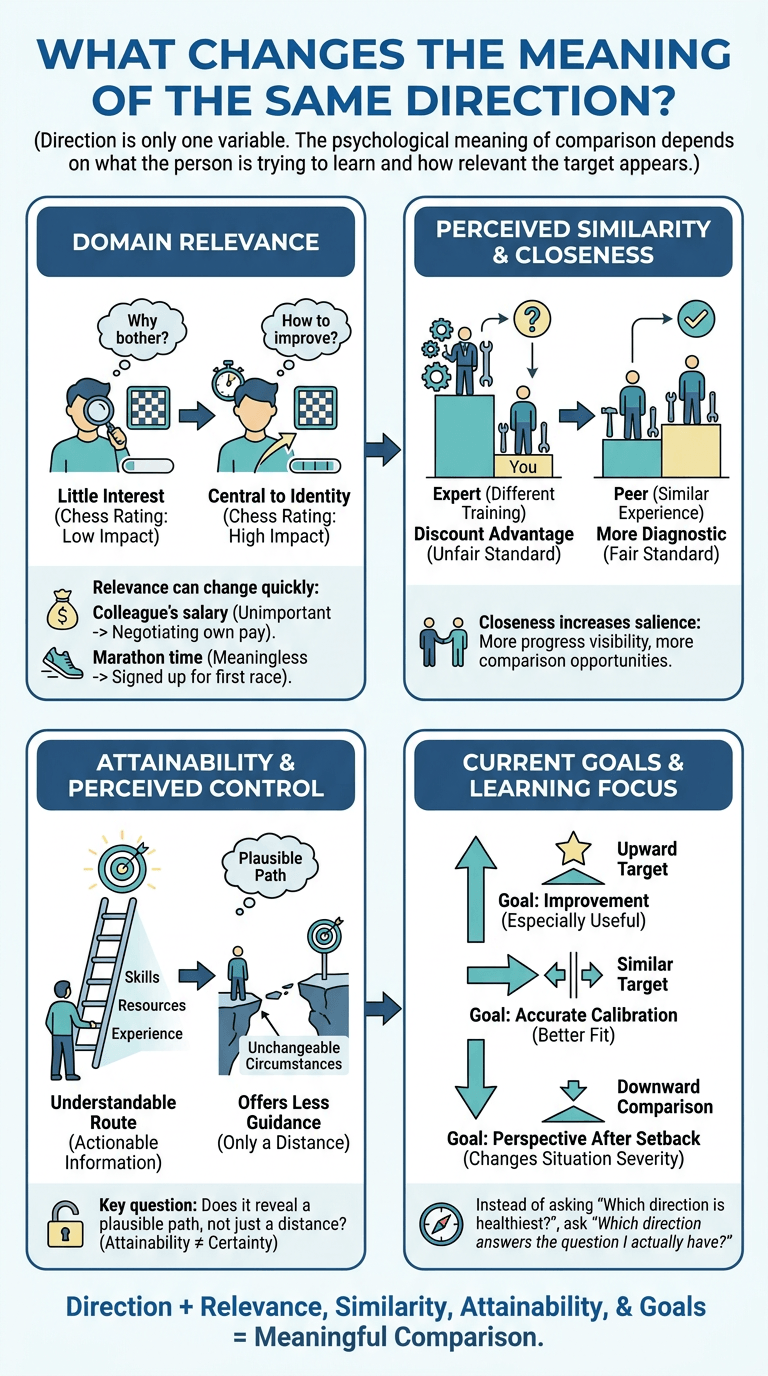
Direction is only one variable. The psychological meaning of comparison depends on what the person is trying to learn and how relevant the target appears.
Domain relevance
A gap matters more when it occurs in a domain you care about. If you have little interest in chess, a friend’s rating may not affect you much. If chess is central to your identity and current goals, the same gap may receive much more attention.
Relevance can also change quickly. A colleague’s salary may feel unimportant until you begin negotiating your own pay. Someone’s marathon time may become more meaningful when you sign up for your first race.
Perceived similarity and closeness
Similarity influences whether the target feels like a fair standard. You may discount an expert’s advantage because their training history is completely different, while a peer with similar experience feels more diagnostic. Closeness can increase salience because you see more of the person’s progress and have more opportunities to compare.
Attainability and perceived control
A higher standard can feel useful when the route toward it seems understandable. If you can identify skills to practice, resources to obtain, or experience to build, the gap contains actionable information. If the difference depends on circumstances you cannot change, the same upward target may offer less guidance.
Attainability is not the same as certainty. A target can appear reachable and still require substantial effort. The key question is whether the comparison reveals a plausible path rather than only a distance.
Current goals and what the person is trying to learn
If your goal is improvement, an upward target may be especially useful. If your goal is accurate calibration, a similar target may be better. If your goal is perspective after a setback, a downward comparison may change how severe your situation feels, although it may provide little information about how to improve.
Instead of asking, “Which direction is healthiest?” ask, “Which direction answers the question I actually have?”
Direction vs Assimilation and Contrast
Comparison direction and comparison effect are separate axes. This distinction prevents one of the most common conceptual errors in social comparison.
Direction asks where the target stands
Direction is descriptive. Is the other person above you, below you, or roughly similar on the focal dimension? If someone has stronger presentation skills, the comparison is upward on presentation skill. That remains true whether you feel inspired or diminished.
Assimilation/contrast asks how the target shifts self-evaluation
Assimilation and contrast ask a different question: does exposure to the target make your self-evaluation move psychologically toward the target or away from it? An upward target might make success feel more attainable, which can pull your judgment upward. The same target might instead make the gap feel larger, producing contrast.
The two-axis distinction is simple: direction describes the target’s position; assimilation or contrast describes how the target affects your judgment of yourself.
Direction vs Relative Deprivation and Envy
Upward comparison is often involved in both envy and relative deprivation, but neither concept is identical to comparison direction.
Comparative disadvantage is not the same as direction
Relative deprivation involves perceiving yourself or your group as disadvantaged relative to a meaningful standard, often with a sense that the discrepancy matters or is unjustified. Upward direction alone does not establish that interpretation. You may notice that another person earns more without concluding that your own situation is unfair.
Wanting another person’s advantage is an emotional response, not the definition of upward comparison
Envy involves another person possessing an advantage you desire. Upward comparison only requires that the other person is higher on the dimension being compared. You can compare upward to a highly skilled musician because you want to learn technique, even if you feel no desire to possess their career or recognition.
Same Target, Different Dimension: A Worked Example
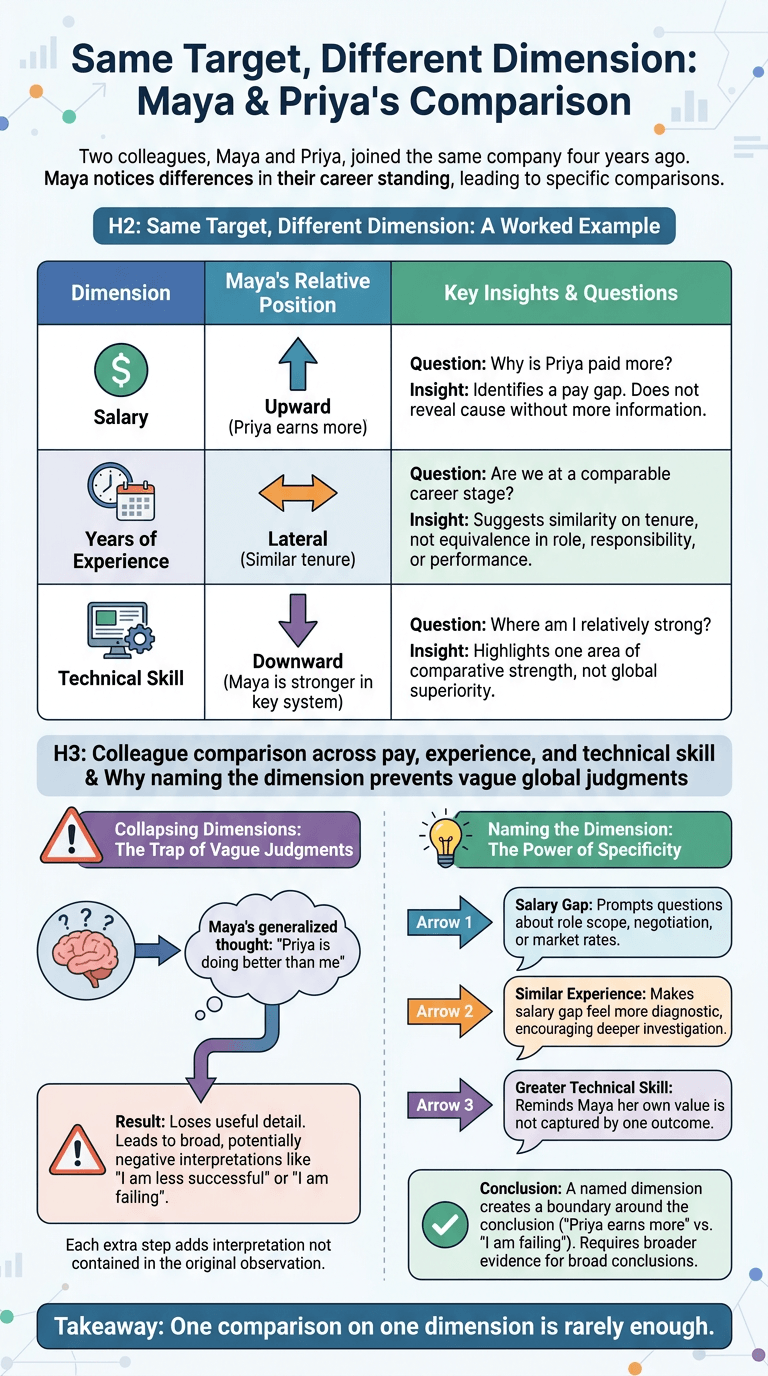
Consider Maya and Priya, two colleagues who joined the same company four years ago. Maya notices that Priya earns more. She also notices that they have similar years of experience, while Maya is stronger in the technical system their team uses most often.
| Dimension | Relative position | Possible question | What the comparison can and cannot tell Maya |
|---|---|---|---|
| Salary | Upward | Why is Priya paid more? | It identifies a pay gap. It does not reveal the cause without more information. |
| Years of experience | Lateral | Are we at a comparable career stage? | It suggests similarity on tenure, not equivalence in role, responsibility, or performance. |
| Technical skill | Downward | Where am I relatively strong? | It highlights one area of comparative strength, not global superiority. |
Colleague comparison across pay, experience, and technical skill
If Maya collapses these dimensions into one statement such as “Priya is doing better than me,” she loses useful detail. Salary may prompt a question about role scope, negotiation, or market rates. Similar experience may make the salary gap feel more diagnostic. Greater technical skill may remind Maya that her own value is not captured by one outcome.
Why naming the dimension prevents vague global judgments
A named dimension creates a boundary around the conclusion. “Priya earns more” is specific. “I am less successful” is broader. “I am failing” is broader still. Each extra step adds interpretation that is not contained in the original observation.
This does not mean broad conclusions are always wrong. It means they require broader evidence. One comparison on one dimension is rarely enough.
Choosing a More Informative Comparison Direction
Different directions answer different questions. The most useful target is not necessarily the one that makes you feel best.
When upward comparison helps with learning
Choose an upward target when you want to see what stronger performance looks like or identify a next level. The best target is often not the most exceptional person available. Someone moderately ahead, with enough similarity for the comparison to be meaningful, may offer clearer information about the next step.
For example, a beginner photographer may learn more from an advanced hobbyist who explains lighting choices than from a world-famous professional whose equipment, access, team, and experience are radically different.
When lateral comparison helps with calibration
Choose lateral comparison when the question is, “What is typical for someone in circumstances roughly like mine?” This can be useful in learning, work, sports, creative development, and other areas where objective benchmarks are incomplete.
Calibration improves when you compare multiple relevant peers rather than one convenient person. A single peer may be unusually fast, slow, lucky, unlucky, experienced, or resourced.
When downward comparison provides context but little guidance
A downward target can help you see that a setback is not the worst possible outcome or notice a genuine strength. It may be less useful when the question is how to improve. If you want to become a stronger public speaker, comparing yourself with someone even less experienced may reassure you but offer few clues about what effective speaking requires.
What to Do Next When a Comparison Feels Distorting
A difficult comparison often becomes less confusing when you separate the observation from the story built around it.
Name the domain and direction
Replace “they are ahead of me” with a more precise statement: “They are currently ahead of me in client volume,” or “We are similar in experience, but they are ahead in speaking confidence.” Precision reduces the chance that one visible gap becomes a total judgment.
Ask what information you actually need
Decide whether you are seeking calibration, learning, perspective, or emotional reassurance. Then choose a comparison target that fits that purpose. If you need a realistic benchmark, an extreme upward target may be noisy. If you need a model for improvement, a downward target may not teach you much.
Separate the comparison from the conclusion about your worth
Relative position is information about a defined dimension. It is not a direct measure of human value. Someone else can be faster, wealthier, more experienced, more recognized, or more skilled without that difference proving that you are inadequate as a person.
If comparison repeatedly contributes to severe hopelessness, significant body-image distress, eating problems, self-harm thoughts, or major decline in daily functioning, individualized support from a qualified mental health professional can be more appropriate than trying to solve the problem through better comparison habits alone.
FAQ
Is upward social comparison always bad for confidence?
No. Upward comparison identifies a target who is doing better on the chosen dimension, but its psychological effect varies. It may expose a discouraging gap, provide a useful model, increase hope, or do several of these at once. Similarity, attainability, relevance, and the reason for comparing all influence how the information is interpreted.
Can downward comparison make someone feel worse rather than better?
Yes. Downward comparison may create concern, guilt, discomfort, or a sense that the target is irrelevant to the question you care about. It may also fail to improve your self-evaluation. Historical downward-comparison theory described conditions under which looking at worse-off others could support subjective well-being, but that should not be treated as a guaranteed emotional effect.
Why do people often compare with similar others?
Similar others may provide more diagnostic information because fewer major differences have to be adjusted for mentally. If you want to know whether your progress is typical for a beginner, another beginner may be more informative than an expert. Similarity does not guarantee accuracy, but it often makes the standard feel more relevant.
Can the same person be both an upward and downward comparison target?
Yes, because direction is domain-specific. A colleague may be upward in salary, lateral in years of experience, and downward in a technical skill. Naming the dimension makes the comparison more accurate and helps prevent one advantage from becoming a global judgment about the whole person.
Is lateral comparison the same as comparing with peers?
Not exactly. Peers are often lateral targets because they may share similar age, role, experience, or circumstances, but a peer can still be upward or downward on a specific dimension. Two coworkers at the same level may differ greatly in sales, confidence, speed, or technical expertise. Lateral comparison depends on similarity in the focal dimension, not simply membership in the same broad peer group.
Key Takeaways
- Upward, downward, and lateral comparison describe where another person stands relative to you on a specific dimension.
- Direction does not determine emotion. Upward comparison can inspire or discourage, downward comparison can reassure or unsettle, and lateral comparison can calibrate or intensify competition.
- The same person can be an upward target in one domain, a lateral target in another, and a downward target in a third.
- Similarity, attainability, relevance, closeness, perceived control, and current goals all change what a comparison means.
- Direction and assimilation or contrast are separate ideas: one describes the target’s position, the other describes how the target shifts self-evaluation.
- A useful comparison answers a specific question. It does not turn relative rank into a verdict on absolute ability or personal worth.

Michael Reed is the Founder and Lead Writer at Psychology Exposed. He writes about human behavior, relationships, emotional patterns, self-awareness, and practical psychology topics using research-informed, easy-to-understand content.
Read More About Michael Reed: https://psychologyexposed.com/michael-reed/