

You can feel highly capable in one room and ordinary in the next without losing any skill. A new employee who seemed advanced in a previous job may suddenly feel inexperienced after joining a team of experts. A recreational runner may feel fast among friends, then slow after joining a competitive club. A creator with steady growth may begin to feel behind after spending months around unusually large accounts.
What changed was not necessarily ability, effort, or progress. The comparison pool changed. In psychology, a reference group is a person, group, or social category that becomes relevant enough to influence how you judge yourself, your circumstances, or what seems normal. The group does not have to be one you belong to or even one you like. It matters because you are using it as a standard.
Understanding reference groups helps explain why standards can shift so quickly when you enter a new workplace, school, profession, neighborhood, online community, or level of achievement. It also helps you ask a more useful question than “Am I doing well?”: “Compared with whom, and is that the right comparison for the question I am trying to answer?”
Quick Answer: A Reference Group Is a Standard, Not Necessarily an Identity
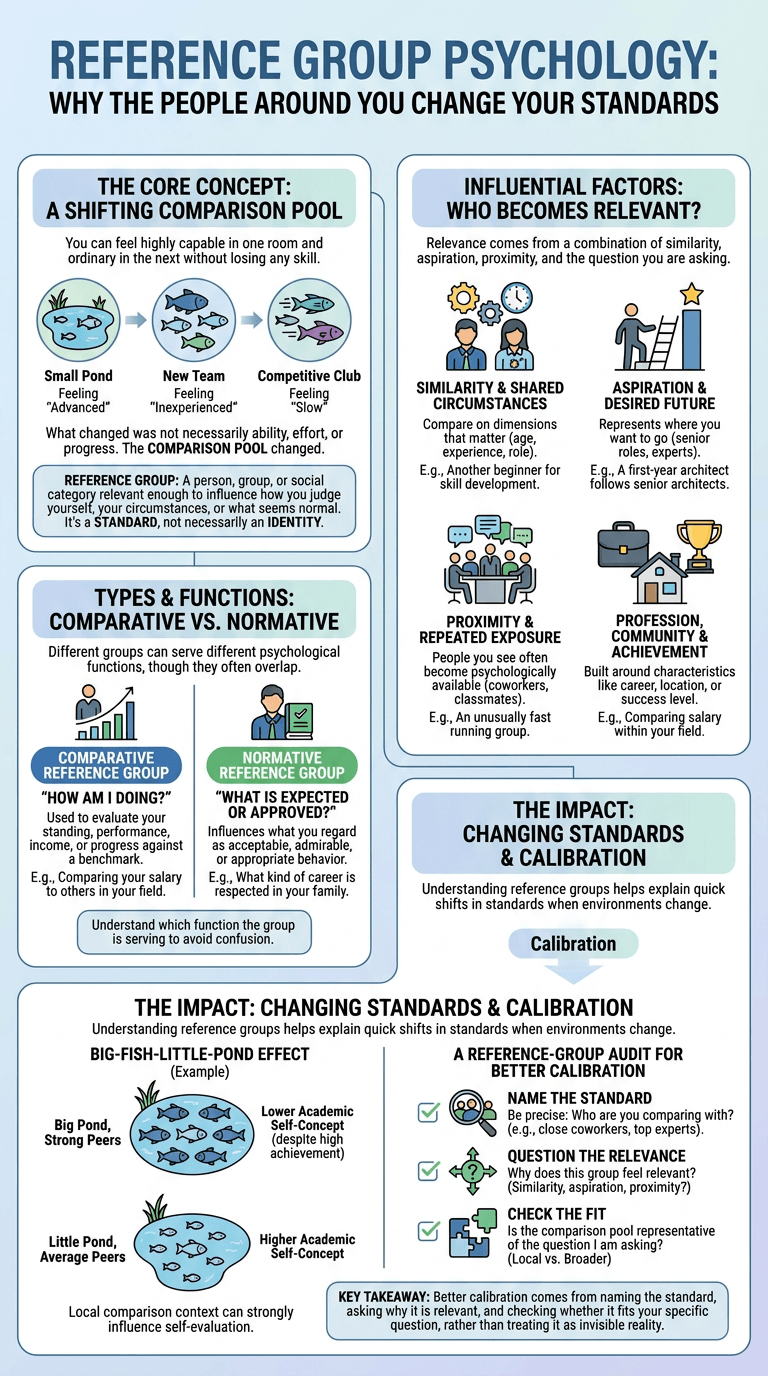
In reference group psychology, a reference group is a socially meaningful standard used to evaluate yourself, your situation, or what seems typical. It may be made up of peers, experts, family members, coworkers, an aspirational community, or even an abstract category. You do not have to identify with the group for it to influence your judgment. Changing the reference group can change your self-evaluation even when your actual performance stays the same.
What a Reference Group Means in Psychology
People rarely evaluate themselves against everyone. Instead, they narrow the field. They compare with “people like me,” “people at my level,” “people in my profession,” “people I want to become like,” or “people whose situation feels relevant.” Those categories create a frame of reference.
Psychologists Colin Leach and Michael Vliek describe meaningful group membership as a frame of reference for interpersonal comparison. Their review emphasizes that comparisons do not occur in a social vacuum. The group context can shape which people feel relevant and how strongly a comparison affects self-evaluation.
Comparative reference groups for evaluating yourself or your situation
A comparative reference group helps answer questions such as “How am I doing?”, “Is my salary typical for someone in my field?”, “Am I progressing at a normal pace?”, or “How strong is my performance relative to others facing similar demands?” The group supplies a benchmark.
For example, a junior software developer could compare with all workers, all developers, developers with the same years of experience, teammates at the same company, or highly visible experts online. Each standard gives a different answer. The comparison is not automatically wrong, but its usefulness depends on whether the group matches the decision being made.
Normative reference groups as a related but different function
Reference groups can also influence what people regard as acceptable, expected, admirable, or appropriate. This is often called a normative function. A group may therefore affect both evaluation and norms, but those are not the same psychological question.
Research on reference groups has long distinguished functions such as comparative and normative influence. A review of reference groups in career research, for example, separates comparative, normative, and supportive functions and notes that people can orient to known groups as well as more abstract social categories.
If you ask, “Am I earning more or less than people at my career stage?” you are using a comparative standard. If you ask, “What kind of career is respected in my family?” you are asking about a normative influence. The same family might serve both functions, but the functions should not be confused.
Who Becomes a Psychologically Relevant Comparison Standard?
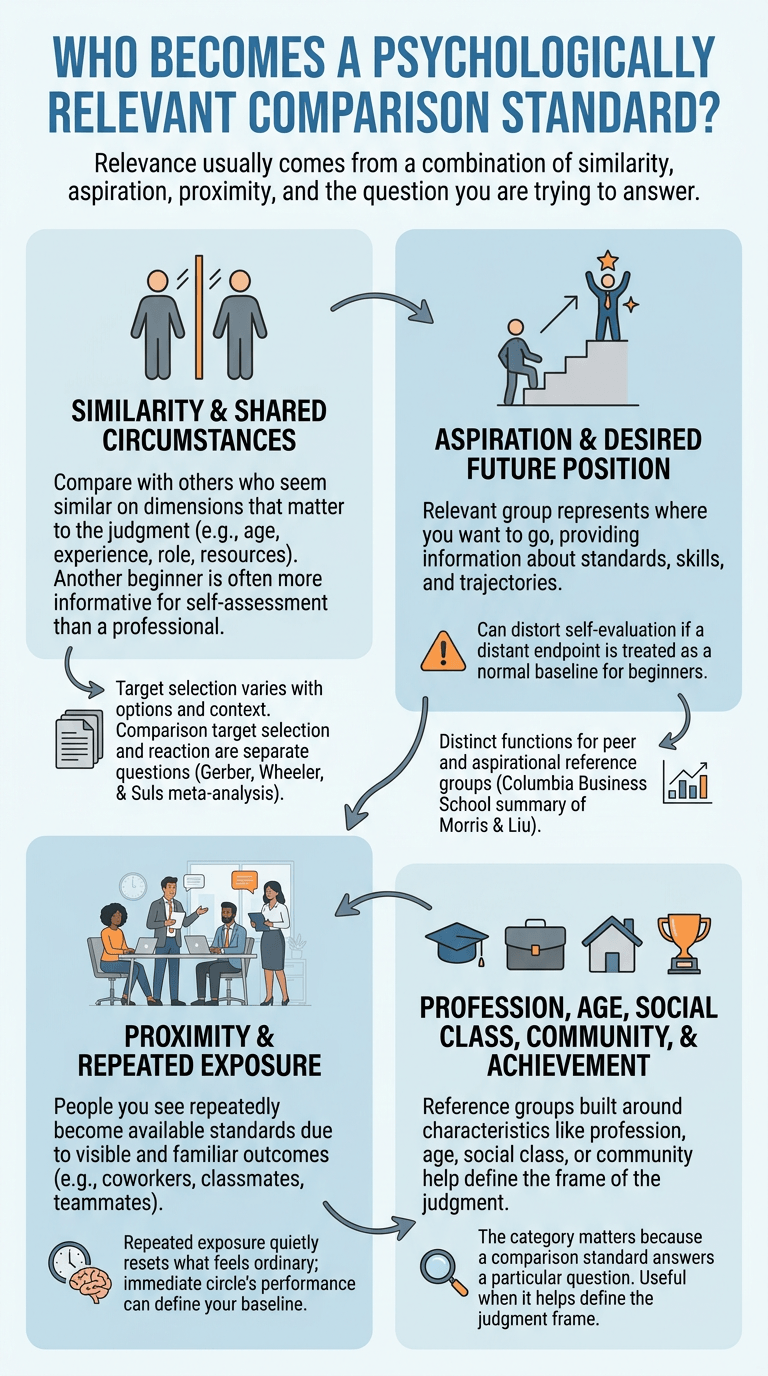
Not every person you encounter becomes a reference point. A stranger who lives a completely different life may provide little useful information, while one coworker with similar experience can become highly influential. Relevance usually comes from a combination of similarity, aspiration, proximity, and the question you are trying to answer.
Similarity and shared circumstances
People often compare with others who seem similar on dimensions that matter to the judgment. Similarity can involve age, experience, training, role, resources, responsibilities, background, or stage of progress. If you want to estimate whether your public-speaking skill is developing normally, another beginner may be more informative than a professional keynote speaker.
This does not mean people compare only with similar others. A large meta-analysis covering more than six decades of social comparison research found that target selection varies with the options and context available. The findings do not support a simple rule that people always choose one direction of comparison. The meta-analysis by Gerber, Wheeler, and Suls is useful here because it shows that comparison target selection and reaction are separate questions.
Aspiration and desired future position
Sometimes the most relevant group is not similar to your current position. It represents where you want to go. A first-year architect may follow senior architects, a local musician may watch touring professionals, or a new manager may pay close attention to experienced leaders.
An aspirational reference group can provide information about standards, skills, language, and possible trajectories. It can also distort self-evaluation if a distant endpoint is treated as the normal baseline for someone just beginning. The useful question is not merely “Are they ahead of me?” but “What exactly am I using them to learn?”
Research on subjective norms distinguishes peer and aspirational reference groups and shows that different groups can serve different psychological functions. A Columbia Business School summary of work by Michael Morris and Zhi Liu discusses peer and aspirational reference groups as distinct sources of social standards.
Proximity and repeated exposure
The people you see repeatedly often become psychologically available standards. Coworkers, classmates, teammates, neighbors, close friends, and members of an online niche are easier to compare with because their outcomes are visible and familiar.
Repeated exposure can quietly reset what feels ordinary. If almost everyone in your immediate professional circle has ten years of experience, advanced performance may begin to feel basic. If your running group is unusually fast, your own pace may seem slow even if it remains strong compared with a broader recreational population.
Profession, age, social class, community, and achievement level
Reference groups can be built around many characteristics. A person may compare career progress with colleagues in the same profession, parenting choices with families in the same community, creative work with others in the same genre, or financial circumstances with neighbors who appear to share a similar lifestyle.
The category matters because a comparison standard answers a particular question. Age may be relevant for some developmental milestones, but irrelevant for a technical skill learned at different times. Profession may matter for salary benchmarks, but less for personal values. A social category becomes useful when it helps define the frame of the judgment rather than merely being noticeable.
Chosen vs Inherited Reference Groups
Some standards are selected deliberately. Others arrive with the environments we enter.
Standards you deliberately seek out
You may intentionally choose a reference group because it offers useful information. A beginning photographer might join a critique community to learn what stronger composition looks like. A new business owner may follow other early-stage founders to understand realistic operational problems. A recreational athlete may train with slightly faster people to identify a next level of performance.
Chosen reference groups are not automatically accurate. People often select unusually visible, successful, or polished examples because they are easy to find. A useful choice therefore depends on purpose. If your goal is inspiration, an elite standard may help. If your goal is estimating what is typical, the same standard may be misleading.
Standards that come with family, school, workplace, neighborhood, or culture
Other standards are inherited from context. Families communicate ideas about what counts as a good career. Schools create local performance distributions. Workplaces establish informal assumptions about pace and competence. Neighborhoods influence perceptions of consumption and lifestyle. Communities make some achievements common and others exceptional.
An inherited reference group may feel natural precisely because it is familiar. That does not make it universal. Someone raised in a family where nearly everyone attended university may experience a degree as an expected baseline, while someone from a different family context may experience the same achievement as unusually significant.
This is one reason self-evaluation benefits from identifying the standard rather than treating it as invisible reality.
Local vs Broader Standards

Reference groups often operate at different levels. Local standards are psychologically close and frequently encountered. Broader standards include professional averages, population data, national benchmarks, or larger communities.
Why local peers can feel more diagnostic than population averages
Local peers often share constraints and opportunities that make them feel relevant. A teacher may compare classroom management with colleagues in the same school because they face similar policies and student populations. A junior analyst may compare with peers on the same team because they use the same systems and have similar expectations.
Local information can therefore be highly diagnostic, but it can also be unusually selective. A top university, elite firm, advanced training group, or specialized online community may contain people far from the population average. If the reader silently treats that local group as “normal people,” the comparison pool becomes narrower than it appears.
When national or professional benchmarks provide a different answer
Broader benchmarks can reveal when a local environment is unusual. A worker who feels underpaid relative to close colleagues may discover that the entire organization pays above the market. Another worker who feels well compensated inside a low-paying team may discover that broader professional salaries are much higher.
Neither local nor broad standards are always superior. They answer different questions. Local standards may be better for understanding immediate expectations. Broader standards may be better for estimating general position. The mistake is using one standard to answer a question designed for the other.
Multiple Reference Groups: Which Standard Wins?
Most people do not have one reference group. They carry several, and the active one can change from moment to moment.
Different standards for skill, lifestyle, parenting, work, or creativity
A person might compare professional performance with coworkers, fitness with training partners, parenting with friends who have children of similar ages, and creative work with people in a specialized community. These groups can point in different directions.
Consider a freelance illustrator who earns more than most local friends but less than many creators in a global online community. Financially, one group suggests “doing very well” while another suggests “behind.” Neither statement is complete without naming the reference group.
Why standards can conflict
Conflicting standards become especially noticeable during transitions. A student may still compare with high school classmates while adapting to a selective university. A newly promoted manager may compare with former peers in one moment and senior leaders in another. Someone moving to a wealthier neighborhood may continue using old friends for some lifestyle judgments and new neighbors for others.
When standards conflict, the feeling of inconsistency can be confusing: “Why do I feel successful around one group and inadequate around another?” The answer may not be unstable self-esteem. It may be that different groups are activating different comparison frames.
One large cross-national study on socioeconomic comparison found that the identity of the reference group mattered when people evaluated their relative position. The study compared standards such as family, friends, neighbors, elites, and people in other countries, illustrating why the question “compared with whom?” deserves to be explicit rather than assumed.
Reference-Group Switching
One of the clearest ways to notice reference-group psychology is to change environments. The same person can carry the same ability into a setting with a very different distribution of performance.
Entering a more selective environment
Imagine a student who was near the top of a large school and then enters a highly selective university. The student may still be academically strong, yet now spends every day around people who were also near the top of their previous schools. The comparison standard changes from “students generally” to “high-achieving students here.”
The same transition can happen when a strong local runner joins an elite training group, an experienced employee moves into a specialist team, or a successful local creator enters an international professional network.
Why normal can change without your ability changing
A new group changes the distribution you can see. What used to look exceptional may become common. What used to feel average may become weak. The shift is relational, not necessarily objective.
| Situation | Objective change | Reference-group change | Possible self-evaluation |
|---|---|---|---|
| Strong student enters a selective program | Ability may be unchanged | Peers are much stronger on average | “Maybe I am only average” |
| Recreational runner joins a competitive club | Pace may be unchanged | Training partners are faster | “I am slow” |
| Experienced generalist joins a specialist team | Skills remain useful | Peers have deeper niche expertise | “I know less than I thought” |
| Growing creator follows only top accounts | Audience may still be growing | Visible comparison pool becomes extreme | “My progress is small” |
Four everyday examples of a changing comparison pool
New employee among experts: A competent hire may initially interpret unfamiliar systems as evidence of weak ability. A more precise interpretation is that the new reference group has deeper local experience.
Student at a selective university: A high-performing student may receive the same score they once considered excellent and now see it as mediocre because classmates perform at a higher level.
Amateur runner in an elite group: The runner may feel slower while simultaneously receiving better training opportunities. Relative position and actual development can move in different directions.
Creator comparing with top accounts: If an algorithmic feed repeatedly shows exceptionally successful creators, the visible pool can make rare outcomes feel ordinary. The creator may then judge normal progress against an extreme standard.
Reference Group vs Social Identity vs Group Norms
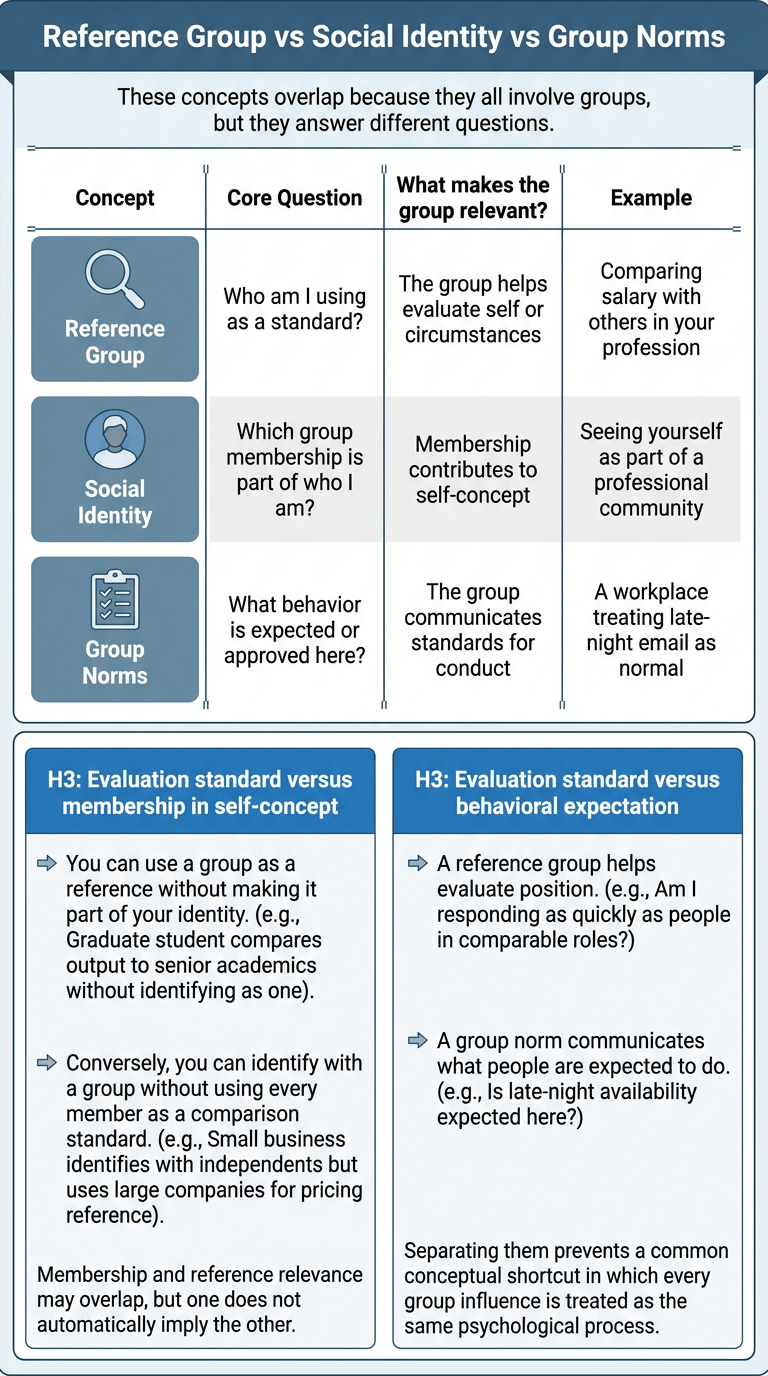
These concepts overlap because they all involve groups, but they answer different questions.
| Concept | Core question | What makes the group relevant? | Example |
|---|---|---|---|
| Reference group | Who am I using as a standard? | The group helps evaluate self or circumstances | Comparing salary with others in your profession |
| Social identity | Which group membership is part of who I am? | Membership contributes to self-concept | Seeing yourself as part of a professional community |
| Group norm | What behavior is expected or approved here? | The group communicates standards for conduct | A workplace treating late-night email as normal |
Evaluation standard versus membership in self-concept
You can use a group as a reference without making it part of your identity. A graduate student may compare publication output with senior academics while not seeing themselves as a senior academic. A small business owner may use large companies as a pricing reference while strongly identifying with independent business owners.
Conversely, you can identify with a group without using every member as a comparison standard. Membership and reference relevance may overlap, but one does not automatically imply the other.
Evaluation standard versus behavioral expectation
A reference group helps evaluate position. A group norm communicates what people are expected to do. Suppose everyone in a team answers messages after 9 p.m. The norm question is, “Is late-night availability expected here?” The reference-group question is, “Am I responding as quickly as people in comparable roles?”
One group can create both effects, but separating them prevents a common conceptual shortcut in which every group influence is treated as the same psychological process.
Reference Groups and Relative Deprivation
Reference groups become especially important when people judge whether they are receiving less than a meaningful comparison standard.
Why perceived disadvantage depends on who counts as “people like me”
A salary can feel acceptable when compared with one group and unfair when compared with another. A promotion timeline may seem normal until a person learns that coworkers with similar responsibilities advanced more quickly. The emotional force of the discrepancy often depends on whether the comparison group feels relevant.
This does not mean that every unfavorable comparison is relative deprivation. The concept usually involves a perceived disadvantage that feels significant and often carries a sense that the discrepancy matters or is unjustified. Reference groups help define the comparison, but they do not determine the conclusion by themselves.
Fairness is one possible interpretation, not the whole reference-group process
A reference group can influence self-evaluation without producing unfairness judgments at all. A musician may compare with advanced players simply to calibrate technique. A parent may compare school schedules to understand what is typical. A new employee may compare workload to determine whether expectations are unusual.
Relative deprivation is therefore one outcome that can emerge from a reference standard. It should not be used as a synonym for reference-group influence.
Reference Groups and the Big-Fish-Little-Pond Effect
The Big-Fish-Little-Pond Effect is a specific, well-studied example of how local comparison context can influence self-evaluation. It should not be treated as the definition of reference-group psychology.
General standard selection versus one specific contextual effect
The broad reference-group question is: “Which group am I using as the standard?” The Big-Fish-Little-Pond question is narrower: “How does being surrounded by higher-achieving peers affect academic self-concept when individual achievement is taken into account?”
A meta-analysis of 33 studies involving more than a million participants found a reliable negative association between class or school average achievement and students’ academic self-concept after accounting for individual achievement. The Big-Fish-Little-Pond meta-analysis is strong evidence for a particular academic frame-of-reference effect. Broader examples in workplaces, sports, or creator communities are useful analogies, but they should not be presented as if the exact academic effect has been established identically in every domain.
A Reference-Group Audit for Better Calibration
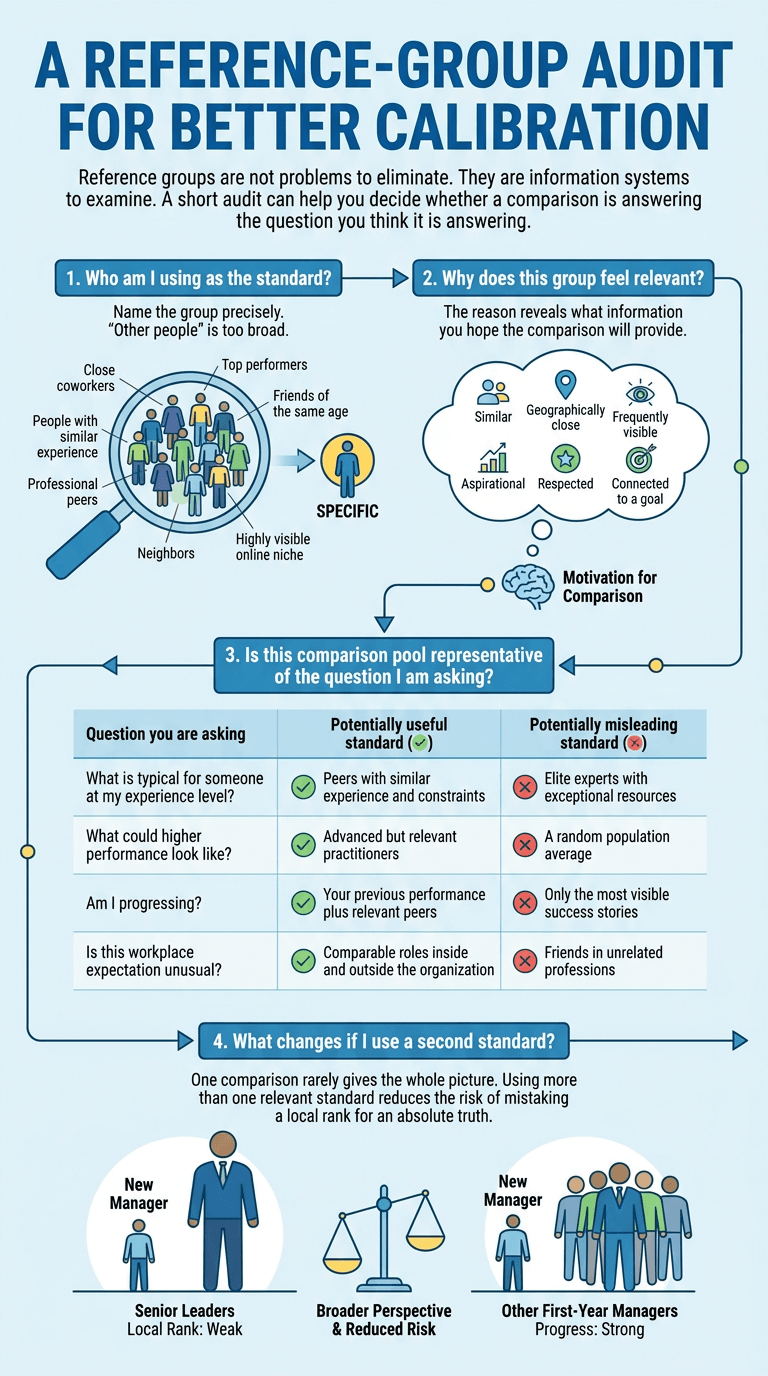
Reference groups are not problems to eliminate. They are information systems to examine. A short audit can help you decide whether a comparison is answering the question you think it is answering.
1. Who am I using as the standard?
Name the group precisely. “Other people” is too broad. Is the standard close coworkers, top performers, people with similar experience, friends of the same age, professional peers, neighbors, or a highly visible online niche?
2. Why does this group feel relevant?
Is the group similar to you, geographically close, frequently visible, aspirational, respected, or connected to a goal you care about? The reason matters because it reveals what information you hope the comparison will provide.
3. Is this comparison pool representative of the question I am asking?
If you want to know what excellent performance looks like, a selective expert group may be useful. If you want to know what is typical for a beginner, it is a poor baseline. If you want to estimate market salary, your five closest coworkers may be too narrow. If you want to understand local team expectations, a national average may be too broad.
| Question you are asking | Potentially useful standard | Potentially misleading standard |
|---|---|---|
| What is typical for someone at my experience level? | Peers with similar experience and constraints | Elite experts with exceptional resources |
| What could higher performance look like? | Advanced but relevant practitioners | A random population average |
| Am I progressing? | Your previous performance plus relevant peers | Only the most visible success stories |
| Is this workplace expectation unusual? | Comparable roles inside and outside the organization | Friends in unrelated professions |
4. What changes if I use a second standard?
One comparison rarely gives the whole picture. If a new manager feels weak relative to senior leaders, comparing with other first-year managers may reveal strong progress. If a student feels exceptional within a small class, a broader assessment may reveal areas that still need development.
Using more than one relevant standard reduces the risk of mistaking a local rank for an absolute truth.
When Another Psychology Lens Fits Better
Reference-group thinking is useful when the main issue is the standard used for evaluation. Other questions call for different concepts.
Use social identity when membership itself is central
If the key question is how belonging to a group becomes part of the self, how “we” and “they” categories shape perception, or how group membership influences identity, the central issue is social identity rather than reference-group selection.
Use group norms when the question is what behavior is expected
If you are trying to understand why a group treats a behavior as normal, approved, discouraged, or required, the important concept is group norms. A group can influence both norms and comparison, but the mechanisms are not interchangeable.
Use status psychology when the question is socially granted rank
If the concern is respect, prestige, recognition, deference, or rank granted by others, the issue is status. Comparing yourself with high-status people may affect how you estimate your own standing, but social comparison does not create status by itself.
If comparison is no longer simply informative and is contributing to persistent hopelessness, major functional decline, severe body-image distress, eating-related symptoms, or thoughts of self-harm, the problem deserves individualized professional support rather than more comparison analysis alone.
FAQ
These questions address common points of confusion about who can function as a reference group and how that differs from simple peer membership.
Can a reference group be a group I do not belong to?
Yes. A reference group can be relevant because it provides a standard, not because you are a member. A junior professional might compare with senior professionals, a hobbyist with experts, or a local creator with international creators. Membership can increase relevance, but it is not required.
What is the difference between a comparative and normative reference group?
A comparative reference group is used to evaluate where you stand, such as whether your performance, income, or progress is above or below a meaningful benchmark. A normative reference group influences what you regard as approved, expected, admirable, or appropriate. The same group can serve both functions, but the questions are different.
Why do my standards change after joining a more selective group?
A selective group changes the people you see most often and the distribution of performance that feels normal. Your objective ability may be unchanged, but stronger peers can reset the local baseline. This is why someone can feel less capable after moving into a more advanced environment while actually receiving better opportunities and continuing to improve.
Can someone have several reference groups at once?
Yes. People commonly use different reference groups for work, money, fitness, parenting, creativity, education, and lifestyle. Even within one domain, the active standard can shift. A person may compare with close peers for what is typical and with experts for what is possible.
Is a reference group the same as a peer group?
No. Peers often become reference groups because they are similar and visible, but a reference group can also be aspirational, distant, abstract, or outside your membership group. A peer group describes a social relationship or similarity. A reference group describes the function the group serves in your judgment.
Key Takeaways
- A reference group is a person, group, or category used as a meaningful standard for evaluating yourself or your circumstances.
- You do not need to belong to or identify with a group for it to become a powerful comparison standard.
- Similarity, aspiration, proximity, repeated exposure, and relevance all influence which groups become psychologically important.
- Local standards can be highly informative while still being unrepresentative of a broader population.
- Changing environments can change self-evaluation because the comparison pool changes, even when actual ability does not.
- Better calibration comes from naming the standard, asking why it is relevant, and checking whether it fits the question you are trying to answer.

Michael Reed is the Founder and Lead Writer at Psychology Exposed. He writes about human behavior, relationships, emotional patterns, self-awareness, and practical psychology topics using research-informed, easy-to-understand content.
Read More About Michael Reed: https://psychologyexposed.com/michael-reed/