
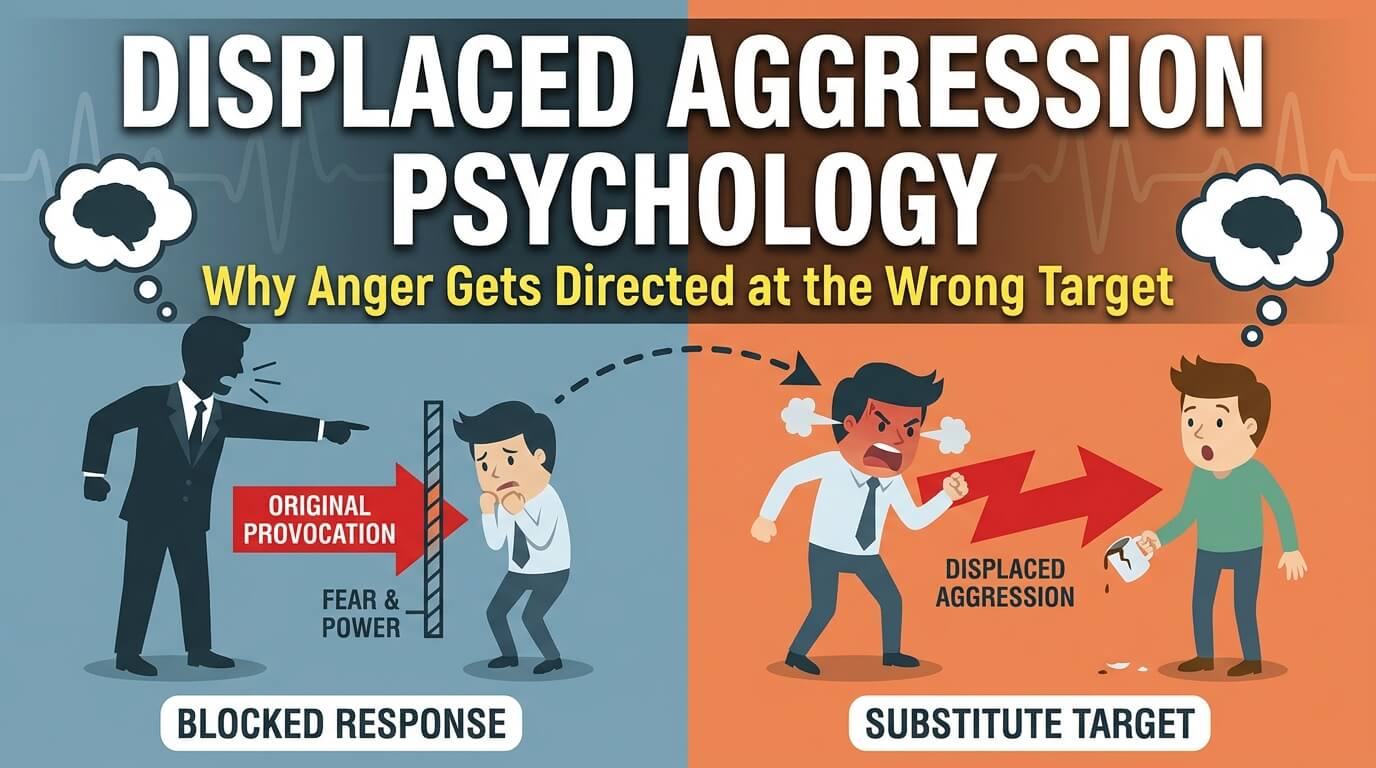
Someone gets humiliated in a meeting, says nothing to the person who did it, then snaps at a friend over a small mistake that evening. A customer cannot challenge a powerful official, then becomes unusually harsh with a service worker. A student absorbs a public insult from someone intimidating, then picks a fight with a peer who had little to do with the original event.
These situations can feel confusing because the strongest reaction lands on the wrong person. Psychology uses the term displaced aggression for an important version of this pattern: aggressive behavior is redirected away from the original provocateur and toward a different person or object. The key issue is not merely that anger lasts. It is that the target changes.
Understanding that sequence can reveal when a reaction partly belongs to an earlier event. An earlier insult, unfair demand, or blocked response may help explain the reaction, but it does not make aggression toward a substitute target acceptable.
Quick Answer
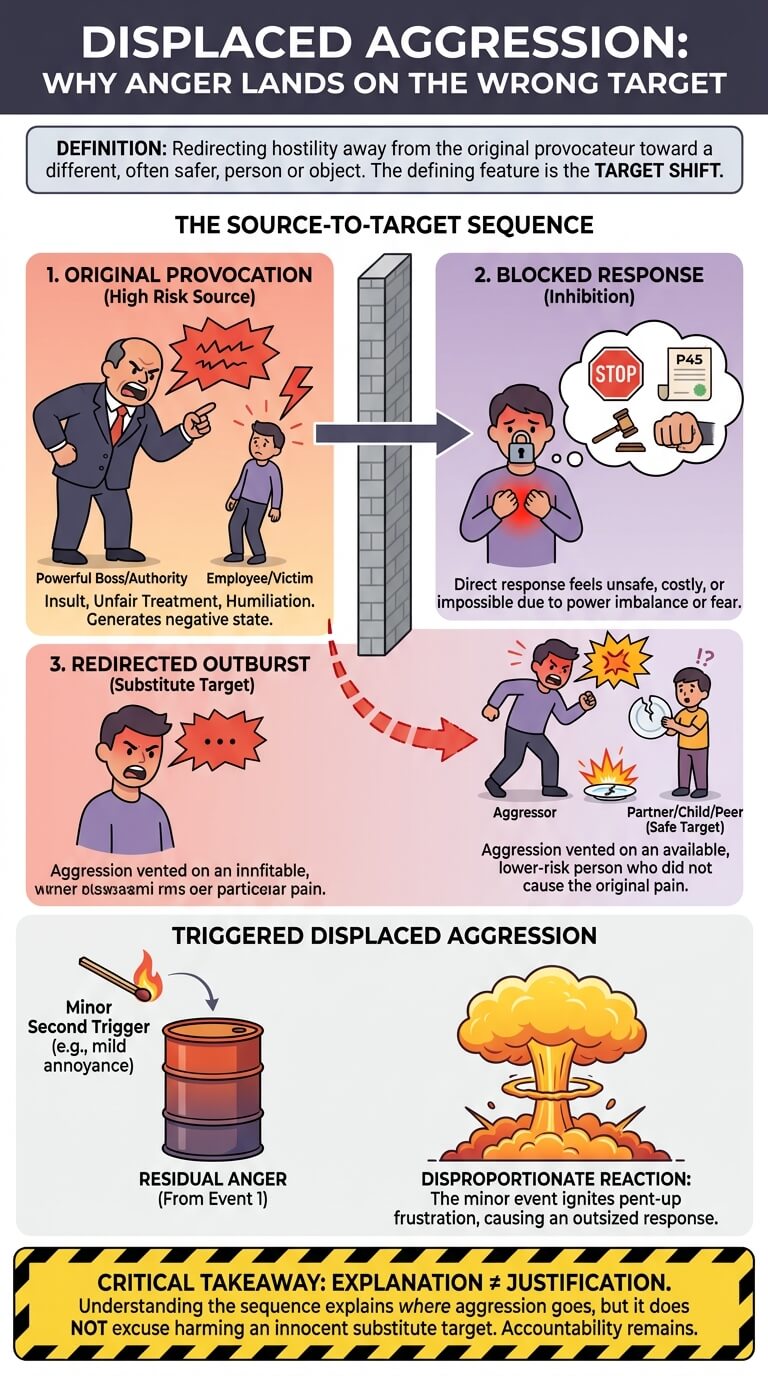
Displaced aggression happens when hostility or aggressive behavior triggered by one source is redirected toward a different target. This may occur when responding to the original provocateur feels unsafe, costly, impossible, or socially constrained. A later minor irritation can sometimes become the immediate trigger for a disproportionate reaction. The explanation concerns where aggression goes, not whether the harm is justified.
What Displaced Aggression Means
The APA Dictionary of Psychology describes displaced aggression as hostility redirected away from the source of frustration or anger toward the self or another entity. A classic reason is that direct confrontation with the original source may carry a risk of punishment or retaliation. The broader psychology of aggression helps separate this target-shift mechanism from anger itself, aggressive function, and escalation.
Original provocateur versus substitute target
The original provocateur is the person or situation that generated the initial grievance. The substitute target is the person or object that receives the later aggressive response.
Suppose a manager publicly belittles an employee. The employee feels angry but fears losing the job, so they do not respond. Later, a sibling forgets to return a borrowed item. If the employee responds with insults far beyond what the forgotten item would normally evoke, the earlier workplace event may be part of the explanation. The sibling did not cause the original grievance, yet receives the aggressive behavior.
Why target shift is the defining feature
Displaced aggression is not simply “being angry later.” A person can remain angry for hours and still address the original issue directly or choose not to act aggressively at all. Displacement becomes relevant when the aggressive response is redirected.
| Sequence | What happens | Is target shift present? |
|---|---|---|
| Direct response | Person A insults Person B, and B later confronts A aggressively | No |
| Non-aggressive carryover | Person B remains irritated after the insult but takes a walk and cools down | No aggressive displacement |
| Displaced aggression | Person B cannot respond to A, then lashes out at Person C | Yes |
| Triggered displaced aggression | Person C gives a small new provocation, and B reacts far beyond that trigger | Yes, with a second trigger |
Displaced aggression versus broad psychoanalytic displacement
The broader term displacement in the APA Dictionary refers to transferring feelings or behavior from an original object to another person or thing. In psychoanalytic theory, displacement has often been discussed as a defense mechanism.
Displaced aggression is narrower. It focuses on aggressive or hostile responding that shifts from the original source to another target. You do not need to accept a broad psychoanalytic theory of personality to understand this specific behavioral process, and the article does not require assuming that every redirected emotion is aggression.
The Source-to-Target Pathway
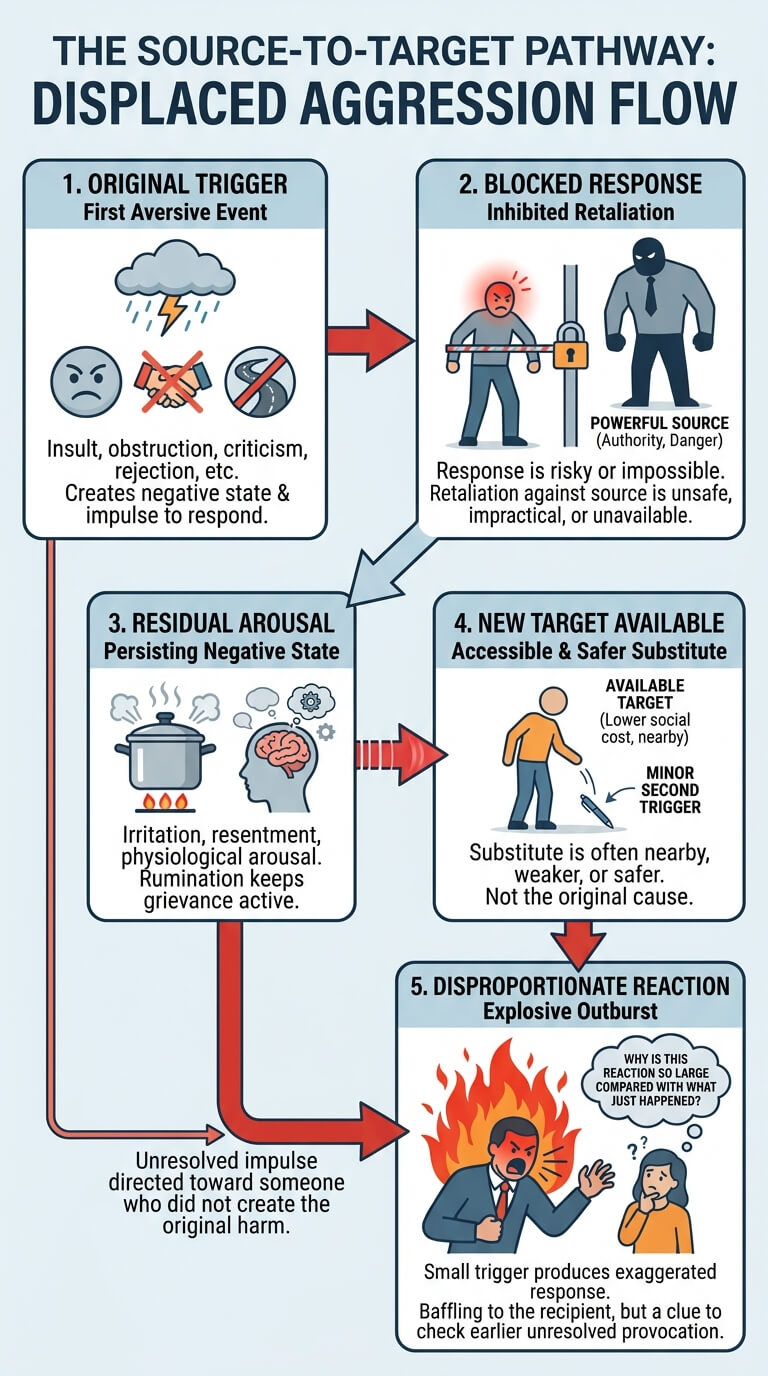
A useful way to recognize displaced aggression is to trace the sequence backward. The final outburst is only the visible end of a chain that may have started somewhere else.
Original trigger or provocation
The first event may involve insult, unfair treatment, obstruction, rejection, humiliation, criticism, loss, or another aversive experience. It does not have to be dramatic. What matters is that it produces a negative state and an impulse to respond.
People differ in what they experience as provoking, so one incident rarely reveals a person’s motive with certainty.
Blocked, costly, or inhibited response to the source
The person may want to respond but decide that doing so is too risky or impractical. The original provocateur may have more authority, social leverage, physical power, or control over something important. In other cases, the person may simply be unavailable, unknown, or gone before any response is possible.
This inhibition can be sensible. Choosing not to retaliate against a dangerous person may protect safety. The problem arises if the unresolved aggressive impulse is later redirected toward someone who did not create the original harm.
Residual arousal, resentment, or negative affect
After the first event ends, the emotional state may not end with it. Irritation, humiliation, resentment, or physiological arousal can persist. Thoughts about the incident may keep the grievance active.
Experimental work on triggered displaced aggression has found that ruminating about a prior provocation can increase later displaced aggression after a minor annoyance. That does not mean rumination always produces aggression. It suggests one way the first event can remain psychologically active long enough to influence a later response.
A new target becomes available
The substitute target is often simply nearby or accessible. Sometimes the person feels safer reacting to this target because the expected social cost is lower. That can create a troubling downward pattern in which someone absorbs pressure from a more powerful person and releases it toward someone with less power.
Availability alone is not proof of displacement. To make sense of the pattern, look for a meaningful mismatch between the earlier source of distress and the later recipient of aggression.
A small second trigger can produce a disproportionate reaction
The second target may do something mildly annoying, ambiguous, or inconvenient. On another day, the event might receive a brief complaint. After an unresolved provocation, the same event may receive a much stronger response.
This is one reason displaced aggression can feel baffling to the person receiving it. They may be thinking, “Why is this reaction so large compared with what just happened?” That question does not prove displacement, but it is a useful clue to check what happened earlier.
Why the Original Source May Not Be Confronted
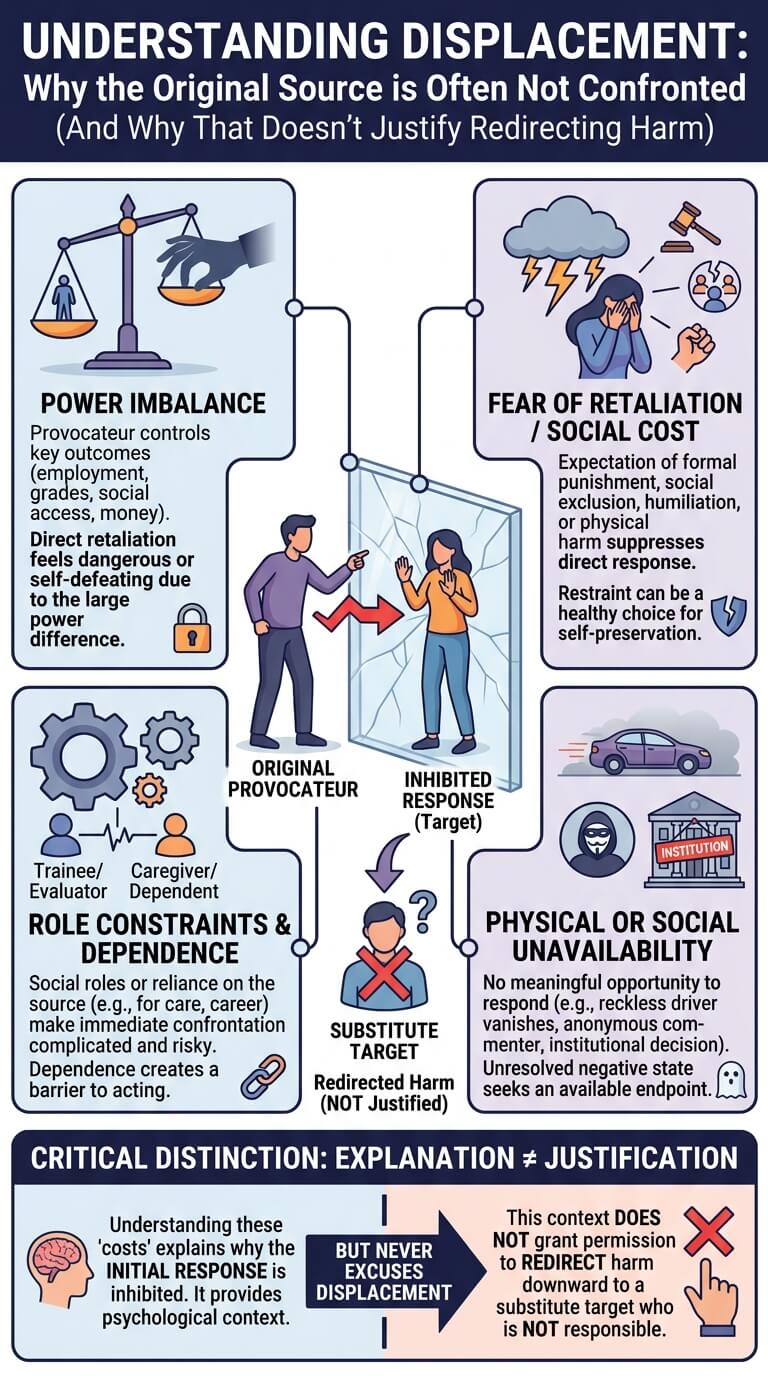
People sometimes describe displacement as if it were simple cowardice. That misses important context. Direct confrontation can carry real costs, and understanding those costs helps explain the target shift without excusing what happens next.
Power imbalance
A person may hold back because the original provocateur controls employment, grades, housing, social access, money, reputation, or another meaningful outcome. When the power difference is large, direct retaliation may feel dangerous or self-defeating.
That pressure can help explain why the response is inhibited at the first moment. It does not grant permission to redirect harm downward. The substitute target is not responsible for the original power imbalance.
Fear of retaliation or social cost
The expected consequence may be formal punishment, social exclusion, humiliation, damage to reputation, or physical retaliation. Even when the fear is partly uncertain, it may be strong enough to suppress a direct response.
Sometimes restraint is the healthiest choice. The important distinction is between not retaliating against the source and finding someone else to punish. Those are not the same behavior.
Role constraints and dependence
Many social roles require people to tolerate some frustration without immediate confrontation. A trainee may depend on an evaluator. A customer may be dealing with a bureaucracy rather than one identifiable person. A family member may rely on another person for transportation or caregiving.
Dependence can make a response feel complicated. Again, the psychological explanation belongs to the first relationship. It should not be turned into a justification for harming a second person.
Physical or social unavailability
Sometimes there is no meaningful opportunity to respond to the original provocateur. A reckless driver disappears into traffic. An anonymous commenter vanishes. A decision comes from an institution rather than a reachable individual.
In those cases, the unresolved negative state may be left without an obvious endpoint. A later person who is available can become a convenient but inappropriate recipient.
Triggered Displaced Aggression
Not all displaced aggression occurs without a new provocation. Researchers use the term triggered displaced aggression for situations in which a person is first provoked, cannot or does not retaliate against the original provocateur, and then encounters a second trigger from another person.
What the research term refers to
A review of displaced and triggered displaced aggression research distinguishes ordinary displacement from the triggered form. In the triggered version, the later target does something that provides at least some immediate reason for irritation, but the reaction can exceed what that second event would ordinarily predict.
The substitute target may not be completely uninvolved. They may have interrupted, criticized, or inconvenienced the person. The question is whether the response reflects only that event or whether an earlier provocation is amplifying it.
Why a minor new provocation can matter
Research on trigger intensity suggests that a relatively mild trigger can sometimes produce the clearest displaced effect because it gives the earlier grievance somewhere to land. In experimental settings, prior provocation plus a mild later trigger has produced aggression beyond what either factor would predict alone.
A newer open-access study similarly examined how anger and hostile attribution may contribute to triggered displaced aggression after provocation and a later trigger. Findings like these are best read as evidence about group-level patterns under studied conditions, not as a tool for diagnosing why one specific person snapped.
Why not every delayed reaction is displaced aggression
Timing is not enough. A person may respond later to the original issue because they needed time to think, because the first setting was inappropriate, or because the opportunity for discussion came later. That is delayed responding, not necessarily displacement.
The stronger evidence for displacement is a changed target combined with an intensity that appears partly connected to an earlier unresolved provocation.
Direct Aggression vs Displaced Aggression
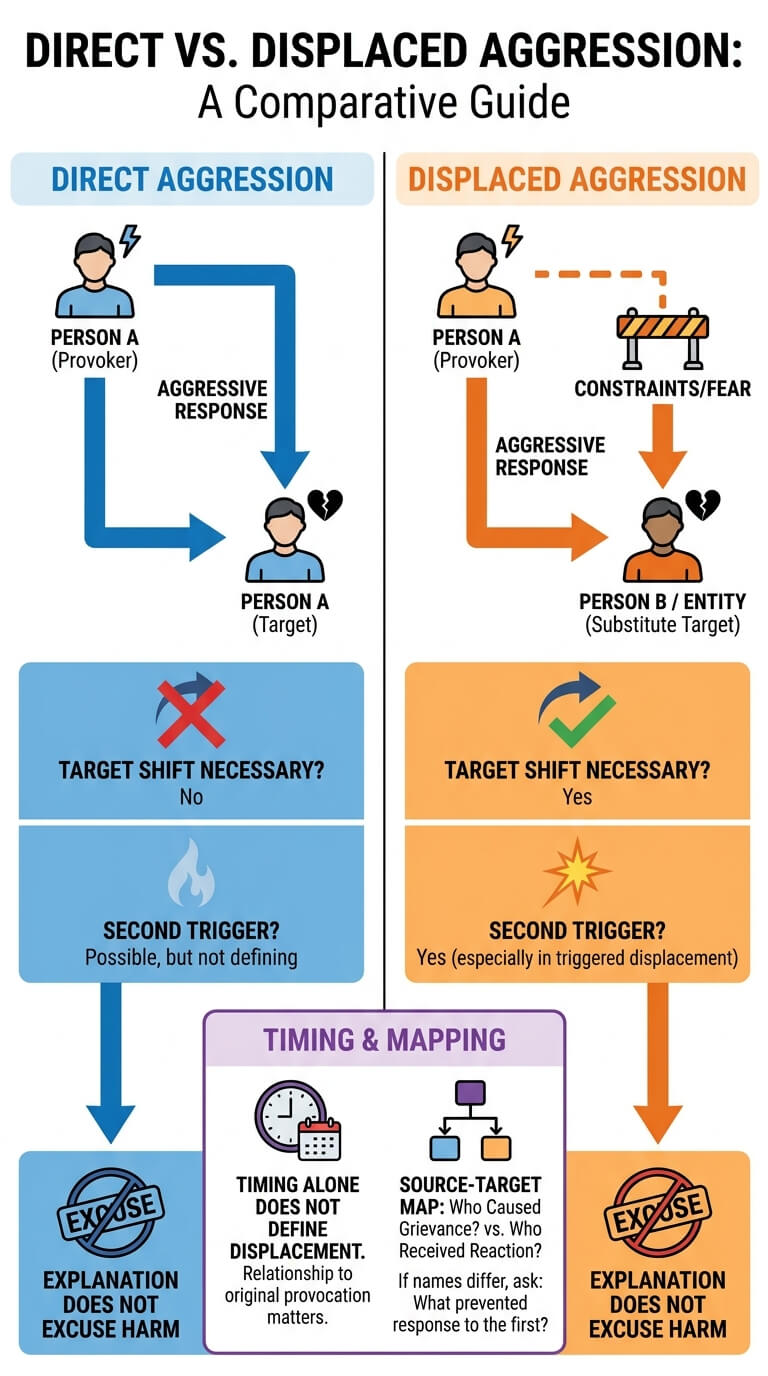
The easiest distinction is to track who caused the grievance and who received the aggressive response.
Same target as source versus substitute target
| Question | Direct aggression | Displaced aggression |
|---|---|---|
| Who provoked the person? | Person A | Person A |
| Who receives the aggression? | Person A | Person B or another entity |
| Is a target shift necessary? | No | Yes |
| Can a second trigger occur? | Possible, but not defining | Yes, especially in triggered displacement |
| Does explanation excuse harm? | No | No |
Why timing alone does not define displacement
A five-minute delay does not automatically create displacement, and a five-hour delay does not prove it. What matters is the relationship between the original provocation and the eventual target.
Someone might wait until after a meeting to tell the same manager, firmly but non-aggressively, that the public comment was unacceptable. That is neither displaced aggression nor necessarily aggression at all. The person is addressing the original source.
A source-target map with everyday examples
Imagine writing two names on paper: Who caused the original grievance? and Who received the harmful reaction? If the names differ, ask a third question: What prevented or discouraged a response to the first person?
This simple map is more useful than labeling someone as “an aggressive person.” It directs attention to sequence, behavior, constraints, and choice.
Cross-Context Examples Without Excusing Harm
Displacement can occur across settings. Examples are useful only if they preserve two truths at once: context can shape behavior, and the substitute target still deserves not to be harmed.
Work frustration followed by hostility at home
Situation: A worker is harshly criticized by a supervisor but feels unable to respond. At home, a housemate leaves dishes in the sink, and the worker launches into personal insults.
What the person may feel: Humiliated, trapped, still physiologically activated, then newly irritated.
What it may mean: The dishes are a real annoyance, but the intensity may be carrying unresolved anger from work.
What to do next: Stop the personal attack, name that the reaction is larger than the current issue, and return to the household problem only when it can be addressed proportionately.
Public humiliation followed by aggression toward a peer
Situation: Someone is mocked publicly by a socially influential person. Later, they ridicule a quieter peer over a minor mistake.
What the person may feel: Shame, resentment, a desire to restore a sense of standing.
What it may mean: The later ridicule may be serving as a redirected response to the earlier humiliation.
What to do next: End the ridicule, acknowledge the harm to the peer, and separate the original humiliation from the new interaction.
Authority pressure followed by a disproportionate reaction toward someone lower-power
Situation: A person is pressured by an authority figure and complies. Later, they become threatening toward someone who depends on them after a small disagreement.
What the person may feel: Powerless in the first interaction, then unusually driven to regain control in the second.
What it may mean: A power shift may have made the second person feel safer to confront. That does not make intimidation acceptable.
What to do next: If the interaction is still safe, stop the threatening behavior and create distance. If threats or fear are escalating, the person receiving them should prioritize safety rather than trying to analyze the aggressor’s earlier frustration.
Why these examples explain sequence, not moral permission
“I had a terrible day” may be true. “My boss treated me unfairly” may also be true. Neither statement transfers responsibility to the person who later gets insulted, threatened, frightened, or struck.
Psychological explanation is most useful when it increases accountability. It helps identify the moment where someone can say, “This reaction started elsewhere, and I do not want to make another person pay for it.”
Displaced Aggression vs Frustration-Aggression
These ideas overlap historically, but they answer different questions. A meta-analytic review of displaced aggression found evidence across studies that provocation can increase aggression toward an innocent target, while also identifying conditions that alter the strength of the effect.
Aggressive readiness after obstruction
The frustration-aggression tradition asks how blocked goals, aversive events, or frustration may increase the likelihood of aggressive responding under some conditions. The central question is about what makes aggression more likely after obstruction.
Target shift after the original response is blocked
Displaced aggression asks a different question: if aggressive responding occurs, why is it directed at someone other than the person or situation that produced the original grievance?
How the two can occur together without being the same process
A blocked goal can create frustration. The person may also be unable to respond to whoever caused the blockage. Later, aggression may be redirected toward someone else. In that sequence, frustration and displacement are both relevant, but they describe different parts of the chain.
Displaced Aggression vs Passive-Aggressive Behavior
These terms are often confused because both can involve indirectness, but the indirectness is not the same.
Target changes versus expression becomes indirect
In displaced aggression, the defining change is who receives the response. In passive-aggressive behavior, the issue is more about how opposition or resentment is expressed, often indirectly.
A person can behave indirectly toward the original person without displacement, or act openly aggressive toward a substitute target, which is displacement even though the behavior itself is direct.
Why indirect behavior and displaced behavior should not be conflated
Calling all indirect hostility “displacement” hides the target-shift mechanism. Likewise, calling every redirected outburst “passive-aggressive” is inaccurate if the behavior is openly insulting, threatening, or physically aggressive.
Tracking both target and form gives a clearer picture than relying on a broad label.
A Source-Target Mismatch Self-Check
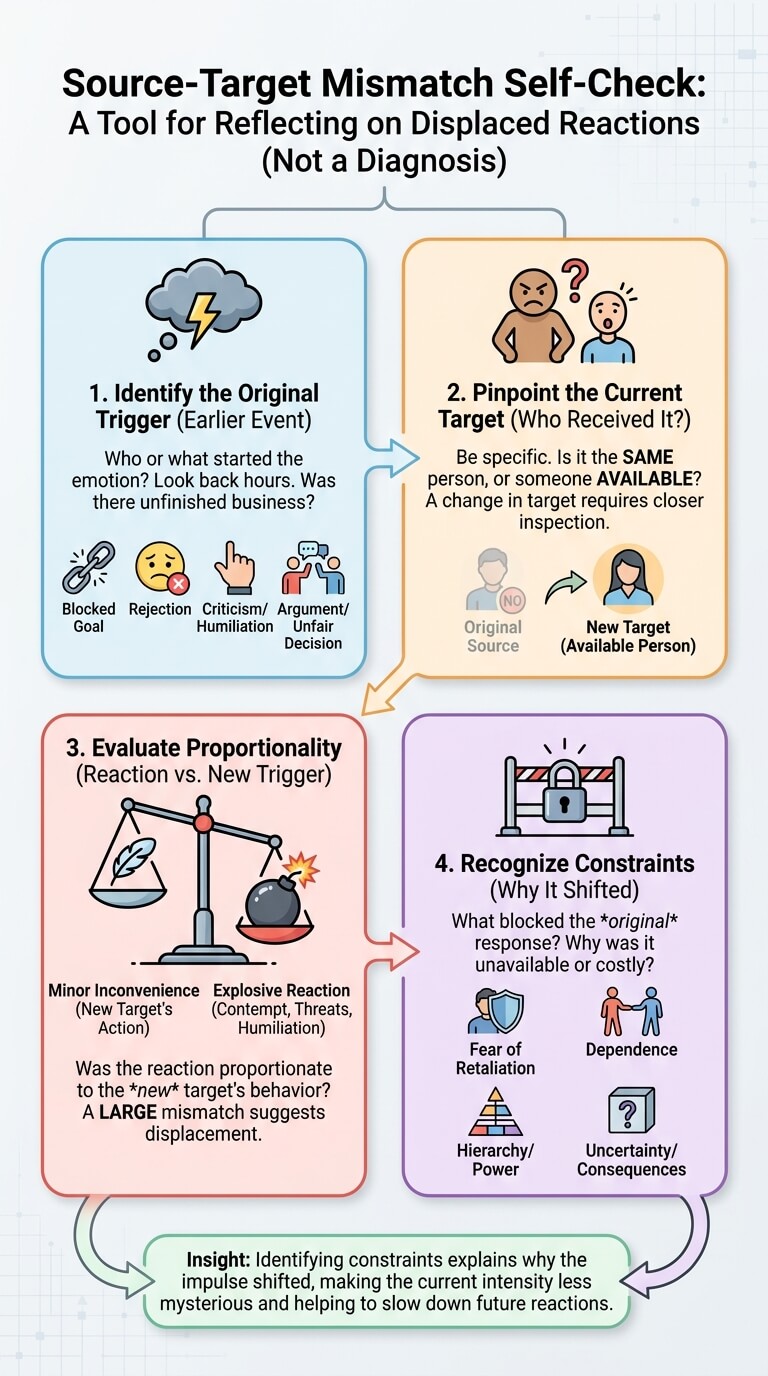
This self-check is not a diagnosis. It is a way to slow down a reaction and ask whether the present person is receiving emotional force that began somewhere else.
Who or what was the original trigger?
Look back several hours if necessary. Was there a criticism, humiliation, blocked goal, argument, unfair decision, rejection, or threat that still feels unfinished? Naming the earlier event can make the current intensity less mysterious.
Who received the harmful behavior?
Be specific. Was it the same person, or someone else who happened to be available? If the target changed, that is a reason to inspect the sequence more closely.
Was the reaction proportionate to the new target’s behavior?
A minor inconvenience does not make every strong reaction displaced. Still, a large mismatch matters. If a small mistake receives contempt, threats, humiliation, or explosive retaliation, ask what else may be feeding the response.
What made the original response feel unavailable or costly?
Was there fear of retaliation, dependence, hierarchy, uncertainty, lack of access, or concern about consequences? Identifying the constraint can reveal why the aggressive impulse did not stay attached to its original source.
Interruption Points Before Harm
The practical aim is not to eliminate anger on command. It is to reduce the chance that a second person becomes the recipient of an earlier grievance.
Identify the original source before acting on the second trigger
When a reaction feels unusually strong, ask: “Is all of this about what just happened?” If the honest answer is no, do not force the current interaction to carry the full weight of the earlier event.
You may still need to address the current problem. The difference is that you can do so without using the second person as a stand-in for the first.
Create distance from a substitute target when reaction intensity is disproportionate
If you notice an urge to insult, threaten, humiliate, break something, or frighten someone, create physical or conversational distance before acting when it is safe to do so. That could mean ending a non-urgent exchange, postponing a discussion, or leaving a shared space briefly.
This is not about making the other person absorb your anger more quietly. It is about preventing harm while the mismatch is still visible enough to interrupt.
Choose a non-harmful outlet or later problem-solving route
The original grievance may still deserve attention. Decide whether a direct response is safe and useful, seek appropriate support, or plan a proportionate way to address it later.
If direct confrontation would expose you to retaliation or danger, you do not need to confront the original person simply to prove that you are not displacing anger. Safety, formal channels, distance, or outside support may be more appropriate.
When Displacement Becomes a Safety Issue
Occasional irritability is not the same as a dangerous pattern. The concern rises when redirected aggression becomes repeated, intimidating, coercive, physically harmful, or concentrated on people who have less power to leave or respond.
Repeated targeting of lower-power people
A recurring pattern of taking pressure from powerful people and directing aggression at children, dependents, junior colleagues, service workers, partners, animals, or others with less ability to push back deserves serious attention. Power may help explain target selection, but it does not reduce responsibility.
Threats, coercion, property destruction, stalking, or physical violence
Once behavior includes credible threats, stalking, coercion, physical assault, intimidation with weapons, blocked exits, strangulation, or property destruction used to frighten someone, the issue is no longer just an interesting question about displacement. The National Domestic Violence Hotline lists threats, intimidation, property destruction, and other controlling behaviors among warning signs that warrant safety attention.
If you are in immediate danger, use local emergency services or another appropriate local safety resource. Do not stay in a dangerous interaction to test a psychological explanation or try to calm the other person through better wording.
Why accountability and safety take priority over explanation
A convincing explanation can sometimes tempt people to minimize the behavior: “They were only upset about work,” or “They did not really mean it because the anger came from somewhere else.” That reasoning can erase the experience of the person who received the aggression.
The healthier use of the concept is the opposite. Understanding displacement should help identify where responsibility was lost and where harm needs to stop.
How Displacement Relates to Other Aggression Processes
Several nearby ideas explain different parts of the sequence, but each answers a different question.
Blocked goals can increase aggressive readiness
Frustration may help explain why a person is primed for a stronger reaction after obstruction. Displacement becomes the more precise concept when the eventual aggression is directed toward someone other than the original source.
Power differences can make direct retaliation feel costly
When the original person controls valued outcomes or can retaliate, the person may suppress a direct response. The power difference provides context for inhibition, while displacement describes the later redirection.
Reciprocal reactions can turn a redirected outburst into escalation
A substitute target may respond defensively or angrily to being attacked. The first person then experiences that response as a fresh provocation, and a new conflict develops around an issue that did not cause the original grievance. At that point, a target-shift process can feed a separate escalation cycle.
FAQ About Displaced Aggression
These questions address the points that most often cause confusion when people try to distinguish displacement from ordinary anger, delay, or indirect behavior.
Is displaced aggression the same as taking anger out on someone?
Often, “taking anger out on someone” is an everyday description of displaced aggression, especially when that person did not cause the original problem. The psychological concept is more specific because it focuses on aggression or hostility redirected from an original provocateur to another target. Simply being quiet, tired, or irritable after a bad day is not automatically displaced aggression.
Can displaced aggression happen without conscious awareness?
Yes. The target shift can occur without an explicit plan to redirect aggression. Lack of awareness does not erase responsibility, and recognizing the pattern creates an opportunity to interrupt it before someone else is harmed.
Is a delayed reaction always displaced aggression?
No. A delayed response may still be directed at the original issue and original person. Someone may wait until they are calmer or until a private conversation is possible. Displacement requires a target shift, not merely the passage of time.
Why are safer or lower-power targets sometimes chosen?
A lower-power target may seem less likely to retaliate, reject the person, threaten a valued outcome, or impose consequences. That can make the target feel psychologically “safer” for aggression. This explanation should never be used to normalize downward aggression. The lower-power person is not responsible for the earlier grievance.
Does understanding the original trigger excuse the behavior?
No. Context can explain why a reaction became more likely or why the target shifted, but explanation and justification are different. The person who acts aggressively remains responsible for stopping harmful behavior, repairing what can be repaired, and seeking appropriate help if the pattern is repeated or difficult to control.
Key Takeaways
- Displaced aggression involves a change in target: the person who receives the aggression is not the person or situation that produced the original grievance.
- Direct retaliation may be inhibited by power differences, fear of consequences, dependence, social constraints, or simple unavailability.
- A small later trigger can sometimes produce an outsized response when an earlier provocation remains active, a pattern studied as triggered displaced aggression.
- Displacement is different from frustration-aggression theory, passive-aggressive behavior, delayed responding, and broad psychoanalytic displacement.
- Tracing the original trigger, substitute target, response mismatch, and blocked direct response can help identify the pattern before harm continues.
- Threats, coercion, stalking, physical violence, or intimidation require safety-focused action. A psychological explanation should never be used to minimize danger or excuse harm.
Final Thoughts
If a reaction seems far larger than the present event, the most useful question may be: Who am I really responding to? That question does not invalidate the current frustration. It helps separate the problem in front of you from an unresolved grievance that began somewhere else.
The next step is concrete: identify the original source, stop directing harm at the substitute target, and decide what safe, proportionate response is available for the first problem. When the behavior has crossed into threats, intimidation, coercion, stalking, or violence, safety takes priority over understanding the mechanism.

Michael Reed is the Founder and Lead Writer at Psychology Exposed. He writes about human behavior, relationships, emotional patterns, self-awareness, and practical psychology topics using research-informed, easy-to-understand content.
Read More About Michael Reed: https://psychologyexposed.com/michael-reed/