

Someone can insult, threaten, humiliate, shove, exclude, or physically attack another person, yet those behaviors do not all belong to exactly the same category. In everyday speech, aggression and violence are often used as if they mean the same thing. In psychology and public health, the distinction is usually more careful.
Aggression is a broad behavioral concept centered on intentional harm. Violence usually refers to a more severe form of harmful behavior involving physical force, serious injury, threatened force, or severe consequences, depending on the framework being used. The boundary varies across psychology, public health, criminology, and law.
This distinction is useful because it prevents two common mistakes. One is calling every hostile or harmful act “violent,” which can blur meaningful differences in severity. The other is assuming that nonviolent aggression is harmless. Threats, humiliation, intimidation, and deliberate social harm can have serious consequences even when no physical assault occurs.
Quick Answer
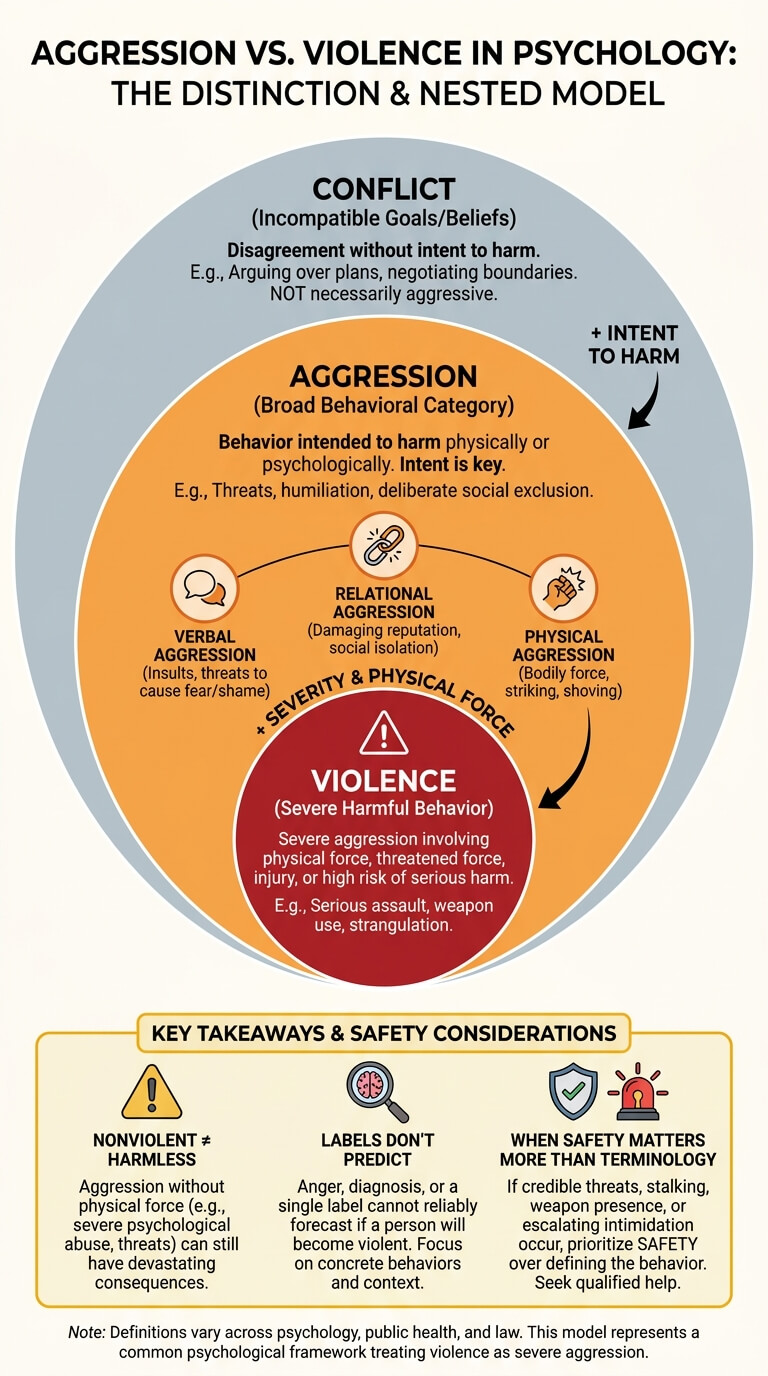
Aggression is a broad category of behavior intended to harm another person physically or psychologically. Violence usually refers to severe aggression involving physical force, threatened force, injury, or a high risk of serious harm, although definitions vary by field. In many psychological frameworks, violence is treated as a severe form of aggression, but not all aggression is violence.
Aggression as the Broader Psychological Category
The cleanest way to begin is with behavior rather than labels about a person. The APA Dictionary of Psychology definition of aggression describes aggression as behavior aimed at harming others physically or psychologically. That broad definition can include acts carried out through words, relationships, threats, or physical force.
This means aggression is not limited to hitting, kicking, or other obvious physical acts. A person can behave aggressively through humiliation, intimidation, deliberate exclusion, or threatening language when the behavior is intended to cause harm or impose an aversive consequence.
Intentional harm or aversive consequence
Intent matters because accidental harm is not usually classified as aggression in the same way. If someone bumps into another person in a crowded train and causes them to drop a phone, harm occurred, but the behavior was not necessarily aggressive. If the same person deliberately shoves someone to frighten or punish them, intention changes the psychological meaning of the behavior.
Intent can be difficult to infer from the outside. Tone, sequence, prior statements, repetition, and context may provide evidence, but observers rarely have perfect access to another person’s motives. For that reason, it is usually safer to describe the behavior first and make motive claims only when the evidence supports them.
Verbal, relational, and physical forms
Aggression can be expressed in several forms. Verbal aggression uses language to insult, degrade, threaten, ridicule, or intimidate. Relational aggression uses relationships, social belonging, reputation, or exclusion as a vehicle for harm. Physical aggression involves bodily force or physical acts directed at a target.
| Form | Typical route of harm | Simple example |
|---|---|---|
| Verbal aggression | Words or messages | Threatening or humiliating someone to cause fear or shame |
| Relational aggression | Belonging, reputation, relationships | Spreading a rumor specifically to isolate someone socially |
| Physical aggression | Bodily force or physical action | Deliberately striking or shoving another person |
These forms can overlap. A confrontation can include threats, public humiliation, and physical contact in the same incident. Real situations do not always fit neatly into one box.
Why conflict alone is not aggression
Conflict means that goals, beliefs, expectations, needs, or interests are incompatible. Two people can disagree strongly without either person trying to harm the other. Negotiating a deadline, refusing a request, arguing about a policy, ending a friendship, or setting a firm boundary can all create conflict without becoming aggression.
The distinction becomes especially important in emotionally charged situations. Raised emotion, frustration, or blunt disagreement may increase tension, but aggression begins when behavior is directed toward harming, threatening, degrading, intimidating, or imposing an unwanted cost on another person.
What Violence Usually Adds
Violence generally marks a more serious level of harmful behavior, but there is no single definition used identically in every discipline. The APA Dictionary of Psychology definition of violence, for example, emphasizes physical force used with intent to injure or damage people or property.
Public-health definitions can be broader because they also consider threatened force, power, psychological harm, deprivation, and harm to groups or communities. The term is being used for different purposes.
Physical force, injury, or severe harm depending on framework
In many psychology texts, violence is treated as a severe form of physical aggression. This makes the relationship relatively easy to visualize: aggression is the larger category, physical aggression is one part of it, and violence occupies the more severe end of physical aggression.
Public health may define violence more broadly. The World Health Organization’s public-health framing of violence includes the intentional use of physical force or power, threatened or actual, when it results in or carries a high likelihood of injury, death, psychological harm, maldevelopment, or deprivation.
Why severity matters
Severity changes the practical meaning of a situation. A deliberately insulting comment and a physical assault can both be aggressive, but the immediate safety implications are very different. A useful classification should preserve that difference rather than flattening all harmful acts into one category.
Severity can involve force, injury risk, threat seriousness, repetition, access to weapons, ability to leave, or credible fear. No single factor is an automatic formula, but these features can make a situation more urgent.
Why violence definitions vary by field
Psychologists may be interested in intention, motivation, cognition, emotion, and behavior. Public-health researchers may focus on injury, population risk, prevention, and consequences. Criminologists may organize behavior around offending patterns, while legal systems use definitions tied to statutes, evidence standards, jurisdiction, and specific offenses.
As a result, the same behavior may be described somewhat differently depending on who is classifying it and why. A psychological definition should not be treated as a legal ruling, and a legal label should not be assumed to capture every psychological dimension of harm.
The Nested Concept Map
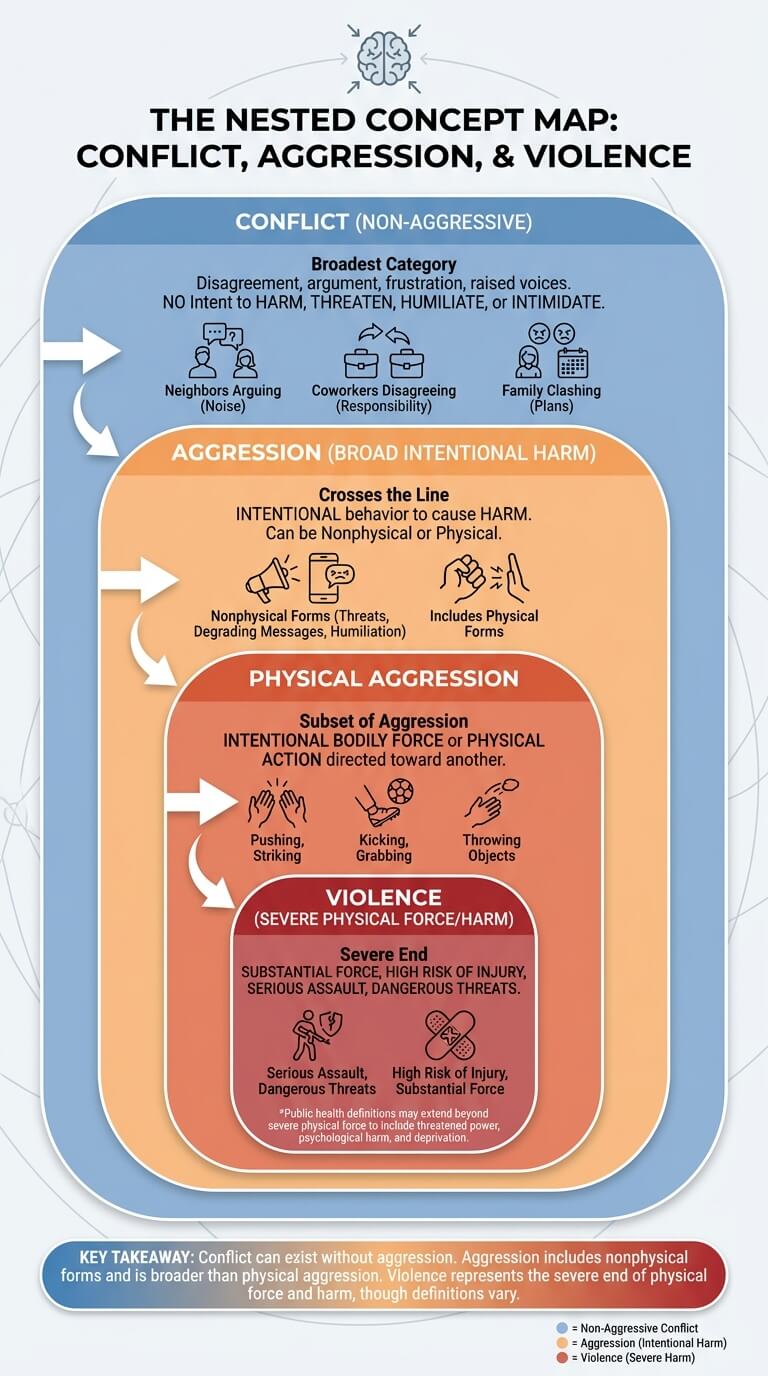
A useful mental model is to picture several levels rather than two completely separate boxes. Conflict can occur without aggression. Aggression includes several nonphysical forms. Physical aggression sits inside that broader category. Violence often refers to severe physical-force or serious-harm behavior, although public-health frameworks may extend beyond that narrow nesting.
Conflict can remain non-aggressive
Two neighbors can argue about noise, two coworkers can disagree about responsibility, or two family members can clash over plans. These situations may involve frustration, anger, or raised voices, but they remain non-aggressive if neither person is intentionally trying to harm, threaten, humiliate, or intimidate the other.
This matters because treating all conflict as aggression can make ordinary disagreement feel more dangerous than it is. It can also make it harder to identify the point at which an interaction actually becomes harmful.
Aggression as the broad intentional-harm category
Once a person intentionally uses behavior to cause harm, the interaction has crossed a different line. The behavior may still be nonphysical. Threatening to ruin someone’s reputation, sending degrading messages, or deliberately humiliating a person can be aggressive even when no one is physically touched.
Physical aggression as a subset
Physical aggression includes intentional bodily force or physical action directed toward another person. Examples include pushing, striking, kicking, grabbing, or throwing an object at someone. The seriousness can vary widely, which is one reason researchers sometimes separate physical aggression from violence rather than treating them as exact synonyms.
Violence as a severe physical-force or harm category in many frameworks
At the severe end, acts involving substantial force, high risk of injury, serious assault, or dangerous threats are commonly described as violence. A review available through PubMed Central on violence terminology illustrates how definitions can include physical force, threatened power, psychological harm, and deprivation depending on the framework.
The important point is not to force every case into an identical hierarchy. It is to recognize that aggression is broader than violence in much of psychological research, while public-health definitions of violence may intentionally cover a wider range of severe harmful conduct.
Examples of Aggression That Are Not Violence
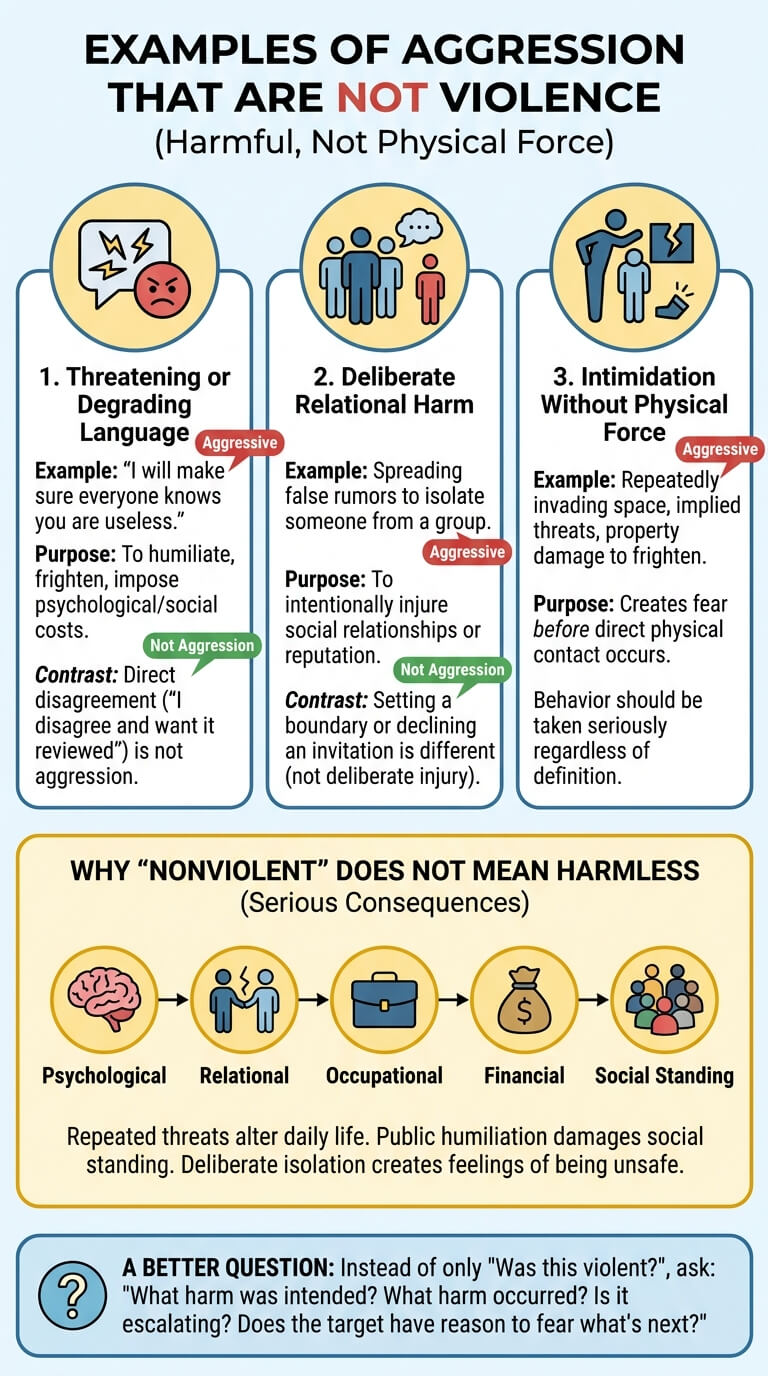
Nonviolent aggression is often easier to understand through concrete examples. These behaviors may be harmful and serious without involving the kind of physical force commonly associated with violence.
Threatening or degrading language
A person tells a colleague, “I will make sure everyone here knows you are useless,” with the purpose of humiliating and frightening them. The language is harmful and potentially aggressive because it is being used to impose psychological or social costs. Whether a specific threat also fits a violence definition depends on what is threatened and which framework is being used.
By contrast, saying, “I disagree with your decision and I want it reviewed,” may be forceful but is not aggression simply because it is direct.
Deliberate relational harm
Someone spreads a false rumor with the goal of isolating another person from a friendship group. No physical force is involved, yet the action may still qualify as aggression because social relationships and reputation are being used intentionally as a route to harm.
Ordinary exclusion is different. A person is allowed to choose whom they spend time with, end a relationship, decline an invitation, or establish a boundary. The key issue is not merely that someone feels left out. It is whether social exclusion is being deliberately used to injure, punish, threaten, or degrade.
Intimidation without physical force
Intimidation can sometimes be aggressive without crossing a narrow physical-force definition of violence. Repeatedly invading someone’s space, making implied threats, or using property damage to frighten a target may create fear even before direct physical contact occurs.
Taxonomy should never become an excuse to minimize the behavior. Something does not need to meet one narrow definition of violence before a person is allowed to take fear, coercion, or intimidation seriously.
Why nonviolent does not mean harmless
The phrase “not violent” can sound reassuring, but it only describes one dimension. Psychological, relational, occupational, financial, and social consequences can be serious. Repeated threats can alter how a person moves through daily life. Public humiliation can damage social standing. Deliberate isolation can make a person feel unsafe in a group.
A better question is not only, “Was this violent?” It is also, “What harm was intended, what harm occurred, is the behavior escalating, and does the target have reason to fear what may happen next?”
Examples That May Cross Into Violence
The point at which physical aggression becomes violence is not always defined by one universal threshold. Still, some behaviors sit clearly toward the severe end because they involve substantial force, serious injury, or a high likelihood of significant harm.
Severe physical assault
Repeatedly punching, kicking, choking, striking with an object, or otherwise using severe physical force against another person would commonly be described as violent behavior. The central issue is no longer only hostile intent. The force itself creates a substantial possibility of injury or worse.
Force causing or risking serious injury
A physical act does not have to produce a visible injury before the risk becomes serious. Some forms of force can create substantial danger even when immediate injuries appear limited. That is why a person facing credible physical danger should not wait for a perfect classification before seeking safety.
Why exact classification depends on the framework being used
Suppose someone throws an object across a room in anger. If it is thrown at another person with intent to injure, that strongly supports an aggression classification. Whether the act is labeled violence may depend on the object, force, distance, resulting injury, and the definition being applied.
This is one reason precise behavioral description is often more useful than arguing over a single word. “He threw a heavy object at her head” communicates more about danger than simply saying “he was aggressive.”
Threats, Property Damage, and Intimidation

Some of the hardest cases involve behavior that is not a completed physical assault but still creates a serious safety concern. Threats, stalking, destruction of property, blocking exits, and weapon-related intimidation can matter greatly even when a taxonomy debate remains unresolved.
Why behavior can create serious safety risk even when taxonomy is debated
A credible threat communicates possible future harm. Stalking can create fear through repeated monitoring or unwanted contact. Blocking a doorway can remove another person’s ability to leave. Each behavior deserves attention based on what it does to safety and freedom, not only on whether someone calls it aggression, abuse, intimidation, or violence.
Property destruction used to frighten or coerce
Breaking an object in private frustration is not automatically aggression toward another person. Context changes the meaning. Smashing a phone during an argument to frighten someone, punching a wall beside them, or destroying belongings as punishment can function as intimidation and may signal a more dangerous situation.
The CDC treats violence as a public-health problem and emphasizes understanding the factors and contexts that influence harmful behavior. Danger is not captured by a single label.
Threats as aggression and potential warning signs without predicting future violence
A threat can itself be aggressive when it is intended to frighten or impose harm. It may also increase concern about safety, especially when it is specific, repeated, paired with stalking or coercion, or backed by behavior that shows access and intent.
That does not mean every angry threat allows a confident prediction of future violence. Risk assessment requires context, history, specificity, access, escalation, and professional judgment. A blog explanation cannot determine whether one individual will act violently.
Why Psychology, Public Health, Criminology, and Law May Define Terms Differently
The word violence carries scientific, public-health, social, and legal meanings. Those meanings overlap, but they are not interchangeable. Understanding the purpose of a definition prevents false certainty.
Research definitions
Behavioral research needs definitions that can be measured consistently. Researchers may distinguish verbal aggression, relational aggression, physical aggression, threats, hostile motives, instrumental motives, and violent outcomes. These distinctions support more precise questions about mechanisms and consequences.
Public-health definitions
Public health often uses broader definitions because prevention requires attention to injuries, psychological harm, threatened force, power, and community impact. A definition designed for prevention may intentionally include behaviors that a narrower laboratory definition would classify differently.
Legal definitions vary by jurisdiction
Law adds another layer. Statutes may define assault, battery, domestic violence, stalking, threats, criminal damage, coercive control, or other offenses differently depending on the country, state, province, or territory. Psychological terminology should not be used as a substitute for legal advice.
Why this discussion does not give legal conclusions
Calling a behavior “aggressive” or “violent” in a psychological sense does not establish that a particular crime occurred. Conduct can also be legally significant even when psychology uses a different descriptive term.
If a situation has legal consequences, the relevant local law and qualified legal guidance matter more than a general psychology definition.
Aggression vs Violence vs Conflict
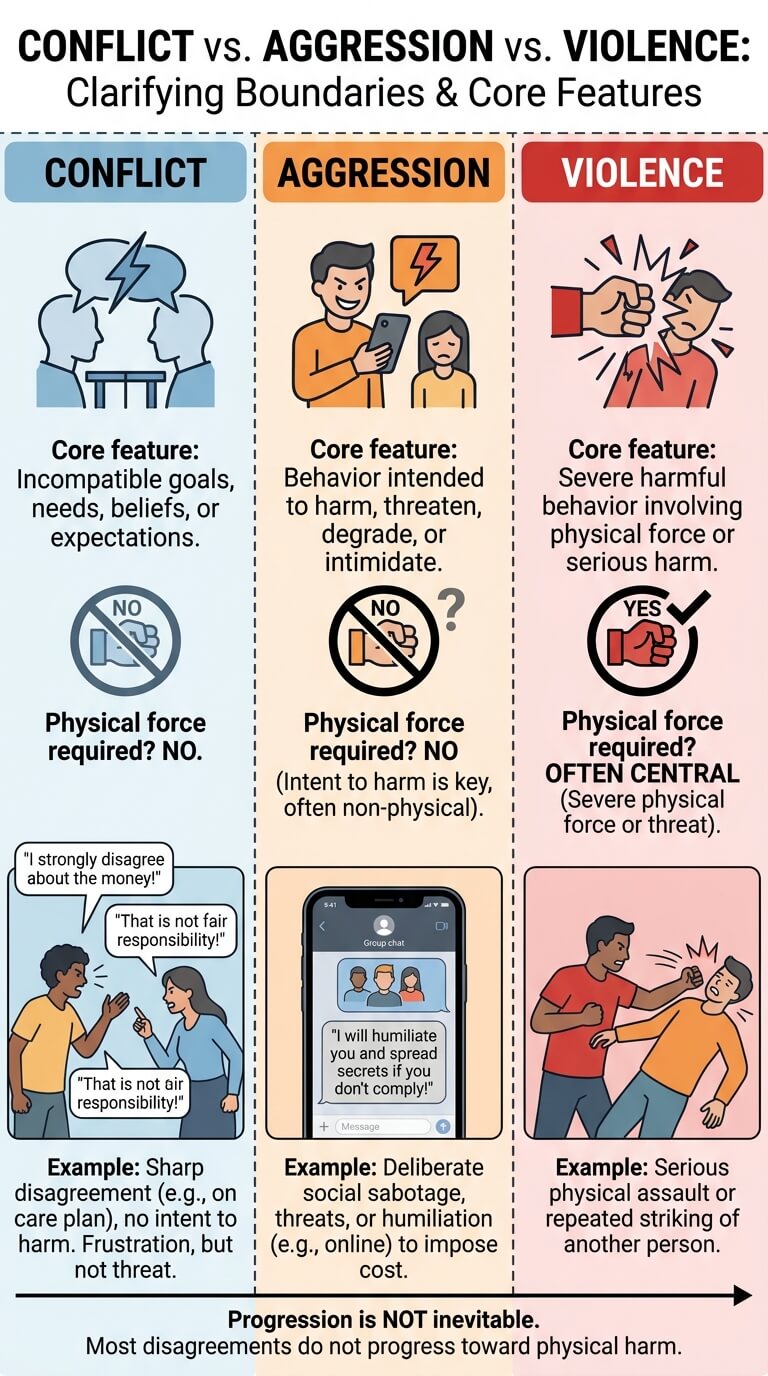
Placing the three concepts side by side makes their boundaries easier to see.
| Concept | Core feature | Physical force required? | Example |
|---|---|---|---|
| Conflict | Incompatible goals, needs, beliefs, or expectations | No | Two people strongly disagree about money or responsibility |
| Aggression | Behavior intended to harm, threaten, degrade, intimidate, or impose an aversive consequence | No | Deliberate humiliation, threats, social sabotage, or physical attack |
| Violence | Severe harmful behavior involving physical force, threatened force, or serious harm in many frameworks | Often central, but definitions vary | Serious physical assault or another act meeting the framework’s violence criteria |
Disagreement and incompatibility
Imagine two siblings arguing about how to care for an aging parent. They disagree sharply, interrupt each other, and leave frustrated. That is conflict. It may be unpleasant, but there is no evidence yet that either person is trying to harm the other.
Intentional harm
Now imagine one sibling responds by deliberately humiliating the other in a family group chat and threatening to spread private information as punishment. The interaction has moved beyond disagreement into intentional harm. That is aggression even though no physical force has occurred.
Severe physical force or harm
If the confrontation becomes a serious physical assault, the behavior would commonly be described as violence. The earlier conflict did not make violence inevitable. Most disagreements do not progress toward physical harm.
A three-level example set
| Situation | Best starting description | Why |
|---|---|---|
| “I strongly disagree and I am leaving this meeting.” | Conflict or boundary-setting | No clear intent to harm |
| “I will humiliate you in front of everyone if you do not do what I want.” | Aggressive threat or intimidation | Language is being used to impose fear or harm |
| Repeatedly striking another person | Violent physical aggression | Intentional severe physical force is involved |
What These Labels Cannot Tell You About One Person
Definitions help organize behavior. They are much weaker at telling us exactly what one person will do next. Human behavior depends on context, history, opportunity, inhibition, relationships, substances, and current circumstances.
Anger does not predict violence by itself
Anger is an emotional state, not a violent act. A person can feel intense anger and choose to leave, speak firmly, seek support, cool down, or solve the problem without harming anyone. Treating anger as a reliable predictor of violence can stigmatize normal emotion and obscure the importance of actual behavior.
Diagnosis, identity, hostility, or one aggressive act cannot support confident individual prediction
A diagnosis, demographic identity, hostile thought, or isolated aggressive incident is not enough to determine that someone will become violent. Group-level associations cannot simply be converted into predictions about a particular person.
The same caution applies in the other direction. The absence of a diagnosis or obvious anger does not guarantee safety. When evaluating an immediate situation, concrete behavior such as threats, stalking, assault, escalating intimidation, and blocked exits matters more than stereotypes.
Risk assessment requires qualified context beyond a general guide
Professional violence-risk assessment, where appropriate, uses structured information and context far beyond a single behavior label. It is not something a reader should try to reproduce from a checklist on the internet.
If you are worried about a specific person’s behavior, focus on what has actually happened, what has been threatened, whether the behavior is escalating, whether you can leave safely, and which qualified local resources are available.
When Safety Matters More Than the Label
There are situations in which deciding whether an act is technically “aggression” or “violence” should not be the first priority. Physical assault, strangulation, credible threats, stalking, weapon threats, blocked exits, escalating intimidation, or serious property destruction used to frighten someone can indicate immediate or increasing danger.
Physical assault, strangulation, credible threats, stalking, weapon threats, blocked exits, escalating intimidation
If these behaviors are present, do not assume that better communication is the main solution. Do not stay in a dangerous interaction simply to clarify intent, prove that you are calm, or finish an argument. Safety takes priority over resolving the disagreement.
Stalking and threats can involve patterns of monitoring, intimidation, and fear even when physical assault has not yet occurred. The National Domestic Violence Hotline’s stalking safety-planning guidance offers examples of concerning behaviors and practical safety-planning considerations for people dealing with stalking or threats.
Distance, emergency help, and qualified local support when danger is credible
If danger feels immediate, prioritize getting to a safer place and contacting emergency services or an appropriate local crisis resource where available. If the danger is not immediate but you are dealing with repeated threats, coercion, stalking, or intimidation, a qualified advocate or local support service can help you think through options without requiring you to confront the person directly.
What works in an ordinary disagreement may be unsafe when retaliation, surveillance, weapons, or blocked movement are involved.
How This Distinction Helps With Other Forms of Aggression
Once aggression and violence are separated conceptually, several confusing behaviors become easier to classify. The most useful next question is often not “Is this person violent?” but “What form of harm is happening, how severe is it, and what does the situation require now?”
The broader map of aggressive behavior
A broad aggression framework helps explain why harmful behavior can be verbal, relational, reactive, proactive, displaced, or physical. Violence is one important part of that map, not the entire map.
How interactions intensify
An escalation perspective asks how a tense interaction changes over time: how provocation is interpreted, how arousal and retaliation build, how threats enter the exchange, and where interruption is still possible. That is different from the definition question addressed here.
Why verbal and relational aggression still matter
Separating aggression from violence makes room to take nonphysical harm seriously without mislabeling every harmful act as violent. Verbal threats, humiliation, reputation attacks, or deliberate social exclusion may require boundaries, accountability, support, or safety planning depending on context, even when physical force is absent.
FAQ About Aggression vs Violence
These questions address the most common points of confusion when people try to decide whether harmful behavior is aggressive, violent, both, or neither.
Is all aggression violent?
No. Aggression is broader. Verbal humiliation, relational sabotage, deliberate intimidation, and some threats can be aggressive without involving physical violence. That does not make them harmless. The form and severity of harm still matter.
Is all violence considered aggression in psychology?
In many psychological frameworks, interpersonal violence is treated as a severe form of aggression because it involves intentional harm through force. Public-health definitions can be broader and may include threatened force or power and several types of harm. Definitions therefore need to be read in context.
Can threats be aggression without being violence?
Yes, under some frameworks a threat can be aggressive because its purpose is to frighten or impose harm, while not meeting a narrow definition of completed physical violence. Other public-health definitions explicitly include threatened force or power within violence. The disagreement in terminology should not distract from whether the threat is credible or creates a safety risk.
Is property destruction automatically violence?
No single label fits every case. Accidentally breaking an object is different from deliberately destroying property to frighten, punish, or coerce someone. When property destruction is used as intimidation or occurs alongside threats, stalking, or physical aggression, the safety significance can be serious even if different systems classify the act differently.
Can psychology predict whether an aggressive person will become violent?
Not from a label, one incident, anger level, diagnosis, or identity alone. Individual prediction requires far more context and, in some settings, qualified risk assessment. If you are concerned about a real situation, pay attention to concrete behaviors and changes in danger rather than trying to diagnose or forecast the person.
Key Takeaways
- Aggression is a broad category of intentional harmful behavior and can be verbal, relational, or physical.
- Violence usually refers to more severe behavior involving physical force, threatened force, injury, or serious harm, but definitions vary across disciplines.
- Conflict can be intense without becoming aggressive, and aggression can occur without becoming violent.
- Nonviolent aggression can still cause serious psychological, social, or practical harm.
- Labels cannot reliably predict whether one person will become violent. Concrete behavior and context matter more.
- When there is assault, strangulation, stalking, credible threats, weapon-related fear, blocked exits, or escalating intimidation, prioritize safety rather than debating terminology.
Final Thoughts
The most useful distinction is simple: ask first whether there is intentional harm, then ask what form that harm takes and how severe the danger is. That separates ordinary conflict from aggression and helps distinguish nonphysical aggression from more severe violence without pretending every field uses the same boundary.
If you are trying to understand a real incident, describe the behavior as precisely as possible before reaching for a label. “They threatened me,” “they deliberately humiliated me,” or “they struck me” tells you more about what needs attention than a vague judgment about someone’s personality. When credible danger is present, the next step is safety, not perfect terminology.

Michael Reed is the Founder and Lead Writer at Psychology Exposed. He writes about human behavior, relationships, emotional patterns, self-awareness, and practical psychology topics using research-informed, easy-to-understand content.
Read More About Michael Reed: https://psychologyexposed.com/michael-reed/