
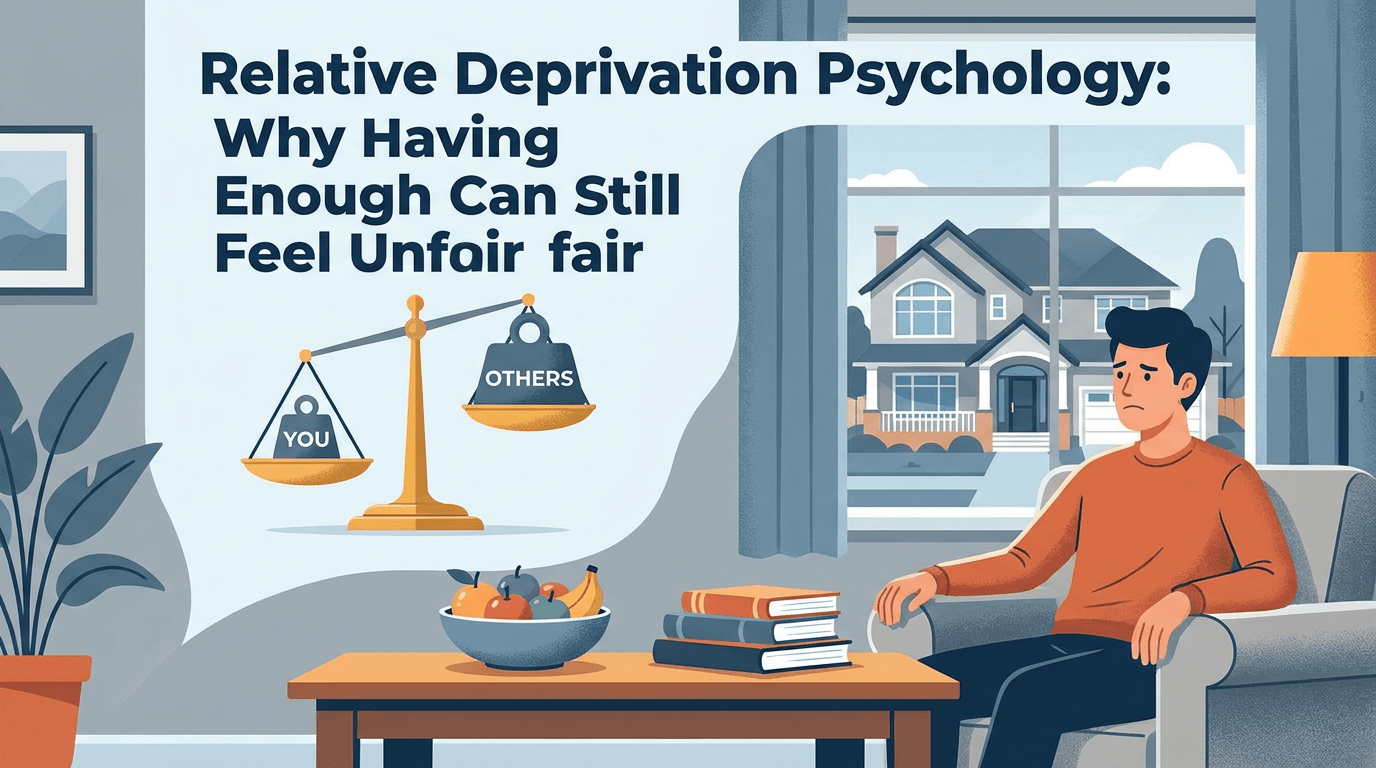
You can be objectively better off than you were a year ago and still feel as if you are falling behind. A raise can feel disappointing after you learn what similar colleagues earn. A good academic result can suddenly feel inadequate when everyone in your study group seems to score higher. A comfortable home can feel less satisfying after your reference point shifts to a wealthier neighborhood.
These reactions are not explained simply by how much you have. They depend partly on what you compare your situation with, whether that comparison feels relevant, and what you think the gap means. In psychology, this is where the idea of relative deprivation becomes useful.
Relative deprivation does not mean that every unfavorable comparison is evidence of unfair treatment. It also does not mean that objective hardship is unimportant. The concept describes a particular psychological process: a person perceives that they are worse off than a meaningful standard, then interprets that disadvantage as significant, undeserved, or unfair.
Quick Answer: Relative Deprivation Is About Comparative Disadvantage, Not Simply Having Less
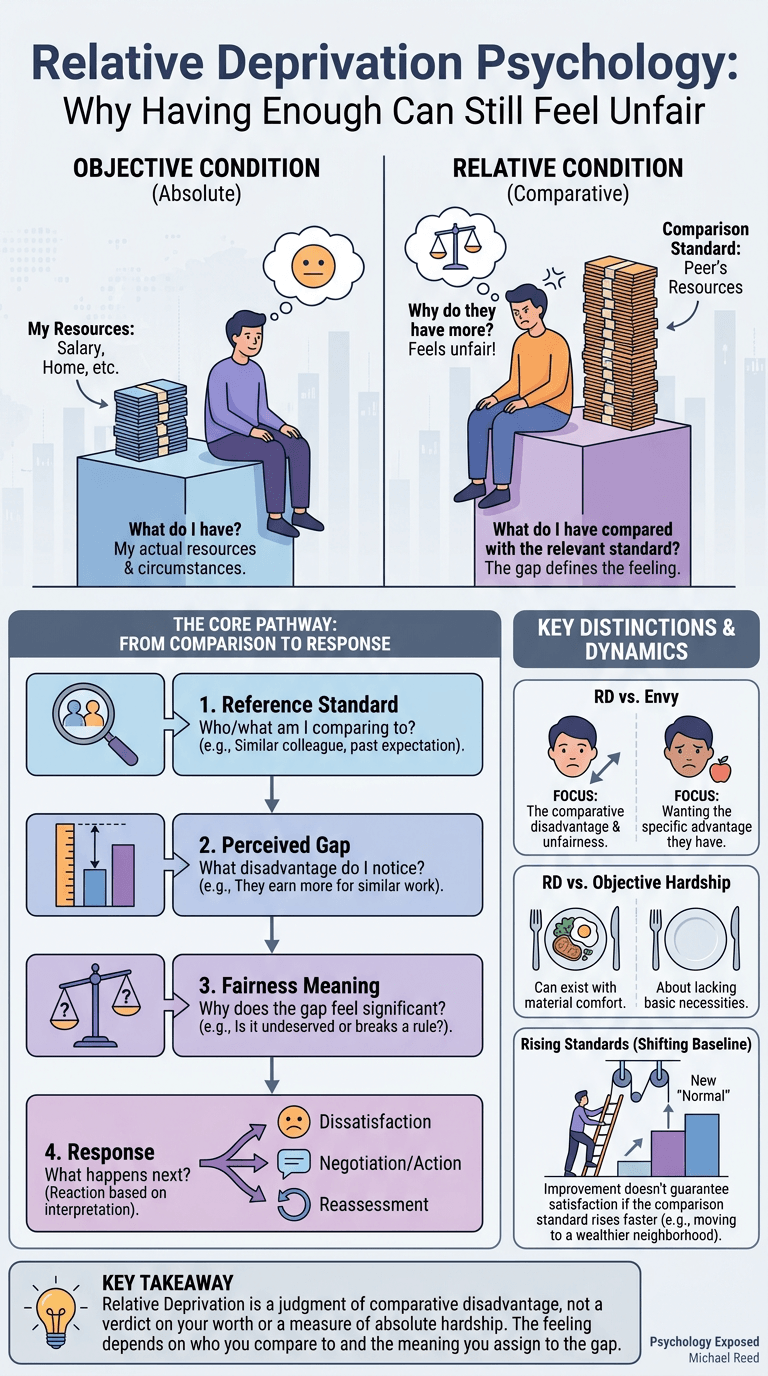
Relative deprivation is the perception that you are disadvantaged compared with a relevant person, group, expectation, or standard. The feeling depends on more than the size of the gap. It is stronger when the comparison target matters, the outcome feels deserved or expected, and the discrepancy is interpreted as unfair or consequential. Someone can therefore feel relatively deprived even when their absolute circumstances are stable or improving.
What Relative Deprivation Means
The APA Dictionary of Psychology definition of relative deprivation centers on perceiving that one has less of a desired resource than a comparison standard. That standard may be what a person expected to receive or what other relevant people possess.
This makes relative deprivation different from simply noticing that another person has more. The psychological issue is not only, “They have more than I do.” It is closer to, “Given who I am comparing myself with and what I believe is reasonable, I am getting less than I should.”
Absolute condition: what do I have?
An absolute condition describes the resources, opportunities, outcomes, or circumstances you actually have. Your salary, test score, housing situation, access to training, amount of recognition, or number of available opportunities can all be described in absolute terms.
Absolute conditions matter. If someone cannot meet basic needs, lacks access to essential care, or faces concrete barriers, those circumstances should not be reduced to a comparison problem. Relative deprivation is not a replacement for measuring material hardship or structural disadvantage.
At the same time, absolute conditions do not fully explain how satisfied or disadvantaged people feel. Two people with similar resources may evaluate their situations very differently because they use different standards.
Relative condition: what do I have compared with the relevant standard?
A relative condition asks where your situation stands in relation to something else. That “something else” might be a coworker with similar responsibilities, people your age, neighbors, classmates, siblings, members of the same profession, or an expectation you formed earlier.
The same salary can feel generous in one comparison context and disappointing in another. The same test score can feel strong in one classroom and weak in another. The resource has not changed, but the frame used to judge it has.
This is why relative deprivation is best understood as a comparison-based judgment rather than a simple measure of how much someone possesses.
The Core Pathway: Reference Standard → Perceived Gap → Fairness Meaning → Response
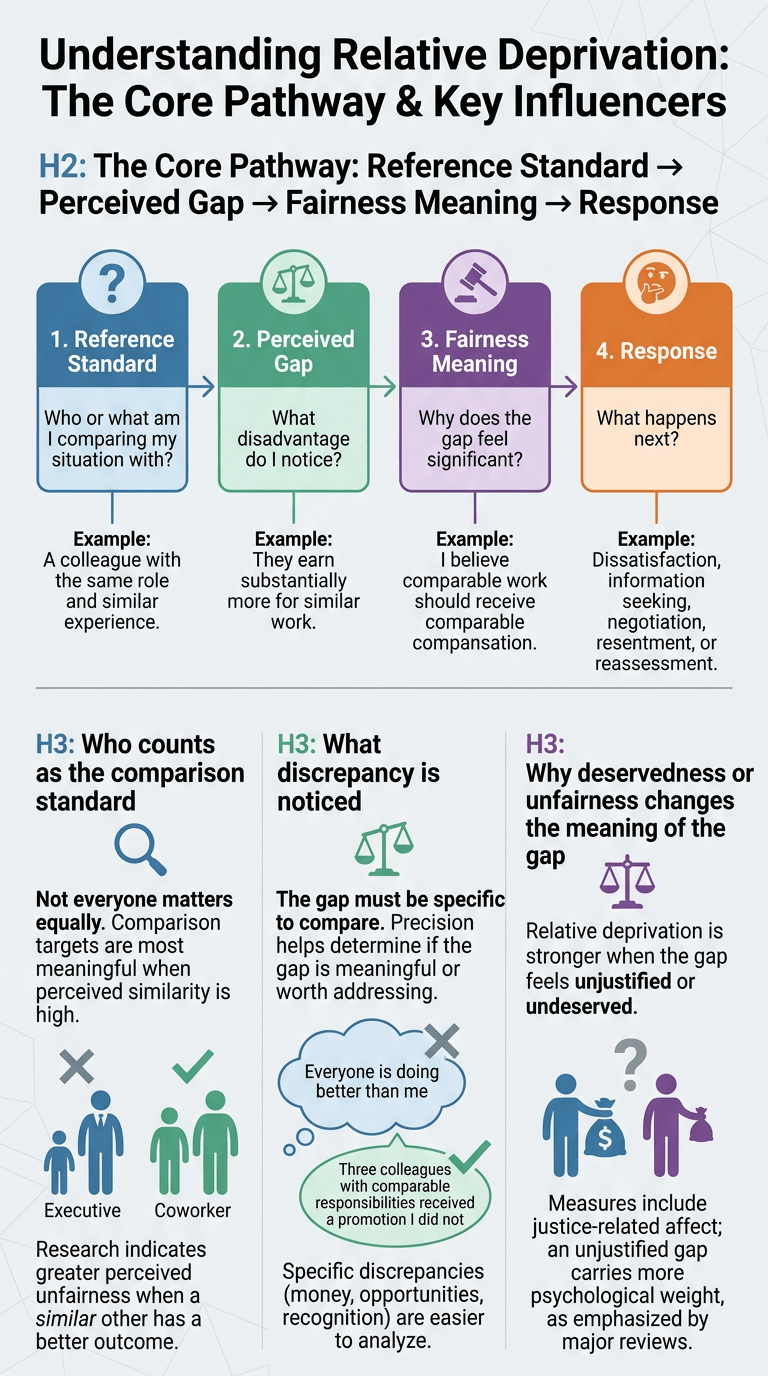
A useful way to understand relative deprivation is to separate four steps that often collapse into one reaction.
| Step | Question | Example |
|---|---|---|
| Reference standard | Who or what am I comparing my situation with? | A colleague with the same role and similar experience. |
| Perceived gap | What disadvantage do I notice? | They earn substantially more for similar work. |
| Fairness meaning | Why does the gap feel significant? | I believe comparable work should receive comparable compensation. |
| Response | What happens next? | Dissatisfaction, information seeking, negotiation, resentment, or reassessment. |
Who counts as the comparison standard
Not everyone matters equally as a comparison target. A famous executive may earn far more than you do, but that gap may feel psychologically irrelevant if their role, experience, industry, and circumstances are completely different. A coworker doing nearly identical work may carry much more weight.
Research on personal relative deprivation has found that perceived similarity can make a comparison target especially meaningful. In a series of studies on financial comparisons, people were more likely to experience perceived unfairness and dissatisfaction when a similar other had a better outcome. The mechanism is described in research on social comparison processes in personal relative deprivation.
What discrepancy is noticed
The gap can involve money, promotion, grades, opportunities, recognition, housing, access, workload, or other outcomes. The important point is that the discrepancy is specific enough to compare.
“Everyone is doing better than me” is too broad to analyze. “Three colleagues with comparable responsibilities received a promotion opportunity I did not receive” is much more precise. Precision makes it easier to determine whether the gap is meaningful, temporary, explained by another factor, or worth addressing.
Why deservedness or unfairness changes the meaning of the gap
Relative deprivation is stronger when the gap feels unjustified. If you expect a more experienced person to earn more, the difference may not feel depriving. If you learn that someone with the same role, experience, and performance receives much more, the same-sized gap can take on a different meaning.
A major theoretical and meta-analytic review found that relative deprivation measures were more strongly related to outcomes when they included justice-related affect and when the level of the comparison matched the outcome being studied. That review, available through PubMed’s record for the relative deprivation meta-analysis, also emphasizes that relative deprivation is more than a simple calculation of who has less.
Why Not Every Unfavorable Comparison Becomes Relative Deprivation
Seeing someone ahead of you does not automatically create relative deprivation. You can recognize a disadvantage without feeling deprived, wronged, or resentful. Several filters determine whether the gap takes on that meaning.
Relevance of the standard
A standard has more psychological force when it seems appropriate to the question. If you are judging entry-level pay, a senior executive is a poor benchmark. If you are judging whether your learning pace is typical for a beginner, a world-class expert is equally unhelpful.
Relevant standards tend to share features that matter to the outcome, such as experience, role, opportunity, age, training, or local context. Similarity is not everything, but it often helps explain why one comparison feels personally important while another is merely interesting.
Expectations and perceived legitimacy
People also compare outcomes with expectations. You may feel relatively deprived when reality falls below what you reasonably anticipated, even if no single person is the comparison target.
Suppose a company publicly states that promotions follow transparent performance criteria. If your results meet those criteria but you are repeatedly passed over without explanation, the discrepancy may feel more significant because the expectation was explicit. By contrast, if advancement depends on a credential you do not yet have and the requirement was clear, the same lack of promotion may be easier to interpret as legitimate.
Whether the discrepancy matters in the focal domain
Comparison only becomes psychologically powerful when the domain matters enough. You may discover that a neighbor has a much larger garden and feel almost nothing because gardening is not important to you. The same person may feel strongly about having fewer professional opportunities than peers because career development is central to their current goals.
Domain relevance helps explain why an identical numerical gap can be emotionally neutral in one area and highly consequential in another.
Individual Relative Deprivation
Individual relative deprivation concerns a perceived disadvantage affecting you personally. The reference point may be another individual, a peer group, an expectation, or a set of similar others.
Pay, promotion, recognition, housing, academic outcomes, and opportunity examples
| Situation | Possible comparison | What may create relative deprivation |
|---|---|---|
| Pay | Similar colleagues earn more | The work and experience appear comparable, so the difference feels difficult to justify. |
| Promotion | Peers advance sooner | The person believes they met the stated criteria but did not receive the same opportunity. |
| Recognition | Comparable contributions receive more credit | The discrepancy feels tied to acknowledgment that the person expected to share. |
| Housing | People in a similar life stage have more space or security | The standard changes what feels normal or adequate. |
| Academic outcomes | Classmates with similar preparation score higher | The gap may challenge expectations about effort, access, or opportunity. |
| Opportunity | Similar people receive training or access | The unequal access feels consequential for future progress. |
None of these situations proves that unfair treatment occurred. They show the kinds of comparisons that can produce a sense of relative disadvantage. A careful evaluation still requires evidence about responsibilities, criteria, resources, timing, and other relevant differences.
Why objective improvement can coexist with growing dissatisfaction
Imagine that your salary rises by 8 percent. In absolute terms, you are better paid than last year. A week later, you learn that coworkers with comparable responsibilities received 15 percent increases. Your objective situation improved, but your comparative position may now feel worse than expected.
This does not mean the raise had no value. It means that satisfaction is being influenced by two pieces of information at once: “I have more than before” and “I received less improvement than people I consider comparable.” Both can be true.
Open-access research distinguishes subjective relative deprivation from objective indicators precisely because perceived disadvantage and measured disadvantage are related but not identical. A recent study comparing objective and subjective relative deprivation illustrates why researchers measure these as separate constructs rather than assuming one fully represents the other.
Group Relative Deprivation at an Introductory Level
Relative deprivation can also be experienced at the group level. Here the comparison is not simply “I have less than another person.” It is “people like us are receiving less than another relevant group” or “our group is not receiving what we believe it should.”
Comparing the outcomes of people like us with another group
A student may think, “Students in our program receive fewer internship opportunities than students in a comparable program.” Employees in one department may believe their unit receives fewer resources than another department with similar demands. Residents of one community may compare access to services with a neighboring community.
Research distinguishes personal and group forms because the level of comparison matters. A person can feel personally well treated while believing their group is disadvantaged, or personally deprived without seeing their wider group as deprived. Work on group membership and everyday social comparison discusses how personal and group-based comparisons operate differently.
Keep group-level findings distinct from conclusions about any individual
Group-level relative deprivation does not tell you what every member thinks, feels, or will do. People differ in which groups matter to them, how they interpret disparities, and whether they see the comparison as legitimate.
This is also where relative deprivation should not be collapsed into Social Identity Theory. Group membership can shape comparison, but a theory of group identity asks different questions about how membership becomes part of the self. Relative deprivation is narrower: it concerns perceived comparative disadvantage.
Absolute vs Relative Disadvantage
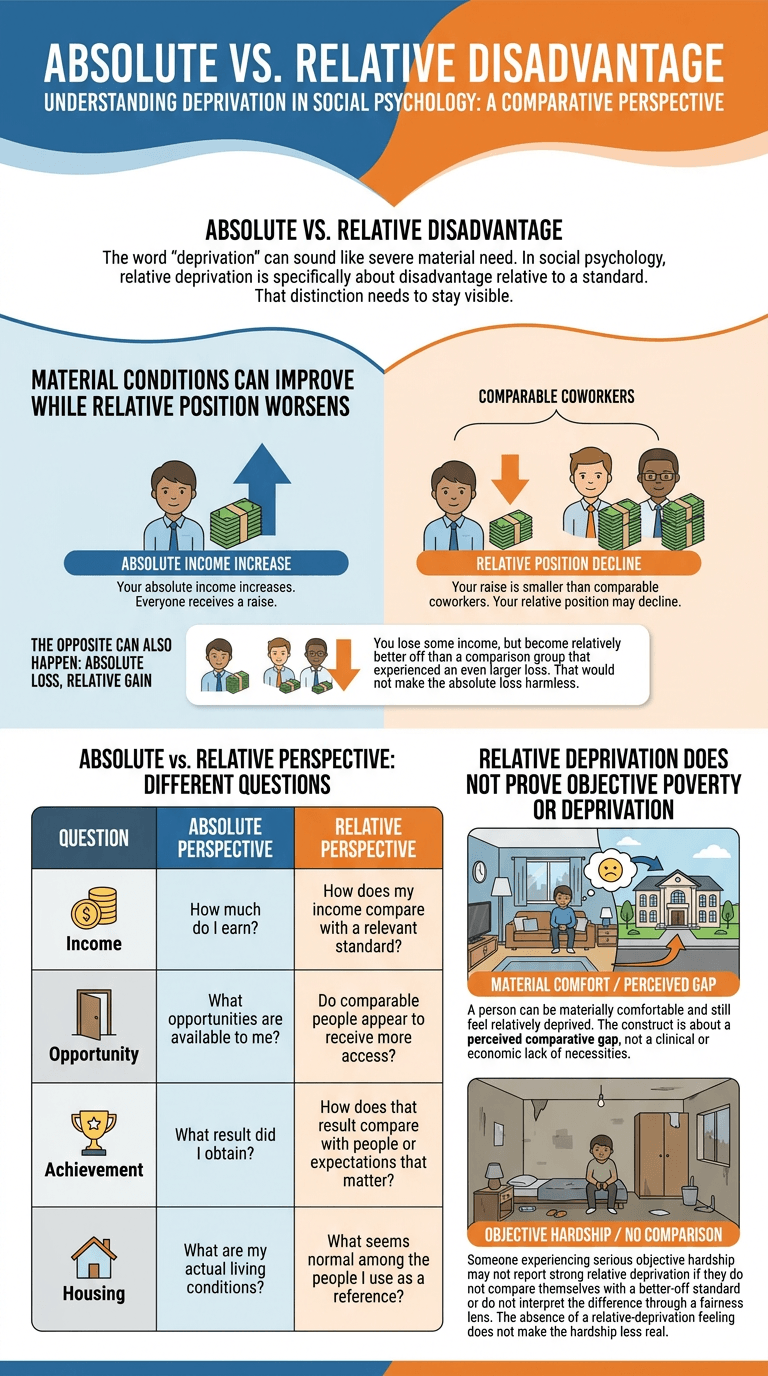
The word “deprivation” can sound as if the concept always refers to severe material need. In social psychology, relative deprivation is specifically about disadvantage relative to a standard. That distinction needs to stay visible.
Material conditions can improve while relative position worsens
Suppose everyone in a workplace receives a raise, but your raise is much smaller than the increases received by comparable coworkers. Your absolute income increases. Your relative position may decline.
The opposite can also happen. You could lose some income while becoming relatively better off than a comparison group that experienced an even larger loss. That would not make the absolute loss harmless. Relative and absolute information answer different questions.
| Question | Absolute perspective | Relative perspective |
|---|---|---|
| Income | How much do I earn? | How does my income compare with a relevant standard? |
| Opportunity | What opportunities are available to me? | Do comparable people appear to receive more access? |
| Achievement | What result did I obtain? | How does that result compare with people or expectations that matter? |
| Housing | What are my actual living conditions? | What seems normal among the people I use as a reference? |
Relative deprivation does not prove objective poverty or deprivation
A person can be materially comfortable and still feel relatively deprived. That does not mean their perception is fake. It means the construct is about a perceived comparative gap, not a clinical or economic declaration that the person lacks necessities.
Likewise, someone experiencing serious objective hardship may not report strong relative deprivation if they do not compare themselves with a better-off standard or do not interpret the difference through a fairness lens. The absence of a relative-deprivation feeling does not make the hardship less real.
Relative Deprivation vs Envy

“I am comparatively disadvantaged” versus “I want the advantage they have”
Envy and relative deprivation can appear together, but they describe different psychological content. Envy centers on another person possessing an advantage, quality, outcome, or resource that you desire. Relative deprivation centers on the judgment that you are comparatively disadvantaged in a way that feels meaningful or unjustified.
If a colleague receives a prestigious award, you may envy the recognition without believing you were deprived of anything. If coworkers with equivalent responsibilities consistently receive better compensation, you may feel relatively deprived even if you do not personally want to take anything away from them.
Why the two can coexist without being interchangeable
You can both want what someone else has and believe the difference is unfair. In that case envy and relative deprivation may coexist. But one should not be used as proof of the other.
This distinction matters because the useful question changes. With envy, you might ask what the desired advantage represents to you. With relative deprivation, you need to examine the comparison standard, the gap, and why you believe the outcome should have been different.
Relative Deprivation vs Fairness Psychology
Comparative disadvantage as one route to perceived unfairness
Relative deprivation often contains a fairness judgment, but fairness is broader than comparison. You might judge a process unfair because rules were hidden, because one person was denied a voice, or because a procedure was inconsistent even when no obvious comparison target exists.
Relative deprivation is one route to unfairness: “I received less than a relevant standard, and I do not think the difference is justified.”
Procedures, reciprocity, need, and proportionality belong to the broader fairness domain
People can evaluate fairness according to many principles. They may care about equal treatment, proportional reward, reciprocity, need, transparency, or consistency. Relative deprivation does not replace those frameworks.
For this reason, a comparison gap should not be treated as automatic proof that an outcome is unfair. It is evidence that the person perceives a disadvantage. Determining whether the situation is objectively unfair may require information about rules, contributions, constraints, and decision processes.
Relative Deprivation vs Status Threat
Disadvantage is not automatically fear of losing rank or respect
Status threat concerns the possibility that standing, respect, reputation, or rank may decline. Relative deprivation concerns having less than a meaningful comparison standard.
A worker may feel relatively deprived because peers receive better equipment, even if their reputation is secure. Another person may experience status threat because their authority is being challenged, even when their material resources are unchanged. The two experiences can overlap, but they are not the same mechanism.
Rising Reference Standards: Why Better Can Still Feel Like Less
One of the most confusing features of relative deprivation is that improvement does not guarantee satisfaction. Sometimes improvement changes the comparison environment itself.
Peer success, neighborhood standards, and shifting expectations
Consider a freelance designer whose income doubles over several years. Early on, they compare themselves with beginners and feel successful. Later, most of their professional network consists of agency owners earning much more. Their absolute progress is substantial, but the reference standard has moved upward.
A similar shift can happen when someone joins a selective university, moves into a higher-income neighborhood, enters an elite sports club, or starts spending time with highly accomplished peers. The environment changes what feels ordinary.
How a changing comparison pool can move the baseline
When your comparison pool changes, yesterday’s “good” can become today’s “normal.” This does not necessarily mean your standards are wrong. New standards can reveal useful information about possibilities, expectations, or inequities. The problem appears when the new baseline is treated as if it were a neutral fact about what everyone should have.
A practical question is: “Would I judge this outcome the same way if I were comparing it with a different but still relevant group?” If the answer changes dramatically, the reference standard is doing important psychological work.
A Neutral Comparison Check
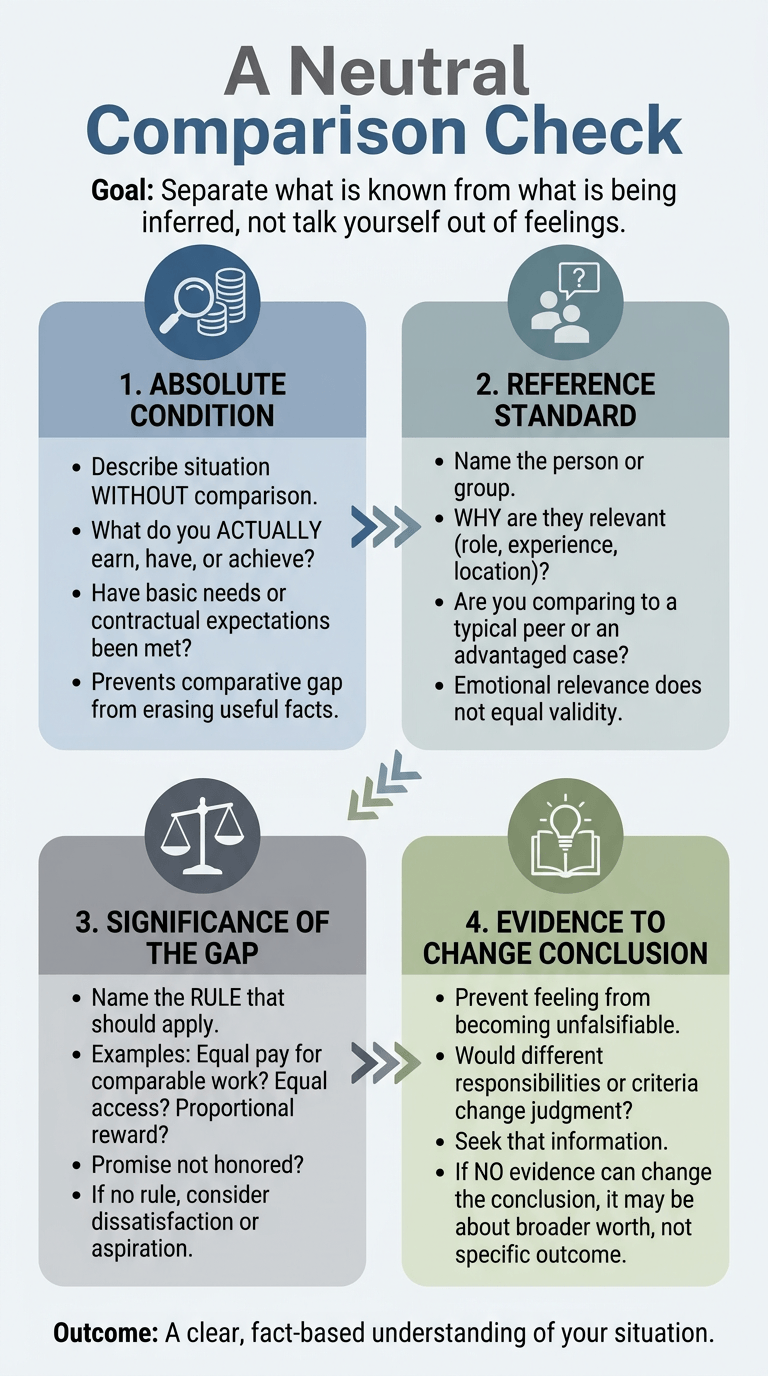
When relative deprivation is driving a strong reaction, the goal is not to talk yourself out of it. The goal is to separate what is known from what is being inferred.
What is my absolute condition?
Describe the situation without comparison first. What do you actually earn, receive, have access to, or achieve? Has that changed over time? Are basic needs, contractual expectations, or concrete requirements being met?
This prevents the comparative gap from erasing useful information about your actual circumstances.
Who is the reference standard and why?
Name the person or group. Then ask why they are relevant. Are they similar in role, experience, workload, location, training, or opportunity? Are you comparing with a typical peer or an unusually advantaged case?
A reference group is not automatically valid because it is emotionally salient.
What makes the gap feel significant or unjustified?
Try to name the rule you believe should apply. Equal pay for comparable work? Equal access to a stated opportunity? Reward proportional to contribution? A promise that was not honored?
If you cannot identify what makes the gap unfair, you may be dealing with dissatisfaction, aspiration, or upward comparison rather than relative deprivation in the narrower sense.
What evidence would change the conclusion?
This question helps prevent a feeling from becoming unfalsifiable. If learning about different responsibilities, experience, performance criteria, or resource constraints would change your judgment, then look for that information.
If no possible evidence could change the conclusion, the comparison may have become tied to a broader story about worth or identity rather than the specific outcome under review.
What to Do Next With the Information
Separate objective needs from relative dissatisfaction
Ask two questions instead of one: “Is there an objective problem I need to solve?” and “Is there a comparative gap that is making the situation feel worse?”
You may discover both. For example, your pay may genuinely be insufficient for your needs, and you may also feel underpaid relative to comparable coworkers. Those are different problems and may require different responses.
Check whether the reference group is appropriate
If your comparison target is unusually privileged, exceptionally successful, or operating under very different conditions, the standard may exaggerate the gap. If the target is highly similar and the rules appear comparable, the comparison may deserve more investigation.
Use several standards when possible. One person can be an anecdote. A pattern across relevant peers, transparent criteria, or reliable benchmark data provides stronger information.
Identify constructive actions without turning comparison into a worth judgment
A relative disadvantage may justify asking for information, requesting transparent criteria, renegotiating compensation, seeking another opportunity, or adjusting expectations. It does not logically justify the conclusion that you are less worthy because someone else has more.
Keep the action tied to the actual gap. “I need clearer promotion criteria” is actionable. “Everyone is ahead, so I am a failure” is global and does not tell you what to do.
If comparison is contributing to persistent hopelessness, severe anxiety or depression symptoms, self-harm thoughts, eating-disorder symptoms, or major impairment in daily life, consider individualized professional support. Relative deprivation is a social-psychological concept, not a diagnosis, and it cannot determine the cause of serious distress on its own.
FAQ
Can someone feel relatively deprived while objectively well off?
Yes. Relative deprivation is defined by comparison with a meaningful standard, not by whether a person meets an external threshold for being well off. Someone can have substantial resources and still believe they are receiving less than comparable others or less than they reasonably expected. That does not prove the situation is objectively unfair, but it fits the psychological structure of relative deprivation.
Is relative deprivation the same as jealousy or envy?
No. Envy focuses on another person having an advantage you desire. Relative deprivation focuses on your own perceived disadvantage relative to a relevant standard, often with a sense that the gap matters or is unjustified. The experiences can overlap, but neither automatically implies the other.
Does feeling unfairly behind mean the situation is objectively unfair?
Not necessarily. The feeling is important information about how you interpret the comparison, but objective fairness may depend on facts you do not yet know. Relevant differences in responsibilities, qualifications, timing, resources, or agreed rules can change the judgment. It is useful to treat the feeling as a reason to investigate rather than as final proof.
Why can a raise still feel disappointing after learning what peers earn?
Because the raise changes your absolute condition while peer information changes your relative condition. You can genuinely be better off than before and still discover that your improvement was smaller than the improvement received by people you consider comparable. The disappointment often comes from the meaning assigned to that gap, especially if you expected similar treatment.
Is group relative deprivation the same as Social Identity Theory?
No. Group relative deprivation concerns the perception that a group is disadvantaged compared with another relevant standard. Social Identity Theory addresses how meaningful group membership becomes part of self-concept and how intergroup processes follow from that identity. Group membership can influence relative deprivation, but the concepts answer different questions.
Key Takeaways
- Relative deprivation is a judgment of comparative disadvantage, not simply a condition of having little.
- The most useful model is: reference standard → perceived gap → fairness meaning → response.
- An unfavorable comparison becomes more powerful when the standard is relevant and the discrepancy feels significant, undeserved, or unfair.
- Absolute conditions and relative position can move in different directions, so improvement can coexist with dissatisfaction.
- Relative deprivation is not interchangeable with envy, broad fairness judgments, status threat, objective poverty, or group identity.
- A careful response separates the actual condition, the comparison standard, the reason the gap feels unfair, and the evidence that could confirm or revise the conclusion.
The most useful next step is not to ask, “Should I stop comparing?” Ask a more precise question: “What standard am I using, what gap am I noticing, and why do I believe that gap should be different?” That turns a vague sense of being behind into something you can evaluate.
Sometimes the answer will be that the reference standard is distorted or unusually selective. Sometimes the comparison will reveal a real discrepancy worth investigating. Either way, the comparison is information about a relationship between your situation and a standard. It is not a verdict on your personal worth.
Michael Reed, Founder & Lead Writer at Psychology Exposed, writes about human behavior, self-awareness, relationships, and everyday psychological patterns in accessible, research-aware language. This educational discussion of relative deprivation is not a diagnosis or a substitute for individualized mental health care.

Michael Reed is the Founder and Lead Writer at Psychology Exposed. He writes about human behavior, relationships, emotional patterns, self-awareness, and practical psychology topics using research-informed, easy-to-understand content.
Read More About Michael Reed: https://psychologyexposed.com/michael-reed/