

You can become more capable and still feel less capable. That sounds contradictory until the comparison environment changes. A student who felt academically strong in one school may enter a highly selective program, perform at roughly the same objective level, and suddenly describe themselves as average. A runner can improve their pace, join a much stronger club, and feel slower. A new employee can be competent, move onto an elite team, and feel inexperienced almost overnight.
The Big-Fish-Little-Pond Effect, usually shortened to BFLPE, is an established finding in educational psychology that helps explain this shift. The strongest evidence concerns academic self-concept: how capable students believe they are academically. The effect does not say that strong environments are bad, that confidence always falls, or that objective performance becomes worse. It shows that self-evaluation is partly contextual because people do not judge ability in a vacuum.
The central distinction is simple: your actual performance, your relative standing, and your self-concept are related, but they are not the same thing.
Quick Answer: Relative Standing Can Change While Objective Ability Stays the Same

The Big-Fish-Little-Pond Effect describes a tendency for equally able students to report lower academic self-concepts when they are surrounded by higher-achieving peers. Their objective ability may not have declined. What changes is the local comparison standard. A person can move from being near the top of one group to near the middle of another, and that shift in relative position can change how capable they feel.
What the Big-Fish-Little-Pond Effect Means
The idea was formalized by Herbert Marsh and John Parker in 1984. Their work examined how the achievement level of the surrounding school context related to students’ academic self-concepts after accounting for individual ability. The pattern became known as the Big-Fish-Little-Pond Effect: students of similar ability can evaluate their academic ability differently depending on the average achievement level of the group around them.
The original Marsh and Parker study helped establish the idea that academic self-concept depends not only on personal performance but also on the frame of reference used to interpret that performance.
The classic academic self-concept context
Academic self-concept is not the same as test score, grade, or general self-esteem. It is a person’s perception of their competence in academic areas, either broadly or in a particular subject. A student can earn a strong math score and still think, “I am not very good at math,” especially when most classmates are performing even higher.
This is why BFLPE research is most precise when it stays close to school and academic self-concept. The effect was developed in educational settings, and later studies repeatedly examined class-average or school-average achievement as the relevant context.
Why the effect concerns local comparison standards
People usually do not interpret numbers without context. A score of 85 may feel excellent in a class where most students score 70, but ordinary in a class where most score 95. The number has not changed. The local standard has.
That local standard is the psychological “pond.” When the pond changes, the meaning of the same performance can change too. BFLPE is therefore a specific example of a broader principle in social comparison: self-evaluation is influenced by the comparison pool that seems relevant.
Same Person, Different Pond
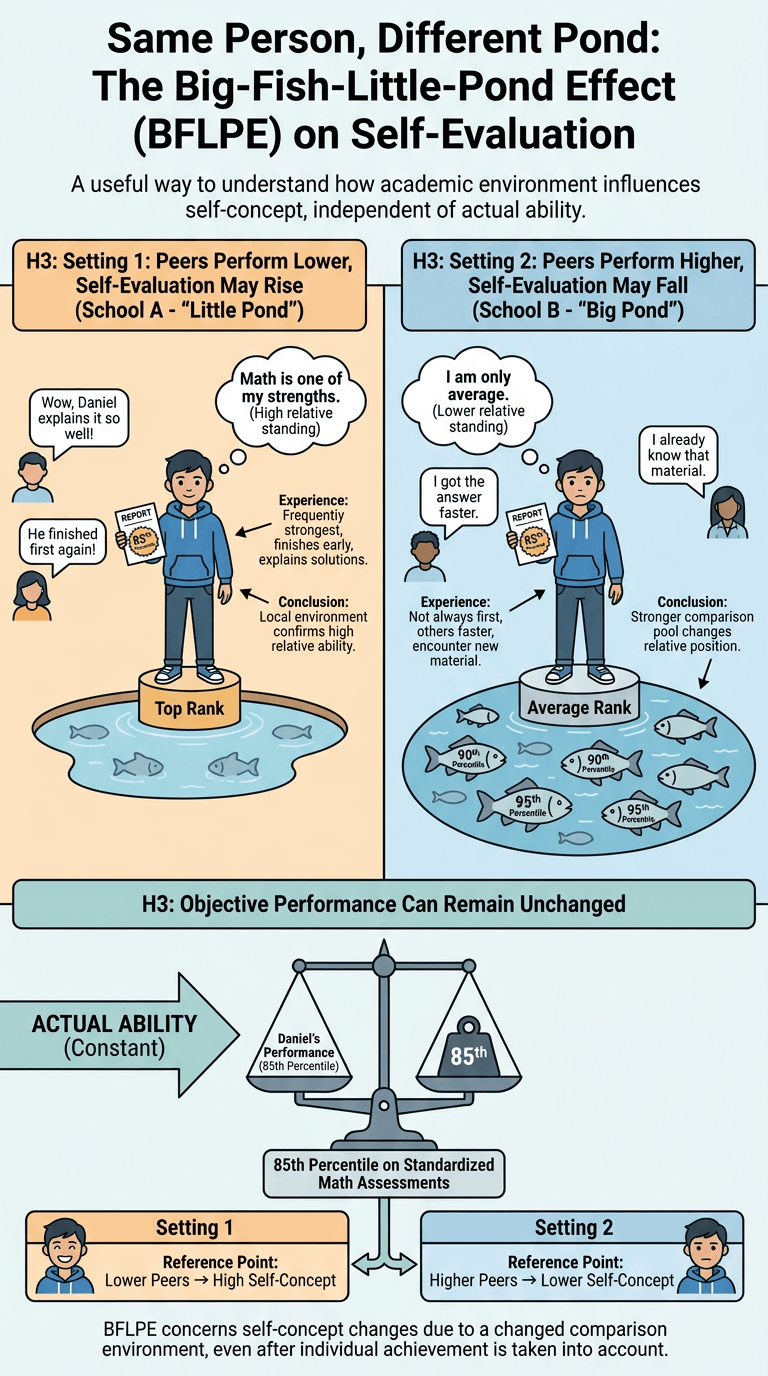
A useful way to understand the effect is to imagine the same person placed in two different academic environments.
Setting 1: peers perform lower, self-evaluation may rise
Imagine a student named Daniel who consistently scores around the 85th percentile on standardized math assessments. In School A, the average peer performs substantially below Daniel. He is frequently one of the strongest students in class, finishes difficult problems early, and is often asked to explain solutions.
Those experiences make his relative standing highly visible. Daniel may reasonably conclude, “Math is one of my strengths.” His objective performance contributes to that judgment, but so does the fact that the local environment repeatedly confirms that he is doing well relative to others around him.
Setting 2: peers perform higher, self-evaluation may fall
Now place Daniel in School B, a selective program where many students also score at or above the 85th percentile. Daniel’s test performance does not suddenly collapse, but his rank within the local group changes. He may no longer finish first. Other students may answer questions faster or know material he has not seen.
Daniel can now interpret the same level of ability as evidence that he is “only average.” The comparison pool has become stronger, so the same performance occupies a different relative position.
Objective performance can remain unchanged
This is the part people often miss. BFLPE is not simply a story about someone performing worse after entering a harder environment. It concerns the possibility that self-concept changes even after individual achievement is taken into account.
That distinction matters because a person may respond to a changed comparison environment by concluding that their ability has disappeared. A better interpretation may be that their reference point changed.
Objective Ability vs Relative Rank vs Self-Concept
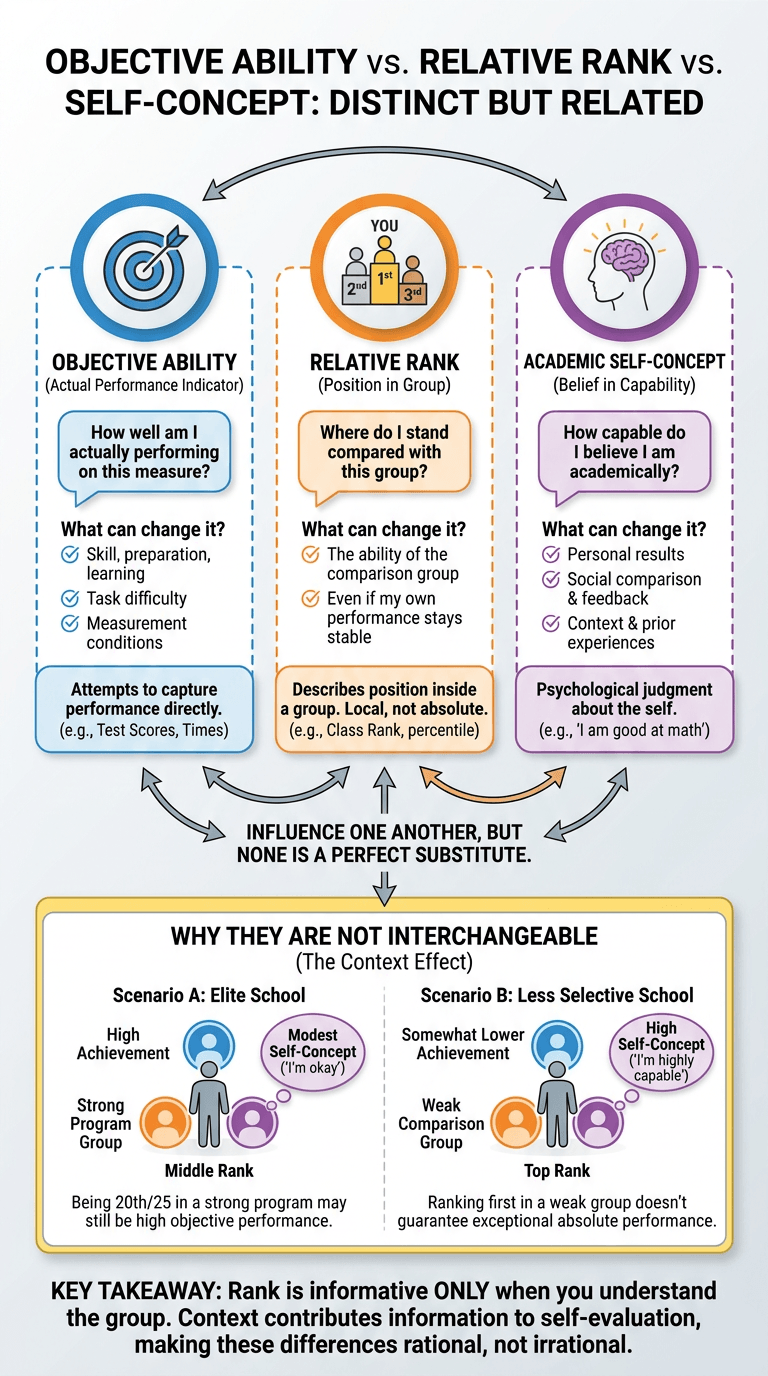
These three ideas are easy to collapse into one, especially in competitive environments. Separating them makes the effect much easier to understand.
| Construct | Question it answers | What can change it |
|---|---|---|
| Objective performance or ability indicator | How well am I actually performing on this measure? | Skill, preparation, learning, task difficulty, measurement conditions |
| Relative rank | Where do I stand compared with this group? | The ability of the comparison group, even if my own performance stays stable |
| Academic self-concept | How capable do I believe I am academically? | Personal results, social comparison, feedback, context, prior experiences |
What each variable measures
Objective indicators attempt to capture performance directly. Relative rank describes position inside a group. Self-concept is a psychological judgment about the self. They influence one another, but none is a perfect substitute for the others.
A student can have high achievement, middle rank in an elite school, and a modest academic self-concept at the same time. Another student with somewhat lower achievement may rank near the top of a less selective school and see themselves as highly capable. That difference does not prove that either student is irrational. It shows that context contributes information to self-evaluation.
Why they should not be treated as interchangeable
Relative rank answers a local question. It does not automatically answer an absolute one. Being twentieth out of twenty-five students in an unusually strong program may still represent a high level of performance in a broader population.
The reverse is also true. Ranking first in a weak comparison group does not guarantee exceptional absolute performance. Rank is informative, but only when you understand the group that produced it.
How the Reference Group Creates Context
BFLPE depends on a reference group because people need some standard against which to interpret their standing. In school settings, classmates and schoolmates often become especially salient standards because students encounter their performance repeatedly.
Local peer achievement as a comparison standard
If nearly everyone around you solves advanced problems quickly, fast problem solving can begin to feel ordinary. If few people around you can do the same work, that ability may feel distinctive. The surrounding group’s average performance changes what counts as “high,” “typical,” or “low” in everyday experience.
This is a contextual comparison process, not a claim that students consciously calculate class averages. People can absorb relative standing through grades, teacher feedback, classroom pace, who answers questions, who receives recognition, and who appears to struggle.
Why selective environments shift the comparison pool
Selective environments intentionally concentrate high performers. That changes the distribution of ability around each student. Someone who was exceptional in a broad population may become typical inside a carefully selected subgroup.
A large cross-cultural study of academically selective schools tested the effect in 26 countries and found negative school-average achievement effects on academic self-concept across all of them. The 26-country BFLPE study is one reason the effect is considered more than a single-school curiosity.
What the Research Is Strongest About
The most responsible way to use BFLPE is to stay close to what has actually been studied. The evidence base is strongest for students, academic achievement contexts, and academic self-concept.
Academic self-concept and school context
A 2018 meta-analysis synthesized 33 studies with 56 effect sizes and more than 1.2 million participants. It found an overall negative association between class or school average achievement and students’ academic self-concept after the relevant individual-level factors were considered. The authors also found variation by age, academic domain, and location.
The open-access BFLPE meta-analysis is especially useful because it shows both robustness and variation. The effect is well supported, but its size is not identical in every population or context.
Probabilistic effects rather than a universal reaction
BFLPE describes a statistical tendency, not a rule that predicts every individual student. A particular student may enter a high-achieving school and become more confident. Another may care little about peer rank. A third may use national test standards rather than classmates as the main reference point.
Individual interpretation still matters. So do feedback, teaching quality, achievement changes, prior identity, subject area, and the specific comparison target. A group-level effect should not be turned into a diagnosis of what one person must be feeling.
Why broad causal claims need care
The research literature includes strong observational, longitudinal, cross-cultural, and multilevel evidence, but readers should still avoid simplistic claims such as “elite schools destroy confidence.” School environments differ in many ways besides peer achievement, and the psychological effect is not the only outcome that matters.
A major review argued that the BFLPE remained robust across many designs and settings while also emphasizing the methodological conditions needed to test it properly. That discussion is available in a review of the BFLPE evidence and methodology.
Stronger Environments Can Bring Benefits and Comparison Costs at the Same Time
One of the most misleading ways to discuss BFLPE is to imply that a stronger peer environment must therefore be a worse environment. That conclusion does not follow.
Opportunities, resources, and challenge can improve
A selective school may provide advanced coursework, highly motivated peers, specialized teachers, stronger academic networks, and more demanding material. Those benefits can matter even if a student’s relative rank falls.
A learner can benefit from the environment and still experience a less favorable self-evaluation. Two outcomes can move in different directions at the same time.
Relative self-evaluation can still become less favorable
Suppose Daniel from the earlier example learns more mathematics in School B than he would have in School A. His objective skill may improve. Yet if his classmates improve even faster or began at a higher level, he may still feel less academically capable relative to them.
This is not a contradiction. Learning is an absolute change in competence. Relative standing is a positional change. Self-concept is an interpretation. They can move together, but they do not have to.
Big-Fish-Little-Pond vs Reference Group Psychology
These ideas are related, but they answer different questions.
General standard-selection process
Reference group psychology asks which people or groups become standards for evaluating oneself. Your reference group might be classmates, coworkers, people in your profession, a local community, or an aspirational group you do not actually belong to.
That is a broad process. It applies to many domains, including income, achievement, lifestyle, skill, and behavior.
Specific contextual effect with an established research tradition
BFLPE is narrower. It examines a particular contextual pattern in which higher average achievement in the surrounding educational environment is associated with lower academic self-concept for students of comparable achievement.
So the reference-group idea helps explain why the effect can happen, while BFLPE names a specific, repeatedly studied phenomenon.
Big-Fish-Little-Pond vs Social Comparison and Self-Evaluation
The broader social-comparison process explains how information about other people can alter a judgment about yourself. BFLPE is one concrete case of that mechanism operating through local achievement context.
One concrete phenomenon versus the broader mechanism
Social comparison can affect self-evaluation in countless settings. You might judge your public speaking, fitness, creativity, parenting, or career progress relative to other people. BFLPE does not claim ownership over all of those comparisons.
Its value is precision. It shows, with a substantial educational research tradition, that the surrounding achievement level can influence academic self-concept even when individual achievement is considered.
What About Workplaces, Sports, and Creator Communities?
The logic of “same ability, stronger comparison pool” is intuitively relevant outside school, but the evidence should not be stretched further than it supports. Workplace, sport, and creator examples are best treated as analogies unless a study directly tests the same mechanism in that domain.
Useful analogies when comparison pools become more selective
A competent software engineer may join a team filled with internationally recognized specialists and suddenly feel mediocre. A strong recreational cyclist may enter an elite club and feel slow. A creator with a successful local audience may enter a professional network where everyone has much larger reach.
In each example, the comparison pool becomes more selective. The person’s absolute skill may be unchanged while relative standing shifts. That resembles the psychological logic of BFLPE.
Why academic evidence should not be assumed to transfer identically
Schools provide structured grades, common curricula, age-group comparisons, and repeated achievement feedback. Workplaces and online communities may have different incentives, visibility, selection processes, and definitions of success. Those differences can change how comparison operates.
So it is reasonable to use BFLPE as a lens for reflection outside education, but not to claim that every elite team or professional community produces the same measured effect.
A Context Check When You Suddenly Feel Less Capable
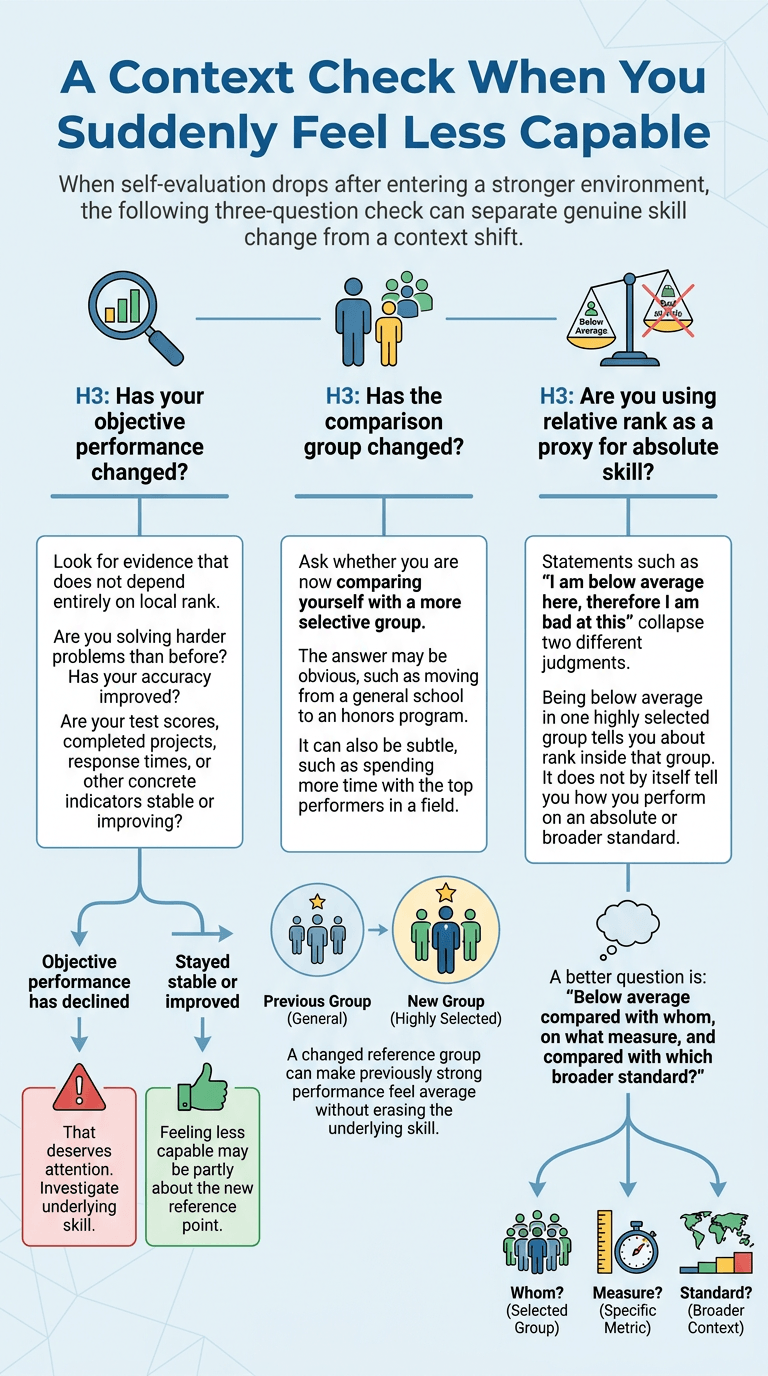
When self-evaluation drops after entering a stronger environment, the following three-question check can separate genuine skill change from a context shift.
Has your objective performance changed?
Look for evidence that does not depend entirely on local rank. Are you solving harder problems than before? Has your accuracy improved? Are your test scores, completed projects, response times, or other concrete indicators stable or improving?
If objective performance has declined, that deserves attention. If it has stayed stable or improved, feeling less capable may be partly about the new reference point.
Has the comparison group changed?
Ask whether you are now comparing yourself with a more selective group. The answer may be obvious, such as moving from a general school to an honors program. It can also be subtle, such as spending more time with the top performers in a field.
A changed reference group can make previously strong performance feel average without erasing the underlying skill.
Are you using relative rank as a proxy for absolute skill?
Statements such as “I am below average here, therefore I am bad at this” collapse two different judgments. Being below average in one highly selected group tells you about rank inside that group. It does not by itself tell you how you perform on an absolute or broader standard.
A better question is: “Below average compared with whom, on what measure, and compared with which broader standard?”
What to Do Next With a Changed Comparison Pool
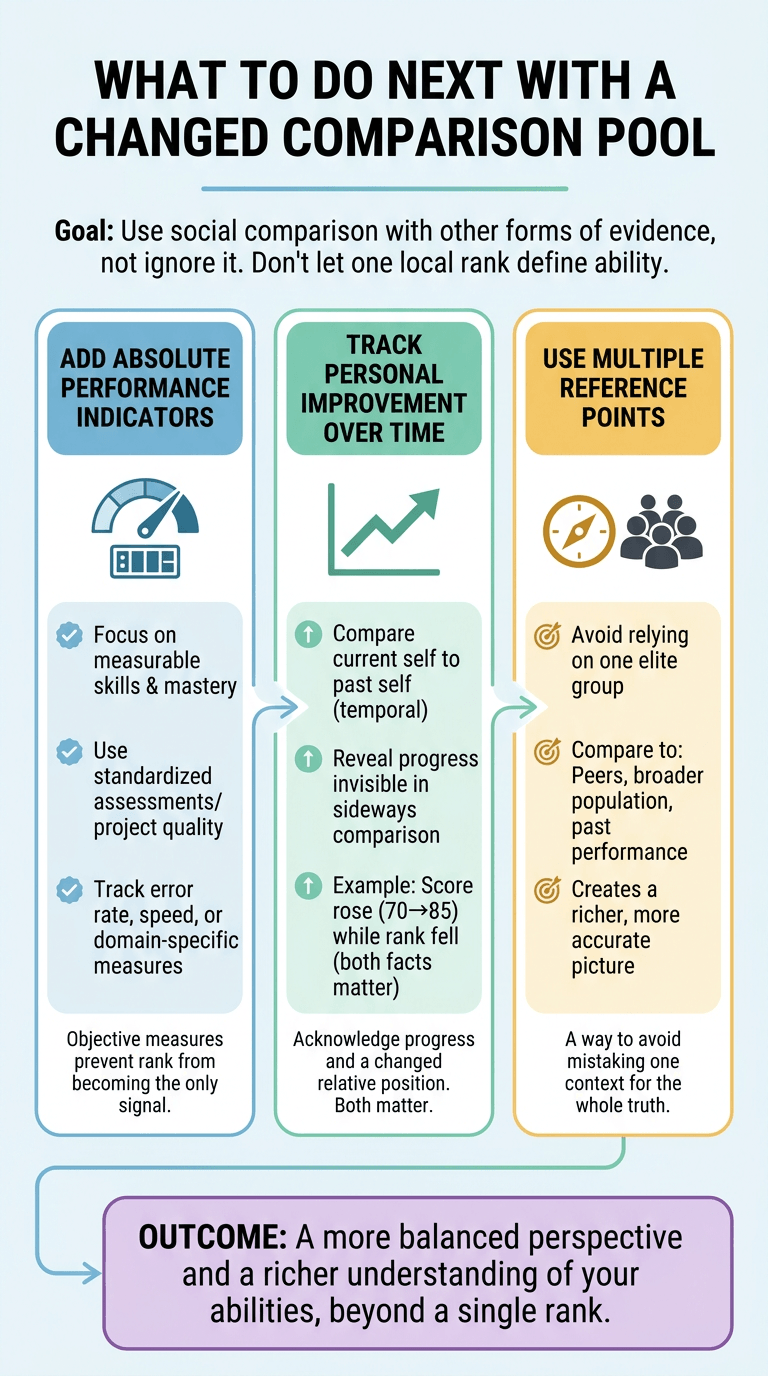
The goal is not to ignore comparison. Social comparison can be useful. The goal is to add other forms of evidence so one local rank does not become the entire definition of ability.
Add absolute performance indicators
Use measures that track what you can actually do. In school, that might include standardized assessments, mastery of learning objectives, or performance on comparable tasks across time. In an analogy outside school, it might mean project quality, error rate, speed, or another domain-specific indicator.
Absolute indicators are not perfect, but they prevent local rank from becoming the only signal.
Track personal improvement over time
Temporal comparison asks how you are doing relative to your own earlier performance. This can reveal progress that disappears when you only look sideways at a stronger peer group.
If your math score rose from 70 to 85 while your rank fell because you entered a selective program, both facts matter. You improved, and your relative position changed. Neither should erase the other.
Use multiple reference points rather than one elite group
A single comparison pool can distort perspective when it is unusually selective. You can compare yourself with local peers, broader population benchmarks, your past performance, and task-specific standards. Multiple reference points produce a richer picture.
This is not a way to search for the most flattering comparison. It is a way to avoid mistaking one context for the whole truth.
Common Misinterpretations
BFLPE is memorable, which makes it easy to oversimplify. Three misunderstandings are especially common.
Selective environments are not inherently harmful
The effect concerns academic self-concept, not a total evaluation of school quality. A selective environment may offer benefits that are not captured by self-concept alone. It may also affect different students differently.
The finding should therefore inform how we understand context, not serve as a blanket argument for or against selective education.
Feeling average in an elite group does not prove low ability
This is the practical insight many readers need most. Average is always average relative to a distribution. If the group is highly selected, “average” can still represent very strong absolute performance.
The label becomes misleading when the selection process disappears from view.
The effect is not the same as impostor syndrome
BFLPE describes a contextual social-comparison effect on academic self-concept. “Impostor syndrome” is a popular label often used for persistent doubts about deserving success or fears of being exposed as less capable than others think. They are not interchangeable concepts.
A person can experience a context-driven drop in academic self-concept without feeling fraudulent, and someone can experience impostor-like thoughts without any BFLPE-style change in comparison environment.
FAQ
Is the Big-Fish-Little-Pond Effect only about school?
The strongest evidence is about academic self-concept in educational settings. The underlying idea of local comparison standards may be useful for thinking about other selective environments, but those examples should be treated as analogies unless directly studied. Calling every confidence drop in a high-performing workplace “BFLPE” would go beyond the established evidence.
Can objective performance improve while academic self-concept falls?
Yes. A student can learn more, earn strong scores, and still evaluate their academic ability less favorably if the surrounding comparison group becomes much stronger. A longitudinal study found BFLPE-related self-concept effects that persisted beyond high school, illustrating that contextual self-evaluation can have a different trajectory from raw achievement. The study is described in research on persistent BFLPE effects after graduation.
Does joining a high-performing group always lower confidence?
No. The effect is probabilistic, not universal. Some people may feel energized by stronger peers, receive encouraging feedback, or use broader standards that protect against a drop in self-concept. The research describes an average contextual tendency, not a guaranteed individual response.
Is the effect the same as being intimidated by experts?
No. Feeling intimidated is an emotional reaction. BFLPE is a more specific research pattern involving the relationship between group-average achievement and academic self-concept while considering individual achievement. Intimidation may occur in some cases, but it is not the definition of the effect.
How is BFLPE different from a general reference-group effect?
A general reference-group effect can occur whenever the group used as a standard changes judgment. BFLPE is narrower and has a specific educational research tradition. It focuses on how the achievement level of classmates or schools relates to academic self-concept for students of comparable achievement.
Key Takeaways
- The Big-Fish-Little-Pond Effect explains why students of similar achievement may see their academic ability differently in stronger versus weaker peer environments.
- Objective performance, relative rank, and academic self-concept are connected but should not be treated as the same variable.
- The evidence is strongest in educational psychology, especially academic self-concept and school or class achievement contexts.
- A stronger environment can provide better opportunities while also making relative self-evaluation less favorable.
- Feeling average in a highly selected group does not prove low absolute ability.
- When a new environment changes how capable you feel, check both your objective performance and the comparison pool before drawing a global conclusion about yourself.
Educational note: This article explains a research concept in educational and social psychology. It does not diagnose confidence problems or determine whether a particular school, program, workplace, or community is right for an individual.

Michael Reed is the Founder and Lead Writer at Psychology Exposed. He writes about human behavior, relationships, emotional patterns, self-awareness, and practical psychology topics using research-informed, easy-to-understand content.
Read More About Michael Reed: https://psychologyexposed.com/michael-reed/