
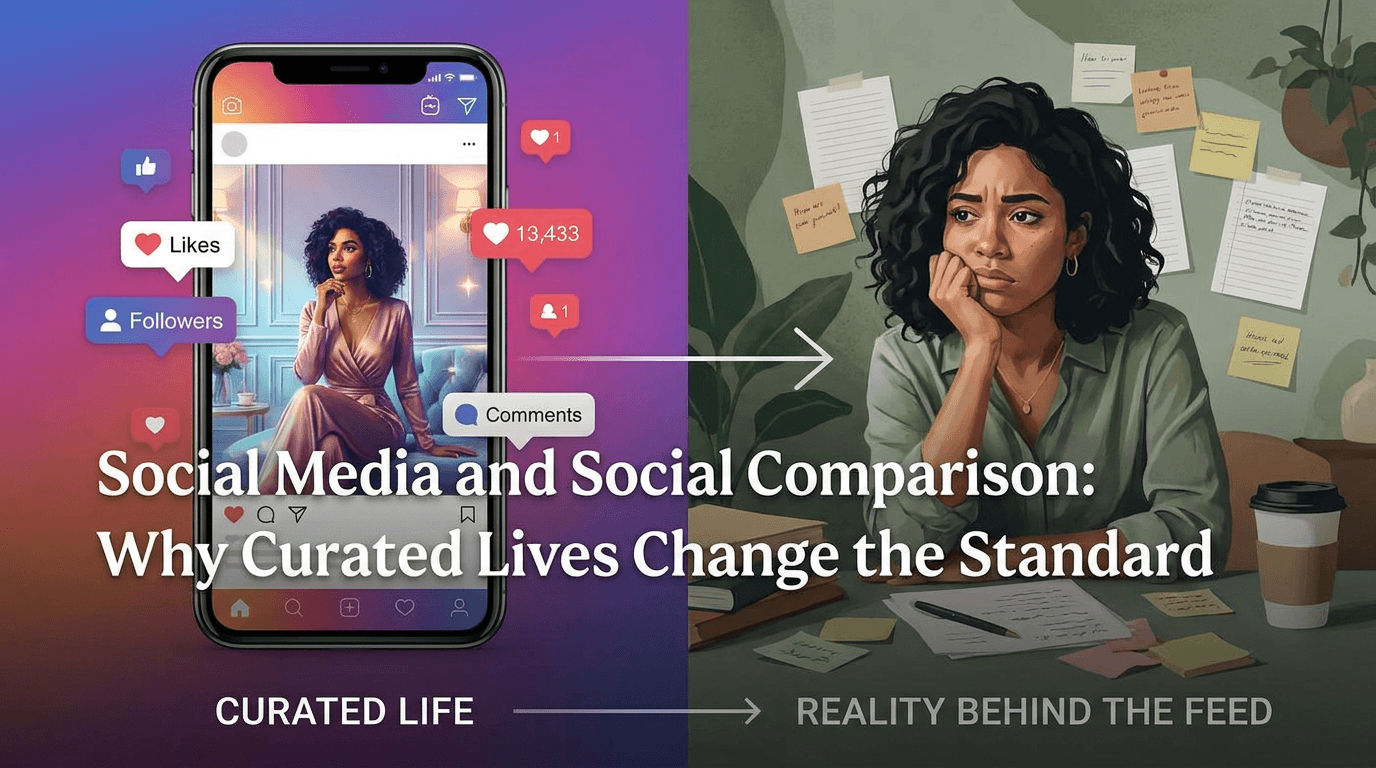
Social media can make comparison feel unusually immediate. A promotion, a polished home, a fitness milestone, a viral post, a family trip, or a creator’s rapid growth can appear beside one another in a few minutes of scrolling. The result is not simply “more information.” It is a stream of people, outcomes, and numbers that can quietly change what looks normal, impressive, late, successful, attractive, or achievable.
That does not mean social media comparison is automatically harmful. Online comparison can help you discover what is possible, learn how other people solve problems, find realistic peers, identify useful benchmarks, or notice progress you want to make. The difficulty begins when a selective feed is treated as if it were a complete sample of reality, or when a visible gap is turned into a sweeping judgment about your own life.
The most useful question is therefore not, “Is social media bad for comparison?” It is, “What comparison did this environment invite me to make, and how much information do I actually have about the standard I am using?”
Quick Answer: Social Platforms Increase Comparison Opportunities, Not One Guaranteed Outcome
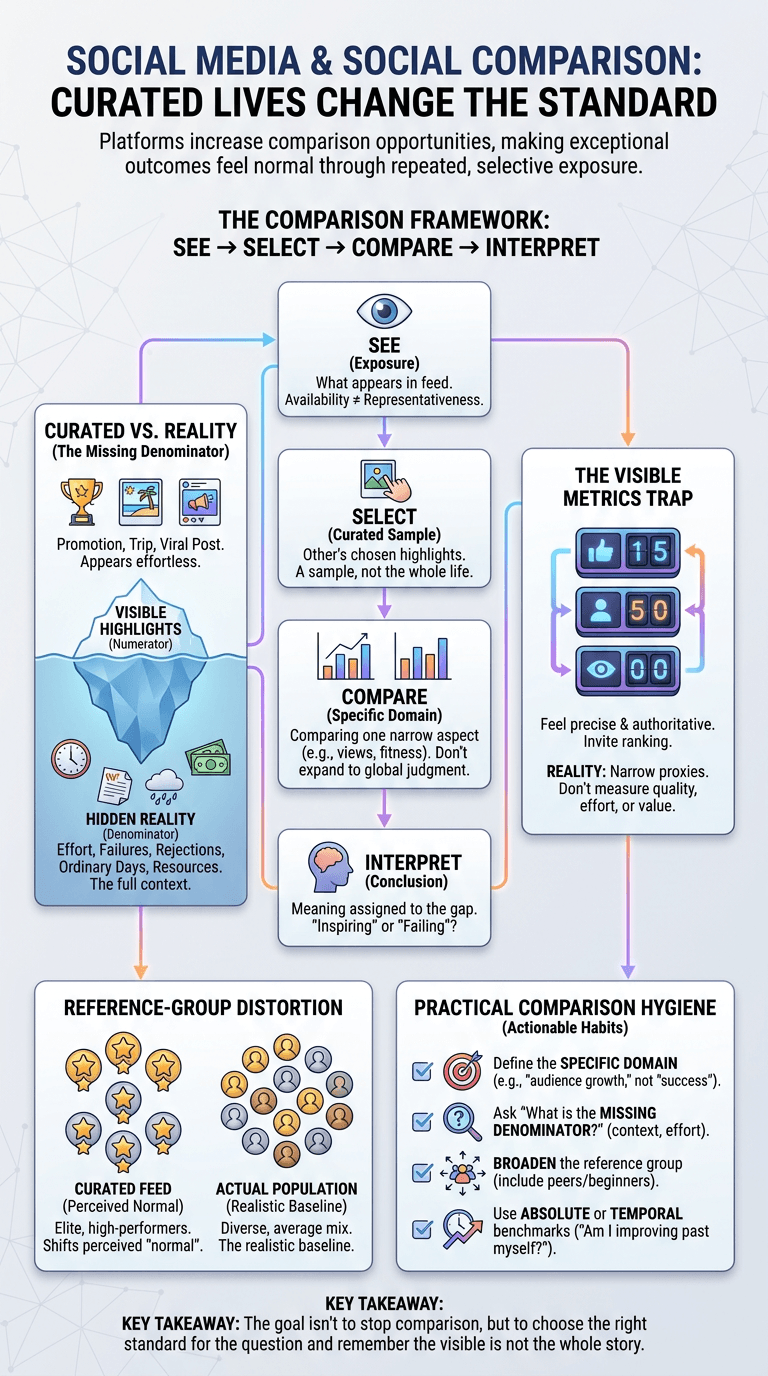
Social media can intensify social comparison because it makes other people’s achievements, appearances, opinions, lifestyles, and popularity cues highly visible and repeatable. The effect depends on what you see, what the other person selected to show, which domain you compare, and what meaning you assign to the gap. Online comparison can inform, inspire, discourage, distort, or barely affect you.
Why Social Media Is a Comparison-Dense Environment
People have always compared themselves with friends, coworkers, neighbors, family members, public figures, and strangers. What changes online is the density and structure of the information. A person can encounter dozens or hundreds of potential comparison standards in a short period, often without deliberately deciding to compare.
A peer-reviewed scoping review of everyday social comparison methods emphasizes that comparison is a dynamic process that varies by target, domain, direction, similarity, and context. Social media adds another setting in which these features can shift rapidly from one post to the next.
More visible people, outcomes, and metrics
Offline, you may know roughly how a few coworkers are doing, how fast your usual running partners are, or how often close friends travel. Online, the comparison pool can expand far beyond people you know personally. You may see elite professionals, hobbyists, celebrities, former classmates, niche experts, beginners, and carefully branded creators in the same session.
Social platforms also make some outcomes numerically visible. Followers, views, likes, shares, comments, rankings, streaks, ratings, subscriber counts, and public milestones can act as ready-made comparison cues. They reduce a messy social reality to a number that looks precise, even when the number is only a partial measure of what you care about.
Repeated exposure to selected information
Repetition matters because a standard can start to feel ordinary simply through frequent exposure. Seeing one person announce a major achievement may register as unusual. Seeing twenty achievements in a week can create the impression that “everyone is moving faster,” even when those twenty people came from a much larger and more ordinary population.
This is one reason a feed can change perceived normality without anyone lying. Selection alone can do it. People are more likely to post some moments than others, and you are more likely to remember some posts than the quiet stretches between them.
The Framework: SEE → SELECT → COMPARE → INTERPRET
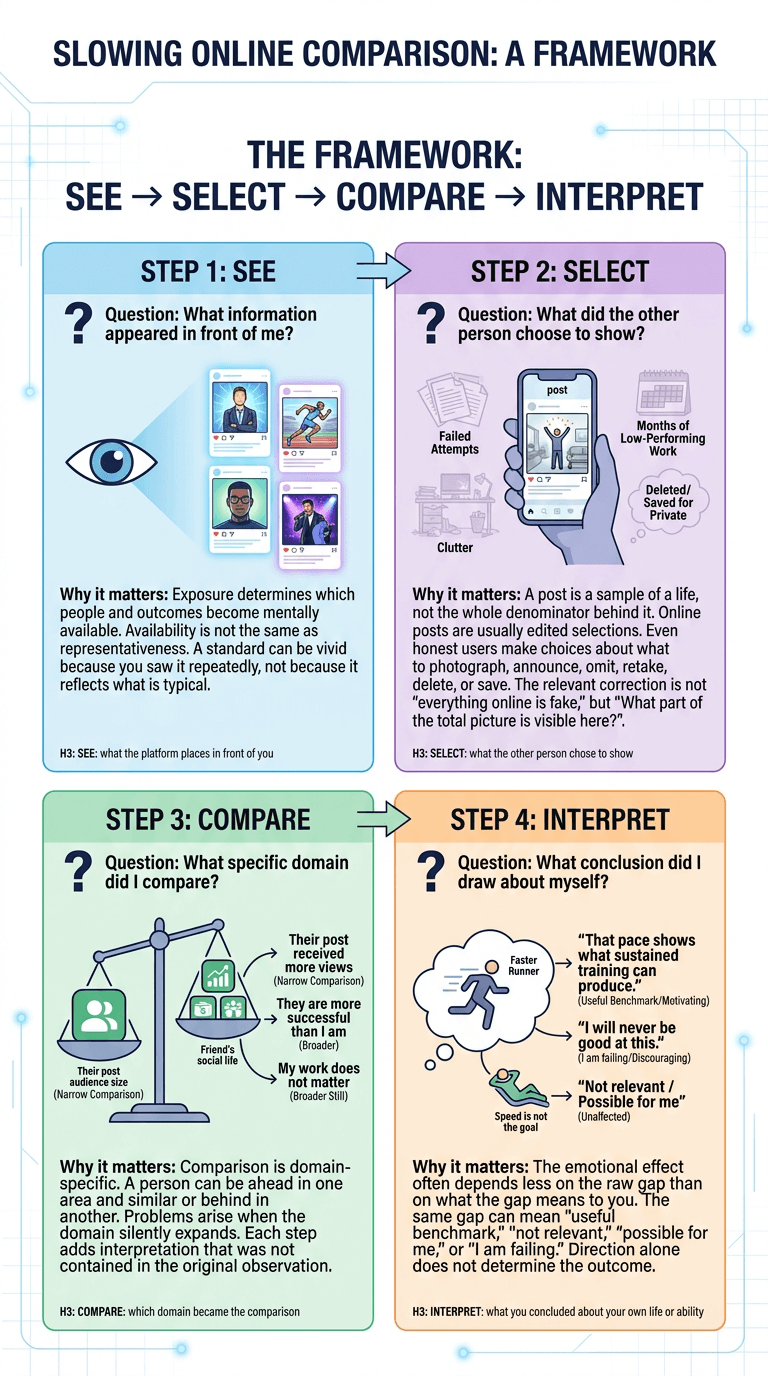
A useful way to slow online comparison is to separate four steps that often collapse into one reaction.
| Step | Question | Why it matters |
|---|---|---|
| SEE | What information appeared in front of me? | Exposure determines which people and outcomes become mentally available. |
| SELECT | What did the other person choose to show? | A post is a sample of a life, not the whole denominator behind it. |
| COMPARE | What specific domain did I compare? | A person can be ahead in one area and similar or behind in another. |
| INTERPRET | What conclusion did I draw about myself? | The same gap can mean “useful benchmark,” “not relevant,” “possible for me,” or “I am failing.” |
SEE: what the platform places in front of you
You do not compare yourself with every possible person. You compare yourself with the people and standards that become available and relevant. If your feed contains many advanced designers, highly productive founders, experienced parents, elite athletes, or professional performers, those examples can become easier to retrieve when you judge yourself.
Availability is not the same as representativeness. A standard can be vivid because you saw it repeatedly, not because it reflects what is typical.
SELECT: what the other person chose to show
Online posts are usually edited selections. Even honest users make choices about what to photograph, announce, explain, omit, retake, delete, or save for private conversation. A successful project may be shown without the failed attempts. A polished room may be shown without the clutter just outside the frame. A creator may celebrate a viral result without displaying months of low-performing work.
The relevant correction is not “everything online is fake.” That is too cynical and often inaccurate. A better question is, “What part of the total picture is visible here, and what would I need to know before treating this as a fair standard?”
COMPARE: which domain became the comparison
Comparison is domain-specific. You may compare one creator’s audience size, another person’s consistency, a colleague’s income, a friend’s social life, and an athlete’s fitness. Those are different judgments, even if they all happen during the same scrolling session.
Problems arise when the domain silently expands. “Their post received more views” is a narrow comparison. “They are more successful than I am” is broader. “My work does not matter” is broader still. Each step adds interpretation that was not contained in the original observation.
INTERPRET: what you concluded about your own life or ability
The emotional effect often depends less on the raw gap than on what the gap means to you. An experienced runner may see a faster runner and think, “That pace shows what sustained training can produce.” Another person may think, “I will never be good at this.” A third may not care because speed is not the goal.
This is why the same post can motivate one person, discourage another, and leave someone else unaffected. Direction alone does not determine the outcome.
Curated Self-Presentation and the Missing Denominator
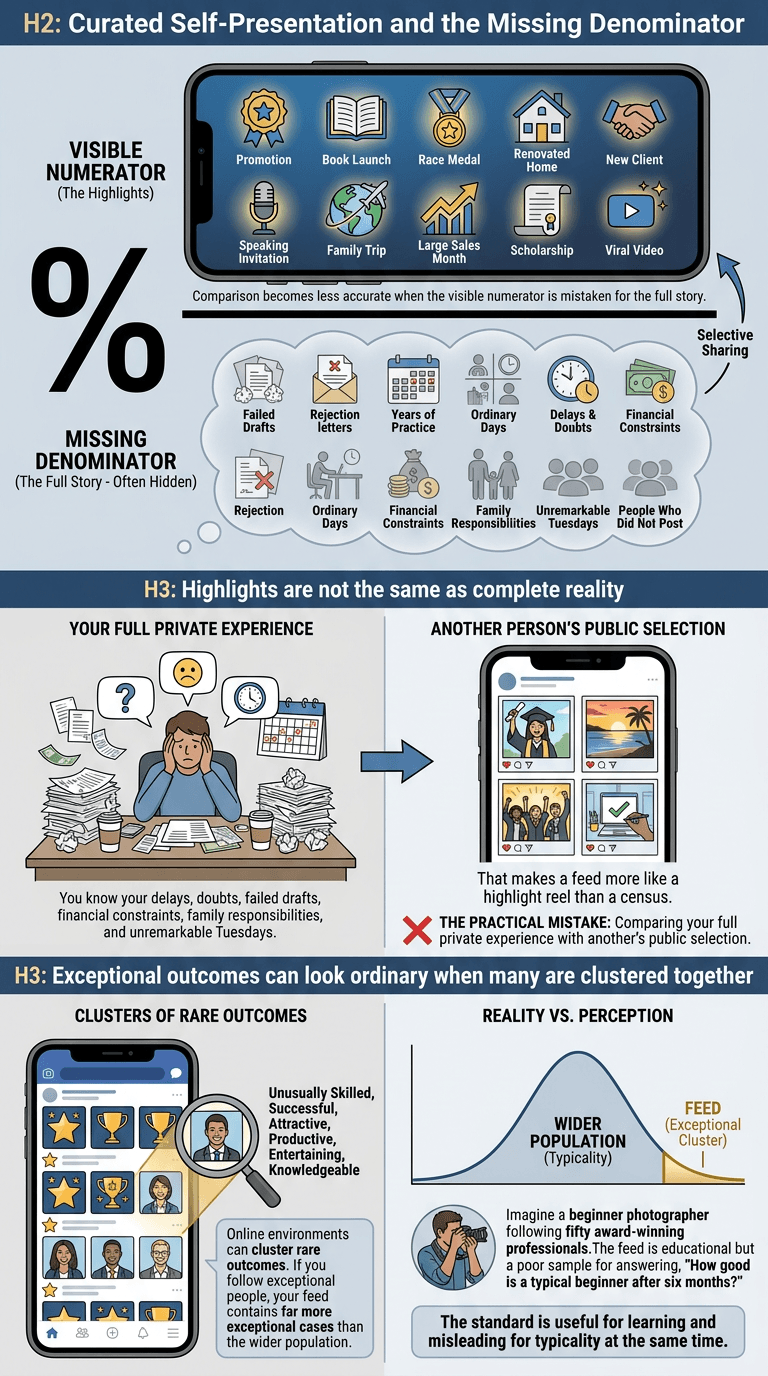
Comparison becomes less accurate when the visible numerator is mistaken for the full story. Suppose you see ten impressive outcomes: a promotion, a book launch, a race medal, a renovated home, a new client, a speaking invitation, a family trip, a large sales month, a scholarship, and a viral video. The feed shows ten successes. It usually does not show the total number of attempts, rejections, resources, years of practice, ordinary days, or people who did not post anything.
Highlights are not the same as complete reality
Selective presentation does not require deception. People naturally share moments they consider meaningful, attractive, funny, useful, or socially appropriate. That makes a feed more like a highlight reel than a census.
The practical mistake is comparing your full private experience with another person’s public selection. You know your delays, doubts, failed drafts, financial constraints, family responsibilities, and unremarkable Tuesdays. You may know almost none of theirs.
Exceptional outcomes can look ordinary when many are clustered together
Online environments can cluster rare outcomes. If you follow people because they are unusually skilled, successful, attractive, productive, entertaining, or knowledgeable, your feed may contain far more exceptional cases than the wider population.
Imagine a beginner photographer who follows fifty award-winning professionals. The feed may be educational and inspiring, but it is a poor sample for answering, “How good is a typical beginner after six months?” The standard is useful for learning and misleading for typicality at the same time.
Visible Metrics as Comparison Cues
Numbers feel authoritative. A follower count appears exact in a way that “influence,” “skill,” “trust,” or “quality” does not. That can make metrics psychologically sticky, even when they are only rough proxies.
Followers, likes, views, engagement, and public rankings
Visible metrics can answer narrow questions. Views tell you how many views a piece of content received under a platform’s counting rules. Followers indicate audience size under that account’s circumstances. Likes reflect one kind of response. None of these numbers directly measures creativity, credibility, usefulness, expertise, long-term income, or personal value.
Research on adolescents also suggests that the emotional meaning of likes is not uniform. In one study, the relationship between like counts and emotional reactions depended partly on participants’ social-comparison and feedback-seeking tendencies, illustrating why the same metric can matter differently to different people. The study is described in PubMed’s record on likes, comparison, and feedback-seeking.
Why metric visibility can make relative position unusually salient
A public number invites ranking. Instead of asking, “Did this post reach the people I wanted to reach?” you may find yourself asking, “Why did theirs get three times more?” The metric changes the question from absolute usefulness to relative standing.
That shift is not always irrational. Comparison can reveal useful information. If two similar newsletters serve similar audiences and one consistently earns more engagement, there may be something to learn. The problem is assuming the number explains why. Timing, audience size, content topic, distribution, paid promotion, account age, network effects, and simple randomness can all matter.
Peers vs Influencers vs Metrics
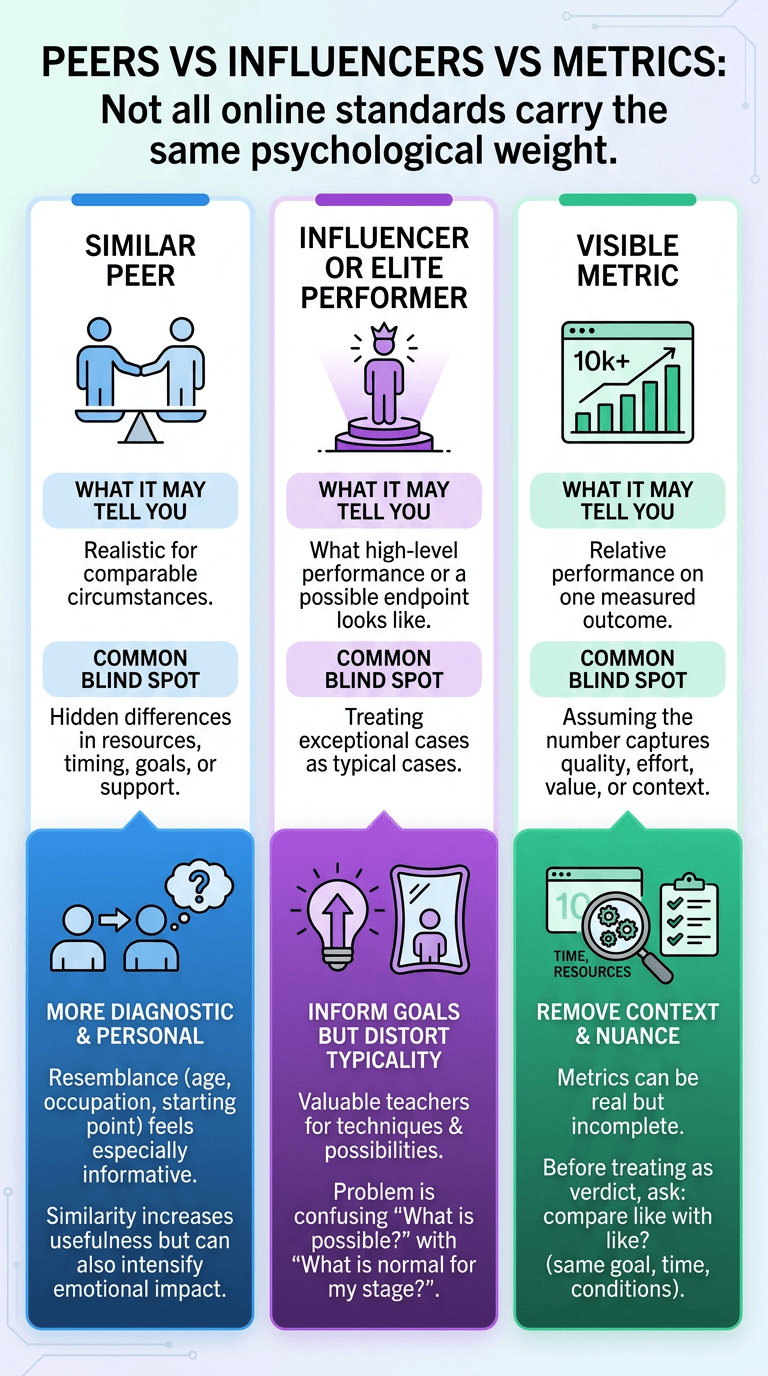
Not all online standards carry the same psychological weight. A close peer, a distant aspirational figure, and a public number each provide a different kind of information.
| Comparison standard | What it may tell you | Common blind spot |
|---|---|---|
| Similar peer | What may be realistic for someone with roughly comparable circumstances | Hidden differences in resources, timing, goals, or support |
| Influencer or elite performer | What high-level performance or a possible endpoint can look like | Treating exceptional cases as typical cases |
| Visible metric | Relative performance on one measured outcome | Assuming the number captures quality, effort, value, or context |
Similar peers can feel more diagnostic
A person who resembles you in age, experience, occupation, resources, or starting point may feel especially informative because the comparison seems fairer. If a coworker with similar tenure receives a promotion, the event may tell you more about your own expectations than a celebrity CEO’s success.
Similarity can increase usefulness, but it can also intensify impact. A distant celebrity may feel irrelevant. A former classmate with a similar background may make the gap feel much more personal.
Aspirational figures can inform goals but distort typicality
High performers can be valuable teachers. They can reveal techniques, standards, possibilities, and pathways you had not considered. The problem is not aspiration itself. The problem is answering a “What is possible?” question with the standard and then accidentally using the same standard to answer “What is normal for someone at my stage?”
Those are different questions and often require different comparison groups.
Metric comparison can remove context about audience size, time, resources, or selection
Two accounts may display the same view count after very different levels of investment. Two professionals may announce the same revenue with different expenses. Two students may show the same grade while managing very different responsibilities. A visible outcome can be real and still be incomplete.
Before treating a metric as a verdict, ask whether you are comparing like with like: same goal, same time horizon, same denominator, and roughly comparable conditions.
Upward Comparison Online Without Reducing It to Envy
Online environments provide many opportunities to see people who appear better off on a particular dimension. That is upward comparison. It is not synonymous with envy, and it does not produce one emotional response.
Learning and inspiration
An upward comparison can be informative when the gap feels understandable and the path seems learnable. A junior developer may study a senior developer’s portfolio. A new gardener may follow experienced growers for seasonal ideas. A public speaker may watch skilled speakers to notice pacing and structure.
In these cases, the comparison supplies information about methods, standards, or possibilities rather than functioning as a verdict on the self.
Discouragement or threat
The same upward comparison can feel discouraging when the standard seems impossibly distant, highly relevant, or repeatedly encountered. Experimental and real-time research has found that upward comparisons on social media can coincide with lower momentary self-evaluations in some contexts. One set of studies examining comparisons while people browsed feeds is summarized in PubMed’s overview of social media comparison and self-evaluation.
A newer meta-analysis also reports an average association between online upward comparison and poorer psychological outcomes across many samples, while noting that much of the evidence is cross-sectional and that stronger longitudinal work is still needed. That distinction matters because association does not establish that comparison alone caused the outcome. See the 2026 meta-analysis of online upward social comparison.
Little emotional reaction when the domain is irrelevant
Relevance changes everything. If you do not care about marathon times, another person’s race result may create no meaningful self-evaluation. If cooking is only a casual hobby, an expert chef’s technique may be interesting without feeling threatening.
One way to understand a strong reaction is to ask, “What exactly does this comparison say about a domain I care about?” That is more informative than assuming the platform itself created the feeling.
Reference-Group Distortion Online
A reference group is the set of people you use, consciously or not, as a standard for judging what is normal, good, late, successful, or expected. Online environments can shift that group without an explicit decision.
How feeds can shift the perceived comparison pool
Suppose a freelance designer begins following mostly top agencies, award winners, and creators with large audiences. Six months later, ordinary competent work may feel weak because the perceived standard has moved. The designer’s skill may have improved during the same period, yet self-evaluation can become harsher because the comparison pool changed faster than the underlying ability.
This does not mean the feed is “wrong.” It means the feed answers one question better than another. It may be excellent for learning advanced techniques and poor for estimating what is typical among all working designers.
Why exposure is not the same as a representative sample
A feed is a selection, not a population survey. Even when every post is accurate, the mix of posts can overrepresent certain outcomes. High-performing accounts may post more often. Dramatic changes may be more memorable. People with nothing notable to announce may remain silent.
A useful correction is to widen the denominator. If your conclusion is “everyone my age is buying a home,” ask what population you are actually observing. If your conclusion is “every creator gets thousands of views,” ask how many quiet accounts are missing from the visible sample.
Active Use vs Passive Browsing: What the Evidence Can and Cannot Say
Research often distinguishes passive browsing, such as scrolling through others’ content, from more active behaviors such as messaging, posting, commenting, or interacting. That distinction can be useful, but it is not a simple good-use versus bad-use rule.
Why study designs and definitions matter
“Passive use” can mean different things across studies, and active use can include very different behaviors. Sending a supportive message to a friend is not psychologically equivalent to repeatedly checking reaction counts on your own post, even though both are active behaviors.
A critical review of social comparison, envy, and social media concluded that the evidence is more heterogeneous and person-specific than a simple “passive use lowers well-being” story suggests. Some findings point toward negative associations, while others reveal positive, conditional, reciprocal, or highly individual effects.
Association versus causation and individual differences
If heavier comparison is associated with lower well-being, several explanations remain possible. Comparison may contribute to worse feelings. People who are already feeling worse may compare differently or more often. Both may influence each other. A third factor may influence both behavior and mood.
This is why broad claims such as “scrolling causes low self-esteem” go beyond what many studies can establish. A stronger interpretation asks what kind of use, for whom, in which domain, compared with whom, and under what circumstances.
Algorithmic Context Without Speculating About Exact Platform Logic
Feeds are not neutral lists. Platforms select and order content using systems that can vary by product, account, behavior, location, time, and ongoing design changes. That matters psychologically because what becomes visible can influence what becomes salient as a comparison standard.
Personalized exposure can shape what becomes salient
If you repeatedly engage with productivity content, you may see more examples of extreme productivity. If you watch business-growth videos, growth milestones may become more available. If you follow elite athletes, athletic performance may become a larger part of your perceived social environment.
The useful point is modest: repeated personalized exposure can change the set of examples you see. You do not need to know the exact ranking system to notice that your comparison environment has narrowed.
Avoid unsupported claims about one universal algorithmic effect
It is tempting to explain every emotional reaction by saying “the algorithm did it.” That turns a complex process into a single invisible cause. Platforms differ, ranking systems change, users shape their own feeds through choices, and the same exposure can be interpreted differently by different people.
A more precise statement is that platform design and personalized exposure help structure which comparison opportunities become available. They do not determine one universal psychological outcome.
Practical Comparison Hygiene

The aim is not to eliminate comparison. It is to make the comparison answer a useful question instead of letting the most visible standard answer every question for you.
Identify the domain before accepting the comparison
Name what you are actually comparing. Is it income, speed, skill, audience size, consistency, creativity, recognition, relationship milestones, or something else? A precise domain prevents one narrow gap from expanding into a global judgment.
Instead of “They are doing better than me,” try, “Their account grew faster during this period.” The narrower statement leaves room to examine why and whether the metric matters.
Ask what was selected out of view
Consider the missing denominator. How long has this person practiced? How many attempts failed? What resources, team, audience, timing, or prior experience might matter? What ordinary days are not shown?
This is not an invitation to dismiss someone else’s achievement. It is a way to compare the visible outcome with enough context to avoid inventing a false baseline.
Broaden the reference group when your feed is unusually elite
If your feed is full of exceptional performers, add standards that answer different questions. Follow people at your stage, look for population-level benchmarks when available, or compare within a realistic peer group. You can keep aspirational examples while refusing to treat them as the statistical middle.
Use absolute or temporal benchmarks when they answer the question better
Some questions are better answered without another person. “Can I now run five kilometers without stopping?” is an absolute benchmark. “Am I writing more clearly than six months ago?” is a temporal comparison. “How does my conversion rate compare with similar businesses?” is a social comparison.
None is universally superior. The useful standard depends on the question.
When Online Comparison Becomes a Different Psychology Problem
Social comparison is a process. Sometimes the main issue shifts to another process or to a level of distress that deserves more individualized attention.
Envy when the desired advantage becomes central
If the main experience is wanting another person’s advantage and feeling pain around their possession of it, envy becomes the more precise lens. Comparison may have triggered the episode, but the emotional experience has its own dynamics.
Body-image or eating concerns when distress becomes severe
Appearance comparison deserves care because repeated exposure can intersect with body-image concerns for some people. Avoid turning a feed into a reason to pursue extreme restriction, punitive exercise, or an unrealistic appearance standard. If appearance comparison is contributing to significant distress, eating problems, or a major change in daily functioning, individualized professional support is worth considering.
Professional support when comparison is tied to self-harm thoughts, major functional decline, or persistent severe symptoms
Online comparison by itself is not a diagnosis. However, if it becomes entangled with persistent depression or anxiety symptoms, severe hopelessness, self-harm thoughts, eating-disorder symptoms, or major impairment in work, school, sleep, relationships, or daily functioning, the priority is not optimizing your feed. A licensed mental-health professional or appropriate local health service can help assess the broader situation. If self-harm thoughts feel immediate or you may act on them, seek urgent local crisis or emergency support.
FAQ
Does passive scrolling cause low self-esteem?
Not as a universal rule. Passive browsing can create many comparison opportunities, and some studies link certain forms of browsing and upward comparison with poorer self-evaluation or well-being. But the evidence varies by person, platform behavior, comparison domain, and study design. People who are already struggling may also use platforms differently. It is more accurate to ask what you are viewing, who you compare with, and how you interpret the comparison.
Why do follower counts feel so meaningful even when they are poor quality measures?
They are visible, simple, and easy to rank. The mind does not have to estimate an abstract quality such as “creative influence” when a public number is sitting next to the profile. That convenience can make the number feel more informative than it is. A follower count may matter for some goals, but it does not directly measure expertise, trust, income, usefulness, or human worth.
Are influencers more harmful comparison targets than peers?
Not necessarily. Influencers may create large upward gaps and can distort typicality if exceptional lifestyles or outcomes are treated as normal. Peers can be more psychologically diagnostic because they seem more similar, which may make a smaller gap feel more personal. The effect depends on relevance, similarity, attainability, what is being compared, and how the person interprets the difference.
Can social media comparison be useful?
Yes. It can help you discover methods, calibrate a skill, identify realistic goals, notice industry standards, find peers, or understand what high performance looks like. The comparison becomes more useful when the domain is specific, the standard is appropriate for the question, and you remember that a feed is selected information rather than a complete population sample.
How can I tell if my feed is giving me a distorted standard?
Look for a mismatch between the question you are asking and the people you are observing. If your feed is dominated by elite performers but you are trying to estimate what is normal for beginners, the standard is distorted for that purpose. Another clue is when many rare outcomes begin to feel ordinary simply because you see them frequently. Widening the reference group can restore context without requiring you to unfollow every aspirational account.
Key Takeaways
- Social media increases the number and visibility of comparison opportunities, but it does not create one guaranteed emotional outcome.
- The SEE → SELECT → COMPARE → INTERPRET framework separates exposure from what was shown, what domain was compared, and what conclusion followed.
- Curated posts can be accurate and still provide a distorted picture of what is typical because selection hides the denominator.
- Followers, likes, views, and similar metrics are easy to rank but often measure a narrower outcome than people assume.
- Peers, influencers, and public metrics answer different comparison questions, so the most visible standard is not always the most informative one.
- A more useful response to online comparison is to choose the right standard for the question, not to assume all comparison should stop.
Educational note: This article explains social comparison as an everyday psychological process. It is not a diagnostic tool and does not replace individualized mental-health care when comparison is tied to severe or persistent distress.

Michael Reed is the Founder and Lead Writer at Psychology Exposed. He writes about human behavior, relationships, emotional patterns, self-awareness, and practical psychology topics using research-informed, easy-to-understand content.
Read More About Michael Reed: https://psychologyexposed.com/michael-reed/