

You finish a presentation feeling reasonably good about it, then hear that a colleague received stronger feedback and suddenly your own performance feels weaker. Your running pace has not changed, but joining a faster training group makes you feel slow. A creator with steady growth can feel unsuccessful after spending ten minutes looking at unusually large accounts. Nothing objective about your ability had to change for your judgment of yourself to shift.
That is the central problem in social comparison psychology. Other people give us information, but the information is always filtered through a domain, a target, a perceived gap, and an interpretation. Comparison can help you calibrate your ability, learn what is possible, notice progress, and understand what is typical. It can also mislead you when the standard is unusually selective, the visible information is incomplete, or a narrow difference becomes a sweeping statement about who you are.
Quick Answer: Social Comparison Is Information, Not a Verdict on Your Worth
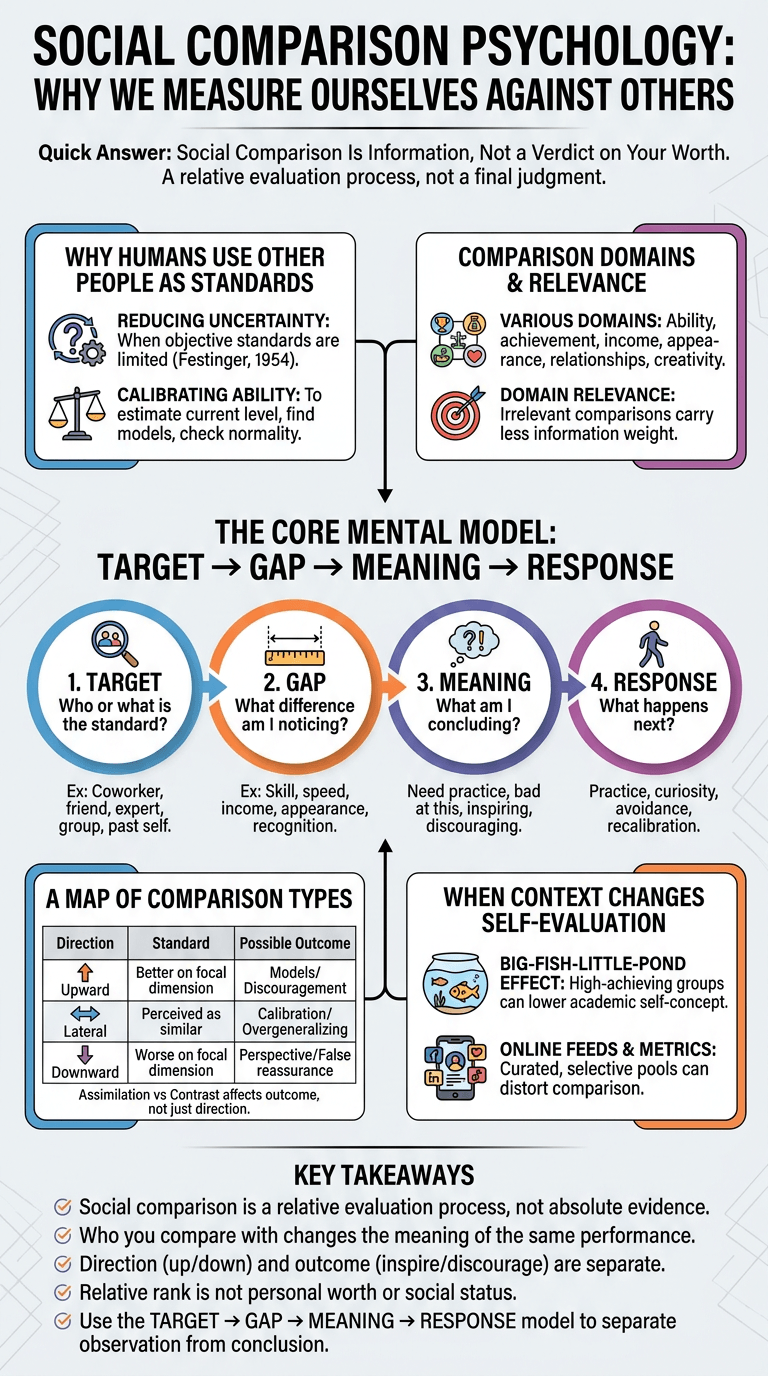
Social comparison is the process of evaluating some aspect of yourself relative to another person or social standard. It can help reduce uncertainty and provide useful calibration, but its effect depends on whom you compare with, what domain matters, how you interpret the gap, and what you do next. Relative position can inform a judgment without defining your absolute ability, social value, or personal worth.
What Social Comparison Psychology Means
Comparison as relative self-evaluation
The APA Dictionary of Psychology entry on social comparison describes a process in which people compare themselves with others. The key word is relative. You are not asking only, “How well did I do?” You are also asking, “How well did I do compared with this person, this group, or this standard?”
Comparison process versus emotion, status, identity, and personal worth
Several ideas sit close to social comparison but should not be collapsed into it. Comparison is a process. Envy is an emotion that may follow some comparisons. Status is socially granted standing, respect, recognition, or rank in a group. Social identity concerns group memberships that become part of how a person understands themselves. Self-perception is broader still, because people form views of themselves from behavior, memory, feedback, emotions, context, and many other inputs.
Why Humans Use Other People as Standards
Reducing uncertainty when objective standards are limited
Leon Festinger’s original 1954 paper, A Theory of Social Comparison Processes, proposed that people have a drive to evaluate their opinions and abilities and may turn to others when objective means of evaluation are unavailable or limited. The historical theory centered especially on opinions, abilities, and the usefulness of comparison with relevant others.
Calibrating ability, opinions, progress, and what seems typical
A comparison may serve several purposes. You might compare to estimate your current ability, find a model for improvement, check whether your reaction is common, or understand what is typical in a community. Later research expanded well beyond Festinger’s initial proposal, and a large meta-analysis of more than six decades of work examined both which targets people select and how they react to those comparisons. The results show that comparison outcomes are not captured by a simple rule such as “upward is bad, downward is good.” The social comparison meta-analysis by Gerber, Wheeler, and Suls found substantial variation in selection and reaction, with contrast often prominent in experimental research.
The Core Mental Model: TARGET → GAP → MEANING → RESPONSE
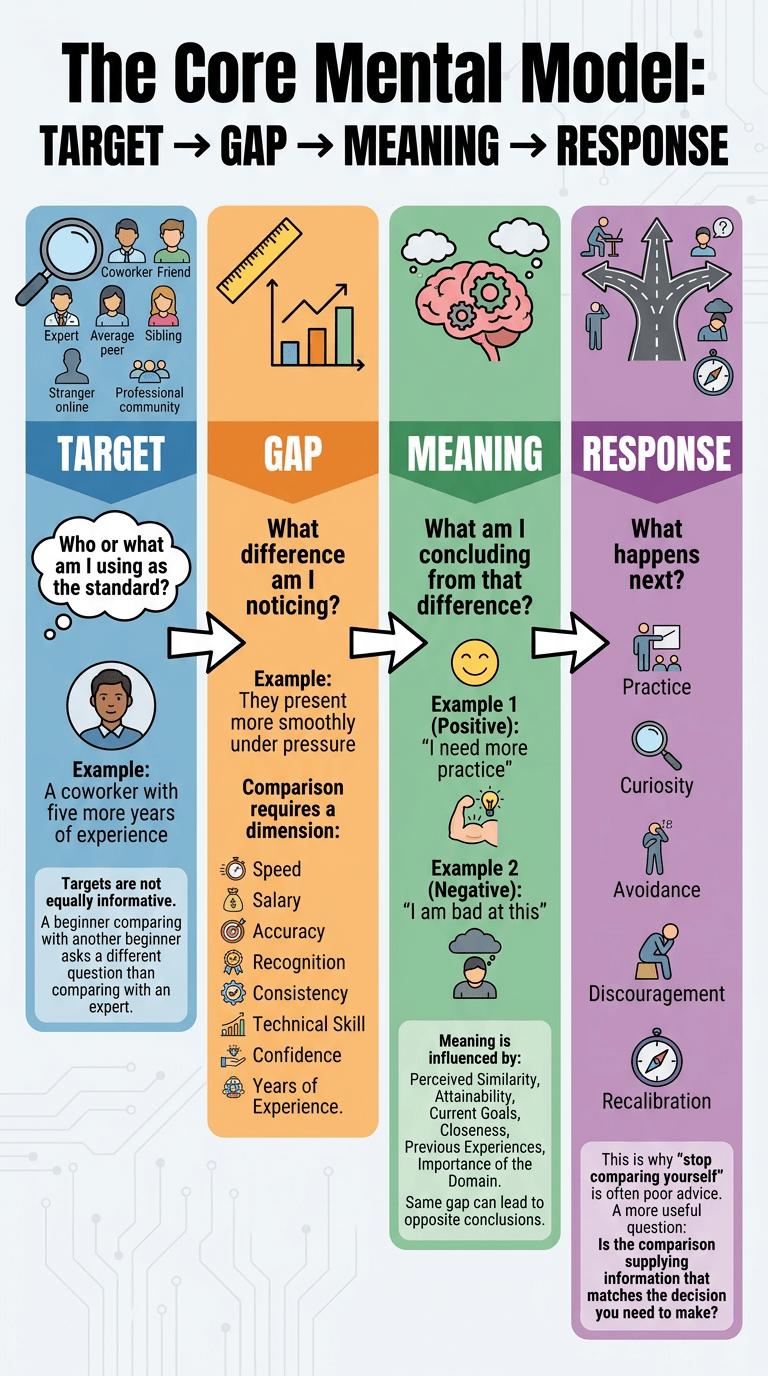
A practical way to understand social comparison is to separate four stages that often blur together in real time.
| Stage | Question | Example |
|---|---|---|
| Target | Who or what am I using as the standard? | A coworker with five more years of experience |
| Gap | What difference am I noticing? | They present more smoothly under pressure |
| Meaning | What am I concluding from that difference? | “I need more practice” or “I am bad at this” |
| Response | What happens next? | Practice, curiosity, avoidance, discouragement, or recalibration |
TARGET: who or what becomes the standard
The target may be a close friend, an expert, an average peer, a sibling, a stranger online, or an entire professional community. Targets are not equally informative. A new designer comparing with another beginner is asking a different question from a new designer comparing with an award-winning creative director.
GAP: what difference is noticed
Comparison requires a dimension. “They are doing better than me” is usually too vague to be psychologically useful. Better at what: speed, salary, accuracy, recognition, consistency, technical skill, confidence, or years of experience?
MEANING: what the difference is taken to imply
Meaning is influenced by perceived similarity, attainability, current goals, closeness, previous experiences, and how important the domain feels. Two people can see the same high-performing peer and walk away with opposite conclusions because they assign different meaning to the gap.
RESPONSE: emotion, motivation, learning, withdrawal, or recalibration
This is why “stop comparing yourself” is often poor advice. A more useful question is whether the comparison is supplying information that matches the decision you need to make.
Comparison Domains: Why the Same Person Can Be Above You in One Area and Below You in Another
Ability, achievement, income, appearance, relationships, creativity, fitness, parenting, academics, and recognition
People compare across many domains because different domains answer different self-evaluation questions. A student may care about exam performance, a new parent about developmental expectations, an athlete about pace, and a freelancer about client demand. Problems arise when information from one domain spills into a global judgment.
For example, “My friend earns more” is an income comparison. It does not directly establish who is more capable, happier, disciplined, respected, or valuable. “My teammate lifts more” is a strength comparison. It says little about endurance, recovery, technique, or the person’s worth as an athlete.
Domain relevance and why irrelevant comparisons carry less information
A target becomes more psychologically powerful when the dimension matters to you. If you do not care about gardening, your neighbor’s prize tomatoes probably carry little self-evaluative weight. If you have spent two years learning photography, another photographer’s work may feel much more diagnostic.
How Comparison Targets Change the Message
Similarity, closeness, attainability, and relevance
People often learn more from targets who seem meaningfully comparable. Similarity can involve experience level, age, background, goals, resources, or constraints. A first-time founder may find another early-stage founder more informative than a billionaire entrepreneur, even if the billionaire is more visible.
Reference groups and why local standards can feel more diagnostic than distant averages
People rarely compare against humanity as a whole. They use local pools: classmates, teammates, coworkers, neighbors, creators in the same niche, or people at a similar life stage. Those groups help define what feels normal, exceptional, early, late, strong, or weak.
Four Questions That Organize Social Comparison
How does the comparison process work?
The first question concerns the basic mechanism: why people seek social information, what makes a target useful, and how a comparison becomes a reaction. The historical theory provides one foundation, while later research adds motives such as self-improvement and self-enhancement and shows that reactions vary across situations.
Who becomes the comparison standard?
The second question concerns target selection. People may use similar peers, aspirational figures, local groups, or broader categories. The standard can be chosen deliberately or absorbed from the environment. The people you see repeatedly can become psychologically normal even when they are statistically unusual.
How does context change the outcome?
The third question concerns the surrounding environment. A selective school, elite workplace, fast training group, or curated online feed can change the comparison pool. Research using daily-life methods also emphasizes that comparisons vary across times and dimensions rather than operating as one stable event. A scoping review of social comparison assessment in daily life highlights this dynamic, within-person character.
How does comparison affect self-evaluation and behavior?
The fourth question asks what people do with the information. Does a difference become a precise judgment such as “I need more practice with presentations,” or a global conclusion such as “I am incompetent”? Does it prompt learning, withdrawal, goal revision, or indifference? The response depends partly on the meaning assigned to the comparison, not simply on whether the other person is above or below you.
A Map of Comparison Types

Upward, downward, and lateral comparison at a glance
| Direction | Standard | Possible useful information | Possible risk |
|---|---|---|---|
| Upward | Someone doing better on the focal dimension | Models, strategies, possibilities, skill gaps | Discouragement if the target feels unreachable or incomparable |
| Lateral | Someone perceived as similar | Calibration, typicality, realistic expectations | Overgeneralizing from a narrow peer group |
| Downward | Someone doing worse on the focal dimension | Perspective, appreciation, awareness of strengths | False reassurance or an unhelpfully low benchmark |
Assimilation versus contrast as a separate outcome axis
Keeping direction and effect separate prevents a common mistake. An upward target is not automatically inspiring or discouraging. The target’s similarity, attainability, extremity, and relevance can change what happens.
Social comparison orientation as an individual difference
People also differ in how strongly they attend to comparison information. Gibbons and Buunk developed the Iowa-Netherlands Comparison Orientation Measure to study this tendency across ability and opinion comparisons. Their work does not make frequent comparison a diagnosis. It describes an individual difference in the tendency to use social comparison information. The original validation is summarized in their research on social comparison orientation.
When Context Changes Self-Evaluation
Selective groups and the Big-Fish-Little-Pond Effect
One of the clearest examples comes from educational psychology. The Big-Fish-Little-Pond Effect describes how students’ academic self-concept can be influenced by the achievement level of the school or class around them, even after accounting for their own achievement. A large meta-analysis of the Big-Fish-Little-Pond Effect synthesized evidence across studies and found a robust negative association between higher class or school average achievement and students’ academic self-concept.
Online feeds, visible metrics, and distorted comparison pools
Online environments make comparison targets unusually available. You can see follower counts, engagement numbers, polished portfolios, milestones, homes, physiques, and career announcements in a few minutes. The problem is not simply exposure to other people. It is that the visible pool may be selective.
Relative deprivation when a comparison gap is interpreted as meaningful disadvantage
Sometimes comparison is not mainly about ability. It is about whether a person believes they are getting less than a relevant standard suggests they should receive. Two employees can both have acceptable salaries in absolute terms, yet one may feel disadvantaged after learning that similar colleagues are paid more.
Comparison Is Not the Same as Self-Perception, Status, Envy, or Social Identity
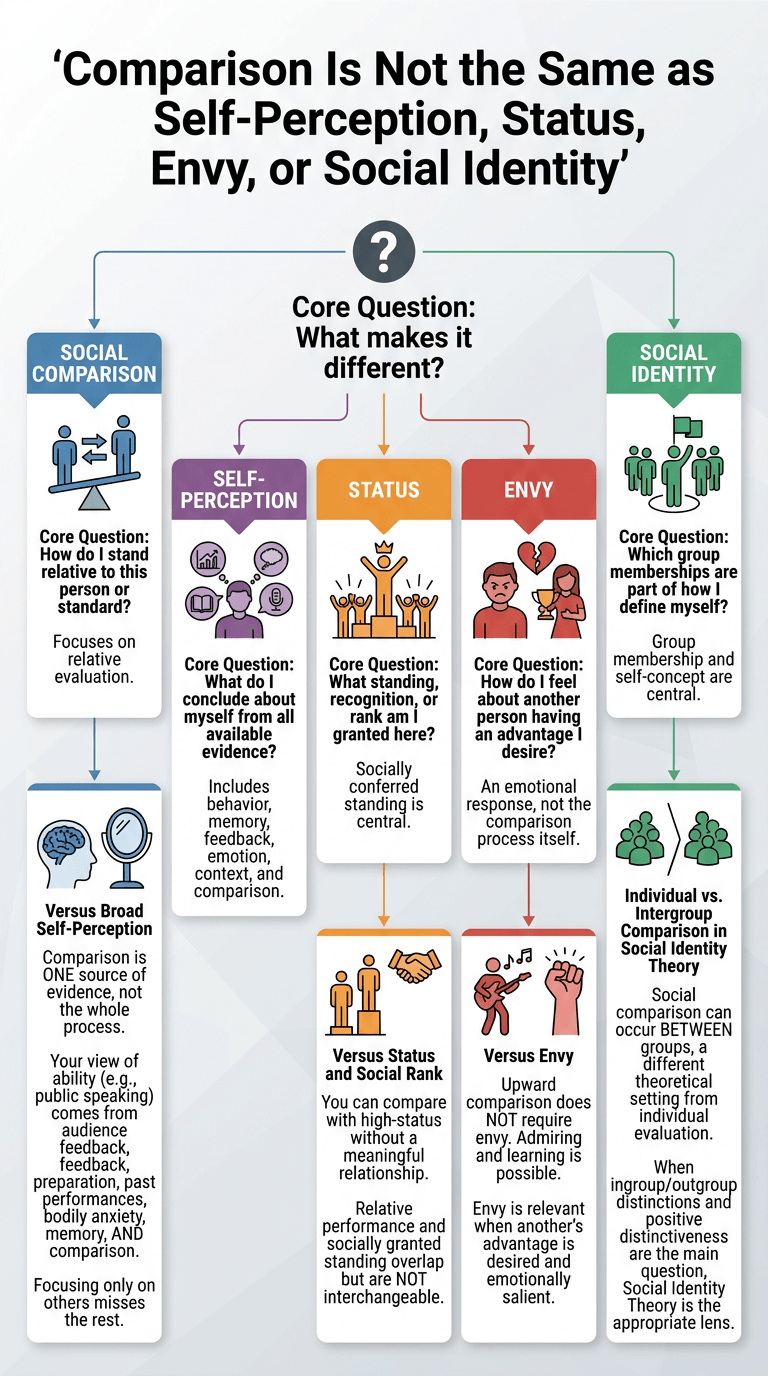
| Concept | Core question | What makes it different |
|---|---|---|
| Social comparison | How do I stand relative to this person or standard? | Focuses on relative evaluation |
| Self-perception | What do I conclude about myself from all available evidence? | Includes behavior, memory, feedback, emotion, context, and comparison |
| Status | What standing, recognition, or rank am I granted here? | Socially conferred standing is central |
| Envy | How do I feel about another person having an advantage I desire? | An emotional response, not the comparison process itself |
| Social identity | Which group memberships are part of how I define myself? | Group membership and self-concept are central |
Social comparison versus broad self-perception
Comparison is one source of evidence about the self, not the whole self-understanding process. Your view of your public-speaking ability may come from audience feedback, preparation quality, prior performances, bodily anxiety, memory, and comparison with other speakers. Focusing only on other people would miss the rest of the evidence.
Social comparison versus status and social rank
You can compare yourself with a high-status person without having a meaningful status relationship with them. You can also hold high status in a group while comparing unfavorably on a particular skill. Relative performance and socially granted standing overlap in some settings, but they are not interchangeable.
Social comparison versus envy
Upward comparison does not require envy. You may admire a better musician, study their technique, and feel pleased that the skill is learnable. Envy becomes relevant when another person’s advantage is desired and emotionally salient. Keeping the concepts separate makes it easier to understand why similar comparisons produce different reactions.
Individual comparison versus intergroup comparison in Social Identity Theory
Social comparison can also occur between groups, but that is a different theoretical setting from evaluating your own ability or progress against another person or reference standard. When group membership, ingroup and outgroup distinctions, and positive group distinctiveness are the main question, Social Identity Theory provides the more appropriate lens.
Why an Accurate Comparison Can Still Produce an Unhelpful Conclusion
Relative rank versus absolute performance
Imagine that your presentation score is 82 out of 100. If everyone else scores around 70, you rank high. If everyone else scores around 95, you rank low. Your score did not change, but your relative position did.
Specific evidence versus global judgments about the self
A useful discipline is to keep the conclusion at the same level as the observation. If the evidence concerns one skill, make a skill-level judgment. If it concerns one moment, avoid turning it into a permanent identity statement.
Where to Go Deeper: Choose the Question You Actually Have
Social Comparison Theory Explained for the historical theory
If your main question is where the idea came from, begin with Festinger’s original proposal that people evaluate opinions and abilities partly through other people when objective standards are limited. A theory-focused explanation can also show how later work broadened the field to include self-improvement, self-enhancement, target selection, upward and downward direction, and different emotional or behavioral reactions. The important historical nuance is that modern findings should not all be credited to the 1954 theory. Separating the original claims from later developments makes it easier to see which ideas are foundational and which emerged through decades of subsequent research.
Upward, Downward, and Lateral Social Comparison for direction
If you are trying to understand why looking “up,” “down,” or “sideways” feels different, focus on comparison direction. The central issue is where the target stands on the specific dimension being judged, not whether the comparison is inherently good or bad.
Social Comparison Orientation for why some people compare more
If you notice that some people constantly scan what others are doing while others seem less attentive to it, comparison orientation is the relevant question. It concerns a tendency to notice and use comparison information, without assuming insecurity, low self-esteem, or a fixed personality problem.
Reference Group Psychology for why some people or groups become the standard
If your question is “Why am I using these people as my benchmark?”, examine reference groups. Age, profession, similarity, aspiration, proximity, community, and achievement level can all influence who feels relevant enough to define what is normal or successful.
Social Comparison and Self-Evaluation for how relative information becomes self-judgment
If another person’s performance quickly becomes a statement about your competence, the key issue is the conversion from observation to self-evaluation. This is where separating fact, comparison, and conclusion becomes especially useful.
Social Media and Social Comparison for feeds, metrics, and curated standards
If the comparison intensifies around feeds, follower counts, likes, professional highlights, or selective self-presentation, look at the online environment itself. The important question is how repeated exposure changes the comparison pool, not whether every platform or every type of use has the same effect.
Relative Deprivation Psychology for comparative disadvantage
If the central thought is “People like me are getting more, and this gap feels significant or unfair,” relative deprivation is the closer fit. It focuses on perceived disadvantage relative to a meaningful standard rather than simple dissatisfaction with what you have.
Assimilation vs Contrast for why a target can inspire or diminish
If a successful peer sometimes makes a goal feel reachable and other times makes you feel farther away, the issue is assimilation versus contrast. Direction alone cannot explain the outcome. Similarity, attainability, and how the target is mentally represented may change the effect.
Big-Fish-Little-Pond Effect for context-driven self-evaluation
If your ability has not changed but joining a stronger environment changes how capable you feel, this effect offers a focused model. The strongest evidence comes from academic self-concept research, so broader workplace, sports, and creative examples should be treated as analogies rather than assumed to work identically.
Social Comparison vs Temporal Comparison for others versus your past self
If you are deciding whether to judge progress against peers or against your own earlier performance, compare social and temporal standards. Neither is automatically superior. Other people can provide calibration, while your past self can reveal personal change that peer rankings may hide.
Common Misunderstandings About Comparison
Upward is not automatically harmful and downward is not automatically healthy
An upward target may provide a model, useful information, or hope. A downward target may provide perspective, but it can also encourage a low benchmark or false reassurance. Psychological outcome depends on more than direction.
Frequent comparison does not automatically prove insecurity
Some people attend more strongly to comparison information, and some environments supply much more of it. Frequency alone does not reveal why the person compares or what the comparison means to them. A professional athlete, for example, may compare constantly because relative performance is genuinely informative.
Comparison can calibrate without defining worth
A ranking can answer a narrow question without answering a human-value question. Being slower than another runner, earning less than a peer, or receiving fewer votes does not convert cleanly into “less worthy.” That leap adds a moral or global meaning that the comparison itself does not contain.
First-Step Comparison Check: Target, Gap, Meaning, Response
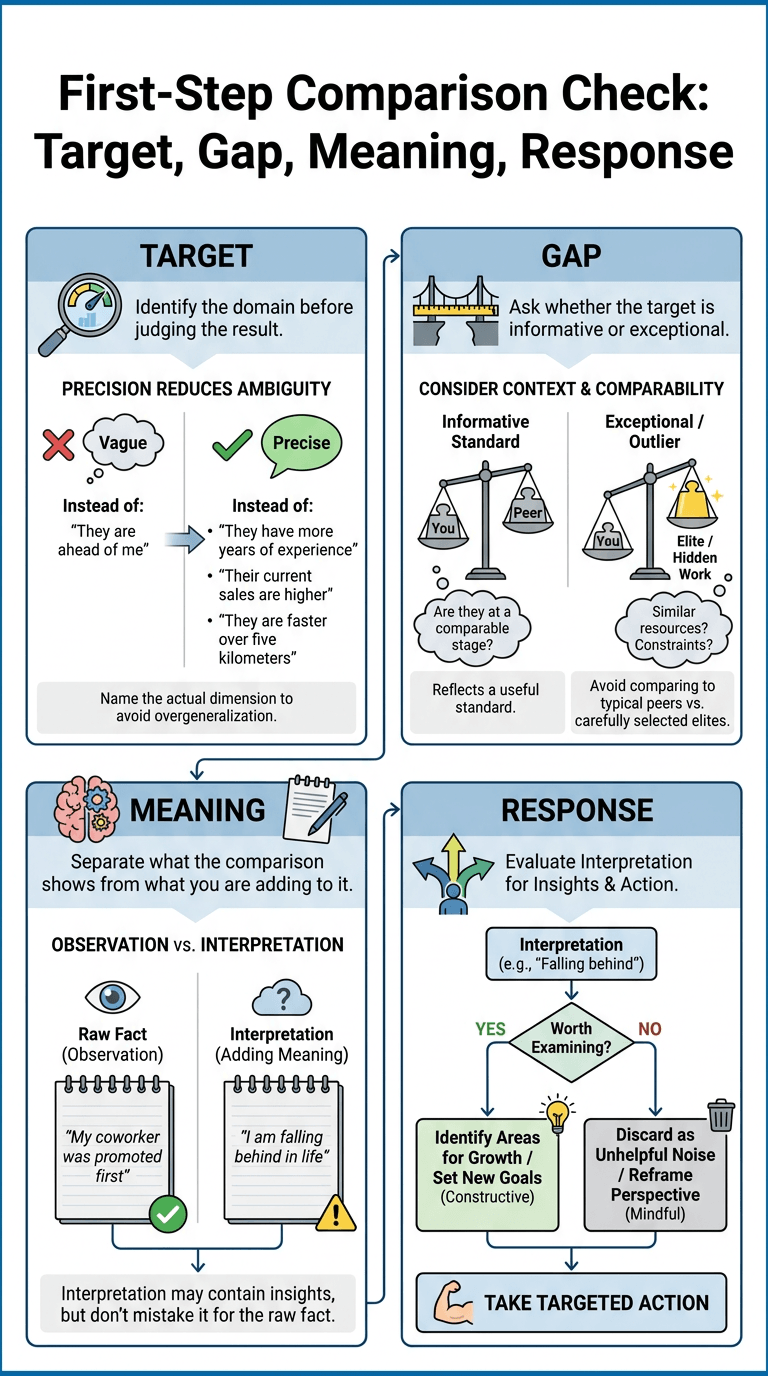
Identify the domain before judging the result
Name the actual dimension. Instead of “They are ahead of me,” try “They have more years of experience,” “Their current sales are higher,” or “They are faster over five kilometers.” Precision reduces the chance that one difference will swallow the whole self-evaluation.
Ask whether the target is informative or exceptional
Consider whether the person reflects a useful standard for your question. Are they at a comparable stage? Do they have similar resources or constraints? Are you comparing with a typical peer, a carefully selected elite, or someone whose visible outcome hides years of unseen work?
Separate what the comparison shows from what you are adding to it
Write the observation and conclusion as two sentences. “My coworker was promoted first” is an observation. “I am falling behind in life” is an interpretation. The interpretation may contain something worth examining, but it should not be mistaken for the raw fact.
When Comparison Is Part of More Serious Distress
Most social comparison is ordinary psychology, not a clinical problem. Still, repeated comparison can become part of a more serious situation when it is tied to severe body-image distress, eating-disorder symptoms, persistent depression or anxiety symptoms, major loss of daily functioning, or thoughts of self-harm. In those cases, the useful next step is not to perfect your comparison strategy. It is to seek individualized support from an appropriate mental health or medical professional.
If self-harm thoughts are present or you feel in immediate danger, use local emergency or crisis services where you live. Educational information about comparison cannot replace direct support for urgent safety needs.
FAQ
Why do people compare themselves even when they know it can feel bad?
Because comparison can still provide information. It may help estimate ability, identify what is typical, locate a skill gap, or reduce uncertainty. A comparison can be informative and emotionally uncomfortable at the same time. The better question is whether the target and conclusion are useful for the decision you are making.
Is comparing yourself with people similar to you more accurate?
Sometimes. Similar people may offer a more relevant benchmark because their circumstances, experience, or resources are closer to yours. But similarity does not guarantee accuracy. A small peer group can still be unusually selective, and people who look similar on the surface may differ in important ways that are not visible.
Can downward comparison be misleading?
Yes. Comparing with someone doing worse may provide perspective or remind you of genuine strengths, but it can also create a benchmark that is too low for the question at hand. If you are trying to improve a skill, a downward comparison may tell you little about what better performance requires.
Does social comparison always affect self-esteem?
No. Some comparisons produce practical information with little effect on global self-evaluation. Others may influence a specific self-judgment without changing overall self-esteem. The domain’s importance, the target, the interpretation, and the person’s current goals all matter.
Is comparing with your past self always better than comparing with others?
No. Comparing with your past self can reveal personal progress, but memory can be selective and circumstances can change. Social comparison can provide valuable external calibration. A more balanced approach is to choose the standard that best answers the question you actually need to answer.
Key Takeaways
- Social comparison is a relative evaluation process, not evidence that comparison is automatically harmful.
- Who you compare with can change what the same objective performance seems to mean.
- Direction and outcome are separate: upward comparison can inspire or discourage, and downward comparison can reassure or mislead.
- Relative rank should not be confused with absolute ability, social status, or personal worth.
- The TARGET → GAP → MEANING → RESPONSE model helps separate observed differences from the conclusions added to them.
- When comparison becomes tied to severe distress or major functional decline, individualized professional support may be more appropriate than self-help strategies alone.
Final Thoughts
The next time a comparison changes how you see yourself, do not begin by asking whether comparison is good or bad. Ask what standard you used, what gap you actually observed, what meaning you assigned to it, and whether that meaning matches the evidence. A well-chosen comparison can be useful information. The goal is to keep information in proportion, so a relative difference helps you understand your situation without becoming a verdict on your entire self.
Author note: Michael Reed, Founder & Lead Writer at Psychology Exposed, writes about human behavior, self-awareness, relationships, emotional patterns, and everyday decision-making in a clear, research-aware way. This material is educational and is not a substitute for individualized mental health care.

Michael Reed is the Founder and Lead Writer at Psychology Exposed. He writes about human behavior, relationships, emotional patterns, self-awareness, and practical psychology topics using research-informed, easy-to-understand content.
Read More About Michael Reed: https://psychologyexposed.com/michael-reed/