

You can feel capable in the morning, notice one person who is further ahead by lunchtime, and suddenly judge the same ability much more harshly. Nothing about your actual skill may have changed. What changed was the standard you used to interpret it.
That is one of the most important things to understand about social comparison and self-evaluation. Other people give us information, but the information does not arrive with a built-in verdict about who we are. We still choose, often very quickly and without noticing, which person counts as relevant, which dimension matters, how large the gap feels, and what that gap supposedly says about us.
Comparison is not automatically inaccurate or harmful. It becomes misleading when a narrow difference is treated as proof of a much broader conclusion, such as “I am not talented” or “I am failing.”
Quick Answer: Comparison Supplies Evidence, but You Still Interpret What It Means
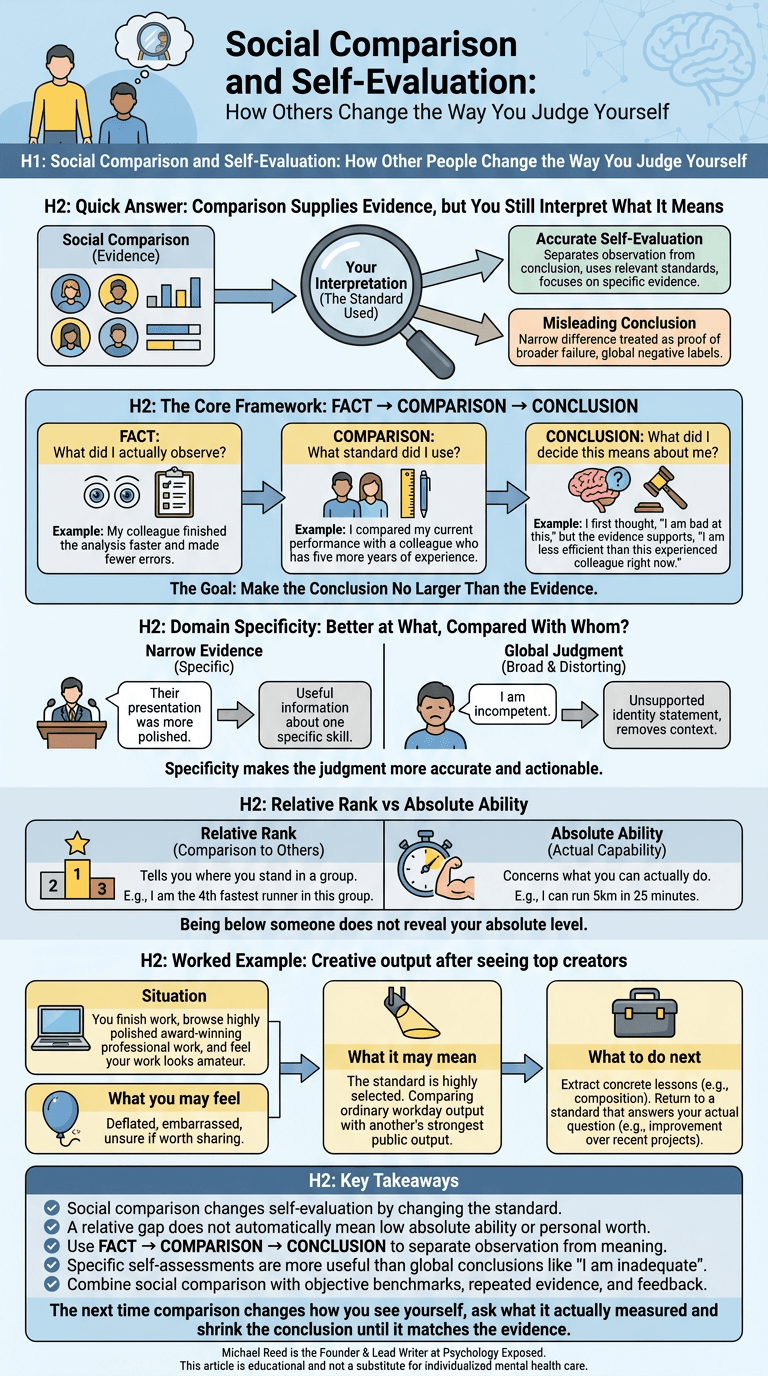
Social comparison can shape self-evaluation by changing the standard against which you judge your performance, progress, or ability. The comparison may reveal something useful about relative position, but relative position is not the same as absolute ability, future potential, or personal worth. A more accurate self-evaluation separates what was observed, which comparison standard was used, and what conclusion is actually justified by the evidence.
What Self-Evaluation Through Comparison Looks Like
Self-evaluation is the judgment you make about some aspect of yourself. It might concern how competent you are at a task, how well you are progressing, whether your work is strong, how attractive you feel, or how successful you think you are in a particular area.
Social comparison enters when another person, group, or social standard becomes part of that judgment. Research on social comparison has long treated other people as potentially powerful reference points, and a large meta-analysis of more than six decades of studies found that comparison reactions can meaningfully affect self-evaluations, especially estimates of ability. The effect is not one simple rule, however. Who is compared, on what dimension, and how the comparison is processed all matter. You can review the abstract of that social comparison meta-analysis on PubMed.
Specific judgments about ability, success, attractiveness, competence, or progress
A useful self-evaluation is usually specific. “My presentation was less polished than Maya’s” is specific. “I am bad at public speaking” is broader. “I am incompetent” is broader still.
The wider the conclusion becomes, the more evidence it needs. One comparison in one setting may tell you something about one performance. It usually cannot support a judgment about your entire competence, personality, or value.
Comparison becomes more distorting when a narrow observation turns into a global identity statement. “Their portfolio is stronger” is different from “I am not creative.” “They solved this faster” is different from “I am not smart enough.”
Why comparison is one input rather than the whole self
Other people can provide useful information because we rarely evaluate ourselves in a vacuum. Yet comparison is only one input. Your actual performance, repeated outcomes, direct feedback, previous experience, task difficulty, preparation, opportunity, and changing circumstances also matter.
A scoping review of social comparison in daily life highlights how comparisons vary by target, dimension, direction, perceived similarity, and context. That helps explain why someone can feel highly competent in one setting and ordinary in another without a sudden change in skill.
The Core Framework: FACT → COMPARISON → CONCLUSION
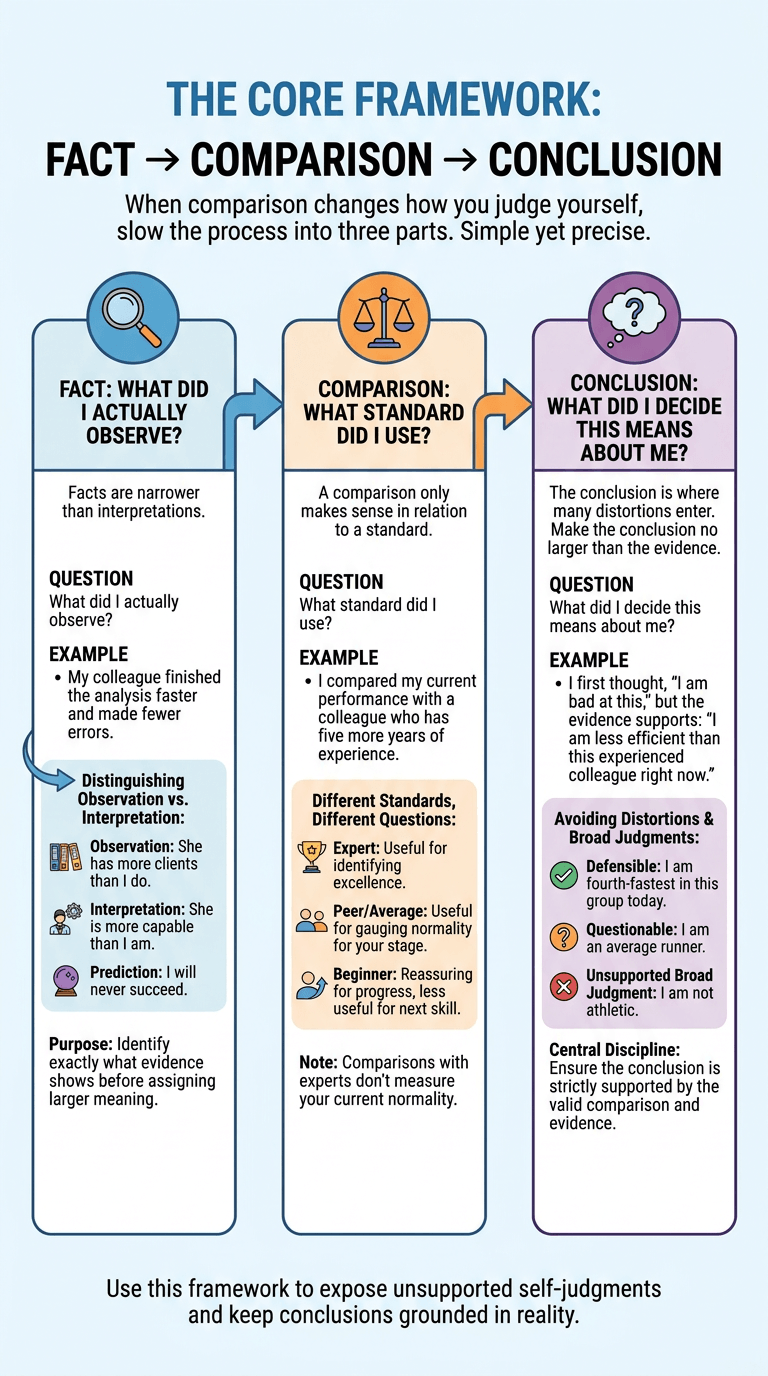
When comparison changes how you judge yourself, it helps to slow the process into three parts. The framework is simple enough to use in real life, but precise enough to expose where a reasonable observation turns into an unsupported self-judgment.
| Step | Question | Example |
|---|---|---|
| FACT | What did I actually observe? | My colleague finished the analysis faster and made fewer errors. |
| COMPARISON | What standard did I use? | I compared my current performance with a colleague who has five more years of experience. |
| CONCLUSION | What did I decide this means about me? | I first thought, “I am bad at this,” but the evidence more directly supports, “I am less efficient than this experienced colleague right now.” |
FACT: what did I actually observe?
Facts are narrower than interpretations. “She has more clients than I do” is an observation. “She is more capable than I am” is an interpretation. “I will never succeed” is a prediction.
Keeping these layers separate does not mean denying uncomfortable evidence. If another person consistently performs better on a relevant measure, that may be meaningful. The purpose is to identify exactly what the evidence shows before assigning a larger meaning to it.
COMPARISON: what standard did I use?
A comparison only makes sense in relation to a standard. That standard may be a close peer, an expert, the average person in your field, the most visible person online, or an unusually high-performing group. Different standards answer different questions.
Comparing yourself with an expert may be useful for identifying what excellence looks like. It is less useful for estimating whether your current performance is normal for your stage of experience. Comparing yourself with beginners may reassure you that you have progressed, but it may tell you little about what skill to develop next.
CONCLUSION: what did I decide this means about me?
The conclusion is where many distortions enter. A valid comparison can still support an invalid conclusion.
Suppose you are the fourth-fastest runner in a group of ten. “I am fourth-fastest in this group today” is defensible. “I am an average runner” may or may not be, because the group could be unusually strong. “I am not athletic” is broader still and requires much more information.
The central discipline is to make the conclusion no larger than the evidence.
Domain Specificity: Better at What, Compared With Whom?
Self-evaluation becomes more accurate when the domain is clearly defined. People often say someone is “better,” “more successful,” or “ahead” without specifying the dimension. Yet performance is rarely one-dimensional.
Why narrow evidence should stay narrow
A coworker may be better at presenting to executives but less skilled at technical troubleshooting. A friend may earn more money but have less flexibility. A musician may improvise more fluently while you read notation more accurately. A parent may appear calmer at school pickup while struggling with bedtime routines you handle well.
When the comparison dimension is vague, the self-judgment expands too easily. “They are better at this one thing” quietly becomes “they are doing better than me.” That shift often removes important context.
How cross-domain comparisons create noise
Cross-domain comparisons become especially confusing when people bundle different outcomes into one general judgment of success. Someone may compare another person’s salary, social confidence, appearance, relationship, and travel experiences all at once, then feel “behind” without being able to identify what the word means.
A clearer approach is to separate domains. If the concern is professional skill, evaluate professional skill. If the concern is financial stability, use financial indicators. If the concern is physical endurance, use relevant measures of endurance. This does not make every judgment emotionally comfortable, but it makes the judgment more informative.
Relative Rank vs Absolute Ability
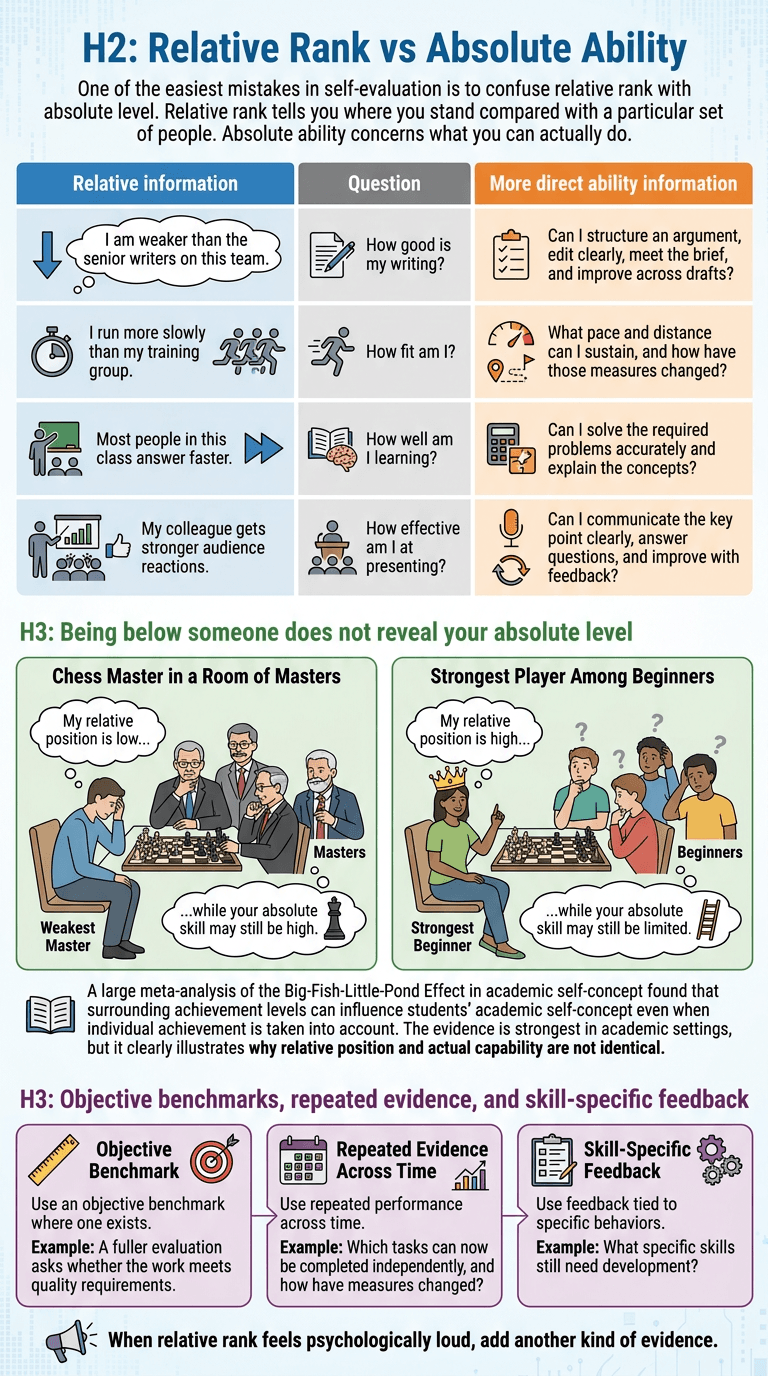
One of the easiest mistakes in self-evaluation is to confuse relative rank with absolute level. Relative rank tells you where you stand compared with a particular set of people. Absolute ability concerns what you can actually do.
| Question | Relative information | More direct ability information |
|---|---|---|
| How good is my writing? | I am weaker than the senior writers on this team. | Can I structure an argument, edit clearly, meet the brief, and improve across drafts? |
| How fit am I? | I run more slowly than my training group. | What pace and distance can I sustain, and how have those measures changed? |
| How well am I learning? | Most people in this class answer faster. | Can I solve the required problems accurately and explain the concepts? |
| How effective am I at presenting? | My colleague gets stronger audience reactions. | Can I communicate the key point clearly, answer questions, and improve with feedback? |
Being below someone does not reveal your absolute level
If you are the weakest chess player in a room of masters, your relative position is low while your absolute skill may still be high. If you are the strongest player among beginners, your relative position is high while your absolute skill may still be limited.
A large meta-analysis of the Big-Fish-Little-Pond Effect in academic self-concept found that surrounding achievement levels can influence students’ academic self-concept even when individual achievement is taken into account. The evidence is strongest in academic settings, but it clearly illustrates why relative position and actual capability are not identical.
Objective benchmarks, repeated evidence, and skill-specific feedback
When relative rank feels psychologically loud, add another kind of evidence. Use an objective benchmark where one exists, repeated performance across time, or feedback tied to specific behaviors.
For example, a new programmer on an expert team may feel weak because everyone nearby solves problems faster. A fuller evaluation asks whether the work meets quality requirements, which tasks can now be completed independently, and what specific skills still need development.
When a Comparison Standard Changes the Judgment
The same performance can feel excellent, ordinary, or poor depending on who surrounds you. That is why the choice of standard deserves attention whenever a self-judgment changes suddenly.
Exceptional targets can make normal performance look weak
Imagine a recreational photographer who follows mostly award-winning professionals. The photographs on the screen are real, and the quality gap may be real. But the feed is not a representative sample of recreational photographers. If that exceptional group becomes the default standard for “normal,” solid amateur work may begin to feel embarrassingly weak.
Excellent work can teach technique and reveal possibilities. Use experts to study excellence, but do not automatically use them to estimate what is typical for your current stage.
Weak comparison pools can make limited performance look stronger than it is
The opposite problem also exists. A person can overestimate performance if the surrounding comparison pool is unusually weak or inexperienced.
This is why accurate self-evaluation often benefits from multiple standards. A salesperson may compare with teammates, with role expectations, and with personal conversion data over time. A student may look at class rank, mastery of the learning objectives, and performance on standardized tasks. No single comparison answers every question.
Changing the reference point can also change some self-ratings. An open-access study on reference-group instructions found that ratings varied when people were asked to compare themselves with different groups or versions of themselves. The size of the effects differed, but the reference used in a judgment still mattered.
Specific Self-Assessment vs Global Self-Judgment

Comparisons become especially painful when they stop describing performance and begin defining the entire person.
They are better at this versus I am inadequate
“They are better at this” contains a domain. It may even contain useful information. “I am inadequate” removes the domain and turns a local difference into a global conclusion.
Consider a junior attorney watching a senior colleague negotiate. The senior lawyer is calmer, faster, and more precise. A specific assessment might be, “My negotiation skills are less developed, especially when I am challenged unexpectedly.” That can guide practice. “I do not belong in this profession” goes far beyond the evidence.
The emotional difference between those sentences can be large, but the more important difference is informational. The first statement contains a trainable skill. The second treats a temporary performance gap as an identity verdict.
Separating performance from personal worth
A poor comparison outcome may matter. It can affect a grade, promotion, competition result, or opportunity. There is no need to pretend otherwise. But consequences and worth are different categories.
If another applicant receives the job, that outcome may indicate that they matched the role better, performed better in the interview, had more relevant experience, or benefited from factors you cannot fully observe. None of those explanations logically establishes that you have less human value.
Keeping that boundary clear is not empty reassurance. It prevents an evaluation system designed for performance from being misused as a measure of personhood.
Realistic Calibration vs Self-Attack
Comparison can correct an inaccurate self-view, but it can also become a way of making conclusions much harsher than the evidence supports.
When comparison provides useful corrective information
Comparison is useful when the standard is relevant, the dimension is clear, and the result points toward information you can act on. A public speaker may discover that peers use stronger openings. A runner may learn that their training pace is not yet competitive for a desired event. A manager may notice that colleagues give clearer feedback.
Research using experimentally manipulated comparative feedback found a strong effect of relative position on performance self-evaluation, with smaller effects on broader self-concept. The 2023 study of social comparison and performance self-evaluation helps show why a task judgment should not automatically become a global self-view.
When the conclusion goes beyond the evidence
Self-attack usually adds claims the comparison did not establish. It uses words such as “always,” “never,” “everyone,” “nothing,” or broad labels about the self.
| Observed gap | Calibrated conclusion | Conclusion that exceeds the evidence |
|---|---|---|
| A peer gets more client referrals. | They currently have a stronger referral pipeline. | I am terrible at business. |
| A friend speaks confidently in groups. | They look more comfortable in this setting. | Everyone is socially better than me. |
| A teammate lifts more weight. | They are stronger on this lift right now. | My training is pointless. |
| A classmate understands the material faster. | They learned this concept faster today. | I am not intelligent enough for this subject. |
The goal is not to replace every negative thought with a positive one. It is to replace an oversized conclusion with a proportionate one.
Comparison and Self-Perception: Where the Boundary Sits
Social standards as one input into a broader self-perception system
Social comparison is one route to self-judgment because other people become reference points. Self-perception is broader and also draws on memories, emotions, behavior, feedback, bodily states, roles, and context.
That distinction matters when a comparison seems to trigger a much larger reaction. The comparison may be the immediate input, but an older memory, a repeated message from others, or current stress may influence what conclusion feels believable.
Memory, emotion, feedback, and context belong to the broader picture
If one poor comparison activates older memories, or if stress makes every gap feel more threatening, the evaluation involves more than present comparative information. Ask, “What did this comparison add?” rather than assuming it created the entire self-view.
Comparison and Self-Efficacy: A Light Distinction
Can I do this specific action? versus where do I stand relative to others?
Self-efficacy concerns belief in your capability to carry out a particular action or task. Social comparison asks where you stand relative to another person or standard. Those questions can influence each other, but they are not interchangeable.
A beginner may be slower than every experienced person in the room while still having good reason to believe, “I can complete this task with the training and tools I have.” Conversely, someone may rank highly in a weak comparison group but still doubt whether they can perform under more difficult conditions.
When comparison informs capability beliefs without defining them
Other people can show what is possible or what skills matter, but direct experience, practice, feedback, and task-specific evidence are more informative than rank alone. If the only evidence for “I cannot do this” is that someone else does it better, the conclusion is incomplete.
A Three-Question Recalibration
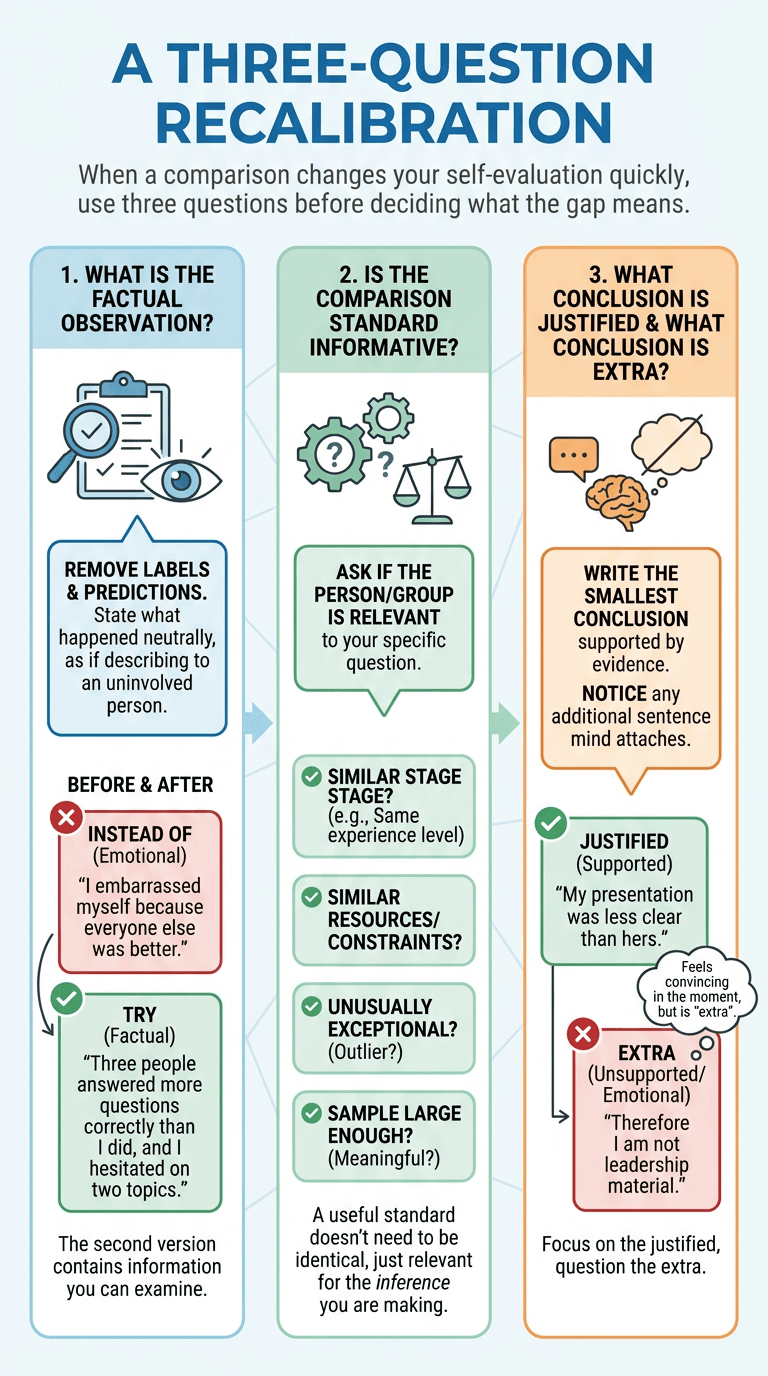
When a comparison changes your self-evaluation quickly, use three questions before deciding what the gap means.
What is the factual observation?
Remove labels and predictions. State what happened as if you were describing it to someone who was not emotionally involved.
Instead of “I embarrassed myself because everyone else was better,” try “Three people answered more questions correctly than I did, and I hesitated on two topics.” The second version contains information you can examine.
Is the comparison standard informative?
Ask whether the person or group is relevant to the question you are trying to answer. Are they at a similar stage? Do they have similar resources or constraints? Are they unusually exceptional? Is the sample large enough to tell you anything meaningful?
A standard does not need to be identical to you to be useful. It needs to be useful for the particular inference you are making.
What conclusion is justified and what conclusion is extra?
Write the smallest conclusion supported by the evidence. Then notice any additional sentence your mind wants to attach.
For example, “My presentation was less clear than hers” may be justified. “Therefore I am not leadership material” is extra, even if it feels convincing in the moment.
Worked Examples Across Domains
Professional skill after joining an expert team
Situation: You were one of the strongest analysts at your previous company. At a new firm, nearly everyone works faster and spots problems you miss.
What you may feel: Less competent than you felt a month ago.
What it may mean: Your comparison group changed. Your current colleagues may reveal genuine gaps, but your previous skills did not vanish when you changed employers.
What to do next: Identify the specific differences in technique, speed, or knowledge. Compare your work with role standards and track learning over several months rather than treating your new relative position as a complete measure of ability.
Creative output after seeing top creators
Situation: You finish a piece of work you liked, then browse highly polished work from established creators and suddenly think yours looks amateur.
What you may feel: Deflated, embarrassed, or unsure whether the work is worth sharing.
What it may mean: The comparison may contain useful technical information, but the standard is highly selected. You may be comparing your ordinary workday with another person’s strongest public output.
What to do next: Extract one or two concrete lessons, such as composition, editing, storytelling, or consistency. Then return to a standard that answers your actual question, such as whether the work improved relative to your recent projects or meets the needs of its intended audience.
Fitness progress when peers have different training histories
Situation: You train consistently for six months but still lift less than people in your gym who appear to be your age.
What you may feel: As though your progress is inadequate.
What it may mean: Age is only one variable. Training history, technique, goals, body size, prior sports experience, injury history, and program design may differ.
What to do next: Use your own performance trend and task-relevant benchmarks alongside peer comparison. The peer gap may still provide useful information, but it should not erase evidence of real improvement.
What to Do Next When Relative Rank Is Distorting the Picture
Add an absolute benchmark
Find a measure that does not depend entirely on who happens to be nearby. This could be a competency standard, a timed result, a quality rubric, a certification requirement, a completed task, or a repeatable performance measure.
Absolute benchmarks are not perfect, but they answer a different question from rank. Combining the two often gives a clearer picture.
Compare multiple relevant standards
If your judgment changes dramatically depending on one person, broaden the comparison pool. Look at people with similar experience, people slightly ahead, and objective expectations for your stage.
This reduces the chance that an unusually strong or weak standard will dominate your conclusion. It also helps you see whether the observed gap is stable or merely an artifact of the group you happened to enter.
Keep the judgment domain-specific
Finish the sentence with the domain attached: “I am less experienced at this type of negotiation,” “I am behind my desired pace in this course,” or “My current editing is weaker than the examples I want to match.”
Specificity makes the judgment more accurate and more actionable. It also prevents a performance difference from quietly becoming a statement about worth.
If comparison is contributing to persistent hopelessness, severe body-image distress, eating problems, self-harm thoughts, or a major decline in daily functioning, individualized professional support may be appropriate. Social comparison alone cannot tell you whether a mental health condition is present.
FAQ
Why can one successful person make me feel less capable?
A highly salient person can become a temporary standard, especially when the domain matters to you. If you interpret their success as evidence about your own standing, your self-evaluation may shift even though your actual ability has not changed. The effect may be stronger when the person feels relevant, similar, close, or especially important as a standard.
Does being below average mean I am bad at something?
No. “Below average” describes your relative position within a particular group and measure. Whether that represents weak absolute performance depends on the group and the standard. Being below average in an elite group can coexist with strong objective ability, while being above average in an inexperienced group can coexist with major skill gaps.
How can I tell whether a comparison standard is realistic?
Ask whether the standard fits the question you are trying to answer. Consider experience level, opportunity, resources, task conditions, and whether the person is typical or exceptional. A standard can be unrealistic for estimating what is normal while still being useful for showing what excellent performance looks like.
Is social comparison part of self-perception?
Yes, social comparison can contribute to how you perceive and evaluate yourself, but it is only one source of information. Self-perception also draws on behavior, memories, emotions, feedback, context, and other evidence. Separating these inputs can help explain why the same comparison affects people differently.
Can comparison improve self-evaluation accuracy?
It can. Comparison is useful when objective standards are incomplete, when you need to understand typical performance, or when another person provides a relevant benchmark. Accuracy improves when you use suitable standards, keep the comparison domain-specific, and combine relative information with direct evidence about what you can actually do.
Key Takeaways
- Social comparison changes self-evaluation by changing the standard against which performance or progress is judged.
- A true relative gap does not automatically establish low absolute ability, poor future potential, or low personal worth.
- The FACT → COMPARISON → CONCLUSION framework helps separate observation from the meaning assigned to the self.
- Exceptional or unusually weak comparison groups can distort how ordinary performance looks.
- Specific self-assessments are usually more accurate and useful than global conclusions such as “I am inadequate.”
- Better calibration comes from combining social information with objective benchmarks, repeated evidence, and domain-specific feedback.
The next time another person’s performance changes how you see yourself, do not ask only, “Am I ahead or behind?” Ask what the comparison actually measured. Identify the fact, name the standard, and shrink the conclusion until it matches the evidence.
You may still discover a real gap. That is not a failure of the exercise. A precise gap can guide learning, practice, or a change in strategy. What becomes less useful is turning relative position in one domain into a verdict about your whole ability or your value as a person.
Michael Reed is the Founder & Lead Writer at Psychology Exposed, where he explains human behavior, relationships, emotional patterns, self-awareness, and everyday decisions in clear, research-aware language. This article is educational and is not a substitute for individualized mental health care.

Michael Reed is the Founder and Lead Writer at Psychology Exposed. He writes about human behavior, relationships, emotional patterns, self-awareness, and practical psychology topics using research-informed, easy-to-understand content.
Read More About Michael Reed: https://psychologyexposed.com/michael-reed/