
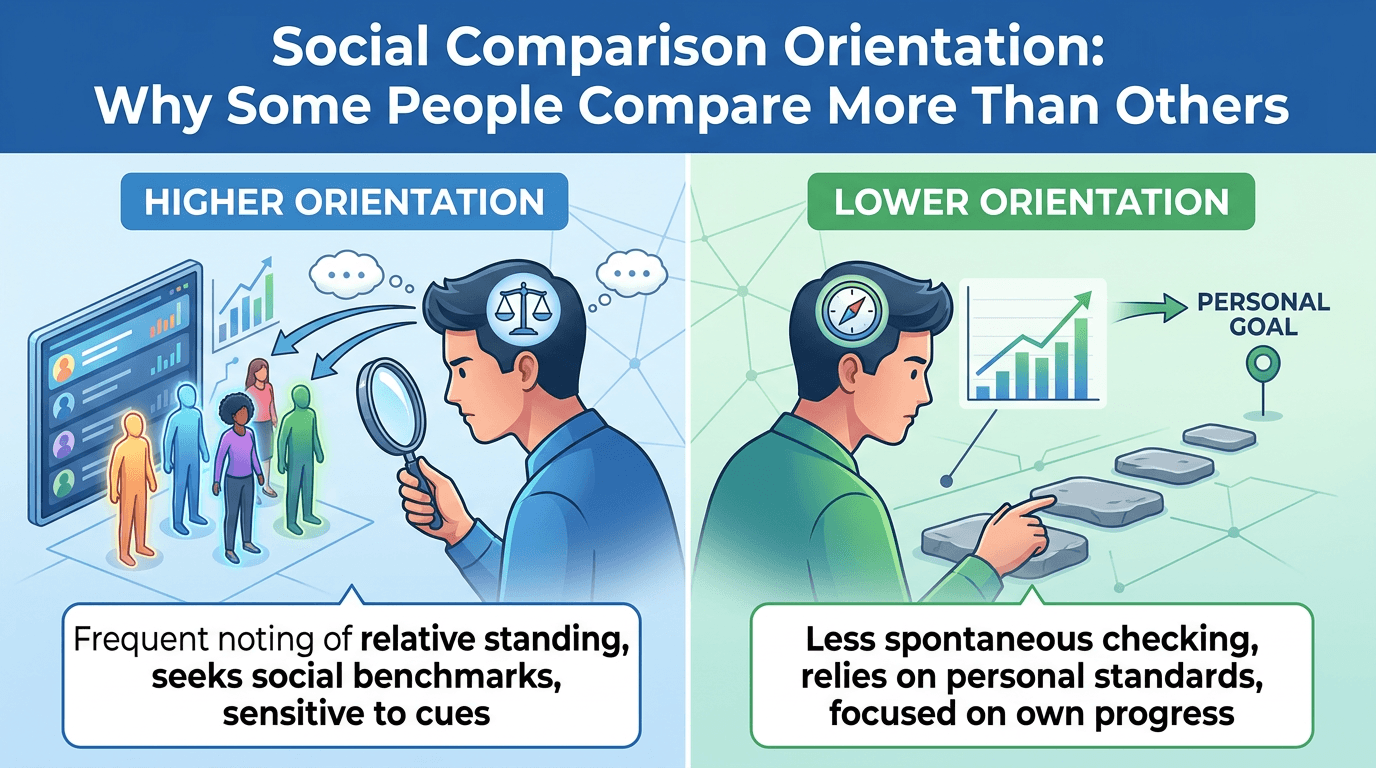
Two people can walk into the same room, see the same group of coworkers, hear the same performance numbers, and leave with very different amounts of comparison in their heads. One person may immediately notice who seems more skilled, more confident, or more successful. Another may register the same information but barely use it to judge their own position.
That difference is one reason psychologists study social comparison orientation: the tendency to notice, seek, and use information about how other people are doing, thinking, or responding. It helps explain why comparison can feel almost automatic for some people in certain settings while remaining much less central for others.
Social comparison orientation is not a diagnosis, and frequent comparison does not prove insecurity, anxiety, competitiveness, or low self-esteem. It describes how much attention a person tends to give comparative social information. The meaning still depends on the domain, target, situation, and conclusion drawn.
Quick Answer: Comparison Orientation Is a Tendency, Not a Diagnosis
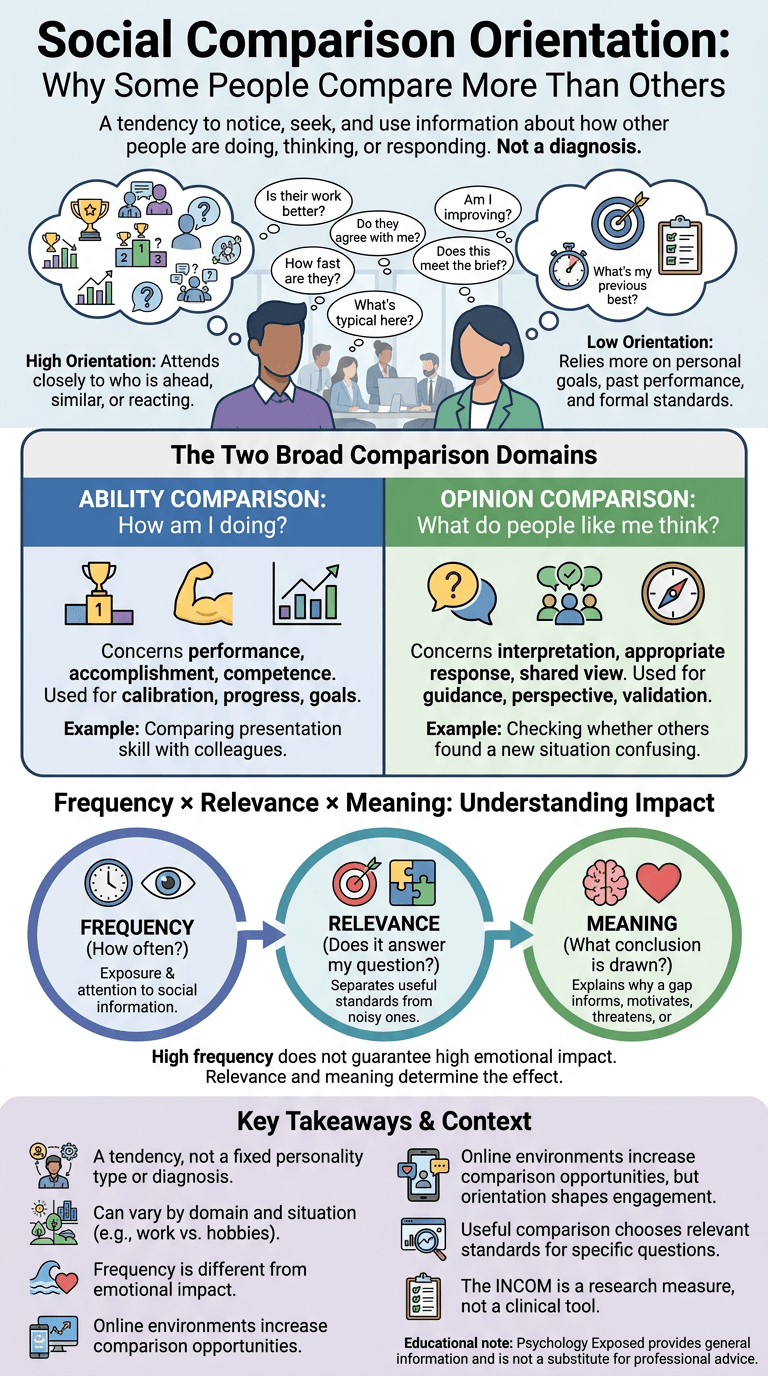
Social comparison orientation describes how strongly or frequently someone tends to use other people as reference points for abilities, opinions, experiences, or outcomes. Higher orientation means comparison information is more likely to capture attention and be used in self-evaluation. Lower orientation means it may play a smaller role. Neither level is automatically healthy or unhealthy, and the emotional effect of a comparison is a separate question.
What Social Comparison Orientation Means
The idea is about how strongly social information enters everyday judgment, not whether comparison exists at all.
Attending to social comparison information
Comparison begins with noticing a possible standard. A runner hears a friend’s race time. A new employee learns how quickly experienced coworkers finish a task. A parent listens to how other families handle bedtime. A student discovers the typical score on an exam. Each piece of information can be treated as background noise or as a meaningful reference point.
Social comparison orientation concerns the tendency to give this kind of information psychological weight. People higher on the tendency may be more likely to ask, explicitly or silently, “Where does that put me?” or “Is my reaction similar to theirs?” People lower on it may rely more heavily on their own goals, past performance, formal standards, or other non-social information when those alternatives are available.
The construct grew from research on individual differences within the broader social-comparison field. Buunk and Gibbons identified individual differences as an important development beyond the earliest question of why comparison occurs at all. Their peer-reviewed overview of the social-comparison field helps separate a general human process from differences in how strongly people use it.
Frequency is not the same as emotional impact
A person can compare often without being deeply upset by most comparisons. Someone who works in sales may constantly check team numbers because the data help with calibration, yet feel little emotional threat. Another person may compare only occasionally, but one comparison involving a highly valued goal may stay with them for days.
This distinction matters because “How often do I compare?” and “How much does a comparison affect me?” are different questions. Frequency describes exposure and attention. Emotional impact depends on factors such as relevance, closeness, perceived attainability, existing concerns, and the meaning assigned to the gap.
It is therefore possible to have high comparison frequency with low emotional intensity, or low comparison frequency with high emotional intensity. Treating those as the same thing can turn a useful psychological concept into an inaccurate personality label.
The Two Broad Comparison Domains Often Studied
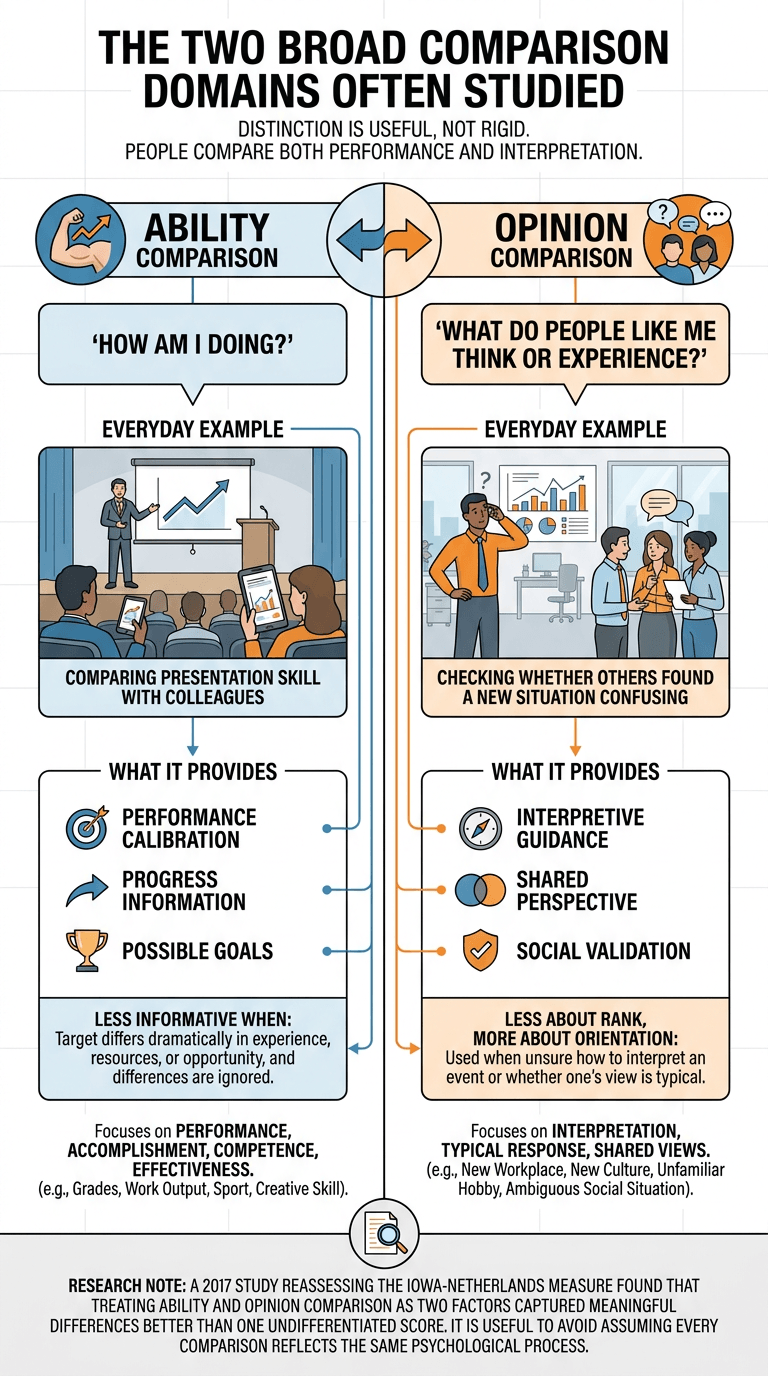
Research on social comparison orientation has often distinguished between comparison of abilities and comparison of opinions. The distinction is not perfectly rigid, but it is useful because people do not only compare performance. They also look to others when trying to understand what to think, feel, expect, or regard as normal.
| Comparison domain | Typical question | Everyday example | What the comparison may provide |
|---|---|---|---|
| Ability | How am I doing? | Comparing presentation skill with colleagues | Performance calibration, progress information, possible goals |
| Opinion | What do people like me think or experience? | Checking whether others found a new situation confusing | Interpretive guidance, shared perspective, social validation |
Ability comparison: how am I doing?
Ability comparison concerns performance, accomplishment, competence, or effectiveness. It can show up around grades, work output, sport, creative skill, public speaking, technical ability, or other domains in which people want to know how their performance stands relative to others.
Imagine two new designers receiving the same project feedback. One immediately checks how long more experienced designers needed to reach a similar level. The other focuses mainly on whether the work meets the client brief and whether it is better than last month’s work. Both are evaluating performance, but one is relying more strongly on comparative social information.
Ability comparison can be useful when the target is relevant and the comparison answers a real calibration question. It becomes less informative when the target differs dramatically in experience, resources, opportunity, or circumstances and those differences are ignored.
Opinion comparison: what do people like me think?
Opinion comparison is less about rank and more about orientation. People often look to others when they are unsure how to interpret an event, what response is typical, or whether their own view is widely shared. This can happen when entering a new workplace, moving to another culture, learning an unfamiliar hobby, or facing an ambiguous social situation.
For example, a person starting their first management role may ask other new managers whether they also found performance reviews uncomfortable. That comparison is not asking, “Who is better?” It is asking, “Is my experience unusual, and how are people in a similar position making sense of it?”
Later research has repeatedly examined the distinction between ability and opinion comparison. A 2017 study reassessing the structure of the Iowa-Netherlands measure found that treating these as two factors captured meaningful differences better than reducing everything to one undifferentiated score. The study on INCOM dimensionality is one reason it is useful to avoid assuming that every kind of comparison reflects the same psychological process.
The Iowa-Netherlands Comparison Orientation Measure
Researchers needed a structured way to study these individual differences instead of relying on vague impressions.
What the INCOM was designed to measure
The best-known measure of social comparison orientation is the Iowa-Netherlands Comparison Orientation Measure, usually shortened to INCOM. Frederick Gibbons and Abraham Buunk developed and validated it to study individual differences in the tendency to compare. Their original work included American and Dutch samples and was designed to produce a measure that could be examined across those two cultural settings.
The 1999 paper evaluated the measure’s psychometric properties and examined whether scores predicted comparison-related behavior in laboratory and field settings. PubMed’s record for Gibbons and Buunk’s INCOM development paper documents the original validation work.
Why a research scale should not be turned into an online personality label
A research measure is not the same thing as a clinical diagnosis or a fixed identity category. A high score does not mean “insecure person,” and a low score does not mean “confident person.” Those claims would go beyond what the construct measures.
Measures also need evidence about reliability, validity, language, culture, and factor structure. Later researchers have tested the INCOM in additional populations. A Brazilian adaptation, for example, reported satisfactory psychometric properties. The open-access validation study illustrates why a measure should be evaluated in a new context rather than casually translated.
For a general reader, the safest use of the concept is descriptive. You can notice whether you tend to seek comparison information, which domains trigger that tendency, and what you do with the information. There is no need to turn the construct into a self-diagnosis.
Low vs High Comparison Orientation: A Continuum, Not Two Types
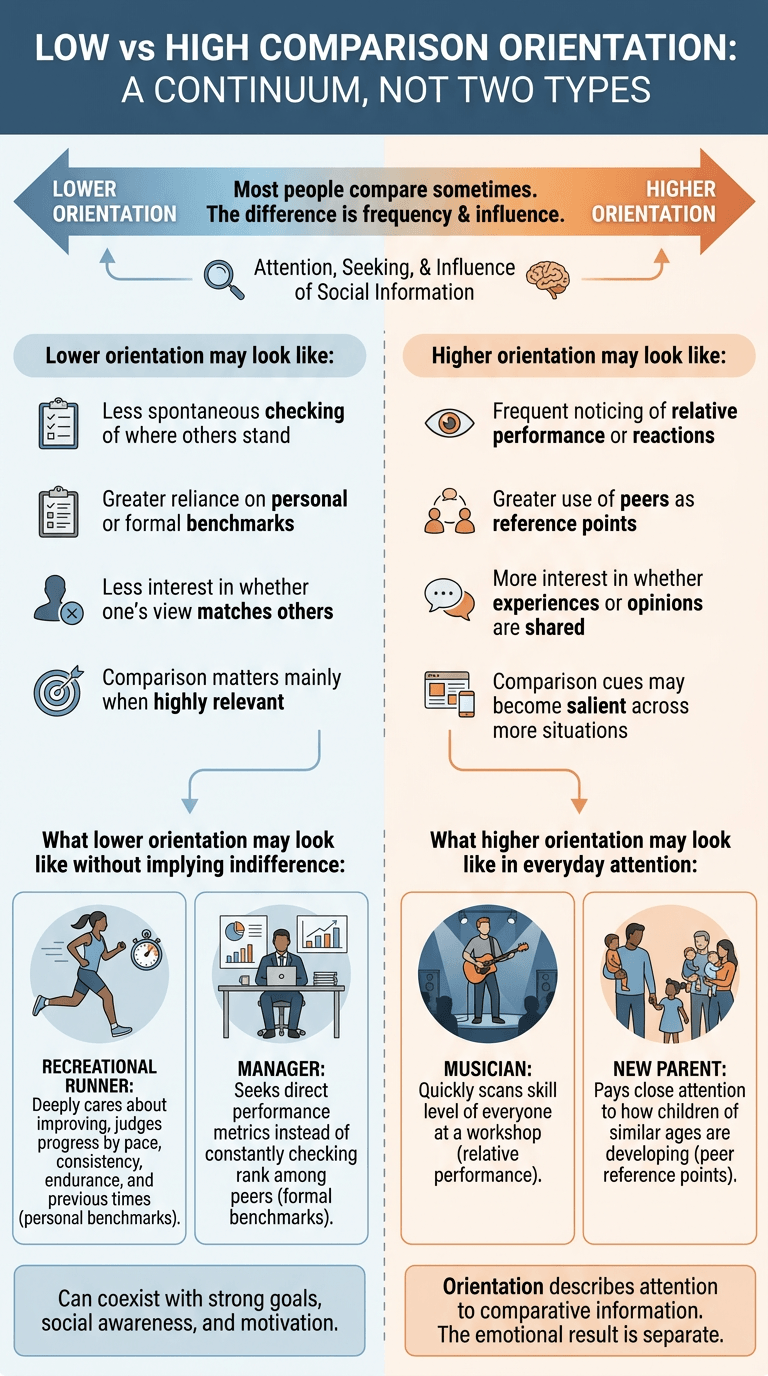
It is tempting to split people into “comparers” and “non-comparers,” but a continuum is more realistic. Most people compare sometimes. The difference is how often social information captures attention, how actively it is sought, and how heavily it influences evaluation.
| Lower orientation may look like | Higher orientation may look like |
|---|---|
| Less spontaneous checking of where others stand | Frequent noticing of relative performance or reactions |
| Greater reliance on personal or formal benchmarks | Greater use of peers as reference points |
| Less interest in whether one’s view matches others | More interest in whether experiences or opinions are shared |
| Comparison matters mainly when highly relevant | Comparison cues may become salient across more situations |
What higher orientation may look like in everyday attention
A higher comparison orientation may show up as quickly noticing who is ahead, who seems similar, or how other people reacted. A musician may scan the skill level of everyone at a workshop. A creator may notice views, posting frequency, and audience growth among peers. A new parent may pay close attention to how children of similar ages are developing.
None of those examples tells us whether the person feels inspired, threatened, curious, reassured, or unaffected. Orientation describes attention to comparative information. The emotional result still has to be explained separately.
What lower orientation may look like without implying indifference
Lower orientation does not mean someone never notices other people, lacks ambition, or ignores useful feedback. A person may simply prefer benchmarks that do not require frequent social comparison.
A recreational runner, for instance, may care deeply about improving but judge progress mainly by pace, consistency, endurance, and previous race times rather than by what friends are doing. A manager may seek direct performance metrics instead of constantly checking how they rank among peers. Lower comparison orientation can coexist with strong goals, social awareness, and motivation.
Why Comparison Orientation Can Vary Across People
There is no single explanation for why one person compares more than another. Current goals, uncertainty, available information, and domain importance can all affect whether comparison becomes salient.
Sensitivity to social information
Some people appear more attentive to cues about what others are doing, thinking, or achieving. This does not automatically mean they are emotionally dependent on those cues. It may simply mean social information enters their evaluation process more readily.
In practice, this could look like noticing how coworkers react to a new policy before forming a view, tracking classmates’ progress while studying, or paying attention to what people with similar experience levels can do. The same sensitivity can be useful in one setting and distracting in another.
Uncertainty and the need for calibration
Comparison becomes especially attractive when objective standards are unclear. If you are learning a new skill and there is no obvious benchmark, another person can provide a rough reference point. If you enter a new professional culture, coworkers may reveal what is typical even before formal expectations become clear.
This does not mean uncertainty is the sole cause of high comparison orientation. Rather, uncertainty can make social information more useful, so people who already attend strongly to comparison cues may rely on them even more in ambiguous situations.
Domain relevance and current goals
Comparison is usually stronger when the domain matters. Someone who rarely compares income may compare intensely around artistic skill because creativity is central to their goals. Another person may ignore appearance comparison but care greatly about academic or athletic performance.
A better question than “Am I a person who compares?” is often, “Where do I use comparison information most, and what question am I trying to answer there?”
Self-focus and social context as related influences, not simple causes
Self-focused attention can make information about one’s own standing more noticeable, while environments full of rankings, visible outcomes, or peer feedback can provide more material to compare. These influences may interact with a person’s usual comparison tendency.
It would be too simple, however, to claim that one personality feature or one environment creates comparison orientation. The construct is better treated as a tendency that can be strengthened, muted, or redirected by context.
Situational vs Dispositional Comparison
A general tendency matters, but the setting can raise or lower how much comparison actually occurs.
A person can compare more in one domain than another
Dispositional language describes a relatively stable tendency, but real behavior is still domain-sensitive. A person can be comparison-focused at work and barely compare in hobbies. They may pay close attention to others when learning something new, then become less comparison-dependent once their own standards are clearer.
Consider someone who changes careers. During the first year, they may constantly monitor peers because they do not yet know what “good” looks like. Five years later, the same person may rely more on project quality, client outcomes, and personal experience. Their general tendency has not necessarily vanished, but the informational need has changed.
Competitive or visible environments can increase comparison opportunities without changing identity
A leaderboard, public ranking, performance dashboard, or highly transparent workplace can increase comparison even among people who are not usually comparison-focused. The environment repeatedly supplies relative information, making it difficult not to notice.
The reverse can also happen. Someone with a strong tendency to compare may do less of it in a setting where useful social information is scarce or where formal standards are clearer. Behavior reflects both the person and the situation.
Comparison Orientation Is Not the Same as Competitiveness or Insecurity
Several nearby concepts can overlap with comparison, but none should be treated as a synonym for it.
Wanting information is different from wanting to beat others
Competitiveness involves wanting to outperform others or treating relative performance as a goal. Social comparison orientation involves attending to or using comparison information. Those can overlap, but they are not the same.
A person may compare frequently because they want accurate calibration, not because they want to win. A novice cook might watch skilled friends closely to learn technique. A public speaker might compare delivery styles to understand what works. The purpose is information, not dominance.
Frequent comparison does not prove low self-esteem
Frequent comparison may correlate with other psychological variables in some studies, but correlation does not justify turning the construct into a simple explanation of someone’s confidence or worth. People compare for many reasons, including uncertainty reduction, learning, self-evaluation, shared understanding, and goal calibration.
A later Oxford overview emphasizes that the effects of social comparison orientation depend on the information and context. The Oxford review of individual differences in social comparison reinforces that higher orientation does not map neatly onto one emotional outcome.
Frequency × Relevance × Meaning: A Better Way to Understand Impact
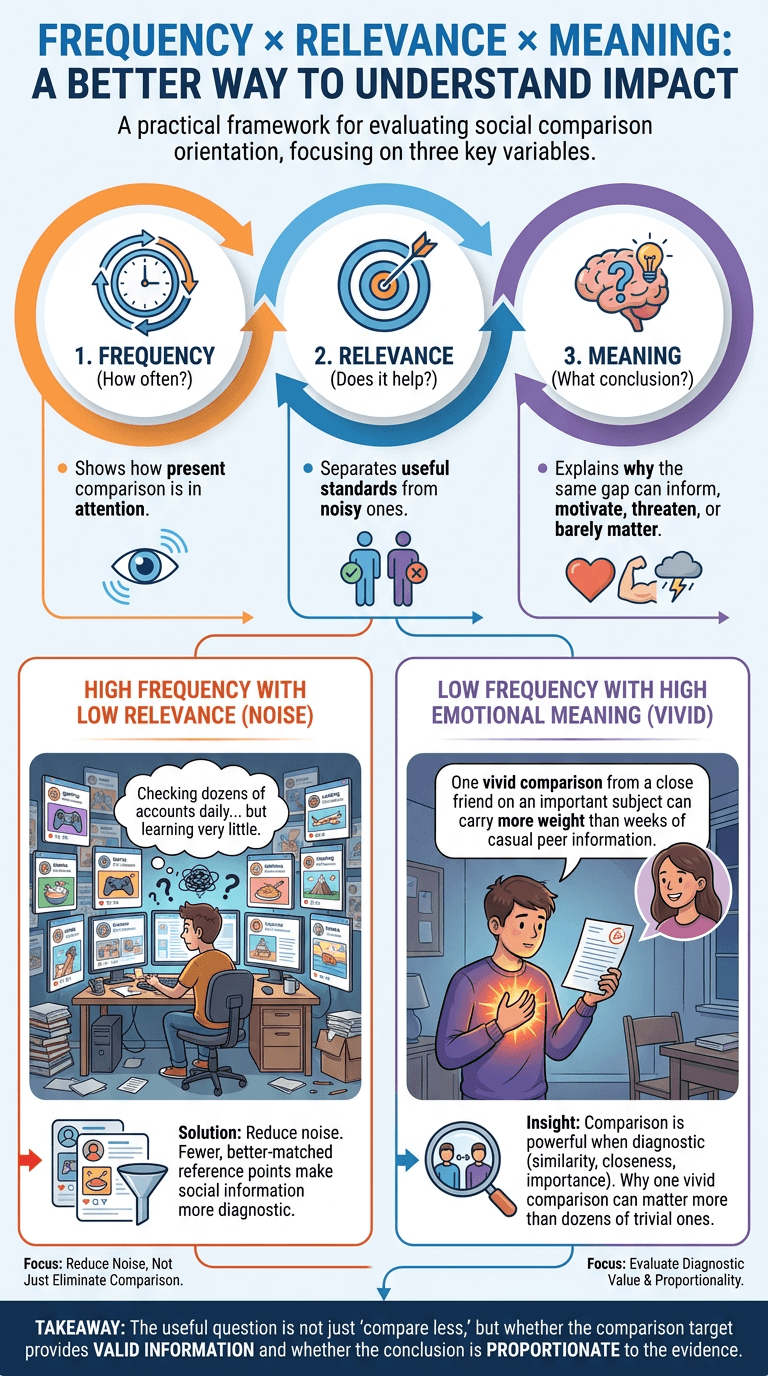
A practical way to think about social comparison orientation is to separate three variables: frequency, relevance, and meaning.
| Variable | Question | Why it matters |
|---|---|---|
| Frequency | How often am I noticing or seeking comparison information? | Shows how present comparison is in attention |
| Relevance | Does this target actually help answer my question? | Separates useful standards from noisy ones |
| Meaning | What conclusion am I drawing from the comparison? | Explains why the same gap can inform, motivate, threaten, or barely matter |
High frequency with low relevance
A creator may check dozens of accounts every day and still learn very little because the accounts differ in niche, audience age, budget, posting history, and platform strategy. The comparison frequency is high, but the reference points are poor for the question “Am I progressing appropriately for my circumstances?”
In such a case, reducing noise may be more useful than trying to eliminate comparison. Fewer, better-matched reference points can make social information more diagnostic.
Low frequency with high emotional meaning
Now imagine a student who rarely compares grades but sees one result from a close friend in a course that matters deeply to them. That single comparison may carry more emotional weight than weeks of casual peer information.
The issue is not frequency. It is relevance and meaning. The friend feels similar, the domain matters, and the result may be interpreted as evidence about the student’s own ability. One vivid comparison can therefore matter more than dozens of trivial comparisons.
Why one vivid comparison can matter more than dozens of trivial ones
Comparison information becomes powerful when it seems diagnostic. Similarity, closeness, credibility, timing, and personal importance can all increase that feeling. A random stranger’s success may be easy to dismiss. A colleague with the same job title, experience, and resources may feel much harder to ignore.
This helps explain why “compare less” is often too crude as advice. The more useful question is whether the comparison target provides valid information and whether the conclusion drawn from it is proportionate to the evidence.
Online Environments as Comparison-Dense Contexts
Digital settings are useful for seeing how personal tendencies meet environments rich in visible social cues.
More available targets and visible metrics
Online environments can supply an unusually large number of comparison cues: follower counts, views, likes, public milestones, portfolios, before-and-after stories, professional announcements, fitness records, and curated achievements. Someone with a high comparison orientation may notice these cues quickly because they offer constant relative information.
But online exposure is not the same as orientation. A platform can make comparisons available, while the individual tendency affects how much those comparisons are noticed and used.
Why platform exposure and personal orientation can interact without proving causation
It is reasonable to expect person and context to interact. Someone who pays close attention to comparative information may use visible online metrics more heavily than someone who does not. At the same time, highly visible environments may increase comparison opportunities for almost everyone.
That does not prove that social media creates a stable comparison orientation, nor that high orientation causes problematic use. A 2026 meta-analysis found a modest association between problematic social-media use and social comparison, but the included studies were largely survey-based, so the authors explicitly treated the relationship as an association rather than proof of a simple causal chain. The meta-analysis indexed in PubMed illustrates why platform behavior and personal comparison tendency should be discussed carefully.
How to Choose Useful Rather Than Noisy Comparison Information
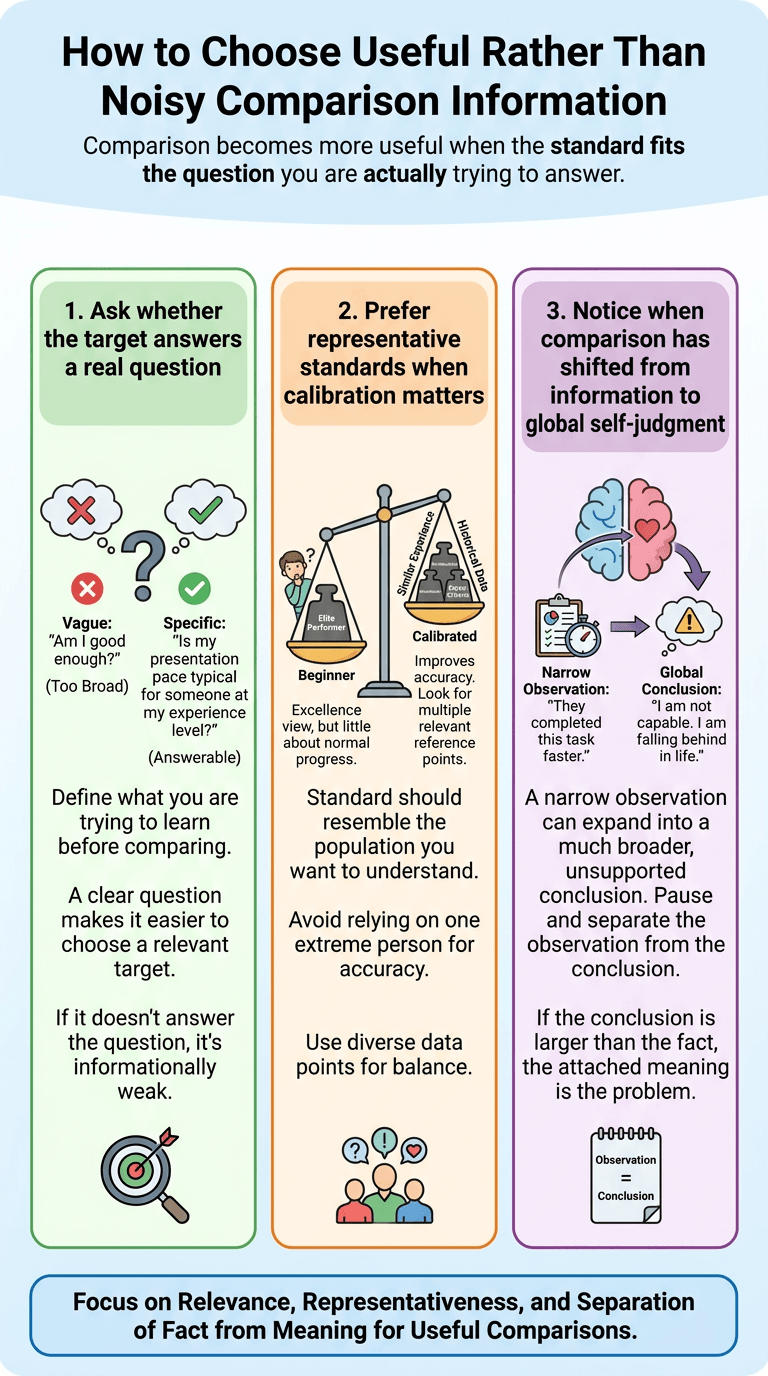
Comparison becomes more useful when the standard fits the question you are actually trying to answer.
Ask whether the target answers a real question
Before treating someone as a standard, define what you are trying to learn. “Am I good enough?” is too broad. “Is my presentation pace typical for someone at my experience level?” is more answerable. A clear question makes it easier to choose a relevant target.
If the comparison does not answer the question, it may be psychologically vivid but informationally weak.
Prefer representative standards when calibration matters
Calibration improves when the standard resembles the population you actually want to understand. Comparing a beginner with an elite performer may reveal what excellence looks like, but it says little about whether the beginner is progressing normally.
When accuracy matters, look for multiple relevant reference points rather than one extreme person. Formal benchmarks, historical data, expert criteria, and your own previous performance can also balance social information.
Notice when comparison has shifted from information to global self-judgment
A comparison may begin with a narrow observation, such as “They completed this task faster,” then expand into “I am not capable” or “I am falling behind in life.” That jump adds a much broader conclusion than the original evidence supports.
A useful pause is to write the observation in one sentence, then the conclusion in another. If the conclusion is much larger than the fact, the problem may not be comparison itself but the meaning attached to it.
A Tendency Meets a Situation
Orientation makes the most sense when personal tendencies and available comparison opportunities are considered together.
Social Comparison Theory explains why social standards can become useful
The broader theory of social comparison asks why people use others to evaluate opinions and abilities, especially when objective standards are limited. Social comparison orientation asks a narrower question: why do some people attend to and use that information more than others?
Keeping those questions separate prevents a common confusion. The existence of a comparison process does not mean everyone engages with it to the same degree.
Online settings show how opportunity and orientation can work together
Digital environments are useful examples because they make comparative information highly available. Yet the same feed does not produce the same response in everyone. One person may scan every metric. Another may focus on content itself. A third may compare only in a personally important domain.
This person-by-situation view is more accurate than treating comparison orientation as destiny. A tendency shapes attention, while context shapes what information is available to be noticed.
A brief reflection check
Instead of scoring yourself, notice where comparison enters your thinking: Which settings make you check how others are doing? Is the comparison about ability, opinion, experience, or recognition? Is the target genuinely informative? Are you trying to learn and calibrate, or has the comparison become a global judgment about your worth? Adding an objective benchmark or your own previous performance can reveal whether the social standard is helping.
Frequent comparison alone is not a mental-health diagnosis. If comparison is tied to persistent severe distress, major functional decline, intense body-image concerns, disordered eating behaviors, or self-harm thoughts, individualized professional support may be more appropriate than trying to solve the problem through comparison strategies alone.
FAQ
These questions clarify what social comparison orientation does, and does not, tell us about a person.
Is social comparison orientation a personality trait?
It is commonly studied as an individual-difference tendency, which means people can differ relatively consistently in how much they attend to and use comparison information. That does not make it a fixed personality type. Situations, domains, goals, uncertainty, and available information can all change how strongly the tendency is expressed.
Does a high INCOM score mean someone is insecure?
No. The INCOM was designed to measure social comparison orientation, not insecurity. A person with a higher score may use comparative information more often, but that alone does not reveal why they compare or whether comparison harms their confidence. Interpreting a research scale as a diagnosis would go beyond what it measures.
Can comparison orientation differ by domain?
Yes in everyday expression. A person may be very comparison-focused in a domain that matters deeply, such as work or sport, while showing little interest in comparison elsewhere. General measures capture an overall tendency, but real comparison behavior remains sensitive to context and relevance.
Can someone compare frequently without feeling bad?
Yes. Comparison may be used for learning, calibration, information seeking, or understanding what is typical. Emotional impact depends on what is being compared, who the target is, and what meaning is assigned to the result. Frequency alone does not determine whether comparison feels inspiring, neutral, useful, or painful.
Does social media create high comparison orientation?
Current evidence does not support such a simple conclusion. Social platforms can create many comparison opportunities, and people who are more comparison-oriented may attend closely to those cues. But association is not the same as proof that platform exposure creates a stable personal tendency. Person and context need to be considered together.
Key Takeaways
- Social comparison orientation describes how strongly or frequently a person tends to attend to and use comparative social information.
- Ability comparison asks how performance stacks up, while opinion comparison helps people orient themselves to views, experiences, and interpretations.
- The INCOM is a research measure, not a diagnostic quiz or a label for insecurity.
- Comparison frequency, comparison relevance, and emotional meaning should be evaluated separately.
- A person can compare heavily in one domain and lightly in another because goals and uncertainty change the value of social information.
- Useful comparison depends less on eliminating comparison and more on choosing standards that actually answer the question you are trying to solve.
Final Thoughts
If you compare more than people around you, focus on where the comparisons happen, what question they answer, and whether the targets are informative. Separating frequency, relevance, and meaning leaves room for comparison to be useful without turning every relative difference into a verdict about ability or value.
Educational note: Psychology Exposed provides general educational information and is not a substitute for individualized diagnosis, treatment, or crisis support.

Michael Reed is the Founder and Lead Writer at Psychology Exposed. He writes about human behavior, relationships, emotional patterns, self-awareness, and practical psychology topics using research-informed, easy-to-understand content.
Read More About Michael Reed: https://psychologyexposed.com/michael-reed/