
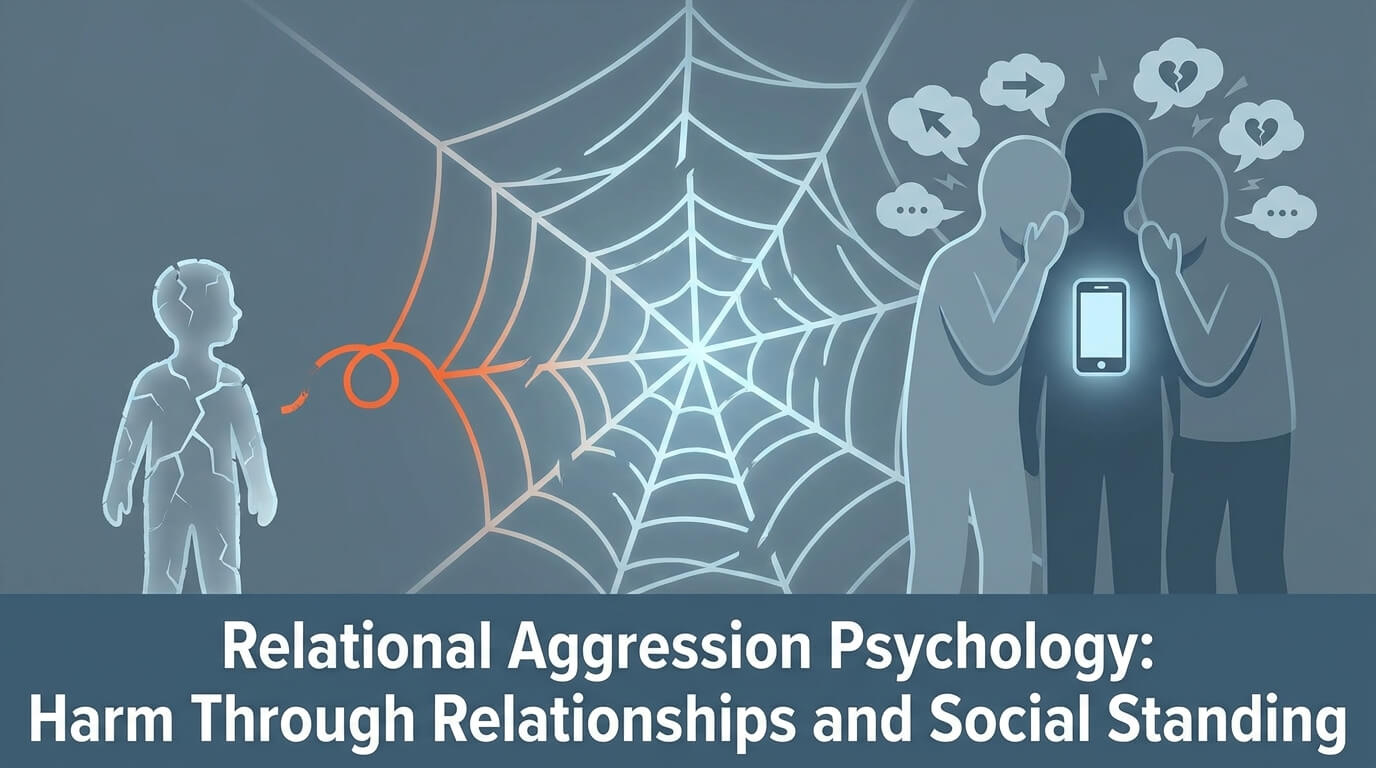
Some forms of aggression are easy to recognize because the harm is direct. Relational aggression is harder to see because the relationship itself, a person’s place in a group, or their reputation can become the means of harm. A person may be deliberately excluded to punish them, threatened with loss of friendship unless they comply, or targeted through rumors meant to turn others against them.
Not every exclusion, friendship ending, private group, or social disappointment is aggression. People can change relationships, leave groups, and set limits. The distinction depends on intention, context, pattern, and whether social connection or standing is being used to hurt another person.
Quick Answer
Relational aggression is behavior intended to harm another person through relationships, belonging, reputation, exclusion, or social standing. Examples can include deliberately isolating someone, spreading rumors to damage their reputation, or threatening friendship withdrawal to cause harm or gain compliance. Ordinary boundaries, changing friendships, limited invitations, or leaving a group are not automatically relational aggression because harmful intent and context matter.
What Relational Aggression Means
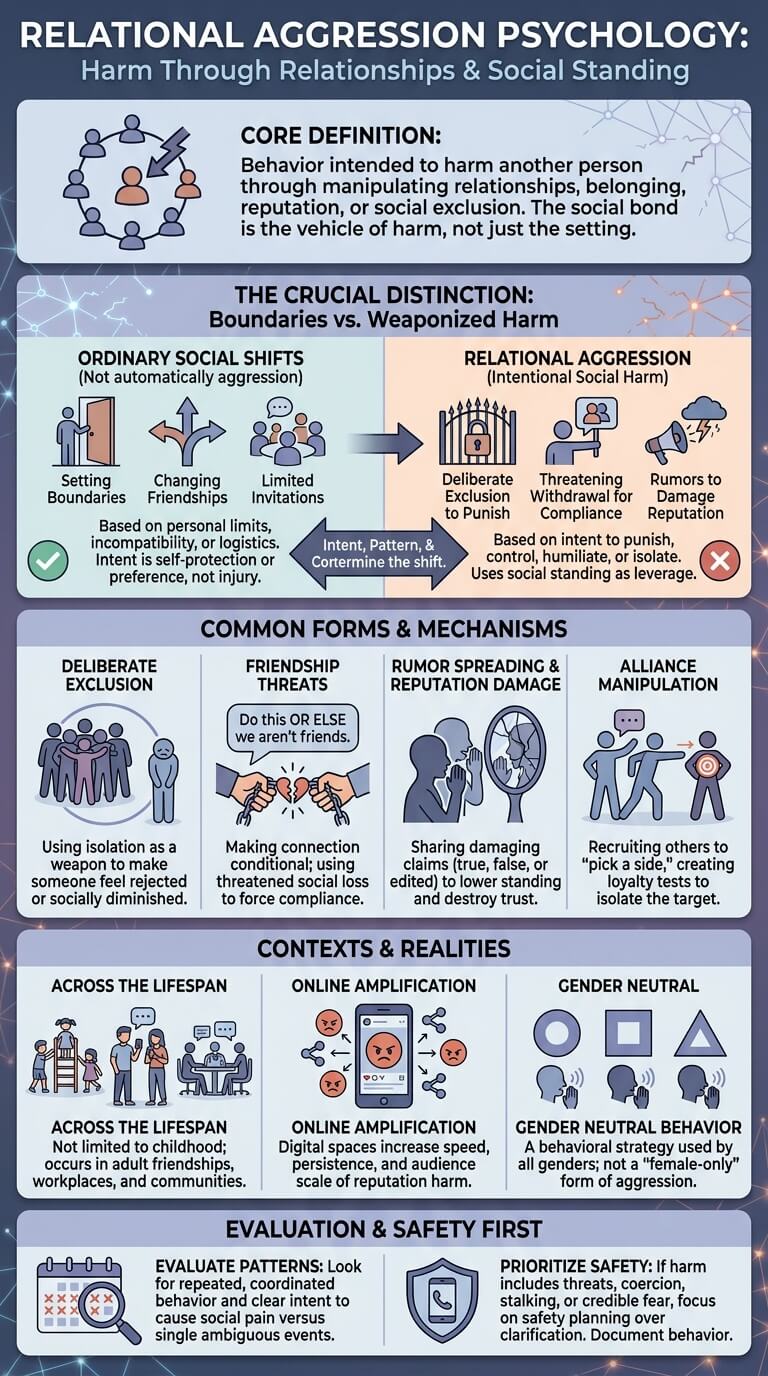
The APA Dictionary of Psychology definition of relational aggression describes behavior that manipulates or damages relationships between people or groups, including behaviors such as gossip and humiliation. The useful psychological idea is that the social relationship is not just the setting. It is part of the mechanism through which harm is delivered.
Relationships, belonging, or reputation as the target or vehicle of harm
Physical aggression uses physical force as the route of harm. Verbal aggression uses language. Relational aggression works through a person’s social world. The target might be their friendship, access to a group, reputation, sense of inclusion, or relationship with other people.
For example, “I need some space this week” may be boundary-setting. Telling mutual friends not to invite someone specifically so that person feels isolated uses the group as a tool of harm.
Why intention to harm matters
A broad definition of aggression usually includes a harm-directed component. The APA definition of aggression centers behavior aimed at causing physical or psychological harm. That makes intent an important part of relational aggression too.
Intent is often hard to observe. One ambiguous event deserves caution, while repeated statements, coordinated behavior, threats involving belonging, or clear efforts to damage reputation provide stronger evidence.
Direct and indirect relational forms
Relational aggression can be direct or indirect. A direct version openly communicates the social consequence: “If you talk to him, you are not my friend anymore.” An indirect version may work behind the target’s back, such as spreading a rumor so that other people withdraw from them.
A developmental review in PubMed Central describes both direct relational threats and indirect reputation-damaging behavior. The distinction is useful because subtlety should not be confused with harmlessness, but neither should subtle behavior be assumed to be aggressive without evidence of intentional social harm. Relational harm may follow a perceived provocation or be used strategically toward a goal, so its function can be reactive or proactive even though its form is relational.
Common Forms of Relational Aggression

Relational aggression can look different across age groups and settings, but the underlying logic is similar: a social bond, reputation, alliance, or place in a group is deliberately used to impose a cost on someone else.
Deliberate exclusion used to hurt
Exclusion becomes relationally aggressive when exclusion itself is used as a weapon. A group might intentionally leave one person out of an event, conversation, or shared activity because they want that person to feel rejected or socially diminished.
A limited guest list or closed group is not aggression by itself. The concern rises when exclusion is chosen specifically to punish, embarrass, or damage someone’s belonging.
Threatening withdrawal of friendship or belonging
Relationships can be used as leverage. Statements such as “If you do not do what I want, none of us will speak to you” combine a demand with threatened social loss. The harm is not simply disagreement. It is the deliberate use of belonging as a pressure point.
Across ages and settings, the underlying move is similar: access to connection is made conditional in a way designed to hurt or control.
Rumor spreading and reputation damage
Rumors can be relational aggression when they are spread to lower another person’s standing, damage trust, or cause others to reject them. The content may be false, exaggerated, selectively edited, or based on private information shared for a harmful purpose.
Talking about someone who is absent is not automatically aggression. The distinction is clearer when the communication is aimed at social damage rather than support, problem-solving, or legitimate safety information.
Alliance manipulation and social isolation
A person may pressure mutual friends to “pick a side” or create loyalty tests that make contact with the target socially costly. The key question is whether others are being deliberately organized or pressured to isolate, punish, or undermine someone.
Public embarrassment when social standing is the target
Public embarrassment can become relational aggression when an audience is used to lower someone’s social standing, such as exposing a private mistake or repeatedly sharing an embarrassing story after being asked to stop. When degrading language is involved, it can overlap with verbal aggression.
| Behavior | What makes it relationally aggressive | What may look similar but is different |
|---|---|---|
| Exclusion | Leaving someone out specifically to punish, humiliate, or isolate them | A limited guest list, privacy, or a group with legitimate membership boundaries |
| Friendship threat | Using threatened social loss to force compliance or cause distress | Ending a relationship because you no longer want to participate in it |
| Rumor spreading | Sharing damaging claims to lower reputation or turn others against someone | Seeking confidential support or sharing accurate safety information |
| Alliance pressure | Recruiting others to isolate or punish a target | Friends independently deciding how they want to respond to a conflict |
| Public embarrassment | Using an audience to damage social standing | Necessary public correction handled without humiliation |
What Is Not Automatically Relational Aggression
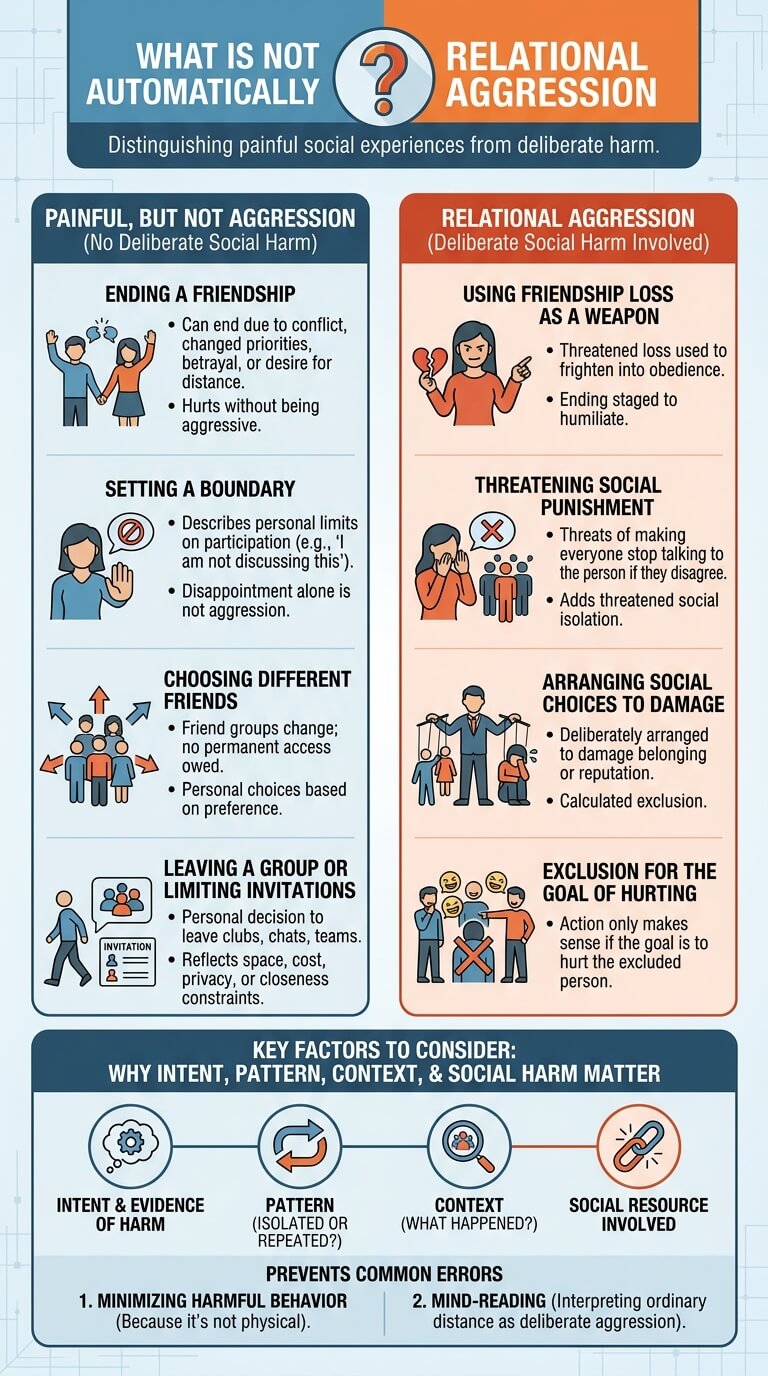
The concept becomes less useful if every painful social experience is placed inside it. Some events hurt deeply while still falling outside aggression because no deliberate social harm is involved.
Ending a friendship
A friendship can end because of conflict, changed priorities, betrayal, or a desire for distance. That may hurt without being aggressive. The picture changes when threatened friendship loss is used to frighten someone into obedience or the ending is staged to humiliate them.
Setting a boundary
A boundary describes what someone will or will not participate in. “I am not discussing this in the group chat anymore” can be a limit. “If you do not agree with me, I will make sure everyone stops talking to you” adds threatened social punishment. Disappointment alone does not turn a boundary into aggression.
Choosing different friends
Friend groups change, and people do not owe equal intimacy or permanent access to everyone they once knew. Relational aggression is more plausible when social choices are deliberately arranged to damage someone’s belonging or reputation.
Leaving a group or limiting invitations
Leaving a club, chat, team, or social circle can be a personal decision. Limiting an invitation list may reflect space, cost, privacy, or closeness. None of those facts alone establish aggression.
One useful test is whether the action would still make sense if the goal were not to hurt the excluded person. If the answer is yes, ordinary boundary-setting or group choice may be the better explanation.
Why intent, pattern, context, and social harm matter
A single behavior rarely tells the whole story. It helps to consider four pieces together: what happened, what social resource was involved, what evidence suggests harmful intent, and whether the event is isolated or part of a repeated pattern.
This prevents two common errors. The first is minimizing harmful behavior because it is not physical. The second is mind-reading, where ordinary distance or disappointment is automatically interpreted as deliberate aggression.
Relational Aggression vs Ordinary Social Conflict
Conflict and aggression are not synonyms. People can disagree strongly about loyalty, invitations, rumors, group decisions, or friendship expectations without intentionally trying to harm one another.
Disagreement or incompatibility without deliberate social harm
Two friends may want different levels of contact. A group may disagree about who should lead a project. Family members may argue about privacy or loyalty. These situations involve incompatible preferences, but they do not become aggression simply because feelings are hurt.
The shift occurs when the disagreement becomes a reason to impose intentional social harm, such as recruiting others to punish one person or spreading damaging information as retaliation.
Retaliatory exclusion versus ordinary distance
Distance says, in effect, “I do not want this level of contact.” Retaliatory exclusion says, “I want you to feel what it is like to lose access to us because you crossed me.” The outward behavior may look similar, but the function differs.
Because motives are not always visible, avoid overconfidence. Look for direct statements, repeated patterns, coordinated behavior, timing after a perceived offense, and whether the exclusion is accompanied by humiliation or reputation attacks.
Why conflict can remain non-aggressive
Conflict can lead to negotiation, compromise, separation, boundary-setting, or simply unresolved disagreement. None requires intentional harm. This is an important protection against the idea that every tense social situation is an aggression cycle.
It is possible to say, “We are not resolving this, so I am stepping back,” without threatening someone’s social standing. It is also possible for both people to feel hurt without either person using relationships as a weapon.
Relational Aggression vs Manipulation
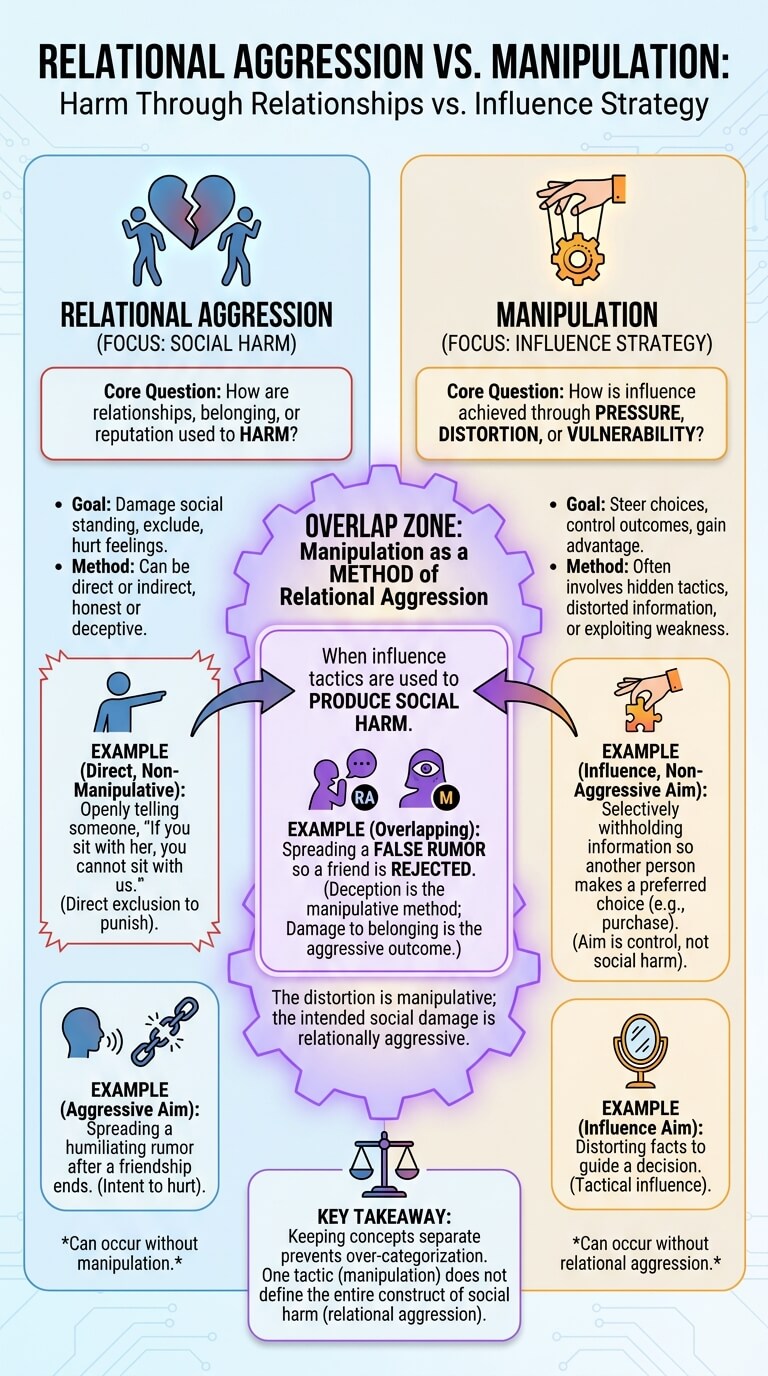
These concepts overlap, but they answer different questions. Relational aggression asks how relationships, belonging, or reputation are used to harm. Manipulation asks how influence is achieved through pressure, distorted information, vulnerability, or constrained choices.
Harm through relationships versus influence strategy
A relationally aggressive act may aim mainly to hurt: spreading a humiliating rumor after a friendship ends. A manipulative act may aim mainly to influence: selectively withholding information so another person makes a preferred choice. Either behavior can occur without the other.
Psychology Exposed covers the broader influence side in psychology of manipulation. Keeping the concepts separate prevents every unpleasant social tactic from being placed into one oversized category.
How manipulation can be a method without defining the whole construct
Manipulation can become a method of relational aggression when influence tactics are used to produce social harm. Someone might distort a story to turn mutual friends against a target. The distortion is manipulative; the intended damage to belonging or reputation is relationally aggressive.
But relational aggression does not require deception. Openly telling someone, “If you sit with her, you cannot sit with us,” can be direct, obvious, and still aggressive if exclusion is being used to harm.
Examples of overlap and non-overlap
| Situation | Relational aggression? | Manipulation? | Why |
|---|---|---|---|
| Spreading a false rumor so a friend is rejected | Yes | Often yes | Deception is used to damage reputation and belonging. |
| Openly excluding someone to punish them | Yes | Not necessarily | The harm is direct even without hidden influence. |
| Hiding information to steer someone’s purchase | Not necessarily | Yes | The aim is influence, not social harm. |
| Ending a friendship without recruiting others | Not by itself | Not by itself | A relationship can end without intentional harm or covert influence. |
Relational Aggression Across the Lifespan
Much of the classic research developed in childhood and adolescence because peer belonging becomes highly visible in schools and youth groups. The behavior, however, is not limited to children.
Childhood and adolescence
Young people may use friendship withdrawal, exclusion, rumor spreading, secrets, or group access as social tools. Peer networks can make these behaviors especially consequential because school and social life often overlap, making it difficult for the target to simply leave one setting behind.
A review of relational aggression research notes associations with peer difficulties and other adjustment problems, but those group-level findings do not mean one episode determines a child’s future. Development is variable, and behavior can change across contexts and over time.
Adult friendship, community, family, or group settings
Adults can also use reputation, inclusion, social alliances, or relationship withdrawal aggressively. Examples include organizing a friendship circle to freeze someone out after a disagreement, repeatedly threatening family belonging to force compliance, or using community gossip to damage another person’s standing.
Research on relational aggression in adulthood supports treating it as more than a childhood phenomenon. At the same time, adult social life is complex, so interpretation should remain behavior-specific rather than turning a few incidents into a fixed personality label.
Why workplace exclusion is not the focus here
Workplaces add formal hierarchy, job security, role expectations, organizational policy, and power over resources. Exclusion at work can therefore involve additional processes that are not captured by a general social-harm explanation.
The same basic behavior may appear, but the surrounding risks and remedies differ. A colleague being omitted from information needed to perform a job is not psychologically or practically identical to a friend not being invited to dinner.
Online Environments as a Context
Digital spaces can expand the audience, speed, and persistence of social harm. Screenshots, group chats, public comments, private channels, reposts, and coordinated blocking can all affect reputation or belonging.
Reputation spread and audience scale
Digital sharing can amplify reputation damage through reposts, screenshots, group chats, or coordinated ridicule. The medium does not change the basic definition; it changes the reach, persistence, and audience of the social harm.
Coordinated exclusion or social signaling
Digital exclusion can be explicit, such as removing someone from multiple shared groups to punish them, or indirect, such as encouraging others to ignore the target publicly. Likes, reactions, and silence can also become social signals when people coordinate them to make rejection visible.
A single mute or unfollow may simply manage personal space. A coordinated campaign intended to isolate or humiliate someone serves a different function.
Why online context does not make every unfollow or group change aggressive
People are allowed to curate feeds, leave chats, block unwanted contact, and limit who sees private content. Those actions can protect attention, privacy, or safety. They are not aggression merely because another person feels rejected.
Instead of asking whether an online action felt unpleasant, ask whether social harm was the intended goal, whether others were recruited into it, and whether the behavior forms part of a larger pattern.
Gender Claims and Measurement Cautions
Relational aggression is often stereotyped as a “female” form of aggression. That shortcut is not supported well enough to use as a rule about individuals.
Why relational aggression should not be portrayed as female-only
Some studies have found gender differences under particular conditions, while others find small or no differences. A nine-country study available through PubMed Central found higher self-reported physical aggression among boys but no significant gender difference in relational aggression across the combined sample.
The practical point is not that gender never matters. It is that “girls use relational aggression and boys use physical aggression” is too simple to serve as a reliable psychological rule.
Age, context, definition, reporting, and measurement
Results can vary with self-report, peer report, observation, age, culture, and how the construct is defined. The boundaries among relational aggression, indirect aggression, social aggression, bullying, and ostracism also differ across research traditions, so categorical claims deserve caution.
Group-level findings do not predict an individual person
Research averages describe groups, not destinies. A finding that one group scores somewhat higher on a measure does not tell you how a particular person will behave. It certainly does not justify treating someone as aggressive because of gender, age, identity, or social role.
Behavior remains the more useful level of analysis: what happened, what was intended, what context shaped it, and what consequences followed?
How to Evaluate a Possible Relational Aggression Pattern
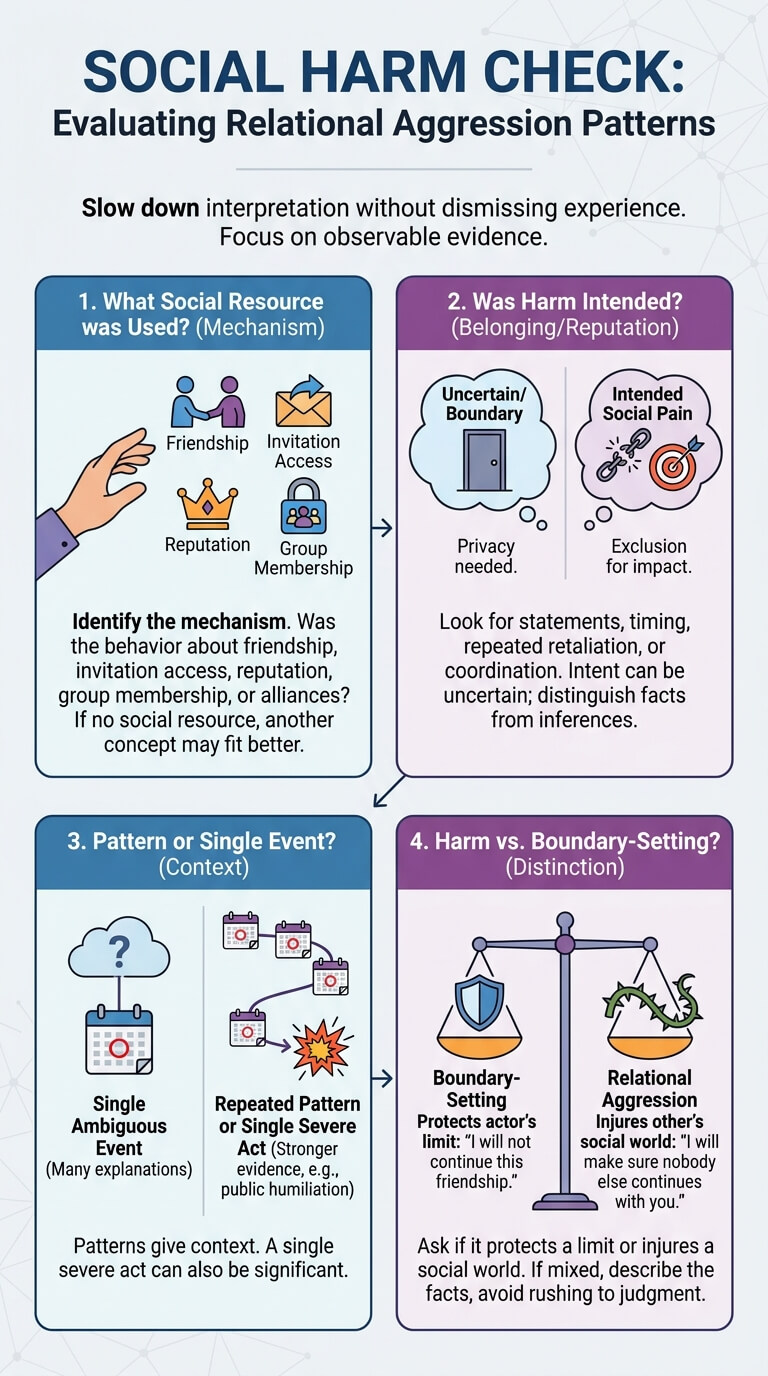
When a social event feels targeted, it can help to slow the interpretation down without dismissing your own experience. A four-part Social Harm Check keeps attention on observable evidence.
What social resource or relationship was used?
Identify the mechanism. Was the behavior about friendship, invitation access, reputation, group membership, social information, or an alliance with other people? If no social resource was used, another concept may fit better.
Was harm to belonging or reputation intended?
Look for statements, timing, repeated retaliation, coordination, or behavior that only makes sense if social pain is part of the goal. “We need privacy for this meeting” is different from “We invited everyone except you so you would know where you stand.”
Intent is sometimes uncertain. Uncertainty is not proof that nothing happened, but it is a reason to distinguish what you know from what you infer.
Is there a pattern or a single ambiguous event?
Patterns give context. One missed invitation has many possible explanations, while repeated exclusion after disagreements plus explicit threats to turn friends against someone offers stronger evidence. A single severe act, such as deliberately releasing private information to humiliate someone publicly, can still matter.
What evidence distinguishes harm from boundary-setting?
Ask whether the behavior protects the actor’s own limit or tries to injure the other person’s social world. Boundaries generally describe participation: “I will not continue this friendship.” Relational aggression adds social punishment: “I will make sure nobody else continues a friendship with you either.”
If the evidence is mixed, describe what happened rather than rushing to a character judgment.
Consequences Without Overstating Diagnosis
Relational aggression can matter even when there is no physical injury. Social belonging, trust, and reputation influence daily life, and damage in those areas can change where a person feels welcome, whom they trust, and whether they participate.
Belonging, trust, reputation, and social participation
Repeated ridicule or exclusion may affect participation, trust, and willingness to disclose personal information. Research links relational aggression and victimization with social and emotional difficulties, but those associations do not predict exactly how one individual will react.
Why impact can be serious even when no physical force occurs
Nonphysical harm can still affect support, access, credibility, and belonging. Yet impact and intent are separate questions: an ordinary friendship ending can hurt deeply without being aggressive, so both the harm and how it was produced matter.
Why harm does not prove a personality disorder
Aggressive behavior should not be treated as a shortcut to diagnosing narcissism, psychopathy, antisocial personality disorder, or any other condition. Many factors can shape behavior, and formal diagnosis requires far more information than an observer has from a social conflict.
Behavioral description is usually more useful: “She repeatedly threatened to exclude me unless I agreed,” or “He spread private information after I refused a request.” Those statements describe what happened without claiming knowledge you do not have.
What to Do Next
The best next step depends on whether you are dealing with an ambiguous social injury, a repeated pattern, or a situation involving credible threat or coercion.
Document specific behavior and context rather than labels
If the situation is repeated, note dates, messages, statements, audience, and what happened before and after. Specific records can make your understanding more concrete and help you explain the problem to an appropriate support person when needed.
Seek clarification only when safe and useful
For a low-risk ambiguous event, a simple question such as “I noticed I was removed from the group after our disagreement. Was that connected?” may clarify intent. Clarification is optional, especially when someone has been threatening, stalking, coercive, or repeatedly retaliatory.
Use safety-focused support if social aggression includes threats, stalking, coercion, or credible fear
If social harm is mixed with threats, stalking, coercive control, blocked access to help, or credible fear, the priority changes from interpreting the behavior to protecting safety. The National Domestic Violence Hotline safety-planning resources provide options for people facing abuse or danger in intimate relationships.
For immediate danger, use local emergency services or an appropriate local crisis resource. Communication advice is not a substitute for safety planning when retaliation or violence is a realistic concern.
How Relational Aggression Connects With Influence, Groups, and Status
Relational aggression often happens in social systems, which means it can resemble other psychological processes without being identical to them.
Influence is broader than relational harm
Manipulation focuses on influence. Relational aggression focuses on harm through relationships or social standing. One behavior can contain both, but keeping the distinction clear helps explain why a tactic was used and what it was meant to accomplish.
Group membership can provide the setting without explaining the aggression
Groups create norms, identities, alliances, and expectations. Those processes can shape how exclusion works, but group membership itself is not aggression. A club deciding on membership criteria is not the same as deliberately organizing rejection to punish one person.
Social leverage can matter without turning every case into a power struggle
A person with more popularity, information, connections, or social credibility may have more capacity to damage someone else’s reputation or belonging. That is a power difference, but aggression and power remain separate concepts. Having social influence does not imply aggressive behavior, and relational aggression does not always increase the aggressor’s status.
FAQ About Relational Aggression
These questions address the boundaries that are most easily confused in everyday life.
Is being left out always relational aggression?
No. People can limit invitations, create private groups, or set boundaries without trying to harm anyone. Exclusion is more consistent with relational aggression when evidence suggests it was deliberately used to punish, humiliate, isolate, or damage social standing.
Can adults use relational aggression?
Yes. Although much early research focused on youth, relational aggression also appears in adult friendships, families, communities, social networks, and close relationships. Examples include reputation attacks, alliance pressure, threatened relationship withdrawal, or intentional isolation.
Is gossip always relational aggression?
No. Gossip has many functions. It becomes relationally aggressive when it is intentionally used to damage another person’s reputation, relationships, or social standing. Context and purpose matter more than simply discussing someone who is absent.
Is relational aggression the same as manipulation?
No. Manipulation is an influence strategy, while relational aggression is aggression delivered through relationships, belonging, or reputation. A person may manipulate others to isolate a target, so the concepts can overlap. But open exclusion can be relationally aggressive without being covertly manipulative, and manipulation can occur without any intent to cause relational harm.
Is relational aggression mainly a female behavior?
Research does not support treating relational aggression as a female-only behavior. Findings on gender vary with age, context, measurement, and reporting method, and some studies find little or no overall difference. Group averages should not be used to predict how a particular person will behave.
Key Takeaways
- Relational aggression uses relationships, belonging, reputation, exclusion, or social connections as the route of intentional harm.
- Ending a friendship, setting a boundary, leaving a group, or limiting invitations is not automatically aggression.
- Intent, context, pattern, and evidence help distinguish deliberate social harm from ordinary relationship change.
- Relational aggression and manipulation can overlap, but one centers social harm while the other centers influence.
- Children, adolescents, and adults can engage in relational aggression, and the behavior should not be stereotyped as female-only.
- When social harm includes credible threats, stalking, coercion, or fear, safety takes priority over clarification or confrontation.

Michael Reed is the Founder and Lead Writer at Psychology Exposed. He writes about human behavior, relationships, emotional patterns, self-awareness, and practical psychology topics using research-informed, easy-to-understand content.
Read More About Michael Reed: https://psychologyexposed.com/michael-reed/