
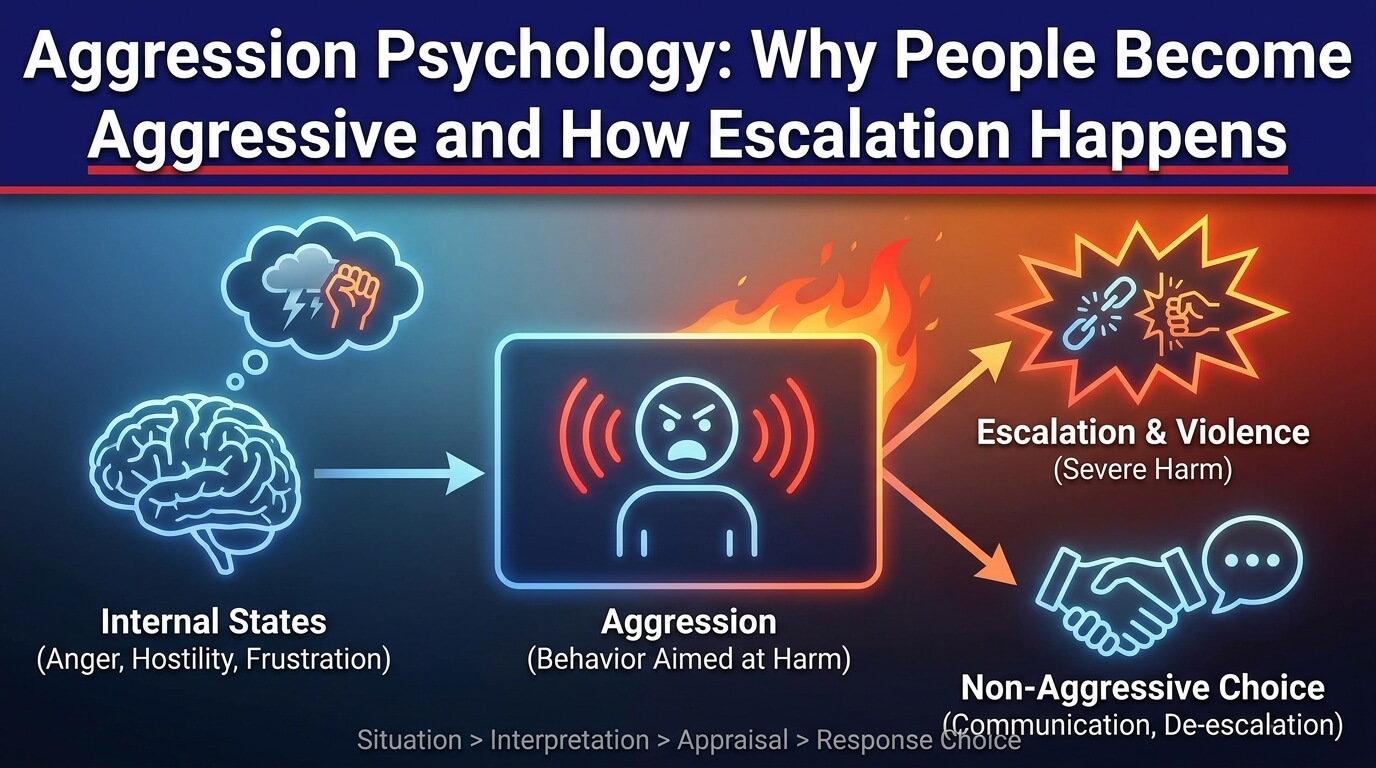
Aggression is often confused with anger, hostility, conflict, or violence. Those concepts can overlap, but they are not interchangeable. A person can feel furious and still choose not to harm anyone. Two people can disagree strongly without either one becoming aggressive. Harmful behavior can also be deliberate and controlled rather than visibly angry.
Understanding aggression is therefore less about asking, “What kind of person does this?” and more about examining behavior, intention, interpretation, context, available choices, and consequences. That shift matters because it helps explain how aggression develops without treating it as a fixed identity or pretending that one cause can predict what any individual will do.
Quick Answer
In psychology, aggression generally refers to behavior aimed at harming another person physically or psychologically. Anger is an emotion, hostility is an antagonistic orientation, conflict is disagreement, and violence usually refers to more severe physical force or harm. Aggressive behavior becomes more likely through combinations of interpretation, arousal, goals, learned expectations, situational cues, and available response choices, but none of these factors makes aggression inevitable.
What Aggression Means in Psychology
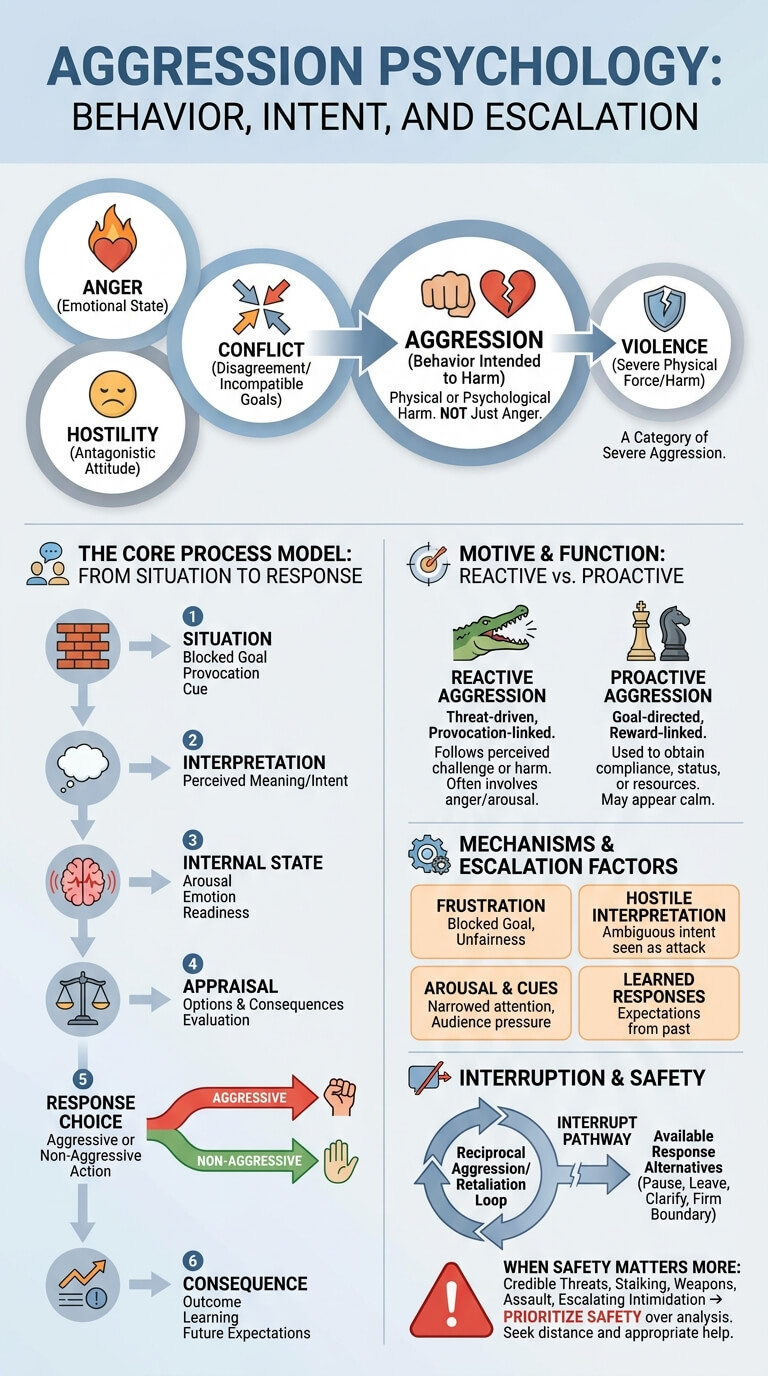
The APA Dictionary of Psychology definition of aggression centers on behavior aimed at causing physical or psychological harm. That behavioral focus is useful because it separates what someone feels or thinks from what they actually do.
Intention to harm and why intention matters
Intent is one of the hardest parts of defining aggression. Accidentally stepping on someone’s foot can hurt them, but the pain alone does not make the act aggressive. Deliberately stepping on someone’s foot to punish or intimidate them is different because harm is part of the intended outcome.
Intent does not always have to mean severe injury. Humiliating someone in front of others, making a threat to frighten them, deliberately damaging their reputation, or excluding them for the purpose of hurting them can all involve aggressive intent. Context still matters, because not every criticism, exclusion, raised voice, boundary, or unpleasant consequence is aggression.
Aggressive behavior is not a fixed identity
It is usually more accurate to describe a behavior than to define a person by it. Saying “he threatened a coworker during the argument” is more precise than deciding from one event that he is “an aggressive person.” A repeated pattern may be important, but even then, psychology does not reduce behavior to a permanent personality label.
Why explanation does not excuse harm
A psychological explanation answers questions about how behavior may arise. It does not erase responsibility or require the harmed person to tolerate it. Fear of losing status, frustration, past learning, anger, or feeling provoked may help explain a sequence, but explanation is not the same as justification.
The Concept Map: Anger, Hostility, Conflict, Aggression, and Violence

These concepts are often treated as if they describe different levels on one ladder. A better approach is to see them as related but distinct categories. They can influence one another, but one does not automatically turn into the next.
| Concept | Main idea | Can exist without aggression? | Example |
|---|---|---|---|
| Anger | An emotional state | Yes | Feeling furious about unfair treatment and choosing to leave |
| Hostility | An antagonistic attitude, feeling, or orientation | Yes | Resenting someone and expecting the worst from them without acting to harm them |
| Conflict | Disagreement or incompatible goals | Yes | Two coworkers disagreeing about how to divide a project |
| Aggression | Behavior intended to harm or impose an aversive consequence | Not applicable | Threatening, humiliating, striking, or deliberately damaging someone’s social standing |
| Violence | Severe physical force or harm in many psychological and public-health frameworks | It overlaps with aggression but is narrower in many uses | Physical assault causing or risking serious injury |
Anger is an emotional state
The APA definition of anger describes an emotion associated with tension and hostility that can arise from frustration, perceived injury, or injustice. Crucially, anger is neither necessary nor sufficient for aggression. Someone may be angry and act constructively, while another person may harm someone for a goal without looking angry at all.
That is why the question “How angry were they?” cannot answer the separate question “Was the behavior aggressive?”
Hostility is an antagonistic orientation
Hostility can involve animosity or antagonism in attitude, feeling, or action. In everyday terms, a hostile orientation may make negative interpretations easier to access, but hostility does not guarantee harmful behavior.
A person can dislike, distrust, or resent someone while still following rules, keeping distance, or handling disagreement without trying to injure, intimidate, or degrade them.
Conflict is incompatibility or disagreement
Conflict is broader than aggression. People can compete for the same resource, disagree about values, resist a decision, or negotiate incompatible needs without trying to harm each other. Even intense conflict can remain non-aggressive if both people preserve the other person’s ability to respond without intimidation or deliberate degradation.
Aggression is intentional harmful behavior
Aggression concerns what is done and what the behavior is intended to accomplish. The behavior might be direct, such as an insult or a shove, or indirect, such as deliberately damaging a person’s reputation. It may be impulsive or planned. It may happen during obvious anger or during a calm, strategic interaction.
Violence is a more severe physical-harm category in many frameworks
Violence is defined somewhat differently across psychology, public health, criminology, and law. The CDC treats violence as a public-health problem and emphasizes that multiple levels of influence can contribute to violent outcomes.
For a practical conceptual map, aggression is the broader category of intentional harm, while violence commonly refers to severe physical force or harm. Not all aggression is violence. A humiliating threat or deliberate social exclusion can be aggressive without being physically violent.
The Core Process From Situation to Response
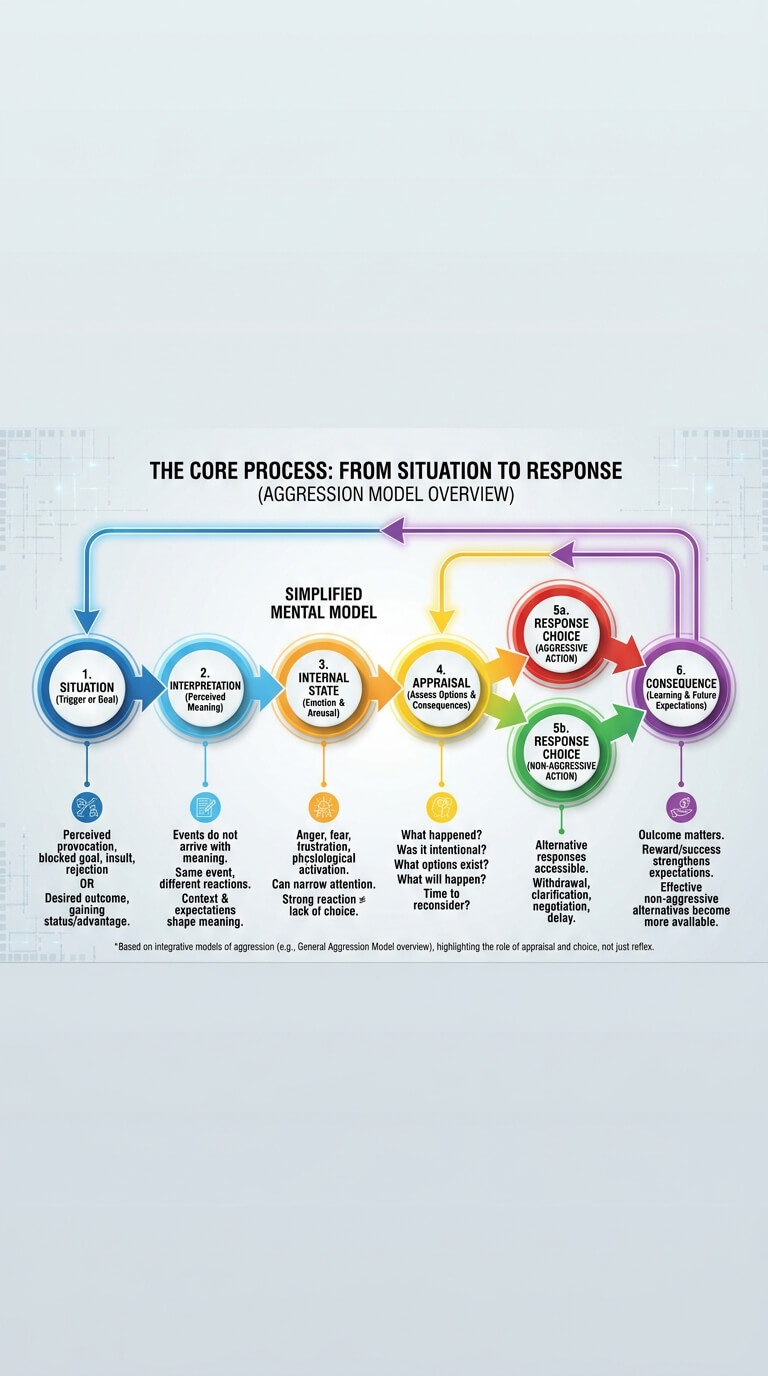
A useful way to understand aggressive behavior is to follow the sequence between an event and an action. Integrative models of aggression describe how personal and situational inputs can influence internal states, appraisal, and behavior rather than treating aggression as a single reflex. One peer-reviewed overview of the General Aggression Model highlights the role of appraisal and the possibility of either aggressive or non-aggressive responses.
A simplified mental model is: situation → interpretation → internal state → appraisal → response choice → consequence.
Trigger or goal
The sequence may begin with a perceived provocation, blocked goal, insult, rejection, competitive situation, threat, or desired outcome. Importantly, aggression does not always begin with something “done to” the person. Sometimes the starting point is a goal, such as gaining compliance, status, access, or advantage.
Interpretation and perceived meaning
Events do not arrive with meaning already attached. Being left out of a message thread might be interpreted as an accident, carelessness, or deliberate disrespect. A stranger bumping into someone might look accidental or provocative depending on context and expectations.
This interpretation stage can strongly change what happens next. It also explains why the same event can produce different reactions in different people or even in the same person on different days.
Emotional and arousal state
Anger, fear, humiliation, frustration, or physiological activation may increase action readiness. They can narrow attention toward the most provocative parts of a situation, especially when the person already expects hostility. Yet arousal is not the definition of aggression, and it does not remove choice.
A person can experience a strong internal reaction and still choose not to harm anyone. Conversely, some goal-directed aggression may happen with relatively little visible arousal.
Appraisal, available options, and response choice
At this stage, the person may quickly assess questions such as: What happened? Was it intentional? What response is available? What will happen if I act? Is there time to reconsider? Does the situation allow withdrawal, clarification, negotiation, or delay?
When options feel narrow, aggressive action may become more likely. When alternative responses are accessible and their consequences are clear, the path can change.
Consequences, learning, and future expectations
What happens after the response also matters. If aggression produces a desired reward, ends an uncomfortable demand, gains attention, or appears to restore status, the outcome may strengthen expectations that similar behavior “works.” If non-aggressive responses achieve the goal more effectively, those alternatives can become more available in the future.
Four Ways to Organize Aggression Psychology
A broad topic becomes easier to use when it is divided by the question being asked. These four lenses separate definition, function, mechanism, and expression so one explanation does not have to do every job at once.
Aggression versus nearby concepts
First ask what kind of phenomenon you are looking at. Is it an emotion, an attitude, disagreement, intentional harm, or severe physical force? This prevents anger, hostility, conflict, aggression, and violence from collapsing into one label.
Aggressive motives and functions
Next ask what the behavior appears to be doing. Some aggression follows perceived provocation or threat. Other aggression is used as a means to obtain something, pressure someone, gain an advantage, or control an outcome. Real situations can contain both functions.
Cognitive and emotional mechanisms
A third question concerns the processes between situation and action. Frustration, hostile interpretation, perceived unfairness, arousal, humiliation, expected reward, and learned response options may all matter. None should be treated as a universal cause.
Forms, displacement, escalation, and severity
Finally, ask how the harm is expressed, who receives it, and how severe it becomes. Aggression can be verbal, relational, or physical. It can be directed at the original provocateur or shifted toward someone else. It can stop after one act or become reciprocal and intensify.
Motive and Function: Reactive and Proactive Aggression at a Glance

Researchers often distinguish aggression by function. The terms are useful as descriptions of behavior, not as permanent human types.
Threat-driven or provocation-linked responding
Reactive aggression tends to follow perceived threat, insult, frustration, or provocation. It is often associated with anger or arousal, but “reactive” does not simply mean “angry.” The defining question is whether the aggression follows a perceived challenge or harm.
Goal-directed or reward-linked aggression
Proactive aggression is more instrumental. Harm is used as a route toward another goal, such as getting compliance, gaining resources, protecting position, or achieving an advantage. The person may appear relatively calm, which is another reason visible anger is an unreliable test for whether behavior is aggressive.
Why mixed motives are common
Real situations can mix motives. Someone may feel insulted while also using retaliation to protect status, so motive should be inferred cautiously from context rather than assumed from appearance.
Mechanisms That Can Raise Aggressive Responding
Aggression rarely has a single cause. It is more useful to examine combinations of blocked goals, perceived threat, arousal, learned expectations, and situational cues that may shift the odds of one response over another.
Frustration and blocked goals
Blocked goals can generate irritation, disappointment, or anger, especially when the obstacle feels unfair, unexpected, or deliberately caused by someone else. That does not mean frustration automatically produces aggression. The same blocked goal may lead to problem-solving, persistence, withdrawal, humor, help-seeking, or acceptance.
Threat appraisal and hostile interpretation
When intent is ambiguous, people have to infer what another person meant. If an accidental action is interpreted as deliberate disrespect or attack, the situation can feel more threatening. Research on hostile intent attribution finds an association with aggressive behavior, but the relationship varies across contexts and does not mean every perception of hostility is mistaken.
Arousal, situational cues, and narrowed options
High arousal can make it harder to consider multiple interpretations or slower response options. Audience pressure, humiliation, repeated provocation, intoxication, or immediate rewards may also change the decision environment. These are risk modifiers, not excuses and not deterministic causes.
Learned responses as background rather than destiny
People learn expectations about conflict and consequences from family, peers, institutions, media, and past interactions. Learned responses may become easier to retrieve, but new norms, consequences, and experiences can make alternatives more available.
Forms and Targets of Aggression
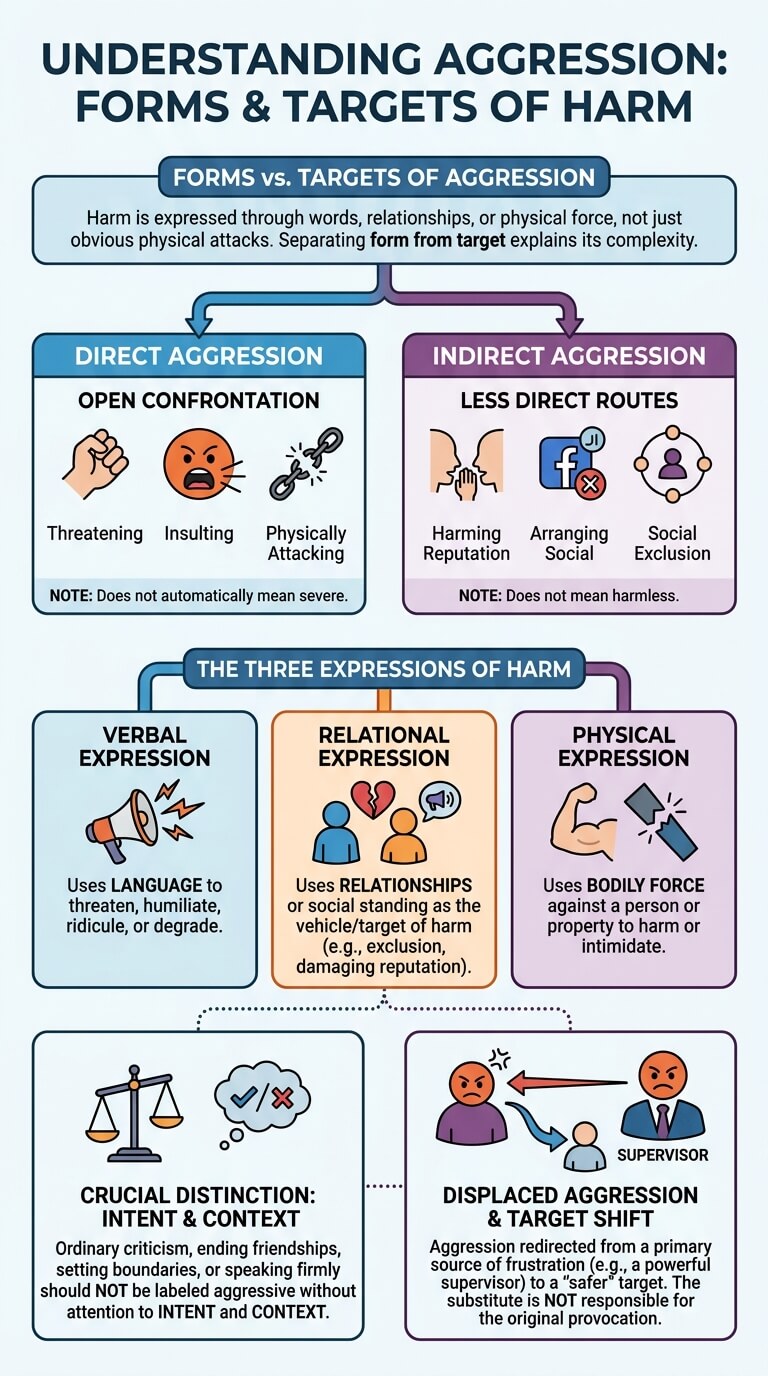
Harm can be expressed through words, relationships, physical force, or indirect routes. Separating form from target helps explain why aggression is not limited to obvious physical attacks.
Direct versus indirect aggression
Direct aggression confronts the target more openly, such as threatening, insulting, or physically attacking them. Indirect aggression uses less direct routes, such as harming reputation or arranging social exclusion. “Indirect” does not mean harmless, and “direct” does not automatically mean severe.
Verbal, relational, and physical expressions
Verbal aggression uses language to threaten, humiliate, ridicule, or degrade. Relational aggression uses relationships, belonging, or social standing as the vehicle or target of harm. Physical aggression uses bodily force against a person or sometimes property in ways intended to harm or intimidate.
Ordinary criticism, ending a friendship, choosing different friends, setting a boundary, or speaking firmly should not be labeled aggressive without attention to intent and context.
Displaced aggression and target shift
Aggression can also be directed at someone other than the person connected to the original frustration or provocation. For example, someone who feels unable to confront a powerful supervisor may later react disproportionately toward a safer target. The target shift helps explain the behavior, but it does not make the substitute target responsible for what happened earlier.
How Aggression Can Escalate
Escalation is best understood as an interaction process, not a personality label. A tense exchange can intensify when each action becomes new evidence that the other person is hostile, disrespectful, or dangerous.
Reciprocal aggression and retaliation loops
One insult may be answered with a sharper insult. That response may then be read as proof that harsher retaliation is justified. As the exchange continues, each person may focus increasingly on the latest offense and less on the original disagreement.
Why humiliation, audience pressure, or perceived status threat may matter
People sometimes react differently when they believe others are watching, when they feel publicly embarrassed, or when backing down seems connected to losing face. These social pressures can change the perceived cost of restraint. They should not be used to excuse aggression, and they do not mean status concerns always produce harm.
Why escalation is not a fixed staircase
There is no universal sequence in which disagreement must become insult, threat, assault, and then greater violence. Interactions can stop at many points. One person can leave, a misunderstanding can be clarified, an audience can disperse, consequences can become more salient, or the parties can shift to a non-aggressive response.
What Can Interrupt the Path Without Turning This Into Anger Management
The key issue here is not a full regulation routine. It is where the sequence from interpretation to harmful action still contains alternative responses, especially before retaliation starts feeding the next round.
Response alternatives and self-control as moderating processes
Aggressive action is less inevitable when other responses are genuinely available. Depending on the context, that may mean pausing, leaving, asking a clarifying question, using a firm non-threatening boundary, delaying a decision, seeking help, or choosing not to retaliate.
Clarifying interpretation when safe
When the situation is ambiguous and there is no credible danger, checking intent can prevent a mistaken interpretation from hardening into retaliation. A simple question such as “Did you mean that as a criticism?” can sometimes reveal a misunderstanding before the interaction becomes more hostile.
Clarification is not appropriate when someone is making credible threats, blocking an exit, stalking, assaulting, or escalating intimidation. In those situations, safety takes priority over resolving the meaning of the conversation.
Consequences and reinforcement after aggressive or non-aggressive choices
What follows an interaction can strengthen or weaken expectations. If threats repeatedly produce compliance, the behavior may become more likely because it appears effective. If firm non-aggressive action achieves the goal while preserving safety and dignity, that option can become easier to use again.
For observers, this is also a reminder not to reward intimidation simply because it ends a tense moment quickly when safer alternatives are available.
Which Aggression Article Should You Read Next?
Once the broad distinctions are clear, the next useful question depends on what is confusing you most: emotion, motive, interpretation, target, form, severity, or escalation.
Aggression vs Anger for emotion versus behavior
Choose this distinction when your main question is whether feeling angry is the same as acting aggressively, or how aggression can occur without obvious anger.
Reactive vs Proactive Aggression for function and motive
This is the useful next question when you want to compare aggression that follows perceived provocation with aggression used as a means toward a goal.
Hostility vs Aggression for attitude versus behavior
Use this comparison when the confusion is between resentment, antagonistic expectations, or negative orientation and actual behavior intended to harm.
Frustration-Aggression Hypothesis for blocked-goal theory
This topic is most relevant when you want to know why blocked goals may increase aggressive readiness under some conditions without making aggression inevitable.
Hostile Attribution Bias for ambiguous hostile-intent judgments
This question becomes useful when an unclear action is interpreted as deliberately provocative or harmful and that interpretation changes the response.
Displaced Aggression for source-target mismatch
Use this lens when the person receiving the aggression is not the person connected to the original frustration or provocation.
Verbal Aggression for harm through language
This focuses on insults, ridicule, threats, humiliation, and other language used specifically as a vehicle for harm rather than ordinary bluntness or disagreement.
Relational Aggression for harm through belonging and reputation
This is the better fit when relationships, social access, reputation, exclusion, or alliances are deliberately used to hurt another person.
Aggression vs Violence for severity and definition
This comparison helps when you need to separate the broad category of intentional harm from more severe physical-force definitions commonly used for violence.
Aggression Escalation for dynamic interaction processes
Use this perspective when the central question is how a tense interaction moves toward retaliation, intimidation, threats, or other increasingly harmful behavior.
Common Misunderstandings About Aggression
Several common assumptions make aggression harder to identify accurately. Correcting them helps avoid both over-labeling ordinary conflict and under-recognizing intentional harm.
Feeling anger is not the same as acting aggressively
Anger can motivate protest, boundary-setting, persistence, withdrawal, or problem-solving. Treating anger itself as aggression can shame people for an emotion while missing the behavior that actually deserves attention.
Firm disagreement is not automatically aggression
Saying no, refusing a request, challenging an idea, setting a consequence, or leaving a conversation can be direct without being aggressive. The key distinction is whether the behavior aims to harm, threaten, degrade, or intimidate rather than simply protect a right or express a position.
Aggression is not automatically violence
Some aggressive behavior is verbal or relational. Some physical aggression may be less severe than what a public-health or legal framework calls violence. Definitions vary, so the safest approach is to describe the actual behavior and severity rather than rely only on a label.
One aggressive incident does not prove a stable personality type
A single event can be serious without revealing an entire personality. Repeated patterns, context, consequences, and severity deserve attention, but psychological concepts should not be used to diagnose someone from a limited story.
When Safety Matters More Than Conceptual Analysis
Conceptual distinctions are useful only while there is enough safety to think through them. When behavior creates credible danger or fear, the practical priority changes.
Credible threats, stalking, blocked exits, weapon threats, assault, strangulation, or escalating intimidation
Once an interaction includes credible danger, the priority changes. A person facing threats, stalking, physical assault, strangulation, weapon-related intimidation, blocked exits, or escalating fear does not need to stay engaged in order to communicate more effectively or test a psychological theory.
Why safety-focused support should replace communication optimization when danger is credible
Distance, trusted support, emergency services where appropriate, and specialized safety planning may be more relevant than conversation techniques. The National Domestic Violence Hotline safety-planning resources offer support for people dealing with relationship-based threats, coercion, stalking, or violence in the United States. People elsewhere should use appropriate local emergency or specialist services.
FAQ About Aggression Psychology
These questions address the places where the concept is most often misunderstood, especially the relationship between aggression, anger, frustration, nonphysical harm, violence, and ordinary conflict.
Can aggression happen without anger?
Yes. Aggressive behavior can be instrumental or goal-directed, so a person may use harm, intimidation, humiliation, or exclusion to get an outcome without appearing intensely angry. Anger is common in some forms of reactive aggression, but it is not required for every aggressive act.
Does frustration always make people aggressive?
No. Frustration may increase the likelihood of anger or aggressive readiness under some conditions, especially when the obstacle feels unfair or intentionally caused. But people can also respond to frustration by problem-solving, waiting, leaving, seeking help, or changing goals. Frustration is neither a sufficient nor a necessary cause of aggression.
Is verbal or relational harm really aggression?
It can be when the behavior is intended to harm. Threats, deliberate humiliation, reputation attacks, and intentional exclusion can fit psychological definitions of aggression even without physical force. However, criticism, boundaries, friendship changes, disagreement, or social disappointment should not automatically be labeled aggression without considering intent and context.
Can psychologists predict who will become violent?
Psychology can identify factors associated with higher or lower risk across groups and situations, but those findings do not allow certain prediction of one individual’s future behavior. Anger, hostility, a diagnosis, a stressful event, or one aggressive incident should not be treated as proof that a person will become violent.
Is conflict itself a form of aggression?
No. Conflict means that goals, beliefs, needs, interests, or actions are incompatible or resisted. Conflict becomes aggressive when intentional harm, intimidation, degradation, threatening behavior, or another aversive action enters the interaction. Respectful disagreement and negotiation can remain entirely non-aggressive.
Key Takeaways
- Aggression is behavior aimed at harm; anger is an emotion, hostility is an antagonistic orientation, and conflict is disagreement or incompatibility.
- Violence overlaps with aggression but usually refers to more severe physical force or harm in psychological and public-health contexts.
- A useful process model is situation, interpretation, internal state, appraisal, response choice, and consequence.
- Reactive and proactive aggression describe different functions of behavior, not fixed personality types.
- Frustration, hostile interpretation, arousal, learned expectations, and social pressure may raise risk under some conditions, but none makes aggression inevitable.
- When credible threats, stalking, physical assault, blocked exits, weapons, strangulation, or escalating intimidation are present, safety should take priority over communication or conceptual analysis.
Final Thoughts
The most useful first step is to describe the behavior precisely. Ask what happened, what harm was intended, what the person appeared to be trying to accomplish, and what happened immediately before and after. Then separate those observations from assumptions about personality or diagnosis.
This makes the next question clearer: are you trying to understand an emotion, a hostile interpretation, a blocked goal, a target shift, a form of aggression, an escalation process, or an immediate safety risk? The answer determines what information is useful next.
Educational note: This article explains psychological concepts for general education. It does not provide diagnosis, individualized mental health treatment, legal advice, or violence-risk assessment.

Michael Reed is the Founder and Lead Writer at Psychology Exposed. He writes about human behavior, relationships, emotional patterns, self-awareness, and practical psychology topics using research-informed, easy-to-understand content.
Read More About Michael Reed: https://psychologyexposed.com/michael-reed/