
People often want a single answer to prejudice: one conversation, one training session, one positive encounter, or one moment of awareness that makes biased judgment disappear. Psychology offers a less dramatic picture. Group-based evaluations and unequal treatment arise through several processes, so the useful question is which process is operating in the situation at hand.
Prejudice reduction is therefore not only about changing what someone says they believe. It can involve better evidence, less reliance on broad categories, improved cross-group interaction, clearer norms, more consistent decisions, and checking behavior over time. The method should match the outcome rather than treating one measure as the whole person.
Quick Answer

Prejudice reduction psychology examines ways to reduce negative group-based evaluation and biased treatment. Evidence suggests that constructive intergroup contact, individuation, norm change, better decision procedures, and repeated opportunities to update expectations may help in some settings. No method reliably removes all bias permanently. Strong evaluation asks what changed, how much it changed, whether behavior changed too, and whether the effect lasted.
What “Prejudice Reduction” Actually Means
Prejudice is commonly discussed as an evaluative orientation based substantially on perceived group membership. Reduction therefore means more than sounding less negative. It can involve changes in evaluation, expectations, behavior, or decision procedures. These strategies make more sense when placed within the broader psychology of prejudice and stereotyping, which separates group beliefs, evaluations, associations, and behavior.
A useful starting point is how social situations shape judgment and behavior. Group cues interact with norms, incentives, roles, prior experience, attention, and available evidence.
Reducing negative evaluation
One goal is a less negative response toward members of another group. A person may become less suspicious, less avoidant, or less likely to interpret neutral behavior negatively. This is only one part of prejudice reduction.
Reducing biased behavioral responses
A person can endorse fair-minded values while still making inconsistent choices. Reduction may therefore focus on treatment: who gets heard, trusted, selected, given the benefit of the doubt, or evaluated by the same criteria. Behavior can change even when feelings change more slowly.
Increasing individualized judgment
Another goal is to reduce the weight of category-based expectation when person-specific evidence is available. The question shifts from “What are people from this group usually like?” to “What evidence do I have about this person here?” Individuation means resisting an unsupported leap from a broad category to an individual conclusion.
First Define the Outcome You Want to Change

Claims about prejudice reduction become confusing when studies measure different things. A method might change self-reported attitudes but not observed behavior, or shift a response-time measure without changing everyday decisions. Before deciding whether something “worked,” define the outcome.
Self-reported attitude
Self-report measures ask what people think, feel, prefer, or endorse. They can capture meaningful conscious attitudes, but wording, social desirability, demand characteristics, and limited self-insight can influence responses.
Measured implicit association
Implicit measures assess relatively automatic associations, often using response times or categorization tasks. They are useful research tools, but changes in an implicit score should not be treated as proof that a person’s deliberate beliefs, intentions, or behavior changed in the same way. A large meta-analysis of procedures designed to change implicit measures found that implicit measures can move, while corresponding changes in explicit measures and behavior were much less consistent.
Observed behavior
Behavioral outcomes ask what people actually do, such as choices, allocation decisions, cooperation, selection, or patterns of interpersonal treatment. They are more concrete than attitudes, but one behavior can still have several causes.
Institutional or decision outcome
Sometimes the relevant outcome is a repeated decision pattern rather than one person’s attitude. A school, team, organization, or community can track whether comparable cases receive comparable treatment, shifting attention from hidden motives to observable procedures and outcomes.
Short-term versus durable change
A result measured immediately after an exercise is not the same as a result that persists weeks or months later. The 2021 Annual Review of Psychology assessment of prejudice-reduction research noted that many studies evaluate light-touch interventions and that long-term effects are often unclear. This is a major reason to treat immediate change as a starting point, not the finish line.
Evidence-Aware Framework: From Category Cue to Better Decisions Over Time
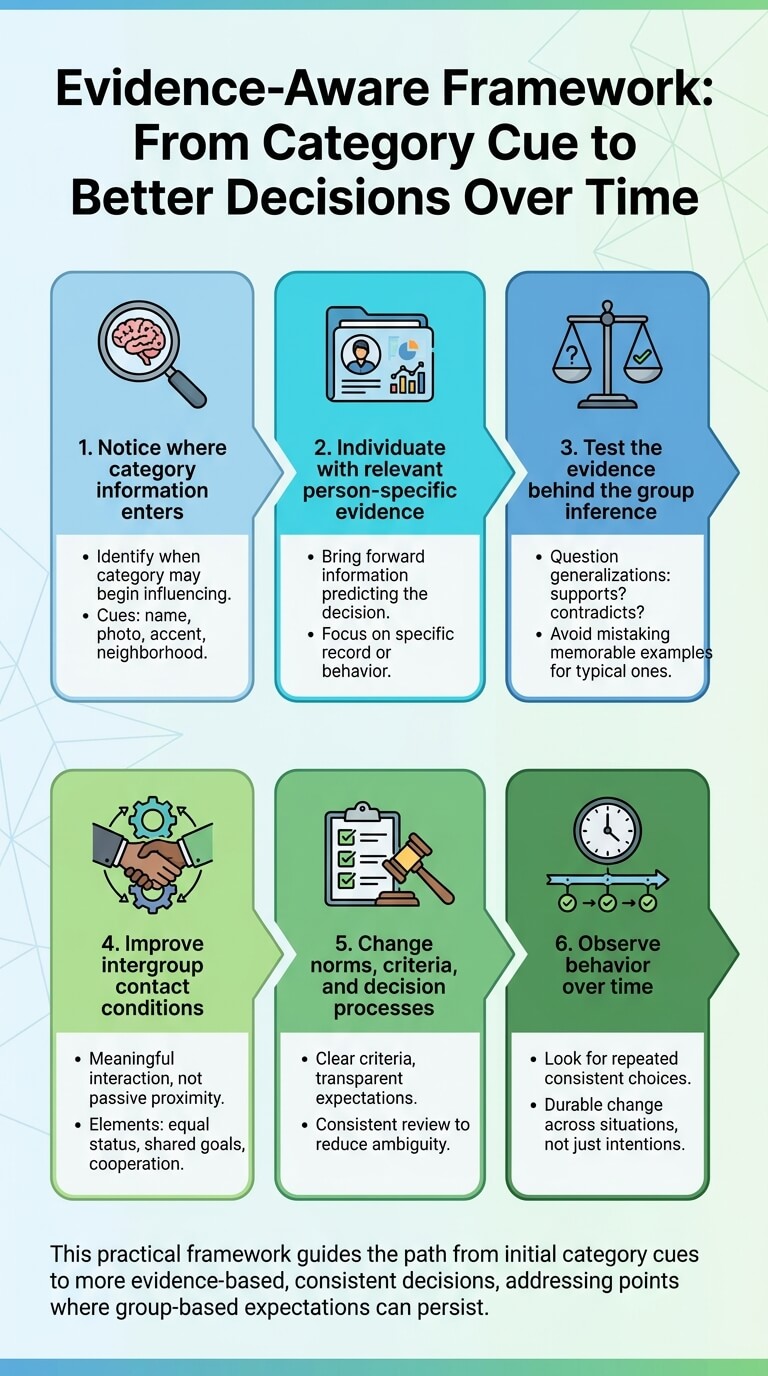
A practical way to organize prejudice reduction is to follow the path from category cue to decision: Notice → Individuate → Test Evidence → Improve Contact Conditions → Change Norms and Processes → Observe Behavior Over Time. Each step addresses a different point where group-based expectations can enter or persist.
Notice where category information enters
Bias is easier to examine when the decision point is concrete. A category might become salient through a name, photo, accent, neighborhood, department label, or school. The goal is not guilt about noticing. It is identifying when the category may begin influencing what evidence receives attention.
Individuate with relevant person-specific evidence
Once a category is salient, bring forward information that actually predicts the decision. If reliability is the issue, review the person’s record or specific behavior. Relevant evidence gives the judgment a more precise basis than a vague category expectation.
Test the evidence behind the group inference
Ask what supports the generalization, what contradicts it, and whether memorable examples are being mistaken for typical ones. Ideas from common judgment biases and evidence shortcuts can help here, provided the focus stays on the inference rather than labeling a person.
Improve intergroup contact conditions
When group boundaries matter, better contact can create new evidence. The strongest opportunities usually involve meaningful interaction rather than passive proximity. Equal status within the setting, shared goals, cooperation, and supportive norms can make it easier for people to see one another as differentiated individuals instead of relying mainly on prior expectations.
Change norms, criteria, and decision processes
Individual insight has limited reach if the surrounding process still rewards ambiguity or inconsistent standards. Clear criteria, transparent expectations, and consistent review make it harder for the same behavior to be interpreted one way for one group and another way for someone else.
Observe behavior over time
Finally, look for repeated evidence. Did choices become more consistent? Were initial assumptions revised more readily? Durable change is better judged across situations than from one good intention or one score.
Individuation and Reducing Category Reliance
Individuation means giving person-specific information enough weight to matter. It is particularly useful when broad group knowledge is a poor substitute for the evidence needed in the immediate decision.
Relevant individual information
Not all personal information is useful. Knowing someone’s favorite movie may humanize them, but it does not help evaluate technical competence. Good individuation uses information relevant to the decision instead of replacing one irrelevant cue with another.
Structured comparison
When several people or cases are being evaluated, compare them on the same dimensions. Decide in advance what counts as strong evidence, weak evidence, and missing evidence. This reduces the opportunity for standards to drift after category information becomes salient.
Avoiding “exception” subtyping as the only update
One counterexample does not always change a stereotype because the person may be mentally filed as “different from the rest.” A better update asks whether the exception reveals more variability in the group than previously assumed. The learning is not merely “this one person is unusual,” but “my earlier category may have been too coarse to predict individuals well.”
Intergroup Contact
Contact is one of the most researched routes to prejudice reduction, but it should not be reduced to “spend more time around different people.” What matters is the quality, meaning, and structure of the encounter.
What contact contributes
Constructive contact can reduce uncertainty, provide direct evidence, create opportunities for perspective-taking, and make outgroup members less abstract. A major meta-analysis of intergroup contact research found that contact typically relates to lower prejudice across many settings and groups, with more favorable conditions often associated with stronger effects.
Why quality and conditions matter
Humiliation, unequal treatment, forced proximity, or competition can produce very different learning from respectful cooperation. Contact should be judged by what happens during the interaction, not by proximity alone. No prejudice-reduction goal requires direct engagement with someone who threatens, stalks, harasses, coerces, intimidates, or retaliates.
Why contact deserves its own deeper explanation
Intergroup contact involves questions about equal status, shared goals, cooperation, authority support, anxiety, friendship potential, generalization, indirect contact, and negative encounters. Those mechanisms are substantial enough that contact is best understood as one pathway within a broader reduction strategy, rather than as a synonym for prejudice reduction itself.
Cooperative Goals and Interdependence
When people depend on one another to reach a meaningful outcome, group boundaries can become less useful for predicting who contributes what. Cooperation can create evidence about competence, reliability, and shared interests that would otherwise remain hidden.
Shared outcomes can alter intergroup expectations
A mixed team solving a practical problem may discover that success depends on complementary strengths rather than category labels. The psychological value is not that everyone becomes identical, but that the shared task creates repeated person-specific evidence under conditions where contribution matters.
Cooperation alone is not a complete solution
Groups can cooperate on one task while stereotypes persist elsewhere. They can also cooperate under unequal or coercive conditions. Cooperation works best as part of a larger environment that supports fair participation, clear norms, and opportunities to generalize learning beyond a single project.
Descriptive and Injunctive Norms
People pay attention to what others appear to do and what others appear to approve of. Those are related but different social signals, and both can influence how safe, acceptable, or ordinary a prejudicial response feels.
What people think others do
Descriptive norms concern perceived behavior: “What do people around here usually do?” If dismissive jokes, exclusion, or unequal standards appear common, people may infer that such behavior is normal even when they privately feel uncomfortable with it.
What people think others approve of
Injunctive norms concern perceived approval: “What do people around here think is acceptable?” Clear signals from peers, leaders, teachers, moderators, or team members can matter because they reduce ambiguity about what behavior will be supported or challenged.
Why norm messages can backfire
A message intended to condemn prejudice can accidentally normalize it if it emphasizes how widespread the behavior supposedly is. Saying “everyone here is biased” may weaken the sense that fair treatment is expected. More useful norm communication separates acknowledgement of a problem from the claim that the unwanted behavior is universal or inevitable.
Counter-Stereotypical and Variability Information
Stereotypes become harder to apply mechanically when people encounter credible examples that show wider variation within a group. The goal is not to collect inspiring exceptions. It is to improve the mental model of how diverse the category actually is.
Broadening the examples associated with a group
If the same narrow image is repeated, it becomes easy to retrieve and may feel representative. Exposure to a wider range of roles, personalities, behaviors, and viewpoints can weaken the assumption that one prototype describes everyone.
Learning within-group variability
Variability matters because categories often hide differences. A field meta-analysis of prejudice-reduction experiments found substantial heterogeneity across interventions and noted promising results for approaches involving perceived variability, while also emphasizing that less-studied approaches need more research. That combination is important: promising does not mean settled.
Avoiding one-token exception logic
If every counterexample is treated as uniquely special, the broader category remains untouched. A stronger update asks whether the group itself contains more variation than the stereotype allowed. That shift changes the prediction rule rather than merely adding a footnote.
Perspective-Taking and Empathy
Trying to understand another person’s perspective can reduce psychological distance, but it should not be treated as a universal solution. Perspective-taking works best when it increases curiosity and accuracy rather than encouraging someone to invent a story about another person’s inner life.
Potential benefits
Perspective-taking may encourage situational explanations, shared concerns, and more nuanced interpretation. It can also interrupt the habit of treating a group member as a symbol rather than a person with their own motives and constraints.
Boundary conditions and emotional overreach
Imagining another person’s experience can be inaccurate. It may even reinforce assumptions if the imagined perspective is built from stereotypes. The safer approach is to combine perspective-taking with listening, observation, and willingness to revise what you think you know.
Why empathy is not a substitute for consistent behavior
A warm emotional response does not guarantee fair treatment. Someone can feel sympathetic and still apply different standards. Empathy is most useful when it supports concrete choices such as listening carefully, using consistent criteria, and correcting unequal treatment when it becomes visible.
Structured Decision Procedures
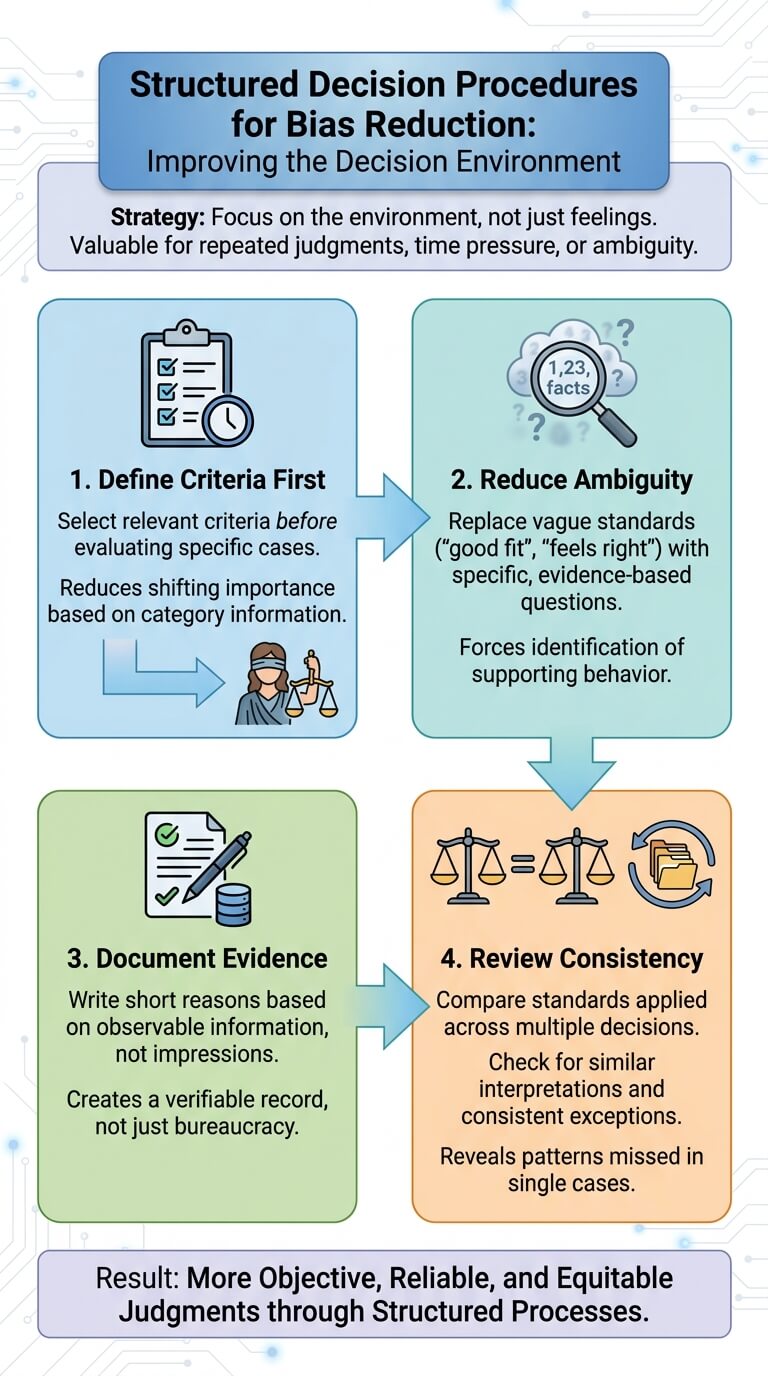
Some bias-reduction strategies focus less on changing feelings and more on improving the decision environment. This can be valuable when the same judgment is made repeatedly, especially under time pressure or ambiguity.
Define criteria before evaluating cases
Choose the relevant criteria before knowing which person or group will be evaluated. This reduces the temptation to change what counts as important after category information becomes salient.
Reduce ambiguity
Vague standards such as “seems like a good fit” or “feels trustworthy” leave considerable room for prior expectations to shape interpretation. More specific questions force the evaluator to identify what behavior or evidence supports the judgment.
Document evidence
A short written reason for a decision can reveal whether the conclusion rests on observable information or on broad impressions. Documentation also makes later comparison possible. The point is not bureaucracy for its own sake, but creating a record that can be checked.
Review consistency across comparable decisions
After several decisions, compare the standards that were actually applied. Did similar behavior receive similar interpretations? Were exceptions granted consistently? Patterns are often easier to see across multiple cases than inside a single decision.
Accountability and Feedback
People improve judgments more reliably when they can see the consequences of their decisions and receive feedback about inconsistency. Accountability is most useful when it clarifies evidence and standards, not when it simply increases fear of punishment.
Making standards visible
Visible standards make it easier for people to know what fair treatment looks like before a difficult case appears. They also reduce the chance that expectations shift quietly from person to person.
Tracking behavior rather than relying only on intentions
Most people prefer to think of themselves as fair. That self-image is not a reliable measurement system. Tracking actual choices, opportunities, interruptions, evaluations, or other relevant behavior can show whether intentions are translating into consistent treatment.
Learning from repeated outcomes
Feedback becomes more informative over time. One surprising case might be noise. A recurring pattern deserves closer examination. The aim is not to infer a hidden moral character from a spreadsheet, but to use repeated evidence to improve the process.
Why Awareness Alone May Not Be Enough
Awareness can be useful because people cannot examine a process they never notice. The problem begins when awareness is treated as if recognition automatically rewires habits, expectations, social norms, and decision procedures.
Recognizing bias does not automatically change habits or systems
A person may sincerely recognize a stereotype and still rely on it when tired, rushed, uncertain, or working inside a process with vague standards. Awareness needs somewhere to go: better evidence, more structured choices, improved contact, clearer norms, or repeated practice.
Information without practice can fade
Learning a concept once may change what someone can explain without changing what they do six months later. The 2009 review of prejudice-reduction research and practice emphasized how difficult it was to draw strong causal conclusions about many widely used approaches. That caution remains useful whenever a program is sold as self-evidently effective because its message sounds reasonable.
Why Guilt, Shame, or Coercion Can Backfire
Prejudice has moral and social consequences, but psychological change is not strengthened simply by maximizing discomfort. Approaches that make people feel accused, trapped, or globally condemned may shift attention from examining behavior to defending identity.
Defensiveness and identity threat
If the message becomes “a good person would never have this reaction,” people may focus on proving they are good rather than checking whether the judgment itself was fair. A more workable question is behavioral: “What evidence did I use, and would I have used the same standard for someone else?”
Compliance without durable learning
People can repeat approved language without changing how they evaluate real cases. Surface compliance may be useful for maintaining basic conduct, but it should not be confused with durable learning or generalized behavior change.
Avoiding moralizing as the mechanism
Fair treatment still requires standards and boundaries. The point is not to remove accountability. It is to avoid relying on shame as the main psychological engine when clearer evidence, consistent procedures, constructive contact, and repeated feedback offer more direct routes to behavior.
One-Off Interventions vs Durable Change
Prejudice is learned and expressed across repeated contexts, so durability matters. A brief intervention may create a measurable shift without changing the environments that repeatedly reactivate old expectations.
Decay over time
Immediate gains may fade when people return to the same cues, peers, incentives, or routines. Follow-up measurement is therefore central to claims about lasting change.
Repeated context and reinforcement
Change is more likely to become ordinary when new expectations are practiced across situations. Consistent norms, recurring cross-group cooperation, better evidence habits, and stable decision procedures can reinforce one another instead of depending on memory of a single session.
Transfer from a measure to real behavior
A reduction on one questionnaire or response-time task should not be assumed to transfer automatically to hiring, friendship, classroom behavior, neighborhood interaction, or conflict decisions. Different outcomes require their own evidence.
How to Evaluate a Prejudice-Reduction Claim

When a headline says an intervention “reduces bias,” six questions can make the claim more informative. This is useful whether the intervention is a workshop, contact program, media message, perspective-taking exercise, decision redesign, or something else.
What was the comparison group?
Improvement after an activity does not prove the activity caused the improvement. A credible comparison condition helps separate the effect of the intervention from time, attention, repeated testing, or unrelated changes.
What outcome changed?
Was the result a self-report, an implicit association measure, an observed behavior, or a repeated real-world decision? These outcomes answer different questions and should not be collapsed into one label.
How large was the effect?
A statistically detectable effect may still be small in practical terms. Ask whether the size of the change is meaningful for the decision or setting that matters.
How long did it last?
Look for delayed follow-up rather than only an immediate post-test. If there is no follow-up, the evidence may support short-term change while leaving durability unknown.
Did behavior change or only self-report?
Self-report is not worthless, but it is different from behavior. If the goal is fairer treatment, evidence about actual choices or repeated outcomes is especially valuable.
Does the intervention fit this context?
An approach that works with students in a structured program may not work the same way with adults or in high-conflict settings. The 2022 field meta-analysis found substantial variation across interventions and populations, reminding us that average effects do not guarantee a particular local result.
Contact Hypothesis vs Prejudice Reduction
The two ideas overlap, but they are not interchangeable. Contact is one pathway. Prejudice reduction is the larger question of how group-based evaluation and treatment might change through several psychological and procedural routes.
One specific pathway versus a multi-method approach
Contact focuses on what happens when members of different groups interact under more or less constructive conditions. A broader reduction plan may also involve individuation, norm change, counter-stereotypical information, structured decisions, accountability, and repeated measurement. Someone can improve a decision process even when direct intergroup contact is not the main lever.
Prejudice Reduction vs General Attitude Change
Prejudice is an attitude-related construct, but not every attitude concerns social groups. The psychology of changing an opinion about a product, habit, policy, or personal preference can involve mechanisms that have little to do with intergroup judgment.
Group-based evaluation and treatment versus attitudes on any topic
For the broader mechanisms through which evaluations change, Psychology Exposed’s guide to attitude change psychology covers information, experience, repetition, emotion, behavior, identity, and social context across many subjects. Prejudice reduction is narrower because the evaluation is tied to perceived group membership and often carries consequences for how people are treated.
A Practical First Step for Everyday Judgment
You do not need to redesign your entire worldview at once. A more testable starting point is to choose one recurring situation where category cues may influence judgment and make that situation more evidence-based.
Pick one recurring decision context
Choose something specific: deciding whose idea sounds credible in a meeting, evaluating applications, choosing who receives a difficult assignment, interpreting behavior in a neighborhood group, or deciding whose mistake deserves a second chance. Specific contexts make it easier to observe change.
Define evidence and criteria before the next case
Write down what should matter before seeing the next person. If reliability matters, define what counts as evidence of reliability. If competence matters, specify the behavior or record that demonstrates competence. This makes category-based improvisation easier to notice.
Observe whether category cues still change treatment
After several cases, compare what happened. Were the same standards used? Did one group receive more benefit of the doubt? Did you seek more evidence before making negative assumptions about some people than others? The purpose is not self-condemnation. It is to turn a vague concern into something observable enough to improve.
FAQ
These questions focus on what prejudice-reduction evidence can reasonably tell us, and where strong claims need more caution.
Can prejudice be permanently eliminated?
Psychology does not support the promise that one technique permanently eliminates prejudice. Group-based evaluations are shaped by learning, context, norms, repeated experience, and decision environments. A more realistic aim is to reduce biased evaluation and treatment, strengthen individualized judgment, and build conditions that support fairer behavior over time.
Does bias-awareness training change behavior?
Awareness can be a useful first step, but it is not the same as behavioral change. Reviews warn that many programs use weak designs, short follow-up, or outcomes that do not directly measure behavior. The stronger question is whether decisions or treatment change in the relevant setting and whether the change persists.
Is intergroup contact the most effective approach?
Contact has a large research literature, and meta-analytic evidence generally links constructive contact with lower prejudice. It is not automatically best for every setting. Quality, safety, status, goals, and repetition matter, while decision procedures, perceived variability, or norm change may be more relevant in other contexts.
Do counter-stereotypical examples reduce stereotypes?
They can help by broadening the examples associated with a group, especially when they encourage recognition of within-group variability. One example may simply be treated as an exception, however. More meaningful updating occurs when the person revises the prediction rule itself and becomes less confident that a broad category tells them what an individual will be like.
How can I tell whether an intervention changed behavior rather than just attitudes?
Look for actual choices or repeated outcomes, such as selection decisions, allocation patterns, cooperation, evaluations, interruptions, or invitations. Then check whether change appears across time and comparable cases. Self-report may still matter, but it should not be called behavioral change unless behavior was measured.
Key Takeaways
- Prejudice reduction can mean changing attitudes, automatic associations, behavior, or repeated decision outcomes, and those are not interchangeable.
- No single conversation, workshop, contact event, or test result demonstrates that bias has been permanently removed.
- Individuation works best when person-specific evidence is relevant to the decision and is compared using consistent criteria.
- Constructive intergroup contact can help, but contact quality, status, goals, cooperation, repetition, and safety all shape what people learn.
- Norms and decision procedures matter because fair intentions can still produce inconsistent treatment when standards are vague.
- Strong claims should specify what changed, how large the change was, whether behavior changed, how long the effect lasted, and whether the method fits the context.
About the author: Michael Reed is the Founder & Lead Writer at Psychology Exposed. He explains human behavior, relationships, emotional patterns, self-awareness, and everyday decisions in a clear, research-aware way for general readers.

Michael Reed is the Founder and Lead Writer at Psychology Exposed. He writes about human behavior, relationships, emotional patterns, self-awareness, and practical psychology topics using research-informed, easy-to-understand content.
Read More About Michael Reed: https://psychologyexposed.com/michael-reed/