
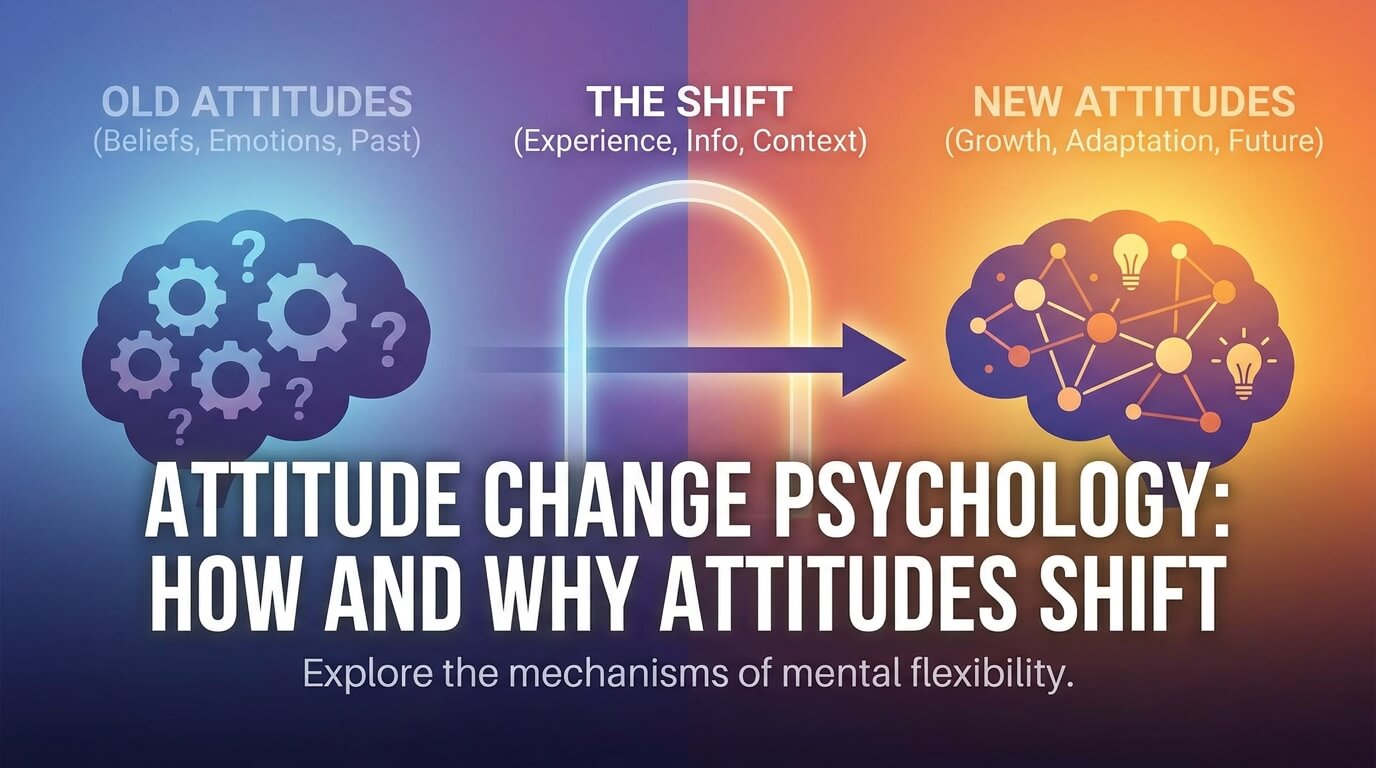
An attitude can feel settled for years and still change after one meaningful experience. Another attitude may survive repeated facts, conversations, and consequences. The difference is rarely explained by information alone. Attitudes are evaluations supported by beliefs, emotions, memories, identity, behavior, and social context. Change becomes more likely when enough of those supports move together.
Someone may become more favorable toward an activity after direct experience, less certain after a prediction fails, or more open after hearing a trusted person describe a different perspective. A public agreement may disappear once social pressure ends. A temporary emotional response may fade when the person returns to the old environment.
Attitude change psychology studies these movements in direction, strength, certainty, accessibility, and ambivalence. It also asks why change lasts in some cases but remains shallow, conditional, or reversible in others.
Quick Answer
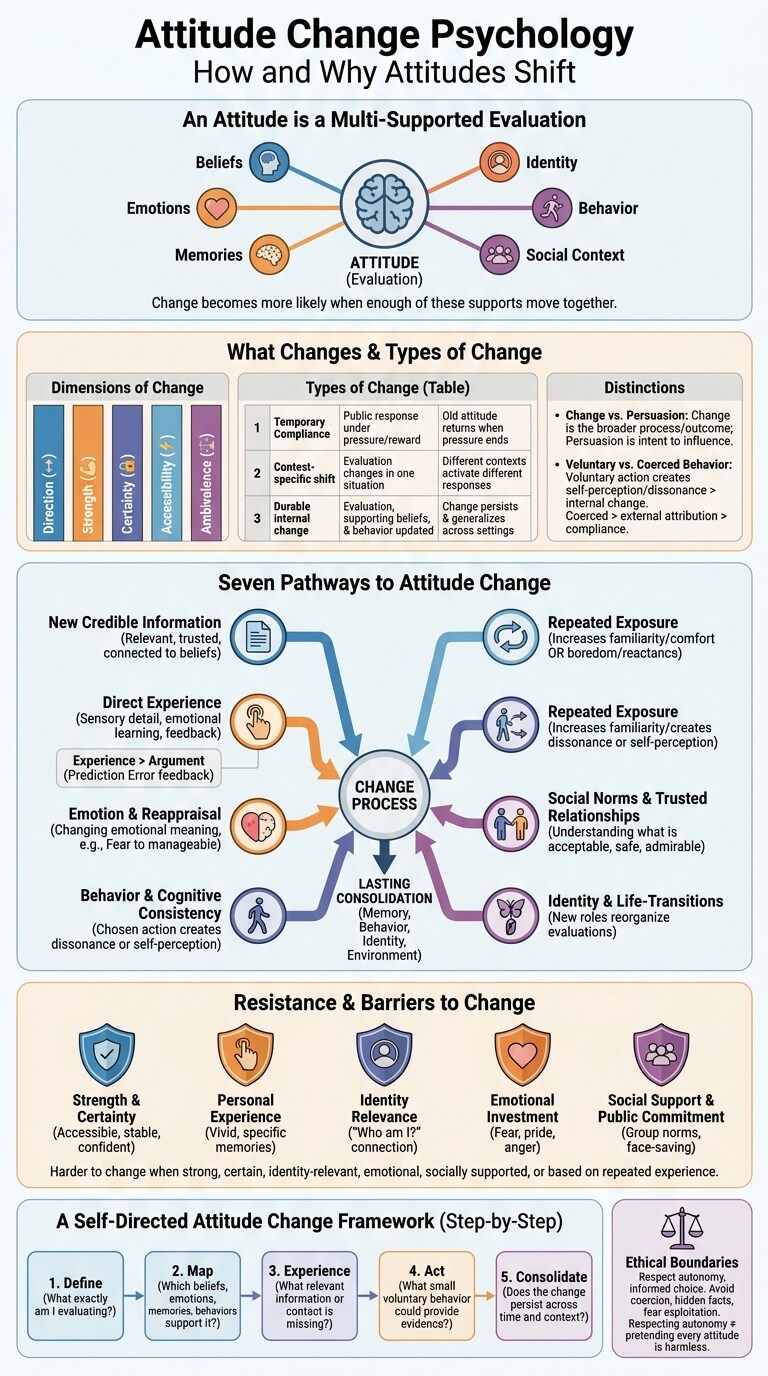
Attitudes change when new information, direct experience, emotion, behavior, identity, or social context alters how a target is evaluated. Change is more difficult when an attitude is strong, certain, identity-relevant, emotionally invested, socially supported, or based on repeated personal experience. Lasting change usually requires more than temporary agreement. It must become integrated into memory, behavior, identity, and the environments where the old attitude was expressed.
What Attitude Change Means
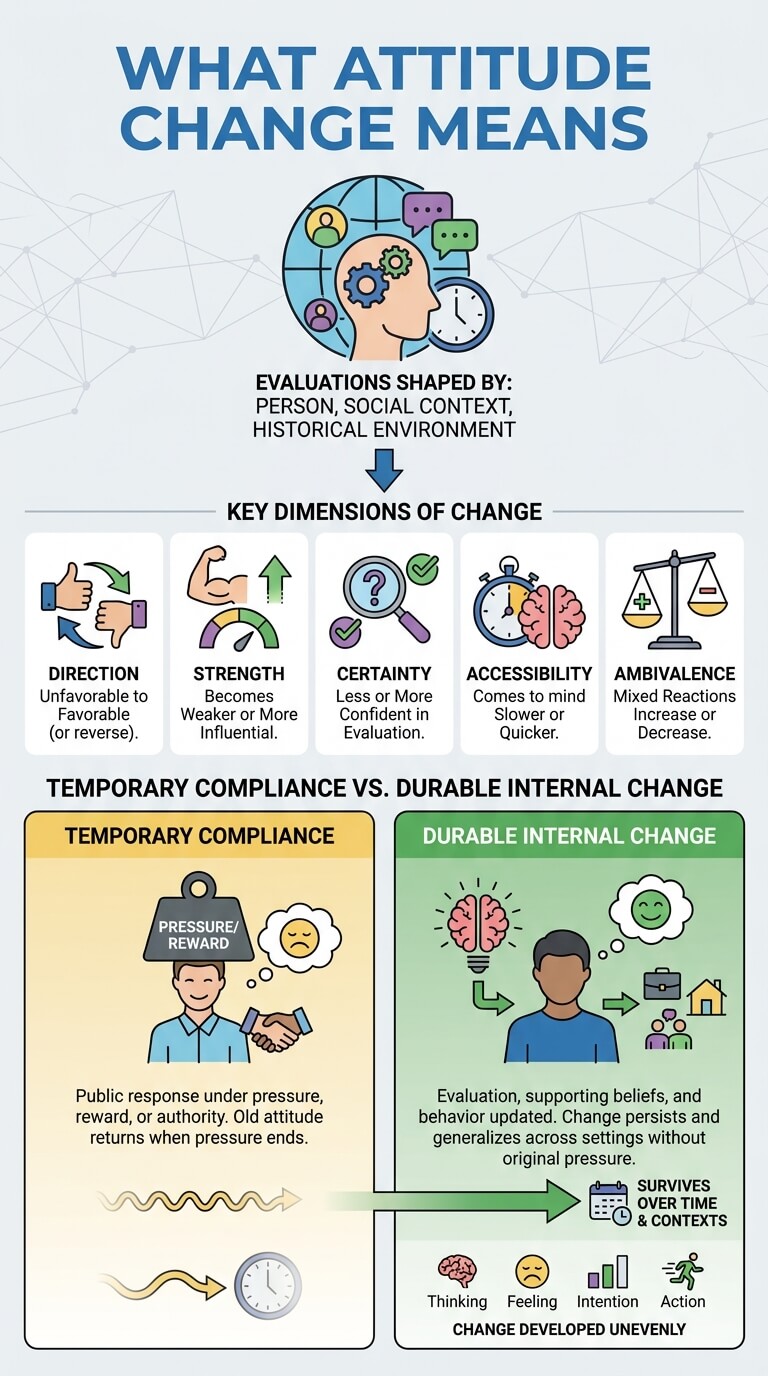
Attitude change is not limited to moving from dislike to liking. A broad review of attitudes and attitude change describes evaluations as shaped within the whole person, the social context, and the wider historical environment. An attitude may remain stable in one setting and shift in another.
Change in direction, strength, certainty, accessibility, or ambivalence
An attitude can change in several ways:
- Direction: unfavorable becomes favorable, or the reverse.
- Strength: a strong evaluation becomes weaker or more influential.
- Certainty: a person becomes less or more confident in the evaluation.
- Accessibility: the evaluation comes to mind more slowly or more quickly.
- Ambivalence: mixed positive and negative reactions increase or decrease.
A person may still dislike public speaking while becoming less certain that every presentation will be humiliating. Another may remain generally positive toward remote work while becoming more aware of isolation and communication costs. Both are meaningful changes even though the attitude did not reverse completely.
Temporary compliance is not the same as lasting change
People sometimes express agreement because of pressure, reward, authority, politeness, fear, or a desire to end the conversation. Their outward response changes while the private evaluation remains the same.
Lasting internal change appears when the evaluation continues without the original pressure, influences later choices, and survives across relevant contexts. Compliance can be useful for safety or coordination, but it should not be mistaken for endorsement.
Durability should be judged over time rather than from one statement. A person may speak differently before their emotional reaction changes, or behave differently before the new attitude feels natural. Internal change often develops unevenly across thought, feeling, intention, and action.
| Type of change | What changes | What happens later |
|---|---|---|
| Temporary compliance | Public response under pressure or reward | Old attitude returns when pressure ends |
| Context-specific shift | Evaluation changes in one situation | Different contexts activate different responses |
| Durable internal change | Evaluation, supporting beliefs, and behavior are updated | Change persists and generalizes across settings |
What Makes an Attitude Easier or Harder to Change
Some attitudes are lightly held preferences. Others are connected to identity, direct experience, and years of behavior. The second group requires more than one counterexample.
Strength and certainty
Strong attitudes are accessible, important, certain, and stable. A meta-analysis of attitude strength and future behavior identifies accessibility, stability, certainty, ambivalence, direct experience, and cognitive-affective consistency as important features.
Certainty can come from reliable evidence, repeated social agreement, personal experience, or simply never encountering a serious alternative. High certainty makes reconsideration less likely, but it does not prove the attitude is accurate.
Personal experience
Direct experience often creates detailed, memorable evaluations. Someone who has repeatedly received poor service has more than a general opinion. They have specific memories, emotions, and predictions that support the attitude.
Personal experience can also change an attitude more effectively than abstract argument. A respectful interaction may challenge a stereotype because it provides concrete information that is difficult to dismiss as theoretical.
However, one experience may be too narrow to justify a broad reversal. Useful updating asks whether the event was representative, whether conditions differed from the past, and whether similar outcomes appear again. Experience is powerful partly because it is vivid, which makes careful sampling important.
Identity relevance
An attitude is harder to change when it answers, “Who am I?” or “Which group do I belong to?” Revision may feel like disloyalty, loss of competence, or rejection of an earlier self.
Identity-relevant change becomes easier when the person can connect the new evaluation to an existing value. “Changing my view means I was foolish” creates threat. “Changing my view means I care about accuracy” preserves continuity.
Emotional investment
Strong fear, pride, anger, affection, disgust, or grief can make an attitude feel self-evident. Emotional memories are often easier to retrieve than neutral corrections.
Emotion can support change when a new experience creates surprise, empathy, relief, or hope. It can block change when arousal narrows attention and turns the interaction into self-protection.
Social support and public commitment
Attitudes are easier to revise when trusted people model reconsideration and when the person has a socially acceptable path to change. Public commitments raise the cost because revision may require explanation, apology, or loss of status.
A person may update privately before speaking differently in a group. Delayed expression does not necessarily mean no internal change has occurred.
Seven Pathways to Attitude Change
Attitudes can move through several pathways. A durable shift often uses more than one.
New credible information
Information changes an attitude when it is relevant, understandable, trusted, and connected to the beliefs supporting the evaluation. One accurate fact may have little effect if the attitude rests on ten beliefs, a strong emotion, and group identity.
Effective updating is specific. Instead of attacking the whole evaluation, identify the claim that changed and explain what should replace it.
Information is more likely to matter when the person can connect it to a prediction. “This program may be useful” is abstract. “If it is useful, I should be able to complete this task with fewer errors after two sessions” creates a standard that later experience can test.
Direct experience
Experience provides sensory detail, emotional learning, and feedback about predictions. It may confirm the original attitude, weaken it, or make it more conditional.
Direct experience is not automatically unbiased. One unusual event can be overgeneralized. The strongest updating comes from representative experience across enough situations to reveal a pattern.
Emotion and reappraisal
An attitude may change when the emotional meaning of a target changes. Fear can become manageable after safe contact. Anger may soften after new context. Admiration may decline after harmful consequences become visible.
Reappraisal changes how an event is interpreted rather than pretending the emotion is wrong. “This discomfort means danger” may become “This discomfort reflects unfamiliarity and can be observed safely.”
Repeated exposure and familiarity
Repeated contact with a previously neutral stimulus can increase familiarity and liking. Research on the mere exposure effect shows that repetition can influence affective evaluation.
Familiarity is not the same as truth, safety, quality, or moral value. Repetition may make something easier to process without making it more deserving of approval.
Behavior and cognitive consistency
Chosen behavior can provide evidence about preferences and identity. A person who volunteers regularly may begin to see the cause as more personally important. Someone who tries a new routine may revise the belief that it is intolerable.
Behavior can also create dissonance when it conflicts with an existing attitude. The person may change the behavior, change the attitude, or add a justification. The direction is not guaranteed.
Social norms and trusted relationships
People use others to understand what is acceptable, common, safe, or admirable. Norms influence attitudes through uncertainty reduction, identity, reward, and enforcement. A review mapping social-norms research shows that norms operate through several distinct pathways.
Trusted relationships matter because difficult information is easier to consider when dignity and belonging are not immediately threatened.
Identity and life-transition changes
New roles can reorganize evaluations. Becoming a parent, changing careers, joining a community, leaving a group, moving, aging, or recovering from a major event can make old attitudes less useful.
Identity change is often gradual. The person experiments with new behavior, receives social feedback, and begins integrating a different view into the self.
Life transitions can also remove the audience or incentives that maintained an old attitude. A person may reconsider a career, relationship pattern, or social rule after leaving the environment where agreement was expected. The shift may feel sudden even though doubt had been developing privately for years.
Why Experience Can Outweigh Argument
An argument describes what might happen. Experience supplies feedback about what did happen.
Concrete feedback, prediction error, and emotional learning
Suppose someone believes a class will be humiliating. Reassurance may be dismissed as optimism. Attending one well-structured session provides a prediction error: the expected humiliation does not occur.
Prediction error matters when the person notices it and sees the situation as relevant. If success is dismissed as luck or treated as a unique exception, the old attitude may survive. Reflection helps connect the event to the broader evaluation.
Experience can also strengthen a negative attitude when it reveals a real cost. Attitude change is not always movement toward positivity. Accurate negative revision can support better boundaries and decisions.
The Role of Repetition
Repeated exposure changes familiarity, attention, memory, and sometimes evaluation. Its effects depend on the starting attitude and the nature of the contact.
Familiarity can increase comfort
Neutral or mildly positive stimuli may become easier to process and more comfortable with repetition. Familiarity reduces uncertainty and can make interaction feel less effortful.
This helps explain why new foods, music, tools, or routines sometimes become more acceptable after repeated low-pressure contact.
Repetition can also create boredom, suspicion, or reactance
More exposure is not always better. Repetition can produce fatigue, irritation, or the feeling that someone is trying to force an evaluation. Negative starting attitudes may become more accessible rather than softer.
Attention also matters. Repeating a complex image does not guarantee that the intended element becomes more liked. The person may attend to a different feature or remember the repetition as intrusive.
How Behavior Can Shift Attitude
Behavior is both an outcome of attitude and a source of new information about it.
Small chosen actions, self-perception, and dissonance
A small voluntary action can create experience without requiring full commitment. Someone uncertain about community work may attend one event. A person with a negative attitude toward exercise may try a form of movement that differs from the activities they disliked.
After acting, people may infer what the behavior means: “I chose to return, so perhaps this matters to me.” If the action conflicts with the old attitude, dissonance may also motivate revision.
Why coerced behavior may not create internal change
When behavior is clearly caused by threat, payment, surveillance, or authority, the person has an external explanation: “I did it because I had to.” The attitude may remain unchanged or become more negative through reactance.
Voluntary choice is therefore ethically and psychologically important. It gives behavior more information about the person’s own evaluation.
Emotion and Attitude Change
Emotion influences attention, interpretation, memory, and the urgency to act.
Fear, hope, empathy, anger, and surprise
Fear can increase caution, but intense fear may narrow attention or produce avoidance. Hope can make change feel possible, but unrealistic hope can weaken preparation. Empathy can add another person’s experience to the evaluation. Anger may energize action while reducing openness to competing information.
Surprise is especially important because it marks a mismatch between expectation and experience. It can create an opening for updating when the person has enough safety and attention to examine what changed.
Emotion can open attention or narrow it
Moderate emotional relevance can make information memorable. Overwhelming emotion can shift the goal from learning to defense. The same message may be processed differently depending on timing, trust, and arousal.
Research on emotion and dissonance-related attitude change illustrates that emotional regulation and attitude revision are connected rather than separate processes.
Social Context and Identity
Attitudes are expressed inside relationships, groups, institutions, and historical conditions.
Group norms, trusted messengers, belonging, and face-saving
A message from an outsider may be treated as a threat even when the evidence is strong. The same information from a respected group member may be easier to consider because it does not immediately threaten belonging.
Psychological safety can support open-mindedness. A review of interpersonal conditions for attitude change argues that feeling understood may reduce defensive processing and make change more possible.
Face-saving matters after public commitment. Allowing someone to say “I am reconsidering” can support change better than demanding an immediate confession of error.
Attitude Change vs Persuasion
Attitude change is the broader outcome or process. Persuasion is communication intended to influence beliefs or evaluations.
Broad change process versus communication intended to influence
An attitude can change without a persuasive message through experience, behavior, life transition, emotion, or new group membership. Persuasion can fail to change attitude, produce only temporary compliance, or change one supporting belief without moving the overall evaluation.
This distinction prevents every change process from being treated as a messaging technique. It also keeps persuasion under ethical limits involving autonomy, truthfulness, and informed choice.
Attitude Change vs Belief Change
A belief concerns what a person accepts as true. An attitude concerns how the person evaluates a target.
Evaluation can shift without full factual revision, and vice versa
A person may continue believing that public speaking is difficult while becoming more positive toward practicing it. Another may correct a factual belief about a product while retaining a negative attitude because of poor past treatment.
Because several beliefs can support the same evaluation, the broader framework of belief psychology helps explain why changing one factual conclusion does not always reverse an attitude.
Several beliefs may support one attitude. Updating one belief may reduce certainty without reversing the full evaluation.
Why Attitude Change Does Not Always Last

A new attitude can be real and still fragile.
Weak consolidation, unchanged environment, competing motives, and context dependence
Change may fade when it rests on one emotional moment, has not been practiced, or is unsupported by the person’s environment. Old cues can reactivate the previous attitude. Competing goals may become more important under stress.
Context-specific learning may not generalize. A person becomes comfortable speaking in one supportive group but still expects rejection elsewhere. Lasting change requires testing the updated evaluation across relevant settings.
Relapse does not prove the change was fake. It may reveal that the new attitude needs more retrieval cues, behavior, social support, or repeated experience.
Consolidation is stronger when the person can explain why the attitude changed, recall several supporting experiences, and act consistently without relying on one emotional state. A change that exists only when one friend is present or one memory is vivid may still be genuine but not yet stable.
A Self-Directed Attitude Change Framework
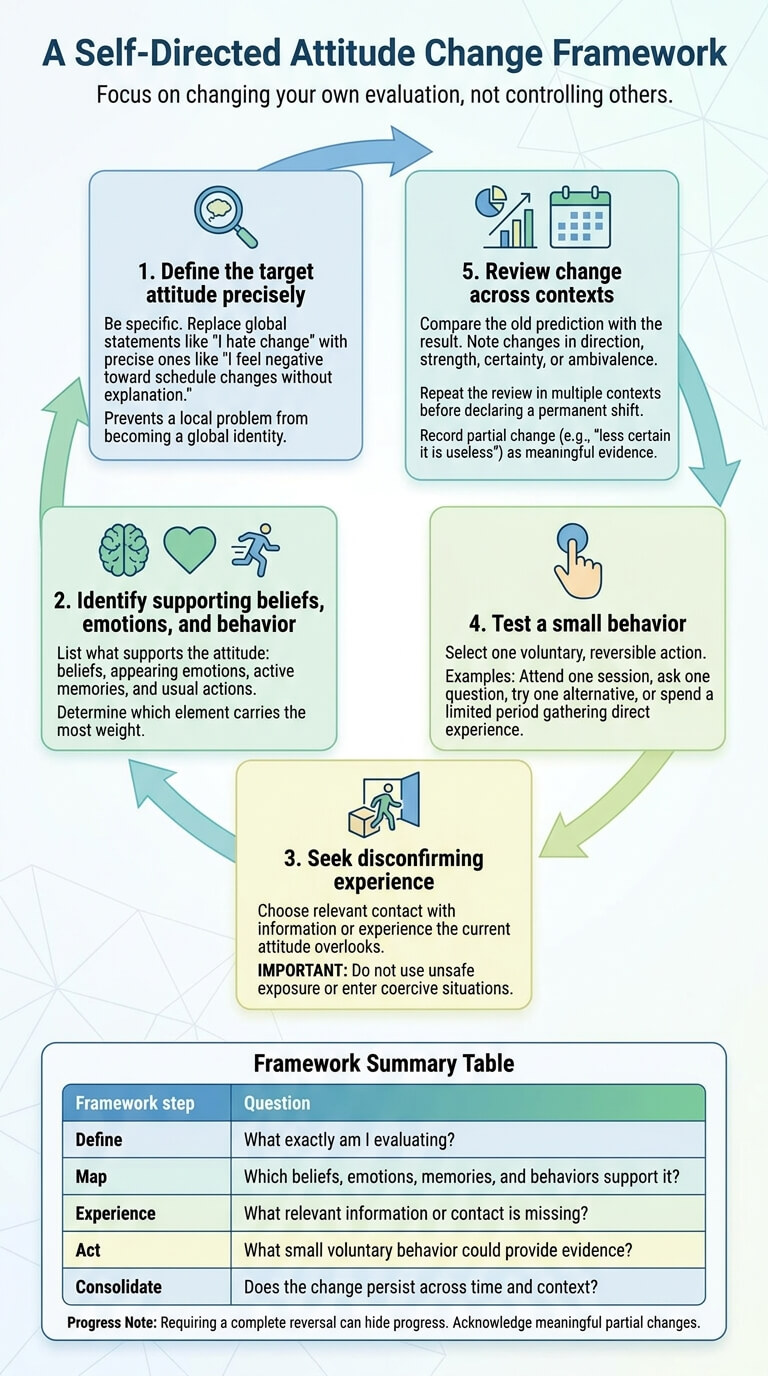
This framework is designed for changing your own evaluation, not controlling someone else’s.
Define the target attitude precisely
Replace “I hate change” with “I feel negative toward schedule changes announced without explanation.” A precise target prevents a local problem from becoming a global identity.
Identify supporting beliefs, emotions, and behavior
List what you believe about the target, what emotions appear, what memories are active, and what you usually do. Ask which element carries the most weight.
Seek disconfirming experience
Choose relevant, representative contact with information or experience that the current attitude may overlook. Do not use unsafe exposure or enter coercive situations to prove flexibility.
Test a small behavior
Select one voluntary, reversible action. Attend one session, ask one question, try one alternative, or spend a limited period gathering direct experience.
Review change across contexts
Afterward, compare the old prediction with the result. Ask whether direction, strength, certainty, or ambivalence changed. Repeat the review in more than one relevant context before declaring a permanent shift.
Record partial change. “I still dislike the activity, but I am less certain it is useless” is meaningful evidence. Requiring a complete reversal can hide progress and encourage exaggerated conclusions from one good or bad experience.
| Framework step | Question |
|---|---|
| Define | What exactly am I evaluating? |
| Map | Which beliefs, emotions, memories, and behaviors support it? |
| Experience | What relevant information or contact is missing? |
| Act | What small voluntary behavior could provide evidence? |
| Consolidate | Does the change persist across time and context? |
Ethical Boundaries
Attitude change becomes ethically problematic when it bypasses autonomy, hides material facts, exploits fear, or punishes refusal.
Autonomy, informed choice, and avoiding coercion
Ethical influence uses accurate information, discloses relevant interests, permits questions, and allows the person to decline. It does not use humiliation, threats, isolation, deception, or unsafe exposure.
Respecting autonomy does not require pretending every attitude is harmless or equally supported. You can state evidence, set boundaries, and leave a conversation without forcing internal agreement.
Bridge: Persuasion, Dissonance, and Belief Perseverance
Several mechanisms can support or block attitude change.
How different mechanisms can support or block change
Persuasion supplies a message. Dissonance creates pressure when behavior and evaluation conflict. Belief perseverance explains why an old conclusion may remain after evidence changes. Reactance explains why threatened autonomy can increase resistance.
These mechanisms may occur together. A message creates dissonance, identity threat activates resistance, and the old attitude remains because its explanation and social support are still intact. Durable change requires identifying the active barrier rather than repeating one intervention.
When Professional Support May Help
Most attitude change is ordinary learning. Support may help when a rigid evaluation is tied to severe distress, compulsive avoidance, or unsafe behavior.
Seek support when rigid attitudes are linked to severe distress, compulsive avoidance, or unsafe behavior
A qualified mental health professional may help when an attitude contributes to panic, major impairment, compulsive checking, inability to access necessary care, severe shame, self-harm thoughts, or persistent harmful behavior. The goal is not to diagnose an “attitude problem,” but to address the underlying distress, learning history, and consequences.
Use local emergency or crisis services if there is immediate danger. Do not use self-directed exposure to test attitudes in situations involving abuse, stalking, coercion, medical risk, or credible threats.
Educational note: Attitude change is not a clinical treatment plan. Individual needs, safety, health, and structural constraints require appropriate professional guidance.
FAQ About Attitude Change
These questions address facts, repetition, relapse, behavior, and persuasion.
Can attitudes change without new facts?
Yes. Direct experience, emotion, behavior, identity shifts, and changing social context can alter evaluation even when no new factual claim appears. The change may still involve new meaning or new evidence about what the target feels like in practice.
Does repeated exposure always improve attitudes?
No. Repetition can increase familiarity and comfort, especially for neutral stimuli, but it can also create boredom, irritation, suspicion, or reactance. The starting attitude, attention, context, and quality of contact matter.
Why do people revert to an old attitude?
The new attitude may be weakly consolidated, tied to one context, unsupported by behavior, or contradicted by the old environment. Stress and familiar cues can make the previous evaluation easier to retrieve.
Can behavior change attitude?
Yes. Voluntary action can provide direct experience, influence self-perception, and create pressure for consistency. Coerced behavior may produce compliance without internal change because the person attributes the action to external pressure.
How is attitude change different from persuasion?
Attitude change is the wider process or outcome. Persuasion is communication intended to influence. Experience, behavior, emotion, identity, and social context can change attitudes without a persuasive message.
Key Takeaways
- Attitude change can involve direction, strength, certainty, accessibility, or ambivalence.
- Temporary compliance, context-specific change, and durable internal change are not the same.
- Credible information, direct experience, emotion, repetition, behavior, norms, and identity can all produce change.
- Strong, certain, identity-relevant, emotionally invested, and socially supported attitudes are harder to revise.
- Repeated exposure can increase familiarity, but it can also create boredom, suspicion, or reactance.
- Durable change requires consolidation across memory, behavior, social support, time, and relevant contexts.
Choose one attitude you want to understand rather than force. Define its exact target, map the beliefs and emotions supporting it, identify one missing experience, and test one small voluntary behavior. Then review whether the evaluation changed in direction, strength, certainty, or ambivalence. A credible shift is often gradual, specific, and easier to see across several contexts than in one dramatic moment.

Michael Reed is the Founder and Lead Writer at Psychology Exposed. He writes about human behavior, relationships, emotional patterns, self-awareness, and practical psychology topics using research-informed, easy-to-understand content.
Read More About Michael Reed: https://psychologyexposed.com/michael-reed/