
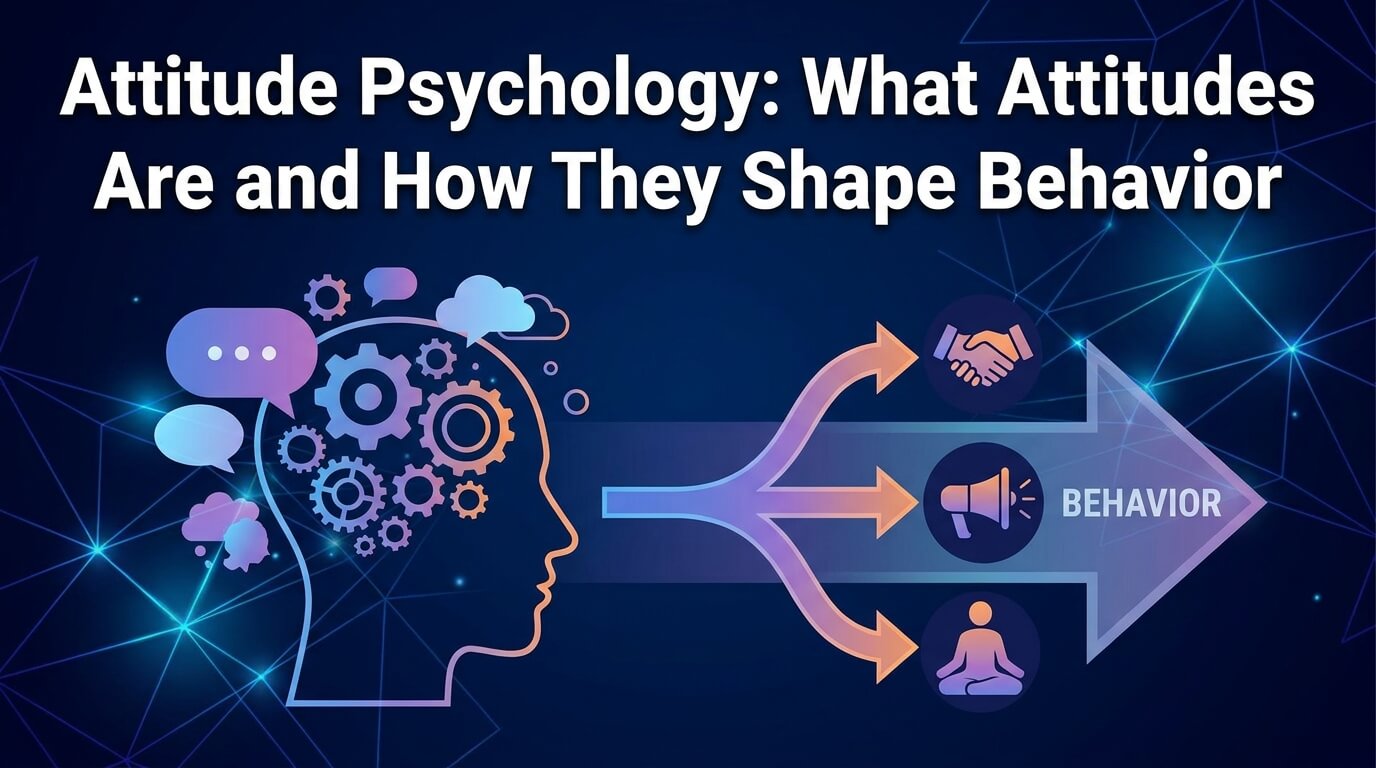
In everyday conversation, “attitude” often means a bad mood, a disrespectful tone, or a difficult personality. Psychology uses the word more precisely. An attitude is an evaluation of something: a person, activity, idea, object, group, policy, or situation. You may have a favorable attitude toward exercise, an uneasy attitude toward public speaking, or a mixed attitude toward working from home.
That evaluation can include thoughts, feelings, and a readiness to respond. It does not guarantee what you will actually do. Someone can value healthy food and still order the fastest available meal. A person can dislike conflict and still start an argument when they feel cornered. The difference between evaluation and action is one of the most useful ideas in attitude psychology.
Understanding attitude requires separating its structure from its expression: why some evaluations feel strong, how deliberate reports differ from faster associations, and why context often decides whether an attitude becomes behavior.
Quick Answer
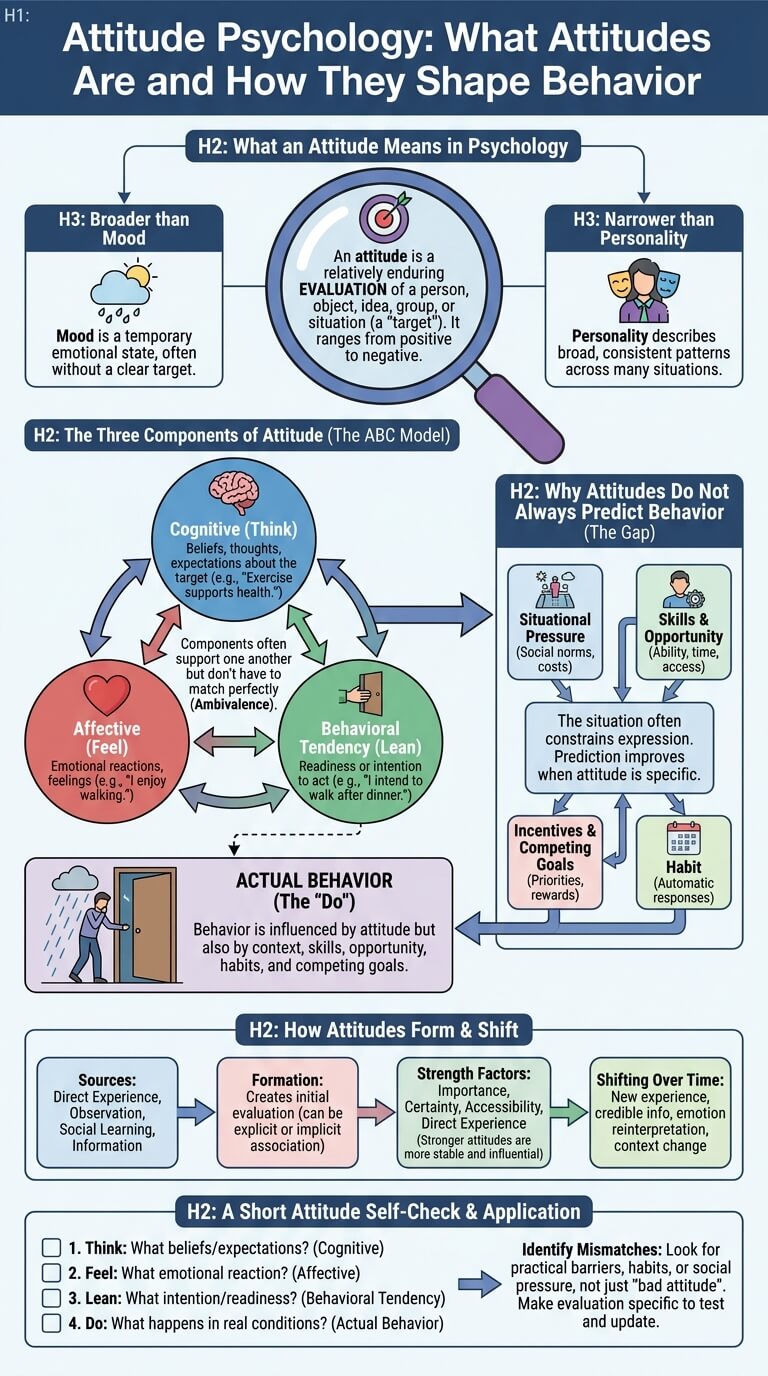
In psychology, an attitude is a relatively lasting positive, negative, or mixed evaluation of a person, object, idea, group, or situation. Attitudes can include beliefs, emotions, and action tendencies, but they are not identical to behavior. Their influence is usually stronger when the attitude is specific, important, easy to recall, based on direct experience, and supported by the situation.
What an Attitude Means in Psychology
The APA Dictionary of Psychology defines an attitude as a relatively enduring and general evaluation that ranges from negative to positive. The central word is evaluation. An attitude tells you whether something feels good or bad, desirable or undesirable, appealing or unappealing, safe or risky, worthwhile or not worth the effort.
Evaluation toward a person, object, idea, or situation
Every attitude has a target. The target may be concrete, such as a particular phone, food, or coworker. It may be broad, such as remote work, authority, therapy, competition, or social media. The broader the target, the more likely the evaluation contains different reactions in different contexts.
For example, “I like technology” is a broad attitude. A person may enjoy navigation apps, distrust facial recognition, feel excited about medical technology, and dislike constant notifications. One general label can hide several narrower attitudes.
Attitudes also vary in direction. Some are clearly favorable or unfavorable. Others are neutral, weak, or ambivalent. A mixed attitude is not an absence of attitude. It can mean that strong positive and negative evaluations are active at the same time.
Attitude is broader than mood and narrower than personality
A mood is a temporary emotional state that may not have one clear target. You can wake up irritable without knowing why. An attitude is directed toward something. You may feel irritated about a new workplace policy, a particular task, or a person’s behavior.
Personality describes broader patterns in how someone tends to think, feel, and behave across many situations. An attitude is more specific. A generally sociable person can dislike networking events. A cautious person can feel strongly positive about one carefully researched investment.
Temporary states can still influence attitudes. Hunger may make a restaurant seem less appealing after slow service. A stressful day may make a neutral message feel more negative. That does not turn mood into attitude, but it shows that evaluations are made inside a changing context.
The Three Components of Attitude
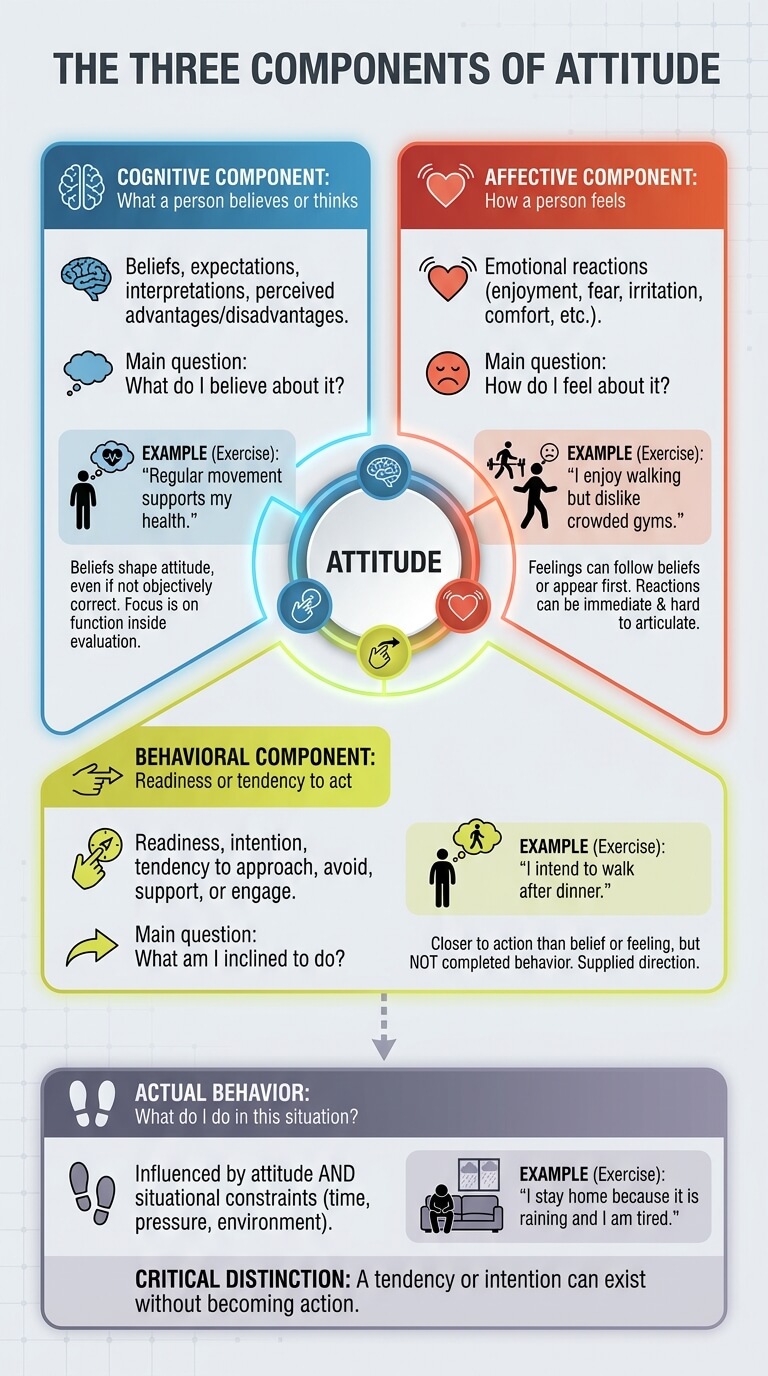
A common way to understand attitude is through three components: cognitive, affective, and behavioral. In plain English, these are what you think, what you feel, and what you are inclined to do. The components often support one another, but they do not have to match perfectly.
Because evaluations often rest on assumptions about what is true or likely, understanding the broader role of beliefs in psychology helps explain the cognitive side of an attitude.
| Component | Main question | Example: exercise |
|---|---|---|
| Cognitive | What do I believe about it? | “Regular movement supports my health.” |
| Affective | How do I feel about it? | “I enjoy walking but dislike crowded gyms.” |
| Behavioral tendency | What am I inclined to do? | “I intend to walk after dinner.” |
| Actual behavior | What do I do in this situation? | “I stay home because it is raining and I am tired.” |
The fourth row is included for an important reason. Actual behavior is influenced by attitude, but it is not simply the behavioral component of attitude. A tendency or intention can exist without becoming action.
Cognitive component: what a person believes or thinks
The cognitive component includes beliefs, expectations, interpretations, and perceived advantages or disadvantages connected to the target. A student may believe that group projects improve learning but also believe that the workload is usually unfair. Both thoughts contribute to the student’s overall evaluation.
Beliefs do not need to be objectively correct to shape an attitude. If someone believes a neighborhood is unsafe, that belief may support a negative attitude toward visiting it even when the information is outdated. Accuracy still matters, but psychology first asks how the belief functions inside the evaluation.
Affective component: how a person feels
The affective component includes emotional reactions such as enjoyment, fear, irritation, admiration, disgust, comfort, or unease. Sometimes feelings follow beliefs. A person believes a product is unreliable, then feels anxious about buying it. At other times the feeling appears first, and the person searches for an explanation afterward.
Emotional reactions can be immediate and difficult to put into words. You may feel warm toward a familiar song before recalling the memory connected to it. You may feel tense around a particular communication style without being able to identify the exact cue.
Behavioral component: readiness or tendency to act
The behavioral component is a readiness, intention, or tendency to approach, avoid, support, oppose, purchase, recommend, delay, or engage. It is closer to action than a belief or feeling, but it is still not the same as completed behavior.
Someone may intend to speak up in a meeting because they care about the topic. When the meeting arrives, time pressure, status differences, or fear of interruption may keep them silent. The attitude supplied direction, while the situation constrained expression.
When the Three Components Agree and When They Do Not
The Think, Feel, Lean, Do framework helps separate four layers that people often blend together:
- Think: the beliefs and interpretations attached to the target.
- Feel: the emotional evaluation.
- Lean: the intention or readiness to respond.
- Do: the action that occurs under real conditions.
A clear attitude often has agreement across the first three layers. Behavior becomes more likely when the fourth layer is supported by time, opportunity, skills, and social conditions.
Consistent attitudes
An attitude is relatively consistent when thoughts, feelings, and action tendencies point in the same direction. A person believes donating blood is useful, feels positive about helping, and intends to book an appointment. This internal agreement makes the evaluation easier to describe and may make action more likely.
Consistency does not remove practical barriers. The same person may be ineligible, unable to travel, or worried about needles. Internal agreement improves clarity, but behavior still depends on what is possible.
Ambivalent attitudes
Ambivalence occurs when a target is evaluated positively and negatively at the same time. Someone may value the flexibility of freelance work while disliking uncertain income. They may appreciate a friend’s honesty while feeling hurt by the delivery.
Ambivalence can feel like indecision, but it may reflect accurate recognition of tradeoffs. Research on cognitive and affective inconsistency examines how mixed thoughts and feelings can affect the stability and influence of an attitude.
A useful response to ambivalence is not to force one side to disappear. Name the positive and negative evaluations separately, then ask which concerns are central, which are temporary, and which can be addressed through conditions or boundaries.
Mixed feelings and competing beliefs
Two people can report the same overall attitude while arriving there differently. Both may say they feel “somewhat positive” about remote work. One sees many advantages and few disadvantages. The other sees major benefits and major costs that nearly cancel each other out.
Those structures matter. The second person’s evaluation may shift quickly when one concern becomes more important. A childcare change, team conflict, or long commute could move the balance even if no new general information appears.
Explicit and Implicit Attitudes
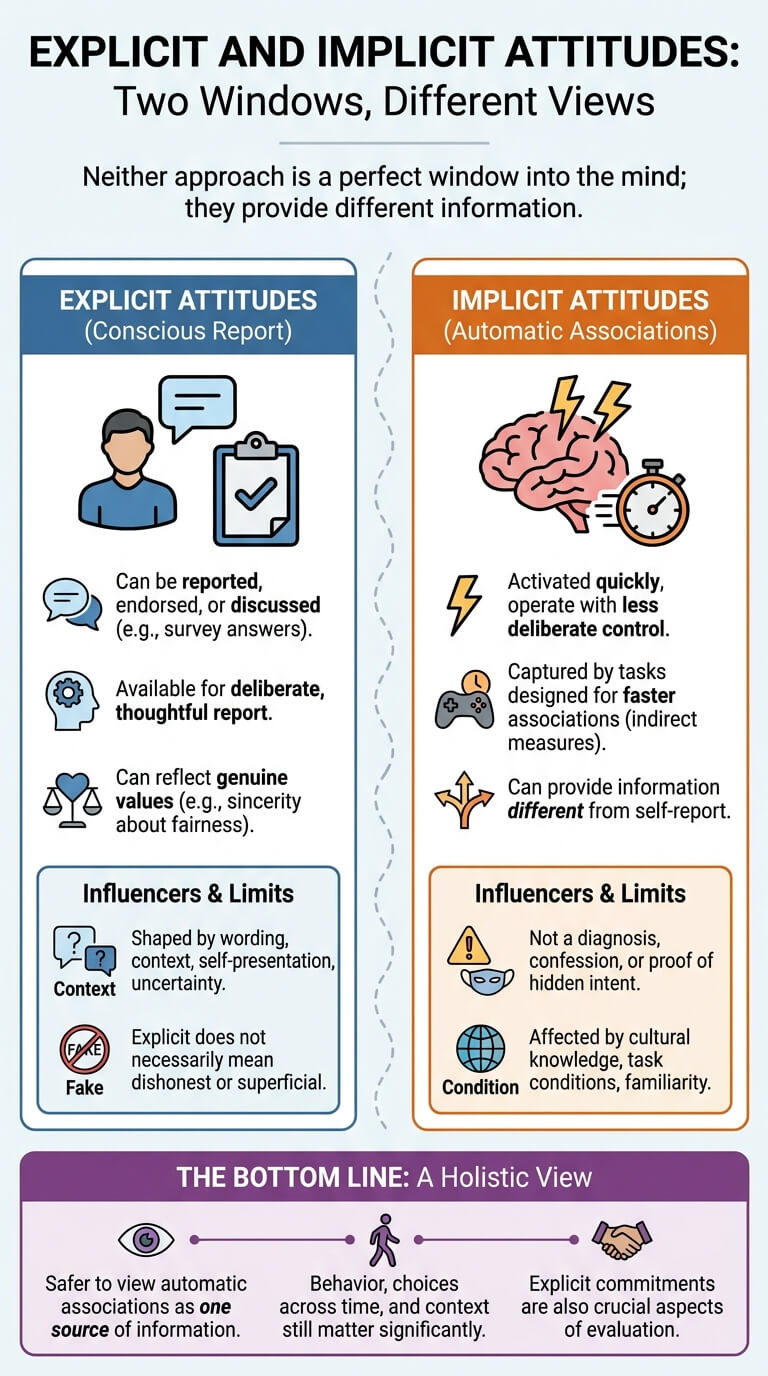
Attitudes can be measured through direct self-report and through tasks designed to capture faster associations. These approaches provide different information, and neither should be treated as a perfect window into someone’s mind.
What people can report consciously
Explicit attitudes are evaluations people can report, endorse, or discuss. A survey may ask how favorable someone feels toward public transportation, online learning, or a health practice. The answer can reflect genuine evaluation, but it may also be shaped by wording, current context, self-presentation, and uncertainty.
Explicit does not mean dishonest or superficial. It means the evaluation is available for deliberate report. A person may thoughtfully endorse fairness as a value and sincerely describe a positive attitude toward equal treatment.
Automatic associations and the limits of inference
Implicit measures are often used to study evaluations that are activated quickly or operate with less deliberate control. A major review of implicit social cognition explains that indirect measures can capture information that differs from self-report and may relate to some forms of behavior.
However, an implicit score is not a diagnosis, confession, or complete description of character. It can be affected by cultural knowledge, task conditions, familiarity, and the specific categories being compared. Researchers debate how best to interpret these measures and how strongly they predict behavior in different situations.
It is safer to view automatic associations as one source of information about learned evaluation, not as proof of hidden intent. Behavior, choices across time, context, and explicit commitments still matter.
How Attitudes Form
Attitudes develop through direct experience, observation, information, emotion, repeated exposure, and social learning. They may begin with a belief, a feeling, a behavior, or a combination of all three.
Experience, learning, social context, and repeated exposure
Direct experience often creates detailed evaluations. Someone who uses a service repeatedly can judge convenience, cost, reliability, and emotional experience. An attitude based only on a brief description may be less stable because fewer personal details support it.
Observation also matters. Watching respected peers enjoy an activity may make it seem more appealing. Repeated exposure can increase familiarity, although familiarity does not guarantee approval. Social norms communicate which evaluations are accepted, expected, or risky to express.
Behavior can contribute as well. A person who voluntarily joins a community project may later infer that the issue matters to them. This does not mean every action reveals a deep attitude. Sometimes people act because of pressure, habit, reward, or limited alternatives.
Why formation is only part of the picture
Knowing where an attitude began does not tell you how strong it is now. An evaluation formed through family influence may later be supported by personal experience. An attitude formed after one bad event may weaken after several different outcomes.
Origin, current structure, and present conditions should be examined separately. That prevents a common mistake: assuming an attitude is invalid simply because it was learned socially. Nearly all attitudes are shaped partly by other people. The better question is whether the evaluation remains useful, accurate, and flexible.
What Makes an Attitude Strong or Weak

Some attitudes are easy to change and have little effect on behavior. Others persist, guide attention, influence decisions, and resist conflicting information. Research often treats strength as a group of related qualities rather than one simple feature.
Importance, certainty, accessibility, personal experience, and identity relevance
| Strength factor | What it means | Why it matters |
|---|---|---|
| Importance | The evaluation matters personally. | People invest more attention and defend it more strongly. |
| Certainty | The person feels confident in the evaluation. | Confidence can increase stability, even when accuracy is uncertain. |
| Accessibility | The evaluation comes to mind quickly. | It is more available when a decision must be made. |
| Direct experience | The evaluation is based on personal contact. | It may contain richer and more memorable information. |
| Identity relevance | The attitude is connected to values or group membership. | Changing it may feel like changing who someone is. |
A meta-analysis on attitudes that predict future behavior found stronger links to later behavior when attitudes were accessible and stable. This does not mean strong attitudes always control action. It means they are more likely to be available and influential when choices arise.
Strength also has limits. Certainty can come from careful evidence, but it can also come from repetition, social agreement, or lack of exposure to alternatives. A strong attitude is psychologically influential, not automatically accurate or morally correct.
Why Attitudes Do Not Always Predict Behavior
People are often surprised by the gap between what they say they value and what they do. That gap does not always indicate hypocrisy. Behavior reflects the interaction of evaluation, intention, habit, skill, opportunity, incentives, pressure, and competing priorities.
Situational pressure and social norms
A person may have a positive attitude toward speaking honestly but stay quiet when a supervisor controls their job security. Someone may dislike gossip yet join a conversation because silence risks social exclusion. The situation changes the cost of acting on the attitude.
Norms can support action too. Recycling becomes easier when bins are visible and coworkers participate. A favorable attitude has a clearer path to behavior because the environment reduces friction and signals approval.
Skills, opportunity, incentives, and competing goals
A positive evaluation does not provide the skill needed to act. Someone can value calm conflict resolution but lack language for expressing disagreement. A person can support exercise but have limited mobility, childcare demands, unsafe surroundings, or no available time.
Competing goals also matter. A student may value deep learning and still choose a shortcut when a deadline conflicts with sleep, work, and family obligations. The behavior reflects several active priorities rather than one isolated attitude.
General attitudes versus specific behavior
Prediction improves when the attitude and behavior are measured at a similar level of specificity. “I care about the environment” is broad. “I am willing to carry a reusable bottle during my daily commute” is closer to a specific action in a specific setting.
A review of the attitude and behavior relationship emphasizes correspondence between the target, action, context, and time. A broad evaluation may still matter, but it competes with many narrower considerations during a real decision.
Attitude, Belief, Opinion, Value, and Preference
These concepts overlap, but they answer different questions. Keeping them separate makes self-reflection and communication more precise.
A comparison framework for five commonly confused concepts
| Concept | Main question | Example |
|---|---|---|
| Belief | What do I accept as true? | “The train is usually faster at rush hour.” |
| Attitude | How do I evaluate it? | “I like taking the train.” |
| Opinion | What judgment or position do I express? | “The city should expand the train system.” |
| Value | What broad principle matters to me? | “Public access and sustainability matter.” |
| Preference | Which option do I favor? | “I prefer the train to the bus.” |
One concept may support another. A value can shape several attitudes. Beliefs can supply reasons for an attitude. A preference can express an attitude in a particular choice. Still, they should not be treated as interchangeable.
The distinction is easier to see in a direct comparison of belief versus attitude: one concerns what is accepted as true, while the other concerns evaluation.
Everyday Examples of Attitudes
Attitudes become easier to understand when each example separates evaluation from actual behavior.
Health, learning, relationships, work, technology, and social groups
| Area | Attitude | What may support it | Why behavior may differ |
|---|---|---|---|
| Health | Positive toward preventive checkups | Belief that early detection is useful | Cost, fear, access, or scheduling |
| Learning | Negative toward group study | Past experiences with distraction | A well-organized group may work differently |
| Relationships | Positive toward direct communication | Value placed on honesty | Fear of conflict may delay speaking |
| Work | Mixed toward remote work | Flexibility plus concern about isolation | Current team practices change the outcome |
| Technology | Favorable toward automation | Expected convenience | Privacy concerns limit adoption |
| Social groups | Uneasy toward an unfamiliar group | Limited contact and repeated stereotypes | Direct respectful contact may add new information |
The table also shows why an observed action does not reveal the whole attitude. Avoiding an appointment may reflect cost rather than a negative view of healthcare. Using a tool may reflect necessity rather than approval.
Attitude vs Moral Judgment
Attitudes involve evaluation, but not every evaluation is a moral judgment.
Evaluation does not automatically mean a right-versus-wrong judgment
You can dislike strong coffee without thinking it is morally wrong. You can feel positive about morning exercise without believing everyone is obligated to do it. Moral judgment adds a claim about right, wrong, fairness, duty, harm, or responsibility.
The distinction matters because moralized attitudes often feel more urgent and less negotiable. Disagreement about taste can become disagreement about character when one side treats a preference as a moral rule. Before arguing, ask whether the issue concerns personal liking, practical consequences, social norms, or an ethical principle.
A Short Attitude Self-Check
Choose one target that creates confusion, such as asking for feedback, using a new technology, attending social events, or setting a boundary. Then complete the four lines below.
What do I believe, feel, intend, and actually do?
- Think: What do I believe will happen? What advantages or risks do I see?
- Feel: What emotional reaction appears when I imagine the target?
- Lean: What am I inclined or intending to do?
- Do: What happens under real conditions?
Use specific language. “I hate feedback” is less informative than “I believe feedback will focus on mistakes, I feel tense before asking, I intend to listen, and I defend myself when the first criticism appears.” The second version shows where the evaluation and action separate.
Where is the strongest mismatch?
If thoughts and feelings conflict, you may be ambivalent. If intention and behavior differ, look for practical barriers, habits, social pressure, or competing goals. If stated evaluation and repeated action differ, avoid assuming dishonesty too quickly. The person may be expressing an ideal, responding to constraints, or describing an attitude that is too broad to predict the specific behavior.
Also ask whether the attitude applies to the target as a whole or to one feature. You may not dislike teamwork. You may dislike unclear roles, unequal effort, or meetings without decisions.
What to Do When an Attitude Creates Unhelpful Behavior
The aim is not to replace every negative evaluation with a positive one. Negative attitudes can protect time, signal risk, and support boundaries. The task is to make the evaluation specific enough to test and flexible enough to update.
Make the attitude specific
Name the target, context, and evaluation. Replace “I hate networking” with “I feel uncomfortable at unstructured events where I must approach strangers.” This version reveals possible changes: attend a smaller event, arrive with one prepared question, or arrange a specific introduction.
Specificity also prevents overgeneralization. A negative attitude toward one platform, teaching style, or supervisor does not automatically apply to all technology, learning, or authority.
Examine evidence, emotion, context, and action barriers
Use four questions:
- Evidence: Which beliefs support this evaluation, and how current are they?
- Emotion: What feeling is attached, and what is it trying to protect or signal?
- Context: In which situations is the attitude strongest or weakest?
- Action barrier: What prevents behavior from matching the attitude or intention?
Then choose one small test. Seek a more representative experience, gather credible information, change one environmental barrier, or try a behavior that is reversible. The result may strengthen the original attitude, weaken it, or make it more precise. All three outcomes can improve understanding.
How Attitudes Shift Over Time
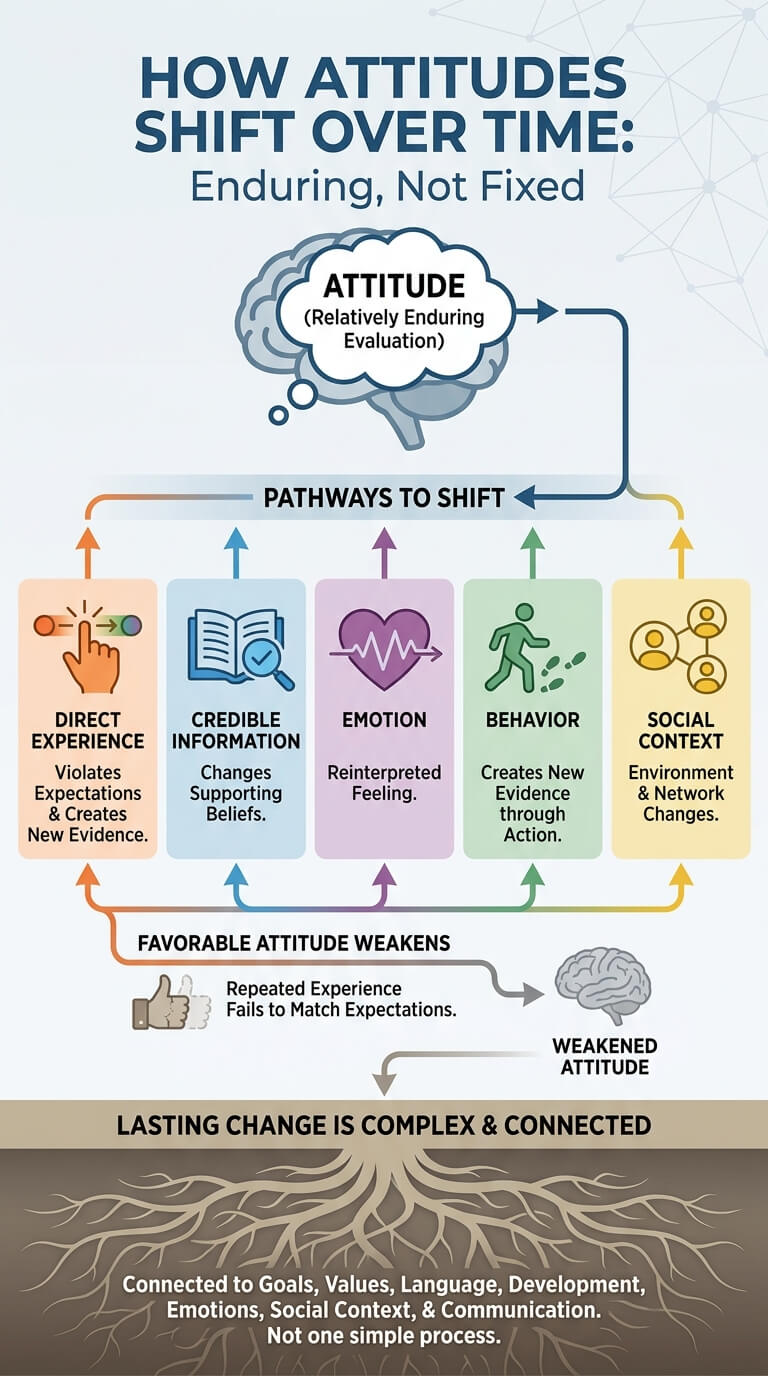
Attitudes are relatively enduring, not permanently fixed.
New experience, credible information, emotion, and social context
An evaluation may shift when direct experience violates expectations, trusted information changes a supporting belief, emotion is reinterpreted, behavior creates new evidence, or a person’s social environment changes. A favorable attitude can also weaken when repeated experience fails to match expectations.
A broad review of attitudes and attitude change describes change as connected to goals, values, language, emotions, development, social context, and communication. Lasting change is therefore not one simple process.
This overview is enough for understanding attitude structure. The practical mechanisms of changing an established attitude deserve separate attention because direct experience, persuasive messages, identity, repetition, and behavior do not operate in the same way.
FAQ About Attitude Psychology
These questions address common confusion about personality, awareness, behavior, negativity, and stability.
Is attitude the same as personality?
No. Personality describes broad tendencies that appear across many situations. An attitude is an evaluation of a particular target. A generally open-minded person can hold a negative attitude toward one technology, institution, or activity. Personality may influence how attitudes develop, but it does not determine every evaluation.
Can someone have an attitude without knowing it?
A person may have a fast or poorly articulated evaluation that becomes noticeable only when the target appears. Indirect measures can provide information about automatic associations, but they should not be treated as perfect evidence of hidden intention or character. Awareness can also be partial: someone may notice discomfort without knowing what beliefs or memories contribute to it.
Why can a positive attitude fail to produce action?
Action requires more than approval. Time, skill, opportunity, habit, money, social pressure, confidence, and competing goals can interrupt the path from evaluation to behavior. Prediction is also weaker when the attitude is broad and the behavior is specific. A person may value fitness while lacking a safe or realistic way to exercise today.
Are negative attitudes always harmful?
No. A negative evaluation can reflect a real cost, risk, boundary, or mismatch. It becomes less useful when it is based on inaccurate information, applied too broadly, or treated as proof about a person’s entire character. The goal is accurate and flexible evaluation, not compulsory positivity.
What makes an attitude resistant to change?
Resistance is more likely when the attitude is important, certain, easy to recall, based on direct experience, connected to identity, or supported by a social group. It may also persist because changing it would create practical or emotional costs. Strength explains influence and stability, but it does not establish accuracy.
Key Takeaways
- An attitude is an evaluation of a specific person, object, idea, group, or situation.
- Thoughts, feelings, and action tendencies may support one another or pull in different directions.
- Actual behavior depends on context, skills, opportunity, incentives, habits, and competing goals as well as attitude.
- Ambivalence can reflect a realistic mixture of benefits and costs rather than simple indecision.
- Automatic evaluations are one source of information, not a diagnosis or proof of hidden character.
- Making an attitude more specific helps reveal whether the real issue is evidence, emotion, context, or an action barrier.
For a useful next step, choose one attitude that does not match your behavior and write four short lines: what you think, what you feel, what you intend, and what you do. The mismatch will usually point toward the next question more clearly than a label such as “good attitude” or “bad attitude.”

Michael Reed is the Founder and Lead Writer at Psychology Exposed. He writes about human behavior, relationships, emotional patterns, self-awareness, and practical psychology topics using research-informed, easy-to-understand content.
Read More About Michael Reed: https://psychologyexposed.com/michael-reed/