
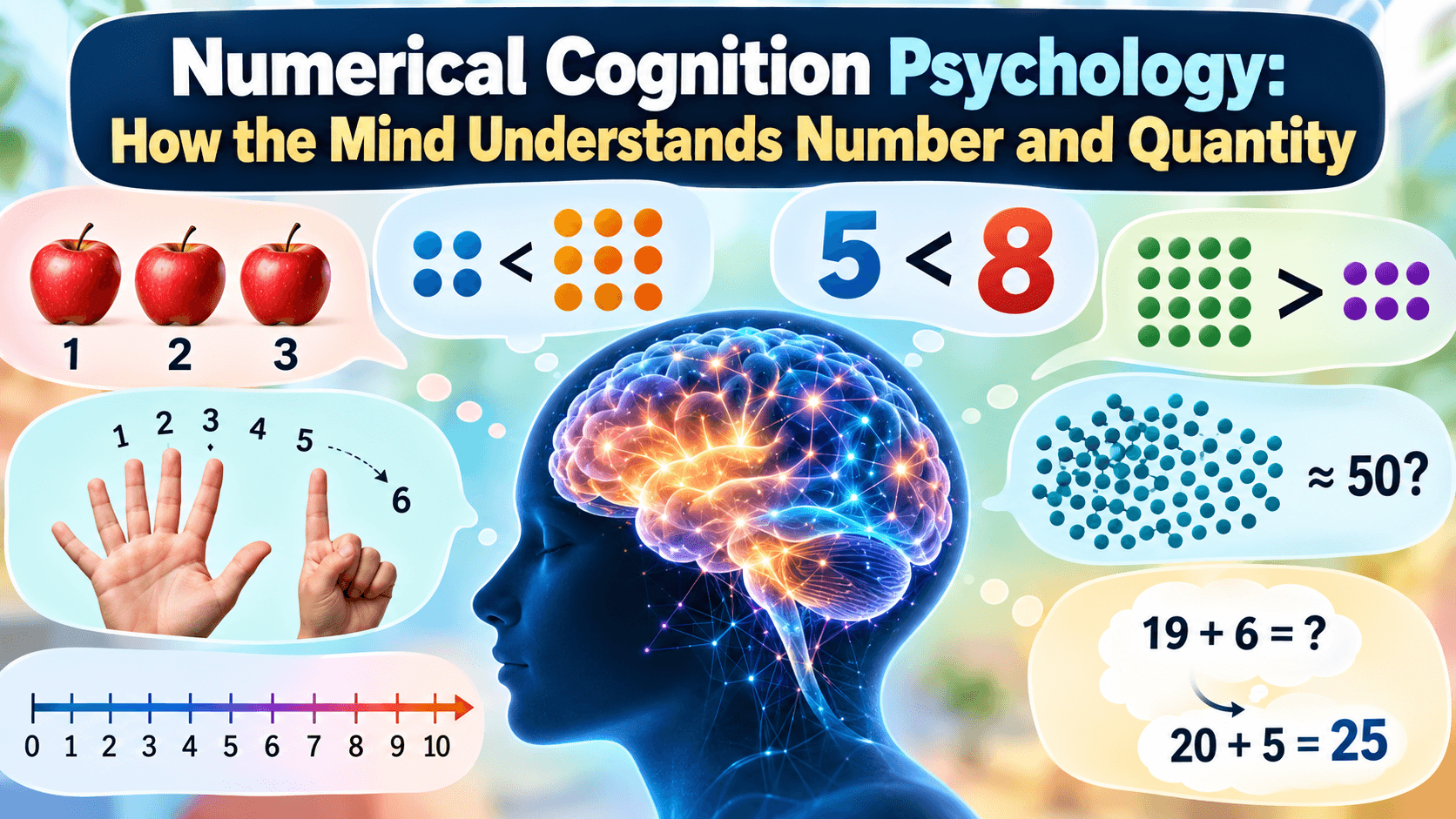
You look at three cups on a table and know there are three without deliberately counting. You glance at two checkout lines and can often tell which is longer. You see the digit 8 and understand that it refers to a greater quantity than 5. Later, you work out 19 + 6 in your head by turning it into 20 + 5. These tasks all involve number, yet they do not depend on one single mental process.
Numerical cognition psychology studies how the mind represents and uses number and quantity. That includes recognizing small sets, estimating larger ones, understanding learned number symbols, comparing numerical magnitude, linking number with space, counting exactly, and carrying out arithmetic. A useful starting point is to separate the question “how much or how many?” from the many different ways the mind can answer it.
Quick Answer
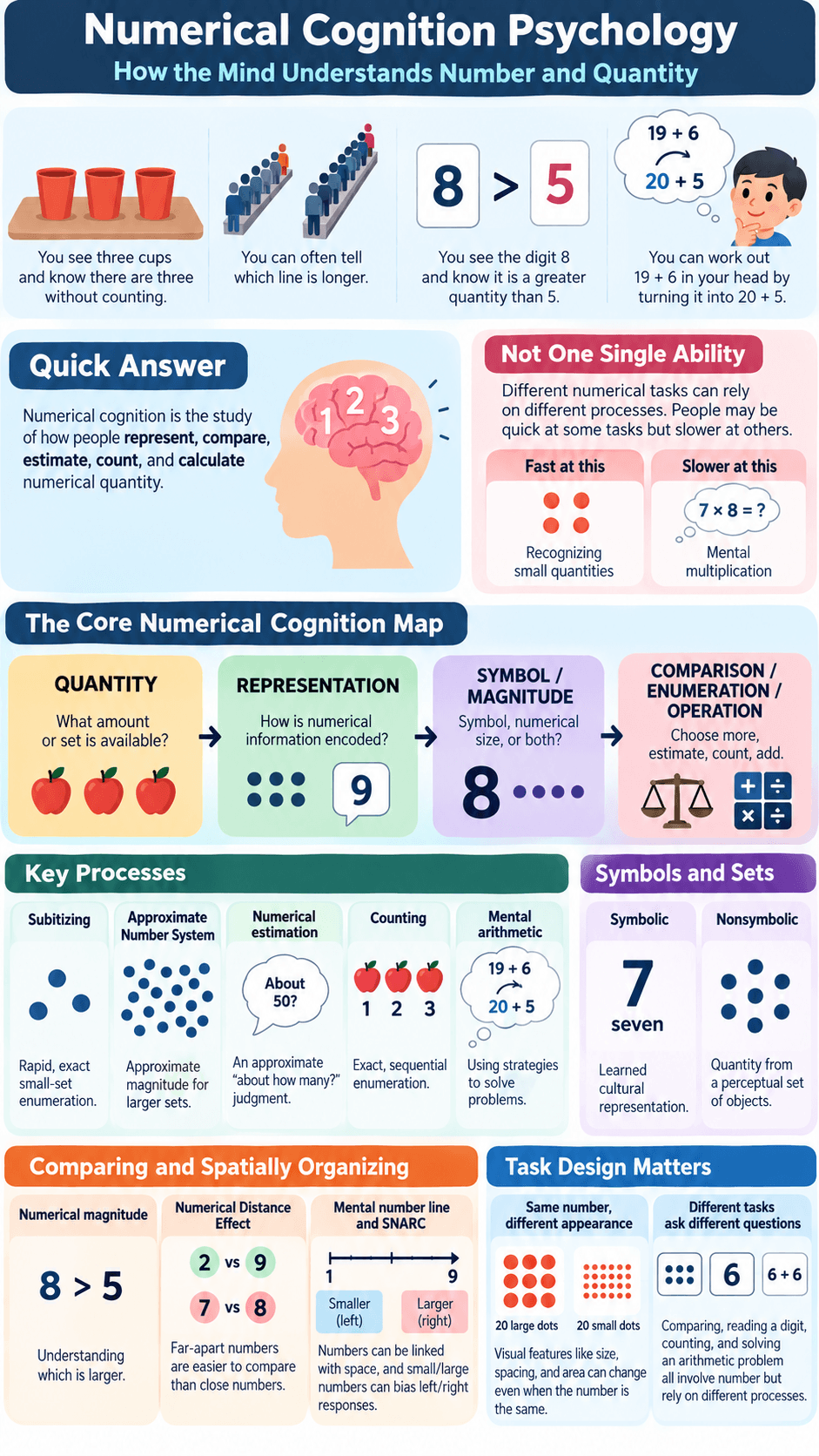
Numerical cognition is the study of how people represent, compare, estimate, count, and calculate numerical quantity. The mind can process exact and approximate amounts, work with both symbols and nonsymbolic sets, compare magnitude, organize numbers spatially, and choose different strategies for arithmetic. These abilities interact, but research does not support treating them as one single “math ability.”
What Numerical Cognition Psychology Studies
Numerical cognition covers the mental processes that let us make sense of discrete quantity and numerical relationships. Researchers examine tasks as simple as deciding which of two dot arrays contains more items and as learned as comparing Arabic digits or solving an arithmetic problem. A broad review of numerical cognition research shows that symbolic magnitude, nonsymbolic magnitude, and arithmetic tasks overlap in some respects while also placing different demands on the cognitive system. A meta-analysis of numerical cognition studies illustrates why it is safer to think in terms of interacting processes than a single format-independent mechanism.
Number, quantity, and numerosity
Quantity is the broad idea of how much or how many. Number can refer to an exact value and to the symbolic systems people use to express that value. Numerosity is more specific: it is the number of discrete items in a set. Eight dots have a numerosity of eight whether they are close together, spread apart, large, or small.
That distinction matters because a visual display contains more than number. A set of 20 large dots may cover more total area than a set of 20 small dots even though the numerosity is identical. Density, spacing, item size, and total occupied area can all change while the number of items stays the same.
Why numerical cognition is not one single math ability
A person may be quick at recognizing small quantities but slower at mental multiplication. Someone may compare familiar digits efficiently yet be less accurate when judging briefly presented dot arrays. These are not contradictions. Different tasks ask the mind to represent information in different formats and then do different things with it.
It is also useful to separate numerical cognition from a global idea such as “mathematical intelligence.” Number processing includes component abilities that can support mathematical behavior, but no single task in this area provides a general measure of intelligence, talent, or future achievement.
The Core Numerical Cognition Map
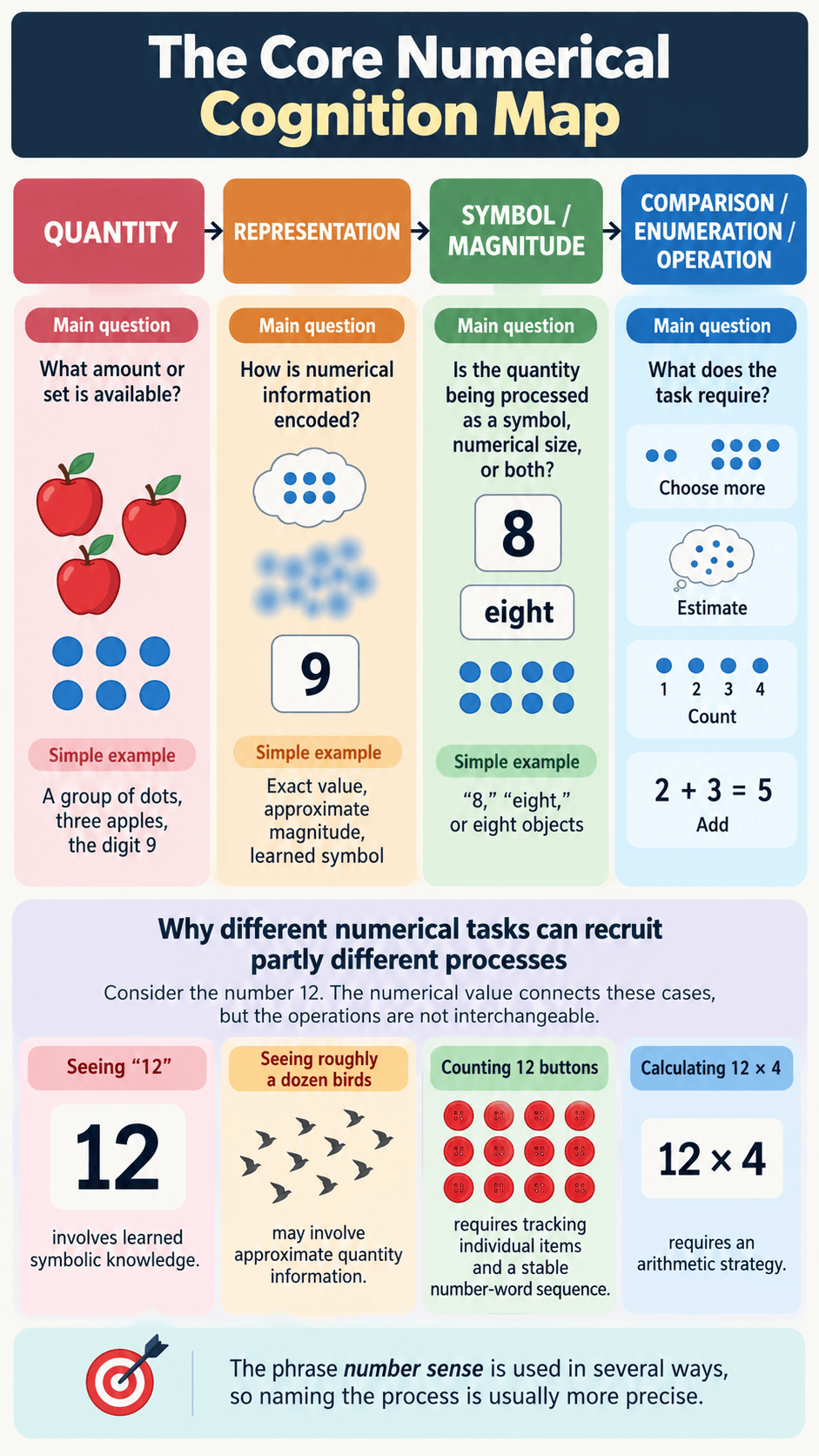
A compact way to organize the subject is:
QUANTITY → REPRESENTATION → SYMBOL / MAGNITUDE → COMPARISON / ENUMERATION / OPERATION
This is a guide to the major questions, not a claim that every numerical task follows one fixed sequence. Sometimes the input is already symbolic, as when you see the digit 7. Sometimes the input is a set of objects. Sometimes the goal is simply to compare. Other times the mind must count, estimate, retrieve a fact, or carry out a procedure.
QUANTITY → REPRESENTATION → SYMBOL / MAGNITUDE → COMPARISON / ENUMERATION / OPERATION
| Stage | Main question | Simple example |
|---|---|---|
| Quantity | What amount or set is available? | A group of dots, three apples, the digit 9 |
| Representation | How is numerical information encoded? | Exact value, approximate magnitude, learned symbol |
| Symbol / magnitude | Is the quantity being processed as a symbol, numerical size, or both? | “8,” “eight,” or eight objects |
| Comparison / enumeration / operation | What does the task require? | Choose more, estimate, count, add |
Why different numerical tasks can recruit partly different processes
Consider the number 12. Seeing “12” involves learned symbolic knowledge. Seeing roughly a dozen birds in the distance may involve approximate quantity information. Counting 12 buttons requires tracking individual items and a stable number-word sequence. Calculating 12 × 4 requires an arithmetic strategy. The numerical value connects these cases, but the operations are not interchangeable.
This is why research often compares specific formats and tasks. The phrase number sense is used in several ways, so naming the process is usually more precise.
Area 1: Representing Quantity
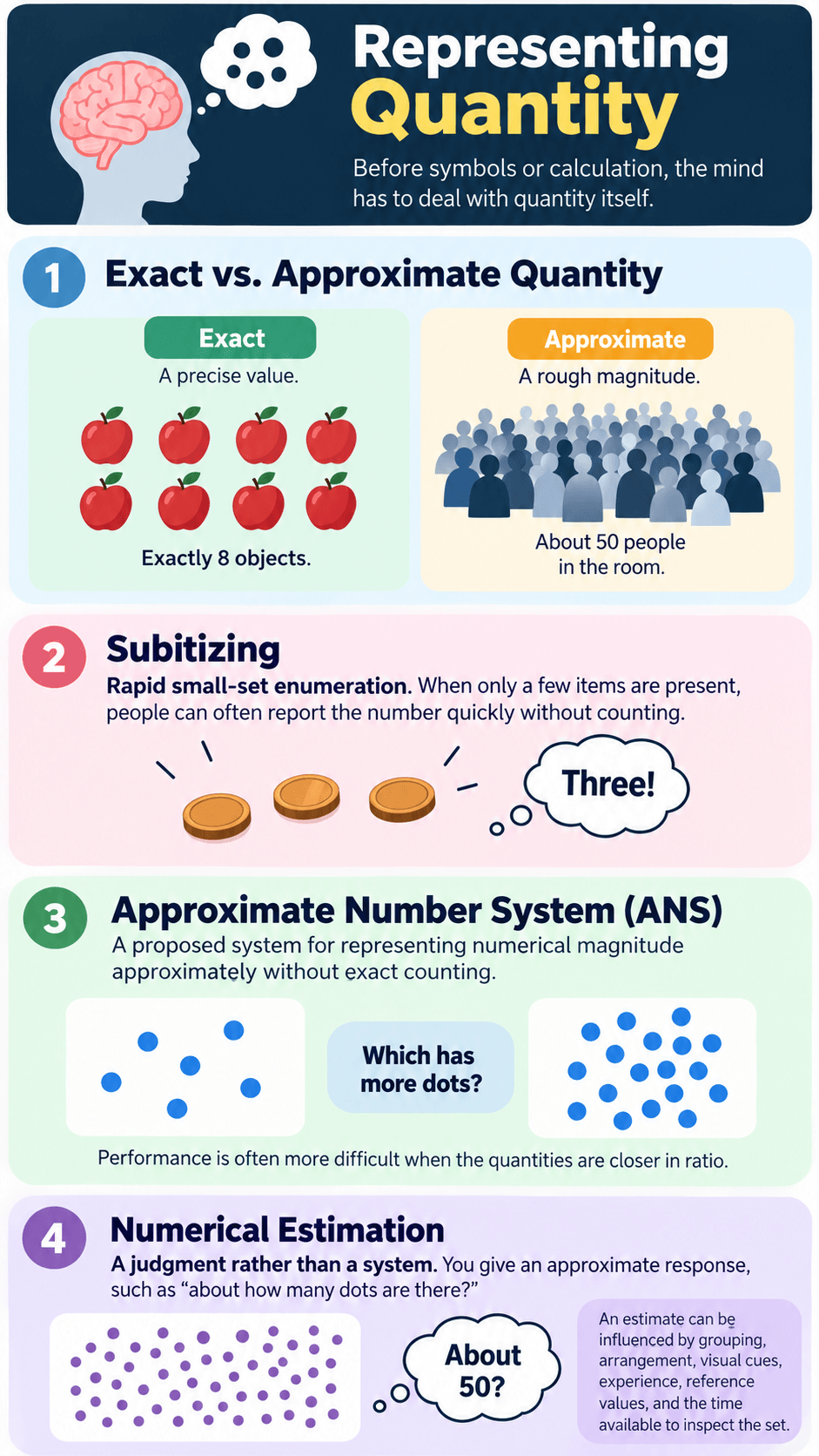
Before symbols or calculation enter the picture, the mind has to deal with quantity itself. That can mean an exact small value or a rough sense of a larger set.
Exact versus approximate quantity
An exact representation specifies a precise value: there are exactly eight objects. An approximate representation gives a rough magnitude: there seem to be about 50 people in the room. Everyday numerical behavior uses both. Exactness matters when you are paying for six items or setting four places at a table. Approximation is often enough when deciding which crowd is larger or whether a container holds roughly 100 objects.
Exact and approximate processing should not be assumed to be two settings on one mechanism. Exact symbolic knowledge relies on learned systems, while approximate nonsymbolic judgments need not first become a precise numeral.
Subitizing as rapid small-set enumeration
When only a few items are present, people can often report the number rapidly and with little apparent serial counting. This phenomenon is called subitizing. If three coins lie separately on a desk, “three” may seem to arrive almost immediately.
Subitizing is usually discussed as small-set, relatively exact enumeration. It should not be defined as an inflexible rule that everyone can instantly recognize exactly four objects in every situation. Arrangement, attention, task design, visual grouping, and individual differences can affect performance. Researchers also continue to debate how small-number processing relates to parallel object individuation and approximate number processing.
Approximate Number System as a proposed approximate representation system
The Approximate Number System, often shortened to ANS, is a proposed system for representing numerical magnitude approximately without exact symbolic counting. A common laboratory task briefly presents two dot arrays and asks which contains more dots. Performance often becomes more difficult when the quantities are closer in ratio.
ANS tasks require methodological care. Dot arrays differ not only in numerosity but also in visual properties such as cumulative area, density, item size, and occupied space. A detailed review of ANS measurement explains why task design, visual controls, presentation time, and reliability can meaningfully change results. This is one reason claims that ANS acuity directly determines formal mathematics are too strong.
Numerical estimation as a judgment rather than a system
Numerical estimation asks for an approximate response, such as “about how many dots are there?” That task may draw on approximate magnitude information, but the response can also be shaped by grouping, arrangement, visual cues, experience, reference values, and the time available to inspect the set.
This distinction prevents a common mix-up. The ANS is a theoretical account of approximate quantity representation. Numerical estimation is a task or judgment. An estimate may reflect more than one process, so an estimation response should not automatically be treated as a pure measure of the ANS.
Area 2: Connecting Quantity With Numerical Symbols
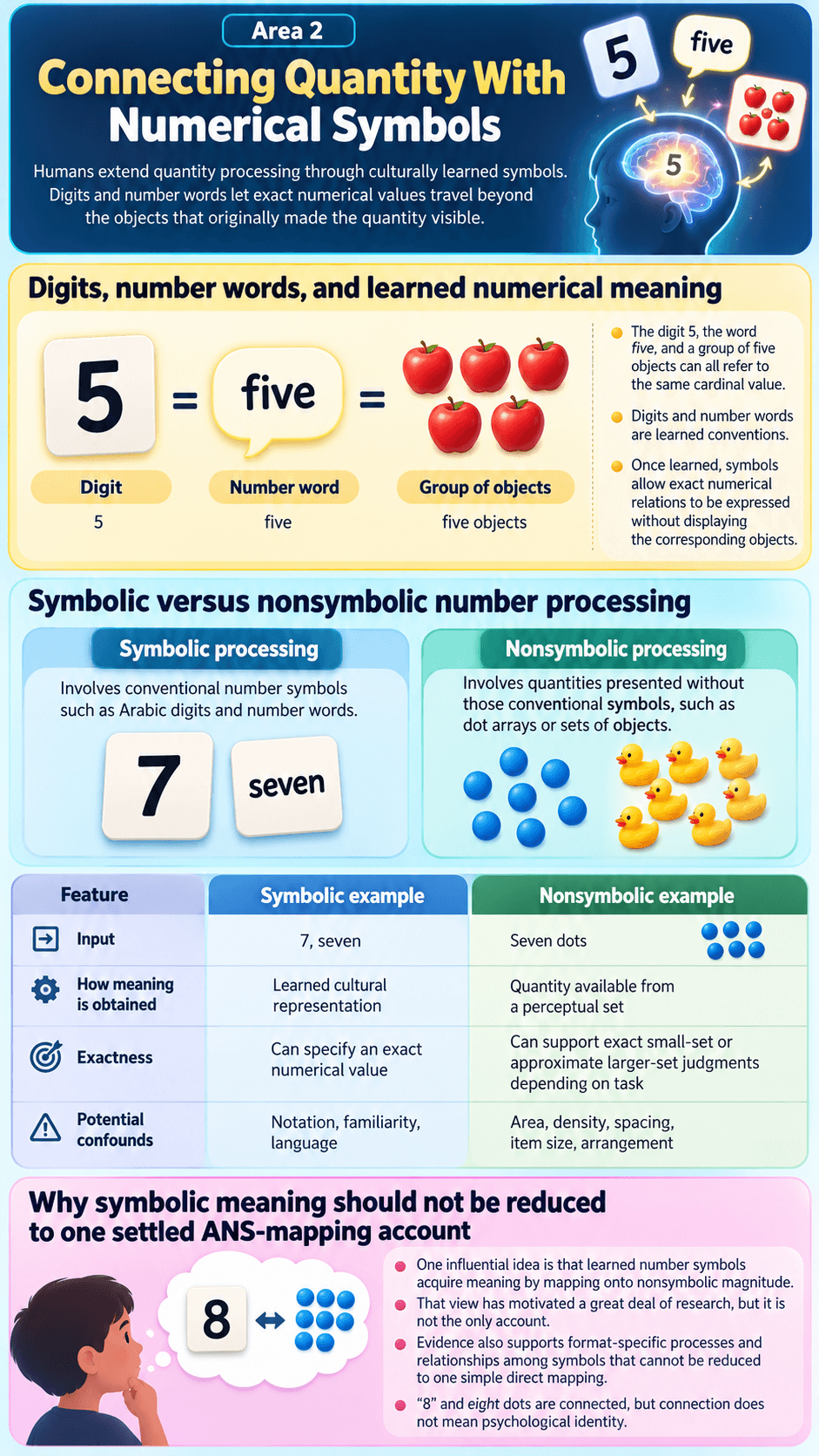
Humans extend quantity processing through culturally learned symbols. Digits and number words let exact numerical values travel beyond the objects that originally made the quantity visible.
Digits, number words, and learned numerical meaning
Human cultures use symbols to express numerical values. The digit 5, the word five, and a group of five objects can all refer to the same cardinal value, yet they arrive in very different forms.
Digits and number words are learned conventions. Children gradually learn that a particular word or written mark stands for a particular numerical value and how those symbols relate to an ordered counting system. Once learned, symbols allow exact numerical relations to be expressed without displaying the corresponding objects.
Symbolic versus nonsymbolic number processing
Symbolic processing involves conventional number symbols such as Arabic digits and number words. Nonsymbolic processing involves quantities presented without those conventional symbols, such as dot arrays or sets of objects.
| Feature | Symbolic example | Nonsymbolic example |
|---|---|---|
| Input | 7, seven | Seven dots |
| How meaning is obtained | Learned cultural representation | Quantity available from a perceptual set |
| Exactness | Can specify an exact numerical value | Can support exact small-set or approximate larger-set judgments depending on task |
| Potential confounds | Notation, familiarity, language | Area, density, spacing, item size, arrangement |
Why symbolic meaning should not be reduced to one settled ANS-mapping account
One influential idea is that learned number symbols acquire meaning by mapping onto nonsymbolic magnitude. That view has motivated a great deal of research, but it is not the only account. Evidence also supports format-specific processes and relationships among symbols that cannot be reduced to one simple direct mapping.
An open-access discussion of symbolic and nonsymbolic numerical representation reviews methodological problems in assuming that performance across the two formats reflects one identical representation. The practical lesson is modest: “8” and eight dots are connected, but connection does not mean psychological identity.
Area 3: Comparing and Spatially Organizing Magnitude
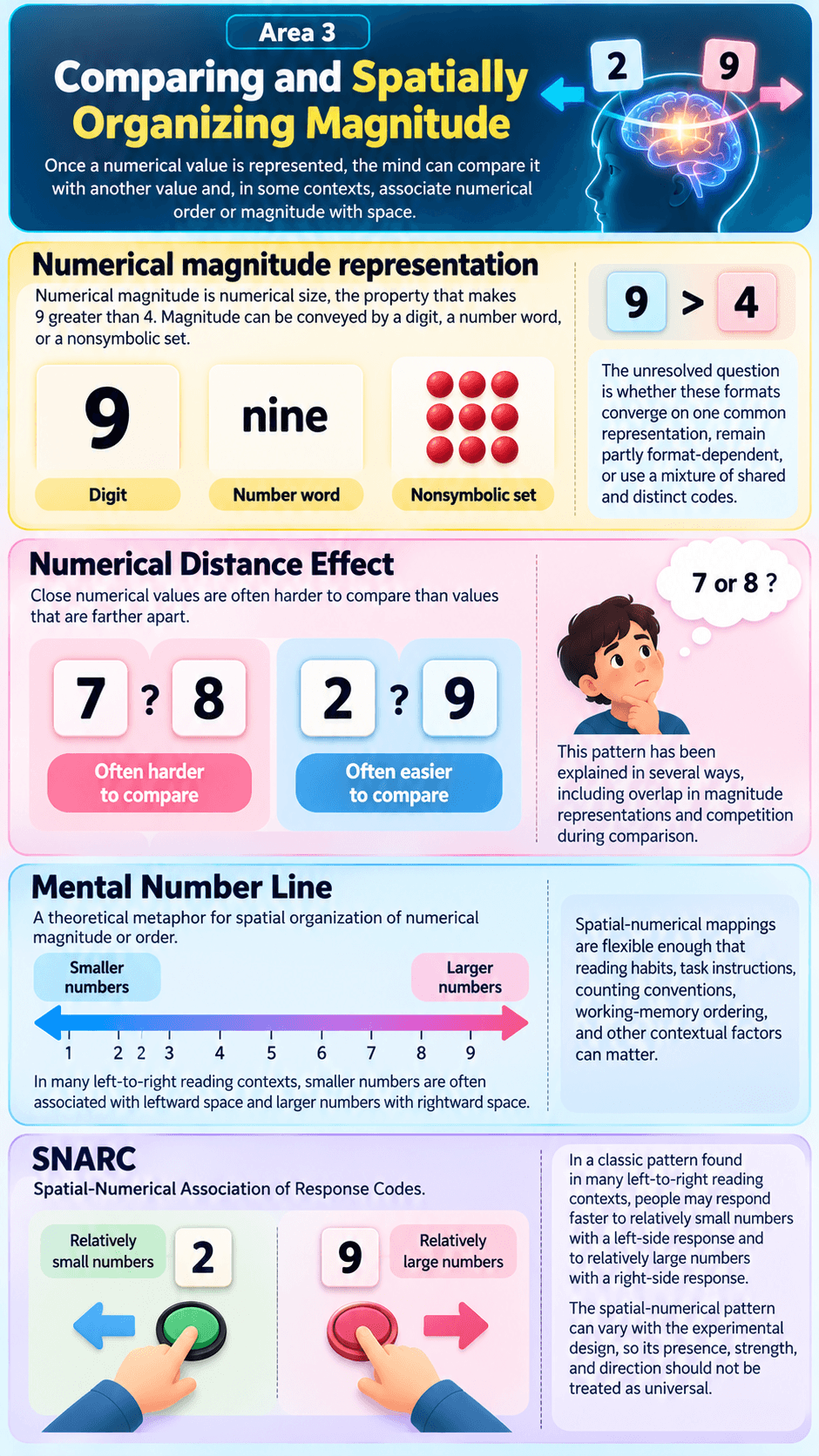
Once a numerical value is represented, the mind can compare it with another value and, in some contexts, associate numerical order or magnitude with space.
Numerical magnitude representation
Numerical magnitude is numerical size, the property that makes 9 greater than 4. Magnitude can be conveyed by a digit, a number word, or a nonsymbolic set. The unresolved theoretical question is whether these formats converge on one abstract common representation, remain partly format-dependent, or use a mixture of shared and distinct codes.
This question is different from asking whether 9 is printed in a larger font than 4. A tiny printed “9” still has greater numerical magnitude than a huge printed “4.” Physical size is a visual property. Numerical size is conceptual.
Numerical Distance Effect
A classic finding in number comparison is the Numerical Distance Effect: close numerical values are often harder to compare than values that are farther apart. Comparing 7 with 8 may take longer or produce more errors than comparing 2 with 9.
Researchers have explained this pattern in several ways, including overlap in magnitude representations and competition during comparison. The effect is important evidence about numerical comparison, but it does not by itself prove that numbers are literally arranged on a left-to-right line inside the mind.
Mental Number Line as a number-space mapping concept
The mental number line is a theoretical metaphor for spatial organization of numerical magnitude or order. In many left-to-right reading contexts, smaller numbers are often associated with leftward space and larger numbers with rightward space. Yet spatial-numerical mappings are flexible enough that reading habits, task instructions, counting conventions, working-memory ordering, and other contextual factors can matter.
A review of spatial-numerical associations emphasizes both biological and cultural contributions and also notes that the Numerical Distance Effect should not automatically be treated as proof of a spatial association. The mental number line is therefore best treated as a model of number-space organization, not a literal anatomical line or a universal fixed direction.
SNARC as a response-compatibility phenomenon
SNARC stands for Spatial-Numerical Association of Response Codes. In a classic pattern found in many left-to-right reading contexts, people may respond faster to relatively small numbers with a left-side response and to relatively large numbers with a right-side response.
SNARC is more specific than the mental number line. It describes a response-compatibility effect observed in experimental tasks. Recent work comparing different SNARC task setups shows that the spatial-numerical pattern can vary with the experimental design, so its presence, strength, and direction should not be treated as universal. It is also different from the Numerical Distance Effect, which concerns close versus far magnitudes rather than left versus right response compatibility.
Area 4: Exact Enumeration and Arithmetic
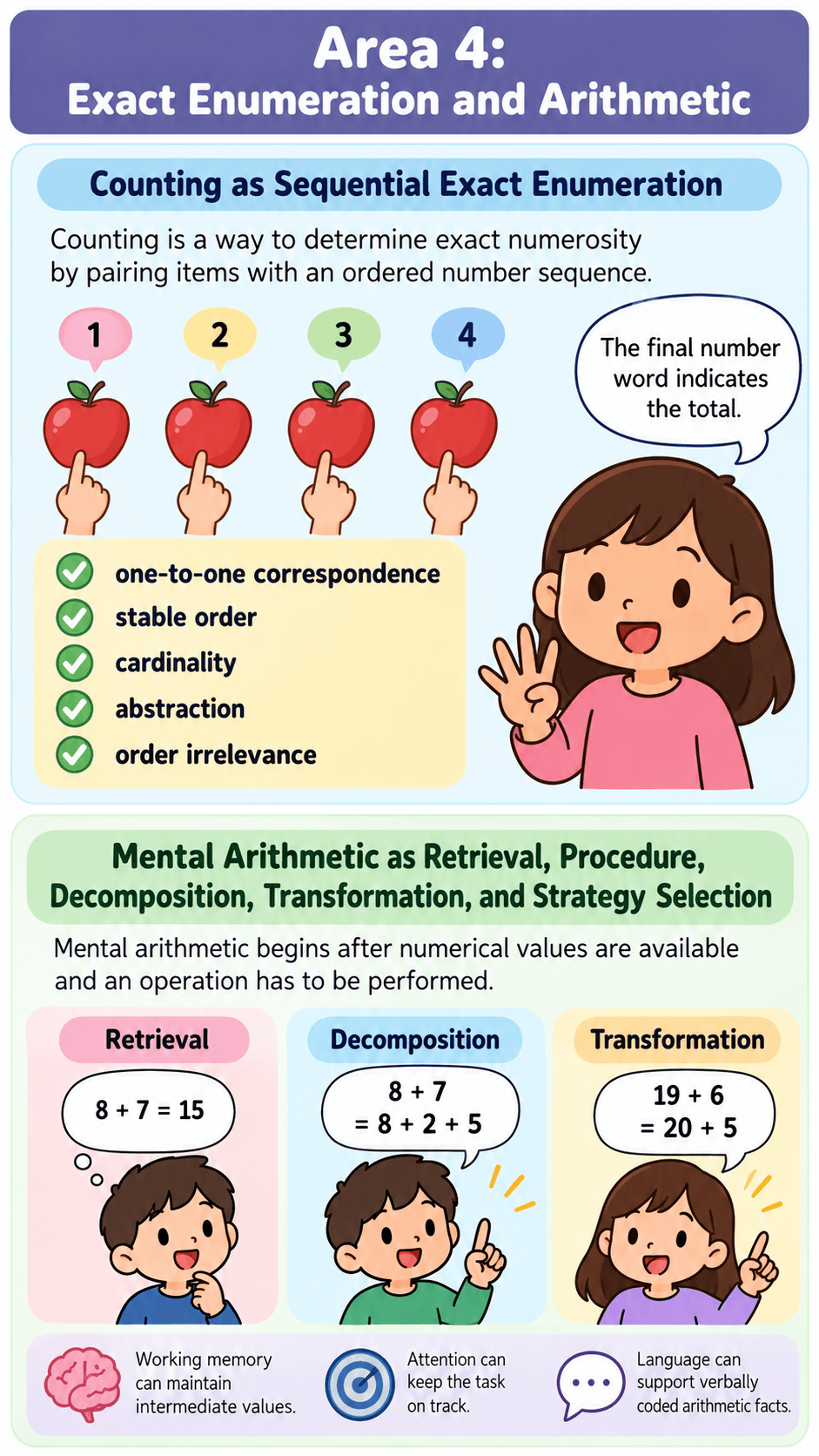
Exact numerical behavior includes more than recognizing a value. Counting establishes the cardinality of a set, while arithmetic transforms known values through operations.
Counting as sequential exact enumeration
Counting is a way to determine exact numerosity by pairing items with an ordered number sequence. In a simple object count, each item must be tracked, each receives one number word, the sequence remains stable, and the final number word indicates the total cardinal value of the set.
This helps explain why reciting “one, two, three, four” is not the same as understanding counting. A person could know the verbal sequence without reliably pairing one word with one object or without understanding that the last number names the size of the whole set. The classical counting framework associated with Gelman and Gallistel includes one-to-one correspondence, stable order, cardinality, abstraction, and order irrelevance. Counting is therefore more than rote number-word production.
Mental arithmetic as retrieval, procedure, decomposition, transformation, and strategy selection
Mental arithmetic begins after numerical values are available and an operation has to be performed. Sometimes an answer is retrieved from memory. Sometimes the person uses a procedure. Sometimes a problem is decomposed or transformed into an easier equivalent.
For example, 8 + 7 might be retrieved as a familiar fact, or solved as 8 + 2 + 5. The problem 19 + 6 can become 20 + 5. A multiplication such as 12 × 4 might be retrieved, broken into parts, or calculated step by step. An open-access meta-analysis of retrieval and procedural strategies in mental arithmetic supports the broader point that arithmetic problems can recruit different strategies rather than one universal calculation mechanism.
Working memory can maintain intermediate values, attention can keep the task on track, and language can support verbally coded arithmetic facts. Mental arithmetic remains the specific problem of carrying out numerical operations.
Number Processing Depends on Task and Representation
The same numerical value can appear as a digit, a spoken word, or a set of objects. What the task asks you to do changes which processes become most relevant.
Symbolic versus nonsymbolic format
If you compare 7 and 9, you are working with learned symbols. If you compare two dot arrays, you are working with nonsymbolic sets. If you count seven objects, you connect a nonsymbolic set to an ordered symbolic sequence. Different formats change what information is immediately available and what has to be learned or inferred.
Exact versus approximate demands
The question “Which pile has more?” may be answered approximately. The question “Exactly how many?” may require subitizing for a very small set or counting for a larger set. The question “What is 8 + 7?” shifts from enumeration to an arithmetic operation.
Because these demands differ, two tasks involving the same numerical values can tell us different things. A person can be accurate at exact symbolic comparison while showing more variability in a brief nonsymbolic estimation task without the two performances being contradictory.
Visual features and nonsymbolic quantity tasks
Dot arrays are especially useful for studying quantity without conventional number symbols, but they create a basic measurement problem. More dots often also mean changes in area, density, spacing, perimeter, or item size. A person may use some of those cues, deliberately or not.
Research on nonsymbolic magnitude therefore pays close attention to stimulus construction. The question is not whether visual features exist, because they inevitably do. The question is how well a task separates numerical information from other continuous properties and how conclusions are limited when that separation is incomplete.
Supporting Cognitive Processes Without Replacing Their Own Topics
Number processing draws on broader cognitive resources. Attention, working memory, language, and development matter, but each contributes in a different way depending on the numerical task.
Attention at overview level
Attention can affect which objects are selected, whether individual items are tracked, and how efficiently a person handles a crowded display. Here the relevant question is how attentional conditions influence numerical representation or use, not how attention works in general.
Working memory at overview level
Working memory matters when a numerical task requires intermediate results. In 27 + 18, a person may hold one partial value while completing another step. This supports the calculation, but the numerical operation itself remains an arithmetic process.
Language at overview level
Number words are linguistic symbols, some arithmetic facts may be retrieved verbally, and counting often uses an ordered verbal sequence. Yet people can also discriminate nonsymbolic quantities without naming them, so numerical cognition includes both language-linked and nonverbal processes.
Development at overview level only
Across development, children learn number words, digits, counting, exact cardinal values, arithmetic facts, and culturally taught procedures. Developmental evidence helps explain how symbolic knowledge becomes connected with quantity processing, but an age-general account still separates what a process does from how it changes across childhood.
Which Numerical Cognition Question Are You Actually Asking?
The easiest way to navigate the subject is to identify the operation hidden inside the question.
| If your question is… | The most relevant concept is… | Key distinction |
|---|---|---|
| How can I recognize a few items without counting? | Subitizing | Rapid, relatively exact small-set enumeration |
| How can I tell which large set has more without counting? | Approximate Number System | Approximate nonsymbolic magnitude representation |
| What is different about “8” and eight dots? | Symbolic vs nonsymbolic processing | Learned symbol versus presented quantity |
| How is numerical size represented? | Numerical magnitude representation | Theoretical coding of more and less |
| Why is 7 vs 8 harder than 2 vs 9? | Numerical Distance Effect | Close versus far magnitude comparison |
| Why do numbers seem spatially organized? | Mental Number Line | Number-space mapping |
| Why can small and large numbers bias left/right responses? | SNARC effect | Spatial response compatibility |
| How do I judge about how many objects there are? | Numerical estimation | Approximate task or judgment |
| How does exact counting work? | Counting | Sequential exact enumeration |
| How does the mind solve arithmetic without writing? | Mental arithmetic | Retrieval, procedure, decomposition, and strategy choice |
Small set without counting → Subitizing Psychology
For a very small set recognized rapidly and relatively exactly, subitizing is the relevant process rather than estimation or serial counting.
Approximate large-set comparison → Approximate Number System Psychology
For fast comparison of two nonsymbolic sets without exact counting, ANS research is relevant, especially ratio dependence and visual controls.
Digit versus dot-array quantity → Symbolic vs Nonsymbolic Number Processing
For differences between a learned numeral and a presented set, focus on representational format without assuming the two are processed identically.
How numerical size is represented → Numerical Magnitude Representation Psychology
For how numerical size is represented across digits, words, or sets, magnitude representation is the central question.
Why close numbers are harder to compare → Numerical Distance Effect Psychology
For harder comparison of nearby values than far-apart values, focus on the distance effect, not physical left-right space.
Why number becomes spatial → Mental Number Line Psychology
For spatial organization of numerical order or magnitude, the mental number line is the broader concept, with context-dependent direction and structure.
Why small/large numbers bias left/right responses → SNARC Effect Psychology
For left-right response differences tied to relative magnitude, SNARC is the relevant response-compatibility effect.
About how many are there → Numerical Estimation Psychology
For an approximate “about how many?” response, estimation is the task and may combine magnitude information with visual structure or strategy.
How exact counting works → Counting Psychology
For item-by-item tracking paired with an ordered number sequence to determine exact cardinality, the process is counting.
How arithmetic is solved mentally → Mental Arithmetic Psychology
For operations on known values, the issue is mental arithmetic, which may use retrieval, procedure, decomposition, transformation, or counting.
Common Misunderstandings
Several familiar phrases can blur important distinctions. Keeping the terms narrow prevents a behavioral effect, theoretical model, or everyday label from being treated as the whole field.
Number sense is not a second broad explanation for everything numerical
“Number sense” is used for intuitive quantity processing, foundational numerical competence, or broader collections of basic numerical skills. Because definitions vary, naming the specific process is clearer when precision matters.
Numerical cognition is not mathematical intelligence or IQ
Fast comparison, accurate estimation, mental arithmetic, and subitizing describe particular aspects of performance. None is proof of high or low intelligence, and people can show very different strengths across numerical tasks.
Numerology is not numerical cognition
Numerical cognition is an empirical area of psychology concerned with how number and quantity are represented and processed. Claims about lucky numbers, angel numbers, life-path numbers, or personality meanings assigned to numbers belong to numerology, not scientific numerical cognition.
FAQ
These questions address some of the most common ways number processing concepts are confused with one another or overinterpreted.
Is numerical cognition the same as math ability?
No. Numerical cognition includes processes such as quantity representation, magnitude comparison, counting, symbolic number processing, and arithmetic. These can contribute to mathematical performance, but math ability also depends on learned knowledge, education, language, attention, memory, reasoning, strategy, and experience. A single numerical task does not summarize a person’s overall mathematical ability.
Is counting the same as estimating quantity?
No. Counting is a sequential method for establishing an exact cardinal value, usually by pairing each item with one element of an ordered number sequence. Estimation produces an approximate judgment and may rely on magnitude information, grouping, visual cues, and strategy. A quick estimate of 50 people and an exact count of 50 people can reach the same number while using different processes.
Do number symbols and dot quantities use exactly the same representation?
That remains a theoretical question rather than a settled fact. Some accounts emphasize shared magnitude information across notations, while other findings point to format-dependent processing or mixed models. Learned digits and number words clearly become connected with quantity, but researchers should not assume that symbolic and nonsymbolic formats are psychologically identical.
Does a mental number line literally exist in the brain?
The phrase is best understood as a theoretical description of spatial-numerical organization, not a literal drawn line stored in the brain. Spatial associations can be influenced by task demands, cultural experience, reading direction, counting habits, and temporary ordering. Different findings may therefore reflect flexible coding rather than one permanent layout.
Does weak mental arithmetic diagnose a learning disorder?
No. Difficulty with mental calculation can arise for many reasons, including unfamiliarity, strategy choice, attention, working-memory demands, language, education, fatigue, or ordinary individual variation. Educational content cannot diagnose dyscalculia or another condition. Persistent, substantial difficulties that interfere with learning or daily functioning require appropriate professional assessment rather than inference from one task.
Key Takeaways
- Numerical cognition is a family of processes for representing and using number and quantity, not one single “math ability.”
- Exact and approximate quantity are different demands, and the mind can work with both symbolic numbers and nonsymbolic sets.
- Subitizing, ANS-based approximation, numerical estimation, and counting answer different versions of the question “how many?”
- Numerical magnitude, the Numerical Distance Effect, the mental number line, and SNARC are related ideas but should not be treated as synonyms.
- Counting establishes exact cardinality, while mental arithmetic operates on known numerical values using retrieval or procedural strategies.
- Task design matters. Visual features, notation, context, and strategy can change what a numerical task measures and how its results should be interpreted.
When you encounter a claim about “the number system” in the mind, the most useful next step is to ask a narrower question: Is the task about recognizing, estimating, comparing, counting, mapping, or calculating? That distinction usually reveals which part of numerical cognition is actually doing the work.

Michael Reed is the Founder and Lead Writer at Psychology Exposed. He writes about human behavior, relationships, emotional patterns, self-awareness, and practical psychology topics using research-informed, easy-to-understand content.
Read More About Michael Reed: https://psychologyexposed.com/michael-reed/