
You walk out of a hotel elevator, turn down a hallway, and suddenly realize you are not sure which direction leads back to the lobby. Or you rearrange furniture in your head before moving anything. Or you know exactly how to drive a familiar route but cannot point toward your destination from a side street. These everyday moments rely on different parts of spatial cognition.
Spatial cognition is not one single skill. It includes the ways we represent where things are, how places relate to one another, how we keep track of direction, how we mentally transform spatial information, and how we use those representations while moving through an environment. Understanding the differences matters because “being good with space” can mean very different things depending on the task.
Quick Answer
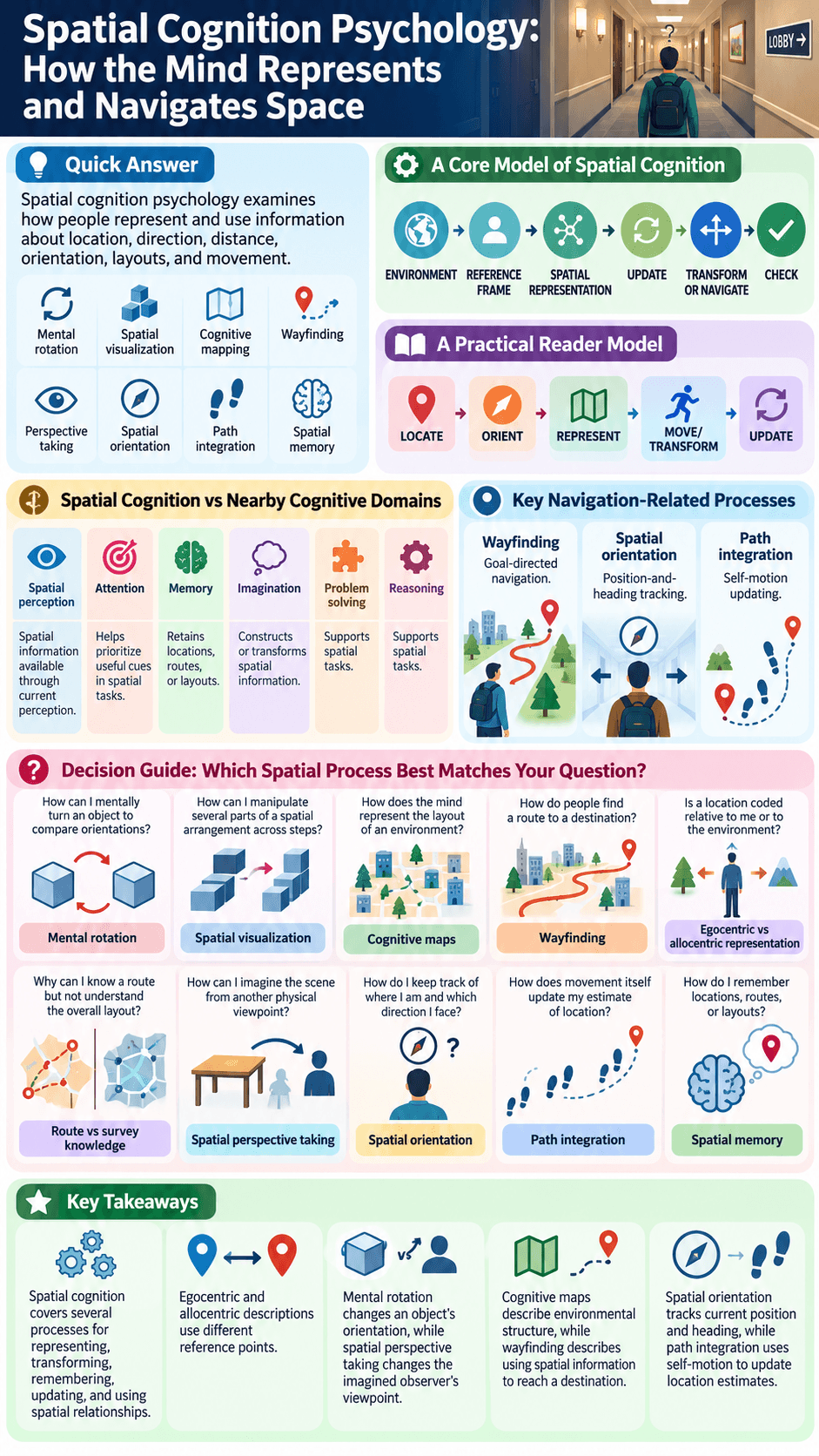
Spatial cognition psychology examines how people represent and use information about location, direction, distance, orientation, layouts, and movement. It includes processes such as mental rotation, spatial visualization, cognitive mapping, wayfinding, perspective taking, spatial orientation, path integration, and spatial memory. These processes overlap, but they are not interchangeable and may rely on different kinds of information and strategies.
What Spatial Cognition Means
At its simplest, spatial cognition concerns relationships in space. Those relationships might be between you and an object, between two objects, between landmarks in a neighborhood, or between your current position and a destination you cannot see.
Spatial information as relationships among places, objects, self, direction, and distance
Consider a coffee cup on a table. You can describe it as being to your right, which uses your own body as the reference point. You can also describe it as being beside the notebook, which uses another object as the reference. In a larger environment, you might know that the library is north of the park, that the station is two blocks beyond the bank, or that two hallways connect to the same lobby.
Why spatial cognition is broader than what is currently visible
Perception gives you information about what is available to your senses right now. Spatial cognition becomes especially clear when the relevant relationship is not fully visible. You may remember where a parked car is behind a building, imagine how a chair would fit after being rotated, or choose a shortcut through streets that cannot all be seen from one location.
A review of human navigation emphasizes that people can use multiple forms of spatial representation, including egocentric and allocentric information, and that the useful representation may change with the scale and demands of the environment. The review of human spatial navigation by Ekstrom and Isham is a useful example of why spatial cognition should not be reduced to a single coordinate system or strategy.
Why Spatial Cognition Matters in Everyday Life
Spatial cognition is active in many ordinary tasks that rarely feel like psychology experiments. It helps when you judge whether a suitcase will fit in a car trunk, remember which level of a parking garage you used, follow directions through a hospital, compare two floor plans, find the bathroom in an unfamiliar restaurant, or mentally picture how a desk would look against another wall.
Rooms, streets, buildings, objects, routes, landmarks, and maps as everyday examples
Different settings emphasize different spatial demands. A tabletop task may require object-to-object relationships. A building may require landmarks and turns. A neighborhood may require a broader sense of direction and layout. A paper map asks you to relate an external representation to the environment around you.
This is one reason a person can feel very capable in one spatial situation and less certain in another. Someone may be excellent at mentally rotating mechanical parts yet depend heavily on landmarks when navigating. Another person may follow routes accurately but have difficulty imagining how a room would look from the opposite doorway.
Why different spatial tasks can rely on different processes
The phrase “spatial skill” can hide important differences. Turning an object mentally is not the same task as remembering where it was placed. Knowing which direction you face is not the same as choosing the best route. Imagining the view from another side of a table is not the same as understanding a whole neighborhood.
A Core Model of Spatial Cognition
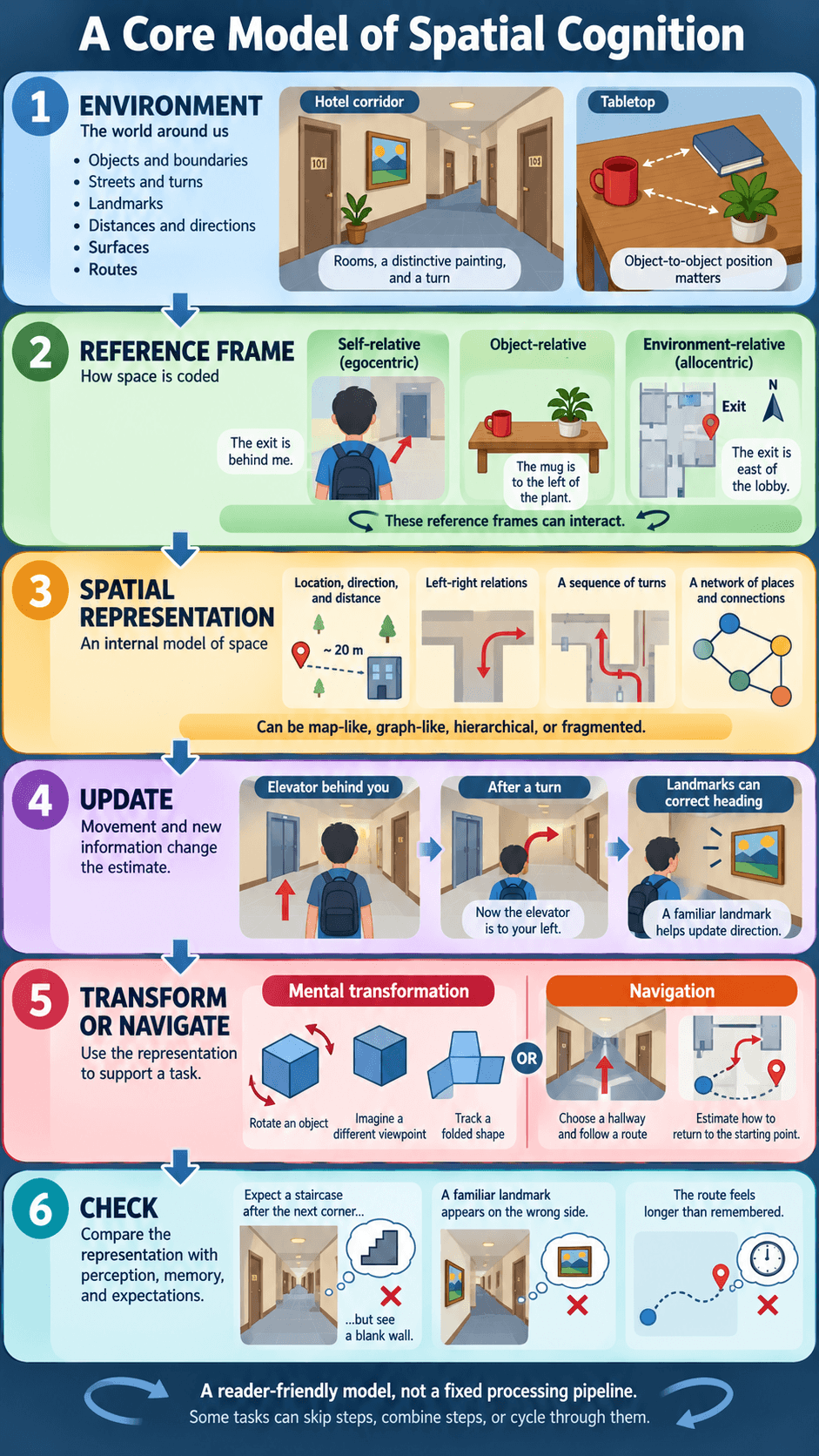
A useful way to organize the topic is:
ENVIRONMENT → REFERENCE FRAME → SPATIAL REPRESENTATION → UPDATE → TRANSFORM OR NAVIGATE → CHECK
This is a reader-friendly model, not a claim that every spatial task follows one fixed processing pipeline. Some tasks skip steps, combine them, or cycle through them repeatedly.
Environment and available spatial information
The environment provides possible spatial information: objects, boundaries, streets, turns, landmarks, distances, directions, surfaces, and routes. Not all of it will be equally useful. In a hotel corridor, room numbers and a distinctive painting may matter more than the color of the carpet. On a tabletop, the relative position of two objects may matter more than the room around them.
Reference frames: self-relative, object-relative, and environment-relative coding
A spatial relationship needs a reference. In an egocentric frame, an object is coded relative to the observer, such as “the exit is behind me.” In an allocentric or environment-centered description, a location is coded relative to other locations or the environment, such as “the exit is east of the lobby.” Research on spatial memory describes egocentric frames as body-anchored and allocentric frames as anchored to external objects or environmental structure, while also noting that these systems can interact rather than operate as mutually exclusive choices.
Spatial representation of location, direction, distance, and layout
Once spatial relationships are represented, the representation may be simple or complex. It might encode a single left-right relationship, a sequence of turns, the approximate distance between landmarks, or a network of places and connections.
The representation does not have to be a perfect picture. Research on cognitive maps increasingly recognizes that environmental knowledge may have map-like, graph-like, hierarchical, or fragmented properties. A review of cognitive maps and cognitive graphs describes evidence that map-like and graph-like forms of representation can both contribute to knowledge of spatial structure.
Updating after movement, turns, landmarks, or new information
Spatial information becomes outdated when you move. If the elevator was behind you before a turn, it may now be to your left. If a new landmark reveals that your estimated heading was wrong, your representation needs correction.
Transforming a representation or using it for navigation
Some tasks ask you to transform spatial information without moving physically. You may rotate an object mentally, imagine a different viewpoint, or track a sequence of changes to a folded shape. Other tasks use spatial information to guide movement, such as choosing a hallway, following a route, or estimating how to return toward a starting point.
Checking the representation against perception, memory, and expected relations
Spatial representations are not guaranteed to be correct. You may expect a staircase after the next corner but see a blank wall. A familiar landmark may appear on the wrong side. A route may feel longer than remembered.
A Practical Reader Model: LOCATE → ORIENT → REPRESENT → MOVE/TRANSFORM → UPDATE
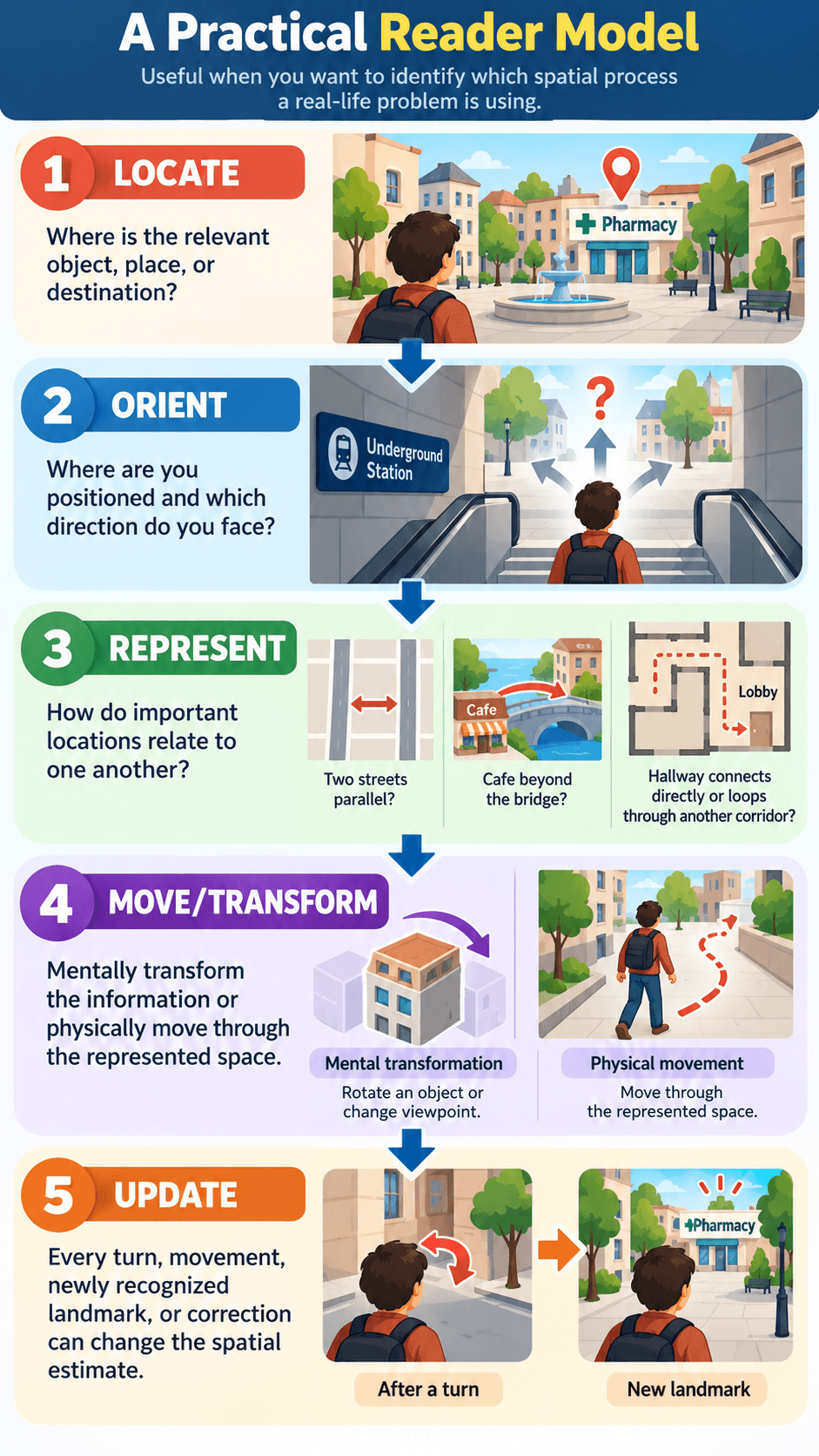
A second model is useful when you want to identify which spatial process a real-life problem is using.
Locate and orient
Locate asks where the relevant object, place, or destination is. Orient asks where you are positioned and which direction you face. The two questions are related but not identical. You might know that the pharmacy is across the square yet be unsure which way you are currently facing after leaving an underground station.
Represent relationships
Representation asks how important locations relate to one another. Are two streets parallel? Is the cafe beyond the bridge? Does the hallway connect directly to the lobby, or does it loop through another corridor? The answer may be encoded relative to the self, landmarks, other objects, or a broader environmental layout.
Transform or move
Sometimes you mentally transform the information, as when rotating an object or changing viewpoint. Other times you physically move through the represented space. Both situations require keeping relevant spatial relations stable enough to make a useful judgment.
Update after change
Every turn, movement, newly recognized landmark, or correction can change the spatial estimate. Updating prevents the representation from remaining frozen at an earlier viewpoint.
Spatial Cognition vs Nearby Cognitive Domains
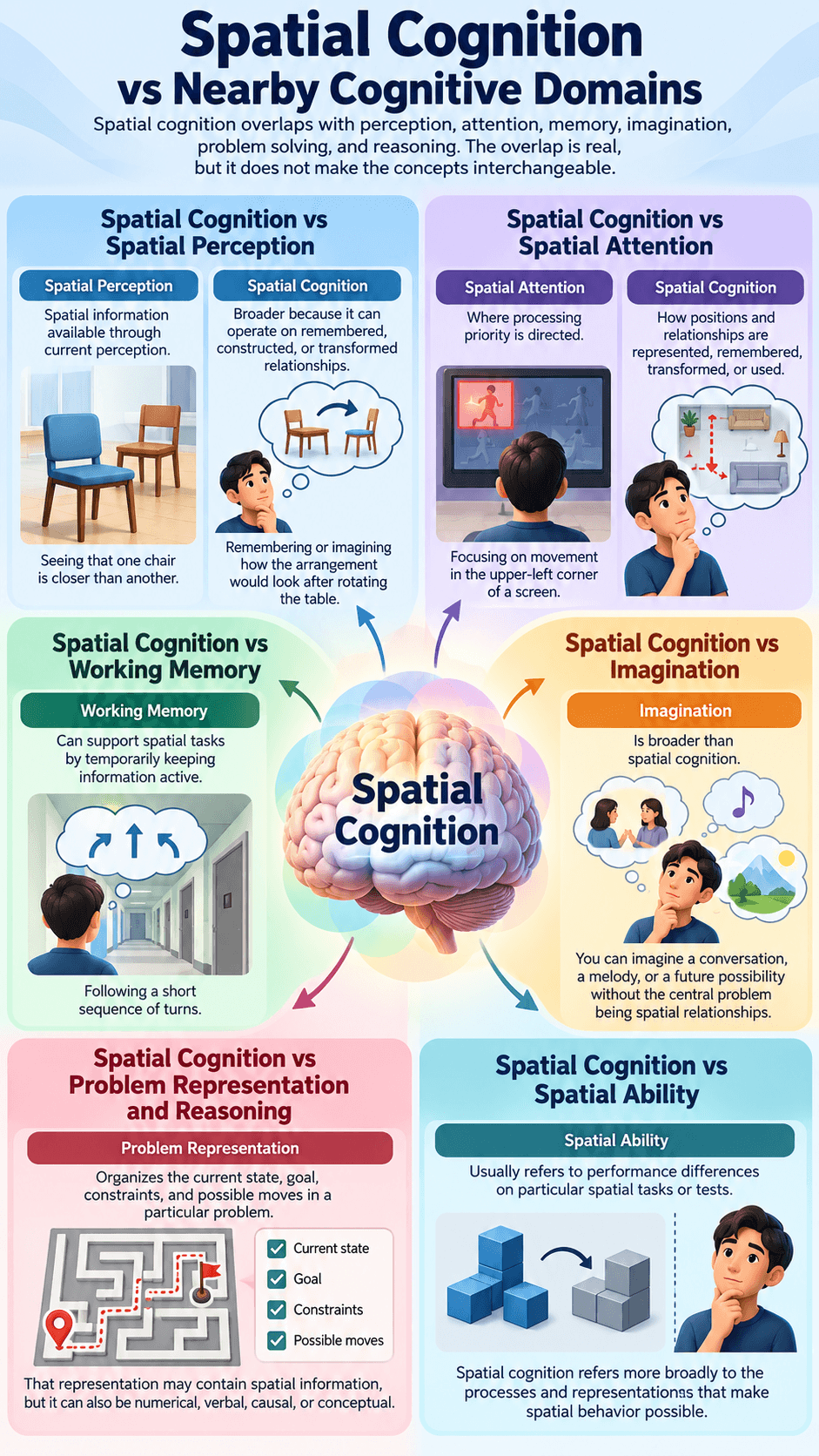
Spatial cognition overlaps with perception, attention, memory, imagination, problem solving, and reasoning. The overlap is real, but it does not make the concepts interchangeable.
Spatial cognition vs spatial perception
Spatial perception concerns spatial information available through current perception, such as apparent position, depth, motion, or orientation. Spatial cognition is broader because it can operate on remembered, constructed, or transformed relationships that are not fully visible at the moment.
For example, seeing that one chair is closer than another is primarily perceptual. Remembering how the chairs were arranged after leaving the room, or imagining how the arrangement would look after rotating the table, involves spatial representation beyond immediate perception.
Spatial cognition vs spatial attention
Spatial attention concerns where processing priority is directed. If you focus on movement in the upper-left corner of a screen, the main question is about selection. Spatial cognition asks a different question: how positions and relationships are represented, remembered, transformed, or used.
Spatial cognition vs working memory
Working memory can support spatial tasks by temporarily keeping information active. For example, following a short sequence of turns may require holding recent instructions while moving. A complex spatial transformation may require tracking intermediate states.
Spatial cognition vs imagination and mental imagery
Imagination is broader than spatial cognition. You can imagine a conversation, a melody, an emotional event, or a future possibility without the central problem being spatial relationships. Spatial cognition becomes the better description when location, orientation, layout, distance, direction, or spatial transformation is the core information being represented.
Spatial cognition vs problem representation and reasoning
A problem representation organizes the current state, goal, constraints, and possible moves in a particular problem. That representation may contain spatial information, but it can also be numerical, verbal, causal, or conceptual.
Spatial cognition vs spatial ability
Spatial ability usually refers to performance differences on particular spatial tasks or tests. Spatial cognition refers more broadly to the processes and representations that make spatial behavior possible.
Representing Spatial Relationships
A spatial relationship becomes meaningful only in relation to some reference. Two common forms describe locations relative to the observer or relative to other parts of the environment.
Egocentric and allocentric reference frames
Egocentric representation codes a location relative to the observer: “the stairs are to my right.” Allocentric representation codes spatial relations relative to other objects or the environment: “the stairs are north of the lobby.” A review of human navigation notes that people can flexibly use more than one representational strategy rather than depending on a single system in every setting.
Object-to-object and self-to-object relationships
Self-to-object relations are often useful for immediate action: the handle is in front of you, the chair is behind you, the doorway is on your left. Object-to-object relations can remain useful when your own position changes: the lamp is beside the sofa, the station is east of the park, or the kitchen connects to the dining room.
Mentally Transforming Spatial Information
Spatial thinking is not limited to storing a layout. The mind can also change an object’s orientation, restructure a configuration, or adopt a different physical viewpoint.
Mental rotation as object-orientation transformation
Mental rotation asks what happens when the orientation of an object changes in the mind. Classic tasks present shapes in different orientations and ask whether they are the same object, often after rotation, or different objects. The central transformation concerns the object rather than the observer.
Spatial visualization as multi-step manipulation
Spatial visualization is broader and often more complex than a single orientation change. Imagine mentally folding a flat pattern, rearranging components, or tracking how several relationships change across multiple steps. The challenge is maintaining and updating the structure as transformations accumulate.
Spatial perspective taking as viewpoint transformation
Spatial perspective taking changes the imagined observer rather than the object. If you stand south of a table, then imagine standing north of it, where would the cup appear relative to the book from that new position?
Research reviews describe multiple strategies for visuospatial perspective taking and caution against assuming that everyone solves such tasks in exactly the same way. A 2023 review of visuospatial perspective taking highlights both strategy variation and individual differences, which is useful when interpreting performance on viewpoint-transformation tasks.
Building Knowledge of Environments
As experience accumulates, separate landmarks and routes can become more organized knowledge about how an environment is structured.
Cognitive maps and environmental structure
A cognitive map is a way of describing internal knowledge about the spatial structure of an environment. It may include landmarks, routes, relative directions, regions, distances, and connections. The idea is useful because it explains how people can sometimes make flexible judgments that go beyond repeating a memorized route.
However, a cognitive map should not be imagined as a perfectly detailed internal copy of a street map. A major review of cognitive maps in humans discusses how spatial coding, landmark anchoring, and route planning can support navigation. Epstein and colleagues’ review of the human cognitive map also makes clear that this is an active research area rather than a claim that the brain contains one literal map file.
Route knowledge and survey knowledge
Route knowledge is sequential and action-oriented: pass the bank, turn left at the lights, continue to the park, then turn right. Survey knowledge concerns the broader configuration: the park lies north of the bank, and the station is east of both.
Knowing a route does not automatically mean understanding the larger layout. Research testing the classic landmark-route-survey progression suggests that environmental knowledge does not always emerge in one rigid stage sequence. Research on landmark, route, and survey knowledge acquisition supports a more flexible view in which different forms of knowledge can develop in parallel depending on task and experience.
Spatial memory for locations, layouts, and relations
Spatial memory allows information about where things are and how locations relate to be retained and retrieved. It can involve remembering where you parked, where a shop lies along a route, which room is beside another, or how landmarks are arranged across a neighborhood.
Updating Location and Navigating Through Movement
Movement creates a new problem: spatial information must remain useful while position and heading are changing. Several processes contribute to that updating.
Wayfinding as goal-directed navigation
Wayfinding is the activity of getting from a current location to a destination. It can involve orienting, choosing a route, noticing decision points, using landmarks, monitoring progress, detecting errors, and correcting course.
Spatial orientation as position-and-heading tracking
Spatial orientation asks two basic questions: Where am I? Which direction am I facing? You can be oriented without actively traveling toward a goal. You can also know a memorized route yet temporarily lose orientation after an unexpected turn.
Landmarks, boundaries, environmental structure, and movement cues can all help restore orientation. The useful cue depends on the setting. A distinctive tower may stabilize direction outdoors, while a numbered elevator bank may be more useful inside a large building.
Path integration as self-motion updating
Path integration refers to updating an estimate of position from information about one’s own movement. A simple version is: start somewhere, move forward, turn, continue, and keep integrating distance and direction so that the current position can be estimated relative to the start.
The process is useful but imperfect. Small errors can accumulate, and external landmarks can help correct the estimate. A review of self-motion and navigation explains why estimating movement depends on combining cues whose reliability can vary. This is one reason “internal GPS” is a misleading literal description.
Decision Guide: Which Spatial Process Best Matches Your Question?
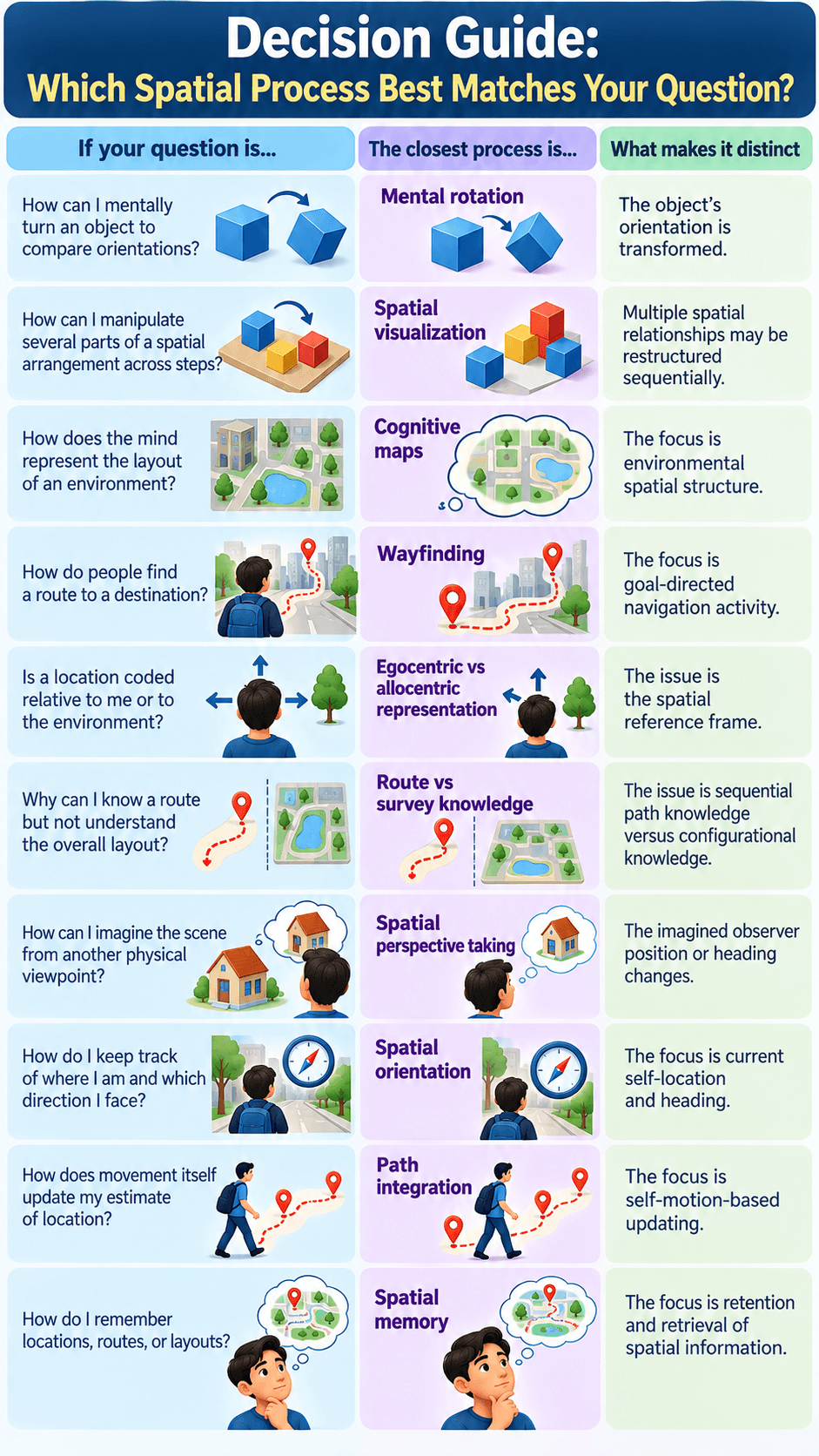
| If your question is… | The closest process is… | What makes it distinct |
|---|---|---|
| How can I mentally turn an object to compare orientations? | Mental rotation | The object’s orientation is transformed. |
| How can I manipulate several parts of a spatial arrangement across steps? | Spatial visualization | Multiple spatial relationships may be restructured sequentially. |
| How does the mind represent the layout of an environment? | Cognitive maps | The focus is environmental spatial structure. |
| How do people find a route to a destination? | Wayfinding | The focus is goal-directed navigation activity. |
| Is a location coded relative to me or to the environment? | Egocentric vs allocentric representation | The issue is the spatial reference frame. |
| Why can I know a route but not understand the overall layout? | Route vs survey knowledge | The issue is sequential path knowledge versus configurational knowledge. |
| How can I imagine the scene from another physical viewpoint? | Spatial perspective taking | The imagined observer position or heading changes. |
| How do I keep track of where I am and which direction I face? | Spatial orientation | The focus is current self-location and heading. |
| How does movement itself update my estimate of location? | Path integration | The focus is self-motion-based updating. |
| How do I remember locations, routes, or layouts? | Spatial memory | The focus is retention and retrieval of spatial information. |
Common Misunderstandings About Spatial Cognition
Broad labels such as “good sense of direction” can make spatial cognition seem simpler and more fixed than the evidence supports.
A cognitive map is not necessarily a literal internal map
The word “map” is a metaphor that can be useful and misleading at the same time. Environmental knowledge may support direction judgments, shortcuts, detours, and route planning without reproducing every distance or angle with cartographic precision. Representations can be selective, distorted, hierarchical, or network-like.
Weak navigation does not equal low intelligence
Getting lost easily, preferring landmark directions, or struggling with a rotation task does not establish low intelligence. Spatial tasks differ in what they demand, and performance can be influenced by experience, familiarity, strategy, task format, and the kind of spatial information involved.
Vivid imagery is not required for every spatial task
Some people describe strong visual experiences when thinking spatially, while others rely more on abstract, verbal, motor, relational, or mixed strategies. A person may understand that one place lies north of another without experiencing a vivid picture of the whole map.
No single strategy is best for every environment
A familiar city, a hotel corridor, a tabletop arrangement, and a mountain trail place different demands on the navigator. Egocentric information may be especially useful for immediate action, while broader environmental relations may support flexible route changes. Landmarks may be crucial at decision points, while movement cues may matter when external information is limited.
How These Spatial Processes Work Together
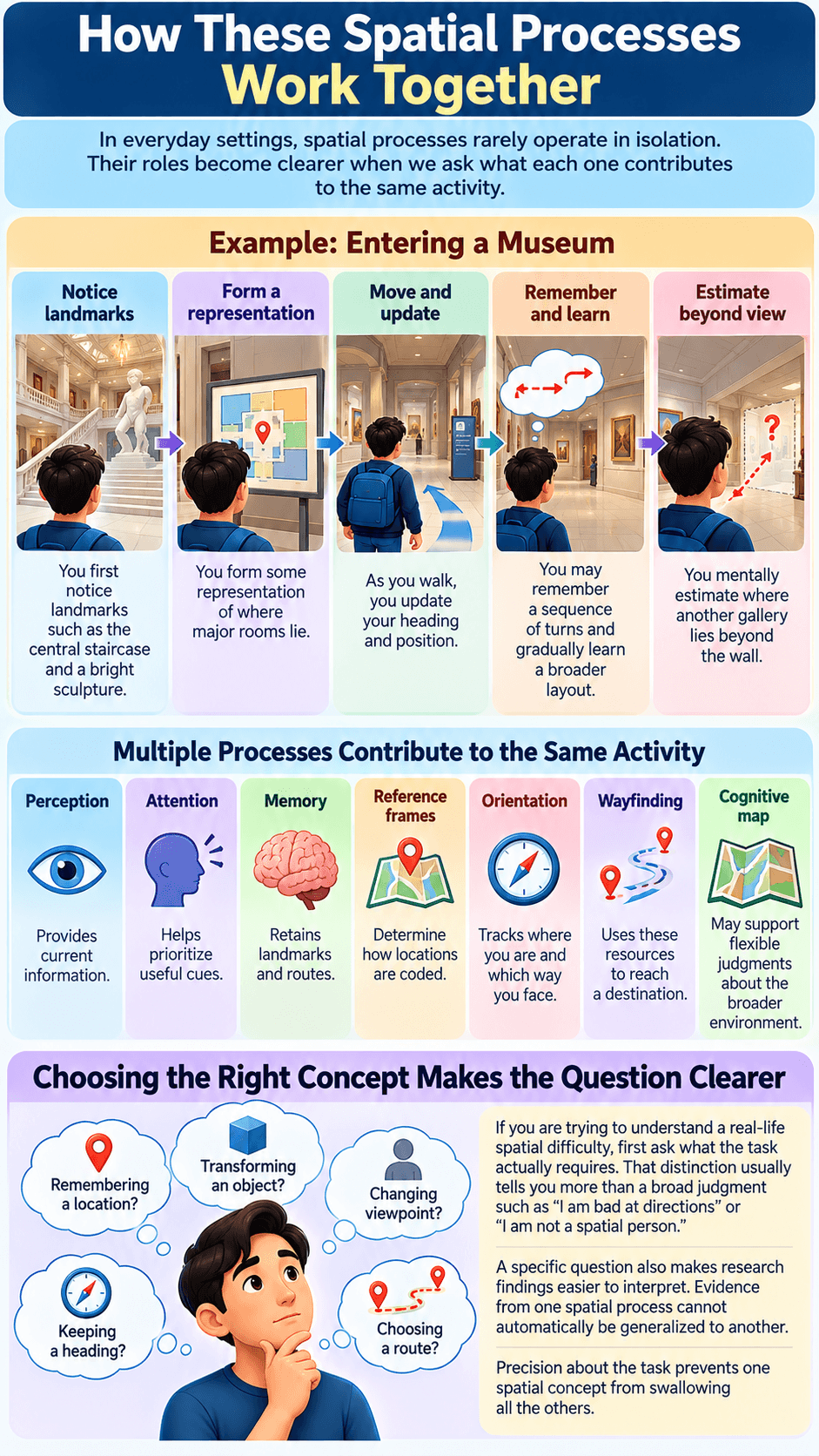
In everyday settings, spatial processes rarely operate in isolation. Their roles become clearer when we ask what each one contributes to the same activity.
Representation, transformation, memory, orientation, and navigation are related but separable
Imagine entering a large museum. You first notice landmarks such as the central staircase and a bright sculpture. You form some representation of where major rooms lie. As you walk, you update your heading and position. You may remember a sequence of turns, gradually learn a broader layout, and mentally estimate where another gallery lies beyond the wall.
No single label captures every operation in that example. Perception provides current information. Attention helps prioritize useful cues. Memory retains landmarks and routes. Reference frames determine how locations are coded. Orientation tracks where you are and which way you face. Wayfinding uses these resources to reach a destination. A cognitive map may support flexible judgments about the broader environment.
Choosing the right concept makes the question clearer
If you are trying to understand a real-life spatial difficulty, first ask what the task actually requires. Is the problem remembering a location, transforming an object, changing viewpoint, keeping a heading, or choosing a route? That distinction usually tells you more than a broad judgment such as “I am bad at directions” or “I am not a spatial person.”
A specific question also makes research findings easier to interpret. Evidence from mental rotation cannot automatically be generalized to wayfinding. Findings about route knowledge do not automatically describe spatial memory in every context. Precision about the task prevents one spatial concept from swallowing all the others.
FAQ About Spatial Cognition Psychology
These questions address some of the most common points of confusion when people first separate spatial cognition into its component processes.
Is spatial cognition the same as visual perception?
No. Visual perception processes information currently available through vision, including features such as position, depth, orientation, motion, and object arrangement. Spatial cognition is broader because it can involve remembered layouts, imagined transformations, viewpoint changes, orientation, and locations that are not currently visible. Perception often supplies important input, but the representation can continue beyond the immediate scene.
Is spatial cognition the same as spatial intelligence?
No. “Spatial intelligence” is often used in broader ability or educational discussions, while spatial cognition refers to the processes involved in representing and using spatial information. A single test score cannot summarize every spatial process. Mental rotation, route learning, perspective taking, orientation, and spatial memory ask different things of the mind.
Do people need vivid mental imagery to think spatially?
Not necessarily. Some tasks may involve visual imagery, but people can also use relational, verbal, motor, or mixed strategies. What matters for spatial cognition is whether relevant spatial relationships can be represented and used. Vividness and spatial performance should not be treated as the same construct.
Are cognitive maps always accurate?
No. Cognitive maps are useful ways of describing environmental knowledge, not guarantees of perfect geometric accuracy. People may preserve some connections while distorting distances, angles, or region boundaries. An internal representation can still support successful navigation even when it differs from a physical map.
Why can someone know a route but still feel disoriented?
Route knowledge and orientation answer different questions. You may remember the sequence “left, straight, right” yet temporarily lose track of which compass direction you face or how the route sits within the wider layout. Following a learned sequence can succeed even when broader orientation is uncertain.
Key Takeaways
- Spatial cognition covers several processes for representing, transforming, remembering, updating, and using spatial relationships.
- Egocentric and allocentric descriptions use different reference points, and people may combine them depending on the task.
- Mental rotation changes an object’s orientation, while spatial perspective taking changes the imagined observer’s viewpoint.
- Cognitive maps describe environmental structure, while wayfinding describes the activity of using spatial information to reach a destination.
- Spatial orientation tracks current position and heading, while path integration specifically uses self-motion information to update location estimates.
- A single difficulty with directions, imagery, or a spatial test does not define a person’s overall intelligence or spatial capability.
Final Thoughts
The most useful next step is to replace a vague label with a specific spatial question. Instead of “Why am I bad at directions?” ask whether the difficulty is remembering routes, keeping track of heading, forming a broader layout, or updating position after turns. Instead of “Can I visualize well?” ask whether the task requires rotating one object, managing several transformations, or imagining a new viewpoint.

Michael Reed is the Founder and Lead Writer at Psychology Exposed. He writes about human behavior, relationships, emotional patterns, self-awareness, and practical psychology topics using research-informed, easy-to-understand content.
Read More About Michael Reed: https://psychologyexposed.com/michael-reed/