
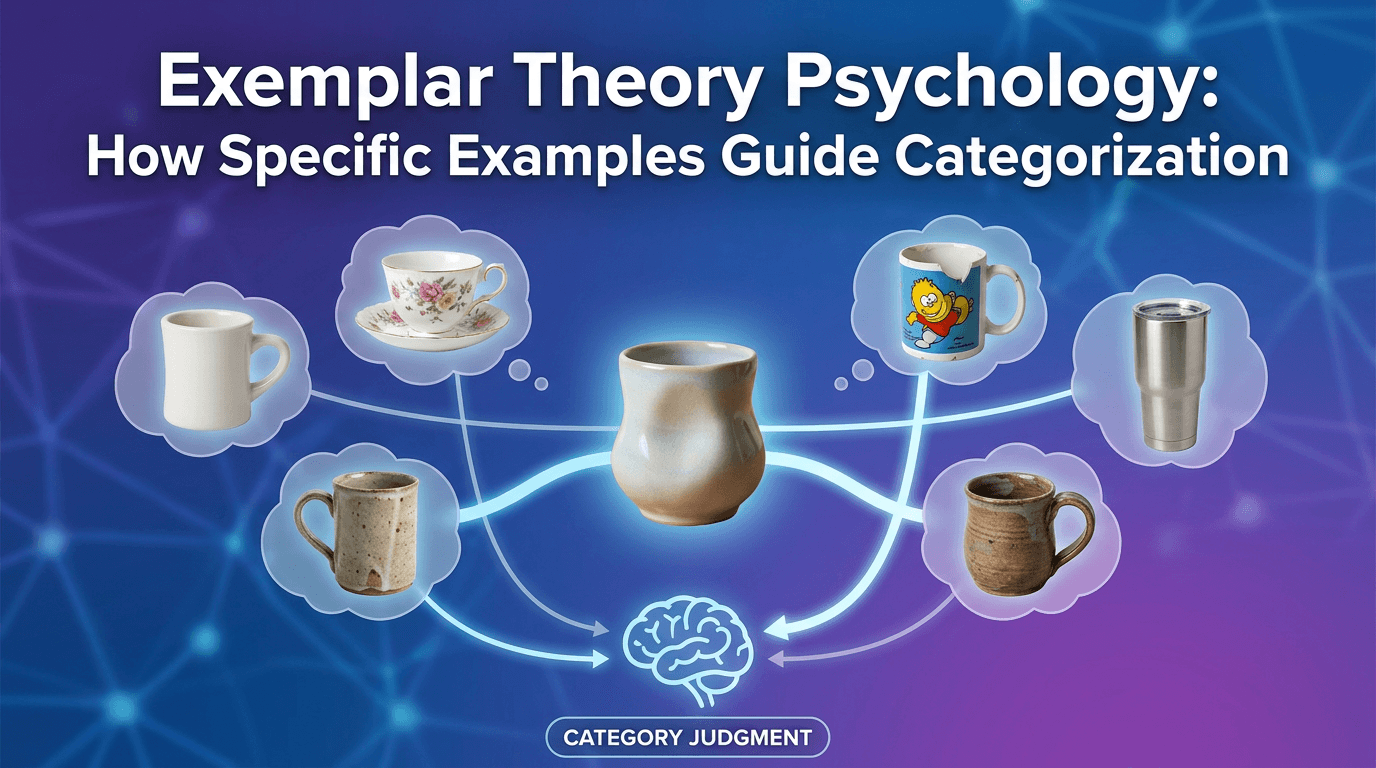
Think about how you recognize a type of dog you have never seen before. You may not compare it with one perfect “average dog.” Instead, the new animal may remind you of several dogs you have encountered before, some similar in size, some in face shape, some in coat, and some in movement. Exemplar theory asks whether categorization can work by comparing new items with specific represented instances like these.
The theory offers a different answer from prototype accounts. Rather than compressing experience into one central pattern, exemplar models preserve information about individual category members and let similarity across those stored instances influence classification. This makes the approach especially useful for explaining categories with variability, exceptions, and unusual members. Still, “stored exemplar” should not be read literally as a perfect photograph of every past experience. It is a theoretical description of instance-specific information used in categorization.
Quick Answer: What Exemplar Theory Proposes
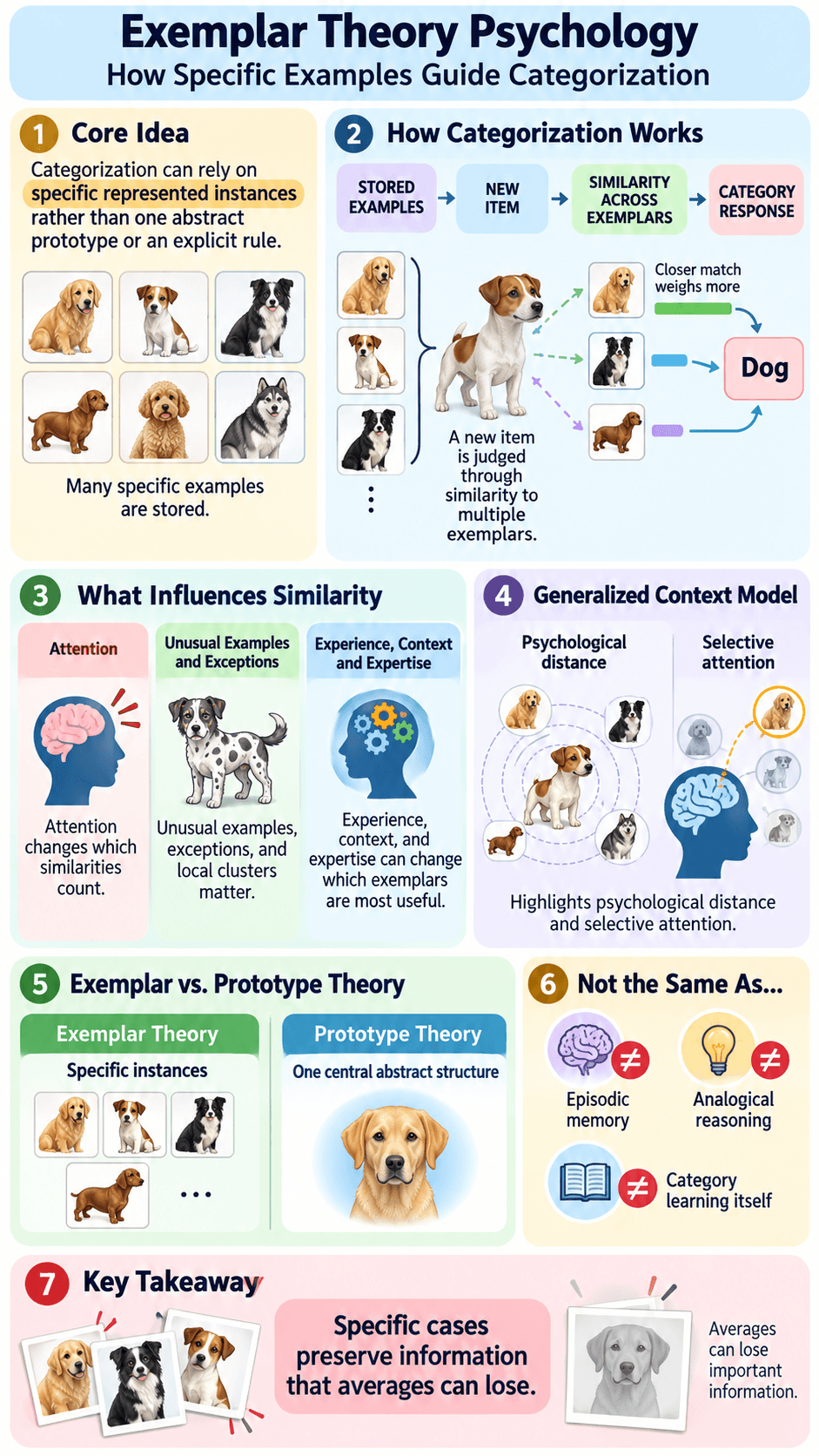
Exemplar theory proposes that a category can be represented through specific individual instances encountered or represented in memory. When a new item appears, its similarity to multiple exemplars can contribute to a category judgment. The theory differs from prototype accounts, which emphasize an abstract central pattern, and from rule-based approaches, which emphasize explicit criteria. No single account should be treated as universally correct.
What Counts as an Exemplar in the Theory?
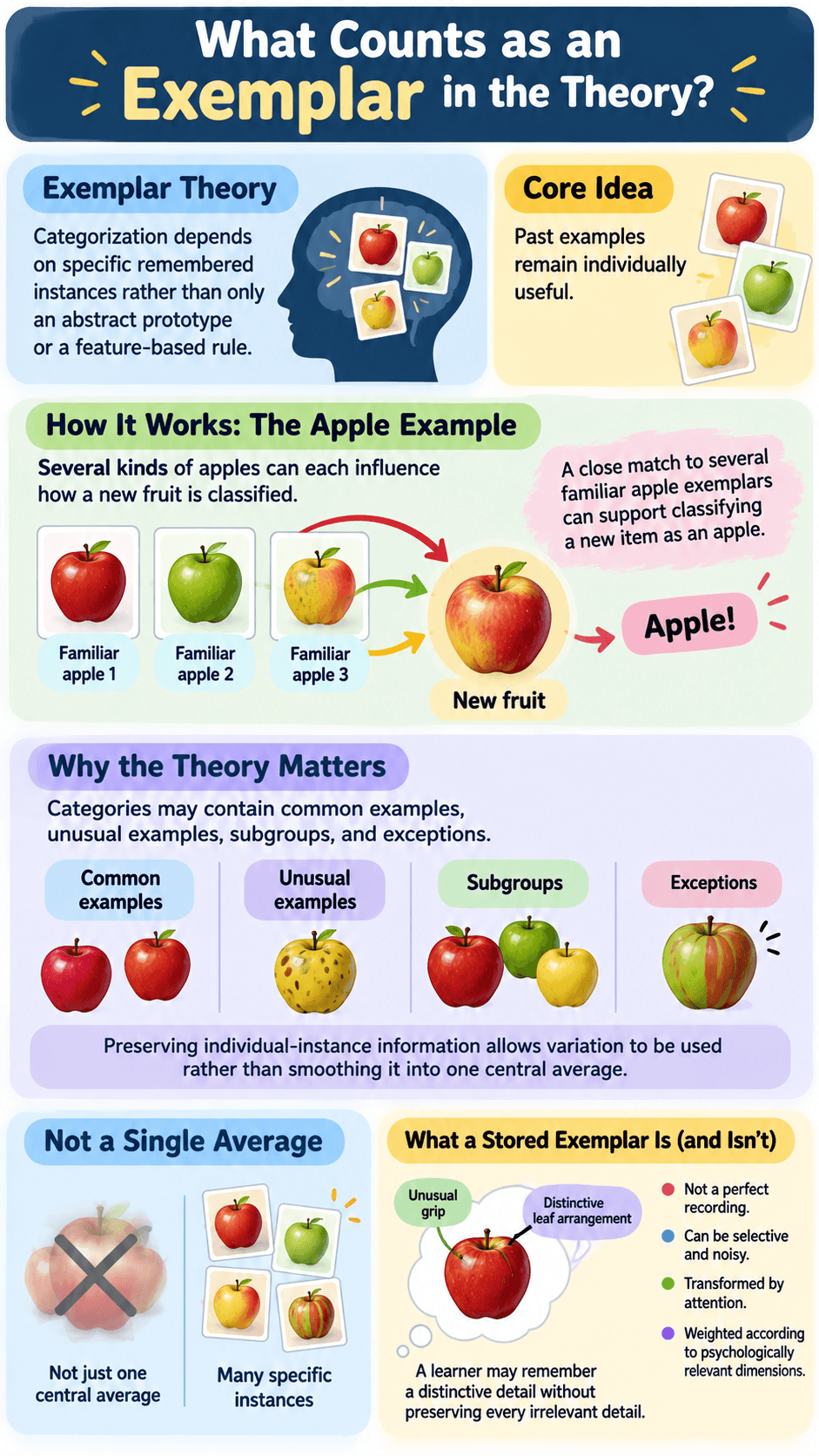
The APA Dictionary of Psychology describes exemplar theory as the hypothesis that categorization depends on specific remembered instances rather than only an abstract prototype or a feature-based rule. The central idea is simple: past examples remain individually useful.
Individual represented category instances
An exemplar is one represented member of a category. If you have encountered several kinds of apples, each represented apple can potentially influence how you classify a new fruit. A close match to several familiar apple exemplars can provide strong evidence that the new item belongs to the apple category.
The theory becomes especially interesting when members vary. A category may contain common examples, unusual examples, subgroups, and exceptions. Preserving individual-instance information allows a model to use that variation instead of smoothing it into one central average.
Why “stored exemplar” does not mean a perfect recording
Exemplar theory does not require the mind to preserve a complete sensory recording of every encounter. A representation can be selective, noisy, transformed by attention, and weighted according to psychologically relevant dimensions.
What matters is that information tied to particular instances remains available enough to influence later classification. A learner may remember that one tool had an unusual grip or that one plant had a distinctive leaf arrangement without preserving every irrelevant detail.
Core Model: Stored Examples to Similarity to Category Response
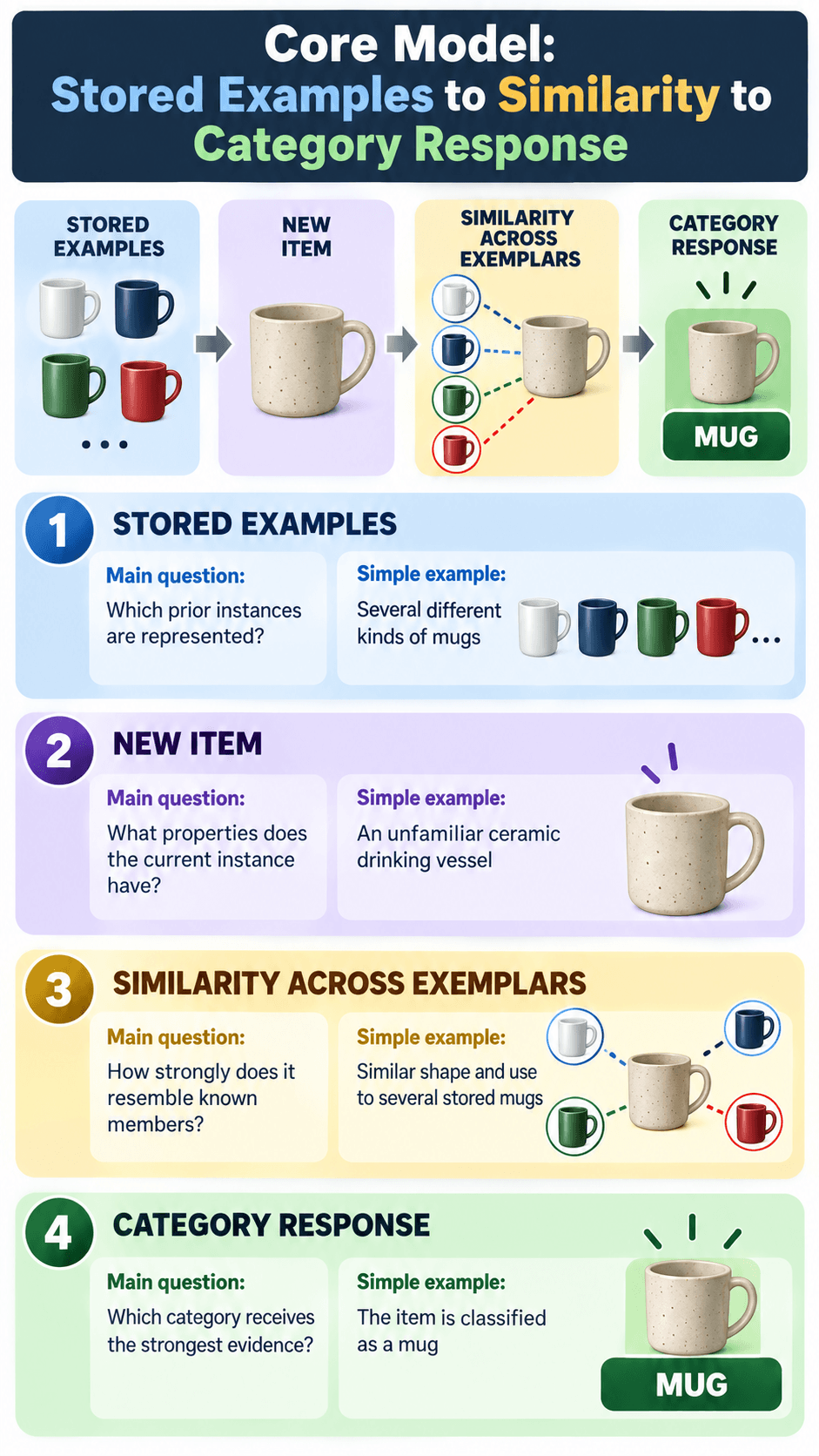
A compact way to express exemplar categorization is:
STORED EXAMPLES → NEW ITEM → SIMILARITY ACROSS EXEMPLARS → CATEGORY RESPONSE
This model captures the main logic without claiming that the process is always conscious or that every stored instance contributes equally.
| Stage | Main question | Simple example |
|---|---|---|
| Stored examples | Which prior instances are represented? | Several different kinds of mugs |
| New item | What properties does the current instance have? | An unfamiliar ceramic drinking vessel |
| Similarity across exemplars | How strongly does it resemble known members? | Similar shape and use to several stored mugs |
| Category response | Which category receives the strongest evidence? | The item is classified as a mug |
How Multiple Exemplars Can Support One Judgment
Comparing a new item with several prior instances
A new object does not have to match one previous example exactly. Evidence can accumulate across multiple exemplars. An unfamiliar bird might resemble one known bird in body shape, another in beak form, and several others in size and movement.
Medin and Schaffer’s influential context theory formalized this general idea by treating a probe item as a cue that accesses information associated with similar stored exemplars. Their 1978 context theory of classification learning helped establish instance-based models as a serious alternative to category-level abstraction.
Similarity-weighted evidence
Not every exemplar contributes equally. Close matches can have more influence than distant ones. A new item that strongly resembles several Category A instances and only weakly resembles Category B instances will tend to produce evidence for Category A.
Similarity is also affected by attention. If color is irrelevant but shape is highly diagnostic, a learner may give more weight to shape. The same physical items can therefore have different psychological similarities depending on which dimensions matter for the task.
Why category frequency and variability can matter
If a learner has encountered many instances from one part of a category, that region of experience may contain more exemplar evidence. This can make frequently represented patterns influential without requiring a single prototype.
Variability matters too. A category with several distinct subgroups can be represented through local clusters of exemplars. A new item may be a good match to one subgroup even if it is far from the overall category center.
The Generalized Context Model and Selective Attention
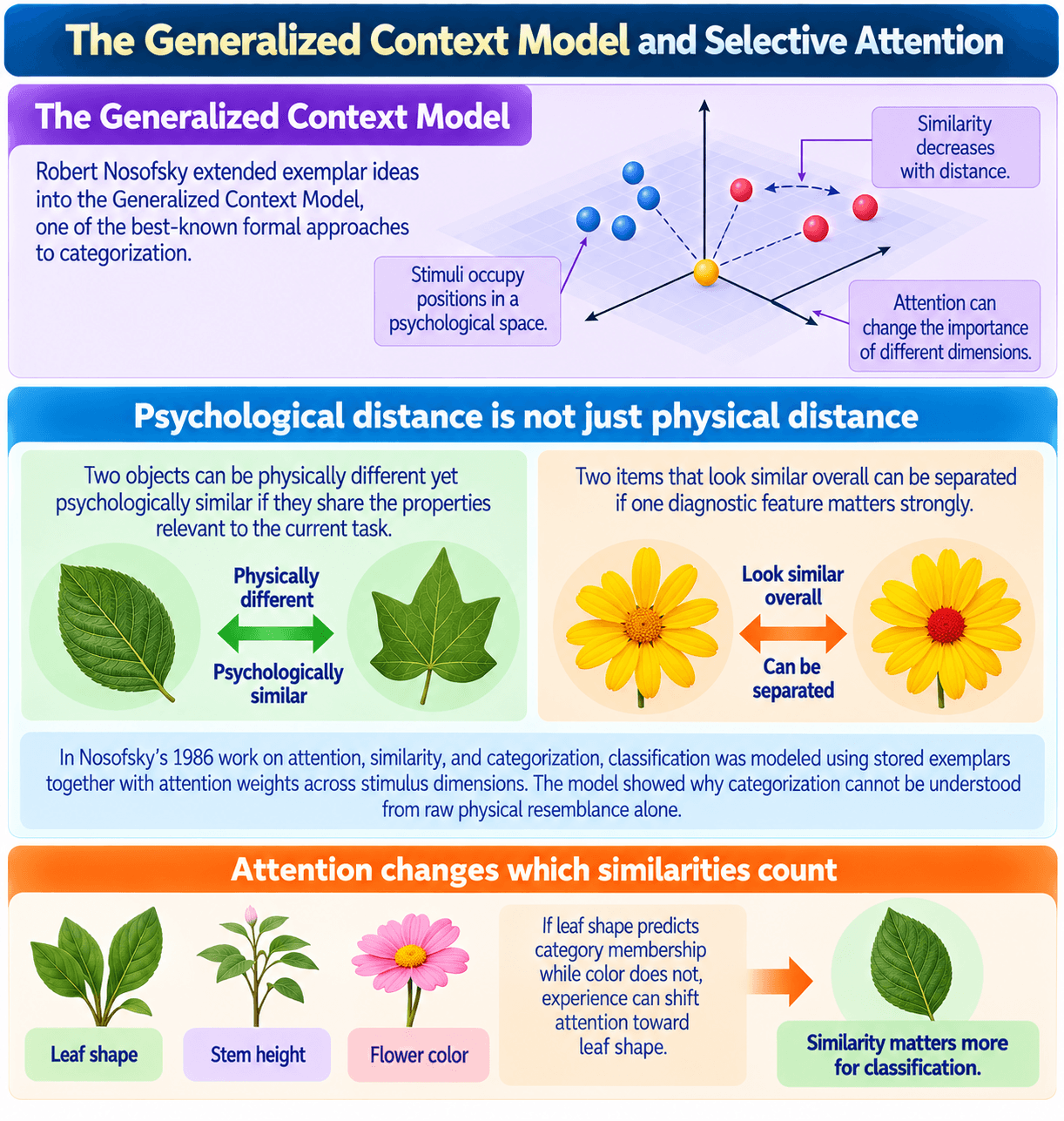
Robert Nosofsky extended exemplar ideas into the Generalized Context Model, one of the best-known formal approaches to categorization. In this framework, stimuli occupy positions in a psychological space, similarity decreases with distance, and attention can change the importance of different dimensions.
Psychological distance is not just physical distance
Two objects can be physically different yet psychologically similar if they share the properties relevant to the current task. Conversely, two items that look similar overall can be separated if one diagnostic feature matters strongly.
In Nosofsky’s 1986 work on attention, similarity, and categorization, classification was modeled using stored exemplars together with attention weights across stimulus dimensions. The model showed why categorization cannot be understood from raw physical resemblance alone.
Attention changes which similarities count
Suppose imaginary plants vary in leaf shape, stem height, and flower color. If leaf shape predicts category membership while color does not, experience can shift attention toward leaf shape. Similarity on that dimension then matters more for classification.
This gives exemplar models flexibility. The set of instances may stay the same while the effective similarity relationships change because the learner has discovered which dimensions are useful.
Why Unusual Examples Matter in Exemplar Models
Exceptions can remain available as information
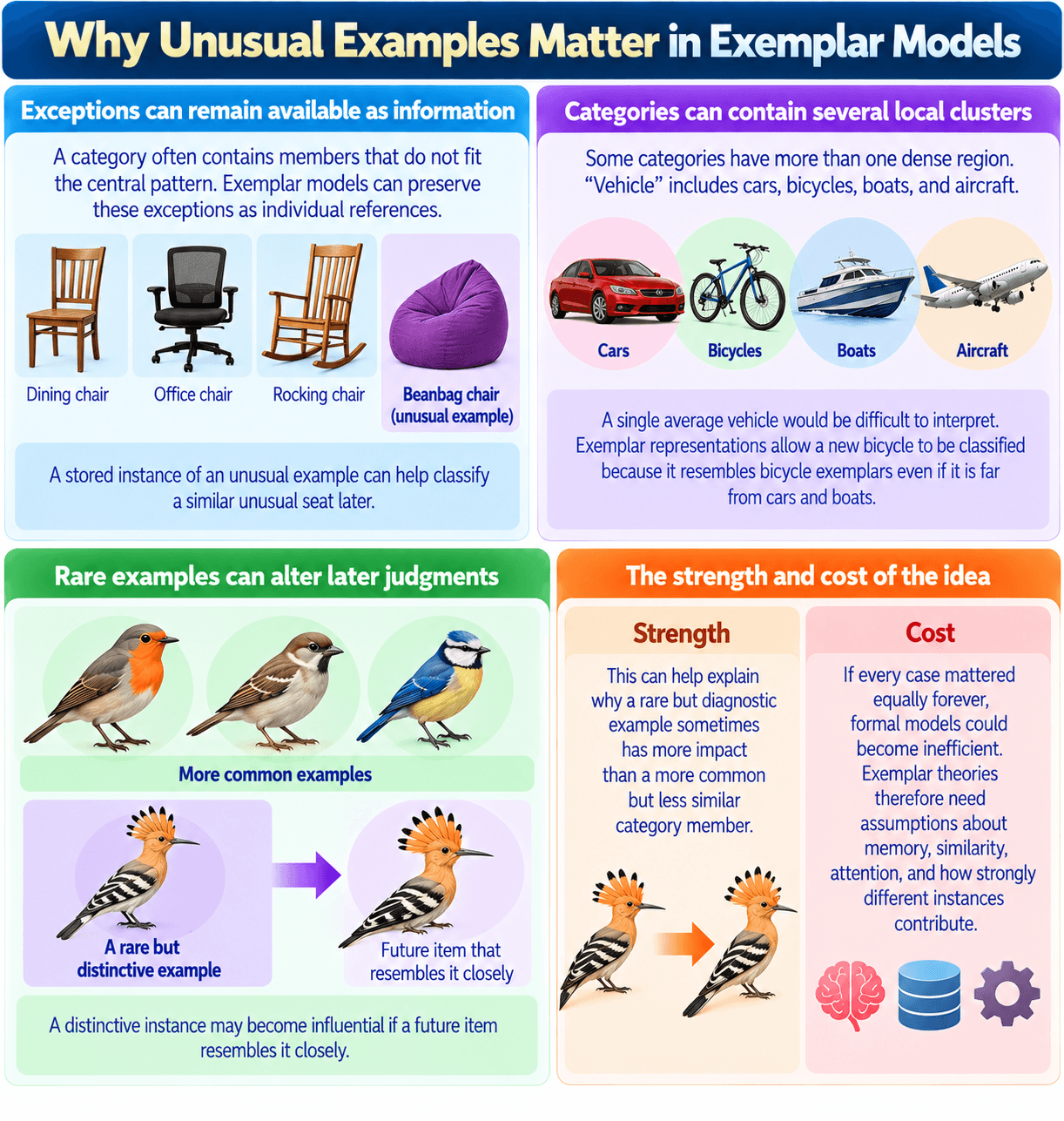
A category often contains members that do not fit the central pattern. Exemplar models can preserve these exceptions as individual references rather than treating them as noise around an average.
Imagine a collection of chairs that includes a conventional dining chair, an office chair, a rocking chair, and a beanbag chair. The beanbag is unusual relative to a simple central chair pattern, but a stored instance of it can help classify a similar unusual seat later.
Categories can contain several local clusters
Some categories have more than one dense region. “Vehicle” includes cars, bicycles, boats, and aircraft. A single average vehicle would be difficult to interpret. Exemplar representations allow a new bicycle to be classified because it resembles bicycle exemplars even if it is far from cars and boats.
Rare examples can alter later judgments
A distinctive instance may become influential if a future item resembles it closely. This can help explain why a rare but diagnostic example sometimes has more impact than a more common but less similar category member.
The strength of this idea is also its cost. If every case mattered equally forever, formal models could become inefficient. Exemplar theories therefore need assumptions about memory, similarity, attention, and how strongly different instances contribute.
How Experience Changes the Exemplar Pool
More encounters add or reshape comparison information
As experience accumulates, a learner has more reference points. Early category judgments may depend on a few instances, while later judgments can draw on a broader distribution of examples.
New experience can also reveal that earlier exemplars were unrepresentative. A person who has seen only red apples may initially overvalue color. After encountering green and yellow apples, color becomes less diagnostic while shape, texture, taste, and function receive greater weight.
Context can change which exemplars matter most
An exemplar that is useful in one context may contribute little in another. When classifying tools by function, prior examples with similar uses may dominate. When sorting them for storage by physical size, different similarities become relevant.
The representation therefore does not have to operate as one fixed cloud of equally weighted memories. Context and attention can determine which instances become the most useful reference points.
Why expertise can alter useful comparisons
Experts often possess many more differentiated examples than novices. A beginner may compare an unfamiliar bird with a few broad familiar cases. An expert may compare it with many species-level examples and notice distinctions that the novice does not represent clearly.
That does not mean experts simply memorize more photographs. Their attention and conceptual organization also change. Exemplar models can accommodate some of this by changing the represented dimensions and the weights given to them.
Why Category Variability Matters So Much
Exemplar theory becomes especially informative when a category contains meaningful variation. If every member were nearly identical, a prototype, rule, and collection of exemplars might make almost the same predictions. The theoretical differences become clearer when a category contains unusual members, overlapping subgroups, or exceptions.
Averages can hide local structure
Imagine two clusters of objects inside one broad category. One cluster is small and round, the other large and narrow. An average of the entire category may fall between the clusters and resemble no actual member particularly well. An exemplar representation can preserve both regions because the individual cases remain available.
Local similarity can outweigh global centrality
A new item may be far from the category’s overall center yet very close to several members in one subgroup. Exemplar logic predicts that those local matches can provide strong evidence for membership. This is one reason instance-based models are attractive for categories with irregular internal structure.
Variability also changes what counts as diagnostic
When category members vary widely on one dimension, that dimension may become less useful. If every tool comes in many colors, color contributes little to classification. If one structural feature remains stable across useful exemplars, attention can shift toward that feature instead.
Advantages of Exemplar Models
Retaining fine-grained detail
Because individual instances remain distinct, exemplar models preserve information that a central average might discard. That makes them well suited to categories in which unusual members or subtle subgroups matter.
A single central representation of “tool” may hide distinctions among cutting tools, measuring tools, fastening tools, and specialized instruments. Specific instances retain the local structure needed to respond to those differences.
Handling exceptions and heterogeneous categories
Exemplar approaches are attractive when a category does not have one obvious center. A new item can receive support from a relevant subset of known instances rather than being compared only with an overall average.
A review of prototype and exemplar processes notes that the relative usefulness of each approach depends on category structure rather than one model being optimal in every situation. That review of prototypes, exemplars, and category structure emphasizes that the ecological usefulness of a representation changes with the problem.
Explaining context-sensitive similarity patterns
Similarity is not fixed. A red apple and a red toy ball are similar in color but not in the dimensions that normally matter for fruit classification. Exemplar models that include selective attention can emphasize task-relevant dimensions and reduce the influence of irrelevant resemblance.
Challenges and Computational Demands
Many comparisons can become costly in a formal model
If categorization requires comparing every new item with every stored exemplar, the number of comparisons can become large. Formal exemplar theories therefore need efficient assumptions about how similarity information is represented and combined.
This computational issue does not automatically disprove exemplar theory. Cognitive models are abstractions, and biological implementation need not literally perform a slow serial search through every memory.
Not all stored detail is equally accessible or weighted
Experience is selective. Some examples are forgotten, compressed, confused, or represented incompletely. Highly diagnostic instances may matter more than routine ones, and attention can change what survives as useful information.
It is therefore safer to describe exemplar theory as instance-based representation than as a claim that all experiences remain equally vivid and available forever.
Exemplar Theory vs Prototype Theory
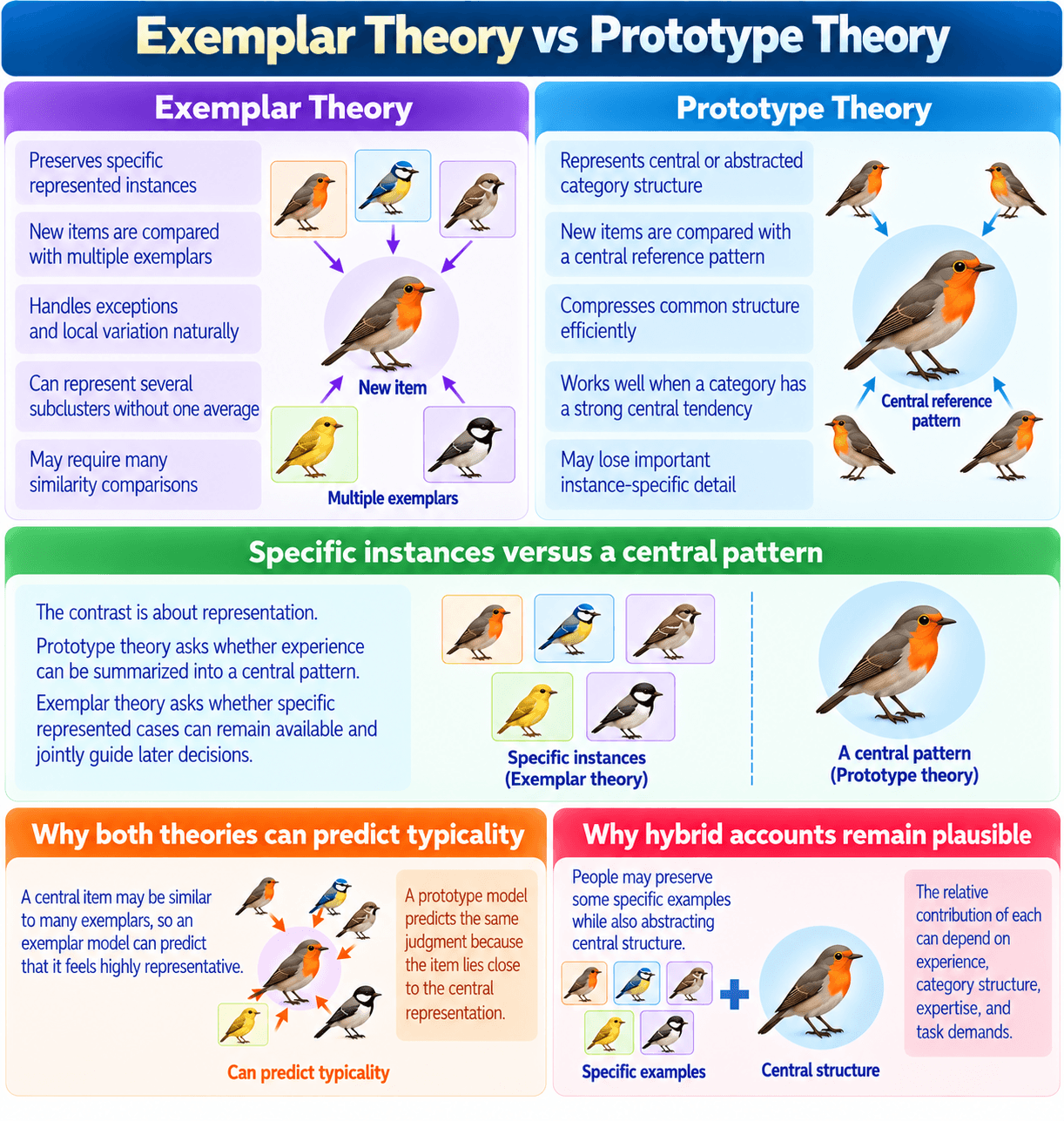
| Exemplar theory | Prototype theory |
|---|---|
| Preserves specific represented instances | Represents central or abstracted category structure |
| New items are compared with multiple exemplars | New items are compared with a central reference pattern |
| Handles exceptions and local variation naturally | Compresses common structure efficiently |
| Can represent several subclusters without one average | Works well when a category has a strong central tendency |
| May require many similarity comparisons | May lose important instance-specific detail |
Specific instances versus a central pattern
The contrast is about representation. Prototype theory asks whether experience can be summarized into a central pattern. Exemplar theory asks whether specific represented cases can remain available and jointly guide later decisions.
A broad comparison of categorization models describes exemplar models as collections of individual items, while prototype models represent an average or prototypical member. Research comparing categorization and generalization models shows how both approaches can support new-item classification through different representational assumptions.
Why both theories can predict typicality
A central item may be similar to many exemplars, so an exemplar model can predict that it feels highly representative even without storing a prototype. A prototype model predicts the same judgment because the item lies close to the central representation.
This is one reason typicality alone cannot settle the prototype-versus-exemplar debate. Researchers need test cases on which the models make different predictions.
Why hybrid accounts remain plausible
People may preserve some specific examples while also abstracting central structure. The relative contribution of each can depend on experience, category structure, expertise, and task demands.
Theoretical competition remains valuable because different models force researchers to specify what information must be represented to explain behavior. A hybrid should not be accepted merely because it is flexible, but neither should cognition be forced into one representation format when evidence supports more than one.
Exemplar Categorization vs Episodic Memory
Instance-specific representation is not the same as autobiographical remembering
An exemplar model uses information tied to particular category instances. Episodic memory, by contrast, concerns personally experienced events situated in time and context. The two ideas can interact, but they answer different questions.
You do not need to relive the afternoon when you saw a particular mug in order for that mug to influence later classification. The exemplar can function as a category reference without requiring a vivid autobiographical memory of the original encounter.
Classification and recognition are related but distinct
Nosofsky and colleagues have used exemplar-based models to explore links between categorization and recognition, which shows that the processes can share representational principles. It does not make categorization identical to memory retrieval.
A category judgment asks where a current item belongs. Recognition asks whether something has been encountered before. A completely new item can be classified successfully even though the correct recognition answer is “new.”
Exemplar Categorization vs Analogical Reasoning
Similarity-based classification versus relational mapping
Both processes can involve prior cases, which makes them easy to confuse. Exemplar categorization asks whether a new item is sufficiently similar to represented category members. Analogical reasoning asks whether relational structure in one case maps onto another in a way that supports an inference.
Suppose a new kitchen tool resembles several known peelers in shape and action. Classifying it as a peeler can be exemplar-based categorization. Using the organization of one transportation network to reason about how information flows through a computer network is a different cognitive operation because the key step is mapping relations, not assigning category membership.
The output is different
Exemplar categorization ends in a category response. Analogy typically supports a transferred relation, explanation, or inference. The same prior example could participate in both processes, but the cognitive question determines which process is being studied.
When Another Explanation Fits Better
When a simple explicit rule defines membership
If a category is defined cleanly by a criterion, a rule-based account may be more direct. A triangle has three sides. Classification does not require finding the nearest remembered triangle if the learner knows and applies the rule.
When a category has a strong central tendency
If most members form a coherent family-resemblance structure and exceptions are unimportant, a prototype model may summarize the category efficiently. A central pattern can provide a compact reference for new-item judgments.
When the main question is how classification was acquired
Exemplar theory describes one possible representation. It does not replace the broader question of category learning. Training order, feedback, labels, attention, and task structure can affect learning regardless of whether the final behavior is best captured by an exemplar, prototype, rule, or hybrid model.
Experiments that directly compare models support this caution. Research competitively testing rule and exemplar models found that different models performed better under different stimulus conditions, consistent with the idea that categorization may involve multiple processes.
A Practical Way to See Exemplar Logic
Choose a category with noticeable variation, such as mugs, shoes, bicycles, or houseplants. Then think of several specific members you have actually encountered.
- Which previous example does a new item resemble most?
- Does it resemble several members moderately rather than one member strongly?
- Is there an unusual prior example that makes the new item easier to classify?
- Which dimensions are you ignoring because they do not matter for the category?
- Would a person with more expertise have a richer set of useful exemplars?
- Would one central average lose an important subgroup or exception?
The exercise does not prove that your mind is using an exemplar model. It illustrates what instance-based classification would require and why specific prior examples can remain useful even when a category has a recognizable center.
FAQ About Exemplar Theory
Does exemplar theory say we remember every example perfectly?
No. “Stored exemplar” is a theoretical description of instance-specific information, not a claim of photographic memory. Representations can be incomplete, transformed by attention, forgotten, or weighted differently. The theory only requires enough information from specific instances to affect later categorization.
Why can rare or unusual examples matter so much?
A rare exemplar can become useful when a new item resembles it closely. Prototype averaging may place both items far from the category center, while an exemplar model preserves the local similarity between them. This makes unusual members informative in categories with exceptions or several subgroups.
Can prototype and exemplar representations both be used?
Possibly. Research has produced evidence compatible with both approaches, and hybrid or multiple-process accounts remain plausible. Which representation is most useful may depend on category structure, experience, expertise, and the exact task.
Is exemplar categorization the same as analogy?
No. Exemplar categorization uses similarity to prior category instances to support classification. Analogical reasoning focuses on mapping relational structure between cases to support an inference. Both use prior information, but their mechanisms and outputs are different.
Key Takeaways
- Exemplar theory proposes that specific represented category members can guide classification of new items.
- A new item can receive evidence from its similarity to multiple exemplars, with closer or more relevant matches contributing more strongly.
- Instance-based representations preserve exceptions, local variation, and subgroups that a single central average may obscure.
- “Stored exemplar” does not mean a perfect photographic record of every experience.
- Exemplar and prototype models can sometimes predict similar behavior, including typicality, so carefully designed model comparisons are needed.
- Exemplar categorization differs from episodic memory, analogical reasoning, and the broader process of category learning.
Final Thought: Specific Cases Preserve What Averages Can Lose
The distinctive insight of exemplar theory is that individual examples may continue to matter after a category has been learned. A central summary is efficient, but it can hide exceptions, rare members, and local clusters. Specific instances preserve that texture. The useful question is therefore not whether every category must be exemplar-based, but when retaining individual cases provides information that a rule or central prototype would miss.
Educational note: Exemplar theory is a model of categorization. It should not be used to infer that a person has superior memory, a fixed cognitive style, a particular level of intelligence, or a neurological or psychological condition.

Michael Reed is the Founder and Lead Writer at Psychology Exposed. He writes about human behavior, relationships, emotional patterns, self-awareness, and practical psychology topics using research-informed, easy-to-understand content.
Read More About Michael Reed: https://psychologyexposed.com/michael-reed/