
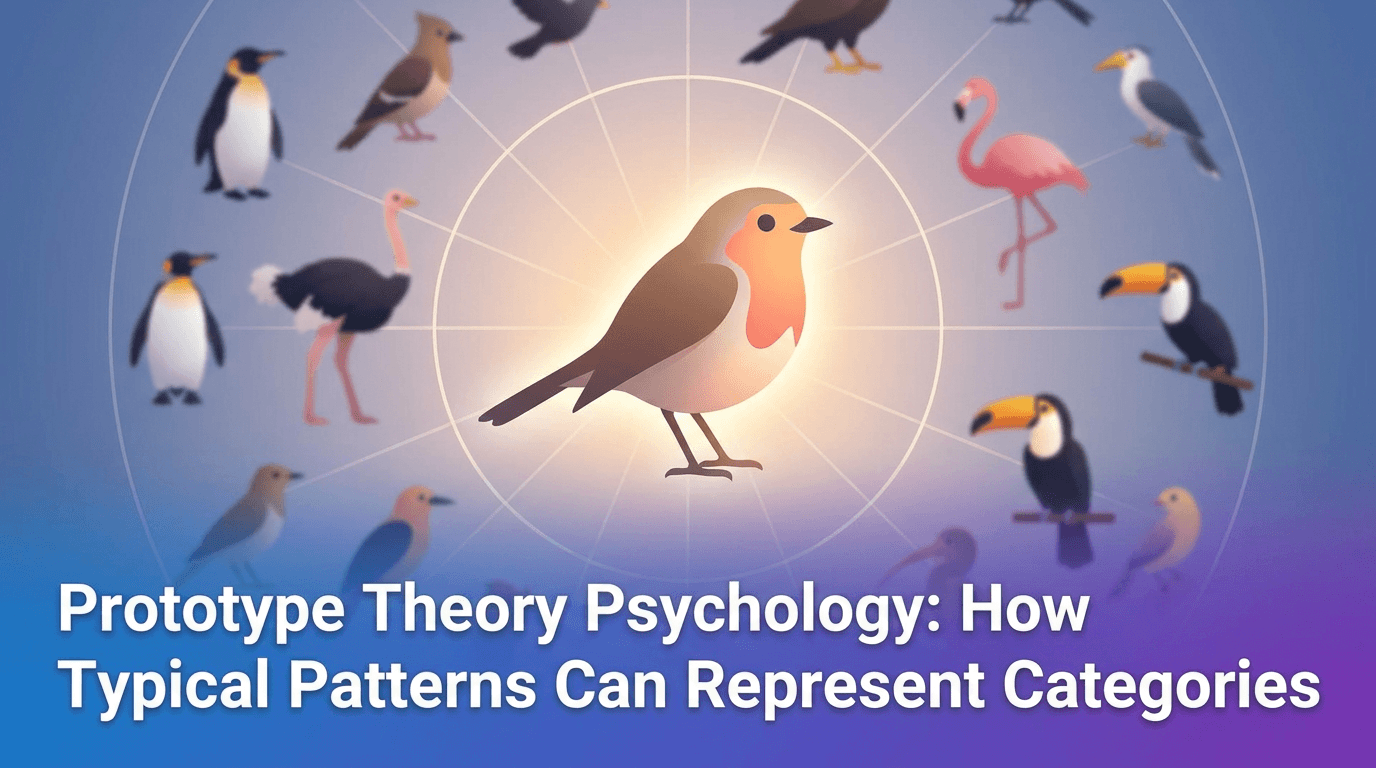
When you picture a bird, you may imagine something closer to a robin or sparrow than to a penguin or ostrich. When you think of a chair, a simple seat with a back may come to mind before a beanbag or an unusual sculptural chair. Prototype theory asks whether this kind of central or highly representative pattern can help the mind organize categories and classify new examples.
The theory is appealing because it offers a compact solution to a difficult problem. Instead of comparing every new object with a long verbal definition, a person may judge how closely it resembles an abstracted pattern built from prior category experience. But the theory needs careful wording. A prototype is not necessarily one real object, the most frequent member, or a literal average stored in one location in the brain. It is a theoretical way of describing how central category structure might be represented and used.
Quick Answer: What Prototype Theory Proposes
Prototype theory proposes that a category can be represented by an abstracted, central, or highly representative pattern. A new item may then be classified partly by how similar it is to that representation. Prototype accounts explain some important findings in categorization research, but they do not prove that every category is stored as one average. Exemplar, rule-based, and hybrid accounts can explain other patterns.
What a Prototype Is and Is Not
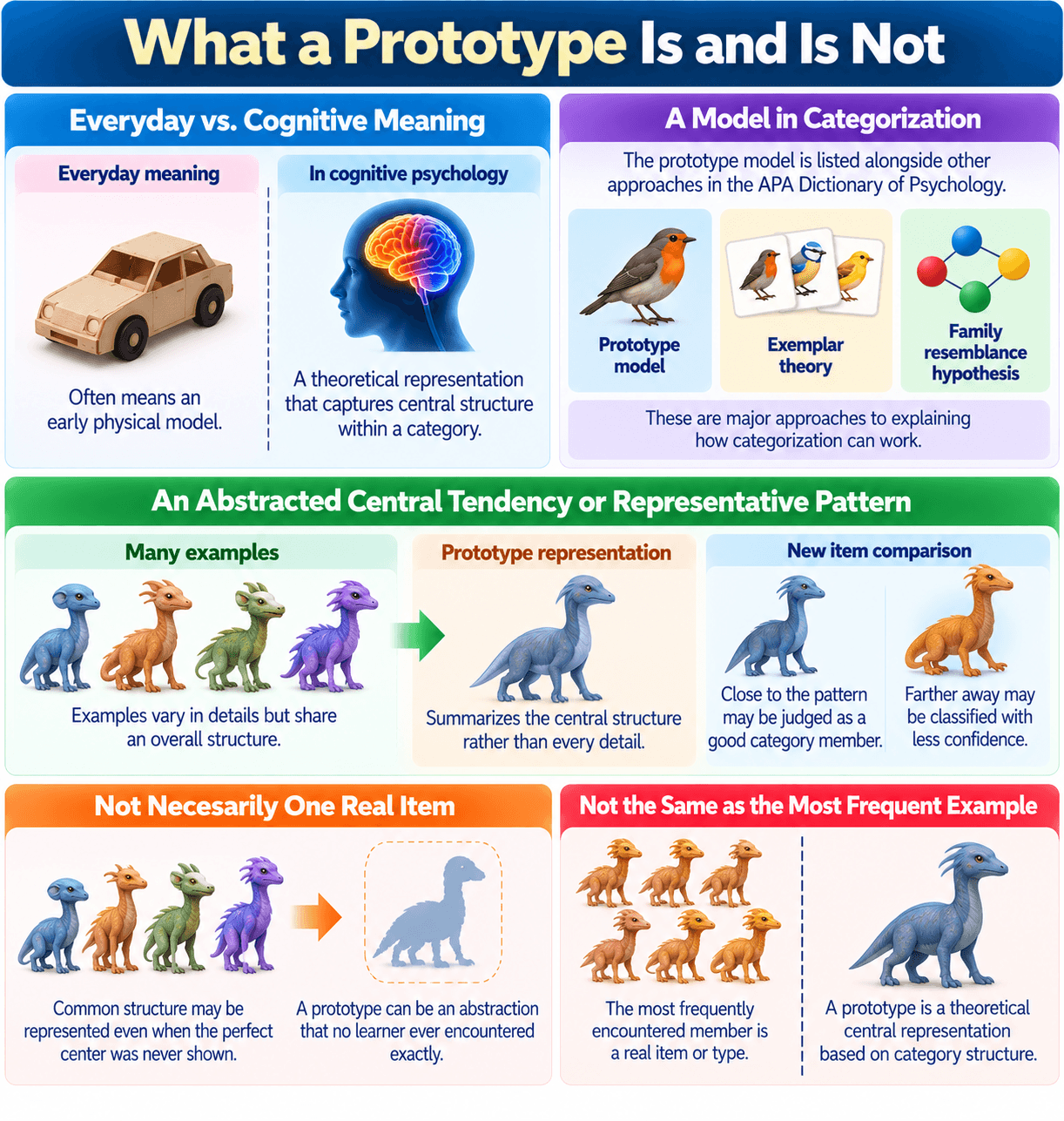
The word “prototype” is easy to misunderstand because everyday language often uses it to mean an early physical model. In cognitive psychology, the idea is different. A prototype is a theoretical representation that captures central structure within a category.
The APA Dictionary of Psychology entry on categorization lists the prototype model alongside exemplar theory and the family resemblance hypothesis as major approaches to explaining how categorization can work. The important word is “model.” Prototype theory is an explanation of representation and classification, not a claim that every category has already been proven to work this way.
An abstracted central tendency or representative pattern
Suppose you encounter many examples of a made-up creature. Some have slightly longer bodies, some have rounder heads, and some have different markings, but the examples share an overall structure. A prototype representation would summarize that central structure rather than preserve every detail of every individual example.
The result can be thought of as a cognitive reference point. A new item that falls close to that reference point may be judged as a good category member. An item farther away may be classified with less confidence or treated as less representative.
Why a prototype does not have to be one real item
A prototype can be an abstraction that no learner ever encountered exactly. If several examples vary around a central pattern, their common structure may be represented even when the perfect center was never shown.
This distinction is central to classic prototype-abstraction experiments. Participants learned categories from distorted patterns and were later tested with both familiar and unfamiliar items. In some tasks, the unseen central pattern was classified especially well, which is one reason researchers became interested in abstraction as an explanation.
Why prototype is not the same as the most frequent example
Frequency and representativeness can be related, but they are not identical. The most frequently encountered member of a category is a real item or type that appears often. A prototype is a theoretical central representation based on category structure.
The APA defines prototypicality as the degree to which something is typical or exemplary of its category. That judgment can reflect feature structure, similarity, knowledge, context, and experience. It should not automatically be reduced to “the thing seen most often.”
Core Model: Category Experience to Prototype to New-Item Comparison
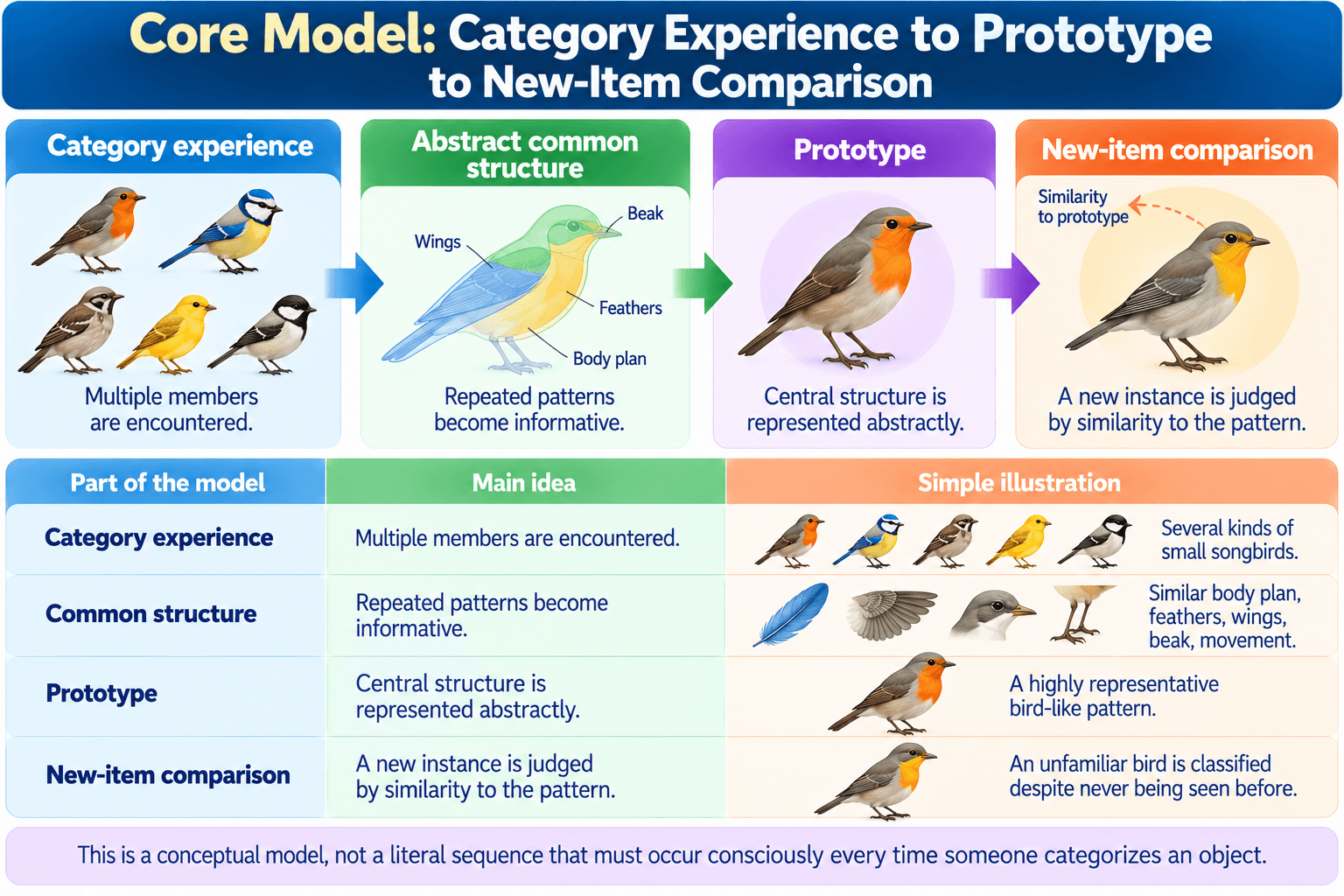
A simple way to visualize the theory is:
CATEGORY EXPERIENCE → ABSTRACT COMMON STRUCTURE → PROTOTYPE → NEW ITEM COMPARISON
This is a conceptual model, not a literal sequence that must occur consciously every time someone categorizes an object.
| Part of the model | Main idea | Simple illustration |
|---|---|---|
| Category experience | Multiple members are encountered | Several kinds of small songbirds |
| Common structure | Repeated patterns become informative | Similar body plan, feathers, wings, beak, movement |
| Prototype | Central structure is represented abstractly | A highly representative bird-like pattern |
| New-item comparison | A new instance is judged by similarity to the pattern | An unfamiliar bird is classified despite never being seen before |
How Similarity to a Prototype Can Support Classification
Feature overlap and weighted similarity
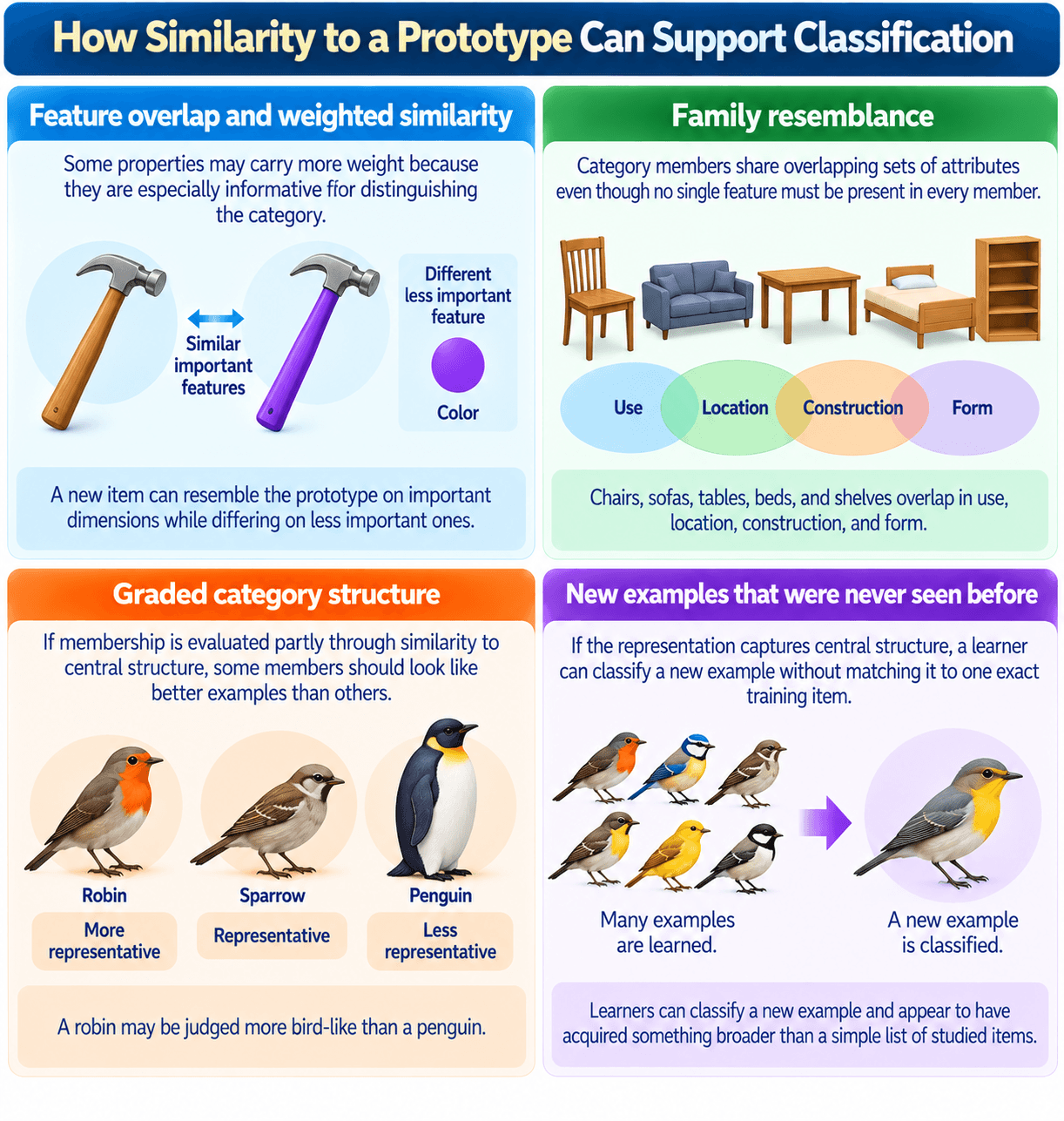
A prototype account does not require every feature to count equally. Some properties may carry more weight because they are especially informative for distinguishing the category. A new item can therefore resemble the prototype strongly on important dimensions while differing on less important ones.
Imagine a category of tools in which function and overall structure matter more than color. A bright purple version of a familiar tool can still be classified easily because its unusual color contributes little to the judgment.
Family resemblance
Family resemblance describes a structure in which category members share overlapping sets of attributes even though no single feature must be present in every member. Eleanor Rosch and Carolyn Mervis’s classic experiments found that members rated as more prototypical tended to share more attributes with other members of the same category and fewer with contrasting categories. Their 1975 family-resemblance research helped establish the idea that natural categories can have meaningful internal structure without relying entirely on strict defining features.
Think of furniture. Chairs, sofas, tables, beds, and shelves overlap in use, location, construction, and form, but it is difficult to identify one visible property possessed by every item called furniture. Family resemblance offers one way to explain how the category can remain coherent.
Graded category structure
If membership is evaluated partly through similarity to central structure, some members should look like better examples than others. A robin may be judged more bird-like than a penguin. A standard dining chair may seem more representative of “chair” than a beanbag.
This graded structure is compatible with prototype theory, but it does not uniquely prove it. A separate article is needed for the typicality effect because the observation that some members are more representative is not identical to the theory used to explain why.
New examples that were never seen before
One attraction of prototype models is their ability to explain generalization. If the representation captures central structure, a learner can classify a new example without matching it to one exact training item.
This makes prototype theories especially interesting in experiments where participants see many distorted members of a category and later recognize or classify the unseen central pattern. The learner appears to have acquired something broader than a simple list of studied items.
Prototype Abstraction in Research
Artificial category experiments
Classic work by Posner and Keele used dot patterns created by distorting unseen prototypes. Participants learned to sort the distorted patterns into categories and were later tested with old patterns, new distortions, and the prototypes themselves.
A modern review discussing that experimental tradition notes that unseen prototypes could receive especially strong classification responses even though participants had not studied them directly. A review discussing prototype-abstraction findings summarizes the Posner and Keele studies and the large body of later work inspired by them.
The striking part is not that people remembered an unseen picture in an ordinary sense. The result suggested that experience with varied examples could support a more central representation that affected later judgments.
Natural-category examples
Prototype ideas also became influential because everyday categories often have better and poorer examples. Fruit, birds, furniture, vehicles, and clothing show internal structure that is difficult to describe with one short definition.
Natural categories, however, are more complicated than laboratory dot patterns. People bring years of knowledge about function, causal relationships, language, goals, and context. A prototype may explain part of the structure without explaining every aspect of the concept.
What laboratory evidence can and cannot establish
An artificial-category experiment can show that a prototype model predicts behavior under a particular set of conditions. It cannot by itself prove that every everyday concept is stored in the same format.
Laboratory categories are intentionally simplified. Researchers know exactly how the examples were generated and which dimensions vary. Real categories may contain exceptions, subcategories, multiple centers, explicit rules, rich background knowledge, and cultural variation.
Why Prototype Representations Can Be Efficient
Compressing repeated structure
If many category members share similar properties, an abstract central representation can reduce redundancy. Instead of treating every common feature as entirely new, the system can preserve what repeatedly matters.
This offers a useful computational idea: summarize recurring structure while allowing individual examples to vary around it. The representation can then guide new classifications without requiring an exhaustive verbal rule for every case.
Generalizing without storing one rule for every case
Natural categories often resist strict definitions. Yet people still recognize unfamiliar members. Prototype theory explains this by allowing graded similarity rather than requiring a new rule for each exception.
A strange-looking chair can still be close enough to central chair structure to be recognized. A bird with unusual coloring can still fit the category if its more important properties align with what the representation captures.
Recognizing central patterns
Central tendencies can be especially useful when variation is noisy. If different examples differ on minor dimensions, the prototype can preserve the pattern that remains stable across them.
This does not mean that abstraction is always superior to retaining specific cases. Some categories depend strongly on exceptions and local variations, which is where prototype accounts can become less efficient.
Where Prototype Theory Struggles
Exceptions and unusual category members
A single central pattern can lose information about exceptions. If a category contains several unusual but important members, averaging may make them appear farther from the center than their true status warrants.
Consider a tool category containing several specialized devices that look very different from common hand tools. Their unusual appearance may make them poor matches to a simple prototype even though their function clearly places them in the category.
Categories poorly represented by an average
Some category structures contain multiple distinct clusters. Imagine a game category with board games, card games, sports, and video games. One average representation may be so vague that it describes none of them particularly well.
Other categories depend on strict rules rather than central resemblance. A triangle is not “more triangular” because it resembles an average triangle. It belongs because it satisfies the relevant geometric conditions.
Context and task effects
The most useful central tendency can change with context. A prototype for “vehicle” during a city-commuting task may emphasize different properties from the representation that matters when planning freight transport.
Context sensitivity creates a challenge for any theory that treats a prototype as permanently fixed. A more flexible account may need prototypes that shift, multiple reference points, or interaction with broader knowledge.
Expertise and shifting representativeness
Experts often organize a domain differently from novices. A casual birdwatcher may have a broad central image of a bird, while an ornithologist has much richer representations that support fine-grained distinctions.
Expertise can therefore change what counts as central, which dimensions receive weight, and whether a broad prototype remains useful. The category itself has not necessarily changed. The knowledge used to represent it has become more differentiated.
Prototype Theory vs Exemplar Theory
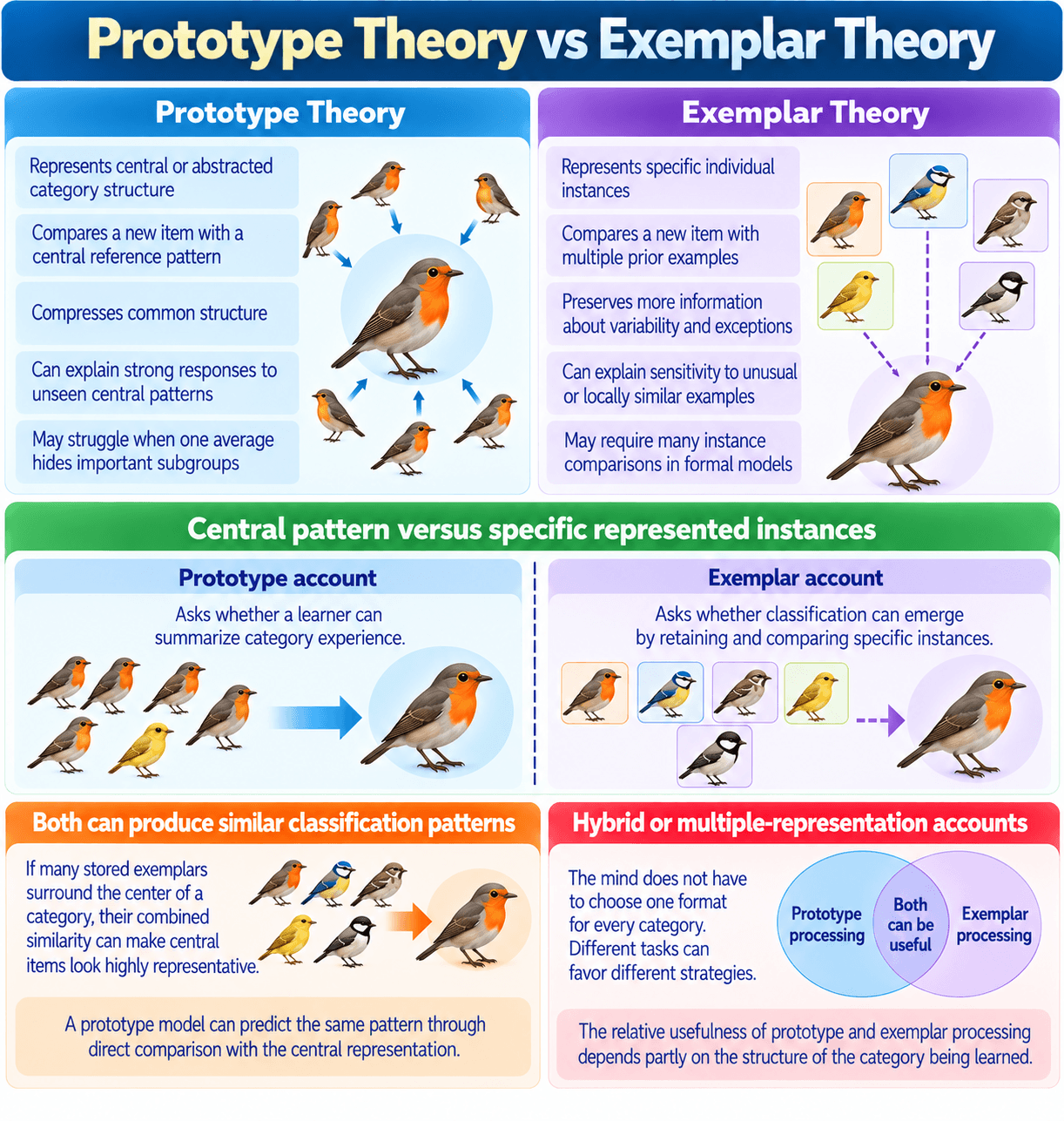
Prototype and exemplar theories offer different answers to the question, “What information supports classification?”
| Prototype theory | Exemplar theory |
|---|---|
| Represents central or abstracted category structure | Represents specific individual instances |
| Compares a new item with a central reference pattern | Compares a new item with multiple prior examples |
| Compresses common structure | Preserves more information about variability and exceptions |
| Can explain strong responses to unseen central patterns | Can explain sensitivity to unusual or locally similar examples |
| May struggle when one average hides important subgroups | May require many instance comparisons in formal models |
Central pattern versus specific represented instances
The prototype account asks whether a learner can summarize category experience. The exemplar account asks whether classification can emerge by retaining and comparing specific instances. The APA Dictionary definition of exemplar theory explicitly contrasts remembered category instances with an abstract prototype or feature-based rule.
How both can produce similar classification patterns
The two approaches can sometimes predict similar behavior. If many stored exemplars surround the center of a category, their combined similarity can make central items look highly representative. A prototype model can predict the same pattern through direct comparison with the central representation.
This is why a typicality effect alone does not tell researchers which representation produced it. Carefully designed test items are needed when competing models make different predictions.
Why hybrid or multiple-representation accounts remain possible
The prototype-versus-exemplar debate does not require the mind to choose one format for every category. Formal models have been hybridized, and different tasks can favor different strategies. A review of prototypes, exemplars, and category structure argues that the relative usefulness of prototype and exemplar processing depends partly on the structure of the category being learned.
A category with a strong family-resemblance center may reward abstraction. A category filled with individually exceptional members may reward retention of specific cases. That possibility fits a broader view in which categorization is adaptive rather than tied to one universal representation.
Prototype Theory vs Typicality Effect
Theory versus empirical phenomenon
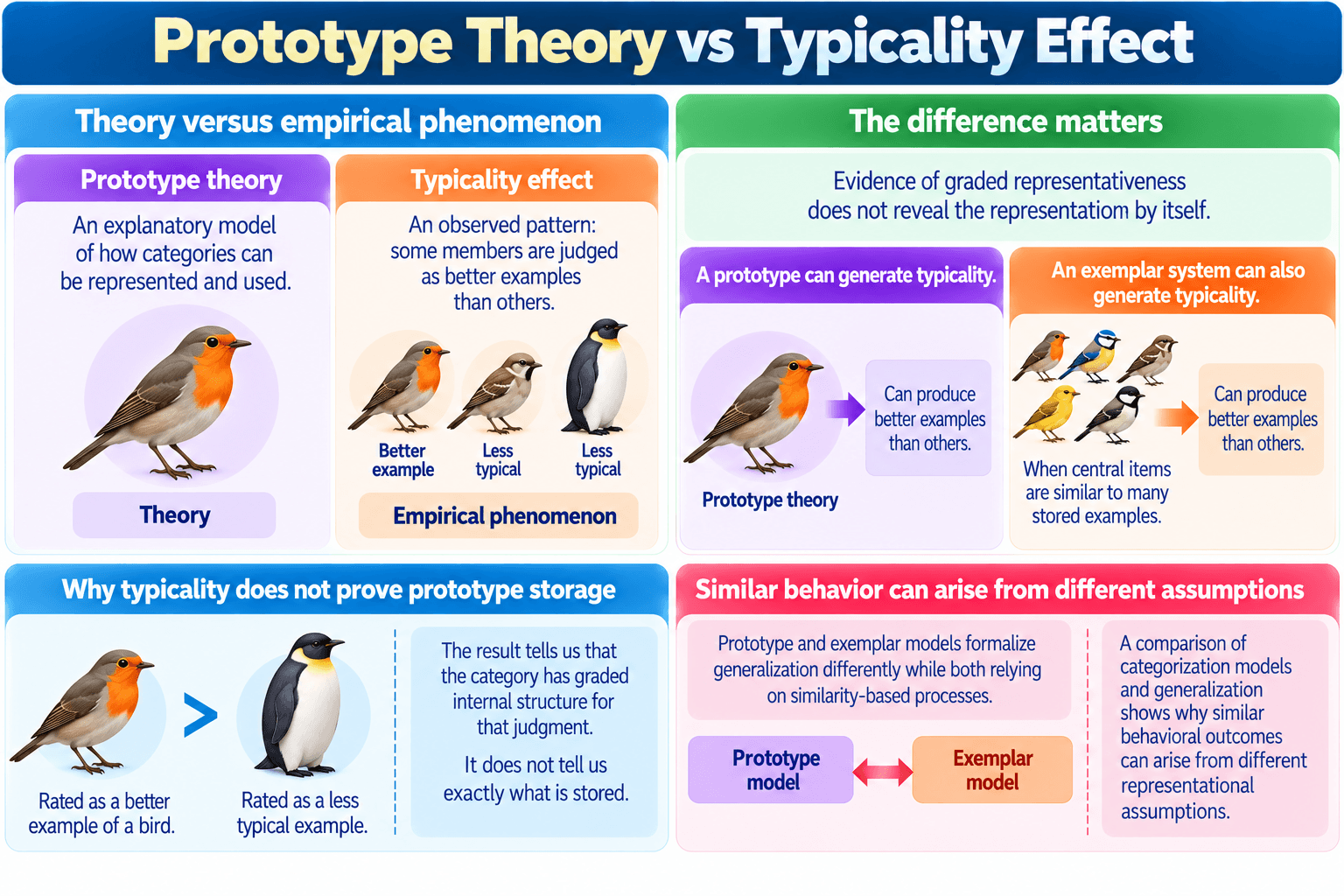
Prototype theory is an explanatory model. The typicality effect is an observed pattern: some category members are judged, recognized, or produced as better examples than others.
The difference matters because evidence of graded representativeness does not reveal the representation by itself. A prototype can generate typicality. So can an exemplar system when central items are similar to many stored examples.
Why typicality does not prove prototype storage
If a robin is rated as a better example of a bird than a penguin, the result tells us that the category has graded internal structure for that judgment. It does not tell us exactly what is stored.
A broader analysis of categorization models notes that prototype and exemplar models formalize generalization differently while both relying on similarity-based processes. A comparison of categorization models and generalization shows why similar behavioral outcomes can arise from different representational assumptions.
Prototype vs Group Prototype vs Stereotype
The same word can appear in different areas of psychology, so boundaries matter. A generic cognitive prototype is not automatically a social stereotype, and a group prototype in self-categorization research answers a different question.
| Term | Main focus | Example question |
|---|---|---|
| Generic cognitive prototype | Central structure of an ordinary category | What makes a new item sufficiently bird-like to classify as a bird? |
| Group prototype | Context-sensitive representation of what distinguishes one group from another | What characteristics are treated as defining “us” in this setting? |
| Stereotype | Generalized expectation or association about members of a social group | What traits are assumed to characterize people in a group? |
Generic cognitive prototype
In this context, prototype theory concerns ordinary category representation. The safest examples are birds, fruit, tools, furniture, vehicles, and artificial laboratory categories because they isolate the cognitive question without introducing social identity.
Group prototype in self-categorization research
Social self-categorization uses the idea of a group prototype in a more specific way. The representation can change with comparison context and reflects what makes an ingroup distinct from relevant outgroups. That is not the same problem as learning the central structure of fruit or furniture.
Social stereotype as generalized group expectation
A stereotype involves generalized beliefs, associations, or expectations about a social category. Categorizing an object by similarity to a prototype does not make stereotyping an inevitable consequence of all categorization, and ordinary prototype theory should not be used to justify group-based assumptions about individuals.
Common Misreadings of Prototype Theory
“The brain stores every category as an average”
This statement goes beyond the evidence. Prototype models formalize a useful theoretical possibility. The field also contains exemplar models, rule-based approaches, decision-bound models, knowledge-based accounts, and hybrids.
A broad review of generalization notes that both prototype and exemplar representations can support categorization while making different predictions under some conditions. Research reviewing how humans generalize summarizes the distinction and the continuing role of multiple model families.
“The prototype is always a real member”
Not necessarily. An abstract prototype may never have been encountered. That is precisely why unseen-prototype experiments became important: they test whether the central structure influences behavior despite not being one of the studied examples.
“Every category must have one prototype”
Categories can differ dramatically. Some are rule-defined. Some contain multiple subgroups. Some depend on relational or causal knowledge. Others may shift with context or expertise. Prototype theory is strongest when category structure genuinely contains a useful center, not when the theory is forced onto every possible concept.
A Practical Way to Think About a Prototype
Choose a familiar category such as “chair,” “fruit,” or “vehicle.” Instead of asking for the dictionary definition, ask what makes an example feel central to the category.
- Which properties appear across many members?
- Which properties distinguish the category from nearby categories?
- Which example seems especially representative?
- Is that example actually the most frequent one in your experience?
- Can you name a genuine member that is far from the central pattern?
- Would an expert choose the same central example?
- Would the prototype shift if the goal or context changed?
This exercise does not reveal a literal representation inside the brain. It simply makes the logic of prototype theory visible: central structure may guide judgment even though real categories contain variation and exceptions.
FAQ About Prototype Theory
Is a prototype the same as the most common example?
No. A frequent example is one encountered often. A prototype is a theoretical central or highly representative pattern. Frequency can influence experience and therefore contribute to representativeness, but the two ideas should not be treated as synonyms.
Can a category have more than one useful prototype?
Potentially, yes. A category may contain distinct subgroups, different contexts may emphasize different properties, or expertise may create several useful centers. A single-prototype model is therefore not always the best description of a complex category.
Does prototype theory explain atypical members?
It can represent atypical members as farther from the category center while still allowing them to belong. The challenge is that highly unusual members and exceptions may carry important information that a central average does not preserve well. Exemplar or hybrid accounts may handle such cases differently.
Is the typicality effect proof of prototype theory?
No. Typicality is a behavioral phenomenon, while prototype theory is one explanation of that phenomenon. Exemplar models and other approaches can also produce graded representativeness. Evidence supporting typicality therefore needs additional model comparisons before it can identify the underlying representation.
Key Takeaways
- Prototype theory proposes that central or abstracted category structure can guide classification of new examples.
- A prototype does not have to be a real item, the most frequent member, or a literal average stored in one brain location.
- Family resemblance helps explain why some natural categories have central structure without one feature shared by every member.
- Prototype models can generalize efficiently, but exceptions, multiple subgroups, context, and expertise can limit a single central representation.
- Prototype theory and exemplar theory make different assumptions about what is represented, even when both predict similar judgments in some tasks.
- The typicality effect does not prove prototype storage, and generic prototype theory should not be confused with group prototypes or stereotypes.
Final Thought: Ask What the Center Leaves Out
Prototype theory becomes most useful when you ask two questions at once: what central structure makes a category easy to recognize, and what important information disappears when experience is compressed into that center? The first question explains the power of abstraction. The second explains why exceptions, context, expertise, and competing theories remain necessary. A prototype can be a powerful reference point without being the only way the mind represents a category.
Educational note: Prototype theory is a model of categorization, not a personality test or diagnostic framework. A person’s preference for central examples, unusual examples, or explicit rules should not be used to infer intelligence, creativity, memory ability, neurodevelopmental conditions, or neurological disease.

Michael Reed is the Founder and Lead Writer at Psychology Exposed. He writes about human behavior, relationships, emotional patterns, self-awareness, and practical psychology topics using research-informed, easy-to-understand content.
Read More About Michael Reed: https://psychologyexposed.com/michael-reed/