
You have an explanation for why something happened. The next question is not whether the explanation sounds plausible, but what evidence should change your confidence in it. A useful hypothesis should lead to expectations that can be checked, compared with alternatives, and revised when the results do not fit.
Hypothesis testing in the psychology of reasoning examines how people move from a candidate explanation to predictions, choose what evidence to inspect, interpret the result, and decide whether to retain, weaken, revise, or replace the explanation. The central challenge is not simply to collect supportive examples. It is to choose tests that can meaningfully distinguish among plausible possibilities.
Quick Answer
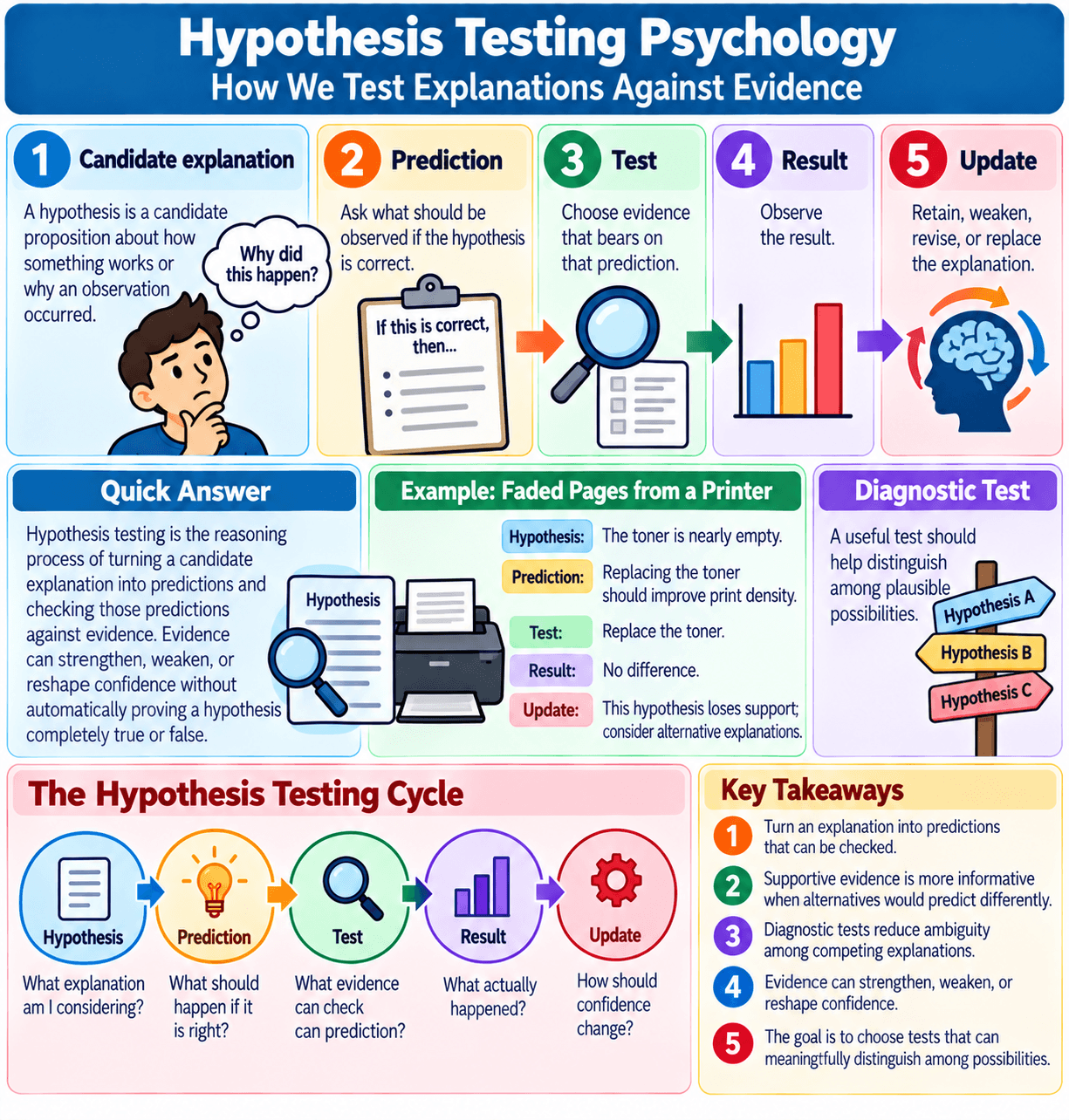
Hypothesis testing is the reasoning process of turning a candidate explanation into predictions and checking those predictions against evidence. A useful test should do more than produce a result consistent with the preferred explanation. It should help distinguish that explanation from plausible alternatives. Evidence can strengthen, weaken, or reshape confidence without automatically proving a hypothesis completely true or false.
What Hypothesis Testing Means in Psychology of Reasoning
Candidate explanation, prediction, test, and update
A hypothesis is a candidate proposition about how something works or why an observation occurred. To test it, the reasoner asks what should be observed if the hypothesis is correct, chooses evidence that bears on that prediction, and then updates the explanation in light of the result.
Suppose a printer repeatedly produces faded pages. One hypothesis is that the toner is nearly empty. That explanation predicts that replacing the toner should improve print density. If replacement makes no difference, the hypothesis loses support and alternatives such as a worn drum or incorrect print settings deserve more attention.
Why a hypothesis is not the same as a belief generally
A belief can be any proposition a person accepts as true. A hypothesis is more specific: it is being treated as a candidate explanation or proposition that can be evaluated through evidence.
You can believe that a machine is unreliable without having formed a precise hypothesis about which component is failing. Hypothesis testing begins when the claim becomes specific enough to generate informative expectations.
The Hypothesis Testing Cycle
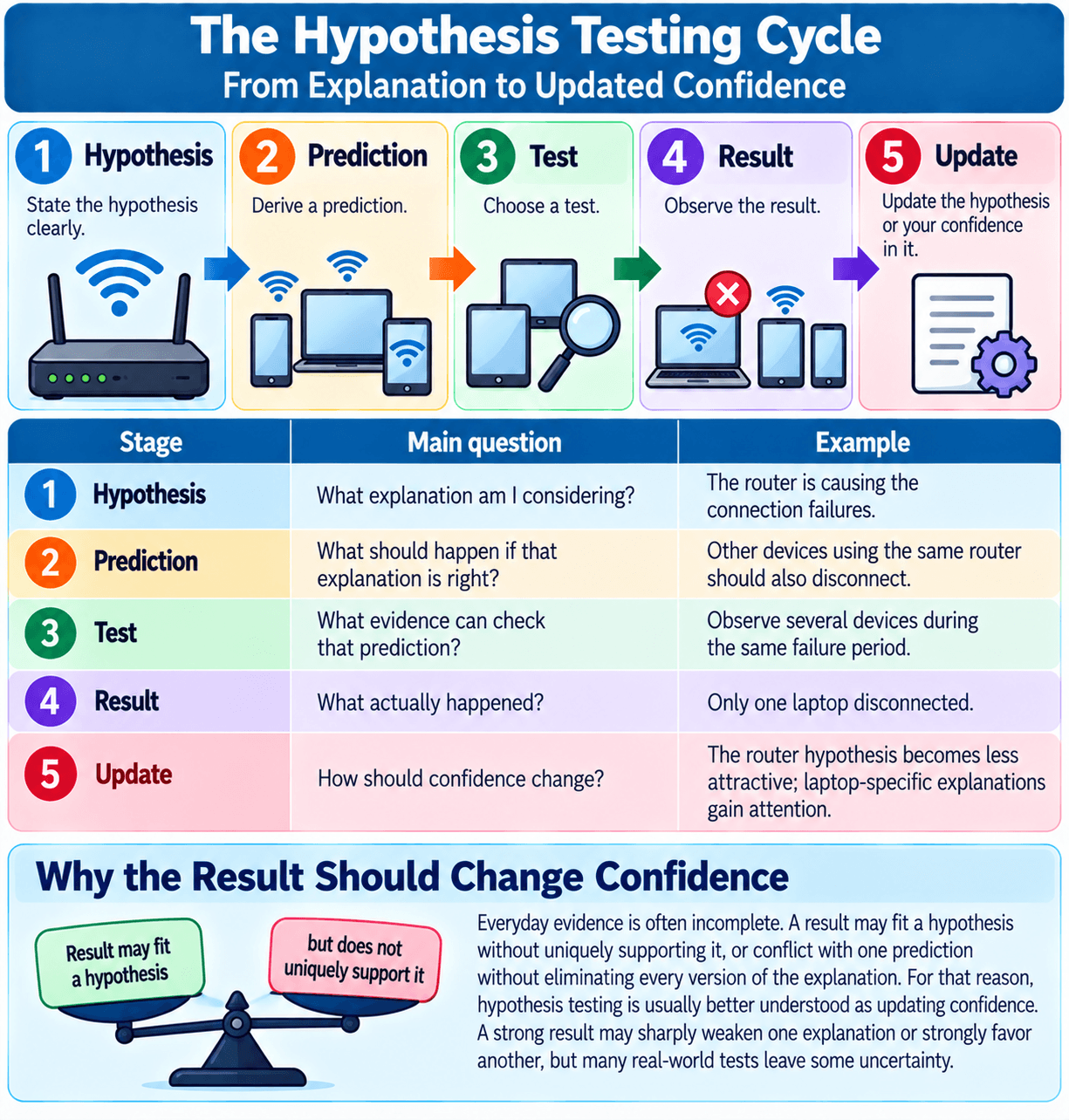
HYPOTHESIS → PREDICTION → TEST → RESULT → UPDATE
A practical model has five stages. First, state the hypothesis clearly. Second, derive a prediction. Third, choose a test. Fourth, observe the result. Fifth, update the hypothesis or your confidence in it.
| Stage | Main question | Example |
|---|---|---|
| Hypothesis | What explanation am I considering? | The router is causing the connection failures. |
| Prediction | What should happen if that explanation is right? | Other devices using the same router should also disconnect. |
| Test | What evidence can check that prediction? | Observe several devices during the same failure period. |
| Result | What actually happened? | Only one laptop disconnected. |
| Update | How should confidence change? | The router hypothesis becomes less attractive; laptop-specific explanations gain attention. |
Why the result should change confidence rather than simply label the hypothesis true or false
Everyday evidence is often incomplete. A result may fit a hypothesis without uniquely supporting it, or conflict with one prediction without eliminating every version of the explanation.
For that reason, hypothesis testing is usually better understood as updating confidence. A strong result may sharply weaken one explanation or strongly favor another, but many real-world tests leave some uncertainty.
From Hypothesis to Prediction
What should happen if the explanation is right?
A hypothesis becomes more testable when it generates a concrete expectation. “The app is unstable” is vague. “The app crashes when memory use exceeds a certain level” is more useful because it predicts a relationship between memory load and crashes.
The prediction should be specific enough that observations can count for or against it.
Which observations would be expected?
List the outcomes that fit the hypothesis. If a plant is wilting because the soil remains waterlogged, you might expect saturated soil, poor drainage, and improvement after excess water is reduced.
Expected evidence matters because it tells you what the hypothesis commits you to. Without that commitment, almost any result can be explained after the fact.
Which observations would be surprising?
Now ask what would be difficult to explain under the hypothesis. If the soil is consistently dry, drains quickly, and watering history shows no excess moisture, the waterlogging explanation becomes harder to maintain.
This question is often more informative than asking only what evidence would “support” your idea. A hypothesis earns credibility partly by surviving results that could have exposed its weaknesses.
Confirming and Disconfirming Evidence
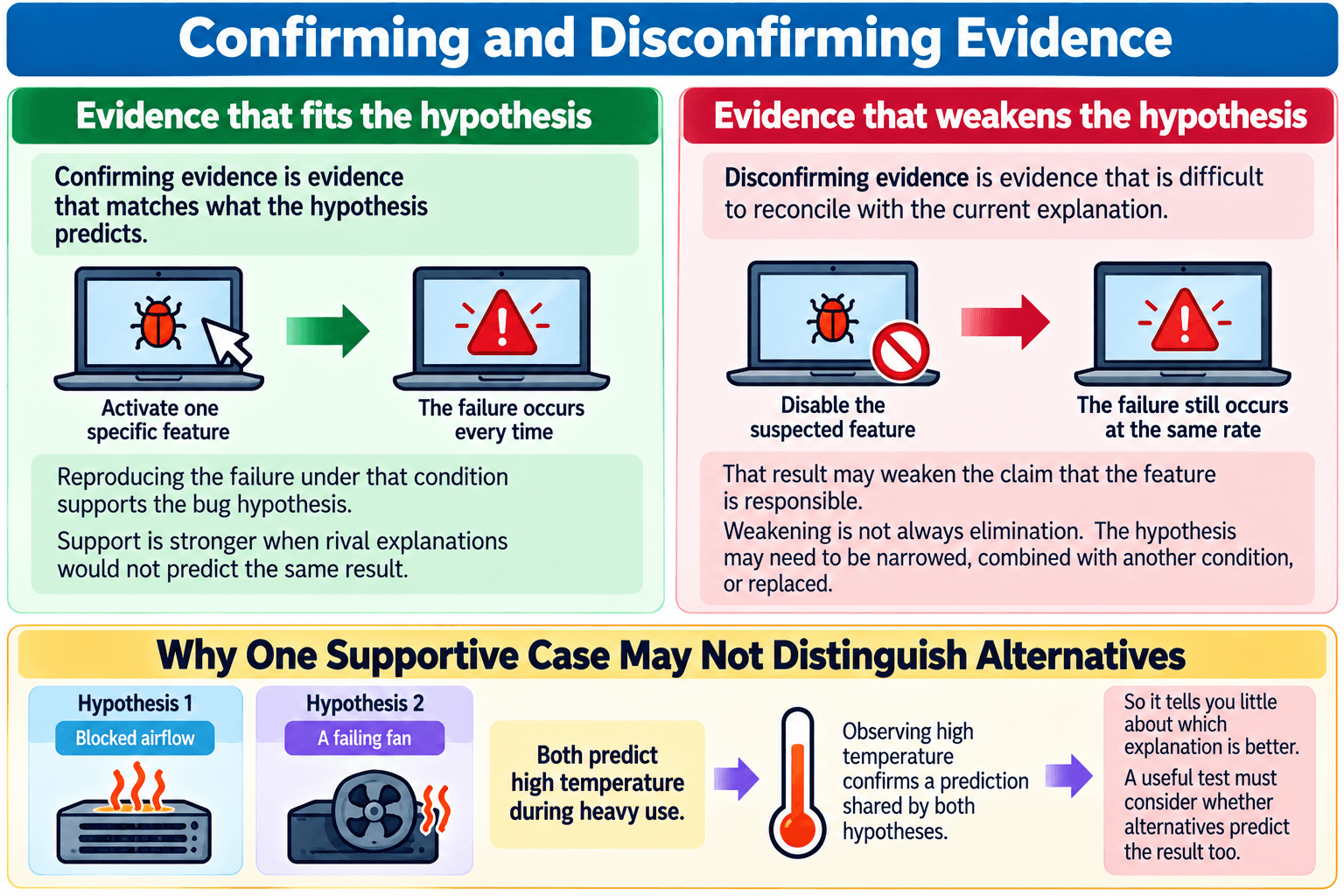
Evidence that fits the hypothesis
Confirming evidence is evidence that matches what the hypothesis predicts. If a suspected software bug occurs every time one specific feature is activated, reproducing the failure under that condition supports the bug hypothesis.
But support is stronger when rival explanations would not predict the same result.
Evidence that weakens the hypothesis
Disconfirming evidence is evidence that is difficult to reconcile with the current explanation. If the suspected feature is disabled and the same failure occurs at the same rate, that result may weaken the claim that the feature is responsible.
Weakening is not always elimination. The hypothesis may need to be narrowed, combined with another condition, or replaced.
Why one supportive case may not distinguish alternatives
Imagine two hypotheses for why a device overheats: blocked airflow and a failing fan. Both predict high temperature during heavy use. Observing high temperature confirms a prediction shared by both hypotheses, so it tells you little about which explanation is better.
A useful test must consider not only whether the preferred hypothesis predicts the result, but whether alternatives predict it too.
Why Repeated Support Can Stop Adding Much Information
Ten similar confirmations may answer the same question ten times
If every test repeats nearly the same conditions, repeated positive results can increase confidence that the pattern is real while adding little information about why it occurs. Ten crashes under the same high-load condition may establish reliability of the observation, but they may not distinguish memory pressure from heat, background software, or another factor that rises with load.
Evidence value depends on what alternatives remain open
The value of another test changes as the hypothesis space changes. Early evidence may rule out broad possibilities. Later tests should target the explanations that remain. Repeating an old test after it has already separated nothing new can create a feeling of accumulating proof without much increase in diagnostic value.
Variation can be more informative than repetition
Changing one relevant condition can reveal more than repeating the same setup. If failures disappear when memory use remains high but temperature is controlled, that result is more informative about competing causes than another ordinary high-load failure.
The point is not that repetition is useless. Replication can establish reliability. The question is whether your current goal is to confirm that a pattern exists or to determine which explanation best accounts for it.
Diagnostic Evidence and Competing Explanations
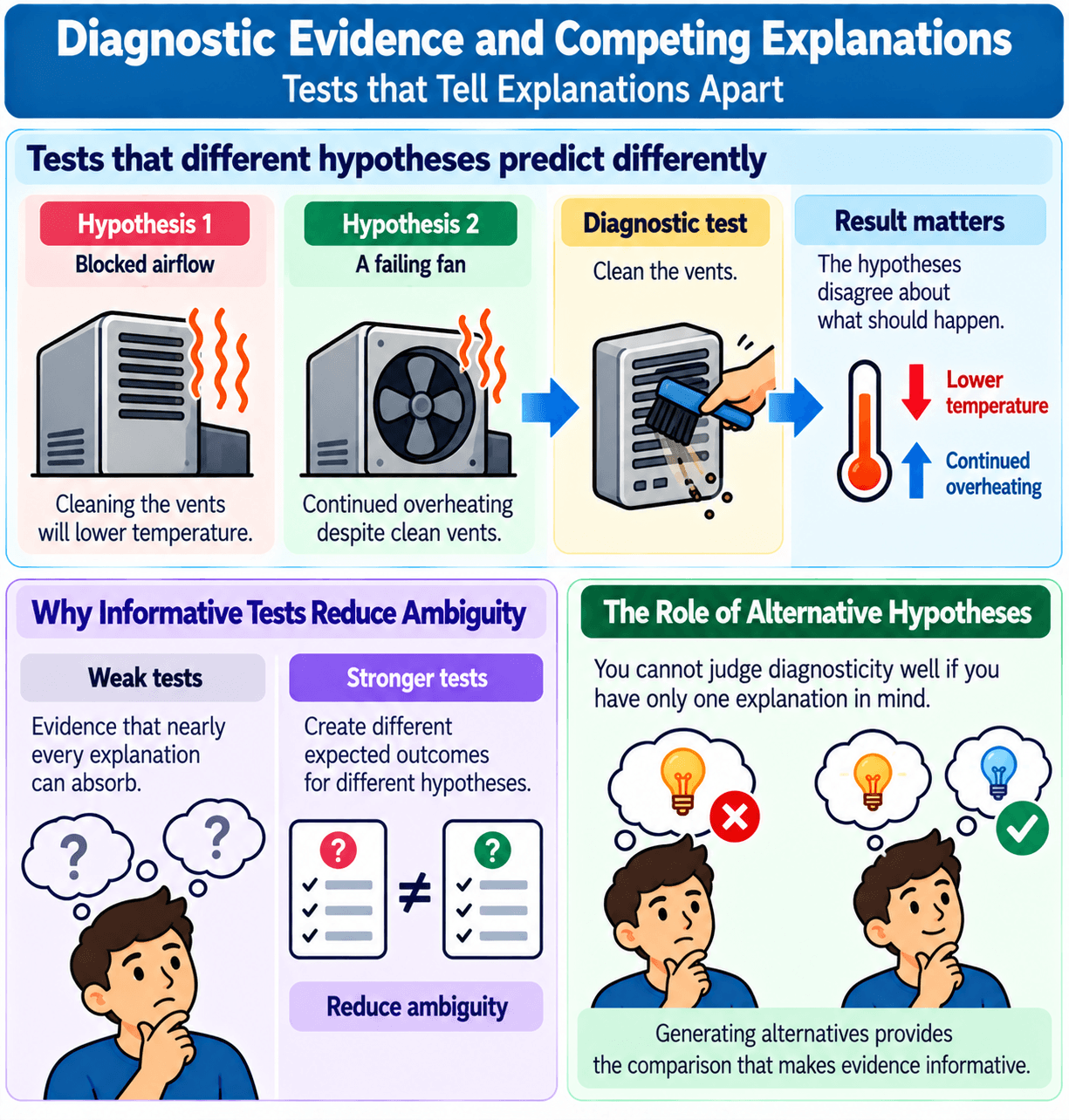
Tests that different hypotheses predict differently
Evidence is especially diagnostic when competing explanations lead to different expectations. If blocked airflow predicts that cleaning the vents will lower temperature, while a failing fan predicts continued overheating despite clean vents, cleaning the vents becomes a more informative test.
The result matters because the hypotheses disagree about what should happen.
Why informative tests reduce ambiguity
Many weak tests generate evidence that nearly every explanation can absorb. Stronger tests reduce ambiguity by creating different expected outcomes for different hypotheses.
Research on evidence selection in hypothesis-testing tasks found that instructions directing people to choose evidence that helps decide between a focal hypothesis and its alternative reduced less diagnostic response patterns. The wording of the goal can therefore change how informative the selected evidence becomes.
The role of alternative hypotheses
You cannot judge diagnosticity well if you have only one explanation in mind. A test may look excellent when evaluated against one hypothesis alone but become weak once a plausible alternative is introduced.
This is why generating alternatives is not merely an exercise in skepticism. Alternatives provide the comparison that makes evidence informative.
Positive Test Strategy
What it means to test cases predicted by a hypothesis
A positive test strategy means testing instances in which the property or relation predicted by the current hypothesis is expected to occur. If your hypothesis says a machine fails under high load, you may test it under high load rather than deliberately seeking a low-load case.
Joshua Klayman and Young-Won Ha’s influential paper on confirmation, disconfirmation, and information in hypothesis testing argued that many behaviors previously described as a general confirmation bias are better understood as positive testing.
Why positive testing can sometimes be informative
Testing a case predicted by your hypothesis is not automatically a reasoning error. If the hypothesis and its alternatives make different predictions about that case, the result can be highly diagnostic.
Later work has emphasized that the usefulness of a positive or negative test depends on the structure of the environment and the hypotheses being compared. A review of positive testing and information search similarly notes that preferences often labeled confirmatory can sometimes be compatible with more adaptive information-seeking goals.
When positive-only testing creates blind spots
Positive testing becomes weak when every selected case is one the favored hypothesis expects and plausible alternatives predict the same thing. The evidence may accumulate without helping distinguish among explanations.
It can also create blind spots when the reasoner never examines conditions where the preferred explanation makes a distinctive prediction or where a rival explanation would clearly outperform it.
The Wason 2-4-6 Task as Historical Context
What the task illustrates
In the classic 2-4-6 rule-discovery task, participants see the triple 2-4-6, are told that it follows an unknown rule, and generate additional triples to discover that rule. For each test, they receive feedback about whether the triple fits.
A historical review of Wason’s 2-4-6 task and its impact on reasoning research describes how the experiment became foundational to the study of hypothesis testing and bias.
Why classic findings should not be simplified into “people only seek confirmation”
Participants often form a relatively narrow initial rule and propose further examples that fit it. If the true rule is broader, those tests may repeatedly receive positive feedback without revealing that the hypothesis is too restrictive.
It is tempting to summarize this as “people only look for confirmation,” but later theory shows why that statement is too crude. Testing predicted cases can be rational in some environments. The problem in the 2-4-6 task is that the selected tests often fail to discriminate the narrow hypothesis from broader alternatives.
Bridge to later research on testing strategies
Modern work continues to use the task to study how alternative hypotheses and contrast cases improve testing. Recent open-access research on thinking in opposites during rule discovery found that prompting reasoners to consider contrasting possibilities can facilitate performance.
The broader lesson is not that every hypothesis should be attacked indiscriminately. It is that a useful test should be chosen with competing explanations in mind.
Three Examples of Stronger Test Design
Example 1: a device fails after twenty minutes
Hypothesis A says the device overheats. Hypothesis B says a background process starts after twenty minutes. Simply running the device again for twenty minutes is weak because both hypotheses predict failure. Monitoring temperature while disabling the background process creates a better comparison because the alternatives predict different patterns.
Example 2: a plant improves after watering
Hypothesis A says the plant was underwatered. Hypothesis B says it improved because it was moved away from direct heat at the same time. One improvement cannot separate those explanations. Future observations that vary water and heat exposure independently would provide more diagnostic evidence.
Example 3: a workflow slows every Friday
Hypothesis A says Friday demand is unusually high. Hypothesis B says one Friday-only approval step creates the delay. Checking total demand and queue location during the slowdown is more informative than simply confirming again that Fridays are slow.
Across all three examples, the stronger test is the one that creates a difference between what plausible explanations predict.
When a Prediction Fails
Check whether the prediction really followed from the hypothesis
A failed prediction matters only if the hypothesis genuinely committed you to that result. If the prediction depended on an unstated assumption, the failure may challenge that assumption rather than the entire explanation.
Check the quality of the observation
Measurement error, missing data, or an unreliable indicator can create an apparent failure. Before revising the hypothesis dramatically, ask whether the test actually measured what it was supposed to measure.
Revise the explanation only as much as the evidence requires
Sometimes a failed prediction eliminates a hypothesis. Sometimes it narrows it. If a machine fails only when high load and high temperature occur together, the original “high load alone causes failure” claim may need revision rather than complete abandonment.
This prevents two opposite mistakes: protecting a favored hypothesis from every negative result, and discarding a useful explanation after one ambiguous test.
Hypothesis Testing vs Confirmation Bias
General evidence-testing process
Hypothesis testing is the broader process of generating predictions, selecting evidence, interpreting results, and updating an explanation. It can be done well or poorly.
Biased evidence search or interpretation favoring an existing conclusion
Confirmation bias refers to patterns in which evidence search, interpretation, or memory systematically favors an existing belief or hypothesis. That bias can affect hypothesis testing, but it is not identical to the whole process.
Why the two concepts are not interchangeable
A person can test a hypothesis positively without being biased if the chosen test is informative. Conversely, a person can gather apparently disconfirming evidence in a biased way if the test unfairly favors an alternative.
The useful question is not “Was the test positive or negative?” but “Did the test discriminate among realistic possibilities?”
Hypothesis Testing vs Abductive Reasoning
Choosing a best current explanation
Abductive reasoning asks which explanation currently fits the observations best. You may compare several possible causes and choose one as the leading explanation.
Testing whether that explanation survives informative evidence
Hypothesis testing begins once that explanation is treated as testable. It asks what the explanation predicts, what alternatives predict, and which observation would separate them.
Abduction can therefore produce the candidate that hypothesis testing examines more deeply. This differs from inductive reasoning, which moves from observed cases toward a broader generalization rather than beginning with a specific explanation to test.
Hypothesis Testing vs Problem Solving
Testing an explanation
Hypothesis testing asks whether a claim about why something happens is supported by evidence. The object being tested is an explanation or proposition.
Testing a possible action or solution path
Problem solving asks whether a strategy moves the situation toward a goal. A solution can work even when the explanation for why it works is incomplete, and an explanation can be correct without immediately providing the best solution.
The two often interact in troubleshooting, but they answer different questions. Testing which explanation the evidence supports produces a conclusion, while choosing what action to take next belongs to the distinction between reasoning and decision making.
Hypothesis Testing vs Belief Formation and Belief Perseverance
Evaluating a candidate proposition
Hypothesis testing concerns evidence brought to bear on a specific candidate claim. Its focus is the relationship between prediction and result.
Broad origins of belief
Belief formation is broader. Beliefs can arise through direct experience, testimony, social learning, memory, inference, repetition, and many other routes.
Persistence after original support weakens
Belief perseverance concerns what happens when a belief remains influential after its original evidential support has been weakened or discredited. Hypothesis testing can provide the challenging evidence, but perseverance describes what happens afterward.
An Informative-Test Checklist
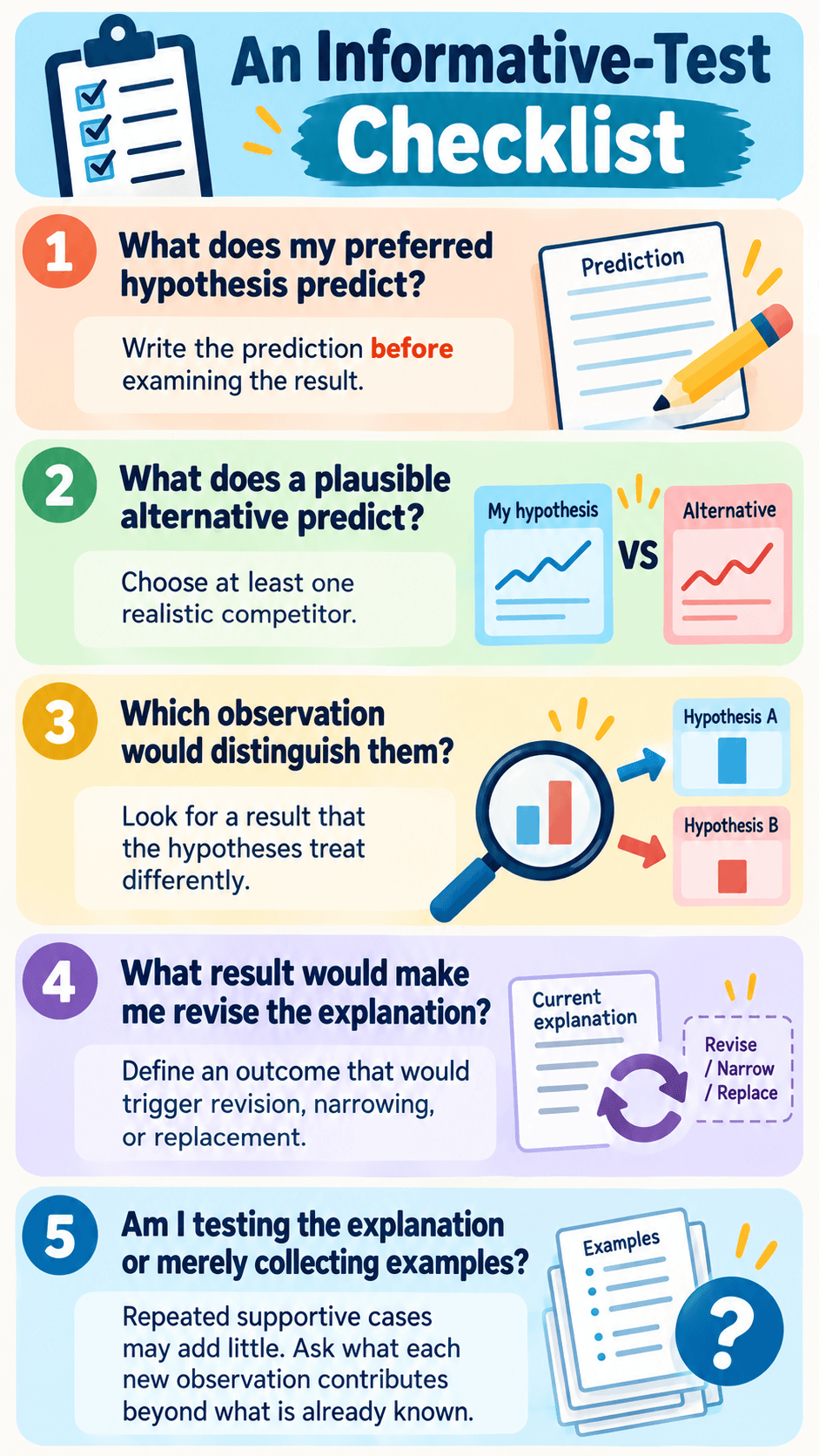
What does my preferred hypothesis predict?
Write the prediction before examining the result. This reduces the temptation to reinterpret any outcome as expected after it occurs.
What does a plausible alternative predict?
Choose at least one realistic competitor. A weak alternative makes the preferred hypothesis look stronger without genuinely testing it.
Which observation would distinguish them?
Look for a result that the hypotheses treat differently. The best test is often not the one most likely to produce a dramatic result, but the one that changes the relative standing of the alternatives.
What result would make me revise the explanation?
If no imaginable result would lower confidence, the hypothesis is not being tested in a meaningful sense. Define at least one outcome that would trigger revision, narrowing, or replacement.
Am I testing the explanation or merely collecting examples?
Examples can be useful, but repeated supportive cases may add little when every competitor predicts them too. Ask what each new observation contributes beyond the evidence already available.
When Simplified Hypothesis Testing Is Not Enough
Medical or mental-health self-diagnosis
Symptoms often fit many possible explanations, and the quality of a diagnostic test depends on prevalence, measurement, clinical context, and professional knowledge. A layperson can use hypothesis-testing ideas to organize questions, but should not treat a few matching symptoms or online checks as proof of a diagnosis.
When health or mental-health concerns are significant, qualified clinical evaluation is more appropriate than informal self-testing.
High-stakes domains requiring expert knowledge
Legal, financial, engineering, safety, and security questions can involve hidden variables, specialized standards, and consequences that are not obvious from everyday reasoning. The logic of competing hypotheses still matters, but expert knowledge may be necessary to know which hypotheses and tests are actually credible.
Missing or low-quality evidence
A well-designed comparison cannot create information that was never collected. Incomplete logs, unreliable measurements, biased samples, or ambiguous observations can leave several hypotheses unresolved.
In such cases, the appropriate update may be “still uncertain” rather than choosing whichever explanation has accumulated the most weakly supportive examples.
FAQ About Hypothesis Testing Psychology
Is positive test strategy the same as confirmation bias?
No. Positive testing means choosing cases where the hypothesis predicts the target property or outcome. That strategy can be informative when competing hypotheses make different predictions. Confirmation bias is a broader tendency for evidence search or interpretation to favor an existing belief in a systematically distorting way.
What makes evidence diagnostic?
Evidence is diagnostic when it changes how plausible one hypothesis is relative to another. A result predicted equally well by every competing explanation may be supportive in a loose sense but not very useful for deciding among them.
Does disconfirming evidence automatically prove a hypothesis false?
Not always. The result may depend on measurement quality, hidden conditions, or an overly broad version of the hypothesis. Disconfirming evidence should reduce confidence or trigger revision when it genuinely conflicts with the prediction, but interpretation still depends on what was actually tested.
How is hypothesis testing different from problem solving?
Hypothesis testing evaluates an explanation against evidence. Problem solving evaluates actions or paths toward a goal. Troubleshooting often uses both: first test what is causing the problem, then test which intervention solves it.
Key Takeaways
- Hypothesis testing turns a candidate explanation into predictions that can be checked against evidence.
- Supportive evidence is most informative when plausible alternatives would have predicted something different.
- Diagnostic tests reduce ambiguity by separating competing explanations rather than merely collecting more matching examples.
- Positive test strategy is not automatically confirmation bias; its value depends on the hypotheses and environment being tested.
- The Wason 2-4-6 task is historically important because it shows how repeated supportive feedback can leave an overly narrow hypothesis unchallenged.
- High-stakes or poorly measured problems may require expert knowledge, better data, or an explicit conclusion of continued uncertainty.
A useful next step is to take one explanation you currently favor and write down one plausible alternative. Then ask what observation the two explanations predict differently. That question changes hypothesis testing from “Can I find support for my idea?” to “What evidence would genuinely help me decide between possibilities?”

Michael Reed is the Founder and Lead Writer at Psychology Exposed. He writes about human behavior, relationships, emotional patterns, self-awareness, and practical psychology topics using research-informed, easy-to-understand content.
Read More About Michael Reed: https://psychologyexposed.com/michael-reed/