
A conclusion can sound sensible without being logically required, and it can sound strange while still following from the premises. That tension is at the heart of deductive reasoning. The task is not simply to decide whether a statement seems true. It is to ask whether the stated information leaves any possible case in which the premises are true but the conclusion is false.
Psychologists study deduction because people do not reason with bare logical forms alone. We interpret language, bring prior knowledge to the task, represent possibilities in different ways, and sometimes add assumptions that were never stated. A deductive problem therefore has two layers: the formal relationship between premises and conclusion, and the psychological process used to understand and evaluate that relationship.
Quick Answer
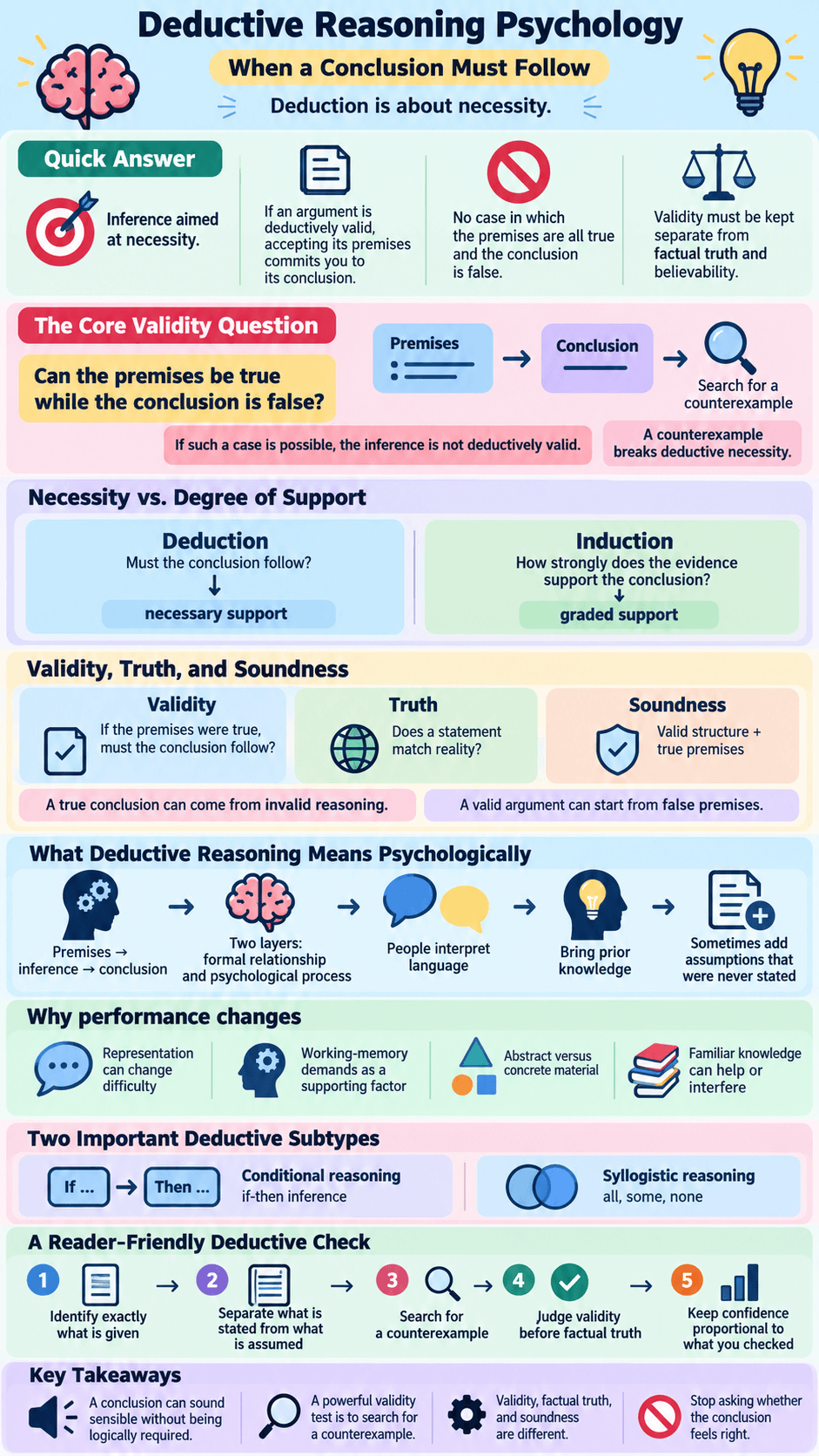
Deductive reasoning is inference aimed at necessity. If an argument is deductively valid, then accepting its premises commits you to its conclusion because there is no case in which the premises are all true and the conclusion is false. Psychology examines how people make these judgments, why content and representation affect performance, and why validity must be kept separate from factual truth and believability.
What Deductive Reasoning Means Psychologically
Premises, inference, and conclusion
A deductive argument begins with one or more premises, uses a relationship among them, and produces a conclusion. The premises are treated as the starting information for the task. The inference is the step connecting that information to what is claimed to follow.
The APA Dictionary of Psychology places deduction and induction within the broader idea of reasoning. For deduction, the distinctive question is not merely whether the conclusion is likely. It is whether the conclusion is required by the premises when the argument is valid.
Necessary support rather than degree of support
Suppose every badge in a box is metal, and the blue badge is in that box. If both premises are accepted, the blue badge must be metal. There is no room within those premises for the badge to be made of paper.
Now compare a different inference: most badges from this supplier are metal, so the next badge will probably be metal. That may be a strong prediction, but it is not deductively necessary. A future badge could be plastic without contradicting the starting information. Deduction is about necessity, while other forms of reasoning may provide graded support.
The Core Validity Question

Can the premises be true while the conclusion is false?
A reader-friendly test for deductive validity is simple to state: can you imagine a case that makes all the premises true while making the conclusion false? If such a case is possible, the inference is not deductively valid. If no such case is possible, the inference may be valid.
Consider: all red folders are archived. Some archived folders are locked. Therefore, some red folders are locked. The conclusion sounds possible, but it does not have to follow. The locked archived folders could all be blue, while the red folders remain unlocked. That imagined arrangement is enough to show that the conclusion is not guaranteed by the premises.
How a counterexample tests an inference
A counterexample is powerful because it does not require showing that the conclusion is actually false in the real world. It only needs to show a possible arrangement in which the premises hold and the conclusion fails. That is enough to break deductive necessity.
This idea is central to one influential psychological account of reasoning. A review of mental models and human reasoning describes deductive evaluation as involving possibilities compatible with the premises, with counterexamples playing a key role in identifying invalid inferences.
Why the test concerns structure, not personal agreement
The validity question can feel unnatural because everyday conversations usually mix logic with factual knowledge. If a premise sounds absurd, people understandably want to reject it. A formal deductive task temporarily asks a different question: assuming the premises for the purpose of the task, what follows?
You do not have to believe that all garden chairs are made of glass to evaluate an argument that begins with that premise. The temporary acceptance of a premise is part of testing the structure, not a statement about what you believe outside the task.
Validity, Truth, and Soundness

A valid argument can start from false premises
Validity is a relationship. It describes how the conclusion follows from the premises. It does not certify that those premises are factually correct.
For example: all rivers are made of silver. The Nile is a river. Therefore, the Nile is made of silver. The first premise is false, but the conclusion follows from the premises. This is why saying “the argument is valid” is not the same as saying “the conclusion is true in reality.”
A true conclusion can come from invalid reasoning
The reverse mistake is also common. A conclusion can be true by coincidence even when the stated premises do not establish it. Suppose all apples are fruit, and this object is fruit, therefore this object is an apple. The object could in fact be an apple, but the reasoning remains invalid because many other things are fruit.
Outcome and inference must be judged separately. A lucky conclusion does not repair a broken logical relationship.
Soundness as valid structure plus true premises
Soundness adds factual requirements to validity. A sound deductive argument has a valid structure and true premises. If both conditions are met, the conclusion is true.
| Question | What it asks | What it does not establish by itself |
|---|---|---|
| Validity | If the premises were true, must the conclusion follow? | Whether the premises are actually true |
| Truth | Does a statement match reality? | Whether it was reached by valid reasoning |
| Soundness | Is the argument valid and are its premises true? | Whether a person will find the conclusion believable |
How People Mentally Represent Deductive Problems
Translating words into relationships
Before anyone can evaluate a deduction, the premises have to be understood. A sentence such as “only registered members may enter” can be represented differently from “all registered members may enter.” Small linguistic differences can change which relationship is being expressed.
This is one reason psychological research does not treat every error as a failure of logic. A person may misread a quantifier, reverse a conditional relationship, overlook an alternative interpretation, or lose track of one premise while combining several others.
Why representation can change difficulty
Some arguments are easy to picture because they map onto familiar spatial or categorical relationships. Others require maintaining several possibilities that cannot all be directly visualized at once. Difficulty may increase when the reasoner must represent alternatives rather than a single obvious case.
Johnson-Laird’s review of deductive reasoning describes major theoretical approaches that have tried to explain human performance, including accounts based on factual knowledge, formal rules, and mental models. The important takeaway for a general reader is that psychologists do not assume there is one universally settled internal procedure for deduction.
Working-memory demands as a supporting factor
A deduction can become harder when several relations must be kept active while alternatives are compared. Working memory can therefore influence performance, especially as the number of possibilities grows. This does not mean deduction is simply a memory task. It means reasoning depends on other cognitive resources while the inference is being represented and checked.
The practical implication is modest: a difficult deduction may reflect the way information is represented and maintained, not a broad judgment about a person’s intelligence.
Why Content Changes Deductive Performance
Abstract versus concrete material
An abstract problem may use arbitrary letters or unfamiliar categories. A concrete problem may describe ordinary objects, actions, or rules. People often find some concrete versions easier because the content helps them interpret the relationship.
Content is not merely decoration. It can influence which possibilities people consider, which assumptions they add, and how a conditional statement is understood. A review of logic and human reasoning discusses how strongly context and content can affect performance on tasks designed to study deduction.
Familiar knowledge can help or interfere
Prior knowledge is useful when it clarifies what a sentence means. It can also interfere when the task asks about formal validity but the conclusion clashes with what the person already knows. Imagine being told, for the task, that every wooden object floats. If a conclusion derived from that premise conflicts with your knowledge of dense woods, the real-world knowledge may compete with the temporary task assumptions.
This competition does not make prior knowledge defective. Outside laboratory tasks, ignoring reality would often be a mistake. The challenge is recognizing which question is being asked: “Does this follow from these premises?” or “Is this actually true?”
Why psychological performance is not the same as formal validity
An argument is either valid or invalid under a specified logical interpretation, regardless of who evaluates it. Human performance is different. It can vary with wording, familiarity, complexity, attention, and interpretation.
This distinction protects against a common overreach. If someone answers one deduction incorrectly, that tells you something about performance on that item. It does not justify a diagnosis of poor intelligence, irrationality, cognitive impairment, or a general inability to reason.
Deductive Reasoning vs Inductive Reasoning
Necessity versus degree of evidential support
Deduction asks whether the conclusion must follow. Induction asks how strongly observations or examples support a broader conclusion. Both are forms of reasoning, but they operate with different standards.
| Feature | Deductive reasoning | Inductive reasoning |
|---|---|---|
| Main question | Must the conclusion follow? | How strongly does the evidence support the conclusion? |
| Ideal output | Valid or invalid inference | Stronger or weaker support |
| Role of exceptions | A counterexample defeats validity | Exceptions may weaken rather than completely destroy a generalization |
| Typical use | Rules, categories, necessary relations | Generalization and prediction from observations |
Why induction is not failed deduction
An uncertain conclusion is not automatically a bad conclusion. Much of everyday life requires reasoning from incomplete samples, past experience, or limited evidence. If the task does not allow certainty, demanding deductive necessity would be the wrong standard.
The important question is whether the form of support matches the claim. A deductive claim should survive every possible counterexample consistent with the premises. An inductive claim should reflect the quality and range of the evidence while leaving room for revision.
Two Important Deductive Subtypes

Conditional reasoning as if-then inference
Conditional reasoning focuses on statements such as “if P, then Q.” Certain inference forms are valid, while others are tempting but invalid under standard interpretations. For example, if a rule says that every activated device displays a green light, seeing an activated device allows the green-light conclusion under the rule. Seeing a green light, however, does not automatically prove the device was activated because another condition might also produce the light.
That narrow family of if-then relations deserves its own treatment because everyday conditional language includes exceptions, permissions, causes, and conversational assumptions. The broad concept of deduction should not be reduced to conditional reasoning alone.
Syllogistic reasoning as categorical premise integration
Syllogistic reasoning works with categorical relationships such as all, some, and none. “All A are B, all B are C, therefore all A are C” is a simple example. The task is to integrate the category relations and determine what must follow.
Syllogisms are especially useful for studying how formal structure can conflict with familiar knowledge. They therefore overlap with research on belief effects, but the categorical structure itself is a distinct topic.
Why each needs its own deeper treatment
Conditional and syllogistic reasoning are both deductive, yet they involve different structures, common errors, and research paradigms. Treating them as separate topics prevents a broad overview of deduction from becoming an overloaded catalog of inference forms.
Three Everyday Validity Checks
A workplace rule
Suppose a workplace rule says: every document marked confidential must be stored in the secure cabinet. This document is marked confidential. Therefore, it must be stored in the secure cabinet. If both premises are accepted as stated, the conclusion follows. The rule applies to every item in that category, and the document has been placed inside the category.
Now change the conclusion: this document is in the secure cabinet, therefore it must be confidential. That does not follow. The cabinet may contain other protected material as well. The conclusion may be true, but another possible case remains, so necessity is lost.
A category example
Suppose all orchids in a greenhouse are tagged, and all tagged plants are recorded in a database. If a particular plant is an orchid in that greenhouse, it follows that the plant is recorded. The relations chain together.
If the premises instead say that some tagged plants are recorded, the same conclusion no longer follows for every orchid. A small change in a quantifier changes the logical commitment. This is why words such as all, some, none, only, and every deserve careful attention.
A conclusion that is true for the wrong reason
Imagine: all bicycles have wheels. This object has wheels. Therefore, this object is a bicycle. You then look up and discover that the object really is a bicycle. The conclusion is true, but the inference is still invalid because cars, carts, and many other objects also have wheels.
This example is useful because it removes the temptation to judge reasoning by the outcome alone. A correct answer can be reached through an invalid route. Deductive evaluation asks whether the route itself guarantees the result.
What Deductive Reasoning Does Not Prove
It does not prove the premises are accurate
Deduction can preserve truth from premises to conclusion when the inference is valid, but it cannot independently verify the premises. If the starting information is false, outdated, incomplete, or misunderstood, valid reasoning can still produce a conclusion that is useless in the real world.
It does not tell you which premises are worth accepting
Questions about evidence quality belong partly outside deduction itself. Before relying on a real-world argument, you may need observation, measurement, expert knowledge, or another form of reasoning to decide whether the premises deserve acceptance.
It does not automatically tell you what action to choose
A valid conclusion can inform a decision without making the decision for you. Suppose you validly conclude that two options both meet a safety requirement. You still need preferences, costs, goals, or constraints to choose between them. Reaching a conclusion and selecting an action are related but distinct cognitive tasks.
It does not guarantee freedom from bias or misunderstanding
A person may apply a valid rule to a misread premise, overlook an alternative interpretation, or accept a faulty starting assumption. Deductive structure is valuable, but it is one part of good reasoning rather than a guarantee that every step around it is correct.
When a Conclusion Feels Wrong Even When the Structure Is Valid
Believability as a source of conflict
People do not enter a reasoning task with empty minds. Existing knowledge makes some conclusions seem plausible and others absurd. When believability and validity point in different directions, judgment may become more difficult.
Research on belief and logical validity in deductive reasoning shows that the interaction is more complex than a simple story in which fast belief always defeats slow logic. The amount and direction of interference can depend on the structure and complexity of the reasoning problem.
Why this is different from general belief psychology
The issue here is not how a belief formed, why it persists, or whether a person changes their worldview. The narrow problem is whether the believability of a conclusion influences the judgment of logical validity.
This distinction matters because the same person can know that a conclusion is implausible in the real world and still correctly judge that it follows from premises supplied for a formal task.
A Reader-Friendly Deductive Check
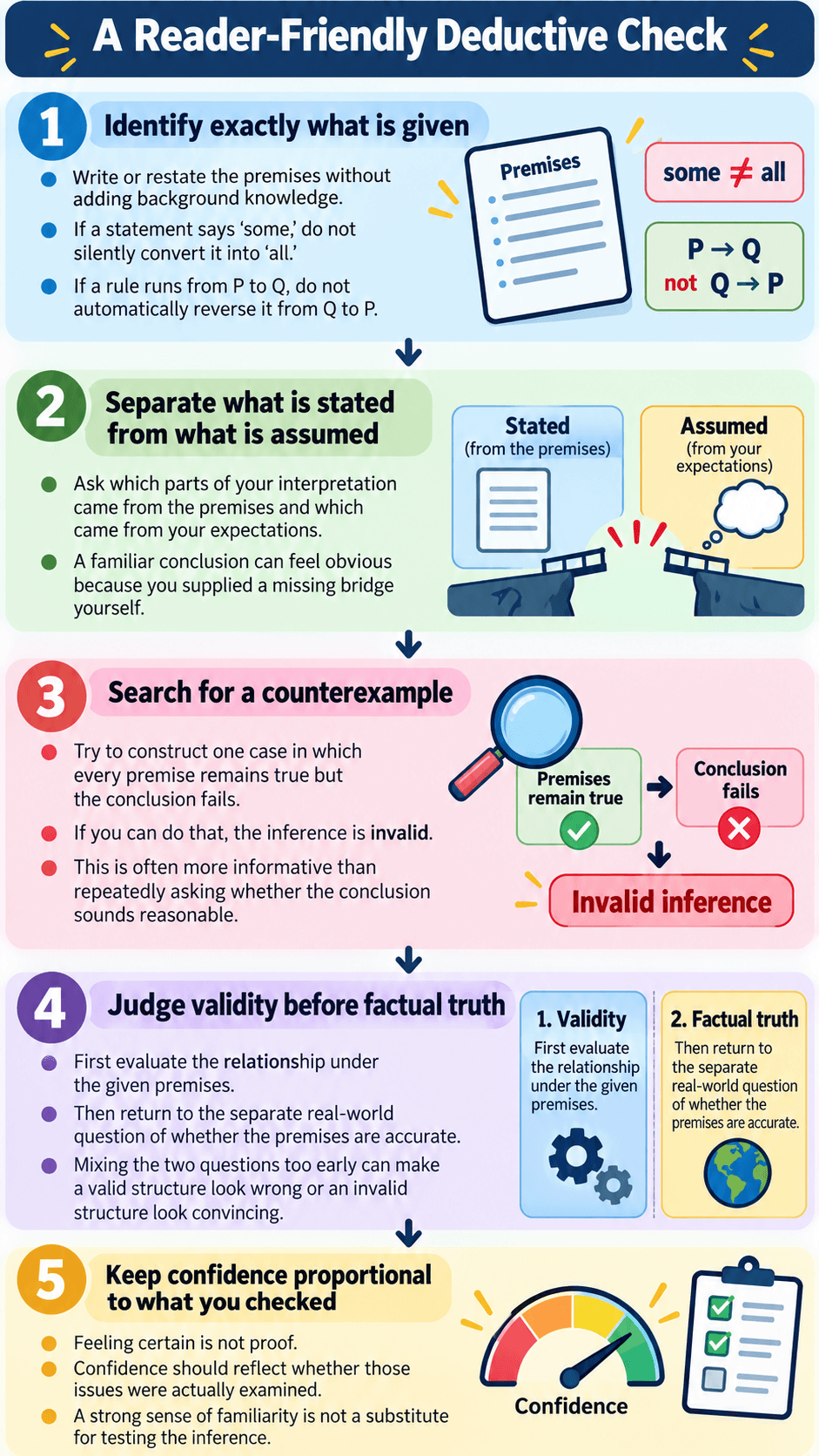
1. Identify exactly what is given
Write or restate the premises without adding background knowledge. If a statement says “some,” do not silently convert it into “all.” If a rule runs from P to Q, do not automatically reverse it from Q to P.
2. Separate what is stated from what is assumed
Ask which parts of your interpretation came from the premises and which came from your expectations. A familiar conclusion can feel obvious because you supplied a missing bridge yourself.
3. Search for a counterexample
Try to construct one case in which every premise remains true but the conclusion fails. If you can do that, the inference is invalid. This is often more informative than repeatedly asking whether the conclusion sounds reasonable.
4. Judge validity before factual truth
For a formal deduction, first evaluate the relationship under the given premises. Then return to the separate real-world question of whether the premises are accurate. Mixing the two questions too early can make a valid structure look wrong or an invalid structure look convincing.
5. Keep confidence proportional to what you checked
Feeling certain is not proof. If the argument contains several premises, unusual wording, or alternative interpretations, confidence should reflect whether those issues were actually examined. A strong sense of familiarity is not a substitute for testing the inference.
Common Mistakes in Everyday Talk About Logic
Treating “logical” as “factually correct”
People often praise a claim as logical when they simply mean that it sounds sensible. In deduction, logical validity has a narrower meaning. It concerns whether the conclusion follows from the premises.
Assuming a true conclusion proves valid reasoning
A person can reach the right answer for the wrong reason. If the premises do not force the conclusion, the inference is invalid even when the conclusion happens to be true.
Assuming an unbelievable conclusion must be invalid
Unbelievable content can trigger rejection before the structure is evaluated. A useful correction is to ask what follows if the premises are temporarily accepted, then separately decide whether those premises deserve belief in the real world.
Assuming one logic error reveals general ability
Deductive tasks vary greatly in wording, complexity, familiarity, and memory demands. Performance on one item is too narrow a basis for labeling someone intelligent, unintelligent, rational, or irrational.
What to Examine Next
If the rule is specifically if-then
The next question is usually about conditional reasoning: which conclusions follow from “if P, then Q,” and why certain invalid forms remain tempting. That topic allows a more precise discussion of necessary and sufficient conditions.
If the premises describe groups or categories
Syllogistic reasoning is the better lens when the premises use relations such as all, some, or none. The central challenge becomes integrating categorical information without letting familiar content replace the structural check.
If believability keeps pulling the judgment
Belief bias becomes the more precise topic when the main problem is conflict between whether a conclusion seems believable and whether it is logically valid. That distinction prevents a general article about deduction from absorbing a separate psychological mechanism.
FAQ About Deductive Reasoning
Can a deductively valid argument have a false conclusion?
Yes, if one or more premises are false. Validity guarantees only that a true set of premises cannot lead to a false conclusion through a valid inference. It does not guarantee that the premises describe reality. A valid argument with false premises may therefore end in a false conclusion.
Is soundness the same as validity?
No. Validity concerns the relationship between premises and conclusion. Soundness requires validity plus true premises. This distinction is useful because it separates the structural question from the factual question.
Why are concrete examples sometimes easier than abstract ones?
Concrete material can make relationships easier to interpret and may help people retrieve relevant knowledge. However, familiar content can also interfere when real-world beliefs conflict with the formal structure. Easier interpretation and stronger validity judgment are not always the same thing.
Does making a deductive error mean someone has low intelligence?
No. Reasoning performance is influenced by representation, wording, task familiarity, memory demands, prior knowledge, and the particular inference being tested. A single error does not justify a broad conclusion about intelligence or cognitive health.
Key Takeaways
- Deductive reasoning asks whether a conclusion must follow from the stated premises, not merely whether it seems plausible.
- A powerful validity test is to search for a case where all premises are true but the conclusion is false.
- Validity, factual truth, and soundness are different judgments and should not be collapsed into one.
- Content, language, prior knowledge, and mental representation can influence how people perform on deductive tasks.
- Conditional and syllogistic reasoning are important deductive subtypes, but each has its own structures and research questions.
- A reasoning error on one task should not be treated as evidence of low intelligence or a cognitive disorder.
The most useful next step when evaluating a deduction is to stop asking whether the conclusion feels right and identify the exact commitment created by the premises. State what is given, remove assumptions that were added automatically, and look deliberately for a counterexample. That single shift turns a vague impression of “logic” into a clearer test of whether the conclusion really has to follow.

Michael Reed is the Founder and Lead Writer at Psychology Exposed. He writes about human behavior, relationships, emotional patterns, self-awareness, and practical psychology topics using research-informed, easy-to-understand content.
Read More About Michael Reed: https://psychologyexposed.com/michael-reed/
3 thoughts on “Deductive Reasoning Psychology: When a Conclusion Must Follow”