
Reasoning and decision making often happen close together, which is why they are easy to treat as the same thing. You may reason about what the evidence supports and then make a choice based on that conclusion. But the two processes answer different questions and produce different kinds of outputs.
Reasoning asks what follows from information, evidence, premises, or rules. Decision making asks which option to choose among alternatives. A conclusion can inform a choice without being the choice itself. Keeping that distinction clear also makes it easier to see where problem solving, attribution, and metacognition fit.
Quick Answer
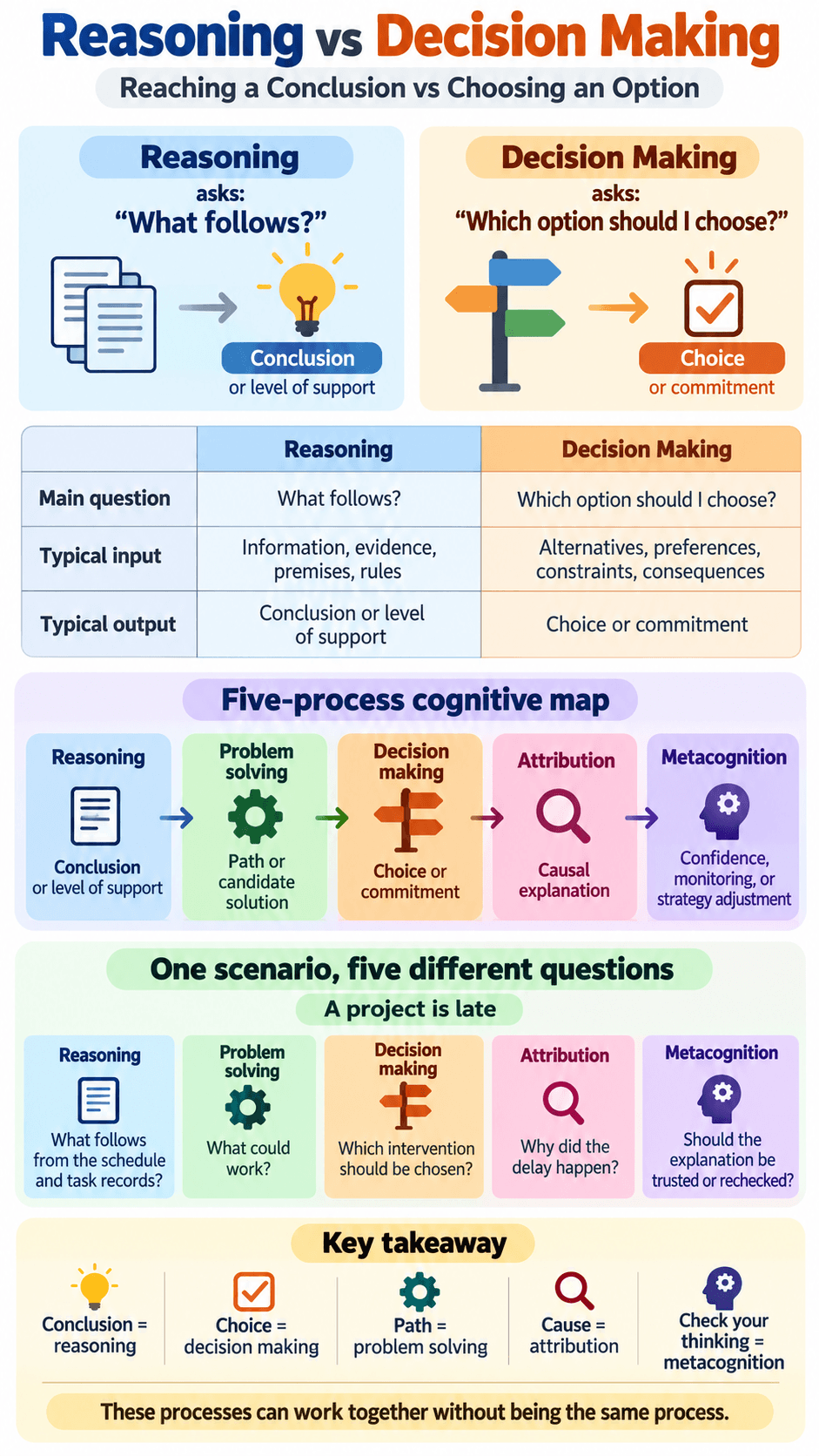
Reasoning and decision making are related but distinct cognitive processes. Reasoning asks what follows from information and typically produces a conclusion or level of support. Decision making asks which option to choose and typically produces a choice or commitment. Reasoning can inform decisions, but choices also depend on preferences, goals, constraints, and consequences that evidence alone does not determine.
The Core Difference: Conclusion vs Choice
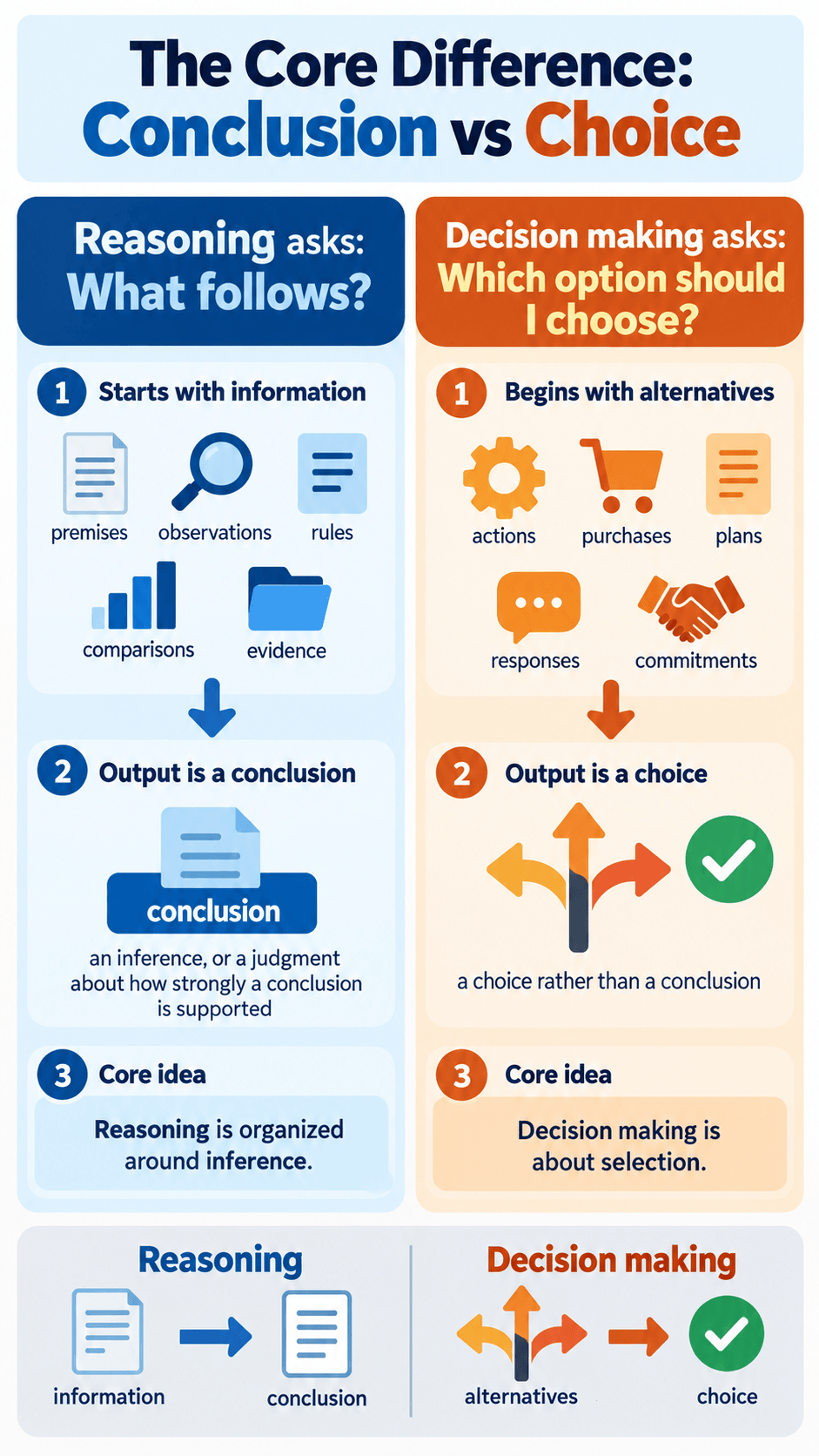
Reasoning asks “What follows?”
Reasoning starts with information and asks what can be concluded from it. The input may be premises, observations, rules, comparisons, or evidence. The output is usually a conclusion, an inference, or a judgment about how strongly a conclusion is supported.
The APA Dictionary definition of reasoning describes reasoning as thinking that uses inductive or deductive processes to draw conclusions from facts or premises. That definition captures the central feature: reasoning is organized around inference.
Decision making asks “Which option should I choose?”
Decision making begins when there are alternatives and some kind of selection must occur. The alternatives may be actions, purchases, plans, responses, or commitments. The output is a choice rather than a conclusion.
The APA Dictionary definition of decision making describes it as the cognitive process of choosing between two or more alternatives. That makes the boundary concrete: a decision is about selection.
Reasoning Psychology in One Frame
Inputs such as premises, observations, rules, and evidence
Reasoning can begin with many kinds of information. Deductive reasoning may start with premises and ask what must follow. Inductive reasoning may start with observed cases and ask what broader conclusion they support. Abductive reasoning may start with an observation and compare possible explanations.
The specific reasoning form changes, but the common feature remains the same. Information is transformed into a conclusion or an evaluation of a conclusion.
Typical output: a conclusion or level of support
A reasoning output might be “the conclusion is valid,” “this explanation fits better,” “the evidence supports this generalization,” or “the available evidence is not strong enough to justify the claim.” None of these outputs necessarily tells you what action to take.
You can conclude that a route is faster without deciding to take it. You can conclude that one explanation is better supported without deciding what intervention to use. Reasoning can stop at a conclusion.
Decision Making in One Frame
Alternatives, preferences, constraints, and consequences
A decision requires alternatives and some basis for selecting among them. Evidence may matter, but so do preferences, goals, costs, constraints, obligations, and expected consequences.
If two routes are available, reasoning may tell you that Route A is faster. The decision still depends on whether speed is your priority. Route B may be safer, cheaper, more scenic, or the only route compatible with another commitment.
Typical output: a choice or commitment
The output of decision making is “choose A,” “take B,” “wait,” “decline,” or some other commitment among available options. A decision may be tentative or reversible, but it still moves from alternatives toward selection.
This output is different from a conclusion about the world. “Option A has the strongest evidence behind it” is a judgment. “I will choose Option A” is a decision.
Side-by-Side Comparison
| Process | Main question | Typical input | Typical output |
|---|---|---|---|
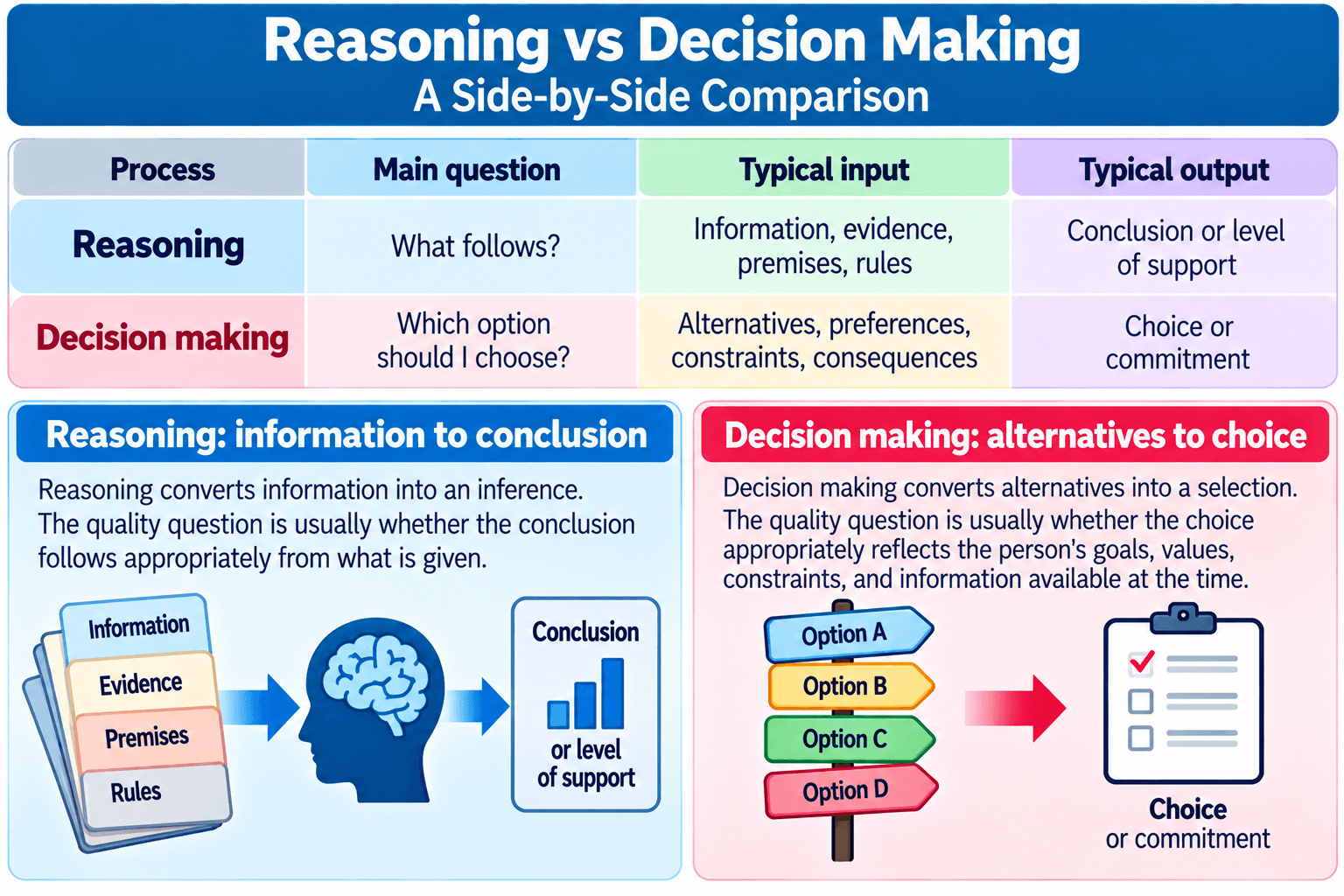
| Reasoning | What follows? | Information, evidence, premises, rules | Conclusion or level of support |
| Decision making | Which option should I choose? | Alternatives, preferences, constraints, consequences | Choice or commitment |
Reasoning: information to conclusion
Reasoning converts information into an inference. The quality question is usually whether the conclusion follows appropriately from what is given.
Decision making: alternatives to choice
Decision making converts alternatives into a selection. The quality question is usually whether the choice appropriately reflects the person’s goals, values, constraints, and information available at the time.
Where Problem Solving Fits
Problem solving asks “What could work?”
Problem solving begins with a gap between a current state and a desired state. The solver looks for a workable route, method, or solution that can reduce that gap.
The APA Dictionary description of problem solving emphasizes attempts to overcome difficulties or move from a starting situation toward a desired goal. Its typical output is therefore a path or candidate solution.
Typical output: a path or candidate solution
If a website is loading slowly, problem solving might generate several possible fixes: reduce image size, improve caching, change hosting, or inspect a plugin conflict. These are candidate paths toward a goal.
Reasoning may then evaluate what the evidence says about the source of the slowdown. Decision making may then select which intervention to try first.
Why this comparison is not the same as Problem Solving vs Decision Making
The central contrast here is conclusion versus choice. Problem solving is included only to show that “finding a possible path” is yet another output.
A dedicated comparison of problem solving and decision making should focus on path versus choice. This article does not recreate that distinction or teach a full problem-solving cycle.
Where Attribution Fits
Attribution asks “Why did this happen?”
Attribution focuses on causal explanation, especially explanations for behavior and interpersonal events. The APA Dictionary entry on attribution describes it as an inference about the cause of a person’s behavior or an interpersonal event.
An attribution therefore has a more specific target than reasoning in general. It asks what caused an outcome or behavior.
Why causal explanation is narrower than reasoning generally
All attributions involve some form of inference, but not all reasoning is attribution. A deductive conclusion about category membership, an inductive generalization from several observations, or a comparison of two explanations need not concern why a person behaved in a certain way.
This distinction prevents every explanation from being labeled attribution and prevents attribution psychology from absorbing the broader study of reasoning.
Where Metacognition Fits
Metacognition asks how much to trust, check, or adjust one’s thinking
Metacognition concerns awareness and regulation of one’s own cognitive processes. The APA Dictionary definition of metacognition emphasizes awareness of one’s cognitive processes and attempts to control them.
In practice, metacognition may ask whether confidence is justified, whether a strategy is working, whether an answer deserves another check, or whether more information is needed.
Why confidence is not the same as conclusion quality
You can be highly confident in a weak conclusion or uncertain about a strong one. Confidence is a judgment about your own cognition, while conclusion quality depends on the relationship between evidence and inference.
Metacognition can improve reasoning by prompting review, but confidence itself does not make a conclusion valid or well supported.
How the Processes Can Occur in Sequence
Problem solving → reasoning → decision as one possible sequence
Imagine a service repeatedly failing. Problem solving generates possible paths to investigate or repair it. Reasoning evaluates what the logs and tests imply about the cause. Decision making selects which intervention to implement.
This sequence is useful, but it is only one possible arrangement. Human cognition does not always move through a fixed pipeline.
Reasoning before a decision
You may first reason that one explanation is better supported than another, then use that conclusion when choosing an action. A medical professional might infer that one diagnosis is more plausible and then choose among tests or treatments based on additional clinical considerations.
The conclusion informs the choice but does not determine it by itself.
Reasoning after options already exist
Sometimes alternatives are given from the start. You may already know that you can buy Product A or Product B. Reasoning is then used to evaluate claims about durability, price, reliability, or compatibility before making the selection.
In this case, decision structure exists before the reasoning episode.
Decisions with little explicit reasoning
People sometimes choose quickly based on habit, preference, convention, or a learned rule. Selecting a familiar breakfast or taking the usual route to work may involve little explicit comparison.
A decision has still occurred because one option was selected, even if the person did not consciously build a chain of reasoning first.
Reasoning with no decision at all
You can also reason without needing to choose anything. A student may determine whether an argument is valid. A reader may decide which explanation best fits a historical observation. A scientist may conclude that current evidence is inconclusive.
These are reasoning outcomes even when no action follows.
Evidence vs Preferences
What evidence can support
Evidence can support claims about what is true, likely, effective, consistent, or causally plausible. It can tell you that one route is faster, one product fails less often, or one explanation fits more observations.
Reasoning organizes that evidence into conclusions.
What values and constraints contribute to a choice
Choices involve more than factual support. A person may value cost over speed, privacy over convenience, flexibility over maximum performance, or stability over novelty.
Constraints also matter. Time, money, obligations, eligibility, available resources, and other limits can remove options regardless of what the evidence says about their abstract quality.
Why a sound inference does not select values for the reader
Suppose the evidence strongly supports the conclusion that Option A is fastest and Option B is cheapest. Reasoning can establish those relationships. It cannot decide whether speed or cost should matter more to you.
That final weighting belongs to the choice process. Evidence can inform preferences but cannot automatically supply a person’s values.
Logical Validity vs Decision Value
A valid conclusion can still be based on poor premises
Deductive validity concerns whether a conclusion follows from premises, not whether those premises are factually correct. A perfectly valid inference can therefore start from false or outdated information.
Using that conclusion in a decision may produce a poor choice if the premises do not match reality.
A good inference can still support a poor decision if goals or constraints are wrong
You may reason correctly that a particular plan maximizes revenue, yet still make a poor decision if the actual goal was stable cash flow or low risk. The inference may be sound relative to one criterion while the choice fails to match the real objective.
Decision quality therefore cannot be reduced to logical validity.
A decision can be reasonable even when evidence remains uncertain
Many choices cannot wait for complete information. A person may need to act while several conclusions remain uncertain. In those situations, a reasonable choice can reflect the best available evidence plus goals, constraints, and tolerance for uncertainty.
This does not make every uncertain choice equally good. It means that decision making often requires commitment before reasoning can deliver certainty.
Conclusion Quality vs Outcome Quality
Good reasoning does not guarantee a good outcome
A well-supported conclusion and a carefully considered choice can still lead to an unfavorable outcome when chance or unknown factors matter. Good process improves the basis for action but cannot control everything that happens afterward.
Research on outcome bias in decision evaluation found that people rated decision thinking more favorably when the eventual outcome was favorable, even when evaluators had the same information that was available to the decision maker beforehand.
A lucky outcome does not prove the reasoning was good
The reverse problem also occurs. A poor process can produce a good result by luck. If someone ignores strong evidence, makes a risky choice for weak reasons, and happens to succeed, the outcome does not retroactively make the reasoning sound.
Separating process quality from outcome quality is important whenever uncertainty or chance plays a role.
Evaluate the process using information available at the time
A fair evaluation asks whether the reasoning and decision were appropriate given what was known before the outcome occurred. Later knowledge can be useful for learning, but it should not be silently projected backward as though it was available earlier.
This protects against judging every good outcome as evidence of good thinking and every bad outcome as evidence of bad thinking.
A Five-Process Cognitive Map
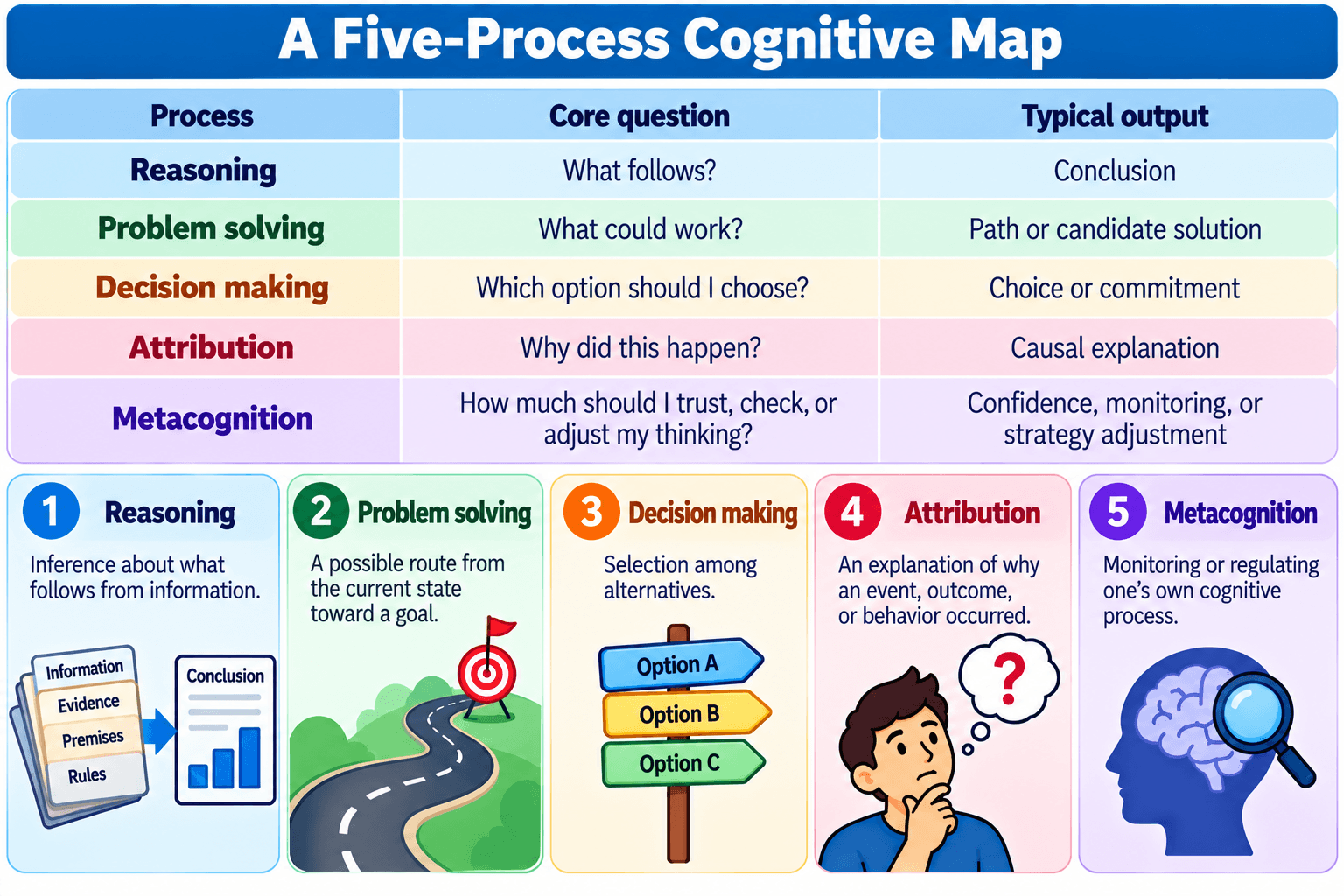
| Process | Core question | Typical output |
|---|---|---|
| Reasoning | What follows? | Conclusion |
| Problem solving | What could work? | Path or candidate solution |
| Decision making | Which option should I choose? | Choice or commitment |
| Attribution | Why did this happen? | Causal explanation |
| Metacognition | How much should I trust, check, or adjust my thinking? | Confidence, monitoring, or strategy adjustment |
Reasoning → conclusion
The defining output is an inference about what follows from information.
Problem solving → path
The defining output is a possible route from the current state toward a goal.
Decision making → choice
The defining output is selection among alternatives.
Attribution → causal explanation
The defining output is an explanation of why an event, outcome, or behavior occurred.
Metacognition → confidence, check, or strategy adjustment
The defining output is monitoring or regulating one’s own cognitive process, including whether to trust, recheck, or change strategy.
Which Process Fits the Question You Are Asking?
“What follows from this information?” → reasoning
Use this frame when the goal is to derive or evaluate a conclusion. The central relationship is between evidence and inference.
“What could work?” → problem solving
Use this frame when the goal is to generate or test a path toward a desired state.
“Which option should I choose?” → decision making
Use this frame when alternatives already exist and a selection must be made.
“Why did this happen?” → attribution
Use this frame when the target is causal explanation, especially for behavior or interpersonal outcomes.
“How much should I trust or recheck my thinking?” → metacognition
Use this frame when the main issue is confidence, monitoring, error checking, or strategy adjustment.
One Scenario, Five Different Cognitive Questions
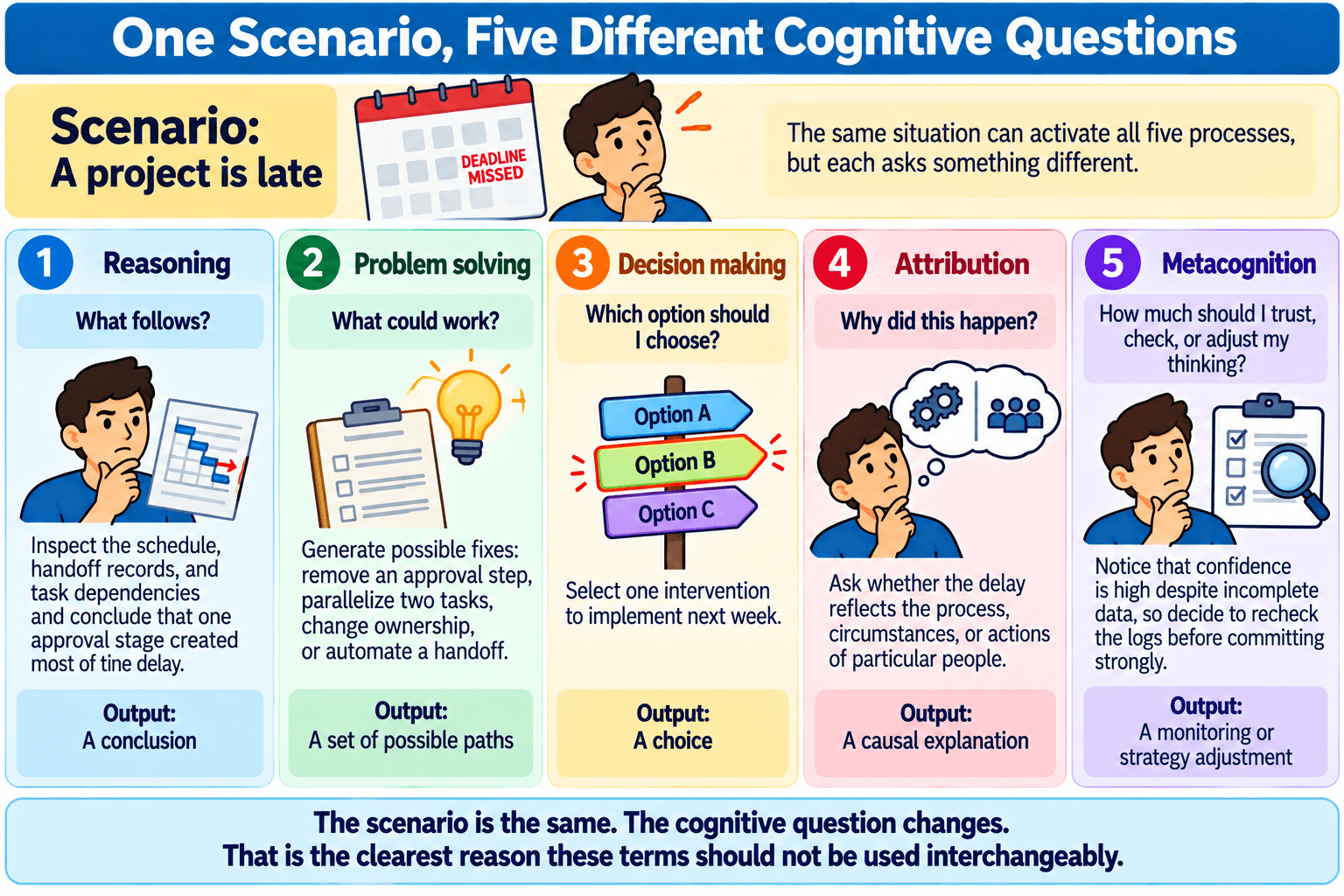
A project is late
Imagine a project that has missed its deadline. The same situation can activate all five processes, but each asks something different.
Reasoning
You inspect the schedule, handoff records, and task dependencies and conclude that one approval stage created most of the delay. The output is a conclusion.
Problem solving
You generate possible fixes: remove an approval step, parallelize two tasks, change ownership, or automate a handoff. The output is a set of possible paths.
Decision making
You select one intervention to implement next week. The output is a choice.
Attribution
You ask why the delay happened and whether it reflects the process, circumstances, or actions of particular people. The output is a causal explanation.
Metacognition
You notice that your confidence in the explanation is high despite incomplete data, so you decide to recheck the logs before committing strongly. The output is a monitoring or strategy adjustment.
The scenario is the same. The cognitive question changes. That is the clearest reason these terms should not be used interchangeably.
Common Misunderstandings
Reasoning is just a longer form of decision making
No. Reasoning can occur without any choice, and decisions can occur with little explicit reasoning. Their outputs are different.
A strong conclusion automatically tells you what to choose
No. A strong conclusion can inform a decision, but choices also depend on goals, values, preferences, and constraints.
Problem solving and reasoning are the same thing
They overlap, but problem solving is organized around finding a path toward a goal. Reasoning can support that process while also occurring in many contexts where no problem is being solved.
High confidence means the reasoning was strong
No. Confidence is metacognitive. It may track reasoning quality imperfectly and should be evaluated separately from whether the inference is well supported.
A good outcome proves a good decision
No. Chance, hidden information, and changing conditions can separate process quality from outcome quality. The reasoning and decision should be evaluated using the information available at the time.
FAQ About Reasoning vs Decision Making
Does reasoning always happen before a decision?
No. Sometimes reasoning comes first and informs a later choice. Sometimes the options already exist and reasoning is used to evaluate them. Some routine decisions occur with little explicit reasoning, while other reasoning tasks end with no decision at all.
Can you reason without making a choice?
Yes. You can judge whether an argument is valid, decide which explanation best fits evidence, or conclude that the evidence is insufficient without selecting an action or alternative.
Is problem solving a type of reasoning?
Problem solving often uses reasoning, but it is useful to keep the concepts distinct. Problem solving is organized around finding a path from a current state to a goal. Reasoning is organized around deriving or evaluating conclusions.
Can a good inference lead to a bad decision?
Yes. A conclusion may be logically or evidentially strong while the decision still uses the wrong goal, ignores an important constraint, or assigns values poorly. Good reasoning improves one part of decision quality but does not determine every element of the choice.
Key Takeaways
- Reasoning asks what follows from information and typically produces a conclusion or level of support.
- Decision making asks which option to choose and typically produces a choice or commitment.
- Problem solving produces paths or candidate solutions, attribution produces causal explanations, and metacognition monitors or adjusts thinking.
- Reasoning can inform a decision without determining the person’s goals, preferences, values, or constraints.
- Good reasoning does not guarantee a good outcome, and a lucky outcome does not prove the reasoning or decision process was good.
- These cognitive processes can occur in different sequences, so reasoning should not be treated as a mandatory first step before every decision.
The simplest way to keep these processes separate is to ask what output you need. If you need a conclusion, you are reasoning. If you need a path, you are problem solving. If you need a choice, you are deciding. If you need a causal explanation, you are making an attribution. If you need to judge whether your own thinking deserves trust or another check, you are using metacognition. They can cooperate closely without becoming the same process.

Michael Reed is the Founder and Lead Writer at Psychology Exposed. He writes about human behavior, relationships, emotional patterns, self-awareness, and practical psychology topics using research-informed, easy-to-understand content.
Read More About Michael Reed: https://psychologyexposed.com/michael-reed/