
A device suddenly stops working, a plant begins to wilt, or a project produces an unexpected result. You usually do not have complete information, yet your mind starts generating possible explanations. One possibility may fit the evidence better than the others, so you treat it as the best current explanation and decide what to check next.
This kind of reasoning is called abductive reasoning. It is different from proving that a conclusion must follow and different from generalizing from repeated cases. Abduction asks a more specific question: given what has been observed, which explanation currently makes the most sense? The answer can be useful without being final, because new evidence may reveal that another explanation fits better. Within the broader psychology of reasoning, abduction focuses specifically on which explanation currently fits the observations best.
Quick Answer
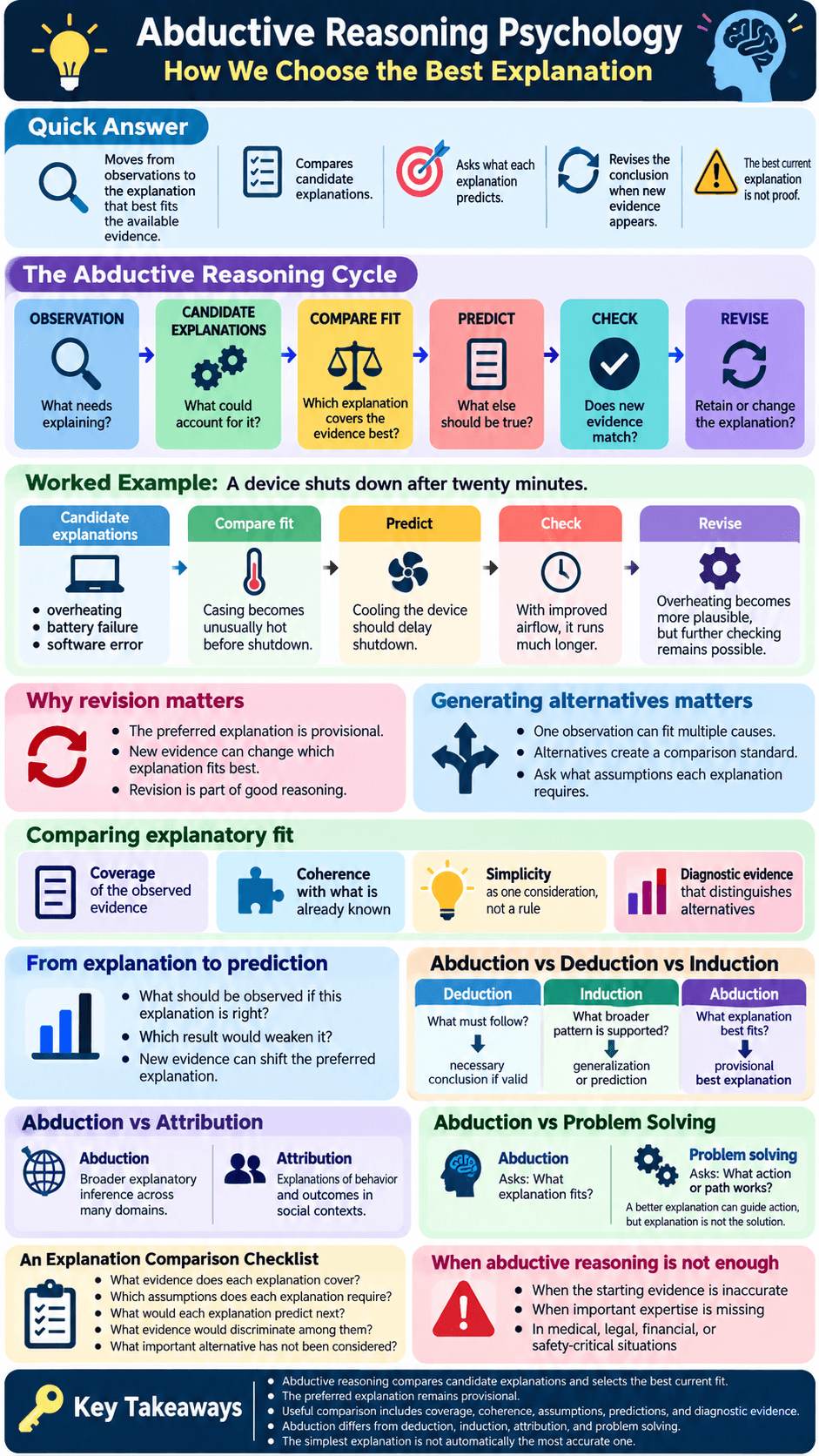
Abductive reasoning is the process of moving from observations to the explanation that best fits the available evidence. The mind considers candidate explanations, compares how well they account for what has been observed, asks what each explanation predicts, and revises the conclusion when new evidence appears. The best current explanation is not proof, especially when important alternatives or evidence may still be missing.
What Abductive Reasoning Means
Observation, candidate explanations, and a provisional conclusion
Abductive reasoning begins with something that needs explaining. Perhaps a machine is making an unfamiliar sound. Several explanations come to mind: a loose component, a worn bearing, debris in a moving part, or a problem elsewhere in the system.
The task is not simply to select the first explanation that sounds plausible. It is to compare alternatives and ask which one best accounts for the observations. A major review chapter on explanation and abductive inference describes explanation-seeking and explanation evaluation as important parts of everyday cognition, learning, and inference.
Why “best explanation” does not mean proven explanation
An explanation can be the best among the options you have considered and still be wrong. You may have missed a better alternative, misunderstood an observation, or relied on incomplete evidence. Abductive conclusions are therefore provisional.
That provisional quality is not a weakness. It is what allows abductive reasoning to remain responsive to evidence. A conclusion becomes more useful when it is treated as the explanation that currently fits best rather than as a fact that no longer needs testing.
The Abductive Reasoning Cycle
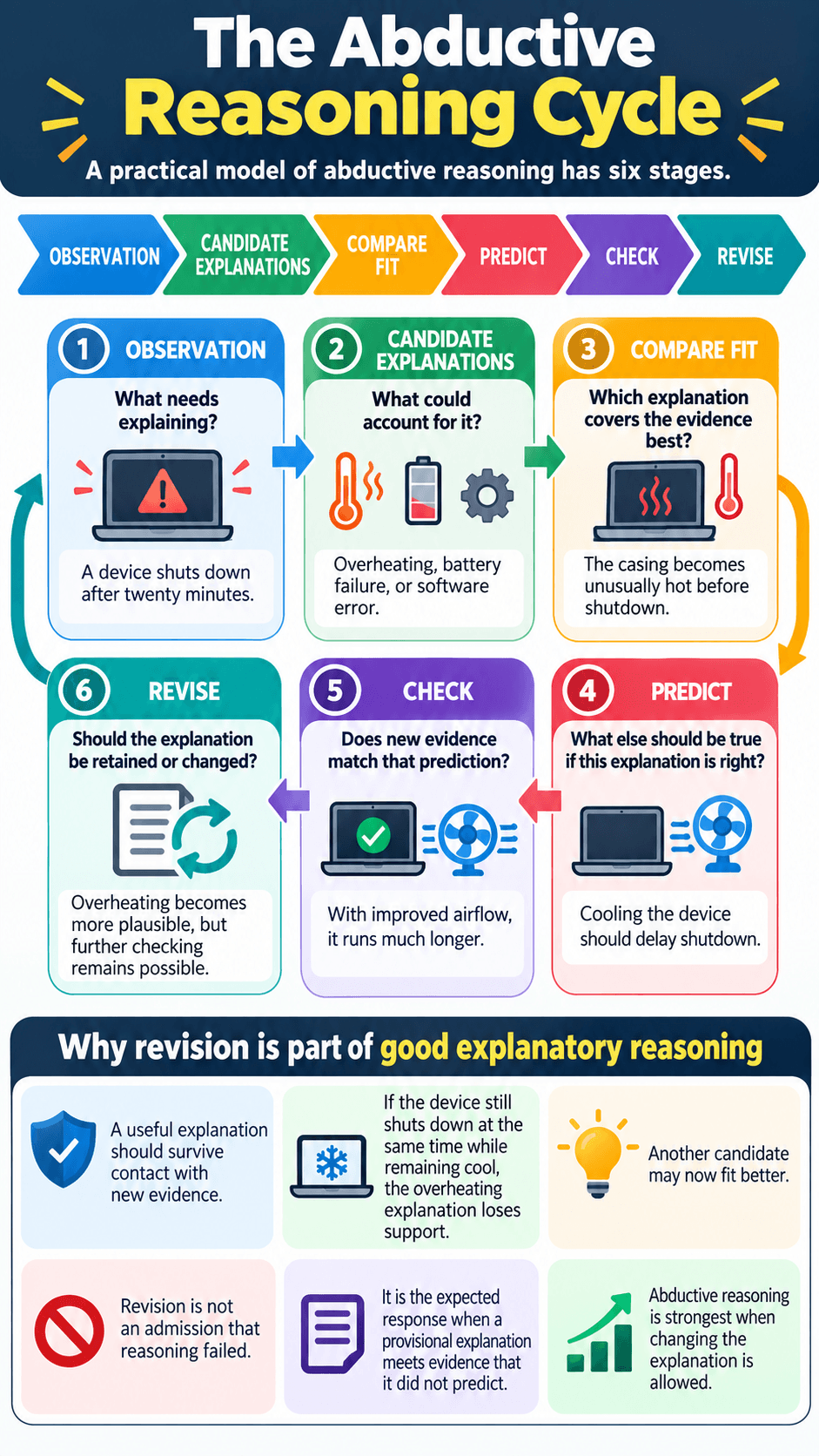
OBSERVATION → CANDIDATE EXPLANATIONS → COMPARE FIT → PREDICT → CHECK → REVISE
A practical model of abductive reasoning has six stages. First, notice what needs explaining. Second, generate more than one possible explanation. Third, compare how well each explanation fits the available evidence. Fourth, ask what each explanation predicts. Fifth, check those predictions against new evidence. Sixth, revise the preferred explanation when the evidence changes.
| Stage | Main question | Example |
|---|---|---|
| Observation | What needs explaining? | A device shuts down after twenty minutes. |
| Candidate explanations | What could account for it? | Overheating, battery failure, or software error. |
| Compare fit | Which explanation covers the evidence best? | The casing becomes unusually hot before shutdown. |
| Predict | What else should be true if this explanation is right? | Cooling the device should delay shutdown. |
| Check | Does new evidence match that prediction? | With improved airflow, it runs much longer. |
| Revise | Should the explanation be retained or changed? | Overheating becomes more plausible, but further checking remains possible. |
Why revision is part of good explanatory reasoning
A useful explanation should survive contact with new evidence. If the device still shuts down at the same time while remaining cool, the overheating explanation loses support. Another candidate may now fit better.
Revision is not an admission that reasoning failed. It is the expected response when a provisional explanation meets evidence that it did not predict. Abductive reasoning is strongest when changing the explanation is allowed.
Generating More Than One Candidate Explanation

How a single observation can fit multiple causes
Most everyday observations are compatible with several explanations. A yellowing plant may be receiving too much water, too little water, inadequate light, unsuitable soil, or a combination of conditions. The observation alone does not identify one cause.
This is why immediately naming one explanation can be risky. The mind often prefers a coherent story, but coherence is not the same as exclusivity. More than one explanation may be able to produce the same observation.
Why alternative explanations matter
Alternatives create a comparison standard. Without them, almost any plausible story can look strong because there is nothing to compete with it. Once alternatives are considered, the question changes from “Can this explain the evidence?” to “Does this explain the evidence better than the other realistic possibilities?”
Research on evaluating explanations relative to alternatives emphasizes this comparative feature of abductive inference. An explanation gains meaning partly through how it performs against competing accounts, not only through whether it can accommodate the evidence in isolation.
Missing evidence and hidden assumptions
Every explanation contains assumptions, some explicit and some unnoticed. If you explain a missed delivery by assuming the courier was delayed in traffic, you are also assuming the address was correct, the parcel left the depot, and no scheduling error occurred.
A good abductive check asks which assumptions are doing the work. If an explanation depends on several unverified assumptions, another explanation that covers the same evidence with fewer unsupported additions may deserve closer attention.
Comparing Explanatory Fit
Coverage of the observed evidence
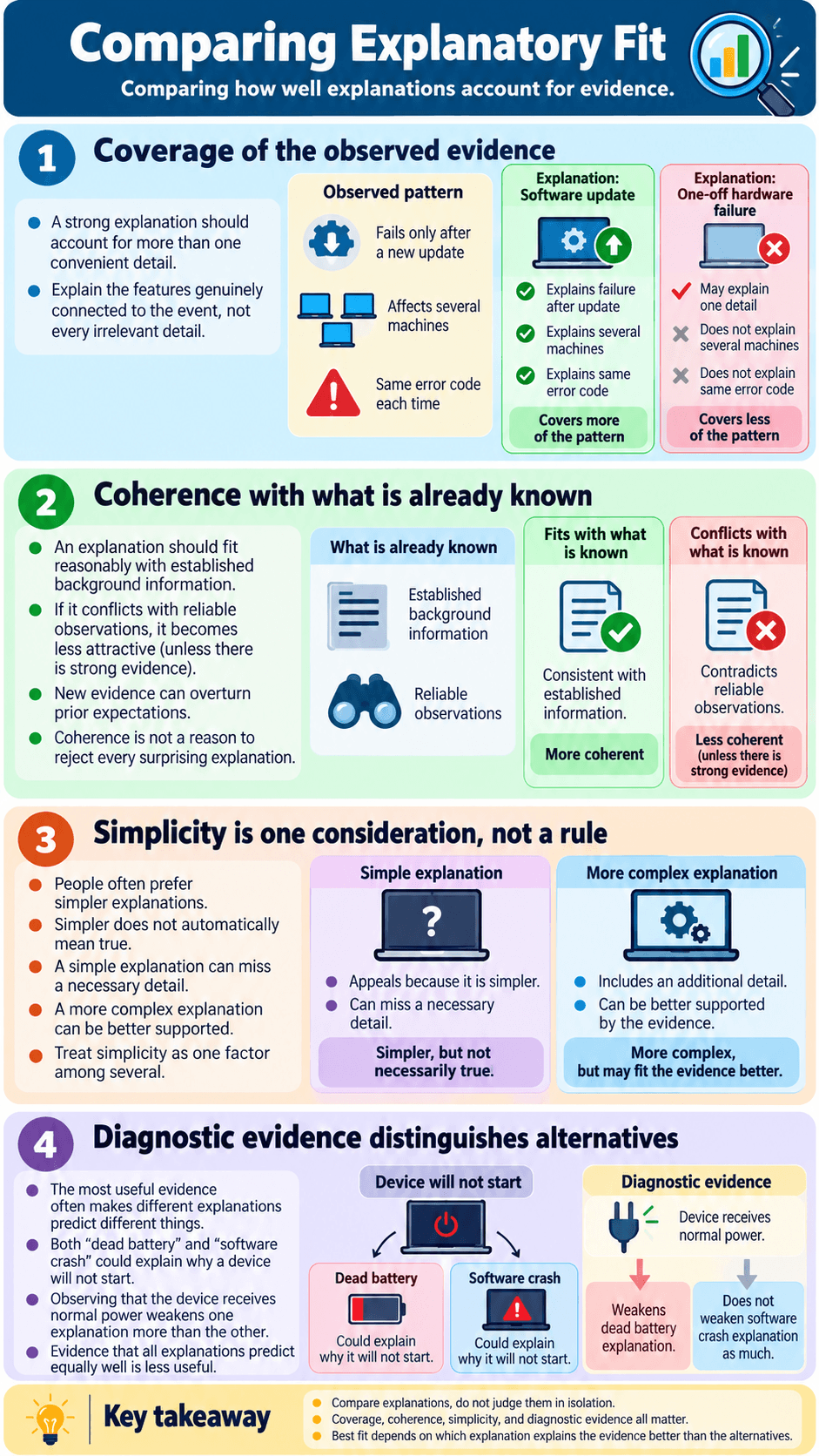
A strong explanation should account for more than one convenient detail. Suppose a software process fails only after a new update, affects several machines, and produces the same error code each time. An explanation tied to the update covers more of that pattern than an explanation based on a one-off hardware failure.
Coverage does not mean explaining every detail at any cost. Some observations may be irrelevant or noisy. The goal is to explain the features that are genuinely connected to the event.
Coherence with what is already known
An explanation should fit reasonably with established background information. If a proposed cause requires several things that conflict with reliable observations, it becomes less attractive unless there is strong evidence for those unusual assumptions.
Coherence is not a license to reject every surprising explanation. New evidence can overturn what was previously expected. It simply means that an explanation carries a heavier burden when it conflicts with well-supported knowledge.
Simplicity as one consideration, not an automatic rule
People often prefer explanations that are relatively simple. Research on explanatory preferences suggests that simplicity and breadth can shape how explanations are evaluated and how people learn from them. A review of explanatory preferences in learning and inference describes systematic preferences for explanations that are simple and broad.
But “simpler” does not automatically mean “true.” A simple explanation can ignore a necessary detail, while a more complex explanation can be better supported. Simplicity is best treated as one consideration among several, not as a rule that ends the comparison.
Diagnostic evidence that distinguishes alternatives
The most useful evidence is often evidence on which competing explanations make different predictions. If both “dead battery” and “software crash” explain why a device will not start, then observing that the device receives normal power does more than add another fact. It weakens one explanation more than the other.
Diagnostic evidence matters because it changes the relative fit among alternatives. Evidence that every explanation predicts equally well may be less useful for choosing between them.
From Explanation to Prediction
What should be observed if this explanation is right?
An explanation becomes easier to evaluate when it produces expectations. If a plant is wilting because the soil stays waterlogged, then improving drainage should change the pattern over time. If nothing changes despite better drainage and the soil is no longer saturated, confidence in that explanation should fall.
Prediction turns an explanation into something that can be checked rather than merely admired for sounding coherent. Once a preferred explanation produces a specific prediction, hypothesis testing becomes useful for asking whether that explanation survives informative evidence.
Which result would weaken it?
People naturally look for confirming details, but an explanation becomes more informative when you can also identify evidence that would count against it. If no possible observation could weaken the explanation, it is difficult to test.
This does not require demanding one dramatic falsification test in every everyday situation. It means being clear about what observations should make the explanation less attractive.
How new evidence can change the preferred explanation
Suppose a team believes a project delay resulted from one supplier. Later records show that the supplier delivered on time, while an internal approval sat untouched for four days. The new evidence changes which explanation fits best.
Abductive reasoning works best when the preferred explanation can move with the evidence rather than becoming an identity or commitment that must be defended.
Cross-Domain Examples of Abductive Reasoning
Troubleshooting a device
A laptop repeatedly loses its network connection. Possible explanations include the router, the laptop’s wireless adapter, a driver problem, or interference. If every other device remains connected while only the laptop disconnects, the router explanation becomes less attractive. If updating the driver removes the problem, the driver explanation gains support.
The reasoning is explanatory rather than action-centered. Installing the update is an action, but the abductive question is which explanation best accounts for the failure pattern.
Interpreting an unexpected project result
A marketing test performs much worse than an earlier test. Possible explanations include a different audience, a change in timing, a weaker offer, a tracking error, or random variation. Simply choosing “the new creative was bad” may feel satisfying because it is concrete, but it ignores alternatives.
A better approach compares which explanation fits the full pattern and what evidence could separate them. If tracking logs are incomplete only during the poor-performing period, a measurement problem becomes more plausible.
Identifying why a plant is failing
A houseplant develops brown leaf tips. Underwatering, mineral buildup, low humidity, damaged roots, or excess fertilizer could all fit the observation. Looking at soil moisture, watering history, recent fertilizer use, and root condition allows the explanations to compete on more than one clue.
The goal is not to turn ordinary plant care into a scientific investigation. It is to notice that one visible symptom does not uniquely identify one cause.
Understanding a process breakdown
An invoice repeatedly fails to reach the correct reviewer. The explanation could involve incorrect account settings, a broken automation rule, an outdated reviewer list, or a manual handoff problem. Mapping where the process first diverges from the expected path helps identify which explanation covers the evidence best.
Once again, diagnosis of the process and repair of the process are connected but not identical. Understanding what happened can guide action, but explanation comes first in this example.
Abduction vs Deduction vs Induction
Deduction asks what must follow
Deductive reasoning starts from premises or rules and asks whether a conclusion necessarily follows. If the inference is valid and the premises are granted, the conclusion cannot be false.
Induction asks what broader pattern the observations support
Inductive reasoning moves from cases or observations toward a generalization or prediction. The conclusion can be strongly supported without being guaranteed.
Abduction asks which explanation best fits
Abductive reasoning starts with observations that need explaining and compares candidate explanations. Its output is the explanation that currently provides the best fit, not a necessary conclusion and not necessarily a general rule. If the task is not explaining an observation but using the relational structure of one case to understand another, analogical reasoning is the more appropriate comparison.
| Reasoning form | Main question | Typical output |
|---|---|---|
| Deduction | What must follow from these premises? | A necessary conclusion if valid |
| Induction | What broader pattern do these observations support? | A generalization or prediction with graded support |
| Abduction | What explanation best fits these observations? | A provisional best explanation |
Abductive Reasoning vs Attribution Psychology
General explanatory inference across many domains
Abduction can be used to explain a mechanical failure, a biological change, a project result, a software error, a market pattern, or a process breakdown. Its defining feature is comparison among explanations for observations.
Social causal explanation of behavior and outcomes
Attribution psychology focuses more specifically on how people explain behavior and outcomes, especially in social contexts. Questions such as whether someone’s behavior reflects personal characteristics or situational pressures belong more directly to attribution research.
There is overlap because attribution involves explanation. The boundary is that abductive reasoning is broader and should not be reduced to explanations of people.
Abductive Reasoning vs Problem Solving
What explanation fits?
Abduction asks what is most likely to explain the observed situation. If a printer produces faded pages, the abductive task is to compare explanations such as low toner, a worn component, or an incorrect setting.
What action or path works?
Problem solving asks how to move from the current state to a desired state. Replacing toner, changing settings, cleaning a component, or testing another printer are possible actions.
How an explanation can guide a solution without being the solution
A better explanation often makes problem solving more efficient because it narrows which actions are worth trying. But the explanatory conclusion itself is not the solution. You can correctly explain a problem and still choose an ineffective action, just as you can occasionally fix a problem without understanding its cause.
An Explanation Comparison Checklist

What evidence does each explanation cover?
Write down the important observations and ask which ones each explanation accounts for. An explanation that fits only one detail may be weaker than one that covers the full pattern.
Which assumptions does each explanation require?
Notice whether one explanation depends on several unsupported assumptions. The more assumptions required, the more places there are for the explanation to fail.
What would each explanation predict next?
A useful explanation should create expectations. If two explanations predict different outcomes, observing the next outcome can provide diagnostic evidence.
What evidence would discriminate among them?
Look for evidence that favors one explanation over another rather than evidence that all candidates predict. This makes checking more efficient.
What important alternative has not been considered?
Before settling, ask whether the candidate set itself is too narrow. The best explanation among three weak options can still be poor if a better fourth explanation was never considered.
Why Explanations Can Feel Better Than the Evidence Justifies
Coherence can create a sense of completion
A good story connects separate observations into one understandable pattern. That sense of coherence is psychologically satisfying, which can make the explanation feel more certain than it is.
Research comparing explanatory measures in abductive inference with competing hypotheses highlights the importance of how candidate explanations compete and how their relationships are represented. Even formal approaches face the problem that “best” depends on what alternatives are included and how explanatory quality is assessed.
One explanation can crowd out alternatives too early
Once a coherent explanation is available, generating another one takes effort. The first explanation may therefore become an anchor for later interpretation even when competing accounts remain plausible.
A useful correction is not endless doubt. It is to generate at least one realistic alternative before committing strongly, especially when the evidence is incomplete or the consequences of being wrong are meaningful.
Explanation quality is not the same as certainty
An explanation can be better than its competitors while still deserving modest confidence. “Best available” is a comparative judgment. “Certain” is a claim about how little room remains for error. Those are different judgments.
When Abductive Reasoning Is Not Enough
When the starting evidence is inaccurate
No explanatory method can rescue bad premises. If the reported symptom, measurement, log, or observation is wrong, the explanation may be coherent and still fail because it is explaining the wrong facts.
When important expertise is missing
Some domains contain mechanisms that are difficult to infer without specialized knowledge. A layperson may generate several plausible explanations while overlooking the explanation that an expert would consider first.
When the stakes are medical, legal, financial, or safety-critical
General abductive reasoning can help a person organize questions, but it should not substitute for qualified assessment where error carries serious consequences. A plausible explanation for a medical symptom is not a diagnosis. A coherent interpretation of a legal dispute is not legal advice. A convincing explanation of a financial loss does not replace professional evaluation of the underlying records and risks.
In high-stakes situations, the safest use of abductive thinking is often to clarify what has been observed, list realistic alternatives, identify missing evidence, and take those questions to someone with the relevant expertise.
FAQ About Abductive Reasoning
Is abductive reasoning the same as guessing?
No. A guess may be made with little comparison or evidential support. Abductive reasoning evaluates candidate explanations in relation to observations and alternatives. The conclusion remains uncertain, but it is meant to be justified by explanatory fit rather than chosen arbitrarily.
How is abduction different from induction?
Induction usually moves from cases toward a broader generalization or prediction. Abduction moves from observations toward the explanation that best accounts for them. Both can involve uncertainty, but they answer different questions.
Is the simplest explanation always the best one?
No. Simplicity can make an explanation attractive, especially when two explanations cover the evidence equally well, but it is not a guarantee of truth. An explanation that is slightly more complex may be better if it accounts for evidence the simpler explanation cannot explain.
How is abductive reasoning different from attribution?
Attribution focuses on explanations for behavior, social events, success, failure, and outcomes involving people. Abductive reasoning is broader and can be used whenever observations invite competing explanations, including mechanical, biological, organizational, and technical situations.
Can the best explanation later turn out to be wrong?
Yes. The preferred explanation is based on the evidence and alternatives currently available. New information can expose a missing assumption, reveal a better explanation, or show that the original observations were incomplete. Revision is a normal part of abductive reasoning.
Key Takeaways
- Abductive reasoning compares candidate explanations for a set of observations and selects the best current fit.
- The preferred explanation remains provisional because missing evidence or a better alternative can change the conclusion.
- Useful comparison includes coverage, coherence, assumptions, predictions, and diagnostic evidence that distinguishes competing explanations.
- Abduction differs from deduction, induction, attribution, and problem solving even though these processes can interact.
- Simplicity can influence explanatory preference, but the simplest explanation is not automatically the most accurate one.
- High-stakes medical, legal, financial, and safety questions require domain expertise rather than relying on general explanatory reasoning alone.
A practical next step is to take one situation you are currently trying to explain and write down at least three plausible explanations before choosing among them. For each one, list what it explains, what it assumes, what it predicts, and what evidence would count against it. The aim is not to delay judgment indefinitely. It is to make the preferred explanation earn its place by fitting the evidence better than realistic alternatives.

Michael Reed is the Founder and Lead Writer at Psychology Exposed. He writes about human behavior, relationships, emotional patterns, self-awareness, and practical psychology topics using research-informed, easy-to-understand content.
Read More About Michael Reed: https://psychologyexposed.com/michael-reed/
1 thought on “Abductive Reasoning Psychology: How We Choose the Best Explanation”