
If you know what a bird is, does that knowledge count as a concept, a category, or both? And when you look at an unfamiliar animal and decide that it is a bird, is that still the same thing? Psychology often discusses these ideas together, which makes the vocabulary easy to blur.
A practical distinction helps. A concept can be treated as the mental representation or organized knowledge used to think about something. A category can be treated as the class or grouping to which instances may belong. Categorization is the process of assigning or treating an instance as a member of a category. These distinctions are useful, but they are not perfectly standardized across every theory in psychology, cognitive science, philosophy, or linguistics.
Keeping the levels separate makes several confusing questions easier to answer. It becomes possible to distinguish what you know about birds from the set of things counted as birds, and to distinguish both from the act of deciding whether a newly encountered animal belongs in that set.
Quick Answer: A Practical Distinction Between Concepts and Categories
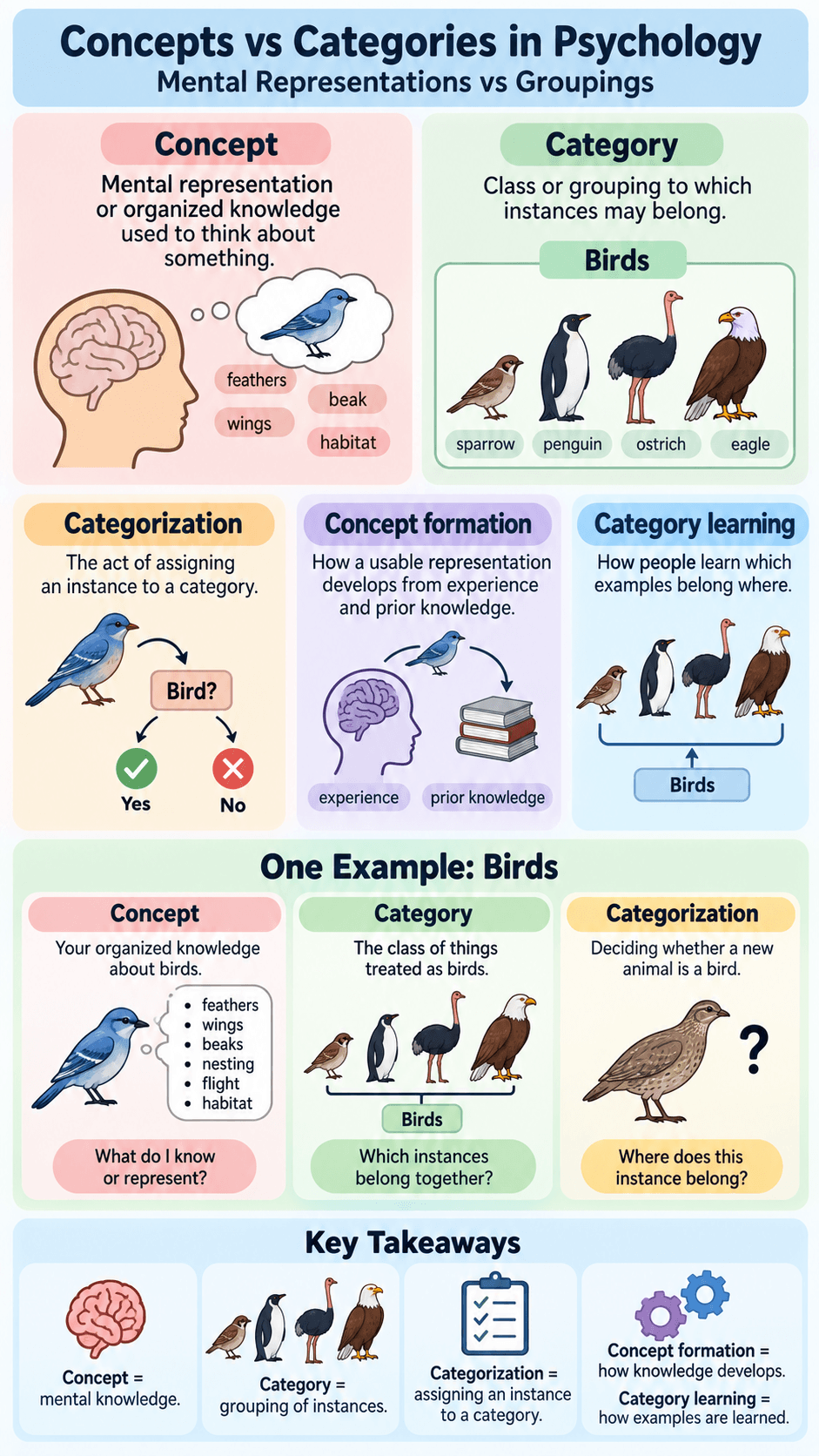
A concept is the mental knowledge or representation that lets you think about something, while a category is the class of instances treated as belonging together. Categorization is the act of assigning an instance to a category. Concept formation concerns how a usable representation develops, while category learning concerns how people learn which examples belong where. Researchers sometimes use these terms differently, so the distinction is a guide rather than a universal rule.
Why Concepts and Categories Are Often Discussed Together
Concepts and categories are difficult to separate completely because they work together in ordinary cognition. To classify something as a bird, you need some usable knowledge about birds. Once you classify it, category knowledge can support new expectations about the instance. Representation and grouping are therefore connected even when they answer different questions.
Research on conceptual knowledge has produced several competing accounts of what representations contain and how they support behavior. A broad Annual Review of Psychology overview of concepts and categories emphasizes that conceptual knowledge involves multiple kinds of information and that theories differ in how they explain its organization.
Representations support category judgments
Suppose you see a small animal with feathers, wings, a beak, and a particular style of movement. Those cues may activate what you know about birds. That knowledge helps you decide whether the animal belongs to the bird category.
The representation does more than produce a label. It may include expected anatomy, behavior, habitats, sounds, functions, relations, and exceptions. A category judgment can use only a fraction of that knowledge at one moment.
Categories help organize many different instances
A category allows different examples to be treated as related despite variation. Sparrows, ostriches, penguins, and eagles differ in size, movement, habitat, and appearance, yet all can be classified as birds. The grouping lets prior knowledge extend across instances that are not identical.
The same logic applies to furniture, vehicles, tools, games, foods, and abstract classes. The basis for grouping can vary. Some categories have explicit rules, others depend strongly on similarity or function, and still others are shaped by background knowledge and context.
Why researchers sometimes use the terms differently
There is no single vocabulary that every research tradition follows. Some authors use “concept” for the representation and “category” for the extension or class. Others use “concept” in ways that overlap heavily with category knowledge. Some theoretical discussions focus on the mental representation, while experimental studies may operationalize a category through a sorting or classification task.
A chapter by Gregory Murphy and Aaron Hoffman in The Cambridge Handbook of Cognitive Science illustrates this breadth by discussing both formal category-learning research and research on the content of concepts and prior knowledge. The important lesson for a general reader is not that one vocabulary is correct and all others are wrong. It is that the question being asked should determine which distinction matters.
One Running Example: Birds
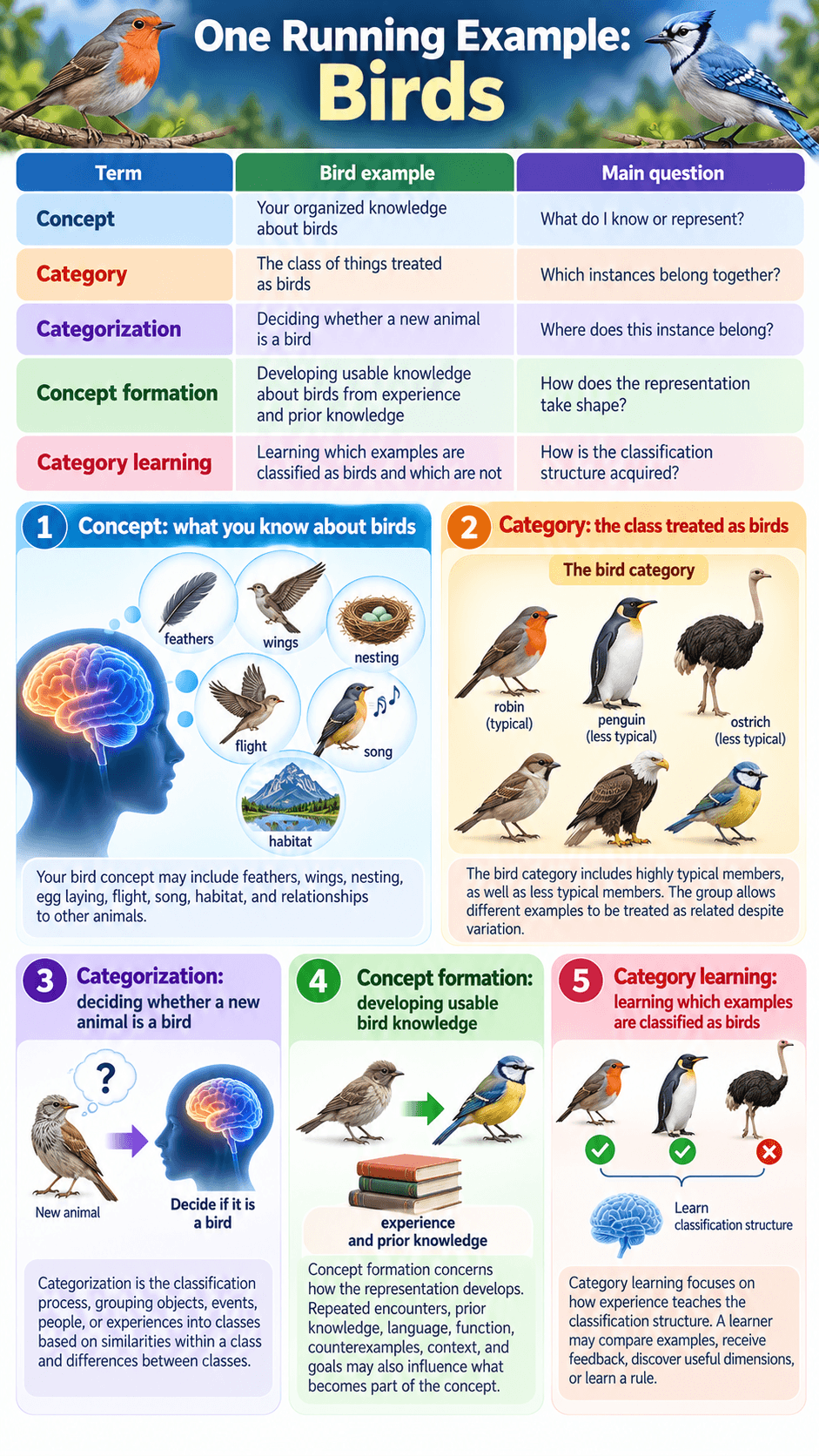
Using one example across several terms makes the differences easier to see. Consider birds.
| Term | Bird example | Main question |
|---|---|---|
| Concept | Your organized knowledge about birds | What do I know or represent? |
| Category | The class of things treated as birds | Which instances belong together? |
| Categorization | Deciding whether a new animal is a bird | Where does this instance belong? |
| Concept formation | Developing usable knowledge about birds from experience and prior knowledge | How does the representation take shape? |
| Category learning | Learning which examples are classified as birds and which are not | How is the classification structure acquired? |
Concept: what you know about birds
Your bird concept may include feathers, wings, beaks, nesting, egg laying, flight, song, habitat, and relationships to other animals. Some of that knowledge is highly reliable, some is typical rather than necessary, and some changes with expertise.
Importantly, a concept does not have to be a verbal definition. You can possess useful knowledge about a category even when you cannot state a perfect rule that captures every member.
Category: the class treated as birds
The bird category is the grouping itself. It includes highly typical members, such as robins in many familiar Western examples, as well as less typical members such as penguins or ostriches. Category membership and typicality are therefore separate questions.
The category can also be discussed independently of one person’s complete knowledge. A learner may classify some birds correctly while still having a sparse or inaccurate concept of birds.
Categorization: deciding whether a new animal is a bird
Categorization is the classification process. The APA Dictionary of Psychology defines it as grouping objects, events, people, or experiences into classes based on similarities within a class and differences between classes.
In practice, categorization can rely on more than obvious similarity. A person may use explicit rules, stored examples, central tendencies, relations, functions, or expert knowledge depending on the task and domain.
Concept formation: developing usable bird knowledge
Concept formation concerns how the representation develops. Repeated encounters can reveal recurring features, but prior knowledge, language, function, counterexamples, context, and goals may also influence what becomes part of the concept.
Someone who first assumes that all birds fly must revise that representation after learning about penguins and ostriches. The representation becomes more useful because it separates what is common from what is essential, optional, or context-dependent.
Category learning: learning which examples are classified as birds
Category learning focuses more narrowly on how experience teaches the classification structure. A learner may compare examples, receive feedback, discover useful dimensions, or learn a rule. A review of categories, concepts, and conceptual development discusses the close relationship between acquiring categories and developing concepts, while also illustrating why the direction between learning and conceptual knowledge can be theoretically complex.
Concept formation and category learning overlap, but separating the questions prevents them from collapsing into one vague process called “learning.”
Representation vs Membership
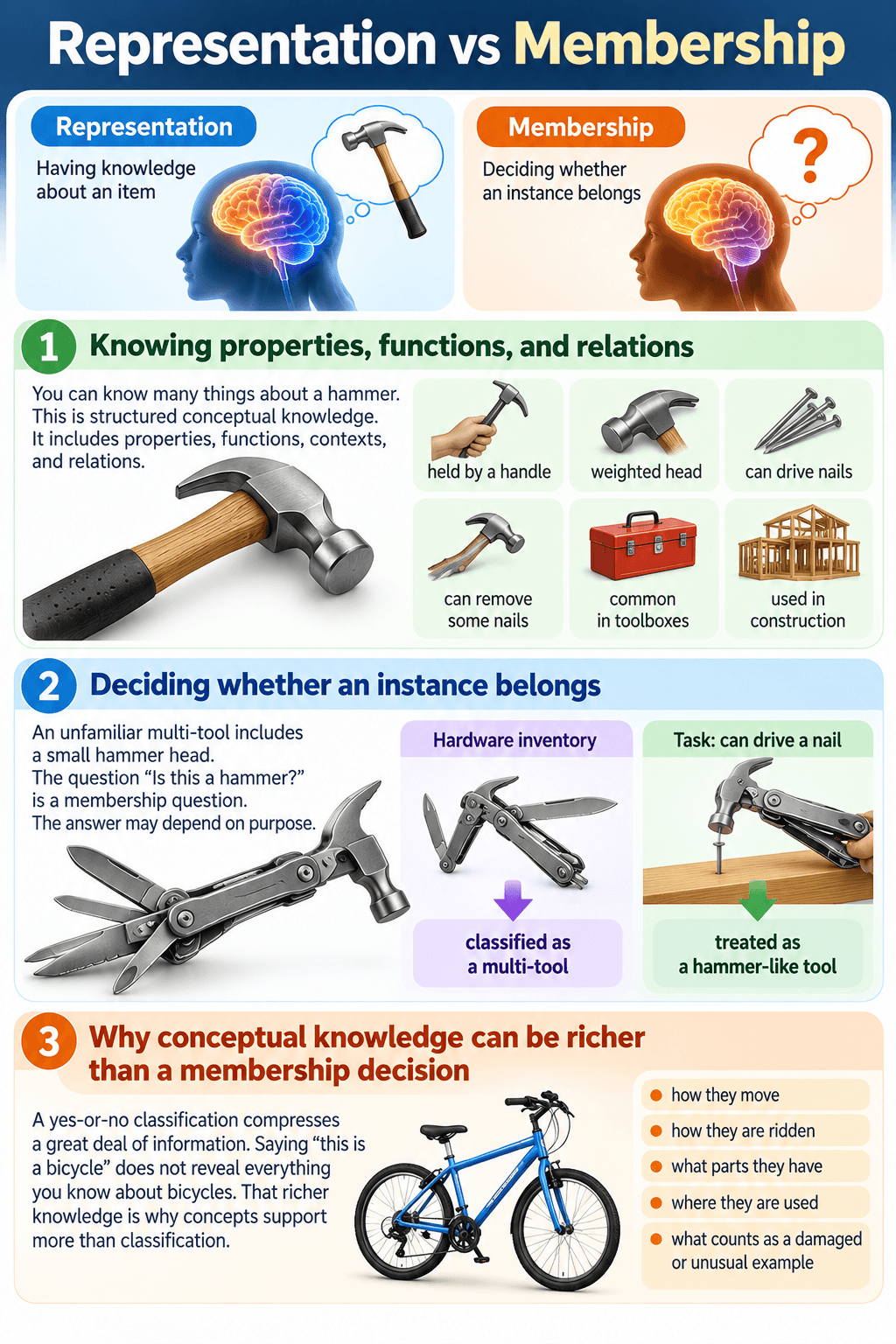
One of the clearest differences between concepts and categories is the difference between having knowledge and deciding membership. A person can know many things about an item without making a category decision, and a person can make a category decision with very limited knowledge.
Knowing properties, functions, and relations
Imagine you know that a hammer is held by a handle, has a weighted head, can drive nails, can remove some nails, is common in toolboxes, and is used in construction. This is structured conceptual knowledge. It includes properties, functions, contexts, and relations.
None of those facts alone is identical to the category “hammer.” They contribute to the representation that allows you to recognize, reason about, and use hammers.
Deciding whether an instance belongs
Now imagine seeing an unfamiliar multi-tool that includes a small hammer head. The question “Is this a hammer?” is a membership question. The answer may depend on purpose. In a hardware inventory, it might be classified as a multi-tool rather than a hammer. In a task where the only issue is whether it can drive a nail, treating it as a hammer-like tool may be useful.
This illustrates that category membership can sometimes depend on context or the level of classification being used. It does not mean all categories are arbitrary. Some have strict definitions. Others are more flexible.
Why conceptual knowledge can be richer than a membership decision
A yes-or-no classification compresses a great deal of information. Saying “this is a bicycle” does not reveal everything you know about bicycles. You may know how they move, how they are ridden, what parts they have, where they are used, and what counts as a damaged or unusual example.
That richer knowledge is why concepts support more than classification. They also help with prediction, explanation, memory, communication, planning, and reasoning.
Category Membership Is Not Always the Same as Typicality
A common source of confusion is the idea that if one member feels less representative, it must belong less. That is not necessarily true.
Genuine members can be atypical
A penguin is an atypical bird in many people’s everyday judgments because it lacks some features strongly associated with familiar birds, especially flight. Yet it is not therefore a “partial bird.” Its unusualness concerns representativeness, not whether it belongs biologically to the class.
The same distinction appears in ordinary categories. A beanbag chair looks less like a classic four-legged chair than a dining chair does, but that does not automatically exclude it from the furniture category or from being treated as a chair in everyday use.
Graded goodness does not automatically mean graded membership
People can rate examples along a continuum from very good to poor examples even when the category itself has a clear boundary. Typicality is therefore an empirical pattern about representativeness, not a complete theory of membership.
This also explains why typicality evidence does not settle whether category knowledge is stored as a prototype. Several models can produce graded judgments.
Concepts Without Simple Concrete Categories
Concrete objects make the distinction easy to illustrate, but concepts are not limited to visible things. People also think with concepts such as justice, danger, promise, ownership, probability, friendship, and cause.
Abstract concepts and relational concepts
An abstract concept may not have one obvious visual template. “Justice” cannot be recognized by shape or color. “Ownership” depends on a relation between people, objects, and social rules. “Danger” can apply to a cliff, a chemical, a driving situation, or a financial decision despite little perceptual similarity.
Lawrence Barsalou and colleagues argue that the traditional concrete-versus-abstract divide is often too simple. Their discussion of abstract concepts emphasizes that conceptual processing is tied to situations, goals, and multiple forms of information rather than being captured by a single concreteness scale.
Why not every concept maps neatly onto one visible set
A concept can organize knowledge even when its extension is difficult to enumerate. Think about “game.” Board games, video games, card games, sports, puzzles, and children’s playground games differ greatly. A rigid visible-feature checklist is unlikely to capture everything that makes the concept useful.
Relational concepts create a similar challenge. “Above,” “owns,” “causes,” and “supports” depend on relationships rather than on one object’s intrinsic appearance.
Category Labels Help, but a Label Is Not the Whole Concept
Words often make categories easier to teach, discuss, and remember, but a label should not be mistaken for the entire representation. Knowing that an unfamiliar object is called a “thermometer” gives you a useful linguistic handle. It does not automatically give you knowledge about what the object measures, how it works, where it is used, or which features distinguish it from a timer or gauge.
A word can organize attention without supplying complete knowledge
Labels can draw attention to similarities that might otherwise be overlooked. When several unfamiliar objects receive the same name, a learner has a reason to search for what they share. That can help category learning and concept formation, especially when the relevant structure is subtle.
Yet the word itself is not sufficient. Two people can know the same label while possessing very different amounts of conceptual knowledge. A novice may know that “cedar” names a type of tree, while a botanist or woodworker may represent many more diagnostic properties, uses, and relations.
The same concept can sometimes be expressed with different labels
Language also varies across communities and situations. Closely related words may carve up experience differently, and one concept may be described with several expressions. This is another reason to avoid defining concepts as nothing more than words stored in memory.
The distinction matters especially when thinking about abstract ideas. Someone may understand a relation, goal, or familiar situation before they can give it a precise name. Conversely, a person may repeat a technical term without having a well-developed representation behind it. Labels participate in conceptual cognition, but they are only one source of structure among experience, relations, functions, prior knowledge, and context.
Categories Can Depend on Goals and Context
The same object can belong to several valid categories at once. A tomato can be grouped as a fruit in one biological context, as a vegetable-like ingredient in cooking, as produce in a supermarket, or as a red item in a color-sorting task. These groupings answer different practical questions.
The same item can be grouped differently for different tasks
Consider a screwdriver. It can be classified as a tool, a hand tool, a household object, a metal object, or an item suitable for a particular repair. No single grouping has to erase the others.
Goals determine which classification is most useful. If you are packing a toolbox, function may dominate. If you are recycling materials, composition may matter more. If you are teaching a child basic vocabulary, a broad familiar label may be preferable.
Why category boundaries can be flexible without becoming arbitrary
Context sensitivity does not mean that any object can be placed in any category. Useful categories still depend on relevant structure, conventions, functions, relations, rules, or knowledge. The flexibility lies in which dimension is prioritized and which level of grouping serves the current purpose.
This is one reason definitions of concepts and categories become difficult when treated as universal formulas. Different domains place different demands on representation and classification.
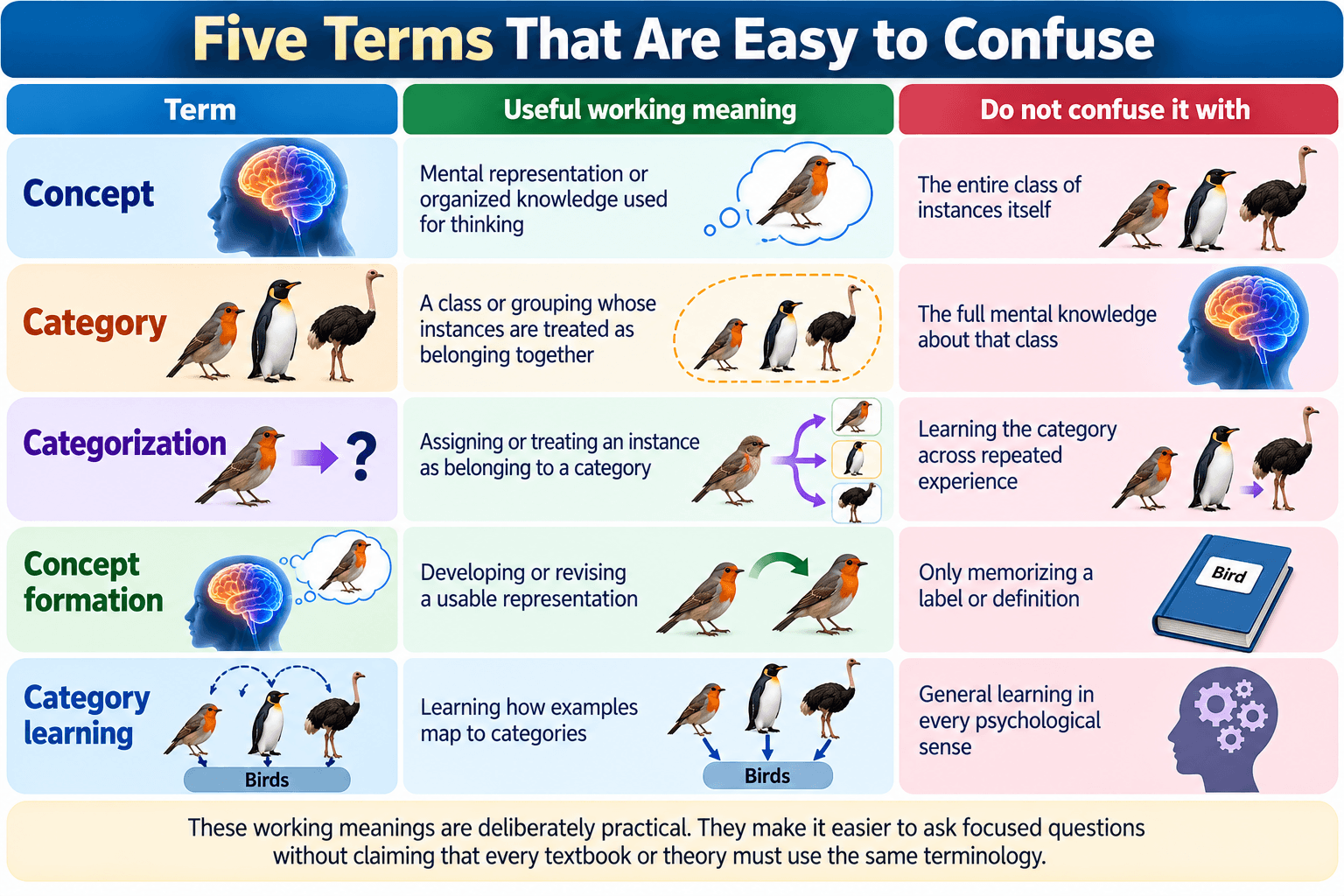
Five Terms That Are Easy to Confuse
| Term | Useful working meaning | Do not confuse it with |
|---|---|---|
| Concept | Mental representation or organized knowledge used for thinking | The entire class of instances itself |
| Category | A class or grouping whose instances are treated as belonging together | The full mental knowledge about that class |
| Categorization | Assigning or treating an instance as belonging to a category | Learning the category across repeated experience |
| Concept formation | Developing or revising a usable representation | Only memorizing a label or definition |
| Category learning | Learning how examples map to categories | General learning in every psychological sense |
These working meanings are deliberately practical. They make it easier to ask focused questions without claiming that every textbook or theory must use the same terminology.
When a More Specific Explanation Fits Better
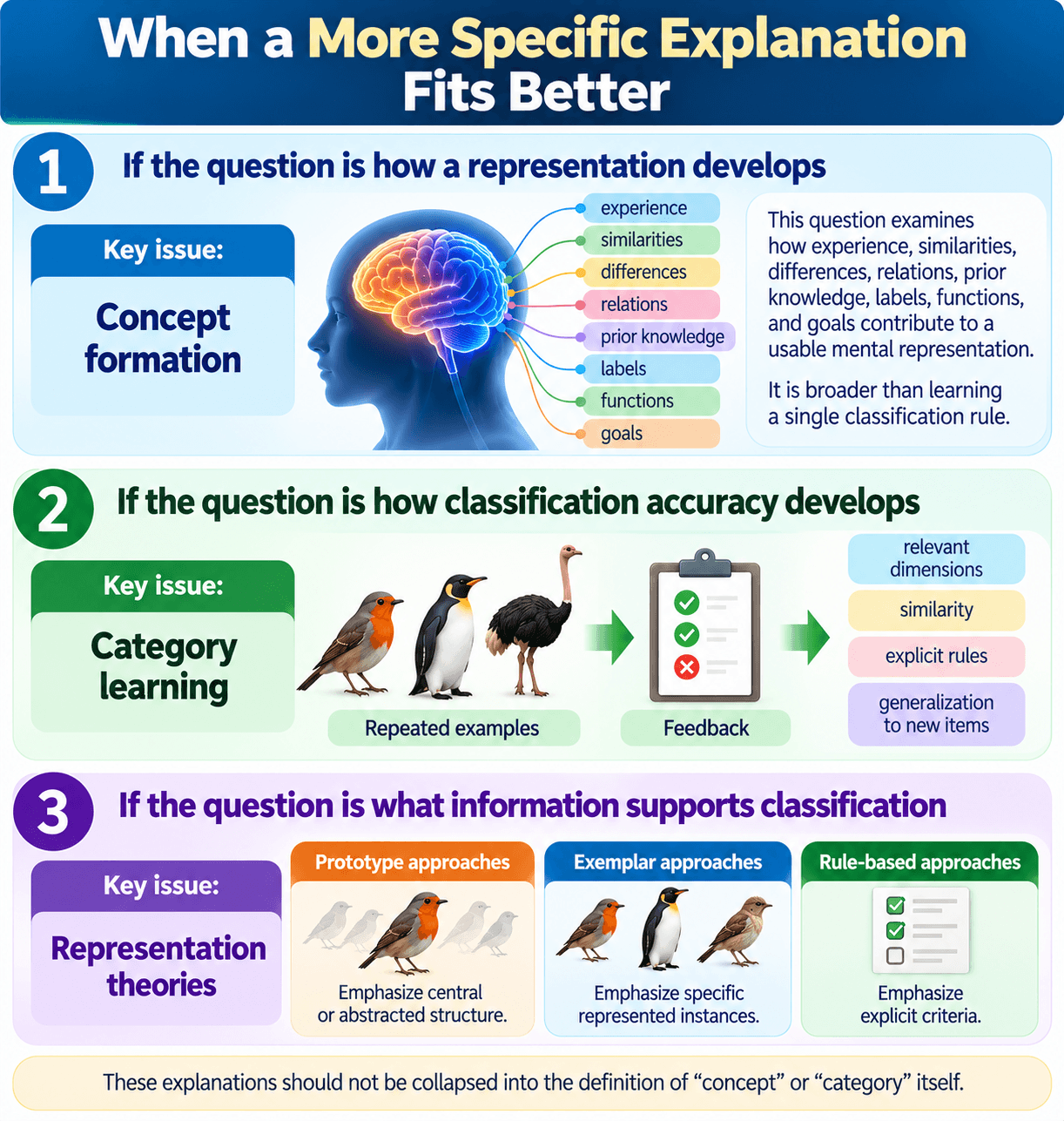
If the question is how a representation develops
The key issue is concept formation. That question examines how experience, similarities, differences, relations, prior knowledge, labels, functions, and goals contribute to a usable mental representation. It is broader than learning a single classification rule.
If the question is how classification accuracy develops
The key issue is category learning. That work examines repeated examples, feedback, relevant dimensions, similarity, explicit rules, and generalization to new items.
If the question is what information supports classification
Then representation theories become central. Prototype approaches emphasize central or abstracted structure. Exemplar approaches emphasize specific represented instances. Rule-based approaches emphasize explicit criteria. These explanations should not be collapsed into the definition of “concept” or “category” itself.
Common Terminology Mistakes
Treating one distinction as universal law
The practical concept-versus-category distinction is useful because it separates representation from class membership. But research vocabularies evolve across disciplines and theories. A definition should clarify the discussion, not erase legitimate theoretical differences.
Calling every category judgment concept formation
Seeing a new dog and recognizing it as a dog does not necessarily mean you are forming the dog concept from scratch. You may be applying an existing representation. Concept formation becomes the more relevant issue when the representation itself is being built or substantially revised.
Equating a label with the complete concept
Knowing the word “triangle” is not identical to understanding the concept of a triangle. A person may repeat a label without knowing the defining structure, or understand a concept without having immediate access to a particular word. Labels can help organize learning, but they are not the entire representation.
Assuming category membership tells you everything about an instance
Classification supports generalization, but it does not erase individual variation. Knowing that something belongs to a category gives you a starting point, not complete knowledge. This matters especially when a category contains substantial diversity.
A Simple Way to Keep the Levels Straight
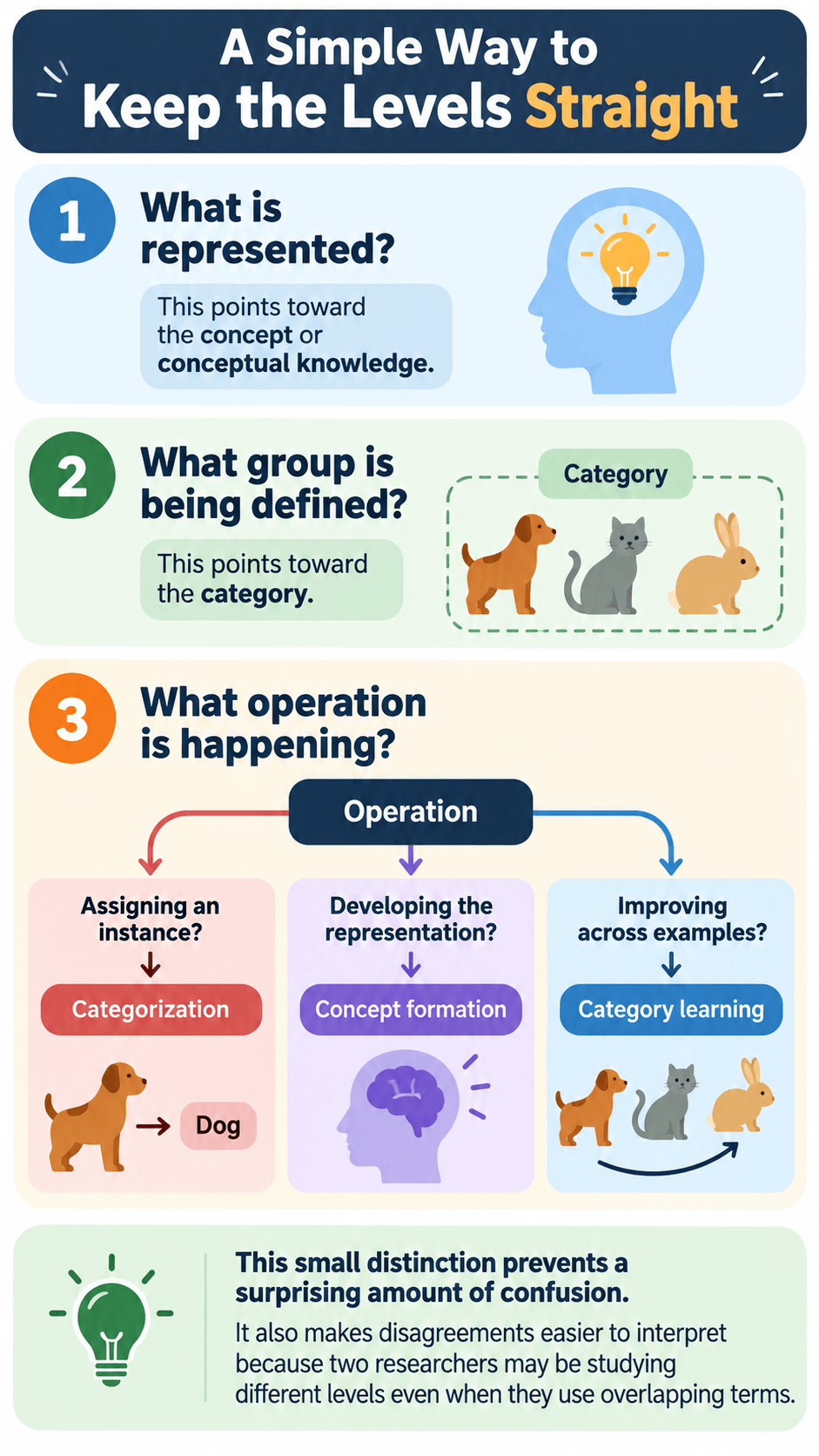
When the vocabulary becomes confusing, ask three questions in order:
- What is represented? This points toward the concept or conceptual knowledge.
- What group is being defined? This points toward the category.
- What operation is happening? If an instance is being assigned, the operation is categorization. If the representation is developing, the issue is concept formation. If classification is improving across examples, the issue is category learning.
This small distinction prevents a surprising amount of confusion. It also makes disagreements easier to interpret because two researchers may be studying different levels even when they use overlapping terms.
FAQ: Concepts, Categories, and Categorization
Can psychologists use concept and category interchangeably?
Sometimes, depending on the theory and context. A useful practical distinction is to reserve “concept” for the mental representation or organized knowledge and “category” for the class of instances. However, this should not be presented as a rule that every researcher follows. The meaning of the term should be checked within the specific theory or study being discussed.
Can a concept exist without a simple concrete category?
Yes. Concepts can represent properties, relations, events, actions, and abstract ideas as well as concrete object classes. Concepts such as justice, cause, ownership, or danger are useful even though they do not map neatly onto one visually uniform set of objects.
Is categorization the same as category learning?
No. Categorization is a classification act, such as deciding that a new object belongs to a particular class. Category learning concerns how a person acquires the information or strategy needed to make those classifications across experience. One is the judgment; the other is the acquisition process that can improve those judgments.
Is typicality the same as category membership?
No. Typicality describes how representative or “good” an example seems. Membership asks whether the instance belongs. An atypical member can still be a genuine member. This is why a penguin can be judged less typical of birds than a robin while still being fully classified as a bird.
Key Takeaways
- A concept can be treated as organized mental knowledge, while a category is the class of instances treated as belonging together.
- Categorization is the classification process, not the same thing as the representation or the group itself.
- Concept formation asks how a representation develops; category learning asks how people learn which examples belong where.
- Conceptual knowledge can be much richer than a yes-or-no membership decision and can include functions, relations, expectations, and context.
- Typicality and membership are different, so a poor example of a category can still be a genuine member.
- The terminology varies across theories, so these distinctions should be used as a clear working map rather than presented as universal definitions.
Final Thought: Separate the Knowledge From the Grouping
When you encounter these terms in psychology, separate the representation from the grouping before asking anything more complicated. What do you know about the thing? Which class is being treated as relevant? What process is assigning the instance, building the representation, or learning the boundary? Once those questions are separated, concept, category, categorization, concept formation, and category learning become much easier to tell apart.
Educational note: These distinctions describe cognitive concepts and research terminology. They are not diagnostic tools and should not be used to infer intelligence, learning disorders, neurodevelopmental conditions, or neurological disease from how someone classifies information.

Michael Reed is the Founder and Lead Writer at Psychology Exposed. He writes about human behavior, relationships, emotional patterns, self-awareness, and practical psychology topics using research-informed, easy-to-understand content.
Read More About Michael Reed: https://psychologyexposed.com/michael-reed/