
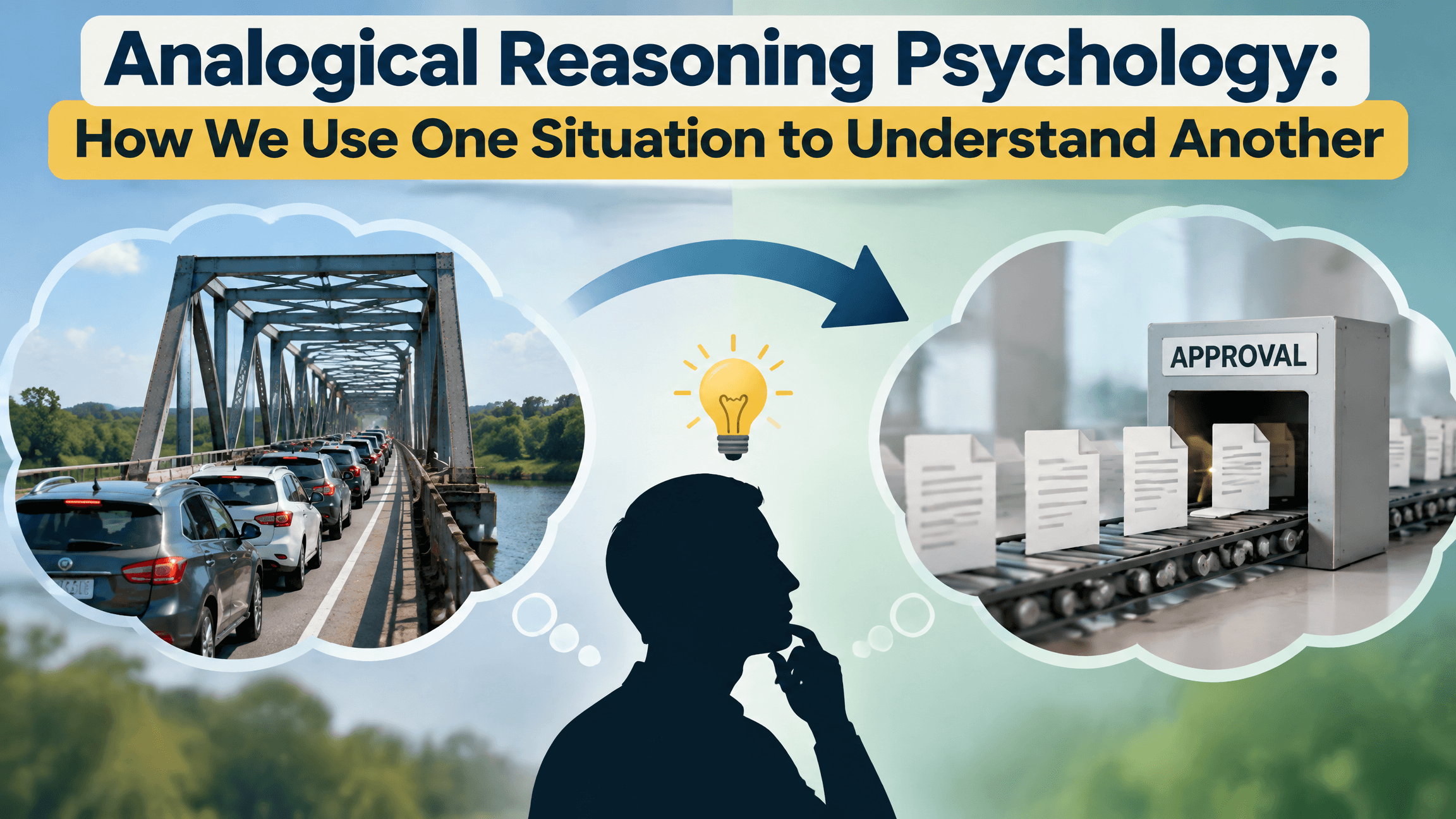
When people face something unfamiliar, they often understand it by comparing it with something they already know. A new computer system may be explained as working like a library, a traffic bottleneck may be compared with water moving through a narrow pipe, or a difficult project may remind someone of a different project that succeeded for similar reasons. These comparisons can be useful, but only when the right relationships are being transferred.
Analogical reasoning is not simply noticing that two things look alike. Its power comes from mapping a meaningful relational structure from a familiar case onto a new one. The important question is not “What features are similar?” but “Do the same roles and relationships operate in both situations?” A strong analogy can support a new inference. A weak one may feel persuasive because of surface resemblance while hiding a structural mismatch.
Quick Answer
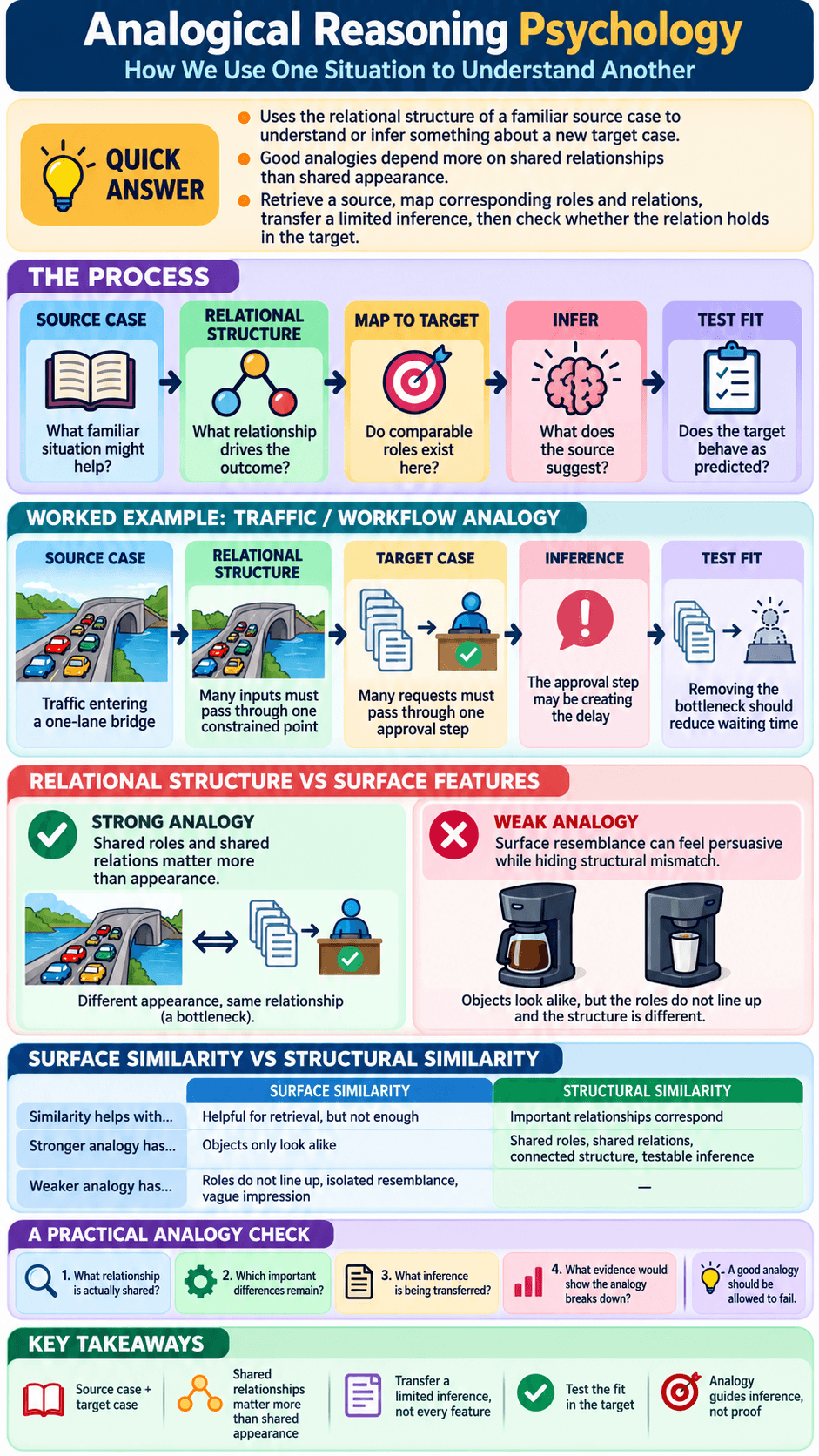
Analogical reasoning is the process of using the relational structure of a familiar source case to understand or infer something about a new target case. Good analogies depend more on shared relationships than on shared appearance. The mind retrieves a source, maps corresponding roles and relations, transfers a limited inference, and then checks whether the relationship actually holds in the target.
What Analogical Reasoning Means
Source case and target case
An analogy links two cases. The source case is the situation you already understand. The target case is the situation you are trying to understand better. Information is not copied from source to target wholesale. Instead, selected relationships from the source are used to organize or interpret the target. Analogy is one part of the broader study of reasoning, showing how a familiar relational structure can support an inference about a new case.
For example, suppose a team is trying to understand why a workflow keeps slowing down. Someone compares the workflow with cars entering a one-lane bridge. The source is the traffic situation. The target is the workflow. The useful part of the comparison is not that files resemble cars or that software resembles a bridge. It is the shared relationship in which many items are forced through one limited-capacity point.
Relational structure versus surface features
Dedre Gentner’s classic structure-mapping theory of analogy emphasizes that analogy depends primarily on mapping relations among elements rather than merely matching object attributes. In simple terms, the pattern connecting the parts often matters more than what the parts look like.
Two situations can therefore be good analogs even when their objects are very different. A bridge carrying traffic and a server processing requests share few visible features, yet both may involve flow, capacity, and congestion. By contrast, two devices may look almost identical while operating according to very different mechanisms.
The Analogical Reasoning Map

SOURCE CASE → RELATIONAL STRUCTURE → MAP TO TARGET → INFER → TEST FIT
A practical model of analogical reasoning has five steps. First, retrieve a potentially relevant source case. Second, identify the relationships that make the source work as it does. Third, map those roles and relations onto the target. Fourth, draw a limited inference about the target. Fifth, test whether the mapped relationship really fits.
| Step | Main question | Example |
|---|---|---|
| Source case | What familiar situation might help? | Traffic entering a one-lane bridge |
| Relational structure | What relationship drives the outcome? | Many inputs must pass through one constrained point |
| Map to target | Do comparable roles exist here? | Many requests must pass through one approval step |
| Infer | What does the source suggest? | The approval step may be creating the delay |
| Test fit | Does the target behave as predicted? | Removing the bottleneck should reduce waiting time |
Why the mapping, not the slogan, does the reasoning work
A catchy comparison can sound insightful without supporting a useful inference. Saying “a company is like a family” does not tell you which relationships are supposed to correspond. Families and companies may share cooperation, roles, dependence, and conflict, but they differ in authority, obligations, exit options, and many other ways.
The reasoning becomes clearer only when the mapped relationship is stated precisely. A good analogy says, in effect, “This relation in the source corresponds to that relation in the target.” Without that step, the comparison may function as rhetoric rather than reasoning.
This precision also limits overreach. If the mapped relation concerns bottlenecks, then the analogy supports questions about capacity and flow. It does not automatically support claims about motivation, fairness, hierarchy, or every other feature of the source. The mapping tells you which part of the comparison is doing cognitive work.
Retrieving a Relevant Analogy
Why familiar examples come to mind more easily
Analogical reasoning cannot begin unless a potentially useful source is retrieved from memory. Familiar cases are easier to retrieve because they are more accessible. Recent experiences, repeated examples, and situations with recognizable features may come to mind before more distant but structurally better matches.
This creates a practical tension. The easiest analogy to remember may not be the analogy that best captures the target’s relationships.
When surface similarity helps retrieval
Surface similarity can be useful at the retrieval stage. If a new problem resembles an earlier one in obvious objects, setting, or wording, that earlier case may be easier to remember. The resemblance acts as a cue.
Classic work by Mary Gick and Keith Holyoak on analogical transfer across different-looking problems showed how difficult spontaneous transfer can be when a useful earlier case comes from a different surface domain. People may know a helpful solution yet fail to retrieve it when the new problem looks different.
Why the easiest analogy to remember is not always the best one
A visually or verbally similar case can dominate attention even if the important relation is different. Imagine comparing two online businesses because both sell subscriptions. If one is limited mainly by customer acquisition and the other mainly by service capacity, the shared subscription model may be less useful than a structurally similar business in a completely different industry.
Retrieval is therefore only the first filter. Once a source comes to mind, its relational fit still needs to be checked.
A practical way to improve retrieval is to describe the target in relational terms before searching memory. Instead of asking, “What other project looked like this?” ask, “When have I seen a situation where many tasks depended on one scarce resource?” That wording makes it easier to search for a structurally relevant case rather than a cosmetically similar one.
Mapping Relationships Across Cases
Correspondences between roles and relations
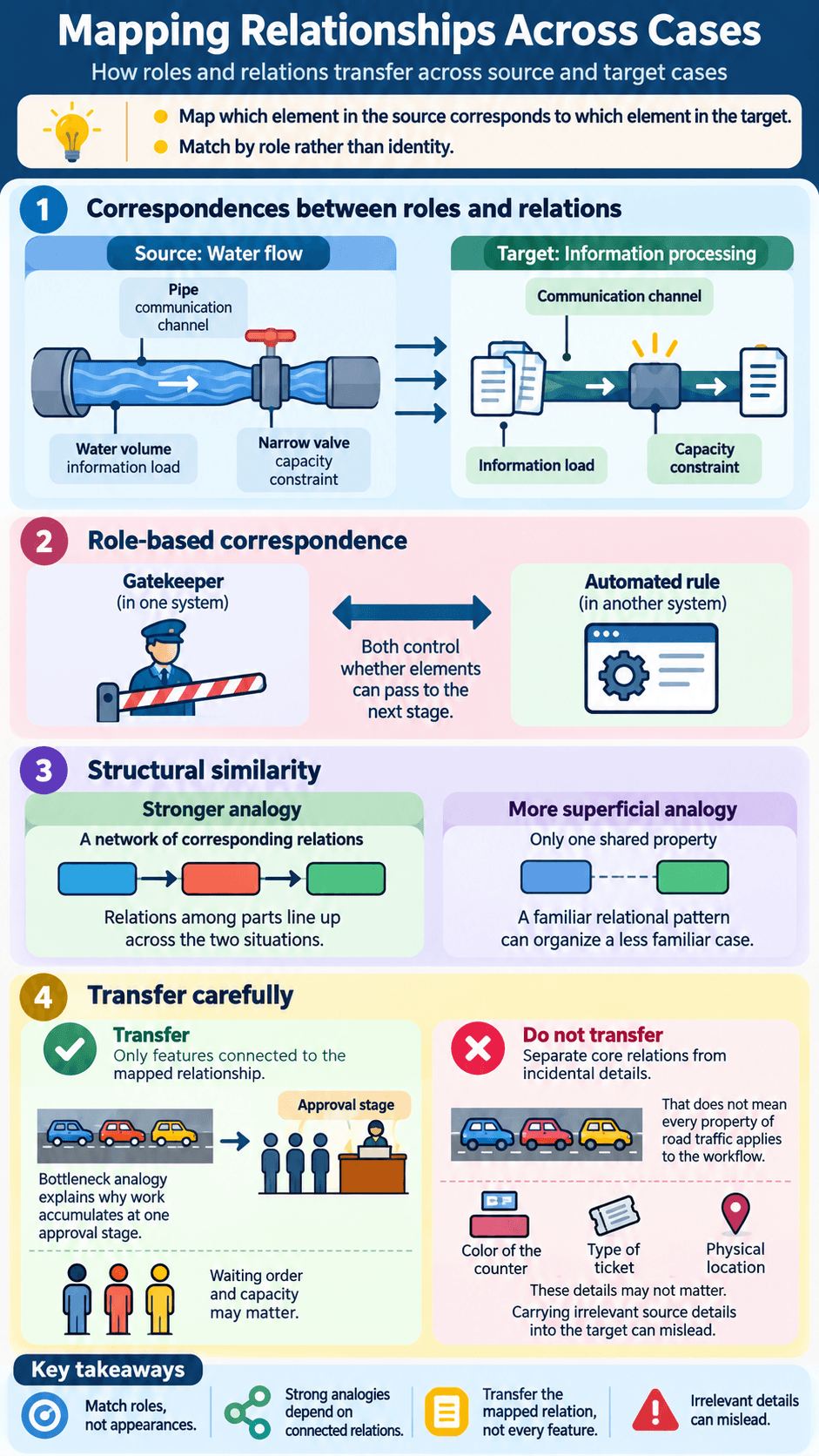
Mapping asks which element in the source corresponds to which element in the target. The match is usually based on role rather than identity. In a water-flow analogy for information processing, a pipe might correspond to a communication channel, water volume to information load, and a narrow valve to a capacity constraint.
The mapping works because each element participates in a comparable relationship. If the roles cannot be matched coherently, the analogy may be superficial.
Role-based correspondence also explains why analogies can work across very different domains. A “gatekeeper” in one system may be a person, while the corresponding role in another system is an automated rule. What matters is not that the two entities share physical features, but that both control whether other elements can pass to the next stage.
Structural similarity
Structural similarity means that the relations among parts line up across the two situations. Gentner’s account gives special importance to interconnected systems of relations rather than isolated matches. A network of corresponding relations supports a stronger analogy than one shared property.
A review of human thinking by Markman and Gentner places analogy among the processes that allow reasoning to go beyond information immediately available. The key cognitive gain is that a familiar relational pattern can organize a less familiar case.
What should and should not be transferred
The safest transfer is limited to features connected to the mapped relationship. If a bottleneck analogy helps explain why work accumulates at one approval stage, it does not follow that every property of road traffic applies to the workflow.
This distinction prevents analogical overreach. The source offers a relational pattern, not a package of facts that can all be copied into the target.
It also helps to separate core relations from incidental details. In a queue analogy, waiting order and capacity may matter, while the color of the counter, the type of ticket, or the physical location may not. When irrelevant source details are carried into the target, the analogy becomes less informative and more likely to mislead.
Surface Similarity vs Structural Similarity
Two cases can look alike but work differently
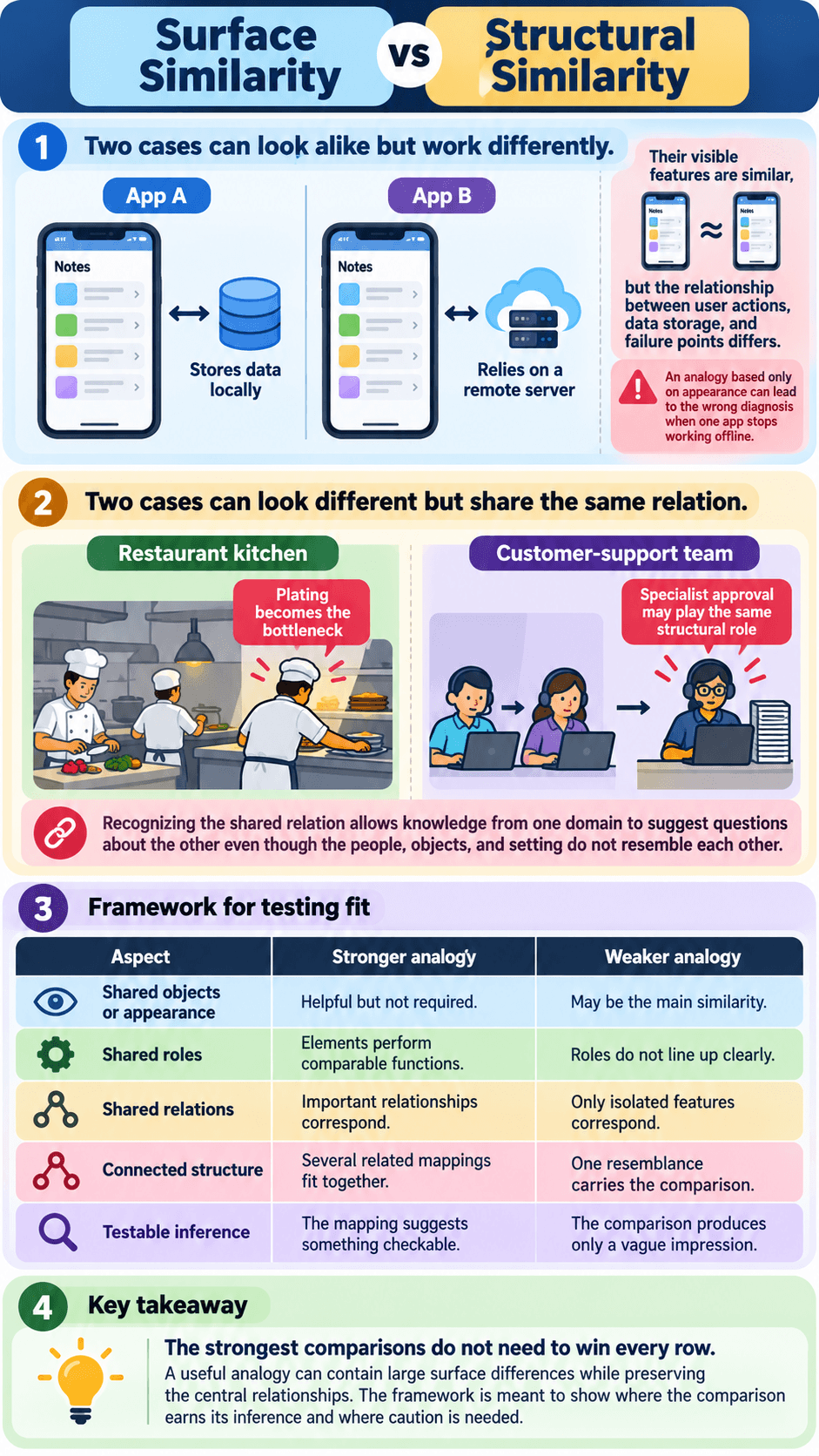
Imagine two mobile apps with nearly identical screens. One stores data locally, while the other relies on a remote server. Their visible features are similar, but the relationship between user actions, data storage, and failure points differs. An analogy based only on appearance could lead to the wrong diagnosis when one app stops working offline.
Surface resemblance can be informative, but it should not be treated as evidence that the underlying mechanism is the same.
Two cases can look different but share the same relation
A restaurant kitchen and a customer-support team look very different, yet both may suffer when incoming tasks exceed the capacity of one specialized stage. In the kitchen, plating may become the bottleneck. In support, specialist approval may play the same structural role.
Recognizing the shared relation allows knowledge from one domain to suggest questions about the other even though the people, objects, and setting do not resemble each other.
A comparison framework for testing fit
| Check | Stronger analogy | Weaker analogy |
|---|---|---|
| Shared objects or appearance | Helpful but not required | May be the main similarity |
| Shared roles | Elements perform comparable functions | Roles do not line up clearly |
| Shared relations | Important relationships correspond | Only isolated features correspond |
| Connected structure | Several related mappings fit together | One resemblance carries the comparison |
| Testable inference | The mapping suggests something checkable | The comparison produces only a vague impression |
The strongest comparisons do not need to win every row. A useful analogy can contain large surface differences while preserving the central relationships. The framework is meant to show where the comparison earns its inference and where caution is needed.
From Mapping to Analogical Inference
What the source suggests about the target
Once a structural match is identified, the source can suggest an inference that has not yet been established in the target. If congestion in the source is caused by one constrained stage, the mapped relation suggests looking for a comparable constraint in the target.
The inference is not automatically true. The analogy provides a reason to investigate it.
Adapting the inference rather than copying it
Useful analogical transfer often requires adaptation. The solution that worked in the source may depend on details that do not exist in the target. A restaurant might reduce a kitchen bottleneck by moving one preparation task earlier. A software workflow may need a different intervention, such as parallel approval or automation.
The source supplies a relational idea. The target determines how that idea should be expressed.
Adaptation is especially important when the source and target operate at different scales or under different constraints. A principle that works for a small team may need modification in a large organization because communication paths, resource limits, and coordination costs differ. The analogy can still be useful if the relational pattern is preserved and the implementation is adjusted.
Testing whether the transferred relationship actually holds
A transferred inference becomes more credible when target-specific evidence supports it. If a workflow is compared with a bottleneck, measure where waiting time accumulates. If the delay occurs elsewhere, the analogy may have pointed attention in the wrong direction.
Testing prevents a useful metaphor from being mistaken for evidence. The analogy suggests where to look; the target must confirm whether the relationship is real. When an analogy generates a specific prediction, testing that hypothesis against evidence is a separate step from the analogy that suggested it.
Useful Analogies
Clarifying a new mechanism
Analogies can make unfamiliar mechanisms easier to understand by connecting them with relational patterns already known. An electrical circuit may be introduced through a water-flow comparison because flow, resistance, and constrained pathways provide an accessible relational starting point.
The value comes from carefully identifying which relationships transfer and which do not. A teaching analogy is strongest when its limits are visible.
Generating a hypothesis
An analogy can suggest a possibility worth testing. If one system becomes unstable when feedback arrives too late, a structurally similar system may also be sensitive to delayed feedback. That does not prove the target works the same way, but it generates a focused question.
This is a productive use of analogy because the inference leads to evidence gathering rather than replacing it.
Supporting learning or problem representation without proving equivalence
Comparison can help a learner notice a deeper pattern that was previously hidden by surface details. It can also help someone represent a new problem in a more useful way. Research on analogical reasoning as relational reasoning describes analogy as depending on the comparison and integration of relationships rather than simple perceptual resemblance.
Even so, understanding through analogy does not establish that source and target are equivalent. The analogy is a cognitive tool for organizing relations and generating inferences, not a proof of identity.
A useful educational comparison often becomes more valuable when learners are invited to name both the match and the mismatch. Saying where an analogy fails prevents the source from becoming a substitute for the target concept. It also forces the learner to identify the relation being learned rather than memorizing a catchy comparison.
Misleading Analogies
Overextending one shared feature
Two systems may both be decentralized, competitive, hierarchical, circular, or networked. Sharing one feature does not mean they share the other relationships needed for a useful inference.
If the entire comparison rests on one adjective, ask what causal or functional relation is actually being mapped.
Ignoring important structural differences
An analogy can contain a genuine similarity and still fail because one difference changes the mechanism. A queue at a physical counter may resemble a digital queue, but digital requests may be duplicated, prioritized automatically, or processed simultaneously. Those differences can alter the entire dynamic.
Strong reasoning therefore asks not only where the analogy fits, but where the target behaves differently.
Treating partial similarity as identity
An analogy says that two cases share some relevant structure. It does not say they are the same thing. This is one of the simplest and most important boundaries in analogical reasoning.
If a city is compared with an organism, the analogy might highlight interdependent systems. It does not follow that every biological concept can be applied literally to a city. Partial similarity supports only partial transfer.
Another warning sign is when disagreement about the analogy is treated as disagreement about the target itself. A person may reject one comparison while still accepting the underlying claim for different reasons. Analogies are tools for inference and explanation, not the only possible route to a conclusion. This differs from abductive reasoning, where the central task is comparing explanations for an observation rather than mapping relations from a source case to a target.
Analogical Reasoning vs Transfer of Learning
Mapping relational structure
Analogical reasoning is specifically about identifying a relational match between a source and a target and using that match to support an inference. The central process is mapping.
Broader carryover of learned knowledge or skill
Transfer of learning is broader. Knowledge or skill learned in one context may improve performance in another without requiring an explicit analogy. A person who learns keyboard shortcuts in one program may adapt more quickly to another program because of general familiarity, even if no clear source-to-target relational mapping is constructed.
Analogy can support transfer, and transfer research often studies analogical cases, but the concepts are not interchangeable.
The distinction becomes clearer if you ask what exactly moved from the earlier experience. If a relational pattern was mapped from one case to another, analogy is central. If practice simply improved a general skill that later helped in a new setting, broader transfer may be the better description.
Analogical Reasoning vs Problem Solving
Analogy as one possible reasoning tool
A prior case may suggest a way to represent or approach a new problem. This can be powerful when the earlier case contains a useful relational pattern. Classic studies of analogical problem solving found that people sometimes benefit greatly from a prior analogous solution once the connection is noticed.
Why full problem solving includes broader search, testing, feedback, and revision
Problem solving includes much more than analogy. A person may generate multiple candidate solutions, test them, encounter feedback, revise goals, discover constraints, and abandon one path for another. An analogy may contribute one candidate representation or solution, but it does not constitute the whole process.
This distinction helps keep analogical reasoning focused on how one case informs another rather than on every step required to reach a successful outcome.
A person may also solve a problem without using an analogy at all. They might work from first principles, trial and error, decomposition, or direct feedback. Conversely, someone can form a strong analogy without having a practical problem to solve, such as when using a familiar system to understand a new scientific concept.
A Practical Analogy Check
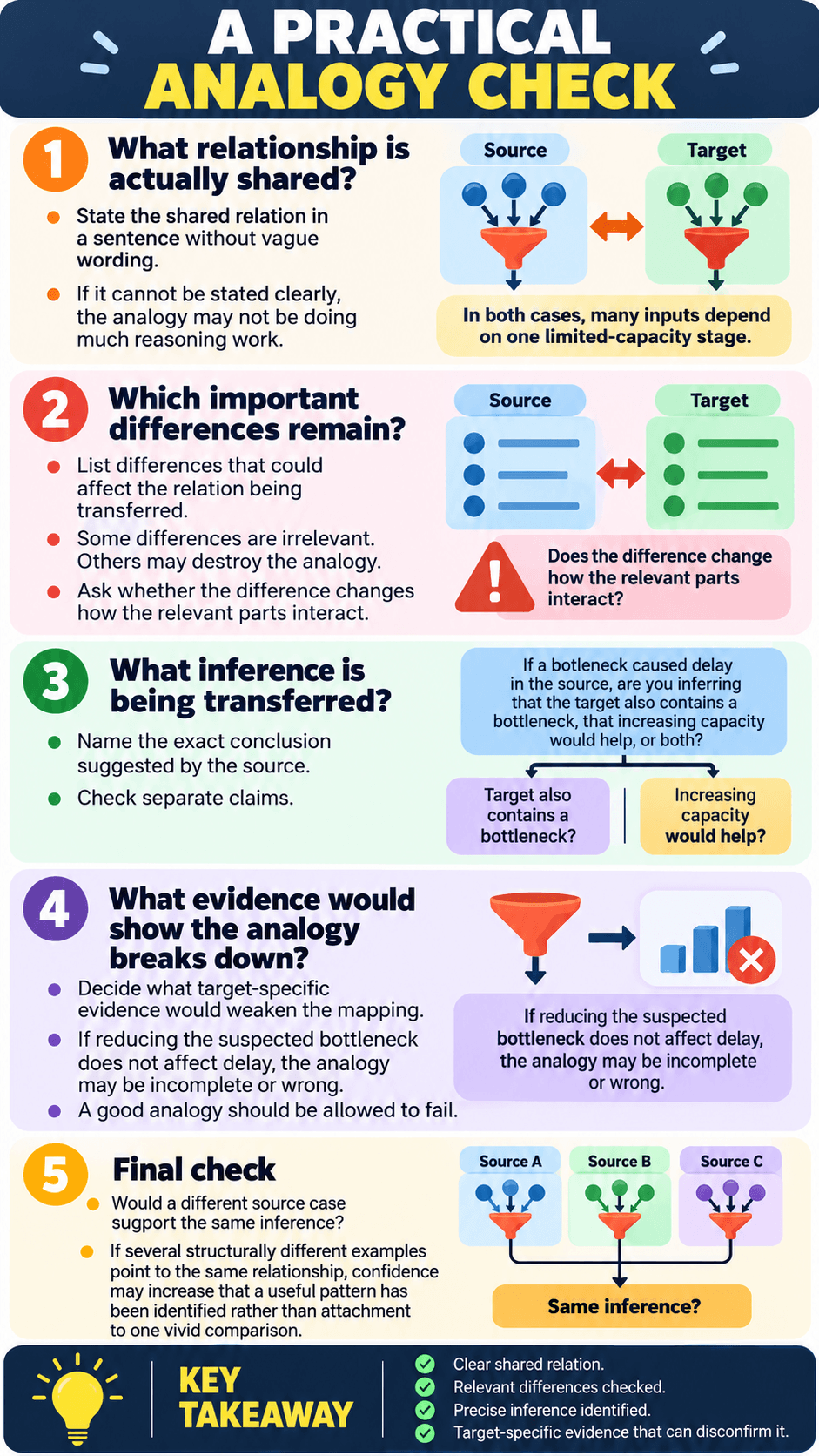
What relationship is actually shared?
State the shared relation in a sentence without relying on vague words such as “similar” or “basically the same.” For example: “In both cases, many inputs depend on one limited-capacity stage.” If the relationship cannot be stated clearly, the analogy may not be doing much reasoning work.
Which important differences remain?
List differences that could affect the relation you are transferring. Some differences are irrelevant. Others may destroy the analogy. The question is whether the difference changes how the relevant parts interact.
What inference is being transferred?
Name the exact conclusion suggested by the source. If a bottleneck caused delay in the source, are you inferring that the target also contains a bottleneck, that increasing capacity would help, or both? These are separate claims and should be checked separately.
What evidence would show the analogy breaks down?
Decide what target-specific evidence would weaken the mapping. If reducing the suspected bottleneck does not affect delay, the analogy may be incomplete or wrong. A good analogy should be allowed to fail.
One final check is to ask whether a different source case would support the same inference. If several structurally different examples point to the same relationship, confidence may increase that you have identified a useful pattern rather than become attached to one vivid comparison.
FAQ About Analogical Reasoning
Is analogy a form of proof?
No. An analogy can support an inference by showing that two cases share a relevant relational structure, but the target still requires its own evidence. Even a strong structural match can break at an important point, so analogy is better treated as a guide to inference than as proof.
What makes one analogy stronger than another?
A stronger analogy usually maps several connected relationships rather than one superficial feature. The roles should correspond coherently, the transferred inference should depend on those relationships, and important differences should not undermine the mapping. The more the conclusion relies on shared structure rather than appearance, the more informative the comparison tends to be.
Why can a superficial analogy feel persuasive?
Surface similarity makes comparisons easy to notice and understand. Familiar objects, similar wording, or vivid imagery can create an immediate sense of fit. That feeling helps retrieval, but it does not guarantee that the underlying relationships correspond. A persuasive comparison can therefore be structurally weak.
Is analogical reasoning the same as transfer of learning?
No. Analogical reasoning specifically involves mapping relational structure from a source to a target. Transfer of learning is broader and includes many ways prior knowledge or skill influences performance in a new context. Analogy can produce transfer, but not every instance of transfer depends on analogy.
Key Takeaways
- Analogical reasoning uses a familiar source case to understand or infer something about a target case through shared relational structure.
- Surface similarity can help a useful analogy come to mind, but structural similarity determines whether the comparison supports the intended inference.
- A strong analogy maps roles and relationships coherently rather than transferring every feature of the source.
- Analogical inferences need adaptation and target-specific testing because similarity does not prove equivalence.
- Analogy can support learning and problem solving, but it is narrower than either transfer of learning or the full problem-solving process.
- A useful analogy should make clear where the mapping works, what conclusion is being transferred, and where the comparison could break down.
The most useful habit is to replace “these two things are similar” with a more demanding question: “Which relationship is shared, and does that relationship support the conclusion I want to transfer?” That shift turns analogy from a loose comparison into a testable form of reasoning. It also makes it easier to keep the useful part of a comparison while rejecting the parts that do not fit.

Michael Reed is the Founder and Lead Writer at Psychology Exposed. He writes about human behavior, relationships, emotional patterns, self-awareness, and practical psychology topics using research-informed, easy-to-understand content.
Read More About Michael Reed: https://psychologyexposed.com/michael-reed/
1 thought on “Analogical Reasoning Psychology: How We Use One Situation to Understand Another”