
You hear a claim, notice a pattern, compare two explanations, or follow a rule and arrive at a conclusion. Sometimes the conclusion feels immediate. At other times, you have to hold several possibilities in mind and check whether the pieces really fit. Psychology of reasoning studies these processes: how people represent information, draw inferences, evaluate conclusions, and revise them when the evidence changes.
The important point is that a conclusion can feel convincing without being well supported, and a conclusion can be logically supported while still feeling strange. Reasoning is also not the same as choosing what to do, solving a problem, explaining another person’s behavior, or deciding how confident you feel. Those processes can interact, but they answer different questions. Understanding the differences makes everyday thinking easier to examine without turning every judgment into a formal logic exercise.
Quick Answer

Reasoning psychology examines how people move from information to conclusions. The mind represents premises, observations, rules, examples, and relationships, then uses some form of inference to decide what follows, what is likely, or what explanation fits best. Good reasoning also includes checking assumptions, looking for counterevidence, and matching confidence to the strength of the support rather than to how believable a conclusion feels.
What Reasoning Means in Psychology
Reasoning as deriving, evaluating, and revising conclusions
Reasoning is not only the moment when a conclusion appears. It also includes evaluating whether that conclusion is supported and changing it when new information matters. A person might infer that a meeting was canceled because nobody arrived, then revise that explanation after seeing a room-change notice. The conclusion is not fixed simply because it came first.
The APA Dictionary of Psychology provides a useful starting point for the concept of reasoning. In psychological research, the focus often extends beyond whether an argument is formally correct to how people actually interpret information, what conclusions they produce, and which features of a task make reasoning easier or harder.
Premises, observations, evidence, assumptions, inference, and conclusions
A premise is information treated as given for the purpose of reasoning. An observation is something noticed or measured. Evidence is information used to support or weaken a claim. An assumption is something added, often without being stated. An inference is the step from what is given to what is concluded.
Consider: “Every package on this shelf has already been checked. This box is on the shelf.” If those premises are accepted, the conclusion that the box has been checked follows from their relationship. Now compare: “Three packages from this supplier were damaged, so the next one will probably be damaged.” That conclusion may be plausible, but it is not guaranteed. The kind of inference matters.
Reasoning versus thinking generally
Thinking is a much broader label. Daydreaming, recalling a memory, imagining a future trip, silently rehearsing a sentence, and noticing a color can all involve thought without requiring an inference. Reasoning becomes the useful term when the mind is moving from some information toward a conclusion, evaluating whether the conclusion follows, or reconsidering it.
The Core Reasoning Map: Information to Conclusion to Check
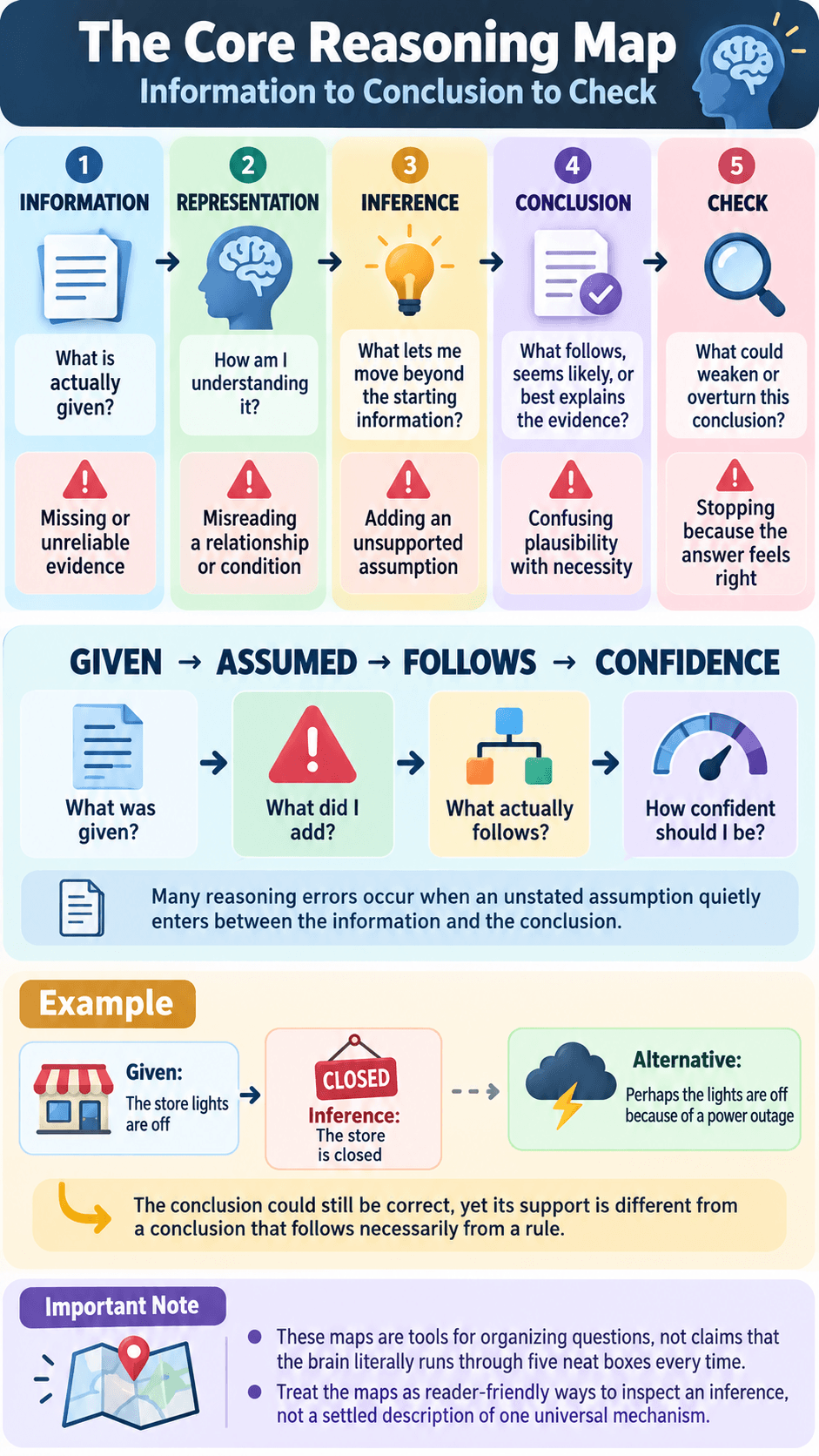
INFORMATION → REPRESENTATION → INFERENCE → CONCLUSION → CHECK
A practical way to understand reasoning is to separate five moments. First comes the available information. Second, the person forms a mental representation of what that information means. Third, some relationship is used to move beyond what is directly given. Fourth, a conclusion is produced. Fifth, the conclusion can be checked against the premises, alternatives, and new evidence.
| Stage | Main question | Common difficulty |
|---|---|---|
| Information | What is actually given? | Missing or unreliable evidence |
| Representation | How am I understanding it? | Misreading a relationship or condition |
| Inference | What lets me move beyond the starting information? | Adding an unsupported assumption |
| Conclusion | What follows, seems likely, or best explains the evidence? | Confusing plausibility with necessity |
| Check | What could weaken or overturn this conclusion? | Stopping because the answer feels right |
GIVEN → ASSUMED → FOLLOWS → CONFIDENCE
A shorter self-check asks four questions: What was given? What did I add? What actually follows? How confident should I be? This is especially useful because many reasoning errors occur when an unstated assumption quietly enters between the information and the conclusion.
For example, “The store lights are off” is given. “The store is closed” may be a reasonable inference, but perhaps the lights are off because of a power outage. The conclusion could still be correct, yet its support is different from a conclusion that follows necessarily from a rule.
Why these are practical mental models rather than one universal cognitive architecture
These maps are tools for organizing questions, not claims that the brain literally runs through five neat boxes every time. Human reasoning is studied through several competing theoretical traditions. A major review of mental models and human reasoning, for example, argues that people often reason by representing possibilities rather than by manipulating formal symbols alone.
Other approaches emphasize rules, probabilities, heuristics, or interactions between intuitive and reflective processes. Research comparing theories continues, so it is more accurate to treat the maps here as reader-friendly ways to inspect an inference than as a settled description of one universal mechanism.
Reasoning Psychology vs Formal Logic
Formal validity versus how people actually reason
Formal logic asks whether a conclusion follows according to specified rules. Psychology asks an additional set of questions: How did the person understand the premises? Which conclusion came to mind? Did familiar content change the judgment? Did the person notice another possible interpretation? How much information could be held in mind at once?
This distinction matters because a formal standard can tell us whether an inference is valid without telling us why a person accepts or rejects it. A review of the relationship between logic and human reasoning notes how strongly content and context can influence performance on deductive tasks.
Why representation, context, beliefs, and cognitive limits matter
Two people can receive the same words yet mentally represent the problem differently. A familiar example may activate useful background knowledge. It may also introduce assumptions that are not part of the task. A long set of relations may be harder to evaluate because several possibilities must be kept active at once.
These effects do not mean formal logic is irrelevant. They show why the psychology of reasoning cannot be reduced to marking answers correct or incorrect. Researchers are interested in the path from the presented information to the judgment.
Validity, Truth, Plausibility, and Confidence Are Different

What validity asks
In deductive reasoning, validity concerns the relationship between premises and conclusion. The key question is: if the premises were true, would the conclusion have to be true? This is a structural question.
Suppose all objects in Drawer A are blue, and this pen is in Drawer A. The conclusion that the pen is blue follows from the premises. Whether Drawer A really exists is a separate question from whether the inference has the required structure.
Why valid does not mean factually true
An argument can be valid even when a premise is false. “All oak trees are made of metal. This tree is an oak. Therefore this tree is made of metal.” The conclusion follows from the premises, so the form can be valid even though the premises do not describe reality.
The reverse problem also occurs. A conclusion can happen to be true even when the reasoning used to reach it is weak or invalid. Correct outcomes do not automatically prove correct inference.
Why plausibility and confidence are not proof
Plausibility concerns how reasonable a conclusion seems given what we know. Confidence is how sure a person feels. Neither is identical to logical validity or factual truth. You can be highly confident in a weak inference, or cautiously accept a conclusion that is strongly supported.
This separation is useful in everyday life because certainty often feels like evidence even when it is only a feeling about the evidence. Confidence may help signal whether more checking is needed, but it cannot substitute for the check itself.
Four Main Areas of Reasoning
Reasoning from rules
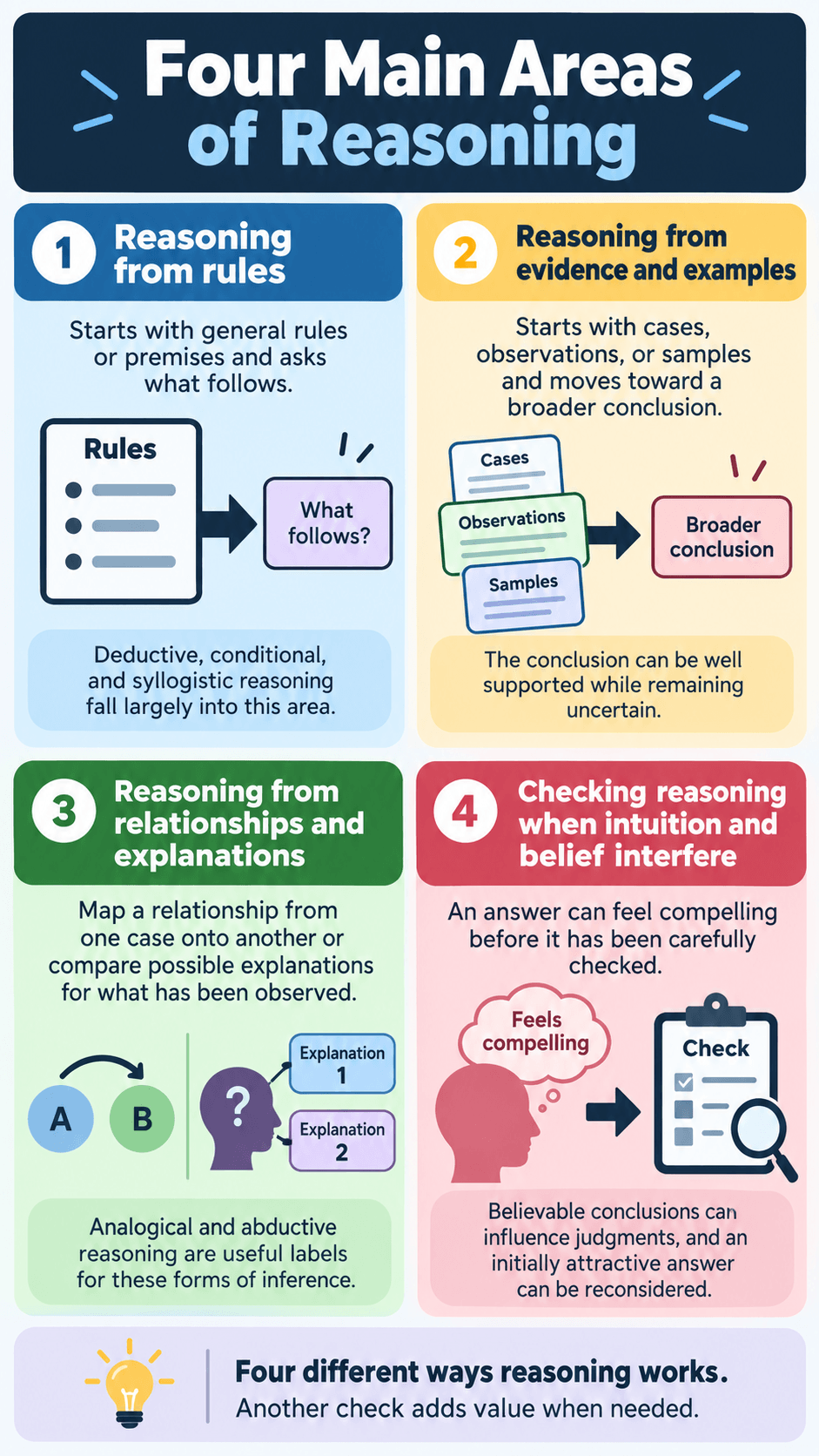
Some reasoning starts with general rules or premises and asks what follows. Deductive, conditional, and syllogistic reasoning fall largely into this area. The central issue is often whether a conclusion is required by the structure of the information.
Reasoning from evidence and examples
Other reasoning starts with cases, observations, or samples and moves toward a broader conclusion. Inductive reasoning belongs here. The conclusion can be well supported while remaining uncertain because future or unobserved cases may differ.
Reasoning from relationships and explanations
Sometimes the task is to map a relationship from one case onto another or to compare possible explanations for what has been observed. Analogical and abductive reasoning are useful labels for these forms of inference.
Checking reasoning when intuition and belief interfere
People also face situations in which an answer feels compelling before it has been carefully checked. Belief bias research examines how believable conclusions can influence judgments of validity. Cognitive reflection research asks when an initially attractive answer is reconsidered. These are not claims that intuition is bad. They are questions about when another check adds value.
Reasoning From Rules
Deductive reasoning in brief
Deductive reasoning aims at necessity. If the premises are accepted and the inference is valid, the conclusion cannot be false while the premises are true. This does not mean the premises themselves are guaranteed to be true.
Psychologists have proposed different accounts of how people perform deductions, including formal-rule approaches and mental-model approaches. The existence of competing accounts is one reason it is risky to describe deduction as if the mind simply runs a miniature logic program.
Conditional reasoning in brief
Conditional reasoning focuses on if-then relationships. If P, then Q. From there, some conclusions follow and others only seem to follow. Real-world language adds another layer because everyday “if” statements can carry assumptions, exceptions, permissions, or conversational meanings that are not captured by a bare logical form.
Syllogistic reasoning in brief
Syllogistic reasoning works with categorical relationships such as all, some, and none. A simple example is: all A are B, all B are C, therefore all A are C. Psychology is interested not only in which forms are valid, but also in how content, wording, and prior beliefs affect people’s judgments.
Reasoning From Evidence and Examples
Inductive reasoning in brief
Induction moves from observations or cases toward a broader conclusion. If several plants of one variety thrive in shade, you may infer that the variety generally tolerates shade. The inference may be sensible while still allowing exceptions.
Inductive strength depends on more than the number of examples. Diversity, typicality, representativeness, and the possibility of missing cases can all matter. Research on reasoning continues to examine whether deduction and induction rely on distinct processes or overlapping ones. A review of theories of deductive and inductive reasoning describes this as an open theoretical question rather than a simple settled split.
Why evidence can support a conclusion without guaranteeing it
Evidence can increase the reasonableness of a claim without making the claim certain. Ten reliable observations may support a generalization more strongly than one vivid example, but an unobserved exception can still exist. This is not a defect unique to human thought. It is part of reasoning beyond the information directly given.
Reasoning From Relationships and Explanations
Abductive reasoning in brief
Abductive reasoning asks which explanation best fits a set of observations. You hear a machine make an unfamiliar sound, see an error light, and consider several possible causes. The best current explanation is the one that fits the available evidence better than the alternatives, but it remains open to revision.
The critical distinction is that “best explanation so far” is not the same as proof. A missing piece of evidence or an overlooked alternative may change the ranking.
Analogical reasoning in brief
Analogical reasoning uses relationships in a known case to understand a new one. A useful analogy depends on structural similarity, not merely on two things looking alike. If the relevant relationships match, the source case may support a new inference. If only the surface features match, the analogy may mislead.
Hypothesis testing in brief
Once an explanation is proposed, reasoning can turn toward testing it. A useful test asks what the hypothesis predicts and whether the result would distinguish it from competing explanations. Evidence that merely fits one idea may be less informative when several alternatives predict the same result.
When Belief or an Immediate Answer Interferes
Belief bias in brief
Belief bias refers to a specific conflict between logical validity and the believability of a conclusion, often studied with syllogisms. A believable conclusion may feel easier to accept even when it does not follow from the stated premises, while a valid but unbelievable conclusion may feel wrong.
This does not mean prior knowledge should normally be ignored. Real-world knowledge is often useful. The research question is what happens when a task deliberately asks for a judgment of structure rather than a judgment of factual believability.
Cognitive reflection in brief
Cognitive reflection research examines situations in which a problem elicits an attractive initial answer that may need checking. The point is not that the first answer is always wrong or that slower thinking is always superior. Reflection may confirm the first response, revise it, or still end in error.
Measures such as the Cognitive Reflection Test have also been debated because performance can be influenced by numeracy, familiarity, comprehension, and task design. One open-access analysis of familiarity with standard Cognitive Reflection Test items illustrates why a short puzzle score should not be treated as a pure measure of general rationality.
Why more effort does not guarantee a correct conclusion
Careful thought can improve a conclusion when it catches a hidden assumption, considers another possibility, or checks evidence. Yet extra effort can also be spent defending a mistaken premise or elaborating an incorrect interpretation. The quality of the check matters more than the mere amount of mental effort.
Reasoning vs Nearby Cognitive Processes
| Process | Main question | Typical output |
|---|---|---|
| Reasoning | What follows from this information? | Conclusion |
| Problem solving | What could work? | Path or solution |
| Decision making | Which option should I choose? | Choice |
| Attribution | Why did this behavior or outcome occur? | Causal explanation |
| Metacognition | How should I evaluate or monitor my thinking? | Confidence, check, or strategy adjustment |
Reasoning → conclusion
Reasoning centers on inference. A conclusion may later influence action, but no action is required for reasoning to occur. You can reason about whether a statement follows without choosing anything at all.
Problem solving → workable path
Problem solving centers on moving from a current state toward a goal. Reasoning may help evaluate a possible path, but generating, testing, and revising solutions is a broader activity than inference alone.
Decision making → choice
Decision making centers on selecting among alternatives. Evidence and reasoning may inform the choice, yet preferences, values, constraints, costs, and consequences also matter. A strong conclusion about the facts does not automatically tell a person which option best fits their priorities.
Attribution → causal explanation
Attribution focuses on explanations for behavior, events, success, failure, and outcomes, especially in social contexts. Abductive reasoning is broader because it can compare explanations in many domains, from a faulty device to an unexpected project result.
Metacognition → monitoring and checking thinking
Metacognition concerns awareness and regulation of one’s own thinking, including confidence, error monitoring, and whether further checking seems useful. Reasoning produces or evaluates a conclusion. Metacognition can monitor that process, but the two are not identical.
What Supports Human Reasoning
Working memory, attention, language, and prior knowledge at overview level
Reasoning does not happen in isolation from other cognitive systems. Attention helps determine which information is selected. Working memory helps keep relations active while they are compared. Language shapes how premises are understood. Prior knowledge supplies meanings, expectations, and possible interpretations.
These supports can help or complicate reasoning depending on the task. Familiar knowledge can make a problem easier to understand, but it can also make an unsupported assumption feel obvious. Complex wording can create difficulty even when the underlying relation is simple.
Ordinary cognitive limits without turning reasoning into a story of failure
People reason with limited time, attention, memory, and information. Those limits do not make everyday reasoning inherently defective. Often the goal is not to produce a formal proof but to reach a useful conclusion from incomplete information.
A fair evaluation therefore asks whether the form of reasoning fits the task. Deductive certainty, inductive support, explanatory fit, and analogy serve different purposes. One should not be treated as automatically superior to the others.
Which Reasoning Question Are You Actually Asking?
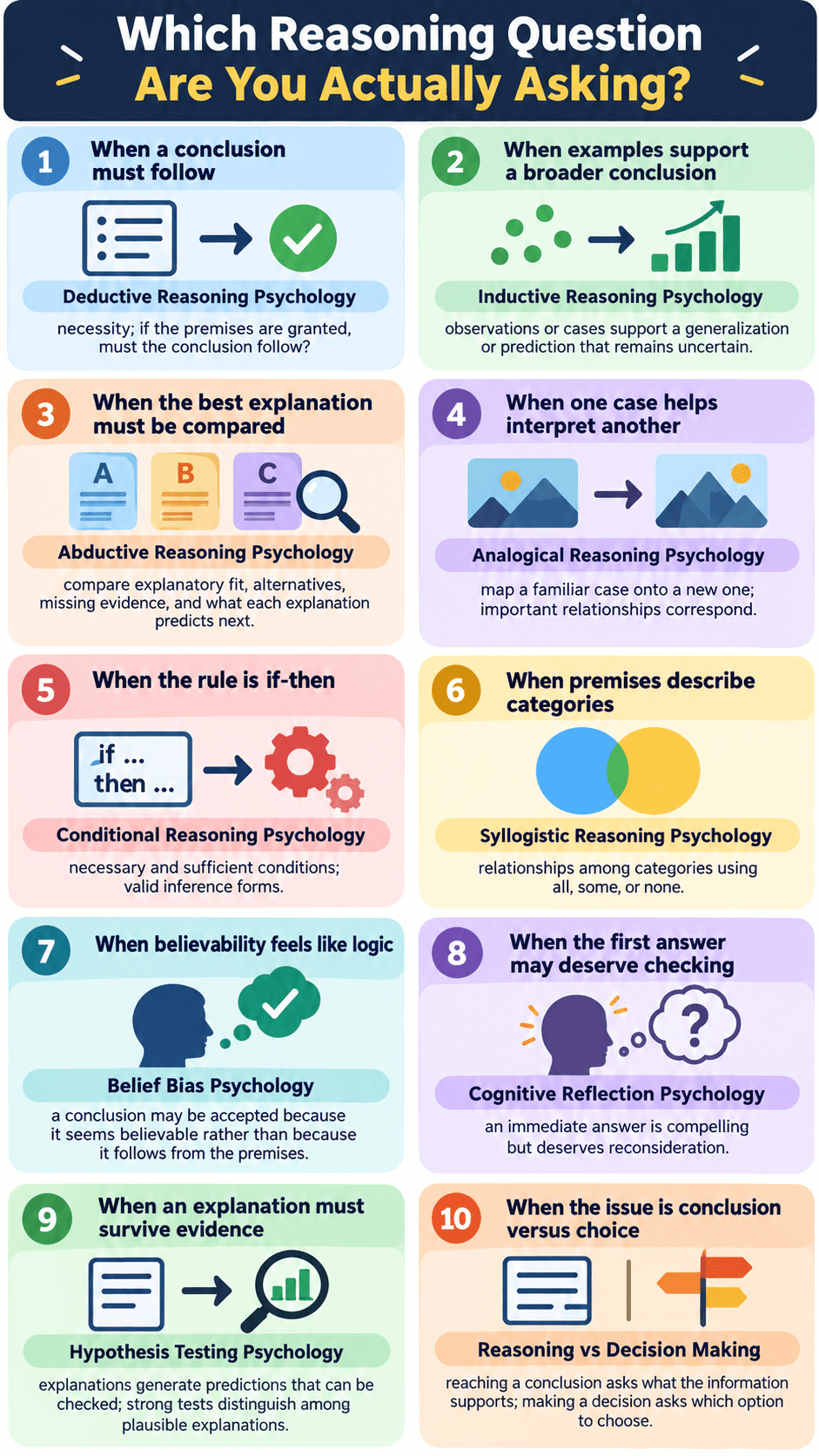
When a conclusion must follow → Deductive Reasoning Psychology
Use a deductive lens when the central issue is necessity: if the premises are granted, must the conclusion follow? This is where validity, soundness, and counterexamples become central.
When examples support a broader conclusion → Inductive Reasoning Psychology
Use an inductive lens when observations or cases support a generalization or prediction that remains uncertain. The quality and range of the evidence matter more than a simple true-or-false rule.
When the best explanation must be compared → Abductive Reasoning Psychology
Use an abductive lens when several explanations could fit the same observations. The task is to compare explanatory fit, alternatives, missing evidence, and what each explanation predicts next.
When one case helps interpret another → Analogical Reasoning Psychology
Use an analogical lens when a familiar case is being mapped onto a new one. Ask whether the important relationships correspond, not merely whether the two situations look similar.
When the rule is if-then → Conditional Reasoning Psychology
Use a conditional lens when the problem turns on an if-then relation. Necessary and sufficient conditions, valid inference forms, and real-world interpretations of conditional language become especially important.
When premises describe categories → Syllogistic Reasoning Psychology
Use a syllogistic lens when premises describe relationships among categories using forms such as all, some, or none. The task is to integrate those relations without letting familiar content replace structural evaluation.
When believability feels like logic → Belief Bias Psychology
Use a belief-bias lens when the question is whether a conclusion is being accepted because it seems believable rather than because it follows from the premises. Keep belief formation and belief persistence separate from this narrower issue.
When the first answer may deserve checking → Cognitive Reflection Psychology
Use a cognitive-reflection lens when an immediate answer is compelling but the structure of the problem gives a reason to reconsider it. Reflection is about checking the response, not proving that slower thinkers are more rational.
When an explanation must survive evidence → Hypothesis Testing Psychology
Use a hypothesis-testing lens when an explanation generates predictions that can be checked. Strong tests are useful because different plausible explanations make different predictions, not simply because they produce more supporting examples.
When the issue is conclusion versus choice → Reasoning vs Decision Making
Use this distinction when two processes are being blended together. Reaching a conclusion asks what the information supports. Making a decision asks which option to choose, which may require preferences and constraints in addition to evidence.
Common Misunderstandings About Reasoning
Logical does not mean factually correct
A logically valid inference can begin with false premises. A factually correct conclusion can also be reached through weak reasoning. Structure and truth must be evaluated separately.
Slow reasoning is not automatically better
Taking more time may allow additional checking, but time alone does not fix a misunderstood premise or missing evidence. Fast responses can also be correct when the relationship is familiar or simple.
Reasoning quality is not the same as intelligence, education, confidence, or speed
A mistake on a logic puzzle does not diagnose intelligence, cognitive impairment, or a learning disorder. Performance can depend on wording, prior exposure, knowledge, numeracy, memory demands, and the particular reasoning form being tested. Broad judgments about a person should not be drawn from one narrow task.
FAQ About Reasoning Psychology
Is reasoning the same as decision making?
No. Reasoning is about deriving or evaluating a conclusion from information. Decision making is about selecting among alternatives. The two often interact, because a conclusion can inform a choice, but a person can reason without making a decision and can sometimes make a decision with little explicit reasoning.
Is deductive reasoning always more reliable than inductive reasoning?
No. Deduction and induction serve different purposes. Valid deduction offers necessity if the premises are accepted, but false premises can still produce a factually wrong conclusion. Induction allows useful generalization from evidence when certainty is unavailable. The relevant question is whether the reasoning form fits the task and the available information.
Can a valid conclusion still be based on false premises?
Yes. Validity concerns whether the conclusion follows from the premises, assuming those premises are true. It does not certify that the premises describe reality. An argument is stronger in a broader sense when both the structure is valid and the premises are well supported.
Why can an unbelievable conclusion still be logically valid?
Because validity and believability answer different questions. A conclusion may conflict with your world knowledge while still following from premises that you have been asked to accept temporarily. Formal reasoning tasks sometimes use unusual content precisely to separate structural judgment from prior belief.
Does careful reasoning eliminate bias?
No. Careful checking can expose unsupported assumptions and competing explanations, but effort does not guarantee correctness. A person may reason carefully from inaccurate information or spend more time defending an initial interpretation. Good checking requires attention to premises, alternatives, evidence quality, and what could change the conclusion.
Key Takeaways
- Reasoning is the process of deriving, evaluating, or revising conclusions from information.
- Validity, factual truth, plausibility, confidence, and evidence strength are related but different judgments.
- Deduction, induction, abduction, analogy, conditional reasoning, and syllogistic reasoning answer different inference problems.
- Believable or immediate answers can feel convincing without being logically supported, which is why checking assumptions and alternatives matters.
- Reasoning is not the same as problem solving, decision making, attribution, or metacognition, even though these processes often interact.
- Reasoning performance should not be treated as a simple measure of intelligence, education, or general rationality.
A useful next step is not to ask whether you are a “logical person.” Instead, identify the kind of conclusion you are trying to reach. Are you checking what must follow from a rule, generalizing from examples, comparing explanations, mapping an analogy, or testing a hypothesis? Once the reasoning task is clear, it becomes easier to ask the right question about evidence, assumptions, alternatives, and confidence.
Educational note: General reasoning frameworks are useful for understanding everyday inference, but they do not replace qualified expertise in medical, legal, financial, emergency, or personal-safety situations. A coherent argument can still be wrong when the premises are inaccurate, important evidence is missing, or domain assumptions are mistaken.

Michael Reed is the Founder and Lead Writer at Psychology Exposed. He writes about human behavior, relationships, emotional patterns, self-awareness, and practical psychology topics using research-informed, easy-to-understand content.
Read More About Michael Reed: https://psychologyexposed.com/michael-reed/
1 thought on “Reasoning Psychology: How the Mind Reaches Conclusions”